
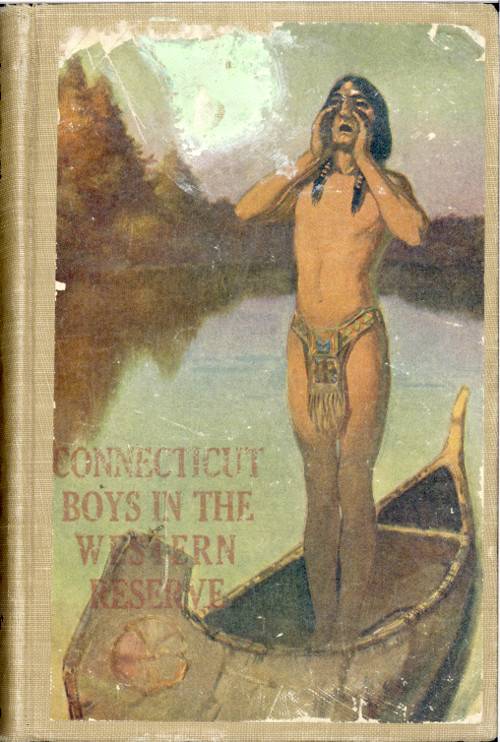
The Project Gutenberg eBook of Connecticut Boys in the Western Reserve: A Tale of the Moravian Massacre
Title: Connecticut Boys in the Western Reserve: A Tale of the Moravian Massacre
Author: James A. Braden
Illustrator: W. Herbert Dunton
Release date: November 17, 2018 [eBook #58292]
Language: English
Credits: Produced by Stephen Hutcheson and the Online Distributed
Proofreading Team at http://www.pgdp.net
“Was I scalped?” he gasped. (See page 115)
CONNECTICUT BOYS
=======IN THE=======
WESTERN RESERVE.
A TALE OF THE MORAVIAN MASSACRE
...BY...
James A. Braden.
AUTHOR OF
“FAR PAST THE FRONTIER,” ETC.
ILLUSTRATED BY
W. Herbert Dunton
C
AKRON, OHIO
THE SAALFIELD PUBLISHING CO.
NEW YORK CHICAGO
MADE IN U. S. A.
Copyright, 1927
By
The Saalfield Publishing Company
CONTENTS
- I. A RAINY NIGHT. 9
- II. TALL TODD’S WARNING. 23
- III. A MYSTERY OF THE FOREST. 38
- IV. THE LONE INDIAN. 52
- V. HIDDEN TREASURE. 67
- VI. THE CABIN BY THE RIVER. 84
- VII. THE REWARD OF VIGILANCE. 101
- VIII. THE FATE OF BLACK EAGLE. 117
- IX. THE CAMP IN THE TREE-TOP. 134
- X. THE QUAKER’S STORY. 148
- XI. HELPING THE DELAWARES—DANGER. 165
- XII. BANDS OF BLACK. 181
- XIII. A CRY FROM THE DARKNESS. 197
- XIV. CAPTURED. 212
- XV. THE SEARCH. 227
- XVI. THE CAVE OF THE FORTUNE HUNTERS. 242
CHAPTER I.
A RAINY NIGHT.
A dismally wet and cold September day had come early to a close and thick darkness had settled down an hour since, when the horse attached to a heavy, canvas-covered, two-wheeled emigrant wagon stopped, at its driver’s command, before an inhospitable looking house, from one window of which a feeble light was shining. The rain splashed drearily, the wind moaned in a ghostly way about the structure whose dim outlines were just visible, and flapped the canvas over the wagon fitfully.
The barking of a gruff-voiced dog from somewhere near the house gave certain sign that the arrival of the cart had been noticed by that animal, as a tall, broad shouldered boy sprang lightly down from the vehicle and walked briskly toward the door of the gloomy building.
“Now, never mind, Ring,” spoke a young, but full and pleasant voice from the front of the wagon, as a large dog that stood beneath growled deep in its throat in answer to the barking of the other canine. Instantly the dog was quieted and at the same moment came the sound of knocking at the door of the partially lighted house. A full minute passed, and the knocking was vigorously repeated before there was a response.
“This ain’t a tavern any more; we can’t keep ye,” said a man who put his head out, before the caller could speak.
“This is the Eagle tavern, isn’t it?” the boy inquired calmly, and the light through the half-open door showed him to be a muscular youth of probably eighteen years, though the serious look about his eyes and mouth, and his dark hair gave him a somewhat older appearance.
“It used to be the Eagle tavern, but it ain’t now. Is that all?” the man in the doorway replied gruffly.
“Why, no, it is not all,” the lad returned. “There are two of us with a horse and wagon and we want to stay all night. The storm is growing worse, and though we had intended to camp by the roadside, we pushed on through the mud and darkness to reach this place. We expect to pay for our lodging.”
“It don’t make no difference, I tell ye! We ain’t keeping a public house.”
“Come, come, Mr. Tavern-keeper, my friend and I have both been here before, and if we are willing to stay, you should surely be willing to keep us.”
“That’s the talk!” called the one who remained in the wagon, “and let’s have a lantern out here, and lose no further time about it!”
The man in the door moved aside to let the light fall more directly on his caller’s face.
“Yes, I rec’lect ye,” he said slowly. And then, his face brightening suddenly, he added more pleasantly, “Wait a jiffy.”
He closed the door and a murmur of voices sounded for a short time from within. Presently, however, the man reappeared with a tallow candle set in a round tin box full of small holes, which he carried by a ring in its top, as a lantern, and followed the young men who had summoned him, to the cart drawn up by the roadside.
“The Eagle tavern’s been closed all summer and we hadn’t ought to keep ye,” the man explained, standing by while the two boys unhitched their horse and led the animal into the log barn across the road from the house. “Ye kin pull yer cart under this shed out o’ the rain,” he went on, indicating a lean-to beside the barn.
In a few minutes the horse had been fed and the host led the way into the house, entering a long, low room, where, in a fireplace, a smoky, cheerless blaze was flickering. On a table set against the wall opposite the fireplace, a candle was burning, and toward the farther end of the dingy apartment two men were seated, their chairs tilted back in careless attitudes.
“There ain’t much here to eat,” the landlord said, as he motioned his guests to a settle in the chimney corner. “My wife died an’ I quit keepin’ a tavern. I’ll git ye what I kin.”
The two boys he thus ushered in did not sit down, but stood before the blaze to allow their clothes to dry; the one who had remained in the wagon while the other went to the door, turning about after a minute or two and stirring the fire till it burned more brightly. He was seventeen years old or thereabout, more slender than his companion and not so tall. His brown hair grew long, and about his blue eyes there was a twinkle of merriment, as he said: “Wood is cheap; we may as well have enough fire to do some good.”
“Right you are, young man,” spoke one of the two strangers still sitting in the semi-darkness. “It’s a nasty night.”
“Right you are,” said the lad, still stirring the fire, adopting the stranger’s own words.
One of the two men arose and stepping up to the blaze seated himself on the settle. He was a villainous looking fellow, his curly black hair cut short, his nose very large, red and sharp pointed, his chin unnaturally prominent, his eyes small, black, and deep-set, marks of smallpox adding further to make his face an unpleasant one. His age was not less than forty-five years.
So disagreeable, indeed, did the two boys find this man’s appearance that instinctively both looked more closely to see what his companion was like. They beheld a man ten years younger than the other, though his hair was turning gray, and his hardened leather-like skin made him seem older than he was. He had fairly honest eyes, however, though he turned them away and looked steadily in another direction when he found that he was observed.
“I was just tellin’ my friends here about Ichabod Nesbit bein’ killed, when you chaps come along,” said the landlord a few minutes later, as he came bringing in some cold meat and a loaf of bread, which he placed on the table. Then asking his young guests to sit down and help themselves, which they proceeded to do, he went on:
“I rec’lect that you boys was sort o’ interested in Nesbit, an’ I heard that it was you two that brought the news East of how he was killed.”
“Yes,” said the older of the two lads in a disinterested way, while the other gave him a quiet pinch under the table.
“Killed by an Indian, you said, didn’t you?” put in the villainous looking man.
“An Injun named Black Eagle,” said the landlord.
Neither boy made any move to join in the conversation and the tavern-keeper took another tack.
“Most forgot how to be polite,” he said. “I don’t rec’lect your names, young men, but make you acquainted with Mr. Samuel Duff and Mr. Lon Dexter, travelers same as you be. My name’s Quilling, ye know that.”
It was to the name Samuel Duff that the villainous looking man answered. His better appearing companion arose as the name Lon Dexter was pronounced.
“My name is Kingdom,” said the older of the two boys, rising to shake hands as the men came forward.
“And mine is Jerome,” said the more slender lad, with none too much friendship in his tones.
“Going West, I take it,” said Duff, trying to speak pleasantly.
“Yes,” said the young man named Kingdom, as both boys reseated themselves and went on with their supper.
“So are we,” he of the evil appearance continued—“Dexter and I.”
“It is a great country—the Ohio country, I mean,” said Kingdom, his keen, dark eyes scrutinizing the fellow who had seemed to suggest that they might travel together, while he mentally decided that he would like no such arrangement.
“Yes, a great country and a big country. We’re just going to look around and see whether there would be a good chance to get hold of first-rate land to settle on when the Indian troubles are over,” Duff answered.
No immediate reply being made to his words, the fellow went on in a careless tone which anyone could have seen was assumed:
“But you won’t catch us staying around long where the Redskins have war paint on. That man Ichabod Nesbit, we were speaking of, would probably have been living yet if he hadn’t gone off to that blasted wilderness. What part of the country was he killed in, anyhow?”
“Beyond Pittsburg. Why?” quickly put in the lad Jerome, his interest aroused. For the thought came to him that Ichabod Nesbit was just such an outlaw as the fellow now inquiring about him looked to be.
“Ho! nothing in particular! You seem to be mighty suspicious, the way you ask ‘Why,’” Duff exclaimed, with anger he tried not to show.
“No harm ain’t be’n done, I don’t see. Jest hear it rain though!” put in the other of the two men, Dexter, speaking for almost the first time. His voice was a hoarse whisper, and gave the impression that he was frightened and afraid to speak louder.
“Why,” said Kingdom, “there is no secret about when and how and where the man Nesbit was killed. He had followed us all the way from this very tavern, clear across the mountains and the Ohio river. On the way West, he fired at us one night, as we were in camp, and happened to kill Northwind, the son of the Indian, Black Eagle. The long and short of it all is, that Black Eagle, after burying his son, found the trail of Nesbit and followed it—tracked him through woods and over mountains, though how he could do it is wonderful, and at last came up with him only a few minutes after Nesbit had fired on our camp a second time, killing our horse. They fought, and Nesbit was killed, but just how or where we do not know. We did not see the fight or know anything about it until Black Eagle told it himself, months afterward, and showed the man’s skull as certain evidence that he was dead.”
For a little time nothing more was said. The wind howled dolefully outside and the rain beating on the roof and windows added to the feeling of melancholy which seemed to pervade the whole place. Little wonder is it that the thoughts of the two boys went back to the terrible experiences they had had in a former trip from their home in Connecticut to the wilderness beyond the western frontier of Pennsylvania. They remembered how a robber and cut-throat by occupation, Ichabod Nesbit, had attempted to relieve them of their money at this very inn—the Eagle tavern—how they had shot at him and he had then secretly followed them, mile after mile, week after week, firing at them from a distance on two occasions and at last killing their horse when they were but a few miles from the spot where, beside the Cuyahoga river, they located and built a cabin.
They remembered, too, that Nesbit had been in search of a cousin, named Arthur Bridges, whom he would have killed had he found him, in order to palm himself off as Bridges, whom he closely resembled, and secure his property. And Nesbit was responsible from the beginning for Arthur Bridges’ never having returned home after the Revolutionary war, in which he was a soldier. They had met on the road and Nesbit told Bridges that his (Bridges’) mother had died and his father was cursing him and hoping never to see him again because he had joined General Washington’s army. And it was only by chance that Bridges had discovered through Tom Fish, a friend who had gone in search of him, that Nesbit had deceived him most cruelly.
“The Indian—did you say his name was Black Eagle?—is quite civilized, I understand,” said Duff, at last. “His home is in the East.”
“More civilized than some white folks,” spoke up young Jerome, remembering that the Redskin had been kind to him and Kingdom.
Duff growled an inaudible reply, in response to this thrust, and Kingdom, being tired and, moreover, wishing to avoid any trouble with this disagreeable fellow, suggested that it was time to go to bed.
The landlord, upon request of the boys, brought a candle and showed them into a small down-stairs room opening into a narrow passageway which led to the general living room where they had passed the evening.
“I wish we had not stopped at this wretched hole,” said Jerome when the boys were alone.
“Oh, I don’t know about that. It is pleasanter to be here, disagreeable as it is, than to be camped along the road,” Kingdom answered. “We could have slept in the wagon, but the horse couldn’t, and it is such a bad night! Make the best of it, old chap.”
For an hour the young friends lay awake talking of their journey and especially of the unusual interest the two strangers had shown in the death of Ichabod Nesbit.
“I must have a drink of water,” said Jerome, as Kingdom turned over to go to sleep; and slipping into his trousers he felt his way along the passage, and opened the door of the living-room. The landlord and Duff and Dexter were sitting beside the little table, their heads bent close to the candle, while they intently examined a frayed and time-worn piece of paper.
“It ain’t no use, it ain’t. I’ve studied it right side up an’ wrong side up an’ side ways an’ length ways, an’ it ain’t no use!” Quilling, the landlord, was saying when Jerome’s footfall attracted the attention of the men.
“Blast you, you blasted spy!” cried Duff, springing toward the boy.
“Don’t repeat that, mister,” was the lad’s cool answer. “I was not spying on you, and don’t intend to let any one call me such names.”
“He was only jokin’—only jokin’,” hoarsely whispered Dexter, trying to laugh.
CHAPTER II.
TALL TODD’S WARNING.
Having gotten a drink of water, as he had set out to do, Jerome quietly returned to his room. He told Kingdom what had happened and they wisely determined to sleep with one eye open. This they did, their trained senses ready to detect the first unusual sound, but nothing occurred to disturb them, and even Ring, their faithful dog, sleeping beside the bed, showed no sign of uneasiness.
“Mr. Duff and Mr. Dexter ain’t up yet,” the landlord explained, as he set out a scanty breakfast for the boys, when morning came. But the young friends made no comment, and though the man stood around hoping to hear some expression from them as to what they thought of the worthy pair of whom he spoke, his curiosity was unsatisfied.
An almost perfect autumn day followed the stormy night. The sky was flecked with clouds, but between them the sun shone bright and cheery and a soft, warm wind aided in drying the muddy roads. The young emigrants, safely on their way once more, were in the best of spirits. They talked at length of the strange actions of the men at the Eagle tavern, and although they could reach no satisfactory conclusion as to the meaning of the piece of frayed paper the fellows had had, they attached not a great deal of importance to it—far, very far, less than it deserved, as they were destined in time to learn.
A long journey lay before these two boys, whom readers of “Far Past the Frontier” will have recognized as Return Kingdom and John Jerome, on their way once more to the wilderness beyond Fort Pitt or Pittsburg. Six months earlier they had left their little cabin in the forests to return to their home in Connecticut. In company with them was Big Pete Ellis, whom they had rescued from the Indians, he and Return having escaped together from a band of Mingoes, who, headed by a Delaware Indian, Big Buffalo, had attacked the boys’ cabin and after a desperate fight captured Kingdom. Also with the lads when they went back to Connecticut, it will be remembered, was Tom Fish, the woodsman whose friendship they had formed on their first trip West, and Arthur Bridges, Tom’s friend, who was a cousin of Nesbit, the outlaw. Bridges had suddenly appeared one evening at the cabin, and as it had been believed that he was dead, there was great rejoicing. Gladly he had gone with Tom Fish and Kingdom and Jerome to Connecticut where for years his mother had been living upon the hope that he would sometime return.
It was in May that the boys and their friends had gone from the savage country where they had built their cabin; and now having worked as harvest hands during the summer, they were headed once more for the land of the Delawares, their cart packed with a well selected stock of supplies for their own use and a variety of articles for trade with the Indians.
On their previous venture, when they had first set out to make homes for themselves in the new country, the two friends had done well as traders; and though this time they meant to give more attention to clearing land for farms, they knew that the Indians would receive them more kindly if they came with merchandise to exchange for furs, while they would be quite unwelcome if they came only as settlers. Such at least, had been their former experience and, notwithstanding the trouble they had had with the Mingoes and Big Buffalo, they hoped to have no further difficulty, as Hopocon, or Captain Pipe, as the white men called him, the chief of the Delawares, had promised his protection when they had paid him for the land on which they built their cabin.
Indeed, they were certain that Big Buffalo would not have dared lead the Mingoes against their cabin, had it not been that Captain Pipe and most of his warriors had gone to the far northwest for fighting which was expected to take place there.
From Connecticut to Ohio in these days is not a very long journey. It was different in the year 1791 when Return Kingdom and John Jerome were making the trip over rough roads, through the forests and an almost unbroken wilderness, constantly growing wilder, as they progressed, and the way more dangerous, especially after passing Pittsburg. Steadily, however, they continued on. The weather was for the most part pleasant, and though the evenings were cool, blazing camp fires gave all the warmth desired.
Only one night after leaving the Eagle tavern did the boys spend under roof, for there were few inns along the way and as the borders of civilization were left farther and farther behind, none whatever. No adventure of importance befell them, however, until they reached Pittsburg, then a rough frontier hamlet built up about the fort from which it took its name. They had learned the road on their previous journey, and though a number of mishaps had occurred, including a hard fall John had had from a great rock he climbed in hope of getting a shot at a bear which had trotted across the rough trail some distance ahead of them, none of these were serious.
And thus, in the late afternoon of a hazy October day the young men drove slowly into the frontier settlement which would be the last sign of civilization they expected to see for a long time to come.
It might be years before they would return to Connecticut again. Return Kingdom, being an orphan, who had known no home except as the bound boy of Henry Catesby, had few near friends there. Mrs. Catesby and her daughter, Mary, had been very kind to him after Mr. Catesby’s death, but they were now living in town that Mary might attend school. Captain William Bowen, an old friend, was the only other person, unless it was Pete Ellis, who cared much about him, he thought. Why should he wish to return? There was only one other tie to bind him to Bruceville, his boyhood home. His mother’s grave was in the little churchyard there. She had been dead a long time, but he loved her memory. His father, killed in the Revolutionary war, he had never known.
As for John Jerome, he was one of a large family. His father was poor. Their little farm would scarcely support them all and work was scarce. That he would be missed John knew, but he also knew that his chances of getting along—of making something of himself—were better in the newer country. He would go home some day to visit, surely, but he had set out to make his own way, and it might be years before the opportunity again to see those he loved, would come.
Maybe both boys were thinking of the friends left behind, as very soberly they drove into Pittsburg. Their heavy, covered wagon drawn by one strong horse attracted no little attention as they passed down the main street of the rough, stockaded town of brick and log buildings, and with the easy familiarity of the early times many called out to them in a friendly, hospitable way to ask whence they came and whither they were going. There were words of astonishment, and grave shaking of heads when the travelers answered that they were bound for the unbroken West. Said one man in a worn-out soldier’s uniform:
“You’ll be safe enough if you go down the river with some big party, but you’ll be scalped, sure, if you go toward Sandusky Plains, as you say. Why, there’s terrible times! General St. Clair left Fort Washington not six weeks ago to march into that country and there’ll be murderin’ an’ scalpin’ to beat all get out! St. Clair was here in the spring, an’ all summer long he has been recruitin’ at Fort Washington for the biggest kind of fightin’; an’ it’s bound to come just as soon as he gets into the Redskins’ country. He’s got two boys o’ mine with him—young fellers ’bout same age as you, but I ain’t worried half like I would be if they was goin’ off by themselves, not a hundred miles west o’ here!”
As the boys drove up to the public house where they had stopped on their former trip to the West, they were recognized by a number of men seated on a split log bench just outside, smoking their pipes.
“Thunder an’ lightnin’! Where ye goin’?” exclaimed one of the loafers, a great, lanky fellow known as Tall Todd, as Kingdom and Jerome, rather enjoying the excitement their appearance caused, stepped up to shake hands with their acquaintances.
“Goin’ back to yer cabin beyond old Fort Laurens? By jinks, ye ain’t! It’s sartin death to both of ye. Wasn’t ye both purty near murdered an’ one of ye purty near burned to the stake? D’ye s’pose them Mingoes will hev forgot that ye killed three or four of the war party at yer cabin? D’ye s’pose that Big Buffalo devil will hev forgot his grudge ag’in ye? By jinks! a Redskin don’t never fergit these things! Fellers, we had all orter be hung fer murder if we let these young shavers throw their lives away, this here way!”
The vehemence with which Todd spoke, refusing to be interrupted, though both Kingdom and Jerome tried to break in on his exclamations, caused the boys some uneasiness; not so much for fear of their safety beyond the border, as for the possibility that their friends would be unpleasantly insistent that they must abandon their trip. They realized that their undertaking was hazardous, but they relied on their ability to make peace with the Indians as they had done before, and they were certain that if Captain Pipe, the Delaware Chieftain, were in his village, a few miles from which their cabin stood, Big Buffalo would not dare attack them again. When their horse had been led away to the stable, and all were seated before the door of the house which did duty as tavern, the young men explained these things to Tall Todd and the others.
“What was Tom Fish an’ Bridges doin’ that they let ye come ’way off here by yerselves?” suddenly asked Todd, who had been shutting his eyes and mouth tight, and shaking his head most emphatically, in answer to everything the boys had said.
“Oh, they said to wait until winter and they would come with us. But we did not agree to that, and as they lived so far away, we did not see them again. It was in July that we saw them last. When we got ready, we started. If they had come it would have been only for a little hunting, and we were afraid they would think they were obliged to go with us, if we sent them word.”
“It was only last week that a white man was found dead and scalped just beyond old Fort McIntosh,” said an elderly man, quietly. “About a month ago a chap named Keaton was tomahawked and his scalp taken, not a day’s march from this very spot. Both were killed in a mysterious way, too—one shot from ambush, the other attacked while he was cooking himself a meal; and he never knew what hit him, from all appearances, they say. It looks mighty bad. I’ve been through the woods a good many times, and I don’t get scared at my shadow, but honest to goodness I mean it, when I say that I wouldn’t care to go a great ways into the Ohio country alone, now.”
“By jinks, it is queer how them two fellers was killed, ain’t it?” put in Tall Todd. “An’ it jest reminds me o’ ol’ man Crane that was killed the same way four days after he left here for the Moravian settlement. Nobody knew how, nor nothin’. Ye remember some fellers comin’ up river picked up his carcass. Not a thing he had was touched. Only his bullets an’ powder was gone—an’ his hair. His gun an’ knife—everything else was layin’ jest as he fell!”
“Well, who did it?” demanded John Jerome, quite abruptly.
“That’s jest it! Who did it?” Todd answered.
“There’s a story told,” said the quiet, elderly man, “that a Redskin who got away at the time of the massacre of the Christian Indians at the Moravian settlement, ten years ago, come next March, has lately come back to these parts and kills every white man he sees, on sight. A couple of hunters and traders coming in here from Kentucky told the tale. We don’t know how true it is.”
“There ain’t nothin’ of it, I’ll bet a gun,” said Todd. “I’ve heard the yarn, an’ it don’t stand to reason. ’Cause as you jest said, Eli, the Moravians was killed ten years ago, come March, an’ that score was all settled when Crawford was burned. An’ right there, youngsters, is somethin’ to put in yer nightcaps, when yer countin’ on the friendship of that ornery Delaware, Captain Pipe, by jinks! He was one of the critters that burnt Colonel Crawford!”
“Yes, we knew that before we ever met him,” said Kingdom cheerfully, lest his friend Jerome should be depressed by these alarming reports.
“I only started out to say that the killin’ of the Moravians was so long ago, that it ain’t likely any Injun has just now started out to hunt scalps and satisfaction on account of it,” Todd replied, somewhat taken back by the young traveler’s cheery reply to his doleful warning against Captain Pipe.
The sun had gone down as the men and boys were talking and now the guests at the place were called to supper. Only one of those who were sitting outside arose and went in with the boys. The others, being there only as loungers, remained where they were or went to supper elsewhere.
The man who accompanied Kingdom and Jerome to the table had little to say, but ate of the roast venison and corn bread which was placed before them, silently. He was a genteel appearing person, of about sixty years, wearing a wig and a riding suit of fine texture. His smoothly shaven face bore marks of refinement though there was a certain look of dissipation about him. He had not spoken outside and the two boys had not learned his name or business, though they knew from his sombre dress that he was a Quaker.
“I tell you, Ree, the stories of those chaps being killed so mysteriously bothers me more than anything else,” said John Jerome to his friend. “Honestly, I would think Ichabod Nesbit was still alive, shooting at people from behind, and all that, if I didn’t know positively that Black Eagle killed him.”
The stranger at the opposite side of the table gave a sudden start,—a start as if an unseen hand had struck him on the back, as the name of Nesbit was mentioned. He cast a quick, intent look toward the two young friends, and perceiving that his agitation had been noticed, put his hand before his mouth and coughed violently, plainly trying to make believe that some obstruction of his throat caused his sudden disturbance.
CHAPTER III.
A MYSTERY OF THE FOREST.
Much as Kingdom and Jerome wondered what interest this well dressed stranger had in Ichabod Nesbit, they were too polite to ask any questions, unless they were first spoken to; but their thoughts turned naturally to the frayed and old piece of writing which John had seen in the possession of the men at the Eagle tavern. They recalled how interested those men had been in learning just where Ichabod Nesbit was killed, and that Duff and Dexter had said they were on their way West.
Yet, much as they tried, neither of the boys could suggest a reason for the interest in the death of the dead robber which seemed to have so suddenly risen. They discussed the subject at much length, sitting alone in the moonlight that evening, on the heavy shafts of their wagon, beside the barn, when they had seen to it that their horse was fed and their dog had a comfortable place for the night on a blanket beneath the cart, insuring the perfect safety of the vehicle and its contents.
The lads had not seen Tall Todd after supper, but as they were going into the house to go to bed, he met them near the door and urged them most seriously to give up their plan to go on into the wilderness alone.
Todd was a good natured, kindly man and undoubtedly meant well by his friends, but by habit he spoke in an extravagant manner, and the young men believed that many of the alarming statements he made were exaggerated—either by himself, quite unintentionally, owing to his manner of speaking, or by those from whom he had heard them. They thought most seriously, however, of the report given by the quiet, elderly man, Eli Hopp, concerning the mysterious murders which had taken place along the extreme frontier, and prudence bade them investigate before venturing into the almost trackless forest alone. They probably would have remained in Pittsburg several days or more for this purpose, but for a remark made by the proprietor of the public house at which they remained over night, next morning.
“Tall Todd says you chaps have decided to stay here awhile and maybe wait for some party goin’ down river, to go along with.”
The words fired Kingdom’s pride. He was usually a cool, thoughtful lad; and though he showed no resentment or injured self-esteem in his tones, now, he answered instantly:
“No, he must be mistaken. We not only did not say that, but we are leaving to-day to go on to the cabin we built on the Cuyahoga river.”
“We have corn and other crops to harvest, if there is anything left of them. We had quite a farm, you know, when we left there last spring,” put in John Jerome jocularly.
The landlord’s face grew serious and he began telling of the Indian disturbances all along the border; but Kingdom adroitly turned the conversation in such a way that he was able without seeming over-curious, to inquire about the well dressed stranger who had sat at table with them the night before and had been so disturbed by mention of the name of Ichabod Nesbit.
“By vum, partner, you’ve stumped me,” the man replied. “That fellow came along here on horseback day before yesterday, engaged his keep, carried his saddle bags to a little room I let him have, as though they was both full of gold—he watched them that close—and this morning he paid his reckoning, got on his horse and away he went, saddle bags and all. Tall Todd couldn’t get anything out of him, so I knew ’twan’t any use my tryin’, though he did tell me what he didn’t tell Todd, and that was, that his name was Theodore Hatch and that he was a surveyor. But bless you! I don’t believe that. I think he’s a British spy, that’s what I think!”
“Pretty dangerous for him to be around here, if he is,” said young Jerome, bristling up as though he would personally assault the gentleman the next time they met.
“The woods are full of British from Detroit,” the landlord went on. “Talk about the war being over, what are the pestiferous Red-coats always setting the Indians against our settlers so, for? We will have to set about licking them out of their boots again, the way they are behaving! But what most of all makes me think this Mr. Theodore Hatch is a Britisher is that he rode off down the river right toward bad Injun country alone. He wouldn’t dare do it, if he wasn’t a Britisher and friendly with the Redskins. And what did he have in them saddle bags, do you suppose? He had gold for the Mingoes and the Delawares and the Wyandots and every red mother’s son of the savages, he had. Now that’s what I think!”
The two boys did not mention the stranger’s agitation of the night before, but they could not understand how a British spy could have any interest in Ichabod Nesbit, and as they talked the subject over by themselves, they concluded that on that point the landlord was probably mistaken.
It was true, nevertheless, that then and for many years afterward there were agents of the British government going among the Indians, rousing them to deeds of violence against the American settlers. British soldiers helped in the defeat of General St. Clair by the Indians that very fall of 1791,—only a month later than that day when Kingdom and Jerome, some time after their talk with the landlord, said goodbye to him and to Tall Todd and others they knew, and set forth again upon their journey on into the western wilds.
Todd was still loud in his declarations that it was nothing less than murder to permit the boys to continue into the wilderness, but their determination overbalanced all his objections and, though cautioning them repeatedly, other men really admired their pluck, as they watched the two friends drive slowly away.
“We will reach the Cuyahoga river within two weeks if we have good luck, Ree,” said John. “That will give us all the time we need to get our corn harvested, if there is any of it left, and to get our little house all in good shape for winter before cold weather comes.”
“I think we will be able to gather some nuts, there are plenty of hickory-nuts and butternuts, too, along the river and back among the hills.”
So with the most hopeful conversation the boys passed the time. Had they fully realized the dangers which would surround them they could not have been so care-free. They knew that they must keep their wits about them and their eyes open wide, and this they did; but they were far from expecting the adventures which were in store for them.
The roads east of Pittsburg had been scarcely worthy of the name, but west of that frontier settlement there were practically none. Neb—short for Nebuchadnezzar—the big black horse the lads drove, had all he could do in many instances to pull the well loaded cart up the little hills which were encountered, and through the swampy places which must now and then be crossed. The trail followed was the same as that taken by the boys upon their previous journey West, the preceding fall, and the work done at that time in opening a roadway where it was impossible otherwise for the cart to pass, stood them in good stead now. But at best their progress was slow, and Colonel Boquet, whose famous Indian expedition many years earlier, traveled in part the same course as that these two sons of Connecticut were now taking, moved as fast as they did, though he made but from seven to ten miles a day.
For several miles, soon after leaving Pittsburg, the trail the boys followed kept them close to the Ohio river. There they discovered the tracks of a horse which had preceded them. Rightly they guessed that the hoof prints were those of the steed of the mysterious stranger who had called himself Theodore Hatch.
“I wish we could overtake him,” said John, speaking of the tracks they saw.
“It is strange that he should be going into this country alone and with practically no baggage,” said Kingdom. “I can’t make out what he’s up to, unless it be true that he is a British agent. Of course it might be that he is a missionary going to the Moravian villages, but he did not look much like one.”
“I should say not. He looked like a soldier, I thought—an army officer dressed up as a Quaker.”
The prospect that the boys might fall in with the mysterious stranger seemed to increase daily. Though he undoubtedly traveled faster than they, it was apparent that he was pursuing the same general course as themselves and much the same trail. They saw places where he had encamped for the night, and often during the day the tracks of his horse. Still there was nothing to indicate the man’s identity.
It was late in the afternoon of the sixth day after leaving Pittsburg. The young travelers had found level land and comparatively easy traveling that day, and having gone a long distance, were casting about for a camping place.
“I’ll forge ahead and see if there is running water in the little valley yonder,” said John. “If there is, we need go no further.”
Hastening forward, he came to the edge of the hill sloping down to the shallow gully of which he had spoken. He heard the trickle and splash of a stream of water, and in another moment would have turned to go back, but his quick eye caught the outlines of a horse’s flank among some low bushes near the brook, and he paused.
Carefully he watched but the animal did not stir. Ree was not more than a hundred yards away, and hurrying to him, John told of the discovery.