
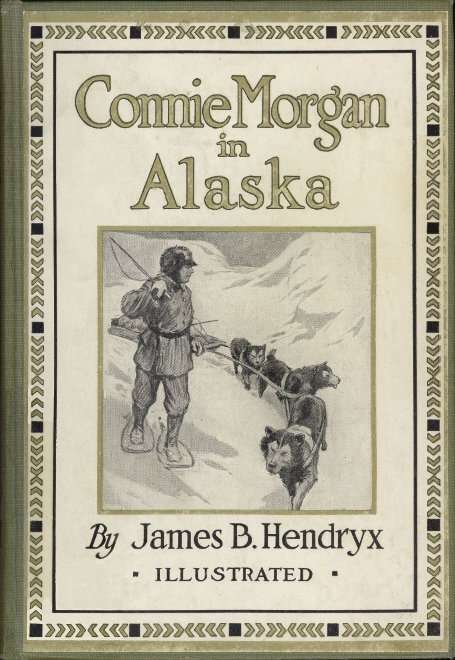
The Project Gutenberg eBook of Connie Morgan in Alaska
Title: Connie Morgan in Alaska
Author: James B. Hendryx
Release date: July 26, 2012 [eBook #40337]
Most recently updated: October 23, 2024
Language: English
Credits: Produced by K Nordquist, Ron Stephens and the Online
Distributed Proofreading Team at http://www.pgdp.net (This
book was produced from images made available by the
HathiTrust Digital Library.)
CONNIE MORGAN IN
ALASKA
BY
JAMES B. HENDRYX
AUTHOR OF
"THE PROMISE," "THE LAW OF THE WOODS," ETC.
ILLUSTRATED
G.P. PUTNAM'S SONS
NEW YORK AND LONDON
The Knickerbocker Press
Copyright, 1916
by
J.B. HENDRYX
Made in the United States of America
CONTENTS
| CHAPTER | PAGE | ||
| I.— | Sam Morgan's Boy | 1 | |
| II.— | The Ten Bow Stampede | 16 | |
| III.— | The New Camp | 30 | |
| IV.— | Partners | 41 | |
| V.— | On the Trail of Waseche | 54 | |
| VI.— | The Men of Eagle | 70 | |
| VII.— | In the Lillimuit | 91 | |
| VIII.— | Waseche Bill to the Rescue | 105 | |
| IX.— | The White Death | 120 | |
| X.— | The Igloo in the Snow | 141 | |
| XI.— | On the Dead Man's Lonely Trail | 156 | |
| XII.— | In the Heart of the Silent Land | 169 | |
| XIII.— | O'Brien | 185 | |
| XIV.— | The Escape from the White Indians | 203 | |
| XV.— | O'Brien's Cans of Gold | 219 | |
| XVI.— | Fighting the North | 234 | |
| XVII.— | The Snow Trail | 251 | |
| XVIII.— | Alaska! | 269 | |
| XIX.— | On the Kandik | 283 | |
| XX.— | The Deserter | 296 | |
| XXI.— | Mister Squigg | 312 | |
| XXII.— | The Man Who Didn't Fit | 325 |
ILLUSTRATIONS
| PAGE | |
| "Like his father before him, he was answering | |
| the call of the gold" | Frontispiece |
| "Making sure that the boy slept, he began | |
| silently to assemble his trail pack" | 42 |
| "McDougall's prize malamutes shot out on the | |
| trail" | 52 |
| "When Connie opened his eyes, daylight had | |
| vanished" | 67 |
| "What could one small boy do in the face of | |
| the ultimatum of these men of the North?" | 81 |
| "My dad would have got out, and, you bet, | |
| so will I!" | 103 |
| "Now, what d' yo' think of that! I'd sho' hate | |
| fo' this heah rope to break!" | 116 |
| Connie Morgan "stared spellbound at the | |
| terrible splendour of the changing lights" | 136 |
| "Waseche Bill attacked the hard-packed snow | |
| with his axe" | 149 |
| "We'ah lost, kid. It's a cinch we cain't find | |
| the divide" | 154 |
| "The boy's lips moved in prayer, the only one | |
| he had ever learned" | 166 |
| "The two partners stared open-mouthed at the | |
| apparition. The face was white!" | 183 |
| "With a palsied arm he motioned to O'Brien, | |
| who stepped before him" | 195 |
| "The boy's fifteen-foot lash sang through the | |
| thin air" | 216 |
| "As they passed between the pillared rocks | |
| the Indians broke cover, hurling their | |
| copper-tipped harpoons as they ran" | 232 |
| "You make me tired!" cried Connie. "Anybody'd | |
| think you needed a city, with the | |
| streets all numbered, to find your way | |
| around" | 237 |
| "Without waiting for a reply, Connie slipped | |
| softly over the edge" | 262 |
| "Recklessly O'Brien rushed out upon the | |
| glittering span of snow while Connie and | |
| Waseche watched breathlessly" | 272 |
| "My dad followed British Kronk eight hundred | |
| miles through the snow before he caught | |
| him—and then—you just wait." | 299 |
| "Mechanically he drew the knife from its sheath | |
| and dragged himself to the body of the | |
| moose." | 310 |
| "Between them walked a little, rat-faced man. | |
| The man was Mr. Squigg." | 331 |
| "Squigg slunk into the star-lit night." | 337 |
Connie Morgan in Alaska
CHAPTER I
SAM MORGAN'S BOY
Connie Morgan, or as he is affectionately called by the big, bearded men of the Yukon, Sam Morgan's boy, now owns one of the crack dog teams of Alaska. For Connie has set his heart upon winning the great Alaska Sweepstakes—the grandest and most exciting race in all the world, a race that crowds both driver and dogs to the very last measure of endurance, sagacity, and skill.
But that is another story. For Connie also owns what is probably the most ludicrous and ill-assorted three-dog team ever assembled; and he is never so happy as when jogging slowly over the trail behind old Boris, Mutt, and Slasher.
No sourdough in his right senses would give fifty dollars for the three, but Sam Morgan's boy would gladly sacrifice his whole team of thousand-dollar dogs to save any one of them. For it was the fine courage and loyalty of this misfit team that enabled him to beat out the Ten Bow stampede and file on "One Below Discovery," next to Waseche Bill, the big sourdough who is his partner—and who loves him as Sam Morgan loved him before he crossed the Big Divide.
Sam Morgan was among those who went to Alaska in the first days of the great gold rush. Like Peg's father in the play, Sam Morgan could do anything but make money. So when the news came of gold—bright, yellow gold lying loose on the floors of creeks up among the snows of the Arctic—Sam Morgan bid his wife and boy good-bye at the door of the little cottage in a ten-carat town of a middle State and fared forth to win riches.
The man loved his wife and son with all the love of his rugged nature, and for their sakes cheerfully endured the perils and hardships of the long trails without a murmur. But in spite of his dogged persistence and unflagging toil he never made a strike. He was in the van of a dozen stampedes—stampedes that made millionaires out of some men and stark corpses out of others—but somehow his claims never panned out.
Unlucky, men called him. And his name became a byword for ill-luck throughout the length and breadth of the Northland.
"She's a Sam Morgan," men would say, as they turned in disappointment from an empty hole driven deep into frozen gravel, and would wearily hit the trail to sink other shafts in other gulches.
So Sam Morgan's luck became a proverb in the North. But Sam Morgan, himself, men loved. He was known among the meat-eaters as a man whose word was as good as other men's bonds, and his cheery smile made long trails less long. It was told in the camps that on one occasion, during a blizzard, he divided his last piece of bacon with a half-starved Indian, and then, carrying the man on his back, made eighteen miles through the storm to the shelter of a prospector's cabin.
His word became law in the settling of disputes. And to this day it is told on the trails how he followed "British Kronk," who struck it rich on the Black Horn, and abandoned his wife, leaving her starving in the cabin where she would surely have died had not Sam Morgan happened along and found her; and of how, after eight hundred miles of winter trail, he came upon him in Candle, and of the great man-fight that took place there on the hard-packed snow; of the tight clamp of the square jaw, and the terrible gleam of the grey eyes as, bare fisted, he made the huge man beg for mercy; and of how he took the man back, single-handed and without authority of law, clear to Fort Yukon, and forced him to recognize the woman and turn over to her a share of his gold.
It is not the bragging swashbucklers, the self-styled "bad men," who win the respect of the rough men upon the edges of the world. It is the silent, smiling men who stand for justice and a square deal—and who carry the courage of their convictions in their two fists.
Of these things men tell in gruff tones, to the accompaniment of hearty fist-bangs of approval. With lowered voices they tell the story of "Sam Morgan's Stumble," as the sharp elbow is called where the Ragged Falls trail bends sharply around a shoulder of naked rock, with a sheer drop of five hundred feet to the boulder-strewn floor of the creek bed. "Just Sam Morgan's luck," they whisper. "The only place on the whole hundred and fifty miles of the Ragged Falls trail where a man could come to harm—right there he steps on a piece of loose ice and stumbles head first into the canyon. He sure played in tough luck, Sam Morgan did. But he was a man!"
When the letters from the North ceased coming, Sam Morgan's wife sickened and died.
"Jest nach'lly pined away a-waitin' fer word from Sam," the neighbours said. And when fifteen-year-old Connie returned to the empty cottage from the bleak little cemetery on the outskirts of the village, he sat far into the night and thought things over.
In the morning he counted the few dollars he had managed to save by doing odd jobs about the village, and placing them carefully in his pocket, together with a few trinkets that had belonged to his mother, left the cottage and started in search of Sam Morgan. He locked the door and laid the key under the mat, just where he knew his father would look for it should he return before he found him.
Connie told nobody of his plans, said no good-byes, but with a stout heart and a strange lump in his throat, passed quietly out of the familiar village and resolutely turned his face toward the great white North.
Thus is was that a small boy stepped off the last boat into Anvik that fall and mingled unnoticed among the boisterous men who crowded the shore. As the boat swung out into the current, the men left the river and entered the wide, low door of the trading post.
Dick Colton paused in his examination of the pile of freight, and noticing for the first time the forlorn little figure who stood watching the departing boat, sauntered over and spoke:
"Hello, sonny, where you bound?"
The boy turned and gravely faced the smiling man. "I've come to find my father," he answered.
"Where is your father?"
"He is here—somewhere."
"Here? In Anvik, you mean?"
"In Alaska."
The man uttered a low whistle. The smile was gone from his face, and he noted the threadbare cloth overcoat, and the bare legs showing through the ragged holes in the boy's stockings.
"What is your father's name, boy?"
"Sam Morgan."
At the name the man started and an exclamation escaped his lips.
"Do you know him?" The boy's face was eager with expectation, and the man found the steadfast gaze of the blue eyes disconcerting.
"Just you wait here, son, for a minute, while I run up to the store. Maybe some of the boys know him." And he turned and hurried toward the long, low building into which the men had disappeared.
"Boys!" he cried, bursting in on them, "there is a kid out here. Came in on the boat. He is hunting for his dad." The men ceased their talk and looked at the speaker with interest. "And, Heaven help us, it's Sam Morgan's boy!"
"Sam Morgan's boy! Sam Morgan's boy!" In all parts of the room men repeated the words and stared uneasily into each other's faces.
"He has got to be told," said Dick, with a shake of the head. "You tell him, Pete. I couldn't do it."
"Me neither. Here you, Waseche Bill, you tell him."
"I cain't do it, boys. Honest I cain't. You tell him." Thus each man urged his neighbour, and in the midst of their half-spoken sentences the door opened and the boy entered. An awkward hush fell upon them—the fifty rough, fur-clad men whose bearded faces stared at him from the gloom of the long, dark room—and the one small boy who stared back with undisguised interest. The silence became painful, and at length someone spoke:
"So you're Sam Morgan's boy?" the man asked, advancing and offering a great hairy hand. The boy took the hand and bore the pain of the mighty grip without flinching.
"Yes, sir," he answered. "Do you know him—my father?"
"Sure I know him! Do I know Sam Morgan? Well, I just guess I do know him! There ain't a man 'tween here an' Dawson don't know Sam Morgan!" Others crowded about and welcomed the boy with rude kindness.
"Is my father here, in Anvik?" the boy asked of the man called Pete.
"No, kid, he ain't here—in Anvik. Say, Waseche, where is Sam Morgan at? Do you know?" Thus Pete shifted the responsibility. But Waseche Bill, a long, lank Kentuckian, was equal to the occasion.
"Why, yes, Sam Mo'gan, he's up above, somewhe's," with a sweep of his arm in the direction of the headwaters of the great river.
"That's right," others added, "Sam Morgan's up above."
"When can I go to him?" asked the boy, and again the men looked at each other helplessly.
"The's a bunch of us goin' up Hesitation way in a day or two, an' yo' c'n go 'long of us. Sam's cabin's at Hesitation. But yo' cain't go 'long in that rig," he added, eyeing the threadbare overcoat and ragged stockings.
"Oh! That's all right. I'll buy some warm clothes. I've got money. Eight dollars!" exclaimed the boy, proudly producing a worn leather pocketbook in which were a few tightly wadded bills.
Eight dollars! In Alaska! And yet not a man laughed. Waseche Bill placed his hand on the boy's shoulder and smiled:
"Well, now, sonny, that's a right sma't lot o' money, back in the States, but it don't stack up very high in Alaska." He noticed the look of disappointment with which the boy eyed his hoard, and hastened to proceed: "But don't yo' fret none. It's lucky yo' chanced 'long heah, 'cause I happen to be owin' Sam Mo'gan a hund'ed, an' it's right handy fo' to pay it now." Hardly had he ceased speaking when Dick Colton stepped forward:
"I owe Sam fifty." "An' me!" "An' me, too!" "An' me, I'd most forgot it!" The others had taken their cue, and it seemed to the bewildered boy as though these men owed his father all the money in the world.
"But I don't understand," he gasped. "Is father rich? Has he made a strike, at last?"
"No, son," answered Dick, "your father is not rich—in gold. He never made a strike. In fact, he is counted the most unlucky man in the North—in some ways." He turned his head. "But just the same, boy, there's not a man in Alaska but owes Sam Morgan more than he can pay."
"Tell me about him," cried the boy, his eyes alight. "Did my father do some great thing?" The silence was broken by old Scotty McCollough:
"Na', laddie, Sam Morgan never done no great thing. He di' na' ha' to. He was great!" And by the emphasis which the bluff old Scotchman placed upon the word "was," of a sudden the boy knew!
"My father is dead!" he moaned, and buried his face in his hands, while the men looked on in silent sympathy. Only for a moment did the boy remain so, then the little shoulders stiffened under the thin overcoat, the hands dropped to his side and clenched, and the square jaw set firm—as Sam Morgan's had set, that day he faced big "British Kronk" on the snow-packed street of Candle. As the boy faced the men of the North, he spoke, and his voice trembled.
"I will stay in Alaska," he said, "and dig for the gold my father never found. I think he would have liked it so." Suddenly the low-ceilinged room rang with cheers and the boy was lifted bodily onto the shoulders of the big men.
"You bet, he'd liked it!" yelled the man called Pete.
"Yo'r Sam Mo'gan's boy all right—jest solid grit clean through. It looks f'om heah like Sam's luck has tu'ned at last!" cried Waseche Bill.
Two days later, when he hit the long trail for Hesitation, in company with Waseche Bill, Dick Colton, and Scotty McCollough, Sam Morgan's boy was clad from parka hood to mukluks in the most approved gear of the Northland.
He learned quickly the tricks of the trail, the harnessing and handling of dogs, the choosing of camps, and the hasty preparation of meals; and in the evenings, as they sat close about the camp fire, he never tired of listening as the men told him of his father. His heart swelled with pride, and in his breast grew a great longing to follow in the footsteps of this man, and to hold the place in the affections of the big, rough men of the White Country that his father had held.
All along the trail men grasped him by the hand. He made new friends at every camp. And so it was that Sam Morgan's boy became the pride of the Yukon.
At Hesitation he moved into his father's cabin, and went to work for Scotty McCollough, who was the storekeeper. Many a man went out of his way to trade with Scotty that he might boast in other camps that he knew Sam Morgan's boy.
One day Waseche Bill took him out on the Ragged Falls trail where, at the foot of the precipice, his father lay buried. The two stood long at the side of the snow-covered mound, at the head of which stood a little wooden cross with its simple legend burned deep by the men who were his friends:
SAM MORGAN
ALASKA
The man laid a kindly hand on the boy's shoulder:
"Notice, son, it don't say Hesitation, nor Circle, nor Dawson—but just Alaska. It takes a mighty big man to fill that there description in this country," and the man brushed away a tear of which he was not ashamed.
CHAPTER II
THE TEN BOW STAMPEDE
With the passing of the winter Connie found himself the proud possessor of a three-dog team. Shortly after the trip to "Sam Morgan's Stumble," Waseche Bill disappeared into the north on a solitary prospecting trip. Before he left he presented Connie with old Boris, a Hudson Bay dog famed in his day as the wisest trail dog on the Yukon, and in spite of his years, a lead dog whose sagacity was almost uncanny.
"He's been a great dog, son, but he's gettin' too old fo' the long trails. I aimed to keep him 'til he died, but I know yo'll use him right. Just keep old Boris in the lead and he'll learn yo' mo' trail knowledge than I could—or any otheh man." Thus Waseche Bill took leave of the boy and swung out into the trail with a younger dog in the lead. Old Boris stood with drooping tail beside his new master, and as the sled disappeared over the bank and swept out onto the ice of the river, as if in realization that for him the trail days were over, he threw back his shaggy head and with his muzzle pointing toward the aurora-shot sky, sent a long, bell-like howl of protest quavering into the chill air.
Later, a passing prospector presented Connie with Mutt, a slow, heavily built dog, good-natured and clumsy, who knew only how to throw his great weight against the collar and pull until his footing gave way.
The third dog of the team was Slasher, a gaunt, untamed malamute, red-eyed and vicious—a throwback to the wolf. His former owner, tired of fighting him over the trails, was on the point of shooting him when Connie interceded, and offered to buy him.
"Why, son, he'd eat ye alive!" said the man; "an' if harm was to come to Sam Morgan's boy through fault of a man-eatin' wolf-dog which same he'd got off o' me, why, this here Alaska land 'ud be too small to hold me. No, son, I guess we'll jest put him out o' the way o' harmin' folks." But the boy persisted, and to the unspeakable amazement of the man, walked up and loosened the heavy leather muzzle.
White fangs an inch long gleamed wickedly as the boy patted his head, but the vicious, ripping slash which the onlookers expected did not follow. The crouching dog glared furtively, with back curled lips—suspicious. Here was something he did not understand—this man-brute of small size who approached him bare-handed and without a club. So he glared red-eyed, alert for some new trick of torture. But nothing happened, and presently from the pocket of his parka this strange man-brute drew a piece of smoked fish which the dog accepted from his bare fingers with a lightning-like click of polished fangs, but the fingers did not jerk away in fear even though the fangs closed together a scant inch from their ends.
A piece of ham rind followed the fish and the small man-brute reached down and flung the hated muzzle far out into the snow, and with it the collar and the thong lash.
The wolf-dog rose for the first time in his life unfettered. He shook himself and surveyed the astonished group of men. The stiff, coarse hair along his spine stood erect and he uttered a low throaty growl of defiance; then he turned and stalked toward the boy, planting his feet deliberately and stiffly after the manner of dogs whose temper quivers on a hair-trigger. Guns were loosened in the holsters of the men, but the boy smiled and extended his hand toward the dog, which advanced, the very personification of savage hate.
The men gasped as the pointed muzzle touched the small bared hand and a long, red tongue shot out and licked the fingers. At the sound, the dog placed himself before the boy and glared at them, and then quietly followed Connie to the corral at the rear of the log store.
"He's yours, son," exclaimed the prospector, as the boy joined them. "No, I won't take no pay for him. You saved his life, an' he b'longs to you—only be careful. Don't never take your eyes off him. I don't trust no malamute, let alone that there Slasher dog."
With the lengthening of the days the Northland began to feel the approach of spring. Snow melted on the more exposed mountain slopes, and now and then the trails softened, so that men camped at midday.
Connie found time to take short excursions with his team up the neighbouring gulches, occasionally spending the night in the cabin of some prospector.
He was beginning to regard himself as a "sure enough sourdough" now, and could talk quite wisely of cradles and rockers, of sluices and riffles, and pay dirt and bed rock.
Then, one day when the store was full of miners and prospectors awaiting the mail, Waseche Bill burst into the room with the story of his big strike on Ten Bow. Instantly pandemonium broke loose. Men in a frenzy of excitement threw their outfits onto sleds and swung the dogs onto the ice trail of the river, struggling and fighting for place.
McDougall, with his mail team of ten fast malamutes, bet a thousand dollars he would beat out Dutch Henry's crack Hudson Bays. Men came down from the hills and joined the stampede, and by evening a hundred dog teams were on the trail.
During the excitement, Waseche Bill sought out Connie and drew him to one side:
"Listen, son," whispered Waseche, speaking hurriedly, and to the point, "git in on this, d'yo heah? Quick now, git out yo' dogs an' hit the trail. Old Boris'll take yo' theh. The's always one mo' pull in a good dog, an' he'll unde'stand. I've been wo'kin' Ten Bow fo' six months, an' he knows the sho't-cut. Keep up yo' nerve, an' follow that dog. He'll swing off up Little Rampa't, an' the othe's will keep to the big riveh—but it's the long way 'round. It's only 'bout eighty mile by the sho't-cut, an' a good two hund'ed by the riveh. I come down the long way so's to have a smooth trail fo' my new lead dog. The other's a rough trail, over ridges an' acrost gulches, up hill an' down, but yo' c'n make it! Boris, he'll see yo' through. An' when yo' strike Ten Bow—yo'll know it, 'cause it's the only valley that shows red rock—swing no'th 'til yo' come to a big split rock, an' theh yo'll find my stakes.
"Now, listen! My claim'll be Discovery." The man lowered his voice yet more: "An' yo' stake out One Below Discovery—below, mind. 'Cause she's a sho' winneh, an' togetheh we'll have the cream o' the gulch—me an' yo' will."
Many outfits passed Connie on the trail; the men laughing and joking, good-naturedly urged the boy onward. He only laughed in return, as he encouraged his ill-matched team—Big Mutt plunging against the collar, Slasher pulling wide with the long jumps of the wolf-dog, and old Boris with lowered head, in the easy lope of the born leader. Mile after mile they covered on the smooth trail of the river, and it seemed to the boy as if every outfit in Alaska had passed him in the race. But he urged the dogs onward, for the fever was in his blood—and like his father before him, he was answering the call of gold.
Suddenly, without a moment's hesitation, old Boris swerved from the trail and headed for the narrow cleft between two towering walls of rock, which was the mouth of Little Rampart. On and on they mushed, following the creek bed which wound crookedly between its precipitous sides.
Again old Boris swerved. This time it was to head up a steep, narrow pass leading into the hills. Connie had his hands full at the gee-pole, for it was dark now—not the black darkness of the States, but the sparkling, star-lit dark of the aurora land.
He camped at midnight on a flat plateau near the top of a high divide. Morning found him again on the trail. He begrudged every minute of inaction, for well he knew the fame of McDougall's mail dogs, and Dutch Henry's Hudson Bays. It turned warmer. The snow slumped under foot, and he lost two hours at midday, waiting for the stiffening chill of the lengthening shadows.
On the third day it snowed. Not the fierce, cutting snow of the fall and winter, but large, feathery flakes, that lay soft and deep on the crust and piled up in front of the sled. That night he camped early, for both boy and dogs were weary with the trail-strain.
During the night the snow stopped falling and the wind rose, driving it into huge drifts. Progress was slow now and every foot of the trail was hard-earned. Old Boris picked his way among boulders and drifts with the wisdom of long practice. Slasher settled down to a steady pull, and Big Mutt threw himself into the collar and fairly lifted the sled through the loose snow. Toward noon they slanted into a wide valley, and the tired eyes of the boy brightened as they saw the bold outcropping of red rock. Then immediately they grew serious, and he urged the dogs to greater effort, for, far down the valley, dotting the white expanse of snow, were many moving black specks.
Old Boris turned toward the north, and the boy saw the huge split rock a mile away. He was travelling ahead of the dogs now, throwing his weight onto the babiche rope, his wide snowshoes breaking the trail. In spite of his efforts the pace was dishearteningly slow. Every few minutes he glanced back, and each time the black specks appeared larger and more distinct. He could make out men and sleds, and he knew by the long string of dogs that the first outfit was McDougall's.
"Hi! Hi! Mush you! Mush you!" faintly the sound was borne to his ears, and he knew that McDougall was gaining fast—he had already broken into Connie's own freshly made trail. The dogs heard it, too, and with cocked ears plunged blindly ahead.
The split rock loomed tantalizingly near, and the boy thanked his stars that he had prepared his stakes beforehand. He loosened them from the back of the sled and, ax in hand, ploughed ahead through the loose snow. His racket struck something hard and he pitched forward—it was one of Waseche Bill's stakes.
Feverishly he scrambled to his feet and drove in his own stakes, following Waseche's directions. With a final blow of his ax, he turned to face McDougall, who stared at him wide-eyed.
"You dang little scamp!" he roared. "You dang little sourdough!" And as he staked out number Two Below Discovery, the hillsides echoed back his laughter.
Other men came. Soon the valley of the Ten Bow was staked with claims running into the forties, both above and below Discovery. But the great prize of all was One Below, and it stood marked by the stakes of Sam Morgan's boy.
That night the valley of the Ten Bow was dotted with a hundred camp fires, and the air rang with snatches of rude song and loud laughter.
Men passed from fire to fire and Connie Morgan's name was on every tongue.
"The little scamp!" men laughed; "cut straight through the hills with them old discarded dogs, an' beat us to it!" "Now, what d'ye know 'bout that?" "If Sam Morgan c'd lived to seen it he'd be'n the tickledest man in the world!" "Poor old Sam—looks like his luck's turned at last!"
From the surrounding gloom a man stepped into the light of a large camp-fire near which Connie Morgan was seated talking with a group of prospectors. He was a little, rat-like man, with a pinched, weasel face and little black eyes that shone beadlike from between lashless lids.
"This Number One claim, boys, it ain't legal. It's staked by a boy. I'm a lawyer, an' I know. He's a minor, an' he can't hold no claim!" He spoke hurriedly, and eyed the men for signs of approval; then he advanced toward Connie, shaking a long, bony finger.
"You ain't twenty-one," he squeaked, "an' I command you to vacate this claim in the name of the law!" From the boy's side came a low growl. There was a flash of grey in the firelight, and the wolf-dog was at the man's throat, bearing him backward into the snow.
The boy was on his feet in an instant, pulling at the dog and beating him off. Luckily for the man his throat was protected by the heavy parka hood, and he sustained no real damage. He arose whimpering with fright.
The other men were on their feet now, and one of them knocked the revolver from the hand of the cowering man as he aimed it at the growling Slasher.
Big McDougall stepped forward, and, grasping the man by the shoulder, spun him around with a jerk.
"Look a here, you reptile! Kin ye guess what that dog 'ud of done to ye, an' it hadn't be'n fer the kid? Well, fer my part he c'd gone ahead an' done it as it was. But, seein' he didn't, just ye listen to me! What he would done won't be a patchin' to what I will do to ye, if ever ye open yer head about that there claim ag'in. An' that ain't all. There's a hundred men in this gulch—good men—sourdoughs, ev'ry one—an' the kid beat us all fair an' square. An', law or no law, we're right here to see that Sam Morgan's boy does hold down that claim! An' don't ye fergit it!"