
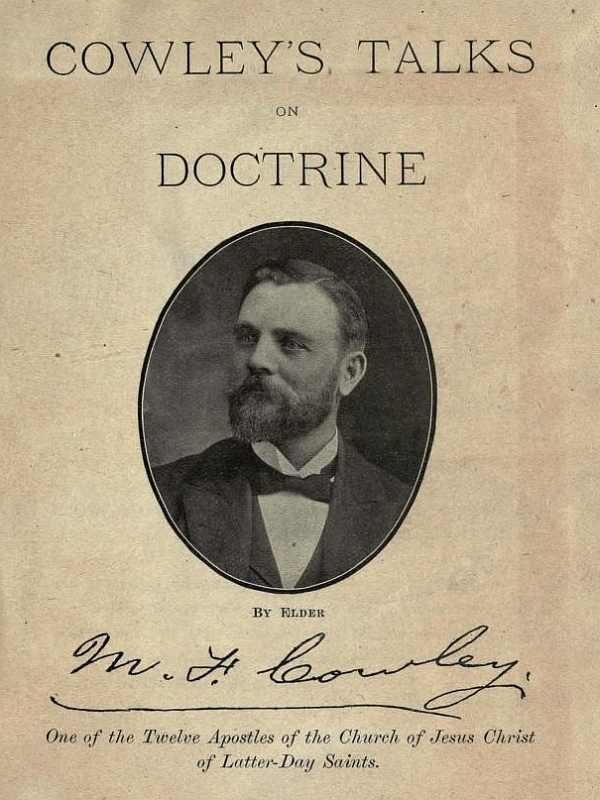
The Project Gutenberg eBook of Cowley's Talks on Doctrine
Title: Cowley's Talks on Doctrine
Author: Matthias F. Cowley
Release date: November 12, 2014 [eBook #47336]
Most recently updated: October 24, 2024
Language: English
Credits: Produced by Renah Holmes and the Mormon Texts Project
(MormonTextsProject.org).
COWLEY'S TALKS
ON
DOCTRINE
By Elder
M. F. Cowley.
One of the Twelve Apostles of the Church of Jesus Christ of Latter-Day Saints.
PUBLISHED BY BEN. E. RICH, CHATTANOOGA, TENN. 1902.
TIMES PRINT, CHATTANOOGA, TENN
PREFACE.
Notwithstanding what has already been written upon the principles and doctrines of the Gospel of Jesus Christ as taught by the Latter-Day Saints, I feel an assurance that this little work will be received with no little pleasure and a great degree of satisfaction by members of the true Church, as well as those who are seeking light upon religious topics.
The style in which the articles comprised in this little volume are written, is pre-eminently plain, and peculiarly adapted to the reading public. Loaded as the articles are, with careful thought and numerous scriptural quotations and references, itself not only a thought gatherer but a thought generator, it will come as a valuable aid to our missionaries and theological organizations, and also to the many investigators throughout the civilized world. Truth in studied brevity has been aimed at, without seeking the least embellishment of diction.
With an intense desire to impart the truth to mankind as widely as possible, this little messenger is sent forth, trusting that it may prove a blessing to thousands who are as yet grovelling in darkness and superstition and lead them to the sunlight of truth.
THE PUBLISHER.
Chattanooga, Tenn., February, 1902.
TABLE OF CONTENTS.
Apostasy
Restoration of the Gospel
The Church
Church Organization
Divine Authority
Personality of God
Revelation
Faith
Repentance
Baptism
Reception of the Holy Spirit
Pre-Existence
Salvation for the Dead
The Gathering of Israel
Tithing
Eternal Rewards and Punishments
Obedience
Charity
The Resurrection
The Book of Mormon
Marriage
The Millennium
APOSTASY.
The subject of Apostasy occupies the minds of people of modern times but very little. This, however, is not surprising when we consider their views regarding the Church of Christ; for they claim a continuation of divine authority and the plan of salvation from the apostolic age to the present time, the idea prevailing among them being, that the Bible alone is a sufficient guide without immediate and continued revelation. In this respect, the position of the Latter-day Saints differs widely from that of all other religious organizations. The Saints bear no relationship to any, but declare in words of soberness, that our Heavenly Father has restored the Gospel by modern revelations to the Prophet Joseph Smith. This being true, there must have been a departure from the proper order of the Gospel.
To prove that this has been the case, we will refer to statements of Holy Writ. In II Peter i:20, it is said, "Knowing this first, that no prophecy of the Scripture is of any private interpretation, for the prophecy came not in old time by the will of man; but holy men of God spake as they were moved by the Holy Ghost." The Savior said, when addressing His disciples: "And then shall many be offended, and shall betray one another, and shall hate one another, and many false prophets shall rise and deceive many, and because iniquity shall abound, the love of many shall wax cold." (Matthew xxiv:10-12.)
To this testimony of Matthew, concerning the words of the Savior, in relation to the subject under consideration, there will be found the corresponding testimonies of Mark and Luke. It will be remembered also, that the testimony of the Lord was in answer to a very important question. When He had foretold the overthrow of the temple, His apostles asked Him: "When shall these things be, and what shall be the sign of Thy coming, and of the end of the world?" The appearance of false prophets; the deception of man; the martyrdom of the apostles; the betrayal of the Saints; the love of many waxing cold; the overwhelming prevalence of iniquity; the universal discord and contentions of the nations, all were prominent events to transpire before the advent of the Savior to reign in power and glory upon the earth. To this we will add the words of Paul: "Now we beseech you, brethren, by the coming of our Lord Jesus Christ, and by our gathering together unto Him, that ye be not soon shaken in mind, or be troubled, neither by spirit, nor by word, nor by letter as from us, as that the day of Christ is at hand. Let no man deceive you by any means: for that day will not come, except there come a falling away first, and that man of sin be revealed, the son of perdition." (II Thes. ii:1-4.)
It is evident from the foregoing that some were likely to be deceived with regard to the time of His second coming. Paul, to prevent their being misled by false teachers who were likely predicting the Savior's advent, testified that there should come a "falling away first." The language is so pointed that one can readily see that nothing but a departure from the unchangeable plan of salvation could fulfill this prediction. We read in the Scriptures that "God hath set some in the Church, first apostles; secondarily, prophets," and other officers; all of whom were divinely inspired "for the work of the ministry," with spiritual gifts following the baptized believers. Only a short time elapsed, however, before these officers, principles, gifts and blessings, mentioned in the New Testament, were not to be found on the earth: and when we examine the religious institutions of the present time, these things, which God set in the Church, are not found, save with the Latter-day Saints. The present generation then, as those of many centuries past have been, are witnesses to the verification of the words we have quoted.
When Paul was about to depart from Miletus, he called to him the Elders of the Church from the city of Ephesus, and in his farewell address warned them, as appears in the following words: "For I know this, that after my departing shall grievous wolves enter in among you, not sparing the flock. Also of your own selves shall men arise, speaking perverse things, to draw away disciples after them?" (Acts xx:29, 30.) As an evidence that this prophecy was being verified as early as the time of the apostle John's banishment on the Isle of Patmos, this appears in the second chapter of Revelations, first and fifth verses: "Unto the angel of the Church of Ephesus write: These things saith he that holdeth the seven stars in His right hand, who walketh in the midst of the seven golden candlesticks; Remember, therefore, from whence thou art fallen, and repent, and do the first works; or else I will come unto thee quickly, and will remove thy candlestick out of this place, except thou repent." By reading the second verse we discover that false teachers had arisen among the people, professing to be apostles, thus verifying the words of Paul. Following closely the context, we discover that similar reproofs were meted out to most of the branches of the Church in Asia, because they were departing from the truth.
Peter, the presiding apostle, also has spoken very plainly regarding the apostasy. Beginning with the first verse of the second chapter of his second epistle, we read: "But there were false prophets also among the people, even as there shall be false teachers among you, who privily shall bring in damnable heresies, even denying the Lord that bought them, and bring upon themselves swift destruction. And many shall follow their pernicious ways; by reason of whom the way of truth shall be evil spoken of. And through covetousness shall they with feigned words make merchandise of you: whose judgment now of a long time lingereth not, and their damnation slumbereth not." From this we learn not only that false teachers should arise among the people, but that they should succeed in deceiving the people, causing them to follow pernicious ways. In connection with this part of the subject, Paul says to Timothy: "For the time will come when they will not endure sound doctrine; but after their own lusts shall they heap to themselves teachers, having itching ears; and they shall turn away their ears from the truth, and shall be turned unto fables." (II Timothy iv:3, 4.) Thus it is clearly stated, not only that men should arise "speaking perverse things," and by their evil designs succeed in making innovations upon the teachings of the apostles, but that the people themselves would be so allured from the way of life, as to heap unto themselves these false teachers, and many would adhere to their spurious doctrines. The terms "heap" and "many" do not signify a few but a great number.
These quotations from the Holy Scriptures bear especially upon the internal eruptions that occurred in the Church, causing many to depart from the straight and narrow path which leadeth unto life eternal. Those causes which create internal division and discord in the midst of the Saints are the worst of all, for "a house divided against itself cannot stand."
Having shown that many of the ancient Saints departed from the plan of salvation, we will now proceed to examine another branch of the subject, namely: The External Events in Connection with the History of the Church which Conspired to Overthrow the People of God. From the quotations here given, stating that "the love of many waxed cold; many shall follow their pernicious ways," etc., it may be asked, "What shall become of the few who were faithful? Did not they confer the authority upon a people in some remote corner of the earth? And from thence has it not continued, as the true Church, down to the present time?" In answer to these queries we shall refer to declarations of Holy Writ.
When the Savior made His appearance in the flesh there were many religious denominations extant, some of which professed a firm belief in the Bible—the Old Testament—and notwithstanding the ancient prophets plainly foretold the birth and ministry of the Savior, the religious element bitterly opposed Him and denounced new revelation, as manifested through the Redeemer. This peculiar perversity of the human family has been displayed prominently whenever the Almighty has introduced a new dispensation of the Gospel. The Lord, fully understanding the result of such bitter persecution, said to His apostles: "Then shall they deliver you up to be afflicted, and shall kill you; and ye shall be hated of all nations for my namesake." (Matt. xxiv:9.)
The vile treatment to which the ancient apostles were subjected and the martyrdom of many of them, is known to all acquainted with the history of those inspired men; and scriptural evidence as to their having been informed thereof in advance is quite abundant. The Savior says in Mark, thirteenth chapter, ninth verse: "But take heed to yourselves; for they shall deliver you up to councils; and in the synagogues ye shall be beaten; and ye shall be brought before rulers and kings for my sake, for a testimony against them." Another witness to this testimony of our Savior has also left us the following: "And ye shall be betrayed both by parents, and brethren, and kinsfolks, and friends, and some of you shall they cause to be put to death."
It is a remarkable fact that, in every age of the world when the Lord has committed a dispensation of the Gospel to men upon the earth, the heavenly message has been rejected by the great majority of the human family, and the envy and hatred of many have been such as to instigate measures of violence against the humble servants of the Lord. Especially is this true when applied to the professedly religious element, and more directly to those who aim to be public instructors of the people. Notice the action taken by the Pharisees, Sadducees and other religious classes regarding the ancient Saints; while the devotees of these sects were divided on points of doctrine and disagreed upon the writings of the prophets, they combined their efforts to overthrow the Lord's chosen people. The Savior, indicating the class who would imbrue their hands in the blood of the prophets, said: "These things have I spoken unto you, that ye should not be offended. They shall put you out of the synagogues; yea, the time cometh, that whosoever killeth you will think that he doeth God's service." (John xvi:1, 2.) This could not apply to the atheistic world, for it denies the existence of God. It could not mean the infidel class, for while they may not deny the existence of a Supreme Being, they disavow all forms of worship. The Savior's prediction was directed to the religious world, and from the facts of the case, it seems especially applicable to that portion of it which claimed to believe in the writings of the ancient prophets. Immediate revelation from heaven has always come in contact with the vain traditions and religious crafts of men, so that the strictest professors of religion anciently were, and are now, among the foremost in persecuting the Saints and seeking to deprive them of the rights and privileges which other men enjoy. In connection with the evidence found in the Holy Scriptures on this part of the subject, the thousands of Latter-day Saints who have suffered by the hand of oppression in this dispensation of the Gospel, are living witnesses.
While the revelator John, who was the last remaining member of the quorum of the Twelve Apostles on the Eastern Hemisphere, was in banishment upon the Isle of Patmos, he saw the image of a beast, representing a power that should arise in the earth, make war upon the Saints and overcome them. And they worshipped the dragon which gave power unto the beast, and they worshiped the beast, saying, "Who is like unto the beast? Who is able to make war with him? And he opened his mouth in blasphemy against God, to blaspheme His name, and His tabernacle, and them that dwell in heaven. And it was given unto him to make war with the Saints, and to overcome them; and power was given Him over all kindreds, and tongues, and nations." This declaration of the Scriptures is very broad, indicating clearly that the Saints should be overcome, and the power of the beast should be so extensive as to cover all "kindred, tongues and nation," thus leaving the people destitute of divine authority and bereft of the glorious plan of redemption.
By turning to the second chapter of Daniel, we learn something with regard to the period of time when this power which made war with the Saints and overcame them should flourish in the earth. The metallic image which Nebuchadnezzar saw in His dream consisted of gold, silver, brass, iron and clay, so we are told in the interpretation given by Daniel the prophet. It represented several kingdoms, beginning with Babylon, which we learn from history flourished in the fifth and sixth centuries before Christ; and second, the Medio-Persian government, from about 580 to 331 B. C.; third, the Macedonian kingdom, founded by Alexander the Great, from 331 B. C., to 161 B. C.; fourth, the Roman Empire, established in 161 B. C., and which flourished until 483 A.D. This last named government was represented in the metallic image by the two legs of iron, which resembled very much the two divisions of the Roman Empire, the one having its seat of government at Rome, the other at Constantinople. These subsequently subdivided into the petty governments of modern Europe, having in them the elements of strength and weakness, as indicated by the feet and toes of the image, which were part of iron and part of clay. It will be observed by the dates given above that it was during the time of the Roman Empire that our Lord and Savior was born into the world. As early as the banishment of the apostle John, about 96 A. D., we discover that nearly all apostles forming the chief quorum of officers in the Church of Christ had been martyred. We are informed in Mosheim's Ecclesiastical Institutes that the year 70 A. D. Vespasian and his son Titus besieged the city of Jerusalem with an army, destroyed the city and the temple and slew many of the inhabitants, this event having been predicted by the Savior, and recorded in Matthew, twenty-fourth chapter.
In speaking of this power that should destroy the Saints, Daniel the prophet, says, "And he shall speak great words against the Most High and shall wear out the Saints of the Most High." We might illustrate how literally these prophecies were verified by the following example: Previous to the late Civil War in the American Union, the South organized a republican form of government with the requisite officers to constitute such a government. In a short time, however, the Northern States engaged in war with the South and overcame them, so that the confederacy of that section ceased to exist. Suppose a stranger should visit the South at the present time and inquire of some person in that region of country if they have a republic entirely independent of the North, and on being answered "We have," the visitor queries, "Where is your president?" "Well, he is done away with, because no longer needed." He is asked, "Where is your vice-president?" "Oh, we have none." "Where is your congress?" "Well, that was dissolved long ago and has not existed since." "Pray, then," says the stranger, "What have you left?" "Well, we have a judge, and a policeman, besides the book which gives a history of the officers you inquire about." Such answers, however absurd and inconsistent, are very similar to those offered by the religious world of today who claim to have the Church of Christ; but when asked where are their apostles, they answer, "We have none, they are done away with." "Have you prophets?" "Oh, no! They are no longer needed." "Do the members of your church enjoy the gifts of the Holy Spirit that Jesus promised should follow believers?" "Certainly not, they have passed away centuries ago, and we have no occasion for them now." "Well, then, what have you left?" "Why, we have a pastor and a deacon, and then we have the good Book, the Holy Bible, that describes the officers you mention."
It is very clear, from the condition of affairs, that we have briefly described, that at some period in the past, the Church of Jesus Christ was taken from the earth and the human family left without the direct and authorized administration of the plan of salvation. The prophecies we have quoted show, first, that such an event was to transpire some time in the future; second, about the period of time in which many of these predictions were verified, and, third, the means of power by which the Saints were overcome.
There are other prophecies in the Bible which plainly show that the extent of the ancient apostasy would be universal and continue in the earth until a certain period in the history of the human family, which will, with other items, form the subject matter for our next consideration. As the predictions of the prophets relating to the past have been so literally verified, this fact should promote, in the hearts of the people, great faith in the words of the Lord, as these are given in the Bible.
We have shown that the Church established by the Savior in all its pristine beauty and purity was taken from the earth. As none of the religious denominations, existing between the time of the ancient apostles and the nineteenth century have received a new commission from heaven, that fact is proof that the effect of the primitive apostasy has extended without interruption to the present age of the world.
Dr. Mosheim is the author of four large volumes of religious history comprehending about eighteen centuries of the Christian era. This work has been translated by Dr. Murdock with copious notes, or extracts, from the writers who lived contemporary with the times of which he writes. From the translation of Mosheim's Ecclesiastical Institutes we make a few quotations.
In speaking of the second century of the Christian era, Mosheim says (Vol. 1, p. 142): "For the noble simplicity and the majestic dignity of the Christian religion were lost, or at least impaired, when these philosophers presumed to associate their dogmas with it and to bring faith and piety under the dominion of human reason." On pages 182 and 183 of the same volume we are informed that, to conform to the customs of Jews and Pagan priests, rites and ceremonies were added to the simplicity of correct worship, and a "large part therefore of the Christian observances and institutions even in this century had the aspect of Pagan mysteries." Passing on to the third century on page 257, we have the following: "All the monuments of this century which have come down to us, show that there was a great increase of ceremonies." Page 259: "Baptism was publicly administered twice a year to candidates who had gone through a long preparation and trial."
Of the fourth century we learn from p. 345 that the regard for Platonic philosophy was embraced and mingled with the doctrine of the Savior: "Hence it is that we see on every hand evident traces of excessive veneration for Saints in heaven; of belief in a fire to purify souls on leaving the body; of partiality for priestly celibacy; the worship of images and relics, and for many other opinions which, in the process of time, almost banished the true religion or at least very much obscured and corrupted it." Of the fifth century, an account is given of impostors perpetrating artifices to make people think they were miracles and thereby induce them to embrace Christianity. Religious teachings, we are informed, "were substantiated, not so much by the declarations of the Holy Scriptures, as by the authority and logical reasonings of the ancient doctors." Page 455: "The whole Christian Church was in this century overwhelmed with these disgraceful fictions."
We might proceed with similar quotations relative to subsequent centuries intervening between the fifth and the time of the Reformation, but the foregoing will suffice to show that religious matters grew worse from one age to another, presenting to the world a mass of religious confusion. Although there may have been honorable men who protested against these evils, it is evident that genuine authority and the principles of the Gospel in their purity could not be derived from such a corrupt source. We are informed in the Scriptures that an evil tree will not produce good fruit nor a bitter fountain send forth sweet waters. As neither Luther, Melancthon, Huss, Zwingli, Calvin nor any of the reformers of that age received revelation from heaven authorizing them to establish the Church, we find that the world was still without the plan of salvation, and that the products of the Reformation, as religious bodies, are the offspring of the mother church, described in the Scriptures as the "mother of harlots and abomination of the earth." This unnatural mother, like some of the fashionable women of modern times (whose husbands and illicit patrons are zealously opposing the Latter-day Saints), endeavored to procure abortion, but failing in this, she tried to destroy her children after birth. Both attempts being futile, the children grew to years of maturity and in turn gave birth to other children, and so on until now there are several generations of them living. These offspring, being without natural affection, have been and still are quarreling with each other and casting missiles at their mothers and grandmothers as the case may be.
In the midst of this religious spectacle, however, there are and have been many honorable people who have realized the fallen condition of the world and were honest enough to acknowledge the same. From Elder John Morgan's Tract No. 1, we make the following extracts: "Roger Williams refused to continue as pastor over the oldest Baptist church in America on the grounds that there was no regularly constituted church on earth nor any person authorized to administer church ordinances, nor can there be until new apostles are sent by the Great Head of the Church for whose coming I am seeking." (See Picturesque America, page 502.) Smith's Bible Dictionary also says: "We must not expect to see the Church of Holy Scriptures actually existing in its perfection on the earth. It is not to be found thus perfect either in the collected fragments of Christendom or still less in any one of these fragments." The names of sixty-five learned divines and biblical scholars are on the preface page as contributors to and endorsers of this book.
Mr. Wesley states that the reason the gifts are no longer in the church, is because the love of many waxed cold and the Christians had turned heathens again and had only a dead form left. (See volume 1, sermon 94.)
The situation of the religious world is beautifully depicted in poetic verse on page forty-one of the Latter-day Saints' Hymn Book, in a hymn from Wesley's collection. In speaking of the golden age of the apostles and prophets, when the Saints were endowed with spiritual gifts and graces, the writer says:
"Where shall we wander now to find
Successors they have left behind?
The faithful whom we seek in vain
Are 'minished from the sons of men.
Ye different sects who all declare:
'Lo! here is Christ' or 'Christ is there!'
Your stronger proofs divinely give,
And show me where true Christians live."
I will now quote from the Bible to illustrate how plainly the prophets foretold what the writers from whom I have quoted clearly show to have been verified: "Behold the days come, saith the Lord God, that I will send a famine in the land, not a famine of bread nor a thirst for water, but of hearing the words of the Lord: And they shall wander from sea to sea and from the north even to the east they shall run to and fro to seek the word of the Lord, and shall not find it." (Amos viii: 11, 12.) We learn from this that the time was coming when men should seek to the four points of the compass, and in all directions, and yet fail to find the word of God; but we find the Bible in every direction, and that is said to contain the word of the Lord. Very true, but that word was directed to past generations and is a record of the dealings of our Heavenly Father with His children in bygone days.
The sacred record states: "Surely the Lord God will do nothing, but He revealeth His secrets unto His servants the Prophets." (Amos iii:7.) From this we learn that if there are no prophets of the Lord, then our Heavenly Father is doing nothing in a religious sense among the people of this earth; but if He is doing a work among them for their redemption, then there must be prophets. By this it will be easy to ascertain whether the prediction of Amos has been verified or not. Who, previous to the year 1827, for many centuries has found in his researches an inspired prophet who could stand in the midst of the people and say, "Thus saith the Lord?" Have not the people denied the prophets and visions of heaven? We learn from the nineteenth chapter of Revelations that "the testimony of Jesus is the spirit of prophecy." Therefore, if any have had this testimony they have been inspired with the spirit of prophecy. And again, we are informed by the Savior, as written in the sixteenth chapter of John, that the "Spirit of truth shall guide into all truth," and "show you things to come." Who has seen things to come? And where is the word of the Lord? Surely not with those who deny prophets and apostles.
We learn from the twenty-fourth chapter of Isaiah that the effects of this ancient apostasy would be so universal as to cover all classes of society, affecting not only the religious and social circles, but the business transactions of the human family. In the second verse he says: "And it shall be as with the people, so with the priest; as with the servant, so with his master; as with the maid, so with her mistress; as with the buyer, so with the seller; as with the lender so with the borrower; as with the taker of usury, so with the giver of usury to him." By reading the fifth verse of the same chapter we learn that even the earth upon which we dwell is seriously effected. Isaiah says: "The earth also is defiled under the inhabitants thereof, because they have transgressed the laws, changed the ordinances, broken the everlasting covenant."
As a testimony to the fulfillment of this prophecy, thousands of people in the American Union are witnesses to the fact, that in many parts the land will not produce such prolific crops as it would several years ago, but is gradually growing weaker and losing its virtue. Many places once fruitful are now turned aside as being too poor to cultivate, and are occupied by hedge grass, sassafras bushes and growths of small pine. Such is the rapid decline of the strength of the soil. I have been informed that in one state some of the people, desiring to learn why the soil was losing its virtue, took quantities of earth from different points and had it analyzed. The analysis revealed the fact that the soil had lost its salt and was therefore comparatively of but little worth, only to be trodden under the foot of man. This test of the soil in one section is a fair sample of the same condition of the land in many other places. These are the terrible effects, Isaiah informs us, of the inhabitants of the earth transgressing "the laws," changing "the ordinances," and breaking the "everlasting covenant."
Among other important features wherein the everlasting covenant has been broken is that pertaining to the marriage contract, which, agreeable to the laws of heaven, is binding through time and eternity, not recognizing death, which is said to be the "wages of sin," as having power to sever that which is joined together by the power and authority of God. The world is now following the pattern of the Sadducees (who denied the resurrection), and therefore pronounce the ceremony of marriage "until death do you part."
Another prophecy which vividly portrays the religious state of affairs in the last days is that contained in (II Timothy iii:1-6) as follows: "This know also, that in the last days perilous times shall come. For men shall be lovers of their own selves, covetous, boasters, proud, blasphemers, disobedient to parents, unthankful, unholy, without natural affection, truce-breakers, false accusers, incontinent, fierce, despisers of those that are good, traitors, heady, high-minded, lovers of pleasure more than lovers of God; having a form of godliness, but denying the power thereof; from such turn away."
This is so plain that no one need to doubt its verification. It clearly sets forth the very evils that are now prevalent in all the civilized nations of the earth. While this statement of evils may apply to the world at large, it is evident that it was directed specially to a certain class of people—not to infidel nor atheist, nor yet to the heathen nations, which are unacquainted with the name of the Savior and with what is termed Christianity, but to those religious bodies which, as Paul declares, "have a form of godliness, but deny the power thereof." It plainly describes the situation of the Christian world at the present time, who, while they have various forms of worship, deny the gifts of vision, prophecy, healing, tongues and nearly all the manifestations of the power of the Lord, as enjoyed by the ancient Saints. In fine, they deny the Gospel, for that, says Paul, "is the power of God unto salvation." The apostle, it appears, would not attribute to them even true forms of worship, for he says they have a "form of godliness." "From such," says Paul, "turn away."
If all would receive this admonition and "turn away" from these powerless forms, what would become of the churches that are now extant? With the foregoing positive predictions upon this subject, and the facts before us in verification of the same, we can testify that the words of Isaiah have been fulfilled, wherein he says: "Behold the darkness shall cover the earth and gross darkness the people;" and that nothing short of more revelation direct from heaven could place the present generation in possession of the everlasting Gospel.
Having shown that many of the ancients fell away from that Gospel; that the faithful remainder were warred against by the enemies of truth, and that the last of the saints who held the Priesthood were overcome, leaving no successors to continue the works of the ministry; it is therefore made clear that the plan of salvation was taken away from the earth, that the results of the ancient apostasy were universal and have extended down without interruption to the present century.
The gloom that these serious events would cast upon the minds of the honest in heart who saw this sad picture unfolded to the gaze of the world, and which would effect their posterity in future generations, was greatly relieved when they beheld, while rapt in heavenly vision, angels from the mansions of glory descending to the earth with the Gospel message in all its purity and holiness, to deliver to the sons of men, causing the "poor among men to rejoice in the Holy One of Israel." The apostle John, while in banishment upon the Isle of Patmos, said: "And I saw another angel fly in the midst of heaven having the everlasting Gospel to preach to them that dwell on the earth, and to every nation, and kindred, and tongue, and people, saying with a loud voice, Fear God, and give glory to Him; for the hour of His judgment is come; and worship Him that made heaven, and earth, and the sea, and the fountains of water." (Revelation, xiv:6, 7.) There are now thousands of honest-hearted people upon the earth who testify that the angel spoken of in the foregoing quotation visited Joseph Smith, the prophet, and delivered to him the everlasting Gospel. Scattered Israel is coming to a knowledge of the truth while the day spoken of by Jeremiah is dawning. "O Lord, my strength, and my fortress, my refuge in the day of affliction, the Gentiles shall come unto Thee from the ends of the earth, and shall say, surely our fathers have inherited lies, vanity, and things wherein there is no profit." (Jeremiah xvi:19.)
These predictions are being fulfilled and will be fulfilled to the very letter; and as the apostasy and its effects were universal, so will the restoration of the Gospel be universal, extending to every nation, kindred, tongue and people, until Satan shall be bound and the voice of "peace on earth and to men good will" shall be heard from the rivers to the ends of the earth; when "the earth shall be full of the knowledge of the Lord, as the waters cover the sea;" and when "they shall teach no more every man his neighbor, and every man his brother, saying, know the Lord; for all shall know Me, from the least of them unto the greatest."
RESTORATION OF THE GOSPEL.
Having shown conclusively that the Church of Christ in its purity and entirety was taken from the earth, we find the world without divine authority, without ordinances of the Gospel, having a "form of godliness but denying the power thereof." "From such turn away."
This would be truly a sad picture to gaze upon and contemplate, were it not that the Lord also revealed to the apostles and prophets anciently that in the last days there would be a restoration of all that had been enjoyed in previous dispensations. The apostle Peter, speaking of the second advent of the Messiah, prophesied as follows: "And He shall send Jesus Christ, which before was preached unto you: whom the heaven must receive until the times of restitution of all things, which God hath spoken by the mouth of all His holy prophets since the world began." (Acts iii:20, 21). This prediction is so plain that a "wayfaring man, though a fool, need not err therein."
A restitution means bringing back that which was lost; even if God had not spoken by the mouth of many prophets since the beginning, giving in detail various conditions which would be restored to the earth, this prophecy would be sufficient in itself in assuring "a restitution of all things" to justify mankind in looking for a new dispensation containing all the gifts and powers of the apostolic age.
These gifts and powers do not exist in the Catholic church, nor in any Protestant denomination of modern Christendom. Nothing short of new revelation from God will fulfill the prediction of the apostle Peter.
The twenty-second and twenty-third verses of the same prophecy read: "For Moses truly said unto the fathers" (his prophecy here quoted by Peter is found in Deuteronomy, 18th chapter, commencing with the fifteenth verse), "A prophet shall the Lord your God raise up unto you of your brethren, like unto me; Him shall ye hear in all things, whatsoever He shall say unto you. And it shall come to pass that every soul which will not hear that prophet shall be destroyed from among the people." This prophecy undoubtedly refers to the Savior, but the conditions specified were never verified at His first coming. Those who would not hear Him were not destroyed from among the people. It is plain therefore that the prediction must allude to His second advent. In this connection, we refer our readers to the third chapter of Malachi, 1 to 3, inclusive: "Behold, I will send my messenger, and He shall prepare the way before me; and the Lord whom ye seek shall suddenly come to His temple, even the messenger of the covenant whom ye delight in, behold He shall come, said the Lord of hosts. But who may abide the day of His coming? And who shall stand when He appeareth? For He is like a refiner's fire, and like fuller's soap, and He shall sit as a refiner and purifier of silver, and He shall purify the sons of Levi, and purge them as gold and silver, that they may offer unto the Lord an offering in righteousness."
These conditions did not exist when Jesus came as the Babe of Bethlehem. The people then abode His coming. They despised Him, and persecuted Him to the death. The sons of Levi were not purged. Many centuries have elapsed since they offered an acceptable offering unto the Lord, so far as we are informed in sacred or other history. The Messiah did not come suddenly; He came as other infants came, only under humbler circumstances, being born in a stable and cradled in a manger. Truly does the Scripture say: "He descended below all things that He might rise above all things." He did not come to His temple, for He said that "the foxes had holes and birds of the air had nests, but the Son of Man had not where to lay His head;" and again that the temple occupied by money changers, rather than being a house of prayer, had become a "den of thieves."
When He comes in verification of Malachi's prophecy, He will come suddenly and in power and great glory. He will find a temple to come to. To do this, there must be a people called of God, instructed by revelation direct, in order to know where, when and how to erect, in keeping with divine approval, such a sacred edifice. Such information cannot be found in the written word of bygone ages, much less in the writings and commentaries of learned divines who deny the necessity of new and continuous revelation. Nothing short of a new Gospel dispensation, ushered in and perpetuated by direct revelation from the Lord, can fulfill the provisions of Malachi's prediction.
Passing on to chapter four of Malachi's prophecy, we find the inspired utterances respecting the judgments of God, the burning and overthrow of the wicked and the rising of the Son of Righteousness to those who fear His holy name. In the fifth verse it is said: "Behold, I will send you Elijah, the prophet, before the coming of the great and dreadful day of the Lord." This is so definite that comments are unnecessary. The prophet Elijah who was taken to heaven in a chariot of fire without tasting death is doubtless referred to.
In the verse following the one quoted, the mission of Elijah is specified to "turn the hearts of the fathers to the children and the hearts of the children to their fathers." How consistent and glorious such a mission! The children receiving the Gospel in a new dispensation naturally inquire what has become of their fathers who died without the Gospel. In other pages of this volume, referring to the redemption of the dead, we notice more fully this prophecy and testify that Elijah has come and also restored the keys of salvation for the dead.
Zechariah saw the time when Jerusalem should be rebuilt, and said: "Behold, the angel that talked with me went forth and another angel went out to meet him, and said unto him, run, speak with the young man, saying, Jerusalem shall be inhabited as towns without walls for the multitude of men and cattle therein." (Zech. ii:3, 4.) Continuing, the prophet speaks of Israel coming from the North, and from Babylon, and being gathered to their inheritances, and that God Himself "shall dwell in the midst of thee." The Scriptures are replete with similar prophecies pointing to the gathering of Israel to Zion and Jerusalem, the coming of the Lord, and other important events. How any one could believe that these glorious prophecies could be verified without more revelation and the establishment of a new dispensation of the Gospel, is more of a marvel to a true believer in the Bible than is believing in prophecy, revelations, visions, miracles, etc.
In Revelations, chapter xiv, verses 6 and 7, we have the following very clear prophecy on this important subject: "And I saw another angel fly in the midst of heaven, having the everlasting Gospel to preach unto them that dwell on the earth, and to every nation, and kindred, and tongue, and people, saying with a loud voice, Fear God and give glory to Him, for the hour of His judgment is come; and worship Him that made heaven, and earth, and sea, and the fountains of waters." The inspired utterance cannot have reference to an event in the age in which it was uttered for two reasons at least: first, the people had the Gospel at the time, and John's mission was to declare the same; second, the voice from heaven as recorded in Rev. iv:1, 2, called to John saying, "Come up hither, and I will shew thee things which must be hereafter."
"What is prophecy but history reversed?" Thus the book of Revelation is one unbroken chain of prophetic history from first to last. The declaration that an angel should come with the Gospel is proof that the Gospel would be taken away. Again, the angel was to come in the "hour of God's judgment," a day not at all fulfilled during the earthly ministry of our Savior. One of the most remarkable features of the prophecy is that the inhabitants of the earth, without exception (every nation, kindred, tongue and people, is included in the glorious message), are called upon to worship Him who made the heaven and earth and the sea and the fountains of water.
When we come to the subject of personality of God, it will be our purpose to show that the "God without body, parts, and passions" is not the God who made the heaven and the earth, and hence the necessity of just such an injunction as that quoted from the fourteenth chapter of Revelation being given to the world in the last days. The specifications of the prophecy are plain. The question which logically follows is, "Has that angel come?" If he has not, then he must do so, or the word of God is null and void, and this is impossible. "Not one jot or tittle shall fall unfulfilled." "Though heaven and earth shall pass away, my word shall never pass away."
Certainly the angel has not come to any Catholic or Protestant ministers, for they dispute the necessity of angels. The only claim to the reception of the heavenly message is made by Joseph Smith, the Prophet, and his followers, who testify that the angel came to the young man Joseph. It will not do to dismiss this claim by saying that "false prophets shall come," for false prophets, counterfeit coin, and every spurious imitation exists as a counterfeit to the true article, so that the existence of false prophets is usually a very fair indication that true prophets are not far away.
Following the coming of the angel having the Gospel to restore was to be another, urging the Saints to come out of Babylon: "And I heard another voice from heaven, saying, come out of her, my people, that ye receive not of her plagues." (Rev. xviii:4.) Thus it is a gathering dispensation, as stated by Paul in the first chapter of Ephesians. The Savior, in speaking of the signs associated with His second coming and the consummation of His Father's work in the last days, says: "And this Gospel of the kingdom shall be preached in all the world for a witness unto all nations; and then shall the end come." (Matt. xxiv:14. ) This prophecy was uttered in connection with the stating of other signs given by the Savior respecting His second advent, and in answer to a question by the disciples: "Tell us when shall these things be? and what shall be the sign of Thy coming and of the end of the world?"
"This Gospel of the kingdom;" "The Everlasting Gospel;" The Gospel of apostles, prophets, revelations, visions, miracles and all the gifts of the Holy Ghost. This only true Gospel could not be preached for a witness unto all nations unless restored to earth by modern revelations, for the religious world, so far as enjoying the true Gospel is concerned, comes under the prophecy of Isaiah, chapter ix:2: "For behold darkness shall cover the earth and gross darkness the people;" and again, chapter xxiv:5: "The earth also is defiled under the inhabitants thereof; because they have transgressed the laws, changed the ordinances, broken the everlasting covenant," all this going to prove the necessity of a Gospel restoration.
When Jesus taught His disciples how to pray He instructed them to say, among other things, "Thy kingdom come, Thy will be done in earth as it is in heaven." (Matt. vi:10.) If the kingdom referred to by Him had come, He would not have instructed them to pray for what they already possessed. They were looking for a future day.
On one occasion after His resurrection, the apostles asked the Savior this question: "'Wilt Thou at this time restore again the kingdom to Israel?' And He said unto them, it is not for you to know the times or the seasons, which the Father hath put in His own power." (Acts i:7.) This indicates plainly the establishment of God's kingdom at a future period of time. We may connect with these inspired sayings of the Savior the prophecy of Daniel, recorded in the second chapter of his prophetic utterances. By reading from the second chapter of his book we learn that the king of Babylon had received a dream which, having gone from his mind, he demanded to know of the wise men; and not only the interpretation, but the dream itself. They, of course, failed. Daniel, the prophet, was called in, and in the spirit of a true prophet and Saint of God acknowledged that it was not in man to reveal such things, "But there is a God in heaven that revealeth secrets, and maketh known to the King Nebuchadnezzar what shall be in the latter days." The image seen in the dream is next described by Daniel as being in form like a man, with a head of fine gold, his breast and arms of silver, his belly and thighs of brass, his legs of iron, his feet part of iron and part of clay. The interpretation made known that this image represented the kingdoms of the world, beginning with Babylon, the head of gold; next came the Medio-Persian, under Alexander the Great: then arose the Roman empire, out of which grew the modern kingdoms of Europe, represented by the feet and toes. Here comes the important feature of the prophecy which was to take place in the "latter days," of which the prophet Daniel says, "And in the days of these kings shall the God of heaven set up a kingdom, which shall never be destroyed and the kingdom shall not be left to other people, but it shall break in pieces and consume all these kingdoms, and it shall stand forever."
The language of this prophecy shows: first, that unlike the preceding kingdoms, this last named kingdom was to be set up by God Himself, in other words, the kingdom of God, not of man. Second, unlike the other kingdoms, it should never be destroyed. Third, it should not, like the kingdoms of men, pass from one people to another, but should not be left to other people. Fourth, that it should have power to break in pieces and consume all other kingdoms.
The terms of this prophecy, and the history of God's dealings with men since it was uttered, are such that no thoughtful, well-informed man can suppose that this event took place at the first coming and ministry of the Savior, for the following reasons: first, the kingdoms represented by the toes and feet, contemporary with which the kingdom of God was to be set up, did not exist; the Roman empire, symbolized by the legs of iron, was that part of the image then extant. Second, the kingdom spoken of by Daniel was not to be left to other people, whereas the Savior Himself said to the disciples, as recorded in Matthew xxi:43, "Therefore say I unto you, the kingdom of God shall be taken from you and given to the nation bringing forth the fruits thereof." To this the testimony of Paul agrees in Acts xiii:46. "Then Paul and Barnabas waxed bold, and said, It was necessary that the word of God should first have been spoken to you: but seeing ye put it from you, and judge yourselves unworthy of everlasting life, lo, we turn to the Gentiles."
These statements taken together, as well as many other conditions referred to, prove clearly that the kingdom spoken of by Daniel was not established in the days of our Savior. We are thus forced to the admission that if the kingdom of God has not come in this age, it is yet to come. There are, however, many other prophecies relating to the restoration of the last days, which show not merely that a restoration has been predicted, but that the Gospel veritably has been restored to man in this dispensation, with all the gifts and blessings which characterized the same in the days of the Messiah; and more, that a people are being prepared for the coming and reign of our Lord and Savior Jesus Christ.
We have proved from the Bible prophecies that a restoration of the Gospel in its fullness, by modern revelation, would take place in the last days. We now desire to show that this restoration has taken place, and that Joseph Smith, the Prophet, was the man through whom God has established anew His Church upon the earth, after the ancient pattern, with apostles, prophets, gifts and blessings, visions and revelations.
Joseph Smith announced to the world that he had received the visitation of heavenly messengers, also that they conferred upon him authority to speak and officiate in the name of the Lord with the same power and authority received and exercised by John the Baptist and the apostle Peter in ancient times.
Now, the prophecies quoted here could not be verified unless some one should come to the world bearing just such a testimony as that borne by Joseph Smith.
Furthermore, when we ask Catholic and Protestant ministers if an angel has come to any of them with the everlasting Gospel, they answer in the negative, and deride the idea of new revelation. Ask them if Elijah the Prophet has come to them, to plant in the hearts of the children the promise made to the fathers. They say no. Has the messenger spoken of by Malachi come to you and taught you how to build a temple to the Lord, that He may "suddenly come to His temple?" The very question itself is treated with utter astonishment, and the man who asks it is regarded as being erratic. We must therefore turn from sects having forms of godliness "but denying the power thereof," to other sources to find some one who has received, or shall receive, the revelations of the Almighty in the last days.
One thing is certain, if the claims of the Latter-day Saints are not true, then some one must come in the future with just such claims. We ask the question, will the world be any better prepared to receive a message of this character in the future than it is today? Certainly the hearts of the people are not being prepared for such testmonies by the influence and teachings of modern ministers. Come, dear readers, let us reason together; let us divest our minds of all prejudice. "Prove all things, hold fast that which is good," and ask the question, what constitutes complete evidence that a man is a prophet of God?
To be a reliable witness in a human court, an individual must be a person of veracity, whose honor cannot be impeached. Such a man was Joseph Smith, the Prophet. His parents were hard-working farmers. They had a standing in the community of virtue, honesty, industry and sincerity in religious devotion, unexcelled by any. His forefathers were among the early founders of New England, who came from the "mother country" to enjoy the greater liberty of worshiping God without molestation and according to the dictates of conscience. His progenitors were soldiers of the Revolution. They offered their lives freely upon the altar of liberty, for the freedom of the American colonies and their descendants for all generations to come. From such a line of ancestors came the Prophet Joseph Smith. If they were not popular, nor great, nor affluent, in the eyes of the world, neither were the immediate ancestry of Jesus and His apostles. If Joseph was poor and earned his bread by the sweat of his brow, so did most all of the prophets since the world began. He enjoyed the reputation, among those who knew him best, in every state in which he lived throughout life, of being an honest, industrious, virtuous, patriotic man. On trumped-up charges by the enemies of truth, he was arrested and tried thirty-nine times in courts not conducted by men of his own faith, and thirty-nine times he was honorably acquitted. The last time he was arrested, his enemies said, "If the law cannot reach him, powder and lead shall." How like the experience of Jesus before Pilate! Honorably acquitted by the judges, they cried out, "Let His blood be upon us and our children!" And so it has been; the same is true of those who shed the blood of the Prophet and Patriarch in these last days.
In view of the unpopularity of believing in angels and revelations in this age, what purpose could a man have in view, to make such a declaration, unless it was true? Joseph Smith gained no popularity or honors of men by it; he made no wealth of a worldly character by such a course. On the other hand, he suffered ignominy, scorn, and persecution in almost every form, including hunger, fatigue, exile, imprisonment and death at the hands of assassins. If it could be urged with the least propriety that when he announced his first vision he was so young—only about fifteen years of age (not much older than Samuel the prophet when God called him)—that he did not realize the terrible consequences of such a testimony, he certainly realized in a very short time and had every opportunity to correct his assertions had they been false.
Human nature is not such as to maintain known errors with such unwavering integrity and consistency against the bitter opposition of the world from boyhood to the grave. Yet with all his increasing trials and persecutions, which rolled upon him all his life like the angry waves of the ocean, driven by the winds against the peaceful shore, he never faltered. His testimony never wavered. He testified that he saw God the Father and the Lord Jesus Christ, and received of the ministrations of John the Baptist, Peter, James and John, Elijah and other prophets who lived in bygone ages. With an understanding of these circumstances and a knowledge of his character, the charge of fraud and dishonesty cannot be laid against him. If so, every prophet since the world began can be counted a dishonest man.
The question which naturally follows in this place is: Could Joseph Smith be mistaken? In answer we say: He was not a religious zealot. He was a young man of a practical turn of mind. While not a skeptic, he was reasonable, and thought that men professing to be the servants of the Lord should give proof of their calling similar to that given by the ancient prophets. If they had the true Gospel, with the gifts of the Holy Ghost, they should not be full of contradictions on doctrine, at least. This feature shows that Joseph was of a disposition not easily deluded by the unfounded theories of men. He belonged to no church, and like the ancient apostles, was free from preconceived dogmas and theories. He had no system to bolster up nor pet theory to maintain. His mind was free and of an order most likely to be selected for the great work which the Lord assigned him.
The circumstances which led to Joseph Smith's prayer offered in the grove near Palmyra, New York, in the spring of 1820, were these: A great religious revival had been in progress. He attended. It consisted of people who were Baptists, Methodists, Presbyterians, etc., represented in the pulpit by their respective ministers. When a convert joined the Baptists the other ministers would say: "This is the way; walk ye in it." And another: "This is right; follow this way." Yet their doctrines were in conflict. He could get no light from them. In this frame of mind he commenced to read the Scriptures. He came to the first chapter of James, fifth and sixth verses. This reads as follows: "If any of you lack wisdom, let him ask of God, that giveth to all men liberally and upbraideth not; and it shall be given him. But let him ask in faith, nothing wavering, for he that wavereth is like a wave of the sea, driven with the wind and tossed. For, let not that man think that he shall receive anything from the Lord." Joseph believed the promise. He put it to the test. He knelt in a grove of timber, and asked God which denomination was right. While thus engaged an unseen power seized him, tied his tongue, as it were, and apparently would have destroyed his life. Here are Joseph's words, quoted from the "Pearl of Great Price," page 59: "Just at this moment of great alarm I saw a pillar of light exactly over my head, above the brightness of the sun, which descended gradually until it fell upon me. It no sooner appeared than I found myself delivered from the enemy which held me bound. When the light rested upon me I saw two personages, whose brightness and glory defy all description, standing above me in the air. One of them spoke unto me, calling me by name, and said (pointing to the other), 'This is my beloved Son, Hear Him.' In answer to my question, which of the sects were right, He answered that none of them were, and I was forbidden of the Lord to join any of them."
This prayer was offered by an honest boy, seeking after truth, unable to get the whole truth from men. Would the Lord suffer such a prayer to go unanswered, or suffer this boy to be deceived by Satan? All reason, all Scripture answers, no. "Ask and ye shall receive; knock and it shall be opened unto you." If a son ask his father for bread "will he give him a stone?" "If he ask for fish will he give him a serpent?" The Savior answers, no. If it is argued that Joseph was alone and no one else present to corroborate his testimony, we have two answers: One is that those determined to reject such revelations will deny the veracity of two or three men as readily as the assertion of one; the other is that those who believe the Bible, to be consistent, if they doubt the testimony of Joseph because he was alone, must also doubt the testimony of Moses, who was alone when God spoke to him from the burning bush, and again when he stood in His presence on the mount and received the Ten Commandments. Will they doubt that Isaiah saw the Lord in the days of King Uzziah? (Isa. vi.). Because Stephen alone saw God and His Son in the last moments of His life, is his testimony false? Paul saw the Savior, but the men who were with him saw Him not. Yet the Christian world believes that Paul saw the Lord, even though other men in the presence of Paul did not see him.
While Joseph was alone on the occasion above related, he was not alone in all the manifestations which the Lord gave him. We have other honest witnesses who corroborate the testimony of the Prophet Joseph Smith, and their testimony has not been impeached. They were men of good repute. On the 5th day of May, 1829, John the Baptist appeared to Joseph Smith and Oliver Cowdery, laid his hands upon their heads and conferred upon them the Aaronic Priesthood, which holds authority to preach the principles of the Gospel and baptize in water for the remission of sins, but not authority to administer in the laying on of hands for the gift of the Holy Ghost. This Aaronic Priesthood was held by John the Baptist, by Philip, who baptized the Samaritans, and by others in the times of the apostles. Subsequent to this Peter, James and John presented themselves to the same men, Joseph and Oliver, conferring upon them the holy apostleship, which included authority to organize the Church in its fullness and to open the door of the Gospel to all nations.
Passing over the many remarkable manifestations given to the Prophet and others, we will conclude this part of the subject by reference to the statements of the three witnesses respecting the Book of Mormon. Their testimony will be found in the title pages of every copy of that sacred volume, signed with their names—Oliver Cowdery, David Whitmer and Martin Harris. They assert that an angel appeared before them, held in his hands the metallic plates, giving an account of the ancient inhabitants of America; their origin, history and destiny; the dealings of God with them; and the fullness of the Gospel as taught by the Savior and ancient prophets on this land, from which sacred plates the Book of Mormon is translated into English. The witnesses saw and handled the plates, and gave their solemn testimony to the world. Under all circumstances the witnesses maintained their testimony to the end in private and public; to all who came to ask of them, they told the same unchanging story. Another feature of this evidence of these three witnesses is this: In the course of time they transgressed the rules and regulations of the Church, and of necessity had to be excommunicated. Having thus fallen away from their adherence to the Church, from their association and fellowship with the Prophet Joseph Smith, they were placed in a condition where every inducement was presented them to deny their testimony and in this way frustrate the scheme, if it had been false. If such a procedure had been possible they could thereby gain the fellowship and applause of the world for exposing to ridicule and shame the man who came to the world with a New Dispensation. But they did not do this. Being outside the pale of the Church, may they not be called truly disinterested witnesses, witnesses stronger in that sense than can be produced to substantiate the divinity of ancient Jewish Scriptures?
The writer once sat in the presence of David Whitmer and can testify from personal contact with him that he was firm and unshaken in the testimony which he bore to the divine authenticity of the Book of Mormon. In David Whitmer's dying hours, when enemies of this work may have had some hopes of his recanting, he asked the leading men of Richmond, Mo., if they could honestly give an affidavit before an officer that, from their acquaintance and dealings with him, he was a man of honesty and truth. This they did, and published it. They were men not of Mr. Whitmer's religious views. With that affidavit signed by about twelve leading business men of the town, and the testimony of his physician that his mind was perfectly sound, he published again to the world his testimony that he had seen the angel, had handled the plates, and that the Book of Mormon was the divinely translated record.
In connection with the coming forth of the Book of Mormon, a remarkable prophecy of Isaiah has been strikingly verified: "And the vision of all is become unto you as the words of a book that is seated which men deliver to one that is learned, saying, Read this, I pray thee: and he saith, I cannot; for it is sealed: and the book is delivered to him that is not learned, saying, Read this, I pray thee: and he saith, I am not learned." (Isaiah xxix:11, 12.) When Joseph obtained the plates he discovered that a portion of them were sealed and learned from the angel that the time had not come to publish that part of the volume, but from the unsealed plates he copied some characters and sent them by Martin Harris to a learned linguist in New York—Prof. Anthon. The learned man examined them and gave Mr. Harris a certificate testifying that they were true characters of Hebrew and reformed Egyptian. Before leaving, the learned man asked Mr. Harris to bring him the plates and he would translate them. Mr. Harris answered that he was forbidden to do that, and also that a portion of the plates were sealed. He replied, "I cannot read a sealed book," and asked where Joseph Smith obtained them. When answered that an angel revealed them, he asked to see the certificate he had given of their genuineness. It was handed him and he tore it up in a rage, saying, "Angels do not appear nowadays." The words of the book, not the book itself, were delivered to the learned man, as Isaiah said they would be. He said he could not read a sealed book, as Isaiah said he would say. The book itself was delivered to Joseph, the unlettered youth, and in his humility he said, I am not learned; but God gave the gift of translation, that it should be done; not by the wisdom and learning of men, but by the power of God.
Other Bible prophecies might be quoted referring to the Book of Mormon, but our purpose at present is not to treat upon that sacred record, but incidentally to show that its coming forth furnishes strong evidence that Joseph Smith was a Prophet of God. How it would be possible for an unsophisticated youth to devise a scheme that would answer in its workings so minutely the details of ancient prophecy, unless God inspired him, should require far more credulity to believe than it would that he was sent of God, and thus attribute to the Almighty the honor for the great work.
With this array of corroborating witnesses, and the practical character of Joseph Smith, we do not see the possibility of his being mistaken any more than were Paul, Stephen, Moses, Peter, James and John and all the ancient prophets. It should be remembered that God has His own way and does not show Himself openly to all the people, but to chosen witnesses. "Him God raised up the third day, and showed Him openly, not to all the people, but to witnesses chosen before God." (Acts x:40, 41.)
We come now to another phase of evidence that the Gospel has been restored, namely, that the organization of the Church as established by the Prophet Joseph Smith, and also the doctrines taught by him, are in perfect accord with the teachings of the Bible. The proof of this is given in other chapters of this volume. The evidence there given of the divine mission of Joseph Smith is all the stronger when we take into consideration the fact that for seventeen centuries learned men have been organizing churches and teaching what they esteemed to be the essentials of salvation, without being able from the fragmentary teachings of the apostles to organize a church with apostles, prophets, seventies, etc. The force of this condition is also enhanced when we recall that each generation of reformers has possessed the advantages arising from the experience and conclusions of each generation preceding them. Neither has been able to unite upon the principles essential for mankind to obey in order to secure salvation.
Joseph Smith presents to the world a system which is a monument of inspiration, both as to the scriptural evidence that the organization is divine and in the fact that the practical workings thereof are perfect. He does not stop at this. He says to his followers that on condition of their acceptance of faith in God and in His Son, Jesus Christ, repentance from all sin, baptism by immersion for the remission of sins, and the laying on of hands by Elders of the Church of Jesus Christ of Latter-day Saints, they shall receive the Holy Ghost, and that the fruits thereof are the same as in olden times; they shall prophesy, speak in tongues, have dreams, visions, revelations, healings and miracles. There are in the Church today 310,000 souls. Of this number many are children, but the thousands who have arrived at the years of accountability have put the promise to the test, and the universal testimony of these people is that they have received knowledge of God for themselves. The tens of thousands, also, who have passed from life, since the date of the organization of the Church (1830), received the same testimony.
During the troubles of the Saints in Illinois, judge Stephen A. Douglas was an acquaintance of Joseph Smith and his people. He knew the injustice heaped upon them by his personal acquaintance with the facts. While in the presence of judge Douglas and others, the judge requested the Prophet to give him a history of the persecutions in Missouri, which he did. While addressing the judge the Prophet said: "Judge, you will aspire to the presidency of the United States; and if you ever turn your hand against me or the Latter-day Saints, you will feel the weight of the hand of the Almighty upon you; and you will live to see and know that I have testified the truth to you; for the conversation of this day will stick to you through life." (Deseret News, Sept. 24th, 1856.)
Judge Douglas aspired, as stated, to the Presidency of the United States, and was nominated for that position on June 23d, 1860, at the Democratic convention held in Charleston. When he thus aspired he was a popular man, eloquent and gifted, and no one seemed to have brighter hopes of success. However, in his mistaken effort to win popular approval, in a speech delivered in Springfield, Illinois, June 12th, 1857, he, in defiance of his own knowledge of the Latter-day Saints and their character, said: "The knife must be applied to this pestiferous, body politic. It must be cut out by the roots and seared over by the red-hot iron of stern and unflinching law." Much more he uttered against the Latter-day Saints, in harmony with misguided public sentiment. When the election came Douglas was badly defeated. Of the electoral votes he had but twelve. He carried but one state. Feeling "the weight of the hand of the Almighty upon him," he died a disappointed, heart-broken man, in less than a year, in the prime of life, being but forty-eight years of age. Thus the word of the Lord was fulfilled with terrible accuracy.
Again Joseph said: "I prophesied that the Saints would continue to suffer much affliction and would be driven to the Rocky Mountains; many would apostatize, others would be put to death by our persecutors or lose their lives in consequence of exposure and disease; and some of you will live to go and assist in making settlements and build cities and see the Saints become a mighty people in the midst of the Rocky Mountains." (Mill. Star, Vol. xix., page 630.) The Saints did continue to suffer much persecution, some did apostatize, others did die of exposure, disease and privation. Others were put to death by persecutors; some lived to go to the Rocky Mountains. They have assisted there in building cities, towns and temples, in making a great commonwealth, and the Saints have become a mighty people in the midst of these mountains. They attract the attention of the world. "A city set on a hill cannot be hid." These prophecies, uttered by Joseph Smith, have come to pass, as have many others, and that, too, contrary to all human prospects. All his prophecies not yet verified relate to future times, and will come to pass as literally and exactly as those of the past or those of any other prophet since the world began, for God inspired and Joseph spoke.
Having finished his mission, accomplished all in the flesh the Lord gave him to do, the Prophet Joseph Smith suffered the shedding of his blood at the hands of a wicked mob, June 27th, 1844, in Carthage, Illinois. Why was he slain? His doctrine, his promises, his life, his prophecies, all proved him to be a prophet of God before he died a martyr. Let the Scriptures answer the question: "For where a testament is, there must also of a necessity be the death of the testator." (Heb. ix:16.) God gave to the world through Joseph Smith a new testament of the plan of salvation. He gave the Book of Mormon, a record of the Gospel to the ancient inhabitants of America. He gave the Doctrine and Covenants, containing the revelations of God to the Saints of the last days. These do not supplant the Bible. They prove it true, and all agree in one. "In the mouth of two or three witnesses shall every word be established." Through Joseph, to this generation, came the witness of the Holy Ghost and the authority of the Holy Priesthood. By the continuation of that authority the Church exists today, with the Prophet Joseph F. Smith as its earthly living head. Every Elder of the Church can trace his authority back directly to Joseph Smith, who was ordained by the apostles Peter, James and John, who received it from the hands of the Lord Jesus Christ.