
THE VALLEY OF OLWEN.
Eastward, the sky was covered with pale cobalt; and in the midst of the far-spreading blue hung a white and crimson cloud, like a puff of bright-stained vapour blown up above the rim of the world. Westward, the sky was coloured with brilliant primrose; and on the edge of the distant moorlands lay a great bank of mist, rainbow-tinted with deep violet, and rose, and orange. For a space immediately on each side of the mist the primrose deepened into daffodil—a chaste yet intense splendour that seemed to stretch into infinite distances and overlap the sharply defined ridges of the dark horizon. The green of the upland pasture and the brown of the ploughland beyond were veiled by a shimmering twilight haze, in which the varied tints of the sky harmoniously blended, till the umber and indigo shadows of night loomed over the hills, and the daffodil flame flickered and vanished over the last red ember of the afterglow. Thus the first calm day of early spring drew to its close.
Kweek, the little field-vole, asleep in his hidden nest beneath the moss, was roused by the promise that Olwen, the White-footed, who had come to her own beautiful valley among our western hills, whispered as she passed along the slope above the mill-dam in the glen. He uncurled himself on the litter of withered grass-bents that formed his winter couch, crept towards the nearest bolt-hole of his burrow, and peeped at the fleecy clouds as they wandered idly overhead. He inhaled long, deep breaths of the fresh, warm air; then, conscious of new, increasing strength, he continued his way underground to the granary in which, some months ago, his mother had stored the columbine seeds. But the earth had been scratched away from the storehouse door, and nothing remained of the winter supplies. Hungry and thirsty, yet not daring to roam abroad while the sun was high, the vole moved from chamber to chamber of his burrow, washed himself thoroughly from the tip of his nose to the tip of his tail, then, feeling lonely, awakened his parents from their heavy sleep, and spent the afternoon thinking and dreaming, till the sun sank low in the glory of the aureolin sky, and the robin's vesper trilled wistfully from the hawthorns on the fringe of the shadowed wood. Becoming venturesome with the near approach of night, but still remembering the danger that had threatened him before the last period of his winter sleep, he lifted himself warily above the ground, and for a little while stayed near the mound of earth beside the door of his burrow. Cramped from long disuse, every muscle in his body seemed in need of vigorous exertion, while with each succeeding breath of the cool twilight air his hunger and thirst increased.
Determined to find food and water, Kweek started towards the copse. No beaten pathway guided his footsteps; wind and rain, frost and thaw, and the new, slow growth of the grass, had obliterated every trail. But by following the scent of the parent voles that had already stolen into the wood, he reached in safety the banks of the rill. Having quenched his thirst, he scratched the soft soil from beneath a stone and satisfied his hunger with some succulent sprouts of herbage there exposed to sight. Soon, tired from his unwonted exertion, and feeling great pain through having torn the pads of his feet—which, like those of all hibernating animals, had become extremely tender from want of exercise—he crept home to his burrow, and rested till the soreness had gone from his limbs, and he felt active and hungry again.
For the vole, guided as he was by his appetite, the most wholesome vegetable food was a ripe, well-flavoured seed. It contained all that the plant could give; leaf and stalk were tasteless compared with it, and were accepted only as a change of diet, or as a medicine, or as a last resource. Next to a seed, he loved a tender root, or a stem that had not yet thrust itself through the soil, and was therefore crisp and dainty to the taste. But the vole did not subsist entirely on vegetable food. Occasionally, when the nights were warm, he surprised some little insect hiding in the moss, and pounced on his prey almost as greedily as the trout in the stream below the hill rose to a passing fly. And just as the cattle in the distant farm throve on grain and oil-cake, and the pheasant in the copse near by on wood-ants' “eggs,” and the trout in the Cerdyn brook on ephemerals hatched at the margin of the pool, so Kweek, the field-vole, abroad in the nights of summer, grew sleek and well conditioned on good supplies of seeds and grubs. But now, worn out by long privation, he was tired and weak.
Gradually, from the bed of winter death, from the rotting leaf-mould and the cold, damp earth, the fresh, bright forms of spring arose. The purple and crimson trails of the periwinkle lengthened over the stones; then the spear-shaped buds, prompted by the flow of pulsing sap, lifted themselves above the glossy leaves and burst into flowers. The dandelion and the celandine peeped from the grass; the primrose garlanded each sunny mound on the margin of the wood; and the willow catkins, clothed with silver and pearly grey, waved in the moist, warm breeze as it wandered by the brook. The queen-ant, aroused by the increasing warmth, carried her offspring from the deep recess where, in her tunnelled nest, she had brooded over them while the north-east wind blew through the leafless boughs, and laid them side by side in a roomy chamber immediately beneath the stone that screened the spot to which, in the autumn dusk, the father vole resorted that he might watch and wait before the darkness deepened on the fields and woods. The bees from the hives in the farm garden, and innumerable flies from their winter retreats in the hedgerows, came eagerly to the golden blossoms of the furze near the bank-voles' colony. The bees alighted with care on the lower petals of the flowers, and thence climbed quickly to the hidden sweets; but the flies, heedless adventurers, dropped haphazard among the sprays, and were content to filch the specks of pollen dust and the tiny drops of nectar scattered by the honey-bees. A spirit of restlessness, of strife, of strange, unsatisfied desire, possessed all Nature's children; it raised the primrose from amid the deep-veined leaves close-pressed on the carpet of the grass, it tuned the carols of the robin and the thrush, it caused the wild jack-hare to roam by daylight along paths which hitherto he had not followed save by night. Kweek felt the subtle influence; long before dark he would venture from his home, steal through the “creeps,” which had now become evident because of frequent “traffic,” and visit the distant colonies of his kindred beyond the wood.
Of the flourishing community living in the burrow before the weasels' raid none survived but Kweek and his parents. One night, however, the father vole, while foraging near the hedgerow, was snapped up and eaten by the big brown owl from the beech-wood across the valley. In the woodlands the greatest expert on the ways of voles was the brown owl. His noiseless wings never gave the slightest alarm, and never interfered with his sense of hearing—so acute that the faint rustle of a leaf or a grass-blade brought him, like a bolt, from the sky, to hover close to the earth, eager, inquisitive, merciless, till a movement on the part of his quarry sealed its doom.
The mother vole, feeling lonely and more than ever afraid, wandered far away, and found another mate in a sleek, bright-eyed little creature inhabiting a roomy chamber excavated in the loose soil around a heap of stones on the crest of the hill. Kweek, nevertheless, remained faithful to the place of his birth. Though most of his time was spent near the colony beyond the wood, he invariably returned to sleep on the shapeless litter which was all that now remained of the neat, round nest in which he had been nursed.
Kweek's frequent visits to his kindred beyond the wood led to numerous adventures. Every member of the colony seemed suddenly to have turned to the consideration of household affairs, and a lively widow-vole flirted so outrageously with bachelor Kweek that, having at last fallen a victim to her persistent attentions, he was never happy save in her company. Unfortunately a big ruffian mouse also succumbed to the widow's wiles, and Kweek found himself awkwardly placed. He fought long and stubbornly against his rival, but, unequally matched and sorely scratched and bitten, was at last forced to rustle away in the direction of his burrow as quickly as his little feet could carry him. He slept off the effects of his exhaustion and the loss of a little blood and fur, then returned, stealthily, to his well-known trysting place, but found, alas! that his fickle lady-love had already regarded with favour the charms of the enemy. Kweek caught a glimpse of her as she carried wisps of withered grass to a hole in the middle of the burrow, and at once recognised that his first fond passion had hopelessly ended.
Fortune continued to treat him unkindly: that night, while returning homewards, he was almost frightened out of his wits by the shrieks of some little creature captured by the cruel owl, and, immediately afterwards, a rabbit, alarmed by the same ominous sounds and bolting to her warren in the wood, knocked him topsy-turvy as he crouched in hiding among the leaves. These adventures taught him salutary lessons, and henceforth the confidence of youth gave place to extreme caution; he avoided the risk of lying near a rabbit's “creep,” and was quick to discern the slightest sign, such as a shadowy form above the moonlit field, which might indicate the approach of the slow-winged tyrant of the night.
Among animals living in communities it is a frequent custom for a young male, if badly beaten in his first love episode by a rival, to elope with a new spouse, and seek a home at some distance from the scene of his defeat. Kweek suffered exceedingly from his disappointment; it was a shock to him that he should be bullied and hustled at the very time when his passion was strongest and every prospect in his little life seemed fair and bright.
For a time he dared not match himself against another of the older voles. But in an unimportant squabble with a mouse of his own age, he soon proved the victor, and, finding his reward in the favour of a young she-vole that had watched the quarrel from behind a grass-tuft, ran off with her at midnight to his old, deserted burrow in the pasture. After thoroughly examining the various galleries in the underground labyrinth, the fastidious little pair dug out a clean, fresh chamber at right angles to the main tunnel, and, contented, began in earnest the duties of the year.
April came; and often, as he sat by his door, Kweek watched the gentle showers sweep by in tall pillars of vapour through the moonbeams falling aslant from the illumined edges of an overhanging cloud, and through the shadows stretching in long, irregular lines between the fallow and the copse; and night after night the shadows near the copse grew deeper, and still deeper, as the hawthorn leaf-buds opened to the warmth of spring.
The grass-spears lengthened; the moss spread in new, rain-jewelled velvet-pile over the pasture floor; the woodbine and the bramble trailed their tender shoots above the hedge; a leafy screen sheltered each woodland home; and even the narrow path from the field-voles' burrow to the corner of the copse led through a perfect bower of half-transparent greenery. The birds were everywhere busy with their nests in the thickets; sometimes, in the quiet evening, long after the moon had risen and Kweek had ventured forth to feed, the robin and the thrush, perched on a bare ash-tree, sang their sweet solos to the sleepy fields; and, with the earliest peep of dawn, the clear, wild notes of the missel-thrush rang out over the valley from the beech-tree near the river. The rabbits extended their galleries and dug new “breeding earths” in their warren by the wood; and often, in the deep stillness of the night, the call-note of an awakened bird echoed, murmuring, among the rocks opposite the pines far down the slope.
During the past few weeks great events had happened in the new-made chamber of the field-voles' burrow. Hundreds of dry grass-bents, bleached and seasoned by the winter frosts and rains, had been collected there, with tufts of withered moss, a stray feather or two dropped from the ruined nest of a long-tailed titmouse in the furze, and a few fine, hair-like roots of polypody fern from the neighbouring thicket. And now, their nursery complete, four tiny, hairless voles, with disproportionate heads, round black eyes beneath unopened lids, wrinkled muzzles, and abbreviated tails—helpless midgets in form suggestive of diminutive bull-dog puppies—lay huddled in their tight, warm bed. It was a time of great anxiety for Kweek. While his mate with maternal pride went leisurely about her duties, doing all things in order, as if she had nursed much larger families and foes were never known, he moved fussily hither and thither, visiting his offspring at frequent intervals during the night, creeping into the wood and back along his bowered path, scampering noisily down the shaft if the brown owl but happened to hoot far up in the glen, and doing a hundred things for which there was not the slightest need, and which only served to irritate and alarm the careful mother-vole.
Kweek inherited his timorous disposition from countless generations of voles that by their ceaseless watchfulness, had survived when others had been killed by birds and beasts of prey; and though, in his zeal for the welfare of his family, he often gave a false alarm, it was far better that he should be at all times prepared for the worst than that, in some unguarded instant, death should drop swiftly from the sky or crawl stealthily into his hidden home.
During spring, more frequently than at any other season, death waited for him and his kindred—in the grass, in the air, in the trees along the hedge-banks, and on the summit of the rock that towered above the glen. Vermin had become unusually numerous in the valley, partly because in the mild winter their food had been sufficient, and partly because the keeper, feeble with old age, could no longer shoot and trap them with the deadly certainty that had made him famous in his younger days. Bold in the care of their young, the vermin ravaged the countryside, preying everywhere on the weak and ailing little children of Nature. But fate was indulgent to Kweek; though his kindred in the colony beyond the wood, and the bank-voles in the sheltered hollow near the pines, suffered greatly from all kinds of enemies, he and his mate still managed to escape unhurt.
One night a fox, prowling across the pasture, caught sight of Kweek as he hurried to his lair. Suspicious and crafty, Reynard paused at one of the entrances to the burrow, thrust his sharp nose as far as possible down the shaft, drew a long, deep breath, and commenced to dig away the soil from the mouth of the hole. Suddenly changing his mind—perhaps because the scent was faint and he concluded that his labour would not be sufficiently repaid—he ceased his exertions and wandered off towards the hedge. Next day a carrion crow, seeing the heap of earth that lay around the hole, and shrewdly guessing it to mean a treat in store, flew down from an oak-tree, and hopped sideways towards the spot. He peered inquisitively at the opening, waddled over to another entrance, returned, and listened eagerly. Convinced that a sound of breathing came from midway between the two holes he had examined, he moved towards the spot directly above the nest, tapped it sharply with his beak, and again returned to listen near the entrance. But all his artifice was quite in vain; the voles would not bolt; they were not even inquisitive; so presently, baffled in his hopes of plunder, he moved clumsily away, stooped for an instant, and lifted himself on slow, sable pinions into the air.
The mother vole, assisted in questionable fashion by meddlesome Kweek, spent several hours of the following night in repairing the damage done by the fox. She drew most of the soil back into the shaft, and then, where it accumulated in the passage beneath, made the opening towards the inner chamber slightly narrower than before. Soon, moistened and hardened by the constant “traffic” of tiny feet nearly always damp with dew, the mound of earth formed a barrier so artfully contrived that even a weasel might find it difficult to enter the gallery from the bottom of the shaft.
III.
A BARREN HILLSIDE.
Living a secluded life in the pasture with his little mate, Kweek escaped the close attention paid by the “vermin” to his kindred in the colony beyond the wood. The brown owl still remembered where he dwelt, but, loath to make a special nightly journey to the spot, seldom caused him the least anxiety. She seemed to content herself with a strict watch over the bank inhabited by the red voles, and over the fields on the far side of the copse, where the grey voles, notwithstanding that they supplied her with many a delicious supper, were becoming numerous. She awaited an almost certain increase among the “small deer” of the pasture, before commencing her raids on the grey voles there. As events proved, however, her patience was unrewarded.
Kweek's first experience in rearing a family ended disastrously. Two of the nurslings died a few hours after birth; one, venturing from the nest too soon in the evening, was killed by a magpie; and two, while sitting out near the hedge, were trampled to death by a flock of sheep rushing, panic-stricken, at the sight of a wandering fox. By the middle of May, when another vole family of six had arrived, the number of vermin in the valley had perceptibly diminished. The old, asthmatic keeper in charge of the Cerdyn valley died, and a younger and more energetic man from a neighbouring estate came to take his place. Eager to gain the favour of his master by providing him good sport in the coming autumn, the new keeper ranged the woods from dawn till dusk, setting pole-traps in the trees, or baiting rabbit-traps in the “creeps” of stoat or weasel, and destroying nests, as well as shooting any furred or feathered creature of questionable character. The big brown owl from the beech-grove, the kestrel from the rock on the far side of the brook, the sparrow-hawk from the spinney up-stream, together with the weasels, the stoats, the cats, the jays, and the magpies—all in turn met their doom.
A pair of barn-owls from the loft in the farm suffered next. These owls were great pets at the old homestead. For many years they had lived unmolested in their gloomy retreat under the tiles, and regularly at nightfall had flown fearlessly to and fro among the outbuildings, or perched on the ruined pigeon-cote watching for the rats to leave their holes.
The farmer, less ignorant than the keeper, recognised the owls as friends, and treated them accordingly. They were his winged cats, and assisted to check the increase of a plague. Like the brown owl, they knew well the habits of the voles; but their attention was diverted by the rats and the mice at the farm, and they seldom wandered far afield except for a change of diet or to stretch wings cramped by a long summer day's seclusion. The rats, however, were far from being exterminated; and so, when a little child who was all sunshine to his parents in the lonely homestead died from typhoid fever, the village doctor, fearing an epidemic, advised that the pests should be utterly destroyed. Loath to use strychnine, since he knew that in a neighbouring valley some owls had died from eating poisoned rats, the farmer sought the aid of the village poachers, who, with their terriers and ferrets, thoroughly searched the stacks and the buildings. During the hunt it was noticed that about a score of rats took refuge in a narrow chamber under the eaves. The farmer, directing operations in another part of the yard, was unaware of what had occurred. The poachers, knowing nothing of the presence of the owls, pushed a terrier through the opening beneath the rafters of the loft, and blocked the hole with the rusty blade of a disused shovel. For a few moments the quick patter of tiny feet indicated that the terrier was busily engaged with his task; then cries of rage and terror came from the imprisoned dog, while with these cries were mingled the sounds of flapping wings. When at last the poachers unstopped the hole and dragged the terrier out, they found that every rat had been killed, and that the place was thickly strewn with the feathers of two dying owls.
During the rest of the summer, Kweek led a strangely peaceful life, having little to fear beyond an occasional visit from Reynard, or from an astute old magpie that, evading with apparent ease the keeper's gun and pole-traps, lived on till the late autumn, when, before a line of beaters, he broke cover over some sportsmen waiting for their driven game. As soon as the leaves began to fall and exhausted Nature longed for winter's rest, the burrow in the pasture became the scene of feverish activity. Kweek was now the proud sire of five or six healthy families, and the grand-sire of many more. Even the youngest voles were growing fat and strong; and, when the numerous members of the colony set about harvesting their winter stores, ripe, delicious seeds were plentiful everywhere along the margin of the wood.
The winter was uniformly mild, with exception of one short period of great cold which brought a thorough, healthful sleep to the voles; and in the earliest days of spring, when the love-calls of chaffinches and tits were heard from almost every tree, Kweek and his tribe resumed their work and throve amazingly. Every circumstance appeared to favour their well-being. But for the fox, that sometimes crouched beside an opening to the burrow and snapped up an incautious venturer peeping above ground, a young sheep-dog, whose greatest pleasure in life seemed to be found in digging a large round hole in the centre of the burrow, and an adder, that stung a few of the weaklings to death, but found them inconveniently big for swallowing, the voles were seldom troubled. Their numbers, and those of every similar colony in the neighbourhood, increased in such a fashion that, before the following autumn, both the pasture and the near ploughland were barren wastes completely honeycombed with their dwellings. Every grass-root in the pasture was eaten up; every stalk in the cornfield was nibbled through so that the grain might be easily reached and devoured; and the root-crops—potatoes, turnips, and mangolds—on the far side of the cornfield were utterly spoiled; and in the hedgerows and the copse the leaves dropped from the lifeless trees, each of which was marked by a complete ring where the bark was gnawed away close to the ground.
But capricious Nature, as if regretting the haste with which she had brought into the world her destructive little children, and desiring, even at the cost of untold suffering and the loss of countless lives, to restore the pleasant Cerdyn valley to its beauty of green fields and leafy woods, sent her twin plagues of disease and starvation among the voles, till, like the sapless leaves, they withered and died. And from far and near the hawks and the owls, the weasels, the stoats, and the foxes hastened to the scene. The keeper, at a loss to know whence they came, and not understanding the lesson he was being taught, bewailed his misfortune, but dared not stay their advent. At almost any hour of the day, five or six kestrels might be seen quartering the fields or hovering here and there among the burrows. And, long before dark, the stoats and the weasels, as if knowing that, fulfilling a special mission, they were now safe from their arch-enemy, the keeper, hunted their prey through the “trash” of the hedge-banks, or in and out of the passages underground.
The farm labourers, in desperate haste, dug numerous pitfalls, wide at the bottom but narrow at the mouth, and trapped hundreds of the voles, which, maddened by hunger but unable to climb the sloping sides, attacked one another—all at last dying a miserable death. Not only did the customary enemies of the voles arrive on the scene: Nature called to her great task a number of unexpected destroyers—sea-gulls from the distant coast, a kite from a wooded island on a desolate, far-off mere, and a buzzard from a rocky fastness, rarely visited save by keepers and shepherds, near the up-country lakes. Food had gradually become scarce even for the few hundred voles that yet remained. No longer were they to be seen at play together, in little groups, during the cool, hazy twilight, that, earlier in the year, shimmered like a wonderful afterglow on the mossy pasture-floor. Now their only desire was for food and sleep.
Unnoticed by a passing owl, Kweek, worn to a skeleton by sickness and privation, crawled from his burrow into the moonlight of a calm, clear autumn night, and lay in the shadow of the stone where the old male vole had watched and listened for the cruel “vear.” A big blow-fly, attracted, with countless thousands of his kind, to the place of slaughter and decay, had gone to sleep on the side of the stone, and Kweek, in a last desperate effort to obtain a little food, moved forward to secure his prize; but at that moment his strength failed him, his weary limbs relaxed, and the dull, grey film of death overspread his half-closed eyes.
The owl, hearing a faint sound like the rustle of a dry grass-bent, quickly turned in her flight; then, slanting her wings, dropped to the ground, and presently, with her defenceless quarry in her talons, flew away towards the woods.
THE FOX.
I.
THE LAST HUNT.
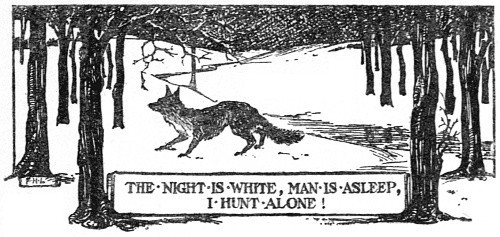
A dark and wind-swept night had fallen over the countryside when Reynard left the steep slope above the keeper's cottage, and stole through gorse and brambles towards the outskirts of the covert, where a narrow dingle, intersected by a noisy rill and thickly matted with brown bracken, divided the furze from some neighbouring pine-woods.
For months nothing had occurred to disturb the peace of his woodland home. Once, about a year ago, he had fled for his life before the hounds; and again, during the last autumn, while lying hidden in the ditch of the root-crop field above the pines, he had been surprised by two sheep-dogs that nipped him sorely before he could make good his escape. But at no other time had he been in evident peril, and so, though naturally cunning and suspicious, he had grown bolder, and better acquainted with the neighbourhood of cottage and farmstead than were certain members of his family living on the opposite side of the valley, among thickets hunted regularly, where guns and spaniels might be heard from early morning till close of day.
Here and there, as the fox crept stealthily among the blackthorns and the gorse-bushes, he stopped for a moment on the scent of a rabbit; but the night was not such as to induce Bunny to remain outside her cosy burrow in the bank. He examined each “creep” in the tangled clumps along his way, and sometimes, resting on his haunches, sniffed the air and listened intently for any sign to indicate the presence of a feeding coney; but even the strongest taint was “stale,” and no sound could be detected that might betray the whereabouts of any creature feeding in the grass. Disappointed, the fox turned towards the uplands and crossed the hedgerow into the nearest stubble. Louping leisurely along, he surprised and killed a sleeping lark. Further on he crossed the scent of a hare, but Puss was doubtless some distance away, feeding in a quiet corner of the root-crop field. Reynard now instinctively made for the farmyard among the pines, trusting meanwhile that luck would befriend him. Across the gap, by the side of the hedgerow, and through an open gateway, he went, seeking spoil everywhere, but finding none. With all his senses alert, he climbed the low wall around the yard, peeped into the empty cart-house, and stealthily approached an open shed. There, unluckily, the dogs were sleeping on a load of hay in the furthest corner. Careful not to arouse his foes, the fox retreated, and, passing the pond at the bottom of the yard, moved silently towards another shed, in which, as he knew from a former visit, the poultry roosted. Though the door was shut, an opening for the use of the fowls seemed to afford the possibility of success. With difficulty Reynard managed to squeeze himself in, only, however, to no purpose. Just beyond the door lay a loose coil of wire, brought home by the labourers after fencing and thrown here out of the way. The fox, fearing a trap, reluctantly abandoned his project, returned to the bank by the pond, and crept down the lane to a spot where the ducks were housed in a neat shelter built in the wall. But here he found everything securely fastened. At this moment a door of the farmstead creaked loudly, the light of a lantern flooded the yard, and the baffled marauder sprang over the wall and trotted across the field towards the wood.
His pace soon slackened when he found himself free from pursuit; and before he reached the end of the meadow he had regained all his cool audacity and was busily planning a visit to the cottage at the foot of the dingle. Hardly had his thoughts turned once more to hunting when fortune favoured him. A hen from the farmyard had laid her eggs in the hedgerow bordering the wood, and was brooding over them in proud anticipation of one day leading home a healthy family, thus causing an agreeable surprise to the farmer's wife. The fox almost brushed against her as he sprang over the hedge, and she paid to the utmost the penalty of indiscretion.
After feasting royally on the eggs, the fox took up the dead bird, and moved slowly away through the trees towards his home. Re-entering the covert, he was met by a prowling vixen that, in company with her four young cubs, inhabited an “earth” not many yards away. Reckless through hunger and maddened by the scent of blood, she attacked him savagely, bullied him out of the possession of the dead fowl, and bore her prize away in triumph to her den. The fox endured his ill-treatment with the submission of a Stoic—he happened to be the pugnacious vixen's mate, and the sire of her family. Soon recovering from the chastisement, he set off, and skirted the covert as far as the cottage garden. Finding the gate of the hen-coop closed, he sprang on the water-butt, climbed to the roof of the shed, and tried to enter the coop from above; but there, as at the farm, he feared a trap, and dared not creep beneath the loose wire netting overhanging the shed. As he jumped from the coop to the wall of the stye, he caught sight of several rats scampering to their holes. Lying flat on the wall, he awaited patiently their re-appearance. At last one of them ventured out beneath the door of the cot, and was instantly killed. But, much to his chagrin, Reynard found the carcass a decidedly doubtful tit-bit, and so, having conveyed it gingerly to the margin of the covert, he scratched a shallow hole among the rotting leaves, and buried his prey, that, perhaps, its flavour might improve with keeping. Afterwards, till the sky lightened almost imperceptibly, and a steel-blue bar, low down beneath the clouds, first signalled the coming of day, he lay motionless among the undergrowth near a warren in the dingle. Then an unsuspecting rabbit hopped out into the grass, and Reynard, his watch rewarded, disappeared with his spoil into the wilderness of the gorse.
Dawn was breaking over the hills. Blue smoke curled up into the sky from the lodge cottage at the foot of the tree-clad slope. The door of the cottage stood wide open, and the scent of the wood-fire hung on the chill, damp air filling the narrow lane. A blackbird flew into the apple-tree overlooking the thatch, shook the moisture from his wings, and cleaned his bright orange bill on a bough. Then his full, reed-like music floated over the fields. The skylarks soared above the upland pastures, and a shower of song descended to the valley out of the pearl-blue haze just lifting in a cloud from the hill-top. Presently the blackbird flew from the apple-tree to feed beside the hedge, and the larks dropped from the mist into the grass. But for the crackle of the cottage fire as the keeper busied himself with the preparation of his morning meal, and the rustle of a withered leaf as the blackbird moved to and fro in the ditch, not a sound disturbed the silence of the dawn. Soon the haze lifted, leaving the dew thick on the grass by the ditch, and on the moss and the ivy in the hedgerow bank. The larks soared once more into the sky; a robin sang wistfully in the ash; a brown wren, with many a flick of her tiny wings and many a merry curtsy, hopped in and out among the trees, trilling loudly a gleeful carol. The tits flew hither and thither, twittering to each other as they flew. The hedge-sparrows' metallic notes sounded clear amid all the varied music, as the birds, moving among the hazels and gently flirting their wings, pursued their coy mates from bough to bough. Through the raised curtain of the mist the sun—a white globe hardly too brilliant to be boldly looked at—illumined the dewy fields with its faint beams, till the cloud-streaked sky became a clear expanse, and the blue and brown countryside glowed with the splendour of a perfect morning. The wind changed and freshened, so that the call of a farm labourer to his team and the constant voice of the river were distinctly heard in the level valley below the wood.
As the morning advanced, signs of unusual stir and bustle were apparent in the neighbourhood of the lodge. Messengers came and went between the cottage and the mansion at the bend of the river, or between the mansion and the distant village. The keeper appeared at his door, and, after satisfying himself that the lane seemed clean and well-kept, walked off briskly in the direction of the “big house.” Scarlet-coated horsemen, and high-born maids and matrons, with all the medley of the Hunt in their train, cantered along the winding road—a mirthful, laughter-loving company. There were the General, stout and inelegant, wont to take his fences carefully, who changed his weight-carrying mount thrice during the day, and liked a gateway better than a thorny hedge, and for the last fifteen years had never been in at the death; and his wife, the leader of fashion, but not yet the leader of the Hunt; the Major, an old shekarry from India, who still could ride as straight and fast as any man in the west; and his niece, the belle of the countryside, whose mettlesome hunter occasionally showed a sudden fondness for taking the bit between his teeth, and carrying his mistress, with reckless abandon, over furrow and five-barred gate and through the thickest hedgerow—anywhere, so long as he had breath and the music of the hounds allured him onward in his impetuous career. The sun glanced between the trees as they passed the cottage door. Then came the Magistrate's Clerk, faultlessly attired, with florid face and glittering eyeglass, who, in an ambitious youth, finding his name too suggestive of plebeian blood, changed a vowel in it, and thereby gave an aristocratic flavour to the title of his partnership, and who acquired, with this new dignity, the taste for a monocle, a horse, and a good cigar. Following were the members of the medley—the big butcher on his sturdy pony, the “dealer” on his black, raw-boned half-bred, the publican on his stolid old mare, farmers, drovers, after-riders, on cropped and uncropped mounts more accustomed to the slow drudgery of labour than to the rollicking, hard-going hunt; and after them the crowd on foot—village children, farm labourers, and apprentices from forge and counter. Riding side by side, and earnestly conversing, were the “vet,” whose horse at the last hunt bolted and left him clinging to a bough, and the shopkeeper, whose grave attire and sober mien seemed strangely out of keeping with the bright, hilarious throng. These were soon met by the main party from the meet, and hounds and hunters sped away in the direction of the hillside covert, while the onlookers adjourned to the uplands, whence an almost uninterrupted view of the valleys for miles around might be enjoyed, and the movements of the fox and his enemies followed more closely than from the hollows beneath the woods.
Reynard, abundantly satisfied with his supper of eggs and early breakfast of rabbit, was lying asleep in a tuft of grass at the top of the thicket when the huntsman passed down the dingle after the meet. Awakened by the noise that reached him from below, he arose, stretched his limbs, and listened anxiously—the clatter of hoofs seemed to fill the valley. Suddenly, from the outskirts of the wood, came the deep, sonorous note of a hound, followed by the sharp rebuke of the whipper-in; Jollity, the keen-nosed puppy, was “rioting” on the cold scent near the stream. Peering between the bushes, the fox could as yet see nothing moving in the covert, but a few minutes afterwards his sharp eye caught a glimpse of a hound leaping over the bank above the gorse, followed by another, and another, and yet another, till the place seemed alive with his foes.
Whither should he flee? The dingle was occupied; men and horses were everywhere in the lane; and the hounds were closing in above the gorse. The far side of the covert offered the only chance of escape, and thither he must hie, else the hounds, now pouring down the slope, would cut off his retreat. Quickly he threaded his way through the gorse, by paths familiar only to himself and the rabbits, till he reached the bank by the willows; but, even while he ran, the full chorus of the hounds echoed from hillside to hillside, as, having “struck the line,” they tore madly in pursuit. He reached the edge of the covert at a point furthest from his foes—then, as he crossed the meadow, a single red-coated horseman, standing sentinel far up the hillside, gave the “view-halloo,” and over the brow of the slope streamed the main body of the Hunt.
It was at once evident to Reynard that by skirting the margin of the covert he could not for the present escape, so he headed down-wind towards the opposite hill, hoping to find refuge in a well-known “earth” amid the thickets. To his surprise he found the entrance “stopped” with clods and prickly branches of gorse, and had perforce to continue his flight. Having well out-distanced his pursuers, he stayed to rest for a while near the stream that trickled by the hedgerow; then, with the horrid music of the hounds again in his ears, he turned, by a long backward cast, in the direction of his home.
But he was wholly unable to shake off his pursuers. For four long hours he was hustled from covert to covert, and hillside to hillside, finding no respite, no mercy, no sanctuary. Breathless, mud-stained, footsore, and sick with fright, his draggling “brush” and lolling tongue betraying his distress, he sought at last the place he had long avoided, and, entering the mouth of the den where the vixen and her cubs were hiding, lay there, almost utterly exhausted. Some minutes elapsed, during which no sound but that of his laboured breathing, and of the tiny sucklings busy by the side of the dam, disturbed the stillness.
Suddenly, a deep-voiced hound broke through the bushes and bayed loudly before the entrance. His fellow joined him, and their foreboding clamour reverberated in the chamber. Terrified, the fox crawled slowly into the recess of the den. Presently a shaggy terrier came down the tunnel, and bit him sorely on the flank. He scarcely had the courage to turn on the aggressor; but the enraged vixen, thrusting her mate aside, quickly routed the daring intruder, and followed his retreat to the very mouth of the “earth,” where she turned back, threatened by the great hounds that stood without. But even the reckless courage of maternity was unavailing. Soon the noise of blows and of falling earth was heard, as the passage was gradually opened by brawny farm labourers, working with spade and pick, and assisted in their task by the eager huntsman, who ever and anon thrust a long bramble-spray into the tunnel and thus ascertained the direction of its devious course.
At last the tip of the fox's “brush” was seen amid the soil and pebbles that had fallen into the chamber. The huntsman had cut two stout hazel rods; these he now thrust into the hollow, one along either flank of the fox; then, grasping their ends firmly about the exposed tail, he drew poor Reynard from his hiding place, and thrust him, defiant to the last, and with his teeth close-locked on one of the hazel rods, into an old sack requisitioned at the nearest farm. The vixen met a similar fate, while the sleek, furry little cubs, treated with the utmost gentleness, were wrapped together in the Master's handkerchief and given to the care of an attendant.
Reynard's life was nearing its close. In the meadow behind the keeper's cottage the hounds were summoned by the huntsman's horn, and the bag was opened. The scene that followed marred, for some of us at least, the beauty of the bright March morning. The vixen and her cubs were carried away, and found a new home in an artificial “earth” prepared for their reception near a distant mansion.
II.
A NEW HOME.
When the vixen recovered from the excitement and distress consequent on her capture, she found herself in a commodious, well ventilated chamber, circular in shape and slightly above the level of two low and narrow passages leading into the covert. The sack had been opened at the entrance of one of these passages, and the vixen had crawled through the darkness till, finding further retreat impossible, she had lain down, with wildly beating heart, on the floor of her hiding place.
Her senses seemed to have forsaken her. Had she dreamed? Often, during the warm, quiet days of a bygone summer, while lying curled in a cosy litter of dry grass-bents—which she had neatly arranged by turning round and round, and with her sensitive black muzzle pressing or lifting into shape each refractory twig—she had dreamed of mouse-hunting and rabbit-catching; her body had moved, her limbs twitched, her ears pricked forward, and her nostrils quivered as the delightful incidents of past expeditions were recalled. And when, with a start, she had awakened, as some venturesome rabbit frisked by her lair, or a nervous blackbird, startled by her movements, made the woodlands ring with news of his discovery, she had retained for a moment the impressions of her vivid dreams. But never in her sleep had she been haunted by such a bewildering sense of mingled dread and anger, such an awful apprehension of the presence of men and hounds, as that which had recently possessed her. Now, however, all was mysteriously tranquil; the full-toned clamour of the hounds and the sharp, snarling bark of the terriers had ceased; no longer was she confined and jostled in the stuffy, evil-smelling sack that yielded to, and yet restrained, her every frantic effort to regain liberty. Her heart still beat violently, as though at any moment it might break; and she crept back towards the entrance, where she might breathe the free, fresh air.
Suddenly she realised, to the full, that the day's bitter experiences were not a dream—the scent of the human hand remained on her brush, her fur was damp and matted with meal-dust, and, alas! her little ones were missing from her side. She was furious now; at all risks she would venture forth on the long, straight journey back towards home; her helpless cubs might still be somewhere under the bushes—perchance in sore need of warmth and food, and whining for their dam.
With every mothering instinct quickened, the vixen crept down the slanting passages in the direction of a faint moonlight glimmer beyond. Reaching the end of the tunnel, she, in her impetuosity, thrust her muzzle into a mass of prickles—the “earth” had been stopped with a branch of gorse. Baffled for the time, she returned to the central chamber; then cautiously, for her eyes and nostrils were smarting with pain, she tried the other outlet, but here, too, a gorse-bush baulked her exit. Now, however, a faint, familiar scent seemed to fill the passage, some tiny creatures moved and whimpered, and, with almost savage joy, the vixen discovered her cubs, alive and unharmed, huddled together near the furze. Quickly she carried them, one by one, into the chamber; then, lying beside the little creatures, which, though blind and helpless, eagerly recognised the presence of their mother, she gathered them between her limbs, covered them with her soft, warm brush, and, in a language used only amid the woodlands, soothed and comforted them, while they nestled once more beneath her sheltering care. When she had fed them and licked them clean from every taint of human touch, and when she had shaken herself free from dust and removed from her brush the man-scent left by the huntsman's right hand while “drawing” her, she became more collected in her mind and more contented with her strange, new situation.
Leaving her cubs asleep, she moved along the passage, determined, if possible, to explore the thickets in hope of finding a young rabbit or a few field-voles wherewith to satisfy her increasing hunger. The entrance was still blocked with furze, but just in the spot where she had found her cubs a couple of dead rabbits lay, and from one of these, though after much misgiving, she made a hearty meal. She endeavoured, but vainly, to dig a shallow trench in which to hide the rest of her provisions; the floor of the artificial “earth” was tiled, and only lightly covered with soil. Her efforts to scratch out a tunnel around the furze-bush proved alike unavailing, so she returned to her cubs, lay down between them and the narrow opening from the chamber, and slept.
That night and the following day were spent in drowsy imprisonment, till, towards the afternoon, the vixen began to feel the pangs of thirst and made fresh efforts to escape. As she was endeavouring to dislodge the tile nearest the furze, she heard the tramp of heavy feet and the sound of human voices.
“They be nice cubs,” said the “whip” to the huntsman; “as nice a little lot as ever I clapped eyes on. If only they can give us such a doing as the old vixen gave us twice last December, they'll pass muster. Them Gwyddyl Valley foxes be always reg'lar fliers. Their meat ain't got too easy-like; that's why, maybe, they're always in working order. Any road, their flags o' distress (tongues) don't flop over their grinders without the hounds trim 'em hard on a straight, burning scent.” “Well, we'll give 'em a good start, whatever happens,” replied the huntsman; “here's two more bunnies for the larder. If the old girl shifts her quarters, find out her new “earth,” and feed her well. I shouldn't like to be near the guv'nor if the young uns turn out mangy when we hustle 'em about a bit in the autumn.”
The voices ceased, the furze-bushes were removed from the tunnel entrances, a cold, steady current of air filled the chamber and the passages, and the vixen knew that a way had been made for her escape. She was not, however, so foolhardy as to venture forth while the scent of her foes remained strong in the thicket; she lingered, in spite of extreme thirst, till the shadows of evening deepened perceptibly in her underground abode.
When the vixen stole out into the grass, the pale moon was brightening in the southern sky, and a solitary star glimmered faintly above the tree-tops. A thrush sang his vesper from the bare branch of an oak near by, and a blackbird, startled by the sight of a strange form squatting beside the brambles, sounded his shrill alarm and dipped across the clearing towards a clump of blackthorn bushes. As soon as she heard the blackbird's warning, the vixen vanished; but, presently reappearing, she trotted across the open space and sat beneath the thorns. For some minutes she remained motionless in the dark patch of shadow, listening intently; then, passing slowly down a narrow path, she reached a trickling streamlet that fell with constant music from stone to stone between luxuriant masses of moss and lichen; and there, at a gravelly pool among the boulders, she cautiously stooped to drink. With exceeding care, she now proceeded to make a thorough inspection of the covert. The night was so calm and bright that the rabbits were feeding everywhere on the margin of the thickets, but the vixen passed them by with nothing but a casual glance; her mind, for the present, was not concerned with hunting. After skirting the covert, she turned homewards by a pathway through the trees.
At the end of the path she paused, with head bent low and hackles ruffled along the spine—the scent of another vixen lay fresh on the ground. The peculiar taint told her a complete story. The strange vixen was soon to become a mother, and probably, in anticipation of the event, inhabited an “earth” close by. Casting about like an experienced hound, she picked up the trail, and followed it into a great tangle of heather, brambles, and fern, where the scent led, by many a devious turn, to the spreading roots of a beech, beneath which a disused rabbit warren had been prepared for the little strangers presently to be brought into the world. The dwelling place was empty.
Retracing her steps as far as the spot where first she had struck the trail, then turning sharply towards the clearing, the crafty creature hastened back to the “earth,” determined to remove her cubs without delay to the newly discovered abode. One by one she bore her offspring thither, holding them gently by the loose skin about their necks, and housed them all before the dispossessed tenant returned from a slow and wearisome night's hunting. The evicted vixen, seeking to enter her home, speedily recognised that in her distressed condition she was no match for her savage, active enemy, and so, reluctantly retiring, took up her quarters in the artificial “earth.”
Henceforth, through all the careless hours of infancy, till summer ended and the nights gradually lengthened towards the time of the Hunter's Moon, the stillness of the woodlands was never broken by the ominous note of the horn, or by the dread, fascinating music of the hounds in full cry. Three of the cubs grew stout and strong, but the fourth was a weakling—whether from injury at the hands of the huntsman or from some natural ailment was not to be determined. He died, and mysteriously disappeared, on the very day when the rest of the cubs first opened their eyes in the dim chamber among the roots of the beech.
Vulp was the only male member of the happy woodland family. His indulgent sisters tolerated his bouncing, familiar manners as if they were born to be his playthings—he was so serious and yet so droll, so stupidly self-assertive and yet so irresistibly affectionate! He seemed to take his pleasures sadly, wearing, if such be possible to a fox, an air of melancholy disdain; and yet his beady eyes were ever on the lookout for mischief, and for the chance of a helter-skelter romp with his sisters round and round the chamber, or to the entrance of the “earth,” where the sprouts of the green grass and the flowers of the golden celandine sparkled as the sunlight of the fresh spring morning flickered between the trees.
As yet, Vulp was unacquainted with the wide, free world. It seemed very wonderful and awe-inspiring, as he sat by the mouth of the tunnel in the shadow of an arching spray of polypody and, for sheer lack of something better to do, half lifted himself on his hind-legs to rub his lips against the edge of a fern, or to peep, with a feeling that his whereabouts were a secret, between the drooping fronds. His mother restrained his rashness; once, when he actually thrust his head beyond the ferns, she with a stern admonition warned him of his mistake; and he promptly withdrew to her side, frightened at his own boldness, but grunting in well assumed defiance of the imagined danger from which he had fled.
This, in fact, was the first lesson learned—that a certain sign from the vixen meant “No,” and that disobedience was afterwards punishable according to the unwritten laws of woodland life. Another sign that he learned to obey meant “Come.” It was a low, deep note, gentle and persuasive; and directly Vulp heard it he would hasten to his mother to be not only fed but also cleansed from every particle of dirt. Such toilet operations were not always welcome to the youngsters, and were sometimes vigorously resented. But the vixen had a convincing method of dealing with any refractory member of her family; she would hold the cub firmly between her fore-feet while she continued her treatment, or administered slight, well-judged chastisement by nipping her wayward offspring in some tender spot, where, however, little harm could be the result.
The cubs were ten days old when they opened their eyes, but more than three weeks passed before they were allowed beyond the threshold of their home. Then, one starlight night, their mother, having returned from hunting, awoke them, and, withholding their usual nourishment, gave the signal “Come.” The obedient little family followed her along the dark passage, and ventured, close at her heels, into the grass-patch in the middle of the briar-brake. Vulp was slightly more timid than his sisters were; even at that early age he showed signs of independence and distrust. While the other cubs played “follow-my-leader” with the dam, he hung back, hesitating and afraid. Even an unusual show of affection by his mother failed to reassure him. A rabbit dodged quickly across a path, and immediately he stood rigid with fright. Hardly had he recovered before an owl flew slowly overhead. Enough! He paused, motionless, till the awful presence had disappeared; then darted, with astonishing speed, straight towards the “earth,” and vanished, with a ridiculously feeble “yap” of make-believe bravado, into the darkness of the den. Confidence, however, came and increased as the days and the nights went by, till, at the close of a week's experiences, Vulp was as bold in danger as either of his playmates. He learned to trust his mother implicitly, and, in her absence, became the guardian of the family when some fancied alarm brought fear. He was always last in learning his lessons; but, as if to make amends, he always profited most by the teaching.
Happy, indeed, were those hours of innocence—filled with sleep, and love, and play. Till Vulp was six weeks old, he was wholly unconscious of that ravenous hunger for flesh which was fated to make him the scourge of the woodlands. Nevertheless, his instincts were slowly developing, and so, when on a second occasion the old buck rabbit that had frightened him in the thicket bolted before his eyes across the path, the little fox bristled with rage and, but for his mother's presence, would doubtless have tried to pursue the exasperating coney. Invariably, when the night was fine, the cubs gambolled about the vixen on the close-cropped sward beyond the den, climbing over her body, pinching her ears, growling and grunting, tugging at each other's brushes, and in general behaving just as healthy, happy fox-cubs might be expected to behave; while the patient, careful mother looked on approvingly—save when, uniting in one strong effort, they endeavoured to disjoint her tail by pulling it over her back—and smiled, as only a fox can smile, with eyes asquint and a single out-turned fang showing white beside the half-closed lip.
A great event occurred when the mother first brought home her prey that she might educate her youngsters in the matter of appetite and prepare them for an independent existence. The victim was an almost full-grown rabbit. Laying it down close to the entrance of the “earth,” the vixen called her cubs, and instantly they rushed from the den, tumbling over each other in their haste, till they gained the spot where she was waiting. At that moment, however, they caught sight of the strange grey object in the grass, and, leaping back, bolted round to their mother's side. Then, feeling safe under her care, they cautiously advanced in a row to sniff the rabbit, and wondered, yet instinctively guessed, at the meaning of the situation. The vixen growled, and, picking up her prey, carried it to the bramble-clump. The cubs followed, making all sorts of curious noises in mimicking their dam, and evincing the utmost inquisitiveness as to the reason of her unexpected conduct. Presently, having succeeded in arousing their inborn passion for flesh, the vixen resorted to a neighbouring mound, and left her offspring in possession of the dead animal, on which they immediately pounced, tooth and nail. How terribly in earnest they became, how bold and reckless in their vain attempt to demolish the subject of their wrath! Vulp fastened his needle-like teeth in the throat, and each of his sisters gripped a leg, while together they jerked, strained, scolded, and threatened, till the mother, fearing lest the commotion would betray their whereabouts to some lurking foe, rated her noisy progeny and in anger drove them away. But as soon as she had gone back to her seat among the grass-bents, the youngsters returned to their work. Anyhow, anywhere, they hurled themselves on the dead creature, sometimes biting each other for sheer lack of knowing exactly what else they should bite, and sometimes simply for the excitement of a family squabble.
At last, their unwonted exertions began to tire them; then the careful vixen, desirous of bringing the lesson to its close, “broke up” her prey and divided it among her hungry children. They fed daintily, choosing from each portion no more than a morsel, and soon afterwards, exhausted by excitement and fatigue, and forgetful of their differences, were fast asleep, huddled together as usual in the roomy recess of the den. For a while the vixen remained to satisfy her hunger; then, having buried a few tit-bits of her provender, she also retired to rest; and silence brooded over the woodlands till the break of day set every nesting bird atune.
The vixen proved to be an untiring teacher, and the education of the cubs occupied a part, at least, of every night. The young foxes were growing rapidly, and accompanied their dam in her wanderings about the thickets. She never went far afield, food being easily procured at that time of year, particularly as in a certain spot additional supplies for the larder were frequently forthcoming because of the vigilance of the huntsman, whose one desire was to fit the cubs to match his hounds in the first “runs” of the coming season.