
THE CUB AND THE POLECAT.
The young fox's education, varied and thorough, steadily proceeded. Though the vixen-cubs were slightly quicker to learn, they were more excitable, and consequently did not benefit fully by each lesson. Vulp soon began to hunt for his own sport and profit. In the meadow above the wood he would sit motionless, his eyes fixed on the ground, till the voles came from their burrows to play beneath the grass-bents; then, with a quick rush, he would secure a victim directly its presence was betrayed by a waving stalk. With the same patience he would watch near a rabbit warren, till one of the inhabitants, hopping out to the mound before her door, gave him the sure chance of a kill. But in the wheat-fields on the slope his methods were altogether different. To capture partridges required unusual cunning and skill, and such importance did the vixen attach to this branch of her field-craft, that, before initiating her youngsters into the sport of hunting these birds at night, she instructed them diligently in the methods of following by scent, training them how to pursue the winding trail left by the larks that fed at evening near their sleeping places, or by the corncrakes that wandered babbling through the green wheat. Vulp's first attempt to capture a partridge chick resulted in failure. The vixen-cubs “fouled” the line he had patiently picked out in the ditch around the cornfield, and, “casting” haphazard through the herbage, alarmed the sleeping birds, and sent them away to a secure hiding place in the clover. But his second attempt was crowned with success, and he proudly carried his prey into a sequestered nook amid the gorse, where he enjoyed a quiet meal.
The cub was fully six months old before he knew the precise difference between stale and fresh scent, or between the scent of one creature and that of another, and how to hunt accordingly; and several years, with many dangers and hair-breadth escapes, were destined to pass before he became expert in avoiding or baffling the numerous enemies—chiefly dogs, and men, and traps—that threatened his life. And yet, during the first few months of his existence, he gained sufficient knowledge for the needs of the moment; and when August drew on towards the close of the summer, and he was three parts grown, he had so extended his nightly rambles that the “lay of the land” was familiar for miles around the covert. His outdoor existence—for now he was wont to sleep in a lair among the gorse and the bracken, instead of in the stuffy “earth”—gave him strength in abundant measure, while his scrupulously clean habits, the care with which he removed even the slightest trace of a burr from his sleek, brown coat, and the plentiful supplies of fresh food which he was able to obtain, naturally preserved him from mange and similar ailments to which carnivorous animals are always prone. For the present, indeed, life meant nothing more to him than the sheer enjoyment of vigorous health, at home by day amid the grateful shadows of the bushes and the trees, or basking in the sun, and abroad at night in the cold, clear air of the dewy uplands.
Just as sportsmen occasionally meet with a run of ill-luck, when for some apparently unaccountable reason they either fail to find game, or fail to kill it, and, to intensify the annoyance, an accident occurs that leaves a bitter memory, so Vulp, during one of his long rambles over the countryside, failed entirely to find sport, and gained a decidedly unpleasant experience. If only his mother had not taught him that in a season of scarcity a weasel might reasonably be considered an article of food! One summer night, as he started on his usual prowl, the covert seemed strangely silent. With the exception of a solitary rabbit that bolted to its burrow when the young fox crossed the clearing, and another that disappeared in similar fashion when nothing more than a slight crackle of a leaf betrayed Vulp's whereabouts near a bramble-clump, every animal had apparently deserted the thickets. So, leaving his accustomed haunts, he crossed the furze-clad dingle, and watched near a large warren in the open. But there, again, not a rabbit could be seen. A field-vole rustled by over the leaves; the cub made a futile effort to capture it, stood for an instant listening to its movements, then thrust his nose into the herbage in another vigorous but vain attempt; the vole, like the rabbits, had sought refuge underground. An owl, that had frightened the cub about five months before when first he ventured outside his home, rose from the hedge, and flew slowly down the valley with a little squealing creature in her talons; she, at any rate, had not hunted in vain.
At last Vulp struck a fresh line of scent which, though particularly strong and uninviting, he took to be that of a weasel. It was mingled with the faint odour of a field-vole that, doubtless, had been pursued and carried away by its persistent enemy. The cub followed the trail, hoping to secure both hunter and victim, but it soon led him to a hole in the hedgerow, and there abruptly ceased. He was about to turn from the spot, when the eyes of the supposed weasel suddenly gleamed at the mouth of the hole, but disappeared when the presence of the cub was recognised. The fox, retreating to a convenient post of observation behind a tuft of grass, settled down to await his opportunity. A few minutes elapsed, and the pursued creature came once more in sight. It appeared like a shadow against the sky, lifted its nose inquiringly, quitted the burrow, sat bolt upright for a moment, then, reassured, proceeded towards the covert on the opposite side of the path. With a single bound, the cub cleared the grass-tuft, reached out at his prey, missed his grip, bowled the animal over, and, turning rapidly, caught it across the loins instead of by the throat. Unfortunately for himself, the fox had made a slight miscalculation. With a scream of rage and pain, the polecat—for such the creature proved to be—turned on the aggressor, and instantly fastened its formidable teeth, like a steel trap, on his muzzle. Vulp had been taught that his fangs, also, were a trap from which there should be no escape, and so he held on firmly, trying meanwhile to shake the life from his victim. He pressed the polecat to the ground, and frantically endeavoured to disengage its hold by thrusting his fore-paws beneath its muzzle; but every effort alike was useless. A scalding, acrid fluid emitted by the polecat caused the lips and one of the eyes of the cub to smart unbearably, and the offensive odour of the fluid grew stronger and stronger, till it became almost suffocating. At last the polecat convulsively trembled as its ribs and spine were crushed in the fox's tightening jaws, its teeth relaxed their hold, and the fight was over.
Sickened by the pungent smell, and with muzzle, lips, and right eye burning horribly from his wounds and the irritant poison, Vulp hastily dropped his prey, and ignominiously bolted from the scene of the encounter. Soon, however, he stopped; the pain in his eye seemed beyond endurance. He tried to rub away the noxious fluid with his paws, but his frantic efforts only increased the irritation by conveying the poison to his other eye and to his wounds. He rolled and sneezed and grunted in torment; he drew his muzzle and cheeks to and fro on the ground, wrestling with the great Earth-Mother for help in direst agony. He could not open his eyes; he stumbled blindly against a tree-trunk, and at last became entangled in the prickly undergrowth. This was Nature's method of succour—she forced her wildling to remain quiet, in helpless exhaustion, till the pain subsided and life could once again be endured. Panting and sick, the cub lay outstretched among the thorns, while the tears flowed from his eyes and the froth hung on his lips. Presently, however, relieved by the copious discharge, he recovered his senses, and, miserably cowed, with head and brush hanging low, returned before dawn to the covert. But the vixen in fury drove the cub away; the scent still clung to him, and rendered him obnoxious even to his mother. In shame he retired to a dense “double” hedge of hawthorn, where he hid throughout the day, till he could summon sufficient courage at dusk to hunt for some dainty morsel wherewith to tempt his sickened appetite. But before taking up his position above the entrance to a rabbit warren, he drank at the brook, dipped his tainted fore-paws in the running water, and, sitting by the margin, removed from his face, as far as possible, the traces left by the previous night's conflict. Repeatedly, at all hours of the day and the night, he licked his paws and with them washed his wounded muzzle and inflamed eyes; but so obstinately did the offensive odour cling to him that a fortnight elapsed before the last vestige of the nuisance disappeared. Meanwhile, he narrowly escaped the mange; and, to add to the discomfort of his wounds, he experienced, now that his mother's aid was lacking, some difficulty in obtaining sufficient fresh food.
At length he recovered, and new, downy hair clothed the wounds and the scratches on his muzzle and throat. Sleek and strong once more, he was welcomed as a penitent prodigal by the relenting vixen, and, having in the period of his solitary wanderings learned much about the habits of the woodland folk, was doubtless able to assist his mother in the future training of the vixen-cubs.
In that luckless fortnight he had acquired a taste for young pheasants, had picked up a few fat pigeon-squabs belonging to the last broods of the year, and had sampled sundry articles of diet—frogs, slugs, snails, a young hedgehog or two, and a squirrel that, overcome with inquisitiveness, descended from the tree-tops to inspect the young fox as he dozed among the bilberries carpeting the forest floor.
Another incident occurred, to which, at the time, the cub attached considerable importance. He had killed what seemed to be a large, heavy rabbit, which, though evidently possessed of a healthy appetite, was almost scentless, and differed in taste from any he had hitherto captured. He was not particularly hungry, so he buried the insipid flesh, and resolved never to destroy another rabbit that did not yield a full, strong scent. Shortly afterwards, when, under the eye of the bright August moon, Vulp and the vixen were hunting in the wheat-fields, he detected a similarly weak scent along the hedgerow, and learned from his wise mother it was that of a doe-hare about to give birth to her young, and therefore hardly worth the trouble of following. The vixen further explained that, except when other food was scarce, creatures occupied, or about to be occupied, with maternal cares—even the lark in the furrow and the willow-warbler in the hole by the brook—were far less palatable than at other times. The cub was also told how, just before he came into the world, the hounds had chased his mother from the thicket, and how old Reveller, the leader of the pack, had headed the reckless puppies, and, rating them for their discourtesy, had led them away to scour another part of the covert.
With the advance of autumn, a great change passed over the countryside. The young fox now found it necessary to choose his paths with care as he wandered through the darkness, lest the rabbits should be warned of his approach by the crisp rustle of his “pads” on the leaves that had fallen in showers on the grass. Hitherto he had associated the presence of man with that of something good for food. An occasional dead rabbit was still to be found near the old “earth,” and, strange to relate, the man-scent leading to the place was never fresher or staler than that of the rabbit. In another spot—a wood-clearing not far from the keeper's lodge—the strong scent of pheasants always seemed to indicate that the birds had ventured thither in numbers to feed, and there, too, the man-scent was strong on the grass. The tracks of innumerable little creatures intersected the clearing in all directions, and, if but for the sport of watching the pheasants, the pigeons, the sparrows, and the voles playing and quarrelling in the undergrowth or partaking of the food provided by the keeper, the fox loved to lurk in the gorse near by. He evinced little real alarm even at the sight of man, though he felt a misgiving and instinctively knew that he must hide or keep at a distance till the curiously shaped monster had gone. The vixen warned him repeatedly; and she herself, after giving the signal “Hide!” would slink away, and wander for miles before returning to her family, if only the measured footfall of a poacher or a farm labourer sounded faintly through the covert.
But soon the young fox learned, in a way not to be misunderstood, that the presence of man meant undoubted danger. One day in October, as he was intently watching the movements of a sportsman in the copse, a big cock pheasant rose with a great clatter from the brambles, a loud report rang through the covert, and a shaggy brown and white spaniel dashed yelping into the bushes. Darting impetuously from his lair, the cub easily out-distanced the dog, and quickly found refuge in an adjoining thicket, where he remained in safety during the rest of the day. Night brought him another adventure. While crossing a pasture towards a wooded belt on the hillside, he discovered, to his surprise, that a man was creeping stealthily towards him through the shadows. A moment later, a great lurcher came bounding over the field. The fox turned, made for the hedgerow, and gained the friendly shelter of the hawthorns just as the dog crashed into the ditch. The frightened creature now ran along the opposite side of the hedge in a straight line towards the wood, and for a second time narrowly escaped the lurcher's teeth; but, by keeping close to the ditch and among the prickly bushes on the top of the hedge-bank, he at last succeeded in baffling his long-legged foe and reached the wood unharmed.
Vulp had thus awakened to the dangers which, during winter and the earliest days of spring, were always to beset him. But the apprehensions caused by his little affair with the spaniel, and even by his narrow escape from the lurcher, were trifling compared with the dread and distress of being driven for hours before the hounds. And so full of perils was the first winter of his life that nothing but a combination of sheer luck with great endurance could then have sufficed to save him from destruction. Quickly, one after the other, the young vixens were missing from the thickets; soon afterwards, three of the cubs belonging to the litter that had been reared in the artificial “earth” disappeared; and an old fox, the sire of that litter, was killed after a long, wearisome chase almost to the cliffs on the distant coast.
One dark and dismal night in December, Vulp, on returning to the home thickets, failed to find his dam. Her trail was fresh; she had evidently escaped the day's hunt; but all his efforts to follow her met with no sort of success. Nature had brought about a separation; in the company of an adult fox, whose scent lay also on the woodland path, the vixen had departed from her haunts. The fox-cub remained, however, among the woodlands where he had learned his earliest lessons, and, for another year, hunted and was hunted—a vagrant bachelor.
IV.
A CRY OF THE NIGHT.
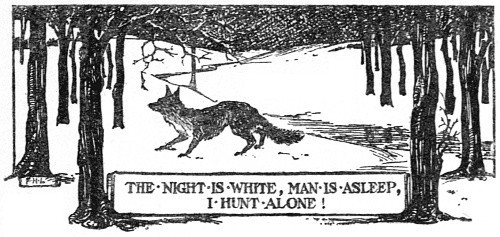
One starlit night, when in early winter the snow lay thick on the ground, Vulp heard the hunting call of a vixen prowling through the pines. A similar call had often reached his ears. Not long after his dam deserted him, the cry had come from a furze-brake on a neighbouring hill-top, and, hastening thither, he had wandered long and wearily, recognising, though with misgiving, his mother's voice. But the exact meaning of the call, not being a matter for his mother's teaching, was unknown to him at the time. Now, however, he was a strong, well fed, fully developed fox, able to hold his own against all rivals, and the cry possessed for him a strange, new significance: “The night is white; man is asleep; I hunt alone!” Almost like a big brown leaf he seemed to drift across the moonlit snow, nearer and nearer to the pines. He paused for a moment to sniff the trail; then, with a joyous “yap” of greeting, he bounded over the hedge, reached the aisles of the wood, and gambolled—again like a big, wind-blown leaf—about the sleek, handsome creature whose call he had heard. The happy pair trotted off to hunt the thickets, till, just before dawn, Vulp, eager to show his skill and training, surprised two young rabbits sitting beneath a snow-laden tangle of briar and gorse, and gallantly shared the spoil with his woodland bride. They feasted long and heartily, afterwards journeying to the banks of a rill, that, like a black ribbon, flowed through the glen; and there, crouching together at the margin, they lapped the water with eager, thirsty tongues.
Presently, happening to glance behind along the line of the trail, Vulp caught sight of another fox, a rival for the vixen's affections, crouching in some bracken scarcely a dozen yards away. With a low grunt of rage, he dashed into the fern, but the watchful stranger simply moved aside, and frisked towards the vixen as she still crouched at the edge of the stream. In response to this insulting defiance, Vulp hurled himself on the intruder, and bowled him over into the snow. The fight was fast and furious; now one gained the advantage, then the other. The grass beneath them became gradually bared of snow by their frantic struggles, and marked here and there by a bunch of fur or a spot of blood. At last the rival fox, his cheek torn badly beneath the eye, showed signs of exhaustion; his breath came in quick, loud gasps; and Vulp, pressing the attack, forced him to flee for life to a thicket on the brow of the slope. There he dwelt and nursed his wounds, till, when the snow melted, the huntsman's “In-hoick, in-hoick, loo-loo-in-hoick!” resounded in the coverts, and he was routed from his lair for a last, half-hearted chase, that ended as Melody pulled him down at a ford of the river below the woods.
During the period of their comradeship—a period of privation for most of Nature's wildlings—Vulp taught the vixen much of the lore he had learned from his mother, while the vixen imparted to him the knowledge she herself had gained when a cub. He taught her how to steal away from the covert along the rough, rarely trodden paths between the farm-labourers' cottages—where the scent lay so badly that the hounds were unable to follow—directly the first faint notes of a horn, or the dull thud of galloping hoofs, or the excited whimper of a “rioting” puppy, indicated the approach of enemies. She taught him to baffle his foes by chasing sheep across the stubbles, and then passing through a line of strong scent where his own trail could not readily be distinguished; also that to cross the river by leaping from stone to stone in the ford was as sure a means of eluding pursuit as to swim the pools and the shallows. He taught her, when hard pressed, to leap suddenly aside from her path, run along the top rail of a fence, return sharply on her line of scent, and follow, with a wide cast, a loop-shaped trail, which, with a tangent through a ploughed field or dry fallow, was usually sufficient to check pursuit till the scent became faint and cold. And gradually each of these woodland rovers grew acquainted with the peculiar whims and habits of the other. Vulp loved to follow stealthily the trail of the rabbit, and then to lie in wait till some imagined cause of alarm sent Bunny back through the “creep” and almost straight into her enemy's open jaws. The vixen preferred to hide in the brambles to leeward of a burrow till an unsuspecting rabbit crept out into the open. Vulp, since his adventure with the polecat, bristled with rage whenever he crossed the track of a weasel, but never dreamed of following; polecat and weasel were the same animal for aught he knew to the contrary. The vixen, however, was not daunted by the unpleasant memory of any such adventure; having chanced to see a weasel in the act of killing a vole, she had recognised a rival and acted accordingly. And so Vulp's repeated warnings to his mate on this matter produced no effect beyond making her slightly more careful than she had hitherto been to obtain a proper grip when she pounced on her savage little quarry. The vixen was exceedingly fond of snails, and would eagerly thrust a fore-paw into the crannies of any old wall or bank where they hibernated; but Vulp much preferred to scratch up the moss in a deserted gravel-pit, and grub in the loosened soil for the drowsy blow-flies and beetles that had chosen the spot for their winter abode. This was the reason for such different tastes: the vixen, when a cub, had often basked in the sun near a snails' favourite resort, and had there acquired a liking for the snails; while the fox, on the other hand, had times out of number amused himself, in the first summer of his life, by leaping and snapping at the flies as they buzzed among the leaves when the mid-day sun was hot, and at the beetles as they boomed along the narrow paths in the thicket near the “earth” when the moon rolled up above the hedge, and the dark, mysterious shadows of intersecting boughs foreshortened on the grass. But Vulp knew well, from an unpleasant experience, the difference between a fly and a wasp.
One day in August, as he lay in his outdoor lair, the brightness and heat of the sunshine were such that his eyes, blinking in the drowsiness of half-awakened slumber, appeared like mere slits of black across streaked orbs of yellow, and gave no indication of the fiery glow that lit the round, distended pupils when he peered at nightfall through the tangled undergrowth. His tongue lolled out, and he panted like a tired hound, but from thirst rather than weariness. The flies annoyed him greatly, now settling on his brush, till with a flick of his paw he drove them away, then, nothing daunted, alighting on his back, his ears, his haunches, till his fur wrinkled and straightened in numberless uneasy movements from the tormenting tickling of the little pests. Presently, with a shrill bizz of rapid wings, a large, yellow-striped fly passed close to his ears. He struck down the tormenting insect with a random flip of his paws, snapped at it to complete the work of destruction, and proceeded leisurely to eat his victim. To his utter surprise, he seemed to have captured a living, angry thorn, which, despite his most violent efforts to tear it away with his paws, stuck in his lip, and produced a smarting, burning sensation that was intolerable. He rolled on the ground and rubbed his muzzle in the grass, but to no purpose. No wonder, then, that subsequently his manner towards an occasional hibernating wasp among the moss-roots in the gravel-pit was deferential in the extreme!
Vulp and his mate soon learned that in rabbit-hunting it was exceedingly profitable to co-operate. Thus, while the vixen “lay up” near a warren, Vulp skirted the copse and chased the conies home towards his waiting spouse. After considerable practice, the trick paid handsomely, and food was seldom lacking. The vixen possessed, perhaps, a slightly more delicate sense of smell than the fox. Frequently she scented a rabbit in a clump of fern or gorse after Vulp had passed it by; suddenly stopping, she would tell her lord of her discovery by signs he readily understood, and then, while he kept outside the tangle, would pounce on the coney in its retreat, or start it helter-skelter into his very jaws. But of all the tricks and the devices she taught him, the chief, undoubtedly, were those concerned with the capture of hens and ducks from a neighbouring farmstead. An adult fox, as a rule, does not pay frequent visits to a farmstead; but Vulp, like his sire, was passionately fond of poultry, and so, in after years, the vixen's instructions caused him to become the dread of every henwife in the district. Undoubtedly he would have been shot had he not been the prize most sought for by the Master of the Hounds, who cared little for the frequent demands made on his purse by the cottagers, so long as the fox that slaughtered the poultry gave abundant sport when running fast and straight before the pack.
The months drifted by, and signs of spring became more and more abundant in the valley. About the beginning of March, Vulp deserted the “earth” prepared by himself and the vixen for their prospective family, and took up his abode among the hazels and the hawthorns in a thick-set hedge bounding the woods.
In preparing the “breeding earth,” Vulp and the vixen observed the utmost care in order that its whereabouts should not be discovered. The chosen site was a shallow depression, scratched in the soil by a fickle-minded rabbit that had ultimately fixed on another spot for her abiding place. This depression was enlarged; a long tunnel was excavated as far as the roots of an oak, and there broadened. Then another long tunnel was hollowed out towards the surface, where it opened in the middle of a briar-brake. The foxes worked systematically, digging away the soil with their fore-paws, loosening an occasional stubborn stone or root with their teeth, and thrusting the rubbish behind them with their powerful hind-legs. As it accumulated, they turned and pushed it towards the mouth of the den, where at last a fair-sized mound was formed. When the burrow had been opened into the thicket, the crafty creatures securely “stopped” the original entrance, so that, when the grass sprouted and the briar sprays lengthened in the woodlands, the “earth” would escape all notice, unless a prying visitor penetrated the thicket and discovered the second opening—then, of course, the only one—leading to the den.
When summer came, and the undergrowth renewed its foliage, and the grass and the corn grew so tall and thick that Vulp could roam unseen through the fields, he left his haunts amid the woodlands at the first peep of dawn, and as long as daylight lasted lay quiet in a snug retreat amid the gorse. There all was silent; no patter of summer rain from leaves far overhead, no rustle of summer wind through laden boughs, prevented him hearing the approach of a soft-footed enemy; no harsh, mocking cry of jay or magpie, bent on betraying his whereabouts, gave him cause for uneasiness and fear. Of all wild creatures in the fields and woods, he detested most the meddlesome jay and magpie. If he but ventured by day to cross an open spot, one of these birds would surely detect and follow him, hopping from branch to branch, or swooping with ungainly flight almost on his head, meanwhile hurling at him a thousand abuses. Unless he quickly regained his refuge in the gorse, the blackbirds and the thrushes would join in the tantalising mockery, till it seemed that the whole countryside was aroused by the cry of “Fox! fox!” After such an adventure, it needed the quiet and solitude of night to restore his peace of mind; and even when he had escaped the din, and lay in his couch among the bleached grass and withered leaves, his ears were continually strained in every direction to catch the least sound of dog or man. When in the winter he ran for life before the hounds, and tried by every artifice to baffle his pursuers, these “clap-cats” of the woods would jeer him on his way. Once, when he ventured into the river, and headed down-stream, thinking that the current would bear his scent below the point where he would land on the opposite bank, the magpie's clatter caused him the utmost fear that his ruse might not succeed. But luckily the hounds and the huntsman were far away. The birds, however, were not the only advertisers of his presence; the squirrel, directly she caught sight of him, would hurry from her seat aloft in fir or beach, to the lowest bough, and thence—though more wary of Vulp than of Brighteye, the water-vole—fling at him the choicest assortment of names her varied vocabulary could supply. Still, for all this irritating abuse Vulp had only himself and his ancestry to blame. The fox loved—as an article of diet—a plump young fledgling that had fallen from its nest, or a tasty squirrel, with flesh daintily flavoured by many a feast of nuts, or beech-mast, or eggs. It was but natural that his sins, and those of his forefathers, should be accounted to him for punishment, and that it should become the custom, in season and out of season, when he was known to be about, for all the woodland folk to hiss and scream, and expostulate and threaten, and to compel his return to hiding with the least possible delay. Thus it happened that he scarcely ventured, during the day, to attack even a young rabbit that frisked near his lair, lest, screaming to its dam for help, it should bring a very bedlam about his ears.
While roaming abroad in the summer night, Vulp gradually became acquainted with all sorts of vermin-traps used by the keepers. Once, treading on a soft spot near a rabbit “creep,” he suddenly felt a slight movement beneath his feet. Springing back, he almost managed to clear the trap; but the sharp steel teeth caught him by a single claw and for a moment held him fast. He wrenched himself loose, and retired for a while to examine his damaged toe-nail. Then, reassured, he again approached the trap, so that he might store up in memory the circumstances of his near escape. He learned his lesson thoroughly, and never afterwards did the smell of iron, or the slightest taint of the trapper's hand, escape him. He even walked around molehills; they reminded him too much of the soft soil about the trap. And, for the same reason, he avoided treading on freshly excavated earth before the holes of a rabbit warren.
The succeeding years of Vulp's eventful life were in many respects similar to the year that began with his courtship of the sleek young vixen in the white wilderness of the winter fields. His fear of men and hounds increased, while his cunning became greater with every passing day. He never slept on a straight trail, but cast about, returned on the line of his scent, and leaped aside, before retiring to sleep in his retreat amid the bracken. Often he heard the wild, ominous cry of the huntsman, “Eloa-in-hoick, hoick—hoick, cover—hoick!” as the hounds dashed into the furze; and the loud “Tally-ho!” as he himself, or, perchance, a less fortunate neighbour, broke into sight before the loud-tongued pack. And more than once, from a safe distance, he heard the awful “Whoop!” that proclaimed the death of one of his kindred.
As the years wore on, Vulp gradually wandered far from his old home. The countryside, for twenty or thirty miles around, was known as intimately to him as a little garden, nestling between sunny fruit-tree walls, is known to the cottager who makes it the object of his daily care. His ears were torn by thorns and fighting; his russet coat was streaked with grey along the spine. At last, when age demanded ease and comparative safety from the long, hard chase over hill and dale, he retired to a rocky fastness on the wild west coast, and there, far above the leaping waves and dashing spray, lived his free, lonely life. And there he died.
It was a bright, hot day in July. Lying among the boulders on the shore, I watched through a field-glass the antics of some birds that wheeled and soared above the cliffs, when, to my surprise, I saw Vulp crawl slowly along a shelf of rock above a deep, dark cavern. His movements, somehow, appeared unnatural. Instead of crouching, with legs bent under him and brush curled gracefully about his “pads,” to bask, his eyelids half-closed, in the sun, he lay on his side. Guided by a companion, who, with waving hand, directed my course as I climbed, I gradually mounted the steep ascent, and peeped over the edge of the rock on which the fox lay. Despite my excessive caution, he was aware of my presence. Slowly and drowsily he lifted his head, uttered a feeble half-grunt, half-whine of alarm, and for a moment bared his teeth defiantly. I remained absolutely still. Then his head fell back, and with a tremor of pain he stretched a stiffened limb. I crawled across the ledge to a rugged path among the cliffs, and descended to the shore. Next day I found him on the rock again, lying in the same position, but dead, while far up in the blue the sea-birds circled and called, and far below, at the edge of the flowing tide, the crested billows leaped and sang.
His “mask” hangs above my study door. It has been placed there—not as a thing of beauty. The hard, set pose devoid of grace, the bent, dried ears once ever on the alert, the glassy, artificial eyes in sockets once tenanted by living balls of fire that glowed in the darkness of the night—all are unreal and expressionless. Yet the “mask” suggests a hundred pictures, and when I turn aside and forget for a moment the unreality of this poor image of death, I wander, led by fancy, among the moonlit woods, where the red mouse rustles past, and the mournful cry of the brown owl floats through the beeches' shadowed aisles. Then I hear a sudden wail, that echoes from hillside to hillside, as the vixen calls to Vulp: “The night is white; man is asleep; I hunt alone!” And the fox, standing at the edge of the clearing, sends back his sharp, glad answer, “I come!”
THE BROWN HARE.
I.
THE UPLAND CORNFIELD.
In midsummer, when the sun rises over the hillside opposite my home its first bright beams glance between the branches of a giant oak in the hedgerow of a cornfield above the wooded slope, and sparkle on my study window. And when at evening the valley is deeply shadowed, the light seems to linger in benediction on the same cornfield, where the great oak-tree, no longer silhouetted darkly against a golden dawn, shines faintly, with a radiance borrowed from the west, against the pearl-blue curtain of the waning day. Except during the early morning or at dusk, the cornfield does not stand out conspicuously in the landscape. The eye is attracted by the striking picture of the woodland wall stretching across the slope from the brink of the river, or by the lower prospect of peaceful meadows and orchards through which the murmuring stream wanders towards the village bridge; but the peaceful uplands beyond rarely greet the vision. For many years I was wont to look from my window only at the woods and the meadows, and somehow I was accustomed to imagine that the line of my vision was bounded by the top of the wood. It was not till more than usual interest had been awakened in me concerning the wild life inhabiting the cornfield, that my eyes were daily turned in the direction of the uplands, where, every evening, the rooks disappear from sight on their way to the tall elms in a neighbouring valley.
Except during harvest, the cornfield is seldom visited by the country folk. It lies away from the main road, and the nearest approach to it is by a grass-grown lane leading from some ruined cottages to a farmstead in the middle of the estate. Many years ago, it was a wilderness of furze and briar, one of the thickest coverts on the countryside, affording safe sanctuary for fox and badger. But gradually it has been reclaimed, till now only a belt of undergrowth, scarcely twenty yards wide, stretches along the horizon between the upper hedgerow and the wheat.
Here, one starry April night, in a snug “form” prepared by the mother hare, a leveret was born. The “form” was hardly more than a depression in the rank grass, to which, for some time past, the doe had been in the habit of resorting at dawn, that she might hide secure through the day, till the dusk brought with it renewed confidence, and tempted her away into the open meadows beyond the cornfield, where the young clover grew green and succulent. A thick gorse-bush, decked with a wealth of yellow bloom, grew by the side of the “form,” and, all around, the matted grass and brambles made a labyrinth, pathless, save for the winding “run” by which the hare approached or left her home.
Unlike the offspring of the rabbit—born blind and naked in an underground nest lined with its parent's fur—the leveret was covered with down, and her eyes were open, from the hour of birth. Nature had fitted her for an existence in the open air. At first she was suckled by day as well as by night, but as she grew older she seldom felt the want of food till dark. While light remained, she squatted motionless by her mother's side in the “form,” protected by the resemblance in colour between her coat and the surrounding herbage, where the browns and greys of last autumn might still be seen among the brambles, with here and there a weather-worn stone or the fresh castings from a field-vole's burrow. In the gloaming, she followed her mother through the “creeps” amid the furze-brake, and sometimes to the edge of the thicket as far as the gap, where she learned to nibble the tastiest leaves in the grass. But soon after nightfall, she was generally alone for some hours while the doe wandered in search of food.
Before daybreak, the doe always returned to suckle her little one. Often in the quiet night, the leveret, feeling lonely or afraid, would call in a low, tremulous voice for help. If the doe was within hearing she immediately responded; but frequently the cry, “leek, leek,” did not reach the roaming hare, and the leveret, crouching in the undergrowth, had to wait till she heard her mother's welcome call. Soon the little home in the thicket was deserted, and the leveret accompanied her mother on her nightly journeys till the fields and the woods for miles around became familiar.
About a month after her birth, the leveret, having grown so rapidly that she was able to take care of herself, parted from her mother, and, crossing the boundary hedge of the estate, took up her quarters on the opposite side of the valley. The doe and her leveret had lived happily in the cornfield and the meadows above the wood. The mother had attended with utmost solicitude to the wants of her offspring, allowing no intruder among her kindred to trespass on her own particular haunts, and careful to select for each day's hiding place some sequestered spot where a human footstep was seldom heard, and the noise of the farmyard sounded faint and remote.
The leveret had learned, partly through a wonderful instinct and partly through her mother's teaching, how to act when there was cause for alarm. Immediately on detecting the presence of an intruder, she lay as still as the stone beside the ant-heap near, trusting that she would not be distinguished from her surroundings. But if flight was absolutely necessary, she sped away towards the nearest gap, and thence over pasture and cornfield, always up-hill if possible, out-distancing any probable pursuer by the marvellous power of her long hind-limbs.
During the late summer and the early autumn, nothing occurred to endanger the leveret's life. The corn grew tall and slowly ripened. Amid its cool shadows the leveret dwelt in solitude. Her “creeps” were out of sight beneath the arching stalks. A gutter for winter drainage, dry and overgrown with grass, formed a tunnel in the hedge-bank between the corn and the root-crop field beyond; and through this gutter the leveret, when at night she grew hungry, could steal into the dense tangle of thistles and nettles fringing the turnips, thence, between the ridges under the wide-spreading leaves, to the narrow pathway dividing the rape from the root-crop, and across the field to a furrow where sweet red carrots, topped with dew-sprinkled plumes, tempted her dainty appetite.
When the calm night was illumined, but not too brightly, by the moon and stars, the leveret would venture far away from her retreat to visit a cottage garden where the young lettuces were crisp and tender. Her depredations among the carrots and lettuces were scarcely such as to deserve punishment. She ate only enough of the lettuces to make a slight difference in the number of seeding plants ultimately devoured by the cottager's pig, or thrown to the refuse-heap; and from the great pile of carrots, to be gathered and stored in the peat-mound by the farmstead, the few she destroyed could never by any chance be missed. On all the countryside she was the most inoffensive creature—the harmless gipsy of the animal world, having no fixed abode, her tent-roof being the dome of the sky.
As autumn advanced, the reapers came to the corn. She heard them enter by the gate; and presently, along the broad path cut by the scythe around the field, the great machine clanked and whirred. All day the strange, disturbing noise continued, drawing gradually nearer the spot where the leveret lay. Through the spaces between the stalks she watched the whirling arms swinging over, and the horses plodding leisurely by the edge of the standing wheat. At last, but almost too late, she leaped from her “form” as the cruel teeth cut through the stalks at her side; and, taking the direction of her “creep,” rushed off towards the nearest gap and disappeared over the brow of the hill.
In the middle of the night she wandered back to the wheat-field. The scene before her eyes revealed a startling change. The corn stood in “stooks” on the stubble; no winding paths led here and there through a silent sanctuary, where countless waving, nodding plumes, bent and released by a gentle-flowing wind, had shimmered in the bright radiance of the harvest moon, when, coming home late at night from the marsh across the hill, she had stayed for a while on the mound by the gate, and tiptoe, with black-fringed ears moving restlessly, had listened to some ominous sound in the farmyard. The prickly stubble felt strange to her feet, so, carefully picking her way by the ditch, she crossed to the nearest gate and ambled down the lane. But the change noticed in the wheat-field seemed to have passed over the whole countryside. It was more and more pronounced during the following week, till, in October, the late harvest had all been cleared. The habits of the hare altered with the season. Having at last grown accustomed to the varied conditions of her life, she sometimes frequented the old tracks over the upland, but rarely resorted to the “forms” in which she had lain amid the summer wheat.
October brought her an experience which might have proved disastrous, but which, fortunately, resulted in nothing more than a passing fright. In the stalk of the rye occurs a knot, forming a slight bulge known to the peasantry as the “sweet joint.” Rabbits and hares are extremely fond of this succulent morsel, and, in consequence, the rye-crop, if near a large warren, is in danger of being totally destroyed. Puss one night had wandered far to a field, where, some time before, she had discovered a patch of standing rye. The few remaining stalks were hard and uninviting, but there were some delicious parsnips among the root-crops. At dawn she settled down to hide between the rows of swedes close by, and remained secreted for the day; but towards evening a sportsman came in at the gate, and, with a low word of command and a wave of the arm, “threw off” his brace of red setters to range the field. Working systematically to right and left, the dogs sought eagerly for game. Soon the hare was scented, and while Juno, with stiffened “stern” and uplifted paw, stood almost over her, Random, “backing” his companion, set towards the furrow where Puss, perfectly rigid, and with ears well over her shoulders, crouched low, prepared for instant flight. Step by step the sportsman, with gun in readiness, moved towards Juno, cautioning her against excitement; while Random, sinking on his haunches, awaited patiently the issue of events. Suddenly, convinced that in flight lay her surest chance of escape, the hare leaped from her “seat,” and with the utmost speed, though from the ease of her motions appearing to run slowly, made her way towards the hedgerow. There was a quick rush behind her as she started from the furrow, and then a loud, rasping exclamation from the sportsman, but nothing more; no shot was fired. She owed her life to several circumstances. The dogs were young, and in strict training; their master, knowing the natural fondness of “first season” setters for “chasing fur,” had purposely refrained from killing the hare, and had turned his attention to the behaviour of his dogs. Then, again, he cherished a certain fondness for Puss, believing her to be the most persecuted, as well as the most innocent and interesting, of Nature's wildlings in the wind-swept upland fields.
Henceforward, but for one other incident, the life of the hare was singularly uneventful till the early spring. That incident occurred within a week of her escape from the setters, and once more her luck was due to the humanity of him who had found her among the turnips. The farm-lands frequented by the leveret were a favourite resort of many of her kind, and when moving about in the darkness of the night she often found signs of their presence near the gaps and gateways. The sportsman, knowing well that after harvest the poaching instincts of the peasantry and of the professional village “mouchers” would receive fresh stimulus, determined to forestall his enemies, and render futile some, at least, of their endeavours. So it came about that one night a keeper, assisted by several of the guests at the “big house” in the valley, and having previously made every preparation for the event, placed a net near each gate and before each likely gap within a radius of half a mile from the heart of the estate.
Unless hard pressed, a hare seldom leaves a field except by certain well-known openings in the hedgerow. Unlike the rabbit, she will not readily leap over any obstacle beneath which she can crawl; and whereas the “creep” of a rabbit through a gateway or a hedgerow is well-nigh invariably at right angles to the line of that gateway or hedgerow, the “creep” of a hare tends sideways and is sometimes slightly curved. To net hares successfully it is necessary to know their habits; and the keeper, having served a lifelong apprenticeship in field-craft, was prepared for every emergency. His object at this time was not to kill the hares, but simply to educate them, to warn them thoroughly once for all against the wiles of their worst enemy, the poacher.
As Puss was busily feeding in the dewy clover, she heard the quick, continuous gallop of a dog. This time, however, she had not to deal with Juno, the setter, but with a trained lurcher, borrowed for the occasion from a keeper who had captured the animal during a poaching affray. The leveret, peeping over the grass-tops, saw the dog coming rapidly on. He was over and past her in an instant. As he turned, she started off straight towards an opening where some sheep had partly broken down the hedge. The lurcher closed in, and drove her thither at tremendous speed. She strained every nerve, and, gaining the ditch, blundered blindly through the gap, and fell, helpless and inert, entangled completely within the treacherous folds of the unseen net. Her piteous cries, tremulous, wailing, heart-rending—similar to the cries of a suffering infant—were borne far and wide on the wind. The keeper soon reached the spot, and, placing his hand over her mouth to stop the cries, tenderly extricated the frightened creature from the treacherous meshes and allowed her to go free. For a few seconds, she lay in abject fright, panting and unable to move. Then, hearing the cries of another hare entangled in a bag-net some distance away, she bounded to her feet, and darted off—somewhere, anywhere, so long as she might leave the awful peril behind. Bewildered, but with every instinct assisting her in the desire for life, she ran along by the hedgerow, and, unexpectedly catching sight of a familiar gate, crouched and passed quickly through the “creep” beneath the lowest bar. But here, again, a net was spread; again the hare fell screaming and struggling into the meshes; and again the keeper released her. Exhausted by intense excitement and fear, she crawled into the “trash” in the ditch, and kept in hiding, not daring the risk of another capture. Luckily for Puss, the lurcher had already hunted the field in which she was now secreted, and so the timid creature remained undisturbed beneath the fern. When her wildly throbbing heart had been quieted by rest and solitude, she stole from her hiding place to nibble the clover at the side of the path. Towards dawn, she journeyed to a wide stretch of moorland on the opposite hills, and there made a new “form” on a rough bank that separated a reedy hollow from the undulating wilderness of heather and fern.
The leveret's adventures were destined to effect a considerable change in her habits. She was being roughly taught that to preserve her life she must be ever cautious and vigilant. Though danger threatened her by day and by night, she lived beyond the usual period of a hare's existence, partly because her early education was thorough and severe. Thus taught, she would pause for an instant at every gap and gateway before she passed through, and, if she found a net in her path, would turn aside, creep along by the hedge, and seek an exit at another place.
The perils to which she had been exposed created a feeling of intense restlessness, which harassed her throughout the winter months, and caused her to travel long distances, by the loneliest lanes and fields, to and from the moorland where now she had made her home. She remembered the scent of a human being since her experiences with the keeper, and, her powers of smell being wonderfully acute, was able to detect even the faintest signs which indicated that her dread enemy—man—had crossed her path. One night she smelt the touch of a hand on the grass-bents near her “form,” and found also that the herbage had been moved aside. Though the scent was faint—the intruder having visited the spot soon after the leveret had set out in quest of food—the cautious creature forsook her lair, and spent the day in a sheltered retreat beside a heap of dry and withered leaves near the outskirts of a copse on the slope overlooking the moor.
Gradually she grew big and strong, becoming unusually fat as the autumn advanced, so that she would be able, if required, to withstand the rigour and the waste of a severe winter. Her coat was thick and beautifully soft, for protection against cold and damp. But while she increased in weight, she remained in hard condition because of her long journeys and frequent change of quarters.
It happened, however, that her first winter was helpful to the welfare of animal life in general. The heavy rains, it is true, greatly distressed the leveret. The nights were so dark, and the constant patter of the rain so interfered with even her highly trained powers of hearing, that, while the wet weather lasted, she seldom dared to leave the neighbourhood of her favourite resort, but crouched in the grass at the margin of the copse, and tried to obtain a meal as best she could from the sodden herbage.
Though on certain occasions Puss might have been discovered in hiding on the marsh, yet there, whenever possible, she chose a dry spot for her “seat.” She loved, best of all, the undulating hills far above the river-mists, which, chilled at nightfall by an occasional frost, descended on the fields like crystal dust, and almost choked her if she chanced to pass within these wreathing drifts that brought discomfort and disease to man and beast alike.
But the want of exercise so affected her, that, when again the weather was fine and she ventured from her lair, she found herself unable to cover the usual distance of her nightly rambles. As the first cold glimmer of the dawn appeared in the south-eastern sky, she started back, in alarm at her fatigue, to complete the remaining mile of her journey home. Her weakness soon became apparent. Then, finding herself powerless to proceed, she turned reluctantly aside, and crouched, with Nature's mimicry for her protection, on the brown ploughland where the winter wheat was thrusting up its first green sprouts above the soil. But after a few days she was well and strong again. She suffered far less from the short, sharp frost that bound the countryside with its icy fetters, than from the rains. The frost scarcely interfered with her movements; indeed, it made exercise more than ever necessary. Forced to seek diligently for her food, she found it in a deserted stubble; there, when the sheep lay sleeping in the bright winter moonlight, she would squat beside them, nibbling the turnips scattered over the field as provender for the flock.