
CHAPTER II.
BATTING.
(By the Hon. R. H. Lyttelton.)
Fig. 1.—The champion.
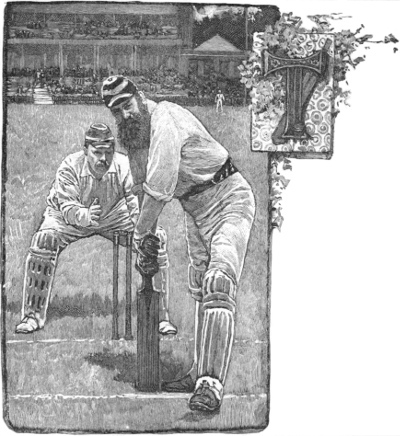
Fig. 1.—The champion.
The great and supreme art of batting constitutes to the large majority of cricketers the most enjoyable part of the game. There are three especially delightful moments in life connected with games, and only those who have experienced all three can realise what these moments are. They are (1) the cut stroke at tennis, when the striker wins chase one and two on the floor; (2) the successful drive at golf, when the globe is despatched on a journey of 180 yards; (3) a crack to square-leg off a half-volley just outside the legs. When once the sensation has been realised by any happy mortal, he is almost entitled to chant in a minor key a ‘Nunc Dimittis,’ to feel that the supreme moment has come, and that he has not lived in vain.
After what has been said in the foregoing chapter we shall here only touch upon the cricket of the past in so far as seems necessary to make this dissertation on batting tolerably complete, and shall then proceed to discuss the principles and science of the art as it now exists.
The shape of the bat in the year 1746—which may be taken as a beginning, for it was in that year that the first score of a match was printed and handed down to posterity, at any rate in Lillywhite’s ‘Scores and Biographies’—resembled a thick crooked stick more than a modern bat.
From the shape of the bat, obviously adapted to meet the ball when moving along the ground, one may infer that the bowlers habitually delivered a style of ball we now call a ‘sneak.’ How long this system of bowling remained in vogue cannot exactly be told. The famous William Beldham, who was born in 1766, and lived for nearly one hundred years, is reported by Nyren to have said that when he was a boy nearly all bowling was fast and along the ground. As long as this was the case it is probable that the bat was nothing but a club, for if the ball never left the ground the operative part of the bat would naturally be at the very bottom, as is usual in clubs. The renowned Tom Walker was the earliest lob bowler; he probably took to the style late in life, or about the year 1800, and several bowlers, notably the great E. H. Budd, raised the arm slightly; but it is believed that the first genuine round-arm bowlers were William Lillywhite and James Broadbridge, both of Sussex, who first bowled the new style in 1827. That year was from this cause a year of revolution in cricket, and the shape of the modern bat dates from that period. As a rule, up to the year 1800 the style of batting was back. William Fennex is supposed to have been the inventor of forward play, and Beldham reports a saying of one Squire Paulett, who was watching Fennex play: ‘You do frighten me there, jumping out of your ground.’ The great batsmen of the early era of cricket were Lord Frederick Beauclerk, Mr. Budd, Beldham, Bentley, Osbaldeston, William Ward, Beagley, William Lambert, Jem Broadbridge, W. Hooker, Saunders, and Searle. The great skill of these players, when opposed to under-hand bowling, was what determined the Sussex players to alter the style of bowling, and, indeed, it is generally the fact that too great abundance of runs raises questions as to the desirability of altering rules.
After the year 1827 the shape of the bat became very like what it is now, but it was much heavier in the blade and thinner in the handle, which seems to indicate that the play was mostly of the forward driving style, and the great exponent of this method of play was the renowned Fuller Pilch. Anyone who has the opportunity of handling a bat of this period will find that its weight renders it inconvenient for cutting, but suitable for forward play. The change from under-hand bowling to round-arm having been effected by slow developments makes it probable that the style of play was generally forward until the under-hand bowling was altogether superseded by round-arm. Some bowlers followed the new order of things by changing from under to round-arm. Round-arm bowling was at first less accurate than under-hand, and consequently all-round hitting greatly developed; and we find Felix, the father of cutting, who began play in 1828, chiefly renowned for this hit. Scoring greatly diminished when round-arm bowling was thoroughly established, and increased again as grounds got better.
Judging from the scores of that day, the best bat in England from 1827 to 1850 was Fuller Pilch, and his scoring would compare favourably with that of nearly all modern players till 1874, with the exception of W. G. Grace. He was a tall man, and used to smother the ball by playing right out forward.
The principle on which his whole play was founded was evidently to get at the pitch and take care of the ball before breaks, bumps, and shooters had time to work their devilries. In order to carry out this method, he used frequently to leave his ground, and consequently the famous Wm. Clarke always found Pilch a harder nut to crack than any of his other contemporaries.
Clarke’s slow balls tolerably well up were met by Pilch, who left his ground and drove him forward with a straight bat. His master appears to have been the great Sam Redgate, who was fast and ripping, and who on one occasion got him out for a pair of spectacles, while, on the other hand, twice in his life he got over 100 runs against Wm. Lillywhite’s bowling, considered in those days to be an extraordinary feat. After Pilch, Joseph Guy, of Nottingham, and E. G. Wenman, of Kent, were considered the best; but several—C. G. Taylor, Mynn, Felix, and Marsden, for example—scored largely, and they all passed through a golden age of bowling, namely, about 1839, when Lillywhite, Redgate, Mynn, Cobbett, and Hillyer all flourished, to say nothing of Sir F. Bathurst, Tom Barker, and others.
From the year 1855, when Fuller Pilch left off play, to the year 1868, when W. G. Grace burst on the world with a lustre that no previous batsman had ever approached, there was, nevertheless, a grand array of batsmen—among professionals, Hayward, Carpenter, Parr, Daft, Caffyn, Mortlock, and Julius Cæsar; and among amateurs, Hankey, F. H. Norman, C. G. Lane, C. G. Lyttelton, Mitchell, Lubbock, Buller, V. E. Walker, and Maitland. These are a few of the great names. They are, however, surrounded by several almost as renowned, such as Stephenson, T. Humphrey, Hearne, Cooper, Burbidge, Griffith, and others; all these, we think, made this era of the game productive of more exciting cricket than has been known since. It may seem odd, but the overpowering genius of W. G. Grace after this time somewhat spoilt the excitement of the game. His side was never beaten. Crowds thronged to see him play, all bowling was alike to him, and the record of Gloucestershire cricket, champion county for some time through his efforts, is the only instance of one man practically making an eleven for several years. The other Gloucestershire players will be the first to acknowledge the truth of this. Gloucestershire rose with a bound into the highest rank among counties when W. G. Grace attained his position amongst batsmen, a head and shoulders above any other cricketer. In his prime Gloucestershire challenged and on one occasion defeated England; when he declined, Gloucestershire declined; in his old age she shows signs of renewing her youth, for which all credit is due to young Townsend, Jessop, Champain, and Board. To return to the period between 1855 and 1868: the greater equality of players made the matches more exciting and established a keener because more evenly balanced rivalry. The grounds were not so true as those of to-day, and the matches were not so numerous; consequently cricketers were not so frequently worn out by the wear and tear of long fielding and days and nights of travel as they are now. The long individual scores having been less in number and at longer intervals, the few great innings were more vividly stamped on the memory, and it is doubtful if even the modern 200 runs per innings will survive as historical facts longer than Hankey’s famous innings of 70 against the Players on Lord’s, Daft’s 118 in North v South on the same ground, and Hayward’s 112 against Gentlemen, also on Lord’s.
The bowling during this period was generally fast or medium, varied by lobs, but of genuine slow round, like that of Peate, Buchanan, Alfred Shaw, and Tyler, there was hardly any in first-class matches. To fast bowling runs come quicker than they do to slow; consequently the game was of more interest to the ordinary spectator, and there was none of that painful slowness, in consequence of the extraordinary accuracy of modern slower bowling, that is so common now, and helps to produce so many drawn matches. Though now, in the year 1897, the average bowling pace is slower than it was in the sixties, it is nevertheless faster than it was in the seventies. The professionals had literally only one genuine slow round-arm bowler in those days—George Bennett, of Kent—and of course this fact accounted largely for the batting style of the period. Wickets being often rough, the most paying length for fast bowling was naturally that length which gave the ground most chance, and prevented the smothering style of play—a little shorter than the blind spot, compelling back play over the crease, instead of forward play. The best batsmen were great masters of this style of play, with which the name of Carpenter is strongly identified. To modern players the sight of Carpenter or Daft dropping down on a dead shooter from a bowler of the pace of George Freeman or Jackson was a wonderful one; but it is rapidly becoming a memory only, for in these days a shooter may be said not to exist. Now, in 1897, a wonderful feature of our great fast bowlers—pre-eminently Richardson—is not that they bowl straighter than Freeman or Jackson, but that they never bowl a ball on the legs or outside the legs. The result is that orthodox leg hitting, and in particular the smite to long-leg with a horizontal bat, and much nearer the ground than a square-leg hit, is never seen. During the entire progress of a match nowadays, between Notts and Lancashire, or Yorkshire and Notts, the unhappy batsman will not get a single ball outside his legs to hit. So great is the accuracy of the bowling, that over after over will go by, and not even a ball on his legs will soothe his careworn and anxious brain. This accurate bowling has caused another change in the way of batting. As no ball is bowled on the leg side at all, so it consequently follows there is no fieldsman on the on side except a forward short-leg and a deep field. The batsman therefore waits till the bowler slightly overtosses a ball—whether pitched outside the off stump or on the wicket he cares not; he sweeps it round to square leg, where no fieldsman stands, and he makes four runs by the hit. In other words, he deliberately ‘pulls’ it. Twenty years ago, on seeing such a hit, the famous Bob Grimston would have shown his emphatic disapproval in a characteristic manner. But the match must be won by runs; to attain this object the ball must be hit where there is no field, and it is useless to waste energy by hitting the ball to every fieldsman on the off side.
W. W. Read, Stoddart, and F. S. Jackson are all masters of this stroke, which revives the drooping attention of the crowd and relieves the monotony of the scorers. To all fast bowling the cut is a hit largely in vogue, and the perfection to which some players arrive with regard to this stroke is a joy to themselves and to the spectators. It is, of course, as will be explained later on, much easier to cut fast bowling than slow, and the heroes of the cut whenever fast bowling is on are, and were, always numerous.
The champion cutter of old times, by universal testimony, was C. G. Lyttelton, whose hits in the direction of point are remembered by spectators to this day. Tom Humphrey, of Surrey, was another great cutter; and there was a player, not of the first rank, who was famous for this hit—namely, E. P. Ash, of the Cambridge University Eleven, 1865 and 1866.
The five champion bats of this era—1855 to 1868—were, in the opinion of the writer, Hayward, Carpenter, Parr, Daft, and R. A. H. Mitchell. The scoring of Hayward and Carpenter between 1860 and 1864 was very large; both excelled on rough wickets, and it is on these wickets that genius exhibits itself.
In all times of cricket, until the appearance of W. G. Grace, there has been a large predominance of skill amongst the professionals as compared with the amateurs. We are talking now of batting; in bowling the difference has been still more to the advantage of the professionals. The Gentlemen won a match now and then, but their inferiority was very great. W. G. Grace altered all this; and from 1868 to 1880 the Gentlemen had a run of success which will probably never be seen again. It was entirely owing to him, though the Players were astonishingly weak in batting from 1870 to 1876; but nothing could stop the crack, and his scoring in the two annual contests was simply miraculous.
We will now attempt to lay before our readers a more detailed exposition of the principles which ought to govern sound batting, and a careful observance of which is found in the method of every sound player. The first consideration is the choice of a bat, and as to this each individual must determine for himself what is the most suitable. It is probable that a strong man will prefer a heavier bat than a batsman of less muscular calibre. In any case the style of play is an important consideration, but the secret of all batting, and especially hitting, is correct timing; this is a quality which cannot be taught, but this is what makes a weak man hit harder than a strong man—the one knows exactly the fraction of a second when all that is muscular, all that he has got in wrist and shoulders, must be applied, the other does not.
At the beginning of this century, when the bowling was fast under-hand, the bat used was of a style suitable for meeting such balls—namely, a heavy blade with great weight at the bottom; for, as already mentioned, the bowling being straight and frequently on the ground, driving was the common stroke, and for this a heavy blade is best adapted. So now, if a player finds that he does not possess a wrist style of play, but a forward driving game, he will probably choose a heavier bat than the wrist-player; for a forward drive is more of a body stroke—that is, the whole muscular strength of the shoulders and back is brought into use, and the ball, being fully met, gives more resistance to the bat than a ball which is cut. This, perhaps, needs a little explanation. Just consider for a moment, and realise the fact that a tolerably fast ball, well up and quite straight, has been delivered. Such a ball is just the ball that ought to be driven. The batsman lunges forward and meets it with very nearly the centre of his bat, just after the ball has landed on the ground, at the time, therefore, when, if there is any spin on it, it is going at its fastest pace. Obviously, therefore, when the pace and weight of the ball are taken into consideration, there is great resistance given to the lunge forward of the bat. The heavier the blade of the bat the better is it able to withstand and resist the contrary motion of the ball. As a rule, players are not equally good both at the forward driving and the wrist-playing games. Some few excel in both, but usually batsmen have preferences. Now let us examine the cut—of course we are now discussing a ball on the off side of the wicket. A wrist-player will cut a ball that the exponent of the driving style would drive, and therefore meet with the full, or nearly full, bat. The cutter does not meet the ball, for the ball has gone past him before he hits it. Take a common long-hop on the off side. The driver meets it with a more or less horizontal bat, and hits it forward between cover-point and mid-off, or cover-point and point, thereby resisting the ball and sending it almost in an opposite direction to its natural course. He hits the ball some time before it arrives on a level with his body, while the cutter, on the other hand, does not hit the ball so soon; in fact, he hits it when it is about a foot in front of the line of the wicket, sometimes almost on a level with the wicket. He then, with his wrist, hits it in the direction of third man. He does not meet the ball at all, but he takes advantage of the natural pace of the ball and, as it were, steers it from the normal course towards long-stop, in the direction of third man. The whole essence of the distinction lies in this fact, that in driving the ball is met directly by the bat; in cutting this is not so; but the ball is, as it were, helped on, only in a different direction. The faster the bowling, the harder, therefore, will be the cut. The reader will at once see from this that the wrist-player will probably prefer a lighter bat than the driving batsman, and a bat that comes up well, as it is called, or is more evenly balanced.
We will now suppose a batsman properly equipped in pads and, at any rate, one glove on the right hand, and with a bat to his taste; our next inquiry must be as to his position at the wicket. He must remember that, after having chosen one position—the most natural and convenient to him—he ought to adopt that position invariably; not alter it from day to day. You never see any material alteration in the position of any great player, and if anyone takes the very necessary trouble to find out the easiest position, he will be a foolish man who varies it, as any change must be for the worse. There is an old engraving, often seen, of a match between Surrey and Kent about the year 1840. Old William Lillywhite is about to bowl, and Fuller Pilch is about to play. The attitude and position of Pilch were taken by the author of ‘The Cricket Field’ as a model; and there is no objection to be raised to the position: it is a fair assumption that it was the natural and most convenient position for Fuller Pilch himself. The author, however, goes on to say that this is substantially the attitude of every good batsman. To this we can only rejoin, that out of the thousands of batsmen who have played cricket, it would be difficult to find two who stand exactly alike. To begin with, some stand with their feet close together, others have them apart; some indeed so far apart that it almost seems as if they were trying to solve the problem of how much length of ground can be covered between the two feet. Some stand with the right foot just on the leg side of a straight line drawn between the leg-stump of the batsman’s wicket and the off stump of the opposite wicket; others stand with the right foot twelve inches or thereabouts from the leg-stump in the direction of short-leg. Players who adopt this position run a risk of being bowled off their legs, one would think; but they ought to know best; we should not, however, advise a beginner to adopt this attitude. W. G. Grace faces the ball, and there is no intervening space between his hands whilst holding the bat and his legs. If you look at the position of Pilch, you will see a considerable interval of distance from the back of his left hand and the right leg. There were three notable batsmen—namely, A. N. Hornby, W. Yardley, and F. E. R. Fryer—who used to throw their left leg right across the wicket so as almost to hide it from the view of the bowler.
Mr. A. J. Webbe stoops very much in his position, while some players stand almost at full height; notably is this the case with W. G. Grace. There are, as far as we know, only three rules which must be observed in taking up a position. The first is (1) stand so that no part of the right foot is in front of the wicket or outside the crease; (2) stand in the attitude most natural and convenient to yourself; (3) do not place the toes of the right foot materially nearer the wicket than the heel. The first rule is essential, for the good player never ought to move his right foot to fast bowling. If, therefore, any part is in front of the wicket, he runs a risk of being leg before wicket when the ball beats the bat; if his foot is outside the crease he is in danger of being stumped; and if the toes of the right foot are materially nearer the wicket than the heel, he will find himself in a very awkward position, unable to get over the ball. Subject to these rules, the batsman takes any position he pleases. The bat should be held firmly with the right hand and loosely or comparatively loosely with the left; neither hand should be tightly clenched. The late Mr. Wm. Ward spoke the truth when he told a sculptor who had made a statue of a batsman at guard that he was no cricketer—the wrists were too rigid and hands too much clenched. It seems that most players lift their bat from the block-hole while the bowler is running prior to delivering the ball, and fig. 2 shows W. G. Grace standing just before the ball leaves the bowler’s hand. His whole position is changed from what it was a few seconds before. His first position before the bowler has begun his run, is given in the sketch at the head of the chapter. The figure here shows him to be standing almost at his full height, his bat suspended in the air, and his weight if anything thrown rather on his right foot. Most players, however, take up a position and stick to it, except that they raise the bat slightly just before the ball leaves the bowler’s hand. Nature is the best guide. Let every player therefore find out the easiest attitude and always adopt it.
We will now consider the manner in which the bat should be held by the hands. This varies in a few trifling particulars with different players: but in very rare instances is there any substantial difference. The muscles ought not to be in a state of rigidity, and whilst the batsman is standing in position waiting for the ball the bat should be held firmly, but not by any means tightly. The batsman cannot depend on any particular ball coming to him; consequently, while the ball is in the air, his mind has to be made up; he has then to set himself for a stroke determined absolutely by the pace, length, and direction of the ball, and there are only a few seconds for him both to make up his mind and make the stroke. There is, no doubt, a scientific, anatomical reason why quickness of hand and muscles is incompatible with rigidity of muscle, but quite practicable when the muscles and sinews are in a natural and easy state of elasticity; but any man will find this out for himself if he begins to play. Hold the bat, then, loosely with the left hand, nearly at the top of the handle, with the back of the hand turned full towards the bowler, the fingers folded round the handle, and the thumb lying easily between the first and second fingers. The right hand is fixed exactly contrary to the left as far as the back and fingers are concerned, for the back is turned away from the bowler and the fingers are turned towards him. The thumb lies across and rests on the top of the first finger, touching the finger about a quarter of an inch from the top on the inside. When any sort of hit or block is made the bat at that instant is held tightly, and both thumbs are slightly shifted so as to lie on and clutch, not the fingers that hold the handle, but the handle itself. Whether the hands are high up on the handle or low down near the blade depends very much on the style of the player. There is no rule on the subject, but we think the old motto, ‘In medio tutissimus ibis,’ is good to observe, and the middle of the handle is, on the whole, the safest. Some players, however—notably Mr. Frank Penn, in his day a tremendous off-hitter and altogether a grand bat—hold the bat with the knuckle of the first finger of the right hand almost touching the top of the blade; and big hitters, rather of the slogging order, as a rule hold the bat higher up, with the left hand almost on the top; in fact, they adopt what may be called the ‘long-handled style.’ In holding the bat, however, follow the precept given before—namely, ascertain the most natural method, and cling to it for your cricketing life.
The actual position at the wicket is the same for both slow bowling and fast, with perhaps this trifling difference, that the batsman ought not to stand so firmly on the right foot to slow as he would to fast. The reason of this will be explained hereafter, when we consider the right method of playing slow bowling. At present we will confine our attention to playing fast bowling, and let us assume that the batsman has taken his natural position with his right toe clear of the wicket and that a fast right-handed bowler is bowling with hand raised above the shoulder and over the wicket. This is the method of bowling most in vogue in these days; in fact, the strict round-arm bowling round the wicket, with a curl from leg, is for some inscrutable reason now comparatively rare. Why this is so nobody can tell, and we believe that some of the present gigantic scoring is partly owing to the absence of this sort of bowling.
However, the popular method will be the first we shall try and instruct the batsman to meet successfully, and we will suppose that the wicket is fast and true. We will begin with laying down one or two rules that must rigorously be observed by every player if he wishes to become a first-rate cricketer. (1) Never move the right foot when playing fast bowling except to cut, or when you want to pull a very short ball. Nobody will ever become a first-rate player if he does not strictly observe this rule. The spot of ground on which the right foot rests is the vantage-point from which every batsman has to judge of the direction of the ball, and if he shifts away from this, all sorts of faults will crop up, chief of which will be an inability to play with a straight or perpendicular bat. He will also, if he moves his right foot towards short-leg—which is the commonest form this vice takes—find that he will drive balls with a crooked bat to the off, when from a proper position he would have hit them on the on side. He will also find himself further removed from the off side, and quite unable, therefore, to play with a straight bat on the off stump. These are a few of the faults that come from not keeping the right foot still. All coaches know that this habit of moving the right leg is the fault most commonly found in young players, and it is most difficult to remove. This arises from the fact that the ball is a hard substance; the beginner naturally dislikes being hit anywhere on the body, and his first and most powerful instinct is therefore to run away. But many instincts are base in their nature, and the young cricketer must realise in this, as in other cases, that the old Adam must be put away and the new man put on. He will find, as he improves, that in these days of true wickets he will not often get hit; the bat will, as a rule, protect him, and if he is hit anywhere on or below the knee the pads will perform a similar function. If he does get hit, well, he must grin and bear it, and try to emulate the heroism of some giants of old in ante-pad-and-glove days, of one of whom, the famous Tom Walker, we read that he used to rub his bleeding fingers in the dust, after the Mold of those days had performed a tattoo on his fingers. (2) Never pull a straight fast ball to leg unless it is very short and you are well in. If you miss it, you are either bowled out or else you run a great chance of being given out leg before wicket. The dead true wickets of these days have no doubt made many more batsmen proficient at this stroke, but still it is sound to remember that you must have got thoroughly used to the pace of the ground before you try this stroke. Ranjitsinhji’s skill at this stroke is marvellous, but few have such supple wrists. (3) Never slog wildly at a ball well outside the off stump, but of a good length. This hit also may occasionally come off, but there is no trap more frequently laid by modern bowlers. Attewell, for example, bowls it so frequently that ‘the Attewell trap’ is becoming a stock phrase, and a little consideration will show how dangerous a stroke it is. A good length ball is one that it is impossible to smother at the pitch, and if it is outside the off stump it has to be played with a more or less horizontal bat, if the slog is attempted. What must be the consequence? The ball is not smothered, consequently any break, hang, or rise that the bowler or the ground may impart to the ball must almost inevitably produce a bad stroke, frequently terminating in a catch somewhere on the off side. The proper way to play such a ball will be discussed later on, but under no circumstances must the ball be hit at wildly at the pitch. (4) Keep the left shoulder and elbow well forward when playing the ball. It is more important in back play than forward, because in forward play the ball is, or ought to be, smothered at the pitch, and the value of the left shoulder being forward is that you are much more master of the ball if it should happen to bump or hang; besides which, the bat cannot easily be held straight unless this rule is observed, neither can the full face of the bat be presented to the ball. In the case of the shooter, or ball which keeps low after the pitch, the movement of the left shoulder towards the left or leg side will inevitably make it more difficult to ground or lower the bottom of the bat.
The art of defence—which is the style of play adapted to stop the ball, as distinguished from the offensive method, where the object is to hit the ball so as to obtain runs—may be roughly divided into forward play and back play. The object of all forward play is to smother the ball at its pitch; that is to say, the contact of the bat with the ball must be almost simultaneous with the contact of the ball with the ground. The player must reach out with a straight bat as near to the pitch of the ball as is possible. It stands to reason that a tall man will reach out much further than a short man, and a bowler, if he is wise, will bowl shorter-pitched balls to a tall man than he will to a short. Let anybody take a bat and reach forward as far as he can, keeping the bat, when it touches the ground at the end of the stroke, slanting so that the top of the handle is nearer to the bowler than the bottom of the blade. There comes a distance when this slant cannot be maintained, and the bat has either to be held in a perpendicular position or with the handle sloping behind the blade and pointing towards the wicket-keeper. Here, then, we come to an invariable rule, viz. never play forward to a ball so that you are unable to keep the bat at the proper slant, with the handle of the bat further forward than the blade. Also, let every player remember that the left foot must be placed as far forward as the bottom of the bat, and all play, whether forward or back, is really between the two feet, or, more strictly speaking, in forward play the bat must not be put further forward than the left foot, and in back play not further back than the level of the right foot.
Some old players may very likely not agree with this precept, and players of the date of Fuller Pilch constantly had their bat a great deal further out than the left foot, which used not to be thrown out so far. Mr. C. F. Buller, again, in his day a magnificent bat, used to play forward in the same style. But let anyone take a bat and throw out his left foot to the fullest extent; he will find that the bat ought not to go any further if the proper slant be maintained, and he will find also that he has greater command over the ball in this position than in Fuller Pilch’s. Look at the position in fig. 3, and you will see that the bat has come down strictly on a level with the left foot. That a greater command is obtained by this method cannot be proved in writing, but anyone who tries the old and the new style will find that the new is preferable as far as command of the ball is concerned. We are not implying that the great players of the old style were bad players because they played in the contrary way, for great players rise above rules and play by the force of their greatness; but we are chiefly concerned with the ordinary mortal, and our advice is, throw the left leg right out and play to the level of the left foot. Some good players maintain that, as the shooter comes so seldom nowadays, it is wasting power to ground the bat when playing forward, it being sufficient if it is placed according to circumstances, varying with the state of the ground. This is no doubt true when the wickets are hard, but if the miraculous should happen and a shooter come, the batsman is out, and on soft wickets they still come. Fig. 3 illustrates grounding the bat in forward play, and fig. 14, at the end of this chapter, illustrates playing forward without grounding.
The ball which is too short for the player to play forward to with his bat at the proper slant must be played back and not forward. To be a good judge of a ball’s length is a source of strength in any player, and a strictly accurate player seldom makes the mistake of playing forward when he ought to play back, and vice versâ. In cricket, however, poor human nature is apt to err oftener perhaps than in most walks of life, and the question may now be asked, What is the batsmen to do when he finds himself playing forward, but unable to smother the ball at the pitch? He has made a mistake; how is he to get out of the difficulty? Let it be remembered that we are at present only concerned with a fast and true wicket, the play on a slow tricky wicket being so different that it will be noticed separately.
Let us assume, then, that the batsman is forward in the position here shown, but that he finds he cannot reach far enough to smother the ball at the pitch. On a fast wicket there is no time to rectify the error by getting back and playing the ball in the orthodox manner; and yet the batsman must do something or he will be bowled out. There are three courses open to him. (1) He must trust to Providence and a good eye, and take a slog, or adopt what a humorous cricketer once called ‘the closed-eye blow,’ in which case, if hit at all, the ball will probably be hit into the air, but perhaps out of harm’s way, or, as is quite as likely, into a fielder’s hands. The famous E. M. Grace, who is blessed with as good an eye as any cricketer, frequently plays this stroke with success. (2) He may adopt what lawyers would call the cy-près doctrine; in other words, though he ought to play forward and smother a ball, he may at the same time play forward and not smother the ball, which may hit the bat nevertheless. The dangers of this play are obvious to every cricketer, for it leaves him at the mercy of the ball that bumps, hangs, or turns. Modern grounds are so good that this stroke is far safer than it used to be; for in the majority of instances the ball comes straight on, and only the experienced observer sees that the batsman comes off with flying colours owing to the excellence of the ground rather than to his skill. (3) He may, after he has got forward and perceived his error, effect a compromise and perform what is sometimes called a ‘half-cock stroke.’ This stroke does not require a violent shuffling about of the legs and feet, which are placed as they would be while playing forward, but, instead of the arms and hands reaching forward, they are brought back so as to hold the bat quite straight over, or a little in front of, the popping crease. This position and style of play may be observed in fig. 4, and it is worth a careful examination; for, in our opinion, it is the proper way for a man to extricate himself out of the difficulty he has been led into by misjudging the length of the ball. Nobody can play a ball in this way more skilfully than W. G. Grace, and the figure shows him in the act of thus playing to a ball which is on the blind spot—that is, either adapted for forward or back play, and therefore eminently qualified for over the crease play, a compromise between the two. The merit of this style of play is that it gives the batsman time to watch the ball, and if it should bump or turn he may alter his tactics to meet it, whereas by the second method his play is fixed and cannot be altered, and the awkward hanging, bumping, or twisting ball beats him. Practise by all means this half-cock stroke; on fast grounds it may be found more useful than even the orthodox back play; for in back play, unless the ball is very short, the pace of the ground may beat a man, especially when he first goes in and has not got accustomed to the pace. The golden rules to guide the beginner in playing forward may be very briefly stated. (1) Play forward when the ball is fairly well pitched up, but remember that the faster the bowling and the faster the wicket the more frequently will forward play be the safer style of play. (2) Keep the bat quite straight and the left shoulder and elbow well forward. (3) Get as near to the pitch of the ball as possible. (4) Do not put the bat further forward than the level of the left foot, which ought to be thrown right forward.
It is often a doubtful question whether a straight drive forward is what is technically a drive or hit, or mere forward play. Of course, when the batsman is well set he may hit as hard as he can to a straight half-volley; but there are many players whose forward play is so powerful that it practically amounts to a drive. Stoddart’s forward play frequently makes mid-off tremble, and the same used to be said of Ford and several other players.
But to the beginner again: until you are well set, do not let all your strength go out to any straight ball; if you do, you will lose more than you gain. On Lord’s, for instance, a hit over the ropes can only realise four, the same as a hit under the ropes; you will very likely, therefore, score as many for a straight hard bit of forward play as you will for a regular swipe.
When the art of back play to fast bowling is discussed, the converse of what has been said about forward play is true, viz. that as the faster the ground the more balls ought to be played forward, so under the same circumstances will fewer balls be played back. As a general rule, it may be observed that strong-wristed players play more back than batsmen who play chiefly with their arms and shoulders. A weak-wristed player playing back on a very fast wicket will frequently be late, and either miss the ball altogether or else half-stop it, in which latter case it may dribble into the wicket. The value of a strong wrist is that the batsman can dab down on a ball and do the feat in a far shorter space of time than a shoulder-and-arm player. The difference between a strong wrist and a weak wrist in playing back is a little similar to what is observed in an altogether different line. Look at a great underbred cart-horse with a leg like a weaver’s beam, and then look at the real thoroughbred with its slim proportions; at first sight it appears that a kick from the cart-horse will inflict much greater damage than a kick from the thoroughbred. People who are learned in horses, however, inform us that the contrary is the case, and the greater weight of the leg of the cart-horse is more than counterbalanced by the far more rapid and sudden movement of the thoroughbred. The bat wielded by a player with a strong wrist goes through the air like lightning, and comes down on the ball far quicker and harder than a ponderous stroke from the arms and shoulders of the batsman with no wrist action. Perhaps the champion back-player of the century was Robert Carpenter, of Cambridgeshire and United All England renown, whose back play on Lord’s to the terrific fast bowling of Jackson and Tarrant will never be forgotten by those who beheld it.
A back style of play does not smother the ball at the pitch, but plays at the ball when its course after contact with the ground is finally determined, and a careful watching of the ball is therefore of the highest importance. It is bad ever to assume that, because a ball has pitched on a line with the off stump, therefore you are safe if you protect the off stump only, on the assumption that the ball is going on straight. The ball may break back, and in order to ascertain that it has done so, and to shift your bat to guard the middle and leg stumps, you must carefully watch the ball. Apart from breaking or curling, the ball may shoot or bump; in either case the batsman has only his eye to guide him, and the wrist has to obey the eye. Fig. 5 represents ‘back play’ to a bumping ball. Sometimes a ball may be so short that if the batsman has got his eye well in, and is thoroughly accustomed to the pace of the ground, he may by a turn of the wrist, keeping the left shoulder and elbow well forward, steer the ball through the slips. The beginner, however, must be careful to attempt nothing but the orthodox forms of play; he is not W. G. Grace or Shrewsbury and such-like, who, in their turn, do not attempt exceptional feats until they are well set. The ball ought to be met with the full face of the bat, and under no circumstances ought the ball to be allowed to hit the bat, which must be the propeller, not the propelled. Mind to respect and carefully follow out the two great commandments—never to move the right foot, and to keep the left shoulder forward and left elbow up. The number of hours that a youngster has to be bowled at before that fatal right foot can be relied upon to keep still is prodigious; but the bat cannot be straight if the body is gravitating towards the direction of short leg while the ball is in the air. To a very short ball different methods of play may be adopted. The one alluded to above, the steering of the ball through the slips, is not often attempted, and a safer method would be to try and come heavily down on the ball and force it past the fields for two or three runs. This is a safe stroke, much safer to adopt than the other. The bat must be straight, and it is wise not to let your whole strength go out, for one or two contingencies may arise for which the player ought to be prepared. In the first place, the ball may shoot, and the crisis must be met accordingly. Now, if the whole of the strength and all the faculties of a batsman are bent towards the carrying out of one particular stroke, there will be no reserve left to provide for any other contingency, for the muscles will be wholly set for one stroke, and one stroke only, and the player will infallibly be late if the ball should keep a little low. Of course, on a great many grounds in these days the chances of such contingencies are reduced almost to a minimum on account of the excellence of modern wickets; but still we have to inform the reader what may happen, not only what happens commonly. Some few players rise superior to grounds, and though of course they can get many more runs on easy wickets, still they show good cricket when the wicket is in favour of the bowler.
The prevalence of easy wickets is not, in our opinion, an unmixed blessing. You may go and watch a match when the ground is as hard as iron and as true as truth, and see a magnificent innings played by some batsman. The same player on a bowler’s wicket is not less uncomfortable than the proverbial fish out of water. A man may be a lion on a lawn, but a mere pigmy when the ground is not a lawn. There are a great many of these lions on lawns in these days, and to hear them all with one consent begin to make excuse when they have been bowled out on a crumbling wicket is very amusing. The ball hung, or it kept low, or ‘broke back a foot, I assure you, dear boy. W. G. in his best days wouldn’t have been near it.’ In his best days, and almost in his worst, Mr. Grace would have often played it, and so would Steel, Shrewsbury, and one or two others—planets among the stars, to watch whom getting thirty runs out of a total of eighty on a difficult wicket is far more enjoyable to a skilled spectator than to see the hundreds got on ABC wickets. The chances that on a hard smooth wicket the very short ball will do anything abnormal is, nowadays, reduced to a minimum. But still it may happen, and it is therefore wise to have in reserve a little strength and a little elasticity. You can play very hard, nevertheless, and for this hard forcing stroke off a short straight ball W. Yardley, the late B. Pauncefote, H. C. Maul, and F. G. J. Ford have never been surpassed.
The ball most to be dreaded for the forcing stroke is the hanging ball, which stops and does not come on evenly and fast to the bat. The batsman will fail to time the ball, with the almost certain consequence that the bat will go on and the ball will be hit from underneath, and up it will go. The advice that has been given to keep a slight reserve of strength to provide against such contingencies as the hanging ball has the same force now. If you have not altogether let the whole force go out, you will have a better chance of doing the correct thing to a ball of this description—namely, to drop the bat and allow the ball to hit it, the exact opposite of your original intention. This is an exception to the general rule that the bat should hit the ball, and not the ball the bat.
In all cases a quick and correct eye will enable its owner to come out of the difficulty with flying colours, and any rules that may be laid down will be utterly useless to him who puts his bat just where the ball is not, but where his inaccurate eye thinks it is. If a youth with the best intentions, but with a false and crooked eye, after reading and thoroughly comprehending every rule directing how every ball ought to be played, stands up and tries to play cricket, what will be the result? He may even have courageously learnt to pin his right foot firmly to the ground; but, notwithstanding this, the result of his efforts will be that, though all proper and necessary postures may be assumed, he will be bowled out, for the bat, except by a lucky chance, will always be in the wrong place, though held quite straight. If cricket could be played with no ball, the careful eyeless cricketer would shine; but the introduction of that disturbing element dashes all his hopes to the ground.
There is a ball that in these days more frequently than any other succeeds in bowling people out, and that is the familiar ‘tice’ or ‘yorker.’ This is nothing else than a ball right up, that pitches in fact near the block-hole, but is not a full pitch. This ball ought to be met by the bat just when it touches the ground, and the bat ought to come down very heavily on the ball. It is a little difficult to understand why this ball is so frequently fatal, as it comes straight up and only requires a straight bat and correct timing. Probably most batsmen hope that the eagerly-looked-for half-volley has at length come; this induces them to lay themselves out for a smite, and when they see their mistake it is too late to alter the tactics. Others, on the contrary, think that a full-pitch is coming, and advance their bat to meet it; the result is, the ball gets underneath it. In fact, the length of the ball is not correctly judged, and the batsman is caught in two minds. A bowler who is in the habit of sending down ‘yorkers’ is fond of doing so the first ball after a new batsman comes in, and if a batsman is known to be of a nervous temperament there is no better ball to give in the first over. It may be here said, however, that it is next door to impossible to bowl a ‘yorker’ to some batsmen. W. G. Grace, for instance, seems always to be able to make a full-pitch of this ball, and a fourer often results. It is obvious that if a ball pitches near or on a level with the block-hole when the batsman is standing still, it ought to be easy to make it a full-pitch by stepping out to meet it. Mr. Grace does this even to fast bowling.
Having endeavoured to the best of our ability to enunciate a few principles as to defensive tactics, we will now try and discuss offensive tactics, or hitting. A curious feature of the present day is that new hits have come into existence. These have not sprung up because they were not occasionally brought off in earlier days, but formerly when they were the batsman used to apologise to the bowler for having wounded his feelings, and a sort of groan used to be heard all round, as if there had been some gross violation of a cricket commandment. The grounds have improved to such an extent that bowlers have had to resort to new tactics to effect the grand object of all bowlers—namely, to get wickets.
A fast bowler has one system of tactics, a medium and slow bowler another. On hard level wickets a fast bowler in these days is very apt to bowl short on the off stump and try and make the ball bump, and to cram a lot of fields in the slips, while the wicket-keeper stands back. The sort of ball that bowls a man out is frequently a ‘yorker.’ This is not the perfection of bowling, it is a bad style that the modern perfect wicket has caused to come in. A bowler who keeps a splendid length with really scientific methods, like Hearne, has his reward in uncertain weather and on catchy wickets, but the baked smooth wickets of modern-day cricket produce such bowlers as Jessop and Jones the Australian, who mainly bowl for catches in the slips—and who can blame them? Slow bowlers have to sacrifice accuracy and length to get twist or break like Trott, the Australian captain, and Hartley the Oxonian, and Wainwright; this is also because the perfect wickets will not allow the combination of length and break. So the bowlers have to cultivate an abnormal break, which cannot be done without the sacrifice of length.