

CHAPTER III.
BOWLING: BY A. G. STEEL.
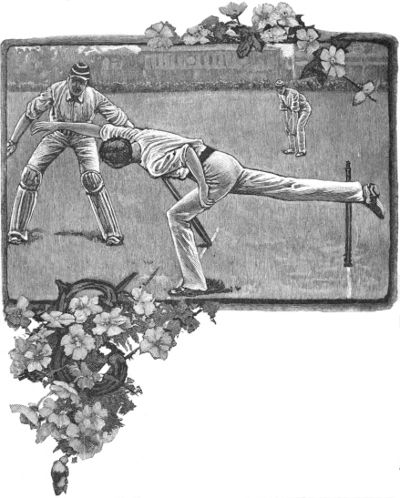
‘The demon bowler.’
Everyone who knows anything at all about cricket will at once admit that bowling is, to say the least, as important a feature of the game as batting. The same share of fame has always been conferred on a really good bowler as on an expert at the other great branch of the game; but, though this has been so from the very earliest days of cricket, there is no doubt that the number of good bowlers whose names figure in the chronicles of the game is much smaller than the number of good batsmen. This would seem to show that the art of bowling is more difficult of attainment than its sister accomplishment, and in face of this supposition, it seems strange that the energy devoted to practising bowling by all beginners at the game should be so greatly exceeded by that devoted to batting. The reason for this may easily be found in the fact that the pleasure derived from making a long score, and the indescribable feelings of delight experienced by every keen cricketer when he has a bat in his hand, seem to offer greater attractions than the more sober, less flashy, and apparently more mechanical duties of a bowler. It is a great pity, in the interests of the game, that at our large public schools and universities more care is not taken to coach beginners in bowling. Hours upon hours are devoted to the teaching of batting, but it is very, very seldom any professional ever thinks of endeavouring to instil into his pupils any of the most elementary rules of bowling.
A question which cannot fail to present itself to the minds of all cricketers, and especially those who recollect some of the heroes of bygone days, is whether the bowling of to-day is as good as it used to be. This particular question—so often put, and answered so differently—seems to me to be one which it is impossible to decide, as the whole nature of the game has altered so much in the last few years. This alteration is due, firstly, to the great improvement in the condition of the grounds; secondly, to the corresponding improvement in batting, for ‘the better the grounds the better the batsmen,’ is generally a correct saying. Formerly bowlers were greatly assisted by the unevenness of the grounds; whereas now, on our billiard-table-like wickets, even our very best bowlers know well that their chance of getting rid of a strong batting side for anything under 300 runs is extremely remote. It is impossible to compare the tall-hatted old heroes of the ball with bowlers of the present day. In olden days the badness of the grounds caused the best batsman’s wicket to be in frequent jeopardy, and fast erratic bowlers were well aware that there would be ample compensation for any accuracy which might be wanting in their delivery in the far from infrequent shooters and abruptly rising balls which so often either levelled the stumps or compelled the retirement of the batsman by a catch in the slips. Nowadays a bowler is nothing unless he has command of the ball and can practise variety: batting is so good and grounds are so level that the merely accurate bowler may keep down runs, but he cannot get wickets, but this fact is hardly realised yet, and our best bowlers—and these consist almost exclusively of the professional class—seem to aim not so much at getting rid of a batsman as at keeping down the runs by bowling a good even straight length, and trusting to chance or the impatience of the batsman for his dismissal. As, however, this subject is one which will best be treated later on, and about which there is a good deal to be said, we will leave it for the present, and turn our attention to a short retrospect of bowling from the earliest days.
Round-arm bowling seems to have come into vogue in 1825. It has been generally supposed that Mr. Willes was the first to start it, and the following story is told of the way in which that gentleman found out the advantages of the round-arm delivery. Mr. Willes, being a most enthusiastic cricketer, and not content with the summer months for his favourite sport, used in the winter daily to repair to his barn, and there measure out the proper distance, pitch the stumps, and, with his sister (also an enthusiast) as bowler, enjoy a good practice. Now everyone who has seen ladies attempting to throw a stone or cricket ball will remember that they invariably have a half-round, half-under sort of delivery, and this Miss Willes, in common with the majority of ladies, seems to have possessed. Her brother, accustomed to play against what in those days was the only known style of bowling, viz. under-arm, was somewhat perplexed and worried with this unknown feminine species of ball, which doubtless he found difficult to tackle. How amusing it would have been to have watched this keen cricketer, probably not unconscious of his own merits as a batsman, entirely puzzled by the deliveries of a lady! We are not told whether his feelings of shame at being thus defeated, or of delight at discovering this new style of bowling, predominated, but we are told that shortly afterwards he made his début as a round-arm bowler, and met with (until he was stopped by the conservatism of the crowd) the greatest success.
From the year 1825 down to the present, round-arm bowling has been universal, and it is now quite an exceptional occurrence to come across a fast under-arm bowler of the old style. This is not much to be regretted, as every attribute of good bowling which was obtainable by the fast under-arm delivery is much more easy of attainment by the round or over-arm style; and many accomplishments pertaining to the bowler’s art are possible to the round-arm which, from the very nature of the action, are impossible to the fast under-arm bowler. Break, spin, and quickness from the pitch are common to both styles, but certainly the two latter are made easier of acquirement by the round-arm style; and with regard to break—an easier matter for the under-arm bowler—the ball that breaks or twists the most is not as a rule the ball that gets the most wickets. To a fast under-arm bowler the variations in flight and pace, so well known to the best round-arm bowlers, are unknown. Slow under-arm bowling, of course, must be excepted from these remarks; later on in this chapter I shall have something to say on the subject of this most useful style, which unfortunately in later years seems almost to have died out.
It was formerly the reproach of amateurs that from the year 1875 to, say, 1887 they had no bowlers. When Appleby and Buchanan retired from first-class cricket in 1875, there was practically nobody except Grace and Studd to carry on the lamp of amateur bowling till Woods, Jackson, Kortright, Streatfeild, Wells, Bull, Jessop, Cunliffe, and Wilson by their pace and accuracy have shown the public what can be done. Woods, Kortright, Jackson, and Jessop for pace, Bull and Wells for slow, and Cunliffe and Wilson for medium are all excellent in their respective classes, and in the sixties, when the grounds would have given them more assistance, they would have been far more deadly than now. Still it is a fact that at most public schools more teaching ought to be bestowed upon bowling. A few words of instruction or encouragement to a beginner might have the effect of awakening in him the interest and keenness about bowling which would eventually cause his development into a good, or at any rate a fairish bowler. Who has not seen over and over again a boy come up to a net where a companion is practising, and picking up a ball, which as likely as not is about half as large again as a match ball, proceed to hammer away at the batsman for about ten minutes or more in all directions, with all pitches, and, what is worse than everything, with different lengths of run? Then, perhaps, getting a little tired, as any bowler will who bowls for long without a rest (which he would get in a match at the end of each over), he exclaims, ‘Now I’ll give you some of Spofforth’s patents!’ and then, with a long run and a kangaroo-like bound (but, probably, altogether unlike the famous Australian bowler), he proceeds to hurl the ball wider and in a more erratic style than ever. Then, perhaps, he will say, ‘Would you like some of W. G.’s?’ and immediately assuming the well-known and somewhat inartistic pose of the English champion, proceed to toss the ball lifeless up in the air. Now this is not the way to learn how to bowl. Bowling, like everything else worth doing, takes a lot of careful practice before it can be expected to meet with success.
There can be no doubt that were boys carefully trained at school in the art of bowling, as they are in that of batting, our universities, from which the ranks of our first-class cricketers are usually replenished, would be continually sending up men who could take the position as leading bowlers now occupied by professionals. But, it may be asked, if we have a supply of fairly good bowlers, what does it matter whether they are professionals or amateurs? There are two answers to this question: first, that the Gentlemen every year play the Players, and are naturally always anxious to beat them; and, secondly, that the more cricket gets into the hands of professional players, the worse it will be for the game and its reputation. We would not say one word against the personal character of the English professional cricketer, for the great majority of this class are honest, hard-working, and sober men. We only say that it is not in the interests of cricket that any branch of the game should be left entirely in their hands. Your professional, as a rule, is the son of a small tradesman, or person in that rank of life, and has been born in a neighbourhood where the greatest interest is taken in sport of all kinds, cricket during the summer months being sedulously played. These neighbourhoods are far more frequent in the northern than the southern counties, the sporting tendencies of the people of Lancashire, Yorkshire, and Nottingham being developed to a much greater extent than in the more southern shires. These three counties, and especially Notts, turn out large quantities of young professionals yearly.
A boy who has been born in one of these cricketing districts is sure to devote a fair share of his time to watching the victories and defeats of his village club, and consequently to imbibing that feeling of ‘pleasing madness’ connected with the game which attacks every cricket enthusiast. The height of his ambition is to bowl a ball or two to the village champion batsman, and when the opportunity arises to gratify his wish you will see him, hardly higher than the stumps, bowling with an action exactly similar to the crack village bowler, and scorning to encroach so much as an inch over the line of the bowling stump. And oh! what sleepless nights ensue from the anticipation of actually seeing with his own eyes on the following Saturday one of the real cracks of England—one who has positively played in Gentlemen v. Players, or represented England against Australia! No wonder the boy becomes imbued with keenness for the game, when everyone in the village, from the parson to the old lady who keeps the sweetshop, is continually talking about cricket. As the boy grows older he begins to make his mark in the village club, and when he is eighteen or nineteen, to the delight of his father, mother, sisters, and himself, he is selected to make one of the twenty-two colts of his county that are chosen to play against the county team. After having played in public, and perhaps tasted the pleasures of success, the father finds that his son is restless and disturbed in his trade, and wishes to give it up and become a professional cricketer. So it happens that his name is sent up to the county secretary as wanting a situation, and the young fellow finds himself launched into the world on his own account as a cricket professional.
With regard to the young man’s prospect of success on starting in his new life, we are bound to say that, assuming he has only the average cricket ability of the ordinary professional, his chances of even making a livelihood are not particularly bright. He may, and no doubt will, earn as much as 2l. a week, or even more, during the summer months; but at the end of August or beginning of September he will find himself with very little money in his pocket, and seven of the coldest and worst months of the year to face. He may get employment in the winter months—many professionals do, either as colliers or as porters, or some other work. We have known them to do clerk’s work for railways in the winter; but all work for men only willing to stick to it for a few months is extremely uncertain, and there can be no doubt that many cricket professionals have a bad time in the winter.
On the whole, professionals who have an assured place in their county eleven have, for men of their social position, a very good time. They only get nominally 5l. a match, but this often means a minimum wage of 10l. a week, and besides this they are well known and consequently well advertised, and this means a good deal. Many have shops for sale of cricket goods and golf clubs, footballs and archery, cum multis aliis. A great many become publicans, which, though many of us think a loathsome profession, is at any rate a livelihood, and they become publicans because they are well known and popular, and brewers like such men to manage their public-houses. Even if they keep no shop, they are constantly selling bats and balls, and a fair proportion of them, the picked men of the profession, get permanent posts in public schools. When there is no county match on a great many, especially in the North, get engagements in the detestable modern one-day league match. Leaving publicans out of the question, at the present day, from our own knowledge, the following old and young professionals keep cricket shops: Daft, Shaw and Shrewsbury, Gunn, Watson, Briggs, Sugg, Nichols, Abel, the two Quaifes, Walter Wright, Baldwin, Peate, Ward, Tunnicliffe, and George Hearne, and there are no doubt many more; while the following have permanent engagements as coaches at schools, often with a shop also: Wright of Nottingham, Louis Hall, Woof, Emmett, F. Ward, Wootton, and Painter.
In addition to all this, in some counties there has arisen, in the last year or so, a system of winter wages, or a bonus paid about Christmas, and when all things are considered, we cannot help thinking that a professional of ability who is steady has a better time of it than any other working man; and even if not a publican or shopkeeper, many have trades to which they can turn their hands in the winter.
The first-class professional cricketer is usually a well-made, strong-looking man, ranging from two or three and twenty to thirty five, with agreeable, quiet manners. He is a great favourite with the crowd, and when his side is in may be seen walking round the ground surrounded by a body of admirers, any one of whom is ready and willing at any moment to treat his ideal hero to a glass of anything he may wish for. It is greatly to the player’s credit that in the face of this temptation to insobriety he is such a sober, temperate man. I have never seen on a cricket field a first-class professional player the worse for drink, and I have only on one occasion heard the slightest whisper against the sobriety of such a man during the progress of a match. I believe that, as a class, and considering the thirsty nature of their occupation and the opportunities that offer themselves for drinking, there is no more sober body of men than cricket professionals.
Having attempted to give a short, and it is hoped impartial, description of the cricket professional, let us, before resuming the subject of bowling, return to the assertion that the more cricket gets into the hands of professional players the worse it will be for the game and its reputation. At present cricket is perhaps the most popular of all our national recreations; it is certainly the most popular game, though football has lately made great strides in popular opinion, and it is rightly considered to be the manliest and the freest from all mischievous influences. What these latter are, and what a pernicious and enervating influence they exercise on other branches of our national sports, is known to everyone. I allude to the betting and book-making element, which from the earliest days has been the curse of sport. What is the worst feature about horse-racing? To what do English lovers of true sport owe the fact that every racecourse is the rendezvous of the biggest blackguards and knaves in the kingdom? Is it not betting, and the pecuniary inducement it offers to every kind of dirty, shabby practice? The sullying influence has spread to the running-path, and even, if report says true, to the river and football field. Happily there is never the slightest whisper of suspicion against the straightness of our cricket players, and this is entirely owing to the absence of the betting element in connection with the game. It is an unfortunate fact that the tendency of first-class cricket nowadays is to swamp the amateur by the professional. Some of our best county teams are almost wholly composed of the latter class. The time taken up in big matches is so great, owing to their being drawn out by a late start and early finish each day, that the amateur is beginning to realise his inability to give up from his business or profession so much of this valuable commodity. What has happened in consequence? Cricket—i.e. first-class cricket—is becoming a regular monetary speculation. Thousands upon thousands troop almost daily to see the big matches, flooding the coffers of the county or club, which does its very best to spin out the match for the sake of the money. If this continue, our best matches will become nothing better than gate-money contests, to the detriment of the true interests of the game and its lovers.
Bowling is as much worthy of the name of an art as any other branch of sport. The skill, science, and practice which are necessary before a man can throw a good salmon fly, or before he can reckon on bringing down a good average of high rocketing pheasants, are equally necessary for one who wishes to become an adept at bowling. Perhaps bowling does not require the same oneness of hand and eye as batting, but it demands, if possible, more practice and experience, and to a far greater extent the exercise of mental qualities. The object of the bowler is to outmanœuvre the batsman; he has either to hit the stumps or draw him into some incautiousness or hesitation of play, which will result in the ball being caught from the bat or in the batsman being stumped out by the wicket-keeper. This is a wide field, and suggests at once that to become proficient a bowler must think—and think deeply too—not once or twice every few minutes, but before each ball, for none should ever be delivered without a particular object. Every ball must be part and parcel of a scheme which the bowler has in his mind for getting rid of the batsman. The object of every bowler, whether fast or slow, is always to bowl what is called a ‘good length’—i.e. to pitch the ball so close to the batsman that he cannot play it on the ‘bounce,’ or, in cricket parlance, ‘on the long-hop,’ and yet so far from him that he cannot play it just as it touches the ground or immediately on the rise—i.e. on the ‘half-volley.’ There can be no precise measurement of the exact spot on which the ‘good-length’ ball must pitch, as it is constantly varying according to the state of the ground, the pace of the bowler, and the size and style of the batsman. When the ground is ‘slow’ and ‘sticky’ from recent rain, the good-length ball will have to be pitched considerably farther than when it is ‘hard’ and ‘fast,’ as of course the ball will come faster off the ground when it is in the latter state than when in the former. The reason why the bowling of this particular ball is always the object of every bowler is because it compels the batsman to meet the ball with the bat by forward play, and because in so doing he often loses sight of the ball from the moment it touches the ground till it strikes the bat. No one can be called a good bowler until he has the power at will of bowling ball after ball of this sort. It often happens when two batsmen are well set, and every wile and ‘dodge’ of the bowlers has been tried without avail, that two bowlers will have to go on to bowl, or try to bowl, nothing else but good-length balls, in the hopes of keeping down the runs. If this can be done effectually, a batsman is bound through impatience to make a mistake which in time may cost him his wicket.
Every ball that leaves the bowler’s hand has, in addition to the propelling power imparted by the bowler, one of four different motions. The ball as it travels is either spinning from right to left; or from left to right; or with a downward vertical motion; or an upward vertical motion. It is a fact that it is well-nigh an impossibility for a ball to leave the hand of the veriest beginner without having one of these four motions to a certain extent imparted to it.
On these four rotary motions depends how much and in what direction the ball will twist or deviate from its course, and also the speed and height it will assume after touching the ground. One of the arts of a bowler is to cheat the batsman by making the ball pitch in one spot and, after the pitch, suddenly take a different direction; another is to make the ball rise quicker off the ground than a batsman would be led to expect from the ordinary rules of reflection. These arts are accomplished by different movements of the fingers and hand at the moment of delivering the ball; for the reason why every ball has a certain amount of spin on it is because the fingers, being in contact with the ball as it leaves the hand, cause it to rotate (though perhaps so infinitesimally as not to be noticeable) on its journey to the ground.
The spin, or rotary motion, from right to left is gained by grasping the ball chiefly with the thumb and first and second fingers, the third and fourth fingers being placed together round the other side of the ball. The moment the ball leaves the hand the latter is turned quickly over from right to left, and at the same time the first and second finger and thumb, coming over with the hand, impart a powerful twist to the ball, which leaves the hand when the latter is turned palm downwards. There is also at the time of delivery an outward and upward movement of the elbow which gives the arm the shape of a curve, or almost a semicircle. The ball goes on its way spinning rapidly from right to left, and the moment it touches the ground twists very sharply towards the off side of the batsman. This ball, termed in cricket parlance the ‘leg-break,’ when well bowled is perhaps one of the most deadly of all balls, but it is also the most difficult for a bowler to master. It is always a slow ball, as to bowl it fast with any accuracy of pitch is an impossibility—at any rate, it may be assumed to be so, as no bowler has ever yet appeared who could bowl it otherwise than slow. Palmer, the Australian bowler, was about the fastest ever known at this ball, but his faster ones were very inaccurate in pitch, and he could only bowl them, strange to say, very occasionally. The author, although he has played innings after innings against this bowler, never remembers receiving a single fast leg-break from him. The fact of the hand having to turn over from right to left, and of the ball being delivered underneath the hand, so to speak, causes it to be extremely difficult to attain accuracy of pitch and direction. There are many men who can bowl this ball in practice at the nets, but who never dare attempt it in a match, having no confidence whatever in their ability to bowl it straight, or even fairly straight. It is no uncommon occurrence to see this ball, bowled by one who has tried it in practice, travelling somewhere near to where point is standing. There are some slow bowlers who have become fairly proficient at it, and who have enjoyed at various times, and especially against batsmen they have never met before, a certain amount of success; but it is a style of bowling which should only be encouraged to the extent of enabling every bowler to use it occasionally. If nothing but this ball is bowled over after over, by constant repetition it loses its sting. The batsman gets wary, and when the ball is pitched on his leg side gets before his stumps to protect them, and hangs his bat in front of him, thereby rendering the loss of his wicket extremely improbable; and when it is pitched straight for the middle stump or on the off side, knowing the danger of a hit at the pitch of this ball, he will simply satisfy himself with protecting his stumps with his legs, and with letting the ball pass the off stump without further protest. The trap laid for the batsman in this style of bowling is the danger he incurs by hitting unless he is actually on the pitch of the ball; if he falls into the snare, the ball is perfectly certain to go up in the air, and generally in the direction of cover-point or mid-off. This, of course, is owing to the twist of the ball causing it to hit the side and not the centre of the bat. Should the batsman in the act of hitting miss the ball altogether, as is not infrequently the case, he pays the penalty of being stumped unless he happens to be a fast-footed hitter. Now, of course, these two traps are well known to every good batsman, and consequently it is, as a rule, useless to bowl ball after ball of this nature to him—one might just as well whistle for grouse at the end of November to come and be shot.
This ball, therefore, should only be bowled at intervals, and when according to the bowler’s judgment it may have a fair prospect of success. Usually this happens on two occasions. The first is when a batsman has just begun his innings, and is playing nervously and without confidence; a twisting ball then from the leg side is extremely apt to fluster and annoy him, and a catch in the slips or at point, or a catch and bowl, is not infrequently the result. The second is when a hitter is in, and is hitting to all parts of the field. Then the ball may be bowled with a great chance of success, especially if the man is anxious and impatient to hit every ball. He is extremely likely to hit a little short of the pitch, with the above-mentioned result. It is not a good thing for the bowler to worry the batsman with this ball if the latter seems not to like it or to play it nervously; it should at most be used not more than twice in an over. Let the bowler always remember that too much of one particular ball, even if distasteful to the batsman, will frighten and steady him, and perhaps in the end teach him to play it correctly. There are some batsmen, and good batsmen too, who never seem to be at home to this ball, although they may have played it scores of times, and I remember once seeing an amusing incident at a match in which a bowler who had adopted it was playing sad havoc with the other side. The first three batsmen had all rushed out to try and hit the leg-break ball, and, failing to do so, paid the inevitable penalty of being stumped. Their captain was furious at their rashness, especially as they were all three good players; he explained, and rightly, that the proper way to play the ball was either by hitting it on the full volley—i.e. before it touched the ground—or else remaining inside the crease and playing it quietly. He went in himself, intending to illustrate this principle, and, lo and behold! was stumped the very first ball he received. He scraped forward a long way to meet the ball, missed it, and remained in a most elegant Fuller Pilch-like attitude, fondly imagining the toe of his boot was inside the crease. It was, as a matter of fact, a good inch outside it. In that match there were five stumped each innings off the same bowler, and the captain was one of them both times. On another occasion a batsman with rather thin and weedy looking legs kept jumping in front of his stumps every time this ball was delivered. Finally the ball, discovering the weak spot in this gentleman’s physical proportions, managed to find (just above the knees) an opening large enough for it to pass through and dislodge the bails. Great was his astonishment and disgust, and as he retired crestfallen to the pavilion he said to the writer, who was one of the fielding side on that occasion, ‘It was not the ball or the bowler that did that; it was all owing to my confoundedly skinny legs!’ A dodge well worth trying with this ball is to bowl a good length about two feet to the leg of the batsman; he is nearly sure to have a hit, and there is a great chance of the spin on the ball causing it to be a miss-hit, which may go straight up in the air, for the wicket-keeper, point, or bowler to secure; even if it is a clean hit to leg it is nearly bound to be in the air, and long-leg may possibly have a chance. If this scheme is to be practised it will be generally a good thing for the bowler to have his long-leg perfectly square, and bring his long field on round till he is almost in the position of a forward long-leg. This should be done by quietly waving the hand in such a manner as to attract the attention of the batsman as little as possible. It is impossible to lay down any rule for the way in which the fieldsmen should be placed for this style of bowling, as this depends so much upon the play of each particular batsman. A long-leg is, however, nearly always necessary, and very often an extra man out on the leg side, as mentioned already. Two men out in the field for the average batsman cannot be dispensed with. The bowler himself, as a rule, will know how to place his field for each batsman, but on no occasion should he ever omit to have a short-slip. This is such a very likely place to get a batsman snapped up that it should never be dispensed with to any style of bowling, except perhaps to slow under-arm, and not always then. A slow bowler who intends to use the leg-break, let us say, once an over, or even once in two overs, and who relies on this ball as most likely to secure wickets, may on ordinary occasions place his men thus, but, as we said before, they must be changed to suit the circumstances.
If the ground is hard and fast, as a rule a third man cannot be dispensed with; but if inclined to be slow, he may be brought forward to extra cover-point, between cover-point and mid-off, or else put deep in the field on the on side. The bowler may, however, see that the batsman is wide enough awake to restrain himself from hitting blindly at the pitch of this ball when straight or on the off stump; it will then be advisable to try him entirely on the leg side—a man may refuse the bait on one side but take it on the other. In these circumstances extra cover-point, and sometimes even cover-point as well, may be brought across the wicket and placed for half-hits wide on the on—i.e. about half the distance from the batsman that a deep field would stand. If the batsman assumes a poky style of play, it is often advantageous, both for saving runs and getting wickets, to have a short-leg a little nearer the stumps than the umpire, and the mid-on as near to the batsman as he can venture consistently with safety. In this, as in every other style of bowling, it is a sovereign rule to make the batsman play to the ball—i.e. to keep it well pitched up, and compel him either to hit or play forward.
A very novel style of this kind of bowling was seen on English cricket grounds in the summer of 1884, when the Australian team of that year included W. H. Cooper, so well known to all our cricketers who have visited the colonies. He bowled round the wicket, and nearly every ball almost a wide to leg. There was more spin and twist on the ball than had ever been seen in this country before (excepting, perhaps, in the bowling of Mr. Stratford, who played for a year or two for Middlesex, but who never made his mark in first-class cricket). The ball seemed to be twisted or screwed out of the side of his hand in the way a billiard-marker will screw a billiard-ball along the table to a certain spot, and then bring it back to him. But, unfortunately for him, he was unable to combine any pace with this tremendous twist. The ball was extraordinarily slow in the air, but directly it pitched it would spin off the ground comparatively quickly, twisting into the batsman on the faster wickets, sometimes as much as a yard or more. All his men except two were on the on side, and he expected his wickets to be obtained by the impatience of the batsman causing him to rush out, miss, and get stumped, or else by wide hitting at the pitch of the ball on the leg side, where there were seven fielders with seven pretty sure pairs of hands waiting for it. In Australia he had met with a fair share of success, especially against some of the English elevens which had been over there. It was this latter consideration which induced the Australian authorities to believe that he would be a useful addition to their team. His bowling was most unsuccessful in this country. Whether this was due to an accident to his hand on the voyage to England, or from the light here being not so glaring and bright for our English eyes as it is in Australia, cannot be said for certain, but I have a strong opinion from my own experience that the reason of his success in Melbourne against Englishmen was owing to the dreadful glare on that ground.
One peculiarity of the leg-twisting ball is that when the ground is soft and sticky it is comparatively of no avail. The ball then, of course, twists to a greater extent than when the ground is hard, but it leaves the pitch so very slowly that the batsman can either wait for it on the long-hop or hit it on the full or half-volley. The leg-break ball on a soft ground, if bowled at all, must be bowled faster than on hard, in order to counteract the deadness of the turf. The best states of the ground for this bowling, as indeed for most, are when the ground has been hard and fast, and has since become crumbly and covered with loose bits of grass and worn turf, and when there has been heavy rain to saturate the ground which is being rapidly dried and caked by a hot sun. In the former state the ball takes plenty of twist, and also leaves the ground very quickly, in addition to sometimes getting up uncomfortably high for the batsman. In the caked state the ball takes lots of twist, and puzzles the batsman by the varied and uneven paces at which it leaves the ground, sometimes coming sharply and high, at other stopping on the ground and, in batsman’s parlance, ‘getting up and looking at you.’
The leg-break diagram.
These positions of the fieldsmen will suit under-arm bowling, except
that, perhaps extra mid-off may be put out on the on side.
The ‘leg-break’ ball is usually bowled from round the wicket, as from this side there is more scope for the bowler to make the ball twist. It is doubtless the best side of the stumps to choose for the delivery of this ball, but every bowler should remember that it is very nearly as good as a change of bowling to change from ‘round’ to ‘over’ the wicket, and this is especially so with leg-break balls. The ball delivered from round the wicket generally leaves the hand a good foot outside the extremity of the bowling crease; this means that it starts about 4 feet 4 inches from the middle stump of the bowler’s wicket, and in its journey through the air, even if pitched in a line with the leg stump of the batsman’s wicket, it has to make considerable way from the leg side of the wicket. This, of course, makes the ball go across the wicket more from the pitch, and, as a rule, means that a leg-stump leg-break ball round the wicket misses the wicket on the off side. A batsman, if the ball is pitched off his wicket, may defend it, as the rule of leg before wicket now stands, with his legs, and consequently the bowler has not much chance of hitting it. When bowled from over the wicket the leg-break ball, being delivered in a direct line with the batsman’s wicket, will naturally, if pitched on the leg-stump or between the legs and the wicket, not twist so much, thus making it more likely to hit the wicket if missed by the batsman. There is also a direct advantage to be gained by bowling over the wicket if the batsman is inclined to get in front of his stumps, as there is always a better chance for the bowler to get an appeal for leg before wicket answered in his favour than when bowling from the other side.
Although, as previously mentioned, there has never been any instance of the leg-break ball being bowled by a fast bowler, some of the best bowlers of the past generation of cricketers used to bowl with a considerable bias from the leg side, and were also of well over medium pace. Martingell and Silcock were bowlers of this class. This old style was very effective, and it is greatly to be regretted that it has almost entirely disappeared from the game at the present day. It differed from the slow ball that has been discussed only in the amount of spin; and as there was so much less power expended in spinning or twisting, the pace of the ball was greatly in excess of that which can be got on to the slow leg-break. The ball was delivered round the wicket, at the very extent of the crease, in order to make the angle from the hand to an imaginary straight line between the two middle stumps as great as possible. The hand was very little higher than the hip when the ball was delivered, and instead of the hand and wrist being completely turned over at the moment of delivery, as in the slow leg-break, the fingers imparted a right to left spin to the ball. The ball, coming from a great distance round the wicket and with a considerable amount of leg spin, would be gradually working away to the batsman’s off side every inch of its journey, both before and after pitching. Catches in the slips and on the off side were numerous from this style of bowling, and it required the batsman’s greatest care and caution to guard himself against playing inside the balls. It is a great pity we do not see more of this bowling now.
The next spin or twist on the ball which we will discuss is the rotary motion from left to right. This, in cricket phraseology, is termed the ‘off’ break, and is far more universal than that from the ‘leg.’ In fact, so common is it, and so easy to learn, that nearly everyone who has ever bowled in a match knows more or less how to put this spin on the ball. It is, of course, always easier to get spin on to a slow ball than on to a fast one.
When the ball to be delivered is a slow one, the fingers and hand may be twisted into almost any shape, as so little power is required actually to deliver the ball; all the strength of hand, of wrist, and of the fingers may be utilised for the purposes of spin alone. When the ball has to be a fast one, the power necessary to propel the ball at the required pace prevents so much of the power of fingers, &c., being expended on spin. A slow ball always takes the spin, after leaving the ground, to a greater extent than a fast one, because it is longer on the ground when it pitches, and the spinning has more time to take effect on the turf.
Likely balls; and what may become of them if not correctly played.
a, a likely one for a wild hitter to get himself out on the off side; b and c, likely for a stump, or, if hit with straight bat, a catch to deep field-off; d and e, likely for ‘catch and bowl;’ f, long-leg and half-hit chances—short-slip and wicket-keeper often get an easy chance off this ball.
The natural spin on every ball which is bowled is from left to right—i.e. the off break. Even when a fielder throws in a ball from a distance it almost invariably has this spin on it. If you watch the smallest boy in the street throwing a stone, you will find, nine times out of ten, the stone has acquired this spin. It is then no wonder that almost every right-handed bowler relies upon this twist as his principal artifice. The twist depends rather more on the power of the fingers than on the hand and wrist, as in the ‘leg-break.’ The ball is usually, by a slow bowler, grasped firmly with all the fingers resting on the seam, as this gives more purchase and resistance for the fingers to operate. The latter at the moment of delivery spin the ball, almost in the same way as they would spin a top, and instead of an upward and outward motion of the elbow, as in the ‘leg-break,’ there is an inward motion towards the side of the bowler. The hand is turned over outwards when the ball is delivered, and, if properly bowled and pitched just outside the off stump, and under good conditions of ground, the ball, after the pitch, will change its course abruptly towards the batsman and the wicket.
Differing from the ‘leg-break,’ this ball can with practice be accompanied by a great accuracy of pitch—an accuracy which has been attained almost to perfection by some of our best known bowlers. The late James Southerton, the famous Surrey bowler, could bowl in this style for hours with only a very occasional variation from a perfect ‘good length.’ Alfred Shaw, of Nottingham, in his day was perhaps the greatest exponent of accuracy of pitch combined with the slow ‘off break,’ or what is generally termed ‘break-back.’ This ball should be bowled a good length, and generally about two or three inches outside the off stump.
Of course the amount of twist the ball will take depends on the state of the ground, and this should at once be apparent to the bowler. The danger most to be apprehended by the batsman from the off break is that in playing forward, if not quite on the pitch of the ball, he is very apt, owing to the twist, to play outside, and allow it to pass between his bat and right leg to the wicket. It is never a wise thing for the bowler to use the ‘off break’ every ball, although there are many who do so. Even if he is devoid of all other artifice, and has no command over the arts of ‘change of pace,’ ‘flight,’ or the ‘leg-break,’ he should often vary his style by a ball without any twist at all, and this should not always be straight. If a batsman has been playing over after over nothing but good-length ‘off break,’ a ball pitched about the same spot, two or three inches outside the off stump, and without any off break at all, will very often be found to go to hand in the slips, because the batsman is expecting the break and plays inside the ball.
The fast ‘off break’ is a most deadly ball, and Lockwood, Richardson, Mold, and Hearne are four bowlers who have a consistent break. A slight slope in the ground from the off side is always a great advantage to fast bowlers who try the ‘break-back.’ This comparatively rare ball, when it does come, is sure to try the very best batsman. Its difficulty arises from the fact that the ball is of such a pace as to necessitate quick forward play, when the sudden turn after the pitch causes it to be missed. For playing ‘off breaks’ of all paces, it is a great and golden rule for batsmen to remember: Never allow space between the bat and the left leg for the ball to pass through. This rule, which insures the left leg of the batsman being placed well across the wicket when playing forward, if followed, will render it almost impossible for him to be bowled out with an ‘off break.’ It is an astounding fact that this simple rule, which should be patent to everyone, seems unknown to all our best batsmen with one or two notable exceptions. W. G. Grace has always played with his leg up to his bat, thereby preventing the ball from finding an opening between the two. W. W. Read, of Surrey, is another who plays thus. We do not express any opinion here as to the bearing of this rule on the leg-before-wicket question. It is sufficient for a batsman at present, as the rule now stands, that so long as the ball does not pitch between the two wickets he cannot be given out ‘l.b.w.’
‘Off breaks.’
A, B, C, all good ones; D, if the batsman stands with his legs some way from the leg stump, this is likely to bowl him off his legs; but it is a beauty to hit on the on side.
The two ‘spins,’ from the leg and the off, are the chief and most important for all practical purposes. If a bowler by constant practice has acquired the power of twisting the ball from off or leg at will, and can at the same time bowl a ‘good length,’ he has laid a tolerable foundation for future success. We say tolerable, because, in bowling, twist, as we shall see later on, is not everything; it is an essential element in good bowling, but it is only one of several, all of which must combine together before anyone can earn the reputation of a first-class bowler.
The two other spins which can be put on the ball are what have been called the ‘upward vertical’ and the ‘downward vertical.’ By the ‘upward vertical,’ I mean when the ball spins in its way to the ground vertically, and upwards with regard to the bowler. It may be compared to the spin imparted to the billiard ball in the screw stroke. This is effected by striking the ball low down, which makes it revolve in its course upwards. The effect this upward revolution has is seen when the striker’s ball meets the object ball, the former having a decided inclination to stop and return to the striker. In the same way a cricket ball, when made to revolve upwards, has a tendency to stop and go slower off the pitch than it went before it reached the ground.
This twist, as a matter of fact, is never practised; and it is a great pity that more attention has not been paid to it. Of course it is very much more difficult to make the ball revolve in this manner than in either the leg or the off break, but it is quite within the powers of the possessor of a fairly strong set of fingers. The lower half only of the ball should be held, so that the upper half protrudes above the hand and fingers, and at the moment of delivery, which must be from the level of the shoulder or lower, the fingers and hand must impart as much upward spin as possible.
The downward vertical spin is the reverse of this, and is caused by the upper half of the ball being grasped instead of the lower, as in the upward. This spin imparts to the ball a tendency to come quicker from the pitch than the pace in the air would seem to suggest, and is analogous to the ‘following up’ stroke at billiards. The latter is made by striking the ball at the top, making it revolve downwards and vertically from the striker. Very many bowlers possess this downward spin in their bowling without being at all aware of the fact. They know, as also do those who play against them, that every now and then one of their balls will, in cricket slang, ‘make haste from the pitch.’ The batsman finds he has mistaken the pace of the ball, which flies past him before he is anything like ready to play it, and when his stumps lie prostrate, as often as not he will come back to the pavilion with the old, old story, ‘Bowled with a shooter;’ whereas, in fact, the ball has hit the middle or even upper part of his stumps. He has entirely lost the ball from the pitch owing to his misjudgment of its pace, and concludes erroneously that it has shot underneath his bat.
We have now considered the four kinds of spin which can be put on to a cricket ball. Of course there may be combinations of two kinds, as, for instance, the ball may be spinning from right to left or left to right, and at the same time be revolving to a certain extent vertically downwards or upwards; but it would be impossible to discuss the result of every such combination.
The ball may break from ‘leg,’ and at the same time show by its acceleration in speed after the pitch that it has been revolving downwards as well, and the same may happen with the break from the ‘off;’ but such variations are beyond the reach of any practical discussion.
Let us now turn to another element of good bowling—change of pace. It does not require any great amount of technical cricket knowledge to understand that, if a bowler delivers every ball at the same uniform pace, his bowling is easier for a batsman to judge and play than when he is continually altering and changing the pace. If a batsman misjudges the pace of the ball he often loses his wicket. If he plays too slow for a fast ball, or too fast for a slow one, he generally makes a fatal mistake. As it is necessary for a shooter to accurately judge the pace of a driven grouse before pulling the trigger, so is it equally necessary for a batsman to judge the pace of the ball before he plays to it. This power of judging pace only comes after long experience; but when it does exist it seems to be exercised almost intuitively, and without any conscious thought—indeed there is often no time for thought.
Perhaps the one thing which made Mr. Spofforth, the famous Australian bowler, superior at his best to all others, and has earned him the reputation of being the best bowler that has ever lived, was his wonderful power of changing the pace of the ball without making it perceptible to the batsman. In his bowling the same run, action, and exertion were apparently used for delivering a slow or medium-paced ball as for a fast one. Many a time, especially on his first arrival in England, when this bowling was strange to our batsmen, the ball seemed to dislodge the bails long after the bat had completed the stroke, and was perhaps high in the air. Change of pace, to be effective, must not mean change of action; and the first thing a bowler who wishes to practise this art must understand, is that the slightest variation in style or action for a slower or faster ball will at once put the batsman on the qui vive and destroy the effect of the device.
C. T. B. Turner, the Australian bowler, was a great adept at changing the pace of the ball without sounding any warning note to the batsman. He is one of the very finest bowlers we have ever seen bowl; he has great command over the ball, and a beautiful and easy delivery. His performances in this country have been wonderful; the only defect in his bowling which, in the writer’s opinion, keeps him from being considered Spofforth’s equal is that his action is too easy to see. A good batsman is not so likely to be deceived by him as readily as by Spofforth’s windmill deliveries.
When a slow or medium-pace bowler wishes to deceive the batsman by a change of pace, he has, of course, two courses open to him—either to accelerate the speed of the ball or diminish it. When he wishes to bowl a faster ball than usual, he must remember that the object of the experiment is to make the batsman play slower to the ball than he has been doing, and that this result will be far more easily accomplished by pitching a good-length—if anything, a little further than a good-length—ball, than by a short one. If the latter is bowled, the batsman, although deceived in the pace up to the pitch, has time to discover his mistake before the ball reaches him, and consequently has his bat ready in time to stop it. If a ball is, however, pitched a good length, or a trifle beyond it, and up to the pitch is successful in deceiving the batsman, he will not have much chance of stopping it afterwards.
Palmer, another of the famous Australians, sends down the best fast ball that has been seen from a medium-pace bowler. There is no change of action to warn the batsman, no longer or faster run, but the ball comes with lightning rapidity, generally pitched well up, and very often in the block-hole, making that most deadly ball a ‘fast yorker,’ about which something will be said farther on. The change from slow or medium-pace bowling to quite slow is much more frequently practised than the change to fast, and consequently we may presume it is more easy of accomplishment. There are few slow or medium-pace bowlers who do not try occasionally to deceive the batsman by making the high slow ball pitch a little shorter than the rest have been doing. But although there are many bowlers who endeavour thus to deceive, there are but few who are really skilful in the art.
It is an extremely difficult thing to reduce the pace on the ball without altering the action. Mr. Spofforth, the Australian, as we have observed, excelled in this, as also did Alfred Shaw, of Nottingham, when at his best. For many years Shaw had the reputation of being the best slow bowler in England, and justly so. His most deadly device was, after he had bowled three or four of his ordinary paced ones, to toss the ball a little higher, a little slower, and a little shorter. Unless the batsman detected the alteration in speed at the moment of delivery, he made what was often a fatal mistake. If he hit, the ball would go high in the air, generally in the direction of deep field-on; if he played forward, a catch and bowl was the very likely result. If this ball is bowled without deceiving the batsman, it generally meets with a very heavy penalty, as, if rightly judged at first, it can generally be either waited for and hit almost to any part of the field on the ‘long-hop’ or bound, or run down and driven past the bowler; but the latter feat can only be accomplished by batsmen who are very quick on their legs.
Some of the best exponents of this ball appear, just prior to delivery, to greatly exert their bodies, and go through their whole customary action, while the arm, dragged slower than usual through the air, delivers the ball when the body is comparatively at rest. This, no doubt, gives the batsman the idea that the ball is going to be delivered before it really does leave the bowler’s hand. But it would be quite beyond the capabilities of the writer to furnish any intelligible hints as to how to bowl this ball; every bowler will with practice find this out for himself.
As a rule, good bowlers of the present day bowl with their arms above the shoulder, and it is a rudiment in the art that the action of delivery should be as high as possible. The high delivery is certainly the most successful where the ground is hard, fast, and true, as then little or no twist can be put on to the ball, and the higher it is made to bound the more chance there is of the batsman making an uppish stroke. In addition to this advantage which the high has over the low delivery, the higher the arm is raised above the shoulder the more difficult it is for a batsman to judge the pitch and flight of the ball.
With regard to the amount of success that slow and fast bowling meet with, a great deal depends on the state of the ground, but speaking of England, and on hard wickets, fast bowlers are having the best of it; at any rate, Richardson is far the most deadly, while Mold, Hearne, Davidson, Bland, Cuttell, and Hirst are very successful. In a later chapter, however, the causes are discussed which seem to show that head bowlers, bowlers who change their pace and methods, will have to be the bowlers of the future. But it is also true, as a general rule, that slow bowling is more difficult to play than fast. The advantages that it possesses over fast are as follows:—
First.—The slowly delivered ball describes a curved line in the air both before it pitches and afterwards to the bat; and balls coming in a curved line are far more difficult to play accurately than those which come quick and straight from the pitch. If the batsman properly judged the fast ball, by simply putting his bat straight forward he would always meet and stop it. It is not quite so with the slower ball. The ball, coming on to the ground in a curve, will leave it in a curve, and may consequently go over the shoulder of the bat. Besides, the quicker the ball is, the shorter time the batsman has to play it; his mode of playing must be decided on instantaneously, so he has no time to get into two minds on the subject.