
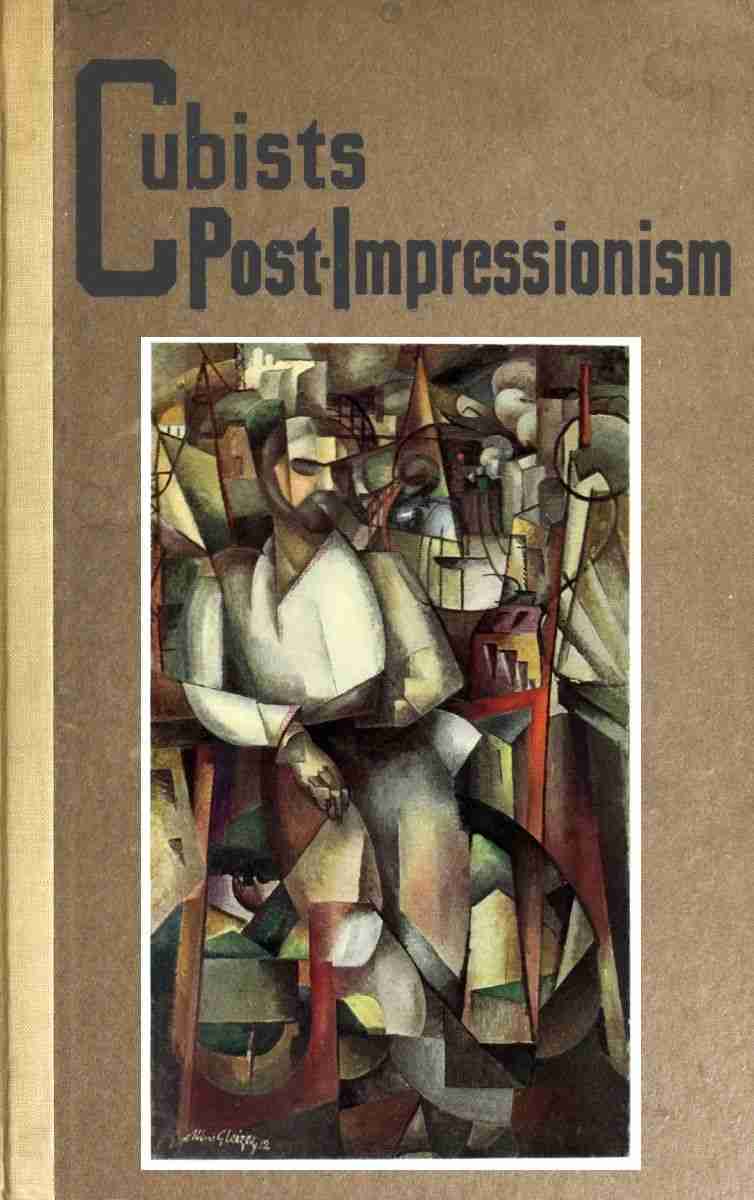
usually discovers the presence of parts and forms drawn from nature, from objects.
As the imitation of natural forms forms no part of the definition of pure art how is it these objective representations creep in?
The origin of painting was the same as that of the other arts, and of every human action. It was purely practical.
If a native hunter chases game for days, he is induced to do so by hunger.
If today a princely hunter chases game, he is induced to do so by the desire for enjoyment. Just as hunger is of bodily value, here the enjoyment is of aesthetic value.
If a savage requires artificial sounds for his dance, he is induced thereto by sexual impulse. The artificial sounds, from which through centuries the music of today developed, moved savages to an expression of passion in the form of dancing.
If the man of today attends a concert he is not seeking the music for practical results, but pleasure.
Also here the original practical motive changed to the aesthetic. That means that also here the practical want of the body changed to that of the soul.
During this progress toward refinement (or spirituality) of the most simple practical (or bodily) wants, two consequences are to be noticed throughout: The separation of the spiritual from the bodily element and its further independent development through the different arts.
Here the above mentioned laws (of the inner element and the form) gradually apply with ever increasing force, until finally out of each art comes a pure art.
This is a steady, logical, natural growth, like the growth of a tree.
The process is to be noticed in painting.
First period, Origin: Practical desire to make use of physical.
Second Period, Development: The gradual separation of this practical purpose, and the gradual ascendancy of the spiritual element.
Third Period, Aim: The attainment of a higher stage in pure art; in this the remains of the practical desire are totally separated (abstracted). Pure art speaks from soul to soul, it is not dependent upon the use of objective and imitative forms.
We can distinguish all of these three stages in various combinations in paintings of today.
First Period: Realistic Painting. The realism here is understood to be such as developed traditionally into the nineteenth century—the practical desire to exhibit objective realities—portraits, landscapes, historical paintings, etc., in the direct sense.
Second Period: Naturalistic Paintings in the form of Impressionism, of the New Impressionism and Expressionism—to which partly Cubism and Futurism belongs: The separation of the practical aim and the general preponderance of the spiritual element; from Impressionism through Neo-Impressionism to Expressionism always increasing separation and always increasing preponderance of the spiritual.
Apparently in this finer development nature as such is no more taken into consideration; but this is only “apparently” so, for as a matter of fact nature is used as a motive, a background, a basis for the pictures, and if the attempt is made to separate the natural or objective part of the picture from the purely artistic, the result is the picture falls for lack of support.
In other words, in most of even the very abstract paintings, such as even Picasso’s, there is a foundation, a background of objects without which the pictures would not exist.
Picasso may refine a “Woman with a Mandolin,” to a dozen intersecting lines that disclose neither woman nor mandolin, but both were present in his mind’s eye when he created his work, and without them the work has no reason for existing.
It is here that one begins to understand Kandinsky’s attitude, and how diametrically he diverges from Picasso. The two have nothing in common save the desire to produce more abstract art, but Picasso abstractions are based on the outer world, while Kandinsky’s are based on the inner.
When Picasso has refined nature, that is, things outside him, to the last degree, to the simplest mode of expression in line and mass, he has reached an impasse, further progress is impossible, further scientific subdivision in unattainable, his art in that direction is finished.
But Kandinsky has before him an unlimited view. With him the elimination of nature, of all things physical from his compositions, simply gives him greater freedom in the painting of compositions representing things—moods—spiritual.
To go on with his own explanation, not in his exact words, but in substance:
It is thus seen that in both the first and second signs in the development of art, the objective foundation or background is not of simply secondary importance, but of first; it is essential because without it the work would not exist.
To create pure art it is necessary to eliminate this background of the physical, and substitute for it pure artistic form, which alone can give the picture independent life.
This step we find in the dawning third period of painting—Compositional painting.
According to the scheme of the three periods, we have arrived at the third one—which was designated as the Aim.
In the compositional painting which is developing today we see the signs of the attainment of the higher step of pure art, in which the remains of the practical desire (all evidences of objectivity) can be perfectly separated, which can speak from soul to soul in purely artistic language.
The conscious and oftentimes also still unconscious striving, which strongly (and ever stronger) shows itself today, to replace the objective (subject paintings) by pure construction (pure composition) is the first sign of the dawning of that pure art to which the past art periods inevitably led.
I have been trying to briefly deal with the entire development and more especially the situation today in broad schematic outlines; therefore there are many deficiencies (gaps) which necessarily remain uncovered, and there are passed over many interesting lesser developments, which are inevitable in progress, like smaller branches on the tree, which extend outward notwithstanding the tree’s growth upward.
The further development, which is pending in painting, will still have to suffer many seeming contradictions and diversions, as was the case with music, which today we know already as pure art.
The past teaches us that the development of humanity consists in the increasing spirituality of various factors. Among these factors art takes the first place.
Among the arts painting is following the road that leads it from the practical-efficiency to the intellectual-efficiency. From the subject-picture to the pure composition.
To better understand the foregoing take the “Improvisation No. 30.”[52]
It is a very pure example of compositional painting, but it
is not absolutely pure, in that it contains many more or less obvious suggestions of familiar forms and objects.
Some workmen who happened to be handling the painting, referred to it as the “War Picture,” and many casual observers insist it is an impression of war or of a battle field.
This is because two cannon are quite plain in the lower right-hand corner, and the two oblong blue masses projecting from the cannons’ mouths would seem to be the smoke of the discharges.
Then, too, the seeming cataclysmic effect, the suggestion of a helmet, a tottering tower, banners, aerial flashes or fireworks, all accentuate the impression of conflict and explosions.
If one looks long enough in this mood it is not difficult to read into the canvas all sorts of interpretations of a warlike character.
Yet the painting was “improvised”—composed with no direct intention of suggesting war.
In his own personal note book wherein he keeps a record of all his work, Kandinsky identifies the picture by a hasty pencil sketch and the words, “Blue Splashes,” or “Masses,” and “Cannons.”
Of the painting he says in a letter:
The designation “Cannons,” selected by me for my own use, is not to be conceived as indicating the “contents” of the picture.
These contents are indeed what the spectator lives, or feels while under the effect of the form and color combinations of the picture. This picture is nearly in the shape of a cross. The centre—somewhat below the middle—is formed by a large, irregular blue plane. (The blue color in itself counteracts the impression caused by the cannons!) Below this centre there is a muddy-gray, ragged second centre almost equal in importance to the first one. The four corners extending the oblique cross into the corners of the picture are heavier than the two centres, especially heavier than the first, and they vary from each other in characteristics, in lines, contours, and colors.
Thus the picture becomes lighter, or looser in the centre, and heavier, or tighter towards the corners.
The scheme of the construction is thus toned down, even made invisible for many, by the looseness of the forms. Larger or smaller remains of objectivity (the cannons, for instance) produce in the spectator that secondary tone which objects call forth in all who feel.
The presence of the cannons in the picture could probably be explained by the constant war talk that had been going on throughout the year. But I did not intend to give a representation of war; to do so would have required different pictorial means; besides, such tasks do not interest me—at least not just now.
This entire description is chiefly an analysis of the picture which I have painted rather subconsciously in a state of strong inner tension. So intensively did I feel the necessity of some of the forms, that I remember having given loud voiced directions to myself, as for instance: “But the corners must be heavy!” In such cases it is of importance exactly to discern all things, the weight, for instance, by the feeling. Generally speaking, I might almost declare that where the feeling that lies in the soul, in the eye, and in the hand is strong enough to faultlessly determine the finest measurements and weights, “schematism” and the much-dreaded “consciosity” will not become dangerous. On the contrary, in this case, the said elements will even prove immeasurably beneficial.
I would that all my pictures might be judged exclusively from this point of view, and that the non-essentials might completely disappear from the judgment.
In subsequent letters he said:
Whatever I might say about myself or my pictures can touch the pure artistic meaning only superficially. The observer must learn to look at the picture as a graphic representation of a mood and not as a representation of objects.
All that anyone can say about pictures, and what I might say myself, can touch the contents, the pure artistic meaning, of a picture only superficially. Each spectator for himself must learn to view the picture solely as a graphic representation of a mood, passing over as unimportant such details as representations or suggestions of natural objects. This the spectator can do after a time, and where one can do it, many can.
Given a work of art, painting, sculpture, music—anything—its appreciation and understanding depend upon the attitude of the audience.
A work of art may be, and ultimately must be viewed from two very different points of view—the point of view of the artist, and the point of view of the observer.
The great majority of people view a painting only from the latter point of view, only in the light of their preconceived notions and prejudices—hence the ridicule of the strange and the protest against the new.
A very, very small minority—a minority so small it numbers scarce one in ten thousand—view a new work searchingly and at the same time sympathetically from the artist’s point of view, seeking diligently to find out what he is trying to do, and not permitting a single prejudice or preconceived notion of their own to bias their judgment.
After this class of observers have ascertained what the artist intended, then, and not until then, do they turn and view the work from their own point of view—that is, in the light of their own likes and dislikes.
Their final appreciation may be that granting the theories of the artist the picture is a fine one, but they do not agree with the artist’s theories, hence the picture from their point of view is a failure as a work of art.
To rightly view a work of art is an act of creation; the true observer is a painter; the true reader is a poet.
It is not at all strange that the great majority referred to should resent Kandinsky’s improvisations, for they are not easy to understand, though most of them are undeniably fascinating in color.
It is not even strange that a large percentage of the intelligent and sympathetic minority should finally reach the
conclusion that the theories of the artist are not sound, and therefore all his work based on his extreme theories fails as art work, but the attitude of this fraction of the minority is an attitude of intelligent and conscientious conviction, reached after long and impartial investigation, while the attitude of the great majority is that of impulsive ignorance and irritation, reached on first impression and without the slightest attempt at understanding.
To illustrate: The great majority of people on first hearing Chinese music exclaim, “What a horrid din!” and turn away.
A very, very small minority, about one man in a million, say, “True, it sounds to us like a din, but to a people of extraordinary civilization it is music; the matter is worth investigating,” and on investigation it would be found that Chinese music from time immemorial has been under state supervision.[53]
The very ancient scale was pentatonic—five tones. It was in the seventh century, B.C., that the Asiatic flute was introduced into Greece and the Greek Doric scale transformed into one of five tones.[54]
Among the more cultivated nations, the Chinese, and Celts of Scotland and Ireland still retain the scale of five notes without semitones, although both have become acquainted with the complete scale of seven tones.
The division of the octave into twelve semitones, and the transposition of scales have also been discovered by this intelligent and skilful nation.
But, generally speaking, both the Gaels and the Chinese, notwithstanding their acquaintance with the modern tonal system, hold fast by the old. And it cannot be denied that by avoiding the semitones
of the diatonic scale, Scotch airs receive a peculiarly bright and mobile character, although we cannot say as much for the Chinese.[55]
While we are content with a scale divided into semitones, the more delicate oriental ear requires quarter tones. The Arab octave is divided into twenty-four intervals. A distinguished musician on a visit to Cairo wrote Helmholtz as follows: “This evening I have listened attentively to the song on the minarets, to try to appreciate the quarter-tones which I had not supposed to exist, as I had thought the Arabs sang out of tune. But today as I was with the dervishes I became certain that such quarter-tones existed.[56]
In discussing the development of our modern, equal temperament (adopted commercially in England for pianos not until 1846), Helmholtz says, “Amiot reports equal temperament from China long previously even to Pythagoras.”[57]
The Chinese are the only people who, thousands of years ago, possessed a system of octaves, a circle of fifths, and a normal tone. With this knowledge, however, their eighty-four scales, each of which has a special philosophical signification, appear all the more incomprehensible to us.[58]
“The Chinese believe their music to be the first in the world. European music they consider to be barbaric and horrible.”[59]
All this goes to show how hazardous it is to jump to the conclusion that what we don’t understand has no meaning.
To one ignorant of Chinese or Japanese or Hebrew handwriting it seems just as absurd and meaningless as a drawing by Picasso or a painting by Kandinsky, but to the earnest
and indefatigable searcher after hidden meanings the strange handwriting and the strange pictures both deliver up a message.
Of such paintings as Kandinsky’s improvisations it is often flippantly said, “They paint that way because they can’t draw.”
As a matter of fact most of the extreme moderns such as Picasso, Matisse, Kandinsky, are past-masters of the art of drawing.
But they do not now attach the importance to drawing, merely for the sake of drawing, they once did.
Kandinsky’s own attitude is expressed in the following extract from a letter:
As regards other artists, I am very tolerant, but at the same time most severe; my opinion of artists is influenced but little by considerations of the element of form, pure and simple; I expect of the artist to bear within at least the “sacred spark” (if not “flame”). There really is nothing easier than to master the form of something or someone. Boecklin is quoted as having said that even a poodle-dog might learn how to draw, and in this he was correct. At the schools I attended I had more than a hundred colleagues who had learned something, many had in good time managed to draw quite well and anatomically correct—still, they were not artists, not a pfennig’s worth. In short, I value only those artists who really are artists; that is, who consciously or unconsciously, in an entirely original form, or in a style bearing their personal imprint, embody the expression of their inner self; who, consciously or unconsciously, work only for this end and cannot work otherwise. The number of such artists is very few. If I were a collector I would buy the works of such even if there were weaknesses in what they did; such weaknesses grow less in time and finally disappear entirely, and though they may be apparent in the earlier works of the artist still they do not deprive even these earlier and less perfect works of value. But the other weakness, that of lack of soul, never decreases with time, but is sure to grow worse and become more and more apparent, and so render absolutely valueless works that technically may be very correct. The entire history of art is proof of this. The union of both kinds of strength—that of intellect or spirituality with that of form, or technical perfection—is most rare, as is also demonstrated by the history of art.
From his exceedingly abstruse article “On the Question of Form” in “Der Blaue Reiter,” I take and paraphrase the following:
At certain times our inner forces—impulses—mature and the result is a longing to create something, and we try to find a material form—manifestation—for the new value that exists in us in spiritual or intellectual form.
This is the seeking of the spiritual for material expression. Matter is but the store house out of which the spirit selects the necessary elements to secure the objective result.
Thus the creative spirit is hidden in the matter, behind the material manifestation through which it must make itself known. But often the material envelope is so dense that only a few people can discern the spiritual idea within and behind it; some people never penetrate behind the matter at all, and therefore, never comprehend the spiritual message.
While many comprehend the spiritual content behind the outward forms of religion, they do not realize that there is, or should be, a spiritual content behind the outward forms of art.
There are whole epochs when men seem blind to the spiritual truths that are behind material manifestations; generally speaking, the nineteenth century was a century of materialism.
It is as if a black hand were placed over the eyes of men so they should not see the spiritual forces behind the material, and the production of new spiritual values is fought by mockery and calumny. The man who produces the new value is held up to ridicule and called a charlatan.
The joy of living is the perpetual victory of the new, the spiritual value. But even as men learn to appreciate the new of yesterday and today they establish it as a barrier against the new of tomorrow. Spiritual development and evolution are a constant throwing down of these bars that are as constantly re-erected by the materialism and blindness of mankind.
Therefore the important thing is not only the impulse to create new spiritual values, but liberty to do so.
The spiritual is the absolute, the outward form is relative, it is born of the place and the hour. Therefore one should not fall into the worship of a particular form, but should use whatever form best serves to express the spiritual content.
And, naturally, each artist must use his own form to express his own ideas, and form should have the stamp of personality.
Each nation, each epoch will develop its own forms, or peculiarities of forms, and it is the reflection of the nation, the epoch, the individual in the particular form that is known as, or makes the style.
When a group of artists is animated by the same spirit the forms they use will be so alike the result will be a “movement” or “school” in art; but a “school” should not be permitted to dominate the freedom of others. Every individual must be at liberty to choose the form that best expresses the spiritual message he wishes to utter.
The form—picture—may be agreeable or disagreeable, beautiful or ugly, harmonious or disharmonious, but it must not be judged on its outward appearance; it must be judged by the idea, the spiritual value behind it. We must look through the form to the spiritual, as we would look through the deformed body of the cripple to the soul of the man.
In practical life we never meet a man who, if he wishes
to go to Berlin, gets off the train at Regensberg. But in spiritual life it is a common thing to find people who step out at Regensberg. Sometimes the engine driver refuses to go on and all the travelers have to leave the train at Regensberg. How many who are looking for God stop before a carved image! How many who are looking for art are caught by some form that has been used by some great artist to express his ideas!
And in conclusion he asserts, it is not of vital importance whether the form is personal, national, according to prevailing mode, or whether it is related to “schools,” “movements,” etc., etc., or is isolated. “The important question is whether the form has grown out of the inner, spiritual necessity.”
In art, especially in painting, we have today striking richness of form which shows the immense striving that is going on.
To adhere stubbornly to one form is to travel a lane that has no outlet.
Many call the present state of painting “anarchy,” and so they say of music, but this appearance of anarchy, of lawlessness, is due to the workings of spiritual forces that cannot be expressed in old forms, but demand new manifestations.
It is one thing to reproduce on canvas an accurate representation of an object, but such a representation is no more than the outer shell; to find out whether the picture has any real, any spiritual value one must get rid of this outer shell. Step by step the “objective,” the photographic elements are eliminated until in the end there may be no trace of any object, and with this elimination the spiritual content becomes plainer and plainer. The steps are:
Abstraction—reality.
Objects need not necessarily be eliminated from a picture, but they should be used not for the sake of forcing their photographic likenesses upon the observer, but solely to more perfectly express the inner, the spiritual significance of the work.
If a painter introduces a suggestion of a landscape or a bit of still life it should be for the purpose of making his meaning, his inner feeling plainer to the beholder, and not for the purpose of making a colored photograph of a field or flowers.
Therefore it does not matter whether actual or abstract forms are used by the artist, so long as both are used to express spiritual values. The sole question regarding form the artist should put to himself is, “Which form, or combination of forms, shall I use in this case to express most fully and plainly my spiritual mood?”
The ideal art critic is not the critic who tries to discover mistakes, ignorance, imitations in the form, but he who tries to feel and understand how the form expresses the inner feeling of the artist and who tries to make the public understand.
A painter may use new and strange forms for the sake of the forms, just for the sake of painting new and strange pictures, but the result will be lifeless.
It is only when new and strange forms are used because they are necessary to express a spiritual content that the result is a living work of art.
“The world reverberates; it is a cosmos of spiritually working human beings. Thus matter is living spirit.”
Rather a fine philosophy, is it not?
One cannot but feel that out of such thoughts good works must come.
To quote once more from a personal letter:
“I have now been exhibiting for almost fifteen years, and for the same fifteen years I have been hearing (although more rarely of late) that I have gone too far on my way; that in time my exaggerations will most surely decrease, and that I would yet paint in an ‘entirely different manner'; that I would ‘return to nature.’ I had to hear this for the first time when I exhibited my studies painted on the naturalist basis with the horn (spatula).
“The truth of the matter is that every really gifted artist, that is, an artist working under an impulse from within, must go in a way that in some mystical manner has been laid out for him from the very start. His life is nothing but the fulfillment of a task set for him (for him, not by himself). Meeting with enmity from the start, he feels only vaguely and indistinctly that he carries a message for the expression of which he must find a certain manner. This is the period of ‘storm and stress,’ then follow desperate searching, pain, great pain—until finally his eyes open and he says to himself, ‘There is my way.’ The rest of his life lies along this path. And one must follow it to the very last hour whether one wants to do so, or not. And no one must imagine that this is a Sunday afternoon’s walk, for which one selects the route at will. Neither is there any Sunday about it; it is a working day, in the strongest sense possible. And the greater the artist, the more one-sided is he in his work; true, he retains the ability to do ‘nice’ work of other kind (by reason of his ‘talent'), but innerly weighty, infinitely deep, and immeasurable serious things he can achieve only in his one-sided art. Talent is not an electric pocket lantern, the rays of which one may at will direct now hither and then thither; it is a star for which the path is being prescribed by the dear Lord.
“As far as I am concerned personally, I was as if thunderstruck, when for the first time and in only a general manner I began to see my way. I was awed. I deemed this inspiration to be a delusion, a ‘temptation.’
“You will easily understand what doubts I had to overcome, until I became convinced that I had to follow this way. Of course, I clearly understood what it means ‘to drop the objective.’ With what doubts I was troubled regarding my own powers! For I knew at once what powers were absolutely required for this task. How this inner development proceeded, how everything pushed me on to this way and how the exterior development slowly but logically (step by step) followed suit, you will see from my book that is to appear shortly (in English). All that I still see ahead of me, all these tasks, the ever-increasing wealth of possibilities, the ever-growing depth of painting I cannot describe. And one must and may not describe such things: they must mature innerly in secret confinement and may not be expressed otherwise than by the painter’s art.
“If in time you acquire the ability to more exactly live my pictures, you will have to admit that the element of ‘chance’ is very rarely met with in these pictures, and that it is more than amply covered by the large positive sides—so amply, indeed, that it is not worth while to mention those weak spots.
“My constructive forms, although outwardly appearing indistinct, are in fact rigidly fixed as if they were cut in stone.
“These explanations lead us too far; they could help only if illustrated by examples. Also, this letter is already much longer than it ought to be. I trust that I have expressed myself clearly! These things are so infinitely complicated,
and how often do I deviate from my theme and thus (instead of producing ‘clarity') cause confusion to become worse confounded!”
The result are paintings such as the four reproduced in color and half-tone.
The brilliant color combinations and harmonies of the originals are inadequately disclosed in the reproductions, the scale is too reduced. But the forms are well indicated, strange, curious forms, meaningless on first impression but insistent.
Most people are repelled at once by the landscapes because they seem so badly drawn a child could do better; but even as landscapes, as impressions of nature—or rather of something in nature—the pictures will not be denied.
If they were intended to be accurate representations of natural scenes, mountains, fields, trees, houses, they would be ridiculous indeed, but they are not so intended, therefore they should not be so judged.
In looking at these pictures—compositions, rather, it is but fair to look at them from the point of view of the painter, try to read them as he wrote them.
“Compositional” painting is no radical departure, no new discovery.
The instinct of the child is to “compose,” to create. It is only after much chiding and correction that the child draws literally—copies what it sees.
It takes a big and strong man to pass through schools and academies and come out unscathed. The art school is a godsend to talent and mediocrity; it is a menace to genius.
Most paintings are “compositional” to some extent. But from the literalness of Monet’s hay stacks to the abstract qualities of Kandinsky’s improvisations the interval is great.
There is, too, a difference in kind, as well as degree, between the compositions of the painter who simply re-arranges nature, persons, or objects to secure a pleasing or effective result, and the painter who uses nature, life, or objects as so many signs or notes to express his inner feelings; the former paints to impress others, the latter paints to express himself to others. The one is thinking all the time of his picture, the other is thinking all the time of his message.
All great painters have combined the two attitudes, they have expressed themselves in pictures that not only convey the message but as pictures impress others—that is characteristic of the world’s great art.
At the moment the pendulum is swinging toward the extreme where everything is subordinated to the expression of the artist’s self, and the indications are that some subtle and wonderful things will be painted before the pendulum swings back.
To what extent the public generally will accept pure compositional painting it is impossible to say; but the number of those who enjoy it will steadily increase until there will be many lovers of art who will collect only the most abstract works.
A Russian painter of great strength but entirely different inspiration and technic was asked, “Do you like Kandinsky’s Improvisations?”
“Very much.”
“Do you understand them?”
“No.”
“Then why do you like them?”
“Because they give me pleasure and I am sure that as I look at them they excite in me the same pleasure they excited in him when he painted them; he has succeeded in conveying to me his own emotions and that is the most any artist can hope to do.”
Which brings us back to the proposition laid down in an earlier chapter: the emotional reaction to music and painting may be and usually is quite independent of the intellectual, and while it may be either increased or diminished in volume by understanding, it is necessarily changed in character.
Another artist, an Austrian, was asked:
“How do you like Kandinsky’s Improvisations?”
After a moment’s hesitation he replied slowly: “They interest me immensely, and I admire the man’s courage to express himself in his own way regardless whether people understand him or not, but he goes so far that it is almost impossible for even his friends and sympathizers to understand his pictures. He goes so far he is quite alone, no one can follow, and therein I think perhaps he makes a mistake, for after all pictures should be so painted that those who earnestly try can understand them.”
But that is just the question that every great artist is obliged to put to himself, “Shall I write or paint so that others will understand, or shall I express myself in my own way even though no one but myself comprehends and even I fail at times?”
It is just as bad to paint with the sole purpose of being understood—commercialism—as it is to paint with the sole purpose of being misunderstood—charlatanism.
VIII
COLOR MUSIC
COLOR music is no new idea, but of late it is finding new expression.
While painters are beginning to paint color harmonies that are independent of the representations of natural objects, others are seeking the same emotional effects with colored lights.
A “color organ” has been invented[60] which deals with color for its own sake as music does with sound, thereby opening up a new world of beauty and interest as yet to a great extent unexplored.
When you enter Mr. Rimington’s English studio you see at one end of it a curious instrument with a keyboard and stops, while at the other end is a white screen, hung in folds to give greater depth and life to the colors playing upon it. What happens when the instrument is played is thus described by Mr. Rimington:
“Imagine a darkened concert room. At one end there is a large screen of white drapery in folds, surrounded with black and framed by two bands of pure white light. Upon this we will suppose, as an example of a simple color composition, that there appears the faintest possible flush of rose color, which very gradually fades away while we are enjoying its purity and subtlety of tint, and we return to darkness. Then, with an interval, it is repeated in three successive phases, the last of which is stronger and more prolonged.
“While it is still lingering upon the screen, a rapid series of touches of pale lavender notes of color begin to flit across it, gradually strengthening into deep violet. This again becomes shot with amethyst, and afterward changing gradually into a broken tint of ruby, gives a return to the warmer tones of the opening passage.
“A delicate primrose now appears, and with little runs and flushes of pulsation leads through several passages of indescribable cinnamon