
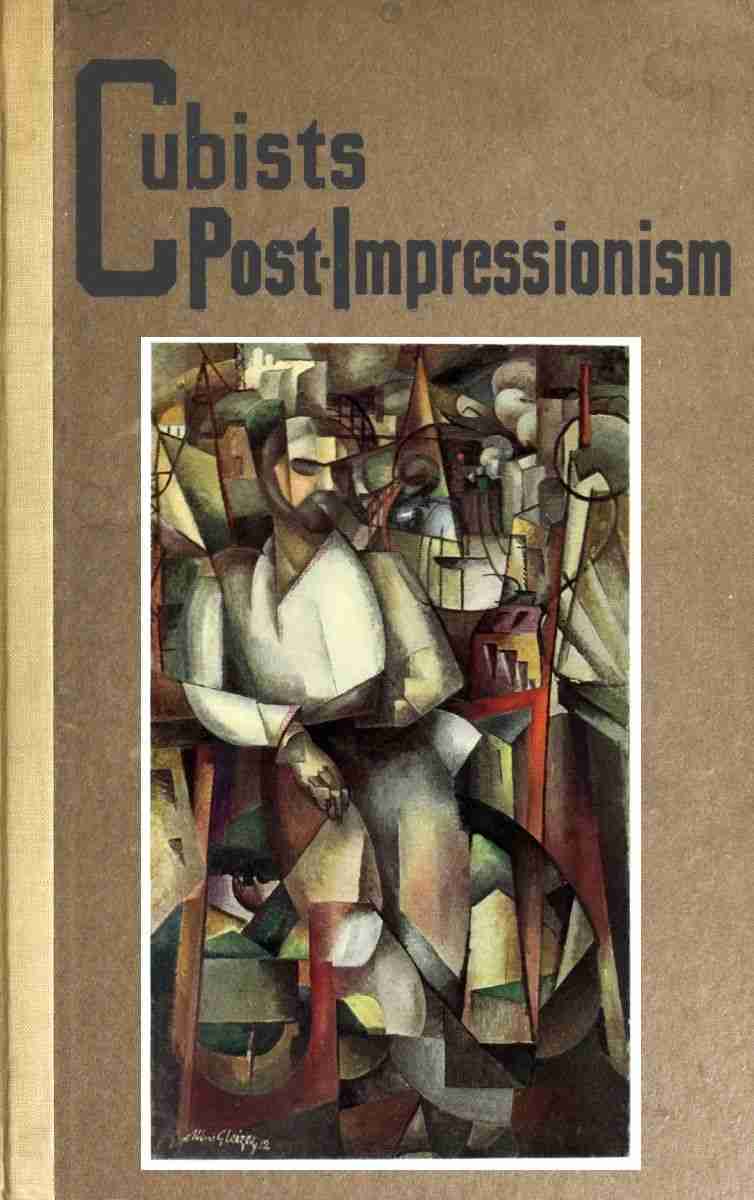
The Project Gutenberg eBook of Cubists and Post-Impressionism
Title: Cubists and Post-Impressionism
Author: Arthur Jerome Eddy
Release date: March 27, 2021 [eBook #64936]
Most recently updated: October 18, 2024
Language: English
Credits: Turgut Dincer, Chuck Greif and the Online Distributed Proofreading Team at https://www.pgdp.net (This file was produced from images generously made available by The Internet Archive)
|
Contents. List of Illustrations Some minor typographical errors have been corrected. (etext transcriber's note) |
CUBISTS
AND POST-IMPRESSIONISM
Cubists and
Post-Impressionism
BY
ARTHUR JEROME EDDY
Author of “Delight, the Soul of Art,” “Recollections and Impressions
of James A. McNeill Whistler,” etc.
With Twenty-three Reproductions in Color of
Cubist and Post-Impressionist Paintings,
and Forty-six Half-Tone
Illustrations
CHICAGO
A. C. McCLURG & CO.
1914
Copyright
A. C. McClurg & Co.
1914
Published March, 1914
W. F. HAL. PRINTING COMPANY, CHICAGO
the beating of whose restless wings
is heard in every land
CONTENTS
ILLUSTRATIONS
CUBISTS AND POST-IMPRESSIONISM
ALAS! ALAS!!
“It is unlikely that any painters will ever again have to face the hostility which was manifested against the Impressionists. The repetition of such a phenomenon would be impossible. The case of the Impressionists, in which withering scorn yielded place to admiration, has put criticism on its guard. It will surely stand as a warning, and ought to prevent the recurrence of a similar outburst of indignation against the innovators and independents whom time may yet bring forth.”
—“Manet and the French Impressionists,”
by Theodore Duret, pp. 180, 181.
Cubists and Post-Impressionism
I
A SENSATION
SINCE the exhibit at the Columbian Exposition (1893) nothing has happened in the world of American art so stimulating as the recent INTERNATIONAL EXHIBITION OF MODERN ART. New York and Chicago, spring of 1913.[1]
“Stimulating” is the word, for while the recent exhibition may have lacked some of the good, solidly painted pictures found in the earlier, it contained so much that was fresh, new, original—eccentric, if you prefer—that it gave our art-world food for thought—and heated controversy.
Art thrives on controversy—like every human endeavor. The fiercer the controversy the surer, the sounder, the saner the outcome.
Perfection is unattainable. As man in his loftiest flight stretches forth his hand to seize a star he drops back to earth. The finer, the purer the development of any art the more certain the reaction, the return to elemental conditions—to begin over again.
The young sculptor looks at the chaste perfection of Greek sculpture and says, “What is the use? I will do something different.” The young painter looks at the great painters of yesterday and exclaims, “What is the use? I cannot excel them in their way; I must do something in my own way.” It is the same in business; the young merchant studies the methods of the successful men in his line and says, “It is idle for me to copy their methods. I will do something different, something in my own way,” and he displays his goods differently, advertises differently, conducts his business differently, and if successful is hailed as a genius, if a failure he is regarded as a visionary or an eccentric—the result making all the difference in the world in the verdict of the public.
Painting today is a terrible problem to an absolutely sincere, honest, and yet ambitious mind.
Fired to set forth something of his very own, to avoid plagiarism and give the world something it has never yet received, the artist, in whatever direction he advances, finds the horizon bounded by a great master whom he cannot hope to surpass. Well, indeed, may he ask what is the use of trying to do what Van Eyck, Botticelli, Vermeer, Rembrandt, Veronese, Michael Angelo, Velasquez—nay, even what Constable, Corot, Claude Monet, and Signac have done to perfection?
In despair at surpassing the limits set by the great masters of progress he harks back, as the pre-Raphaelites did, to the painters before Raphael. Alas, Fra Lippi and Taddeo Gaddi are soon found to be too sophisticated. He goes back farther, to Giotto, to Orcagna, even to the Egyptians, and with the same result. At last he takes his courage in his hands and, throwing overboard the whole cargo of art history, ancient and modern, he seeks to forget that picture was ever painted, and with eyes freed from traditional vision he seeks to recreate the barbaric art of infancy.
Call this man an extremist if you like, but do not lightly dub him insincere and charlatan. He is the counterpart in art of the extremist in politics, the man who has no patience with palliative measures, who demands the whole loaf and nothing but the loaf, who kicks savagely away the fragments of bread tendered him by the moderate and respectable. A dangerous man he may be, but he is no trifler; and, if he succeeds in his purpose, as extremists sometimes do, the whipped world at his feet hails him as reformer and benefactor of humanity.[2]
The Columbian Exposition gave American art a tremendous impetus forward, but of late it has been getting a little smug; the International Exhibition came and gave our complacency a severe jolt.
The net result is that American art has received another impulse forward; it will do bigger and finer and saner things. It will not copy the eccentricities, the exaggerations, the morbid enthusiasms of the recent exhibition, because America as yet is not given to eccentricities and morbidness—though it may be to a youthful habit of exaggeration. America is essentially sane and healthful—say quite practical—in its outlook, hence it will absorb all that is good in the extreme modern movement and reject what is bad.
Neither our students nor our painters will be carried off their feet but they will be helped onward. They will be helped in their technic, and they will see things from new angles, they will be more independent, in short they will be better and bigger painters.
They will not be Cubists, Orphists, or Futurists, but they will absorb all there is of good in Cubism, Orphism, Futurism—and other “isms;” and bear in mind it is the ist who is always blazing a trail somewhere; he may lose himself in the dense undergrowth of his theories but he at least marks a path others have not trodden.
The recent exhibition was not an isolated movement. There are no isolated movements in life. The International Exhibition was just as inevitable as the Progressive political convention of 1912 in Chicago.
The world is filled with ferment—ferment of new ideas, ferment of originality and individuality, of assertion of independence. This is true in religion, science, politics as well as in art. It is true in business. New thought is everywhere. The most radical suggestions are debated at the dinner table. In politics what would have been considered socialistic twenty years ago is accepted today as reasonable. To the conservative masses these new departures may seem like a wild overturning of all that is sacred, but there is no need for fear; all that is really sound will gain in the end.
Neither Cubism, Futurism nor any other “ism” troubles the really great painter; it is the little fellow who fumes and swears.
The poise of the great man is not at all disturbed by the eccentric and the bizarre; on the contrary he looks with a curious eye to see if something of value may not be found.
Whistler would not have painted Cubist pictures, but having known the man I can say that nothing there may be of good in Cubism would have gotten by the penetrating vision of that great painter.
It is characteristic of the little man to ridicule or resent everything he does not understand; it is characteristic of the great man to be silent in the presence of what he does not understand.
Just now the older men are violently opposed to the newer; there is no attempt at understanding and there is abundant ridicule instead of sympathy.
This is inevitable and quite in accord with human nature, but it is a pity. The old and the new are not rivals; the new is simply a departure from the old, simply an attempt to do something different with line and color. The older men should watch the younger with keenest interest; they may feel sure the new is foredoomed to failure, but that is no cause for rejoicing; on the contrary the older man should always be sorry to see the soaring flights of youth come to grief.
Because a man buys a few Cubist pictures it must not be assumed he is a believer in Cubism.
Because a man has a few books on socialism or anarchism in his library we do not assume he is a socialist, or an anarchist; on the contrary it is commonly assumed he is simply broadly and sanely interested in social and political theories. The radical may not convince me he is right, but he may show me I am wrong.
The man who flies into a passion at pictures because they are not like the pictures he owns is on a par with the man who flies into a passion at books because they are not like the books he owns—the world is filled with such men, unreceptive, unresponsive; many intelligent in their narrow way, but bigoted.
To most men a new idea is a greater shock than a cold plunge in winter.
Personally I have no more interest in Cubism than in any other “ism,” but failure to react to new impressions is a sure sign of age. I would hate to be so old that a new picture or a new idea would frighten me.
I would like to own Raphaels and Titians and Rembrandts and Velasquezes, but I can’t afford it. I say I would like to own them; no, I would not, for I have the conviction that no man has the right to appropriate to himself the work of the great masters. Their paintings belong to the world and should be in public places for the enjoyment and instruction of all.
It is the high privilege of the private buyer to buy the works of new men, and by encouraging them disclose a Rembrandt, a Hals, a Millet, a Corot, a Manet, but when the public begins to want the pictures the private buyer, instead of bidding against the public, should step one side; his task is done, his opportunity has passed.
Most men buy pictures not because they want them, but because some one else wants them.
The man who gives half a million for a Rembrandt does so not because he knows or cares anything about the picture, but solely because he is made to believe some one else wants it $450,000 worth.
Read this:
The crowning event of the day was the sale of Rembrandt’s “Bathsheba.” The bidding started at 150,000 francs and within a couple of minutes a perfect whirlwind of bids had carried the price to 500,000 francs offered by a dealer, Mr. Trotti.
Already the smaller fry among the bidders had been eliminated and the contest was circumscribed to a small group, Messrs. Duveen, Wildenstein, Tedesco, Muller and Trotti being the most ardent in the battle.
“Six hundred thousand!” cried Mr. Duveen.
“Six hundred and fifty thousand,” said Mr. Wildenstein.
Mr. Duveen replied with a nod which meant the addition of another 50,000. Then with bids of 10,000 and 25,000 the price mounted, the struggle developing into a duel between Mr. Wildenstein and Mr. Duveen. Eight hundred thousand francs was reached and left behind; 900,000 francs in turn was passed.
“Nine hundred and fifty thousand,” rapped out Mr. Duveen.
“Nine hundred and sixty thousand,” responded Mr. Wildenstein.
Then came “nine hundred and seventy thousand” and “nine hundred and eighty thousand.” By this time the entire gathering was spellbound by the spectacle of the gladiatorial contest for the picture.
“Nine hundred and ninety thousand,” said Mr. Wildenstein.
There was an instant of silence.
“A million!”
Every eye turned from the speaker, Mr. Duveen, to gaze on Mr. Wildenstein expectantly. Then there was silence, signifying his withdrawal from the fight.
A mighty hubbub arose. The Rembrandt had been knocked down to Mr. Duveen for a million francs, or, with the commission, 1,100,000 francs. Never has such a price been given for a Rembrandt.
This is not dealing in art, it is art on the horse-block.
Here is the record of that one painting:
| 1734—Sold at Antwerp for | $109 |
| 1791—Sold at Paris for | 240 |
| 1814—Sold at London for | 525 |
| 1830—Sold at London for | 790 |
| 1831—Sold at London for | 792 |
| 1832—Sold at London for | 1,260 |
| 1841—Sold at Paris for | 1,576 |
| 1913—Sold at Paris for | 220,000 |
During the exhibition in New York and Chicago the pictures were the one topic of conversation; for the time being it was worth while to dine out; society became almost animated.
I recall one delightful and irascible old gentleman, critic and painter, who had not had a fresh appreciation for twenty-five years. For him art ended with the Barbizon school. Whistler, Monet, Degas had no sure places.
We all have the courage of others’ convictions.
The new, however good, is always queer; the old, however bad, is never strange.
Most people laugh at new pictures because they are afraid if they don’t laugh at the pictures, other people will laugh at them.
Now and then a man laughs at a queer picture because he can’t help it, he is a joy.
Laughter is the honest emotion of the child, on the grown-up it is often a mark of ignorance.
It is so easy to ridicule what one does not understand and dares not like.
Laughter never stops to think—if it did there would be less laughter.
If you feel like laughing at a picture, laugh by all means, it will do you good, but be sure you really feel like laughing, and to make sure ask yourself this question, “If that picture were the only one in the room and I were alone with it would it strike me as laughable?”
It always takes just about so many years. What happened with the Barbizon School happened with Impressionism; what happened with Impressionism, will happen with Post-Impressionism; what will happen with Post-Impressionism will surely happen with post-post-Impressionism, and so on. One movement follows another, as season follows season. Life is rhythm.
Each generation thinks itself unique in its experiences.
We go to an exhibition of cubist pictures and we think nothing like that ever happened before, hence we feel safe in denouncing them.
We admit England was wrong when it ridiculed Turner, that France was wrong when it ridiculed Corot, that Paris was wrong when it derided Millet, Manet, Monet, Degas, and a host of other great men, but we are not wrong when we deride the new men. Why? Because we think they are newer and stranger than the men named.