
“What a pity it is that there is no law permitting the taking of legal action against painters who cultivate hatred of beauty in the public mind. These painters are the advance-guard artists and the Cubists.” M. Mourey neglected to tell us if the legal action which he proposes to us would be civil or penal. In our opinion, it would be necessary to make a distinction: The rich painters might be condemned to pay a penalty, and, so that the Government might not be liable to lose its rights where there is nothing, the poor painters might be hung up high and short.
Oh, tolerance! oh, progress! oh, the twentieth century!
In connection with the controversy “L’Art Décoratif” quoted the following letter from Boucher to his pupil Fragonard: “My dear Fragonard: You are going to see in Italy the works of Raphael, Michael Angelo, and their imitators; I say to you in confidence and as a friend, if you take these people seriously you are lost.”
Not the least interesting and amusing feature of the lively article from which the above extracts are taken is its own denunciation of the cubists en bloc.
It resolutely assails the more orthodox critics for what they say about all the moderns it likes and then it echoes their language in its own condemnation of a body of men who are striving earnestly in their way to do things.
Oh! twentieth century!”
One has only to group the conflicting opinions of great painters and critics to see how much depends upon the point of view and the personal equation.
To say certain pictures are worthless is a matter of individual taste and judgment; they may be worthless to me and not to you, just as clothes one man likes another would refuse to wear.
But to say a school or a movement, irrespective of particular works, is a worthless movement involves not one’s taste but one’s philosophy of life; it involves the proposition that a movement in art that challenges the attention of the art-world is so devoid of force of any kind that it is unworthy attention—an obvious contradiction.
Cubism has produced a lot of inane, uninteresting, and ugly pictures, pictures hopelessly bad in both line and color, but it has also produced pictures that are fine in line and color; but whether a particular picture is good or bad is of no importance whatsoever in comparison with the larger and more vital question:
What is the relation of Cubism to the art of today and tomorrow?
When the Société Nationale des Beaux-Arts was founded in 1890 in a spirit of revolt against the old Salon Société des Artistes Français—which dates its expositions from 1673—the schism was complete and the movement was denounced as revolutionary. The art world was divided into two bitterly hostile camps. The two Salons seemed absolutely irreconcilable.
Now they exhibit side by side in practically the same building. The visitor can stand in the main gallery of the one and gaze into the galleries of the other. The only distinctions are separate catalogues and an extra charge of a franc or two if you wish to pass from the one to the other.
Passing from the old Salon to the newer, one still has—to a slight degree—the feeling of passing from older and more conservative pictures to a newer, lighter, and somewhat more modern collection. And there is a difference but it is so slight that casual visitors do not notice it. In fact nine out of ten who visit the two Salons would think they were in but one exhibition, selected and arranged by the same committee, were it not for the additional fee and the two catalogues.
There is no reason today why the two Salons should not coalesce and make one exhibition.
In less than twenty-five years the older has absorbed much of what was good in the revolutionary force of the younger, and so much of the revolutionary enthusiasm of the younger has subsided that the members of the new Société fight side by side with the members of the old against the two more radical exhibitions, the Salon d’Automne, organized in 1903, and the Société des Artistes Independents, organized in 1884.
In time the Salon d’Automne will become quite as conservative as the two older Salons and there will be no reason why it should not exhibit and coalesce with the older.
What is happening in Paris has happened in Munich. The Munich Secessionists, once denounced as aesthetic anarchists, have so far subsided that they exhibit with the academic painters, retaining a faint show of identity by having the word “Secessionist” over the doors of the few rooms they fill.
The old Secession having subsided, the “Neue Sezession” has been organized by “Die Wilden” of Munich and that is now rampant; in ten or twenty years it will be absorbed in the main stream and a still newer secession challenge attention—and so on to the end of progress, for progress depends upon new and newer and ever newer departures. Already there is a division in the New Secession; the “Blue Riders” have withdrawn.
Months after the above was written the London correspondent of the “Chicago Tribune”—Nov. 2, 1913—wrote as follows about the post-impressionist exhibition in the Grafton Galleries:
Many of the pictures which would have provoked happy laughter three years ago now look quite ordinary. The public is inured to them as much as it is inured to Whistler or Degas, and in a little time some of them will be dealers’ pictures, just like the works of the Barbizon school.
There is, for instance, nothing extraordinary about the “Interior of a Café,” by VanGogh, except its quiet excellence. It is all seen as justly and yea as newly as a character in one of Tolstoi’s novels. One feels that any one could have painted it who had had the luck to see it so.
The “Boats at Anchor,” also by VanGogh, is merely a sound but not very interesting impressionist picture, and his flower piece is even academic in a delightful way. Cézanne’s “Boys Bathing” is one of those works on which the art of modern painters like M. Friesz is based.
It looks like a representation of something seen instantaneously, and yet at the same time it is all designed like a work of Nicholas Poussin’s.
M. Matisse’s “Joaquina” is timidly skied, but it is not in the least infuriating, like his famous gentleman in pajamas. Indeed, his method here justifies itself at first sight, for by no other means, one feels, could he have expressed the vitality of his sitter so simply and intensely.
M. Friesz’s “Garden at Coimbra” is one of the pictures that would have astonished us all three or four years ago, but which now looks only pleasant and simple. So are the works of M. Marquet and M. Doucet, and even M. Herbin no longer seems a bad joker. The “Polka” and “Waltz” of Mr. Severini, the futurist, are quite agreeable to the eye, if it refuses to allow itself to be puzzled by the mind; but, if futurist paintings can be academic, they are a little academic, or at least systematic. One feels that any one could be taught to do them pretty well in a studio.
Among the water colors there are some pleasant works by M. Doucet and some remarkable experiments by M. Pechstein. The color prints of M. Manzana are more Chinese than Japanese in spirit, especially the print of horses; and the lithographs of M. Matisse may help some earnest beginners to see some merit in his painting. At any rate, any one who looks at them must see that he can draw.
The exhibition contains a good deal of rubbish, but far less than most exhibitions of what is considered orthodox art.
The Salon d’Independants tends to remain radical notwithstanding it was founded so long ago as 1884 because it has but one article in its creed, “the suppression of juries of admission and permission to artists to exhibit freely their works to the judgment of the public.”
By paying five dollars any artist—real or supposed—is entitled to so much space and can fill that space with such pictures as he pleases, irrespective of their merit.
As a result, each exhibition contains original, revolutionary and radical work mixed with an immense amount of painting and sculpture that is hopelessly bad and some positively objectionable.
The continued vitality of the Independent Salon is due to the fact it has no officials or committees to control its exhibitions and check the appearance of radical work.
The three other Salons grow conservative in the natural ageing of their management; they start with all the enthusiasm of youth but as both members and officers get older they tend to monopolize much of the available space for themselves and, naturally, they admit only those newcomers whose work does not detract or distract from their own. That is the history of the Royal Academy in London, of the National Academy in New York, and of every organization the management of which has the right to hang their own and reject the works of others.
In the development of art all these exhibitions have their values. They are not unlike an army in a campaign, with its scouts, its skirmishers, its advance guard, and its more slowly moving main body—in the end it is the main body that does the most work.
The value of every new movement lies in the possibility of its ultimately contributing something to the mass, not in the possibility of its destroying what has been done.
One has but to recall that both Whistler and Manet—to mention no others—were obliged to exhibit in the Salon des Refuses of their day to realize that an independent salon has its place in the art world quite as important as an official; in fact, wherever there is an official exhibition there should be an un-official, or independent, as a natural complement, otherwise the opportunity of the public to see for itself is limited by official discretion.
For instance, it is the rule of the National Academy in New York that every member and associate has the right to hang a picture irrespective of its merits. As the space is limited the chance for new men is small indeed.
Furthermore it is the older men who pass upon the works of the newer and naturally they feel an instinctive aversion to paintings that clash with or distract attention from their own, hence the more radical, the more novel, the more interesting the picture the less chance it has of being accepted. This is both a fault and a virtue in the Academy—the fault and the virtue of extreme conservatism.
To correct the fault other exhibitions, held under freer conditions, are absolutely necessary not only to the progress of artists, young and old, but to stimulate interest in the public, to make the public feel that it is something more than a passive spectator with nothing to say, but on the contrary its sympathetic cooperation and final verdict of approval are desired.
Nothing is more deadly to the art of a country than a single annual official exhibition such, for instance, as that of the Royal Academy in London, or the old Salon as it was thirty years ago in Paris.
The interest of the public is not aroused. The official selection is accepted as a matter of course. What is in the exhibitions is supposed to be good, what is not accepted is supposed to be bad.
As a result, the really good pictures in such exhibitions are not appreciated at their true value, while the poor are bought simply because they are there.
The truth is it requires the new salons, the independent exhibitions to give vitality to the old, to teach the public to appreciate the good in the old.
Good art, like everything else good, springs from controversy, from the assertion of the individual, from the mighty struggle of every sincere and enthusiastic man to convince the world that he is right and that his works and ways are better than those of all other men.
That is just what the new men are striving to do now—each is trying to convince the world he is right, that his methods, his departures, his theories are true.
The Cubist does not admit much of value in the Futurist, while the latter see nothing at all in Cubism. In short the “isms” are more at war among themselves than with the older schools.
Out of the seething conflict of forces good is sure to come; the amount of good depending directly upon the sharpness of the conflict.
V
WHAT IS CUBISM?
WHAT is “Cubism?”
One more name added to the long roll of “movements” in art. Within the memory of living men we have had “Classicists,” “Romanticists,” “Idealists,” “Naturalists,” “Realists,” “Pre-Raphaelites,” and many more.
Today we have the “Neo-Impressionists,” the “Pointilists,” the “Luminists,” the “Futurists,” the “Orphists,” the “Sensationalists,” the “Compositionalists,” the “Synchronists,” the “Cubists”—tomorrow?
New and ever new departures, experiments, achievements.
All of which goes to prove that art is living, for the sign of life is flux.
The other day I saw three well-known American painters standing before a cubist picture laughing; painters of forty years ago would have laughed quite as heartily at the works of each of the three.
The innovation of today is the conventional of tomorrow.
Because the names of Rembrandt and Hals are now household words in art we are quick to assume their pictures were always considered great. Not so.
Just now it is a fad of millionaires to own Rembrandts; consequently he is over-appreciated and ridiculously overpriced.
The bare thought of the scorn that greeted Wagner’s operas, the poems of Browning, and Whitman, sends a cold
chill down our backs, makes us pause in our headlong criticism lest we, too, pillory ourselves.
Violent judgments are good fun, but they often come back to plague us. Of Wagner’s “Meistersinger” Ruskin said:
Of all the bête, clumsy, blundering, boggling, baboon-headed stuff I ever saw on a human stage that thing last night—as far as the story and acting went—and of all the affected, sapless, soul-less, beginningless, endless, topless, bottomless, topsiturviest, tuneless, scrannelpipiest, tongs and boniest doggerel of sounds I ever endured the deadliness of, that eternity of nothing was the deadliest as far as its sound went. I never was so relieved, so far as I can remember, in my life by the stopping of any sound, not excepting railroad whistles, as I was by the cessation of the cobbler’s bellowing; even the serenader’s caricatured twangle was a rest after. As for the great “Lied,” I never made out where it began or where it ended except by the fellow’s coming off the horse block.
From which the inference is not unwarranted that Wagner did not please Ruskin!
Opposed to all movements in art and life is the academic mind, fed on learning, steeped in tradition, hence conservative.
The term is not here used in a reproachful sense; on the contrary, the philosopher lays stress upon the value of the academic in progress; it is the element that preserves; it is the mass upon which humanity rests; it is the old and stable; it is the past upon which the future is built; it is the essential groundwork of new thought and new effort.
The life of the individual passes from the enthusiasms, the radicalisms of youth to the serene and self-satisfied outlook of old age which instinctively opposes novelty and change—the academic attitude.
Youth makes friends with every chance acquaintance, age shuns the strange.
We are all Impressionists and Futurists at some times in our lives, but we tend to petrify. Sclerosis of the arteries is bad, but nothing compared with sclerosis of the emotions. We not only tend to become petrified as we grow older, but even in our youth we have our petrified sides, our hard spots.
However progressive we may be in certain directions we are sure to be stubbornly conservative in others.
The man who laughs at a cubist picture may be a cubist—that is, an innovator—in his profession or business.
The man who is a conservative in religion may be a radical in politics, and vice versa. As a matter of fact most of the followers of Lloyd George in England are the greatest sticklers for the inerrancy and the literal interpretation of the Scriptures, while most of the hide-bound conservatives are exceedingly tolerant toward “modernism” and “higher criticism” in the church.
So it goes. The merchant or manufacturer, the doctor or lawyer who is up to date in business or profession, who is keenly receptive toward the latest and most revolutionary methods, inventions, discoveries, may be—usually is—a hopeless reactionary toward other lines of human endeavor, a hopeless conservative when it comes, for instance, to looking at pictures.
Now and then one meets a man so sympathetically observant and receptive that, like a good rubber ball, he is resilient at all points of contact. But for the most part we are like defective balls, resilient only in spots, and, like rubber, we become less and less resilient with age.
Happy the man or woman who retains until late in life the power to react to new impressions and to experience new emotions.
The trouble with most of us is that even when we do react to new impressions and experience new emotions we are afraid to admit it. If any one of us, while alone in a museum, happened to run across a strange painting or a strange piece of sculpture—say a Javanese or a cubist production—we would not burst out laughing any more than we would laugh at some of the archaic sculptures and primitive works that are found in every great collection. On the contrary, we would probably study it with good healthy curiosity. But when the crowd is about we are afraid to express our curiosity, we are afraid to be honestly and genuinely interested, so we take refuge in laughter, it is so much easier to mask our ignorance with ridicule than confess it by frankly asking for information.
The man who does not understand a play or a book always condemns it.
It would not be difficult to pick out among one’s business acquaintances those who are conservative, that is, academic, and those who are inventive, speculative, venturesome, and so on to the “wild enthusiasts,” “crazy fellows,” who are always doing the unexpected; failing often but sometimes succeeding so brilliantly the world follows in their footsteps.
There is nothing strange about the Cubists—except their pictures. Their pictures strike us as strange because we do not understand them, but if they were simply trying to do what thousands of inventors are trying to do the world over, namely, devise something new to meet the needs of mankind we would laugh at them no more than—and just as much as—the world laughed at the Wright brothers when they were working on the flying machine.
There are romanticists, realists, impressionists, futurists, cubists, in the theater.
The romantic play is an old, but still delightful story. We have had realism on the stage so long it has become almost academic. Just now there is coming from the Scandinavian countries and from Germany and Russia a form of dramatic representation that is essentially Cubist, Futurist, and Orphist in its expression.[33]
This ferment of new ideas is very disturbing to men who are afraid of change, who favor things as they are, who like to go to bed at the same hour and get up at the same hour, to do today what they did yesterday. But the new ideas will not down; they are constantly breaking out in unexpected places and while they may seem to be different ideas when expressed in music, painting, sculpture, poetry, architecture, from those expressed in science, religion, politics, social reform, and business generally, they are not; they are all fundamentally the same, namely, they are the ideas of a progress so rapid and radical it may be revolutionary and in a measure destructive.
In the very nature of things it is not given to many men to be receptive to new ideas in many lines, for that implies thinking for themselves in many lines. The more intense and advanced a man is in one line of thought, the more apt he is to accept ready made the ideas of others in other subjects. It is a saving of time for the radical scientist to accept his politics and religion ready made from those who devote their time to those matters—the scientist does not always do so, but often when he thinks he is asserting his independence by rejecting current beliefs he is doing so without any real ideas and convictions of his own.
What has been said so far has been a plea for tolerance, for a sober suppression of hasty judgment in the presence of the strange.
Few men seem able to control their resentments and risibilities in the presence of paintings that seem to contradict all the teachings and traditions of art; but because they do seem to stand in opposition to all we have been taught to believe, they are all the more worthy our most serious consideration. It is the man who challenges and denies who stirs other men to think for themselves. That is the chief value of the cubist paintings—they compel us to think for ourselves, to take a careful inventory of our stock of stereotyped notions; with the result that while we may not accept the theories of the Cubists, we cannot fail to readjust our own notions on a broader basis.
I would be very sorry if any reader should take up this volume under the impression it is a plea for Cubism or any other “ism” in either art or life. If it is a plea for anything, it is for tolerance and intelligent receptivity, for an attitude of sympathetic appreciation toward everything that is new and strange and revolutionary in life. Not that we will necessarily end by accepting the new and the strange and the revolutionary, but we cannot get the good there may be in them unless our attitude is one of sympathetic as well as critical receptivity.
It is something more than a mere coincidence that the upheaval in the art world has paralleled the upheaval in the political world. The exhibitions of extreme modern pictures were first held in England just when extreme radical theories were gaining the ascendency. The International Exhibition in America followed hot in the footsteps of the split in the Republican party and the triumph of the Democratic along lines so progressive as to seem almost socialistic.
The artists who organized the exhibition did not realize it, but they were animated by precisely the same motive that animated the organizers of the Progressive party—an irresistible desire for a change.
Youth gazes curiously at the experiment—painting, poem, play—from which age turns in anger.
Cubist paintings interest the young; they irritate the old.
Nothing keeps a man young so effectually as a vivid and sympathetic interest in every new and seemingly revolutionary movement.
People who looked at the cubist paintings and laughed did so through ignorance; the sad part was that many frankly said they did not care to understand; not a few insisted the paintings were quite without meaning, utterly devoid of sense.
In other words, the public, day after day and week after week, struggled and paid to see works that were meaningless!
Painters, sculptors, critics, argued and fought over canvases devoid of significance! A paradox! For if devoid of significance, why should the world of artists, critics, writers, argue, swear, and fight over them?
The question answers itself; the trouble is the works do possess a significance, a significance far beyond the merits of any particular one, far beyond the merits of cubism itself; they are significant of the spirit of change that is within and about us, the spirit of unrest, of the striving, of the searching for greater and more beautiful things.
Cubism will pass away, but the spirit of change will not pass away. One enthusiasm will follow another enthusiasm so long as men possess ambition.
Already there are signs that Cubism is passing. Some of the men are calling themselves Neo-Cubists and Post-Cubists, and they are painting in very different manner.
One has but to look at a series of Picasso’s work to see how often and radically he has changed his style in these ten years from drawing and painting with great facility and success in Impressionistic and Neo-Impressionistic manner to the most abstract Cubism; what he will be doing two years hence, no one can predict, save that, judging by the past, he will not be painting Cubist pictures.
The name “Cubism” was given to the new school “in derision, in the autumn of 1908, by Henri Matisse, who happened to see a picture of buildings the cubical representation of which struck him forcibly.”[34]
That year Georges Braque exhibited a Cubist picture in the Salon des Independents.
In 1910, Jean Metzinger exhibited a Cubist portrait in the Salle d’Automne, and a number of pictures were hung in the Salon des Independents.
The first collection was gathered together in room 41 at the Salon des Independents in 1911. The same year the first exhibition outside of Paris was held in Brussels, and there the names “Cubism” and “Cubistes” were adopted.
In 1911 the exposition of the Cubists in the Salle d’Automne caused considerable sensation. Gleizes, Metzinger, Leger, and, for the first time, Marcel Duchamp and his brother, the sculptor-architect, Duchamp-Villon, exhibited.
Other expositions were held in November, 1911, at the gallery d’Art Contemporaine rue Tronchet; in 1912, at the Salon des Independents, where Juan Gris first exhibited; in May of the same year, in Barcelona; in June, at Rouen, where Picabia joined the new school.
The different tendencies of the movement are described as follows:[35]
1. Cubism scientifique is the tendency toward pure cubism; it is the painting with elements borrowed not from the realities of vision, but the realities of knowledge. The geometrical lines, which so impressed all who first saw their scientific works, resulted from the attempt to paint the essential—rather than the visual—realities of things which were rendered on canvas with an abstract purity, and in which objective realities and story-telling qualities were eliminated.
Most of Picasso’s geometrical representations and Duchamp’s “King and Queen” are good illustrations of scientific or pure Cubism.
2. Cubism physique is painting compositions the elements of which are borrowed for the most part from realities of vision. Inasmuch as objective realities are more or less in evidence in these works, they are not pure Cubism.
Picasso’s “Woman and the Pot of Mustard” is a very striking—and indifferent—example of Cubism physique, which simply means cubist paintings in which figures and objects are more or less apparent to the casual observer. In Marcel Duchamp’s “Chess Players” the figures are quite plain; in Picabia’s “Dance at the Spring” one figure is distinguishable at first glance, the second is not so easily discerned, while the spring is more obscure, though plain enough after a little study.
It is under this head that some of the most interesting
and also some of the most exasperating cubist pictures will be found. To the extent that figures and objects are blocked in in planes and masses in a big, elemental way, the result may be both impressive and beautiful—Derain’s “Forest at Martigues” is an example in point; but in so far as the picture is a puzzle, clear only in part, the result is exasperating; the observer, however sympathetic his attitude, is diverted from enjoying the art of the painter to the attempt to discover the hidden objects.
To the foregoing two divisions are added two more, which are, in reality, but subdivisions or refinements of Cubism Scientifique.
There are really but the two extremes—those who represent objects more or less cubically, i.e., in planes and masses of line and color; and those who compose harmonies of line and color that have no relation to figures or objects.
In the paintings of the one, objects are more or less apparent; in those of the other no object is discernible, because none is represented or suggested.
3. Cubism Orphique is created entirely by the artist; it takes nothing from visual, objective realities, but is derived wholly from the painter’s imagination; it is pure art.
4. Cubism instinctive is described as the painting of compositions of color, not based upon objective realities, but suggested by the instinct and intentions of the artist. The artist who follows his instinct, his fancy of the moment, though he may paint beautiful compositions, lacks the clear comprehension of him who paints according to some well thought out, artistic creed.
It is quite obvious that subdivisions three and four are based upon temperamental rather than logical or scientific distinctions.
To refer to some of the pictures reproduced:
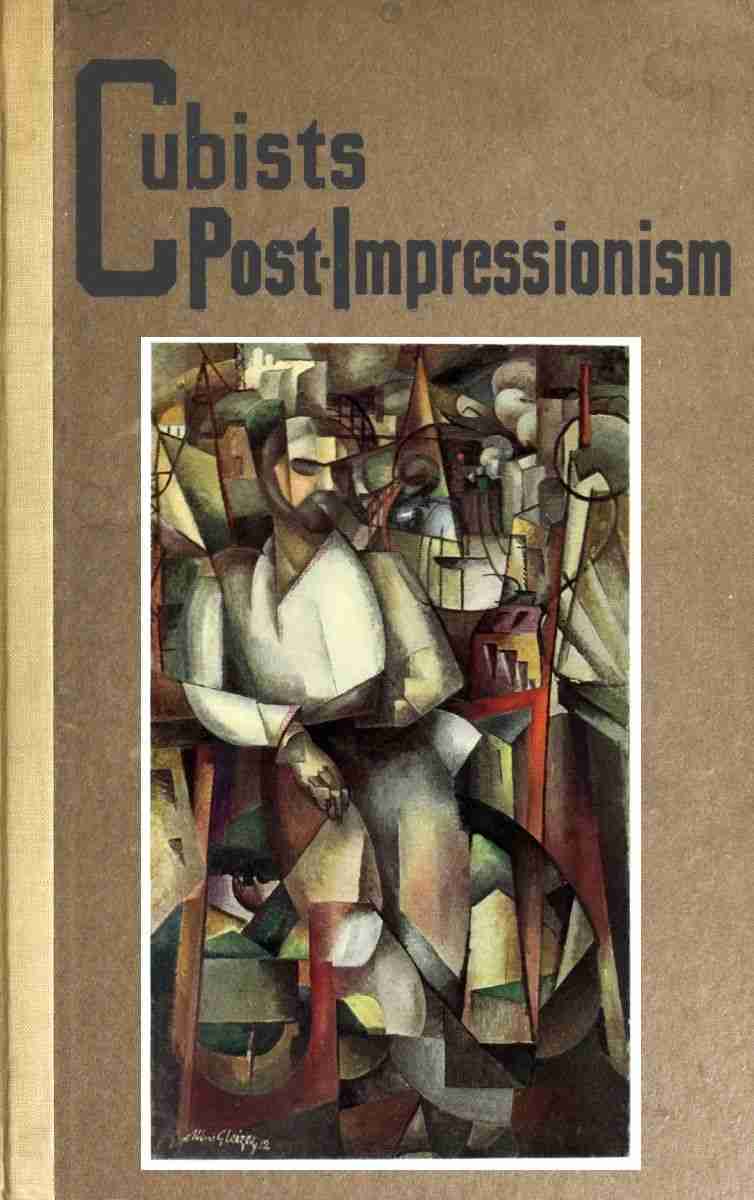
There is no mystery about the “Man on the Balcony.” He is quite in evidence; the background is a little puzzling, yet fairly obvious. The attention of the casual observer is not diverted from the mode and manner of painting—from the Cubism of the picture, so to speak.
It is not a question of “Now I see it, now I don’t see it.” It is obviously the figure of a man leaning on something, apparently a railing, with a confused background. But so far as uncertainty regarding the background and accessories is concerned, that troubles no one, for uncertainty in detail is! characteristic of the backgrounds of many fine and famous portraits.
The point is that the “Man on the Balcony” belongs to that class of Cubist pictures wherein the object is almost as well defined as in pictures with which the public is more familiar; whereas the “King and Queen” belongs to the extreme class wherein the objects have been reduced to symbols or abstractions.
The one is the painting of objects in Cubist fashion; the other is the painting of ideas in Cubist fashion.
Of all the Cubist pictures exhibited, most people liked “The Man on the Balcony” best. Why?
Because it looked like a good painting of a man in armour.
“I like the ‘Man in Armour,’” was an expression frequently heard.
All of which goes to show that appreciation is largely a matter of association rather than of knowledge and taste.
Tell the people it is not a man in armour, and immediately they ask, in a tone of disgust, “Then what is he?” and the picture they liked a moment before becomes ridiculous in their eyes.
The original design is an almost academic freehand drawing of a man—artist or workman—leaning against the railing of a balcony, with roofs of the city at his back. Barring the square treatment of hand and foot, there is little to suggest Cubism.
The drawing is uninteresting, the painting is uninteresting. By blocking out details, emphasizing planes, and laying stress on masses, the artist made his painting incomparably more dignified and stronger than his design.
If he had painted an academic picture, following the lines of his original sketch, the painting probably would have been quite commonplace.
The “Chess Players” gives one a singular impression of human absorption in a game; it is elemental and impersonal. Behind the two players are onlookers, equally intent. One player is resting his chin upon his hand, the other holds a piece apparently making a move. The artist has arbitrarily placed the men and board close to the eye of the player making the move.
While most people might prefer lifelike portraits of two men playing chess, is it not true that this curious reduction of the players to elemental planes and masses gives a very vivid impression of intense absorption, and also a strange feeling of the elemental? A sculptor admired this picture greatly.
Two figures were the basis of the “King and the Queen,” the king at the right, and the queen at the left; but in the finished picture these two figures were reduced to planes, and appear as the two upright conical or cubical masses that are so evident, and a philosophical significance was attributed to the scheme, namely, a representation of the static and dynamic forms of life; the static being represented in the upright masses, the king and queen—dynastic, permanent—while the dynamic forces are represented in the stream of cubical forms that flow in different directions about the two more permanent masses.
On its technical side, Cubism is simply a systematic use of planes.
The power of lines is a manifestation of the new mode of representation.
It is not a semblance of things, but a world of objects that the picture forces us to take in with a glance. The objects may not get lost. The outline is the demarcation and designation of the objects. By its outer essence their inner nature is expressed. The nature of objects is not fixed by a correct drawing, but by a forceful and emotional, intensive and pervasive outline. Not in their restfulness and with their details do the objects serve the picture, but by their relations to each other, which relations combined lead up to the climax.
The long lines form the structure of the picture. They decide how the picture is to be constructed from its parts, and how the parts are to be interlocked in order to become a whole. The long lines define the measure and rhythm of the work. Lines are the vibrations of the soul; lines are reflections of the will, the rigidity of that which endures. Like currents of forces they flow against each other and unite into one. The smaller ones accompany them with playful gambols, like a multiple echo, the sounds of which melt away in the distance.
The picture is not a nicely divided plane. It is like a world arising from chaos. Its essence is the law of order working itself out. The picture is an agglomeration of agitated members, an agglomeration of planes pulsating with blood, enlivened by breath.
The planes may be stratified, parallel and similar to each other; they may rear and pile themselves against each other, or they may interlock like cogs. They may liquefy and melt away, or they may double up and form themselves into balls. They may, more quietly, rest within themselves, becoming effective through the contrast of their essence and yet maintaining themselves. Out of them originates the picture’s spaciousness, out of them the living force of the picture.
The dynamics of the planes is a manifestation of the new style.[36]
Passing one morning among a number of first year students drawing from casts in the Chicago Art Institute, I was struck by the large number who were making what would pass for Cubist sketches; yet not one of these young students had seen a Cubist picture. All were simply following the regular course of instruction and drawing in planes.
I remember one drawing of a statue by Michael Angelo. There was not a straight line in the statue; there was not a curved line in the drawing; the drawing was blocked out far more solidly and geometrically than, for instance, either the original design for “The Man on the Balcony” or the finished painting.
In another room I ran across a teacher who was indicating by a few geometrical lines drawn from points the essential features of a statue the pupil was about to begin blocking in. The lines looked exactly like the geometrical lines in a drawing by Picasso.
There is, therefore, nothing fundamentally new or strange in the technic of the Cubists; it is simply a return to the use of the elemental in drawing, of the very A, B, C of design. The new and the strange lie in the fact that the Cubists stop with planes and lines; they do not attempt to model the surfaces of the things they paint.
Not that the use of planes is all there is to the theory of Cubism, for the theory extends far beyond the painting of surfaces; it embraces the presentation of the very substance and nature of persons and objects by means of a technic in which planes are the vital feature.
Albert Dürer wrote a book on the proportions of the human figure; it was published in 1528, and translated into many languages.
He reduced the human figure to certain elemental lines.[37]