
WeRead Powered by ReaderPub
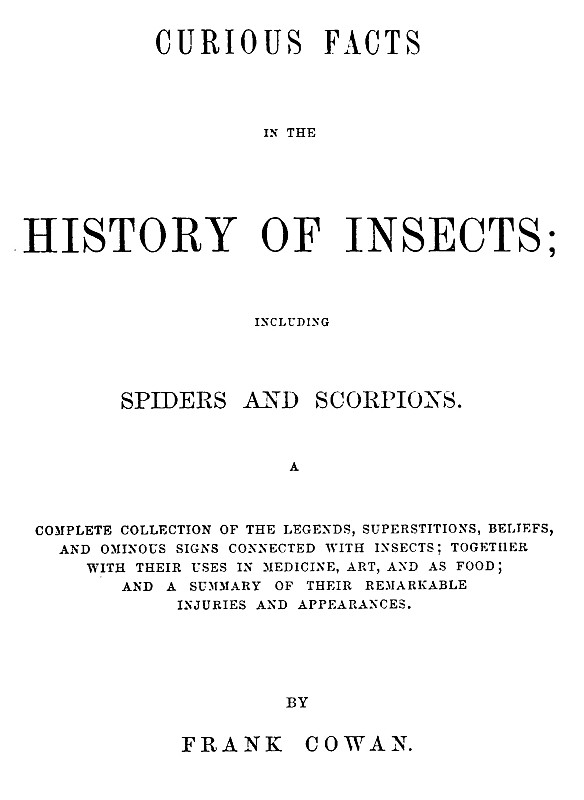
Curious Facts in the History of Insects; Including Spiders and Scorpions. / A Complete Collection of the Legends, Superstitions, Beliefs, and Ominous Signs Connected with Insects; Together with Their Uses in Medicine, Art, and as Food; and a Summary of Their Remarkable Injuries and Appearances. cover

Curious Facts in the History of Insects; Including Spiders and Scorpions. / A Complete Collection of the Legends, Superstitions, Beliefs, and Ominous Signs Connected with Insects; Together with Their Uses in Medicine, Art, and as Food; and a Summary of Their Remarkable Injuries and Appearances.

Chapter 2: PREFACE.
Open in WeRead

About This Book

A compilation of historical, folkloric, and practical material concerning insects, spiders, and scorpions, drawn from chronicles, travel narratives, and scientific sources. Organized by taxonomic groups, it presents legends, superstitions, omens, and anecdotes alongside accounts of medicinal, artistic, and culinary uses and descriptions of injuries or nuisances attributed to particular species. Numerous authorities are cited to document cultural beliefs and remedies connected to specific insects. Emphasizing curious and documentary facts rather than detailed anatomy or classification, the collection surveys human interactions with and attitudes toward many insect families across diverse times and places.

PREFACE.

In the early part of the winter of 1863–4, having the free use of the Congressional Library at Washington, I began the compilation of the present work. It was my prime intent, and one which I have endeavored to follow most carefully, to attach some fact, whatever might be its nature, to as many Insects as possible, to increase the interest, in a commonplace way, of the science of Entomology. I noticed the pleasurable satisfaction I invariably felt when I came accidentally upon any extra-scientific fact, and how the association fixed the particular Insect, to which it related, ineffaceably upon my memory. To collect and group, then, all these facts together, to remember many Insects as easily as one,—was a natural thought; and as this had never been done, but to a very limited extent, I undertook it myself.

The facts contained in this volume are supposed to be purely historical, or rather not to belong to the natural history of Insects, namely, their anatomy, habits, classification, etc. They have been collected mostly from Chronicles, Histories, Books of Travels, and such like works, which, at first view, seem to be totally foreign to Insects: and were only discovered by examination of the indexes and tables of contents.

But are my facts facts?—it may be asked. They are; but I do not vouch for each one’s containing more than one truth. It is a fact, or truth if you will, that Pliny, Nat. Hist. xi. 34, says, “Folke use to hang Beetles about the neck of young babes, as present remedies against many maladies;” but that this statement is entitled to credit, and that these Insects, hung about the necks of young babes, are a present remedy against many maladies, are two things which may be very true or far otherwise. I confine myself to the fact that Pliny says so, and only wish to be understood in that sense, unless when otherwise stated.

The classification of Mr. Westwood, in the arrangement of the orders and families, I have followed as closely as was possible, except in one or two instances: and where Insects have common and familiar names, they have been given together with their scientific ones.

To Dr. J. M. Toner, of Washington, for his suggestions and assistance in collecting material, I tender my thanks; the same also to N. Bushnell, Esq., and Hon. O. H. Browning, of Quincy, Ill., for the use of their several libraries.

I am much indebted, too, to Mrs. A. L. Ruter Dufour, of Washington, for many superstitions and two pieces of poetry contained in this volume. I beg her to accept my thanks.

Greensburg, Penna.,
July 10th, 1865.

CONTENTS.

Authors Quoted 9
COLEOPTERA—BEETLES.
Coccinellidæ—Lady-birds 17
Chrysomelidæ—Gold-beetles 23
Carabidæ 23
Pausidæ 23
Dermestidæ—Leather-beetles 24
Lucanidæ—Stag-beetles 24
Scarabæidæ—Dung-beetles 27
Dynastidæ—Hercules-beetles, etc. 45
Melolonthidæ—Cock-chafers 47
Cetoniidæ—Rose-chafers 49
Buprestidæ—Burn-cows 50
Elateridæ—Fire-flies, Spring-beetles, etc. 51
Lampyridæ—Glow-worms 55
Ptinidæ—Death-watch, etc. 58
Bostrichidæ—Typographer-beetle, etc. 61
Cantharidæ—Blister-flies 62
Tenebrionidæ—Meal-worms 65
Blapsidæ—Church-yard-beetle, etc. 65
Curculionidæ—Weevils 68
Cerambycidæ—Musk-beetles 72
Galerucidæ—Turnip-fly, etc. 74
EUPLEXOPTERA.
Forficulidæ—Ear-wigs 76
ORTHOPTERA.
Blattidæ—Cockroaches 78
Mantidæ—Soothsayers, etc. 82
Achetidæ—Crickets 92
Gryllidæ—Grasshoppers 98
Locustidæ—Locusts 101
NEUROPTERA.
Termitidæ—White-ants 132
Ephemeridæ—Day-flies 138
Libellulidæ—Dragon-flies 138
Myrmeleonidæ—Ant-lions 141
HYMENOPTERA.
Uroceridæ—Sirex 142
Cynipidæ—Gall-flies 143
Formicidæ—Ants 146
Vespidæ—Wasps, Hornets 170
Apidæ—Bees 174
LEPIDOPTERA.
Papilionidæ—Butterflies 216
Sphingidæ—Hawk-moths 232
Bombicidæ—Silkworm-moths 234
Arctiidæ—Woolly-bear-moths 242
Psychidæ—Wood-carrying-moth, etc. 245
Noctuidæ—Antler-moth, Cut-worm, etc. 246
Geometridæ—Span-worms 248
Tineidæ—Clothes’-moths, Bee-moths, etc. 248
HOMOPTERA.
Cicadidæ—Harvest-flies 250
Fulgoridæ—Lantern-flies 255
Aphidæ—Plant-lice 257
Coccidæ—Shield-lice 259
HETEROPTERA.
Cimicidæ—Bed-bugs 265
Notonectidæ—Water-boatmen 275
DIPTERA.
Culicidæ—Gnats 278
Tipulidæ—Crane-flies 286
Muscidæ—Flies 287
Œstridæ—Bot-flies 302
APHANIPTERA.
Pulicidæ—Fleas 305
ANOPLEURA.
Pediculidæ—Lice 316
ARACHNIDÆ.
Acaridæ—Mites 321
Phalangidæ—Daddy-Long-legs 321
Pedipalpi—Scorpions 321
Araneidæ—True-spiders 332
Miscellaneous 363
Index 373