
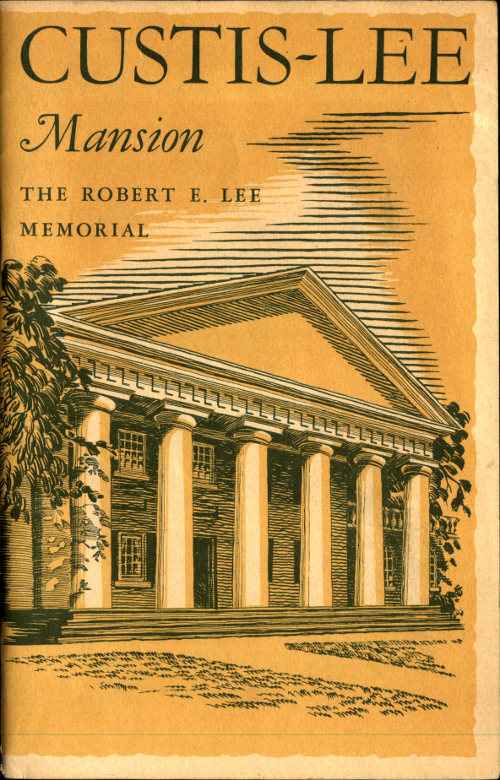
The Project Gutenberg eBook of Custis-Lee Mansion: The Robert E. Lee Memorial, Virginia
Title: Custis-Lee Mansion: The Robert E. Lee Memorial, Virginia
Author: Murray H. Nelligan
Release date: November 29, 2015 [eBook #50570]
Most recently updated: October 22, 2024
Language: English
Credits: Produced by Stephen Hutcheson, Dave Morgan and the Online
Distributed Proofreading Team at http://www.pgdp.net
UNITED STATES DEPARTMENT OF THE INTERIOR
Stewart L. Udall, Secretary
NATIONAL PARK SERVICE
Conrad L. Wirth, Director
HISTORICAL HANDBOOK NUMBER SIX
This publication is one of a series of handbooks describing the historical and archeological areas in the National Park System administered by the National Park Service of the United States Department of the Interior. It is printed by the Government Printing Office and may be purchased from the Superintendent of Documents, Washington 25, D. C. Price 25 cents.
CUSTIS-LEE MANSION
The Robert E. Lee Memorial
VIRGINIA
by Murray H. Nelligan
NATIONAL PARK SERVICE HISTORICAL HANDBOOK SERIES No. 6
WASHINGTON, D.C., 1950 (REVISED 1962)
The National Park System, of which Custis-Lee Mansion is a unit, is dedicated to conserving the scenic, scientific, and historic heritage of the United States for the benefit and enjoyment of its people.
Contents
- Page
- History of Arlington to 1861 1
- Arlington from 1861 to 1865 24
- Arlington from 1865 to the Present 26
- Guide to the House and Grounds 28
- Visitor Service and Facilities 46
- Administration 47
- Suggested Readings 48
General Robert E. Lee in 1865. From the original photograph by Mathew Brady in the National Archives.
Ever since it was built more than a century ago, the Custis-Lee Mansion has dominated the scene across the river from the National Capital. An outstanding example of a Greek Revival building of the early nineteenth century, its dignity and strength, simplicity and steady grace, now make it a most appropriate national memorial to one of America’s greatest men, Robert E. Lee.
Built by his father-in-law, George Washington Parke Custis, the adopted son of General Washington, the mansion was for many years a principal repository of many objects associated with George Washington. As such, it greatly influenced Robert E. Lee when the building was his home. Like him, it experienced the vicissitudes of war and came to be associated with his fame. Now it is maintained by the Nation in his honor, and in the years to come will serve as a constant reminder of his nobility and greatness.
Many years have passed since General Lee lived in the home at Arlington. But so real are the memories evoked by its historic atmosphere, it seems little more than yesterday that he left it for the last time. A visit to the Custis-Lee Mansion gives a deeper, more personal understanding of the life and worth of the man to whose memory it is now dedicated.
History of Arlington to 1861
ANCESTRY OF GEORGE WASHINGTON PARKE CUSTIS. George Washington Parke Custis was born April 30, 1781. His mother was Eleanor (Calvert) Custis, a granddaughter of the sixth Lord Baltimore; his father, John Parke Custis, the only son of Martha Washington by her first marriage. John Parke Custis grew to manhood at Mount Vernon, married Eleanor Calvert in 1774, and died of camp fever in 1781 while serving as aide to General Washington at Yorktown. His death left four children fatherless, so the two youngest, George Washington Parke Custis and his sister Eleanor, were adopted by the Washingtons and taken to Mount Vernon to be raised as their own.
HIS EARLY LIFE AT MOUNT VERNON. Only 6 months old when he was taken to live at Mount Vernon, it was a remarkable experience for a boy as sensitive and gifted as young Custis to grow up on terms of intimacy with General Washington, whose affection the fatherless lad reciprocated with the deepest love and respect. As far as public duties would allow, the General supervised the training and education of the boy, who acquired from him the interests and ideals which established the pattern of his life. “It is really an enjoyment to be here to witness the tranquil happiness that reigns throughout the house,” wrote a guest at Mount Vernon in 1799, “except when now and then a little bustle is occasioned by the young Squire Custis when he returns from hunting, bringing in a ‘valiant deer’, as he terms it, that Grandpa and the Colonel will devour: nice venison I assure you.”
GEORGE WASHINGTON PARKE CUSTIS MOVES TO ARLINGTON. Custis was 18 when the General died in 1799. Mrs. Washington did not long survive her husband, and when she died, early in 1802, Custis moved to “Mount Washington,” as he first called the Arlington estate. This was a tract of nearly 1,100 acres that Custis’ father had bought in 1778 with the intention of establishing a family seat convenient to Mount Vernon, but in 1802 the only tangible remains of his brief ownership were the flourishing willows he had planted along the Potomac.
“ARLINGTON HOUSE” BEGUN. When Custis moved into a cottage built by the former owners of the property, Arlington consisted mostly of woodland and virgin oak forests, with a few cleared fields near the river. His first concern was to get the fields under cultivation, using for the purpose the mules and farm equipment he had purchased at the sales held that year at Mount Vernon to settle the legacies of the several Washington heirs. Equally urgent was the need to build a house worthy of the furnishings and mementoes which he had inherited or bought at the Mount Vernon sales, some of which were deteriorating badly in their temporary quarters. To this end, he seems to have obtained building plans from George Hadfield, a gifted young architect, who had come from England in 1795 to take charge of the construction of the Capitol.
Influenced by the contemporary vogue for classical architecture, Custis wanted his house to be in the new style, and the architect’s finished design was a simplified Greek Doric portico balanced by extended wings, the whole of such sturdiness as to show to advantage when viewed from across the river. Since ornamentation would be lost at such a distance, the architect largely dispensed with it, relying on good proportions to give beauty to his creation. Rooms would be large and have high ceilings and tall windows, and their severely plain walls would be perfect for displaying the many portraits Custis possessed. Having the rooms open into each other would give extensive vistas, framed by pleasing semicircular arches.
Early view of Mount Vernon.
George Washington Parke Custis. From a miniature made at Mount Vernon in 1799.
Though clay for bricks and choice timber were at hand on his estate, Custis lacked the money necessary to build his house all at once. Therefore he followed the common practice of building the wings first, and the main section later. The north wing was built about 1803, and was evidently intended to be one great banquet room. By 1804, the south wing was completed, containing an office and a large room for entertaining. In that year Custis married Mary Lee Fitzhugh. To provide living quarters for himself and his bride he had the north wing partitioned into three small rooms. With a kitchen and laundry in the basement, the young couple had the essentials of living at “Arlington House,” as Custis named his new home, after the old family seat on the Eastern Shore. At this point, work seems to have been stopped. A visitor reported in 1811, “I was struck, on entering the grounds of Mr. Custis, at Arlington, ... with several of the most picturesque views. This seat is on a superb mount, and his buildings are begun in a stile of superior taste and elegance.”
ARLINGTON AND THE DEVELOPMENT OF AMERICAN AGRICULTURE. While building his house, Custis inaugurated an annual fair designed to improve agricultural practices in general, and particularly the breeding of fine-wooled sheep. Beginning in 1803, Custis invited the local gentry each spring to exhibit their best sheep and homespun cloth at Arlington Spring, near the edge of the river. After prizes had been awarded, the fair would close with patriotic speeches and a great dinner under the tent which had been used by Washington during the Revolution.
“ARLINGTON HOUSE,” AS IT APPEARED FROM ABOUT 1804-1816
By breeding the native stock on his farms with the imported stock he had acquired from Mount Vernon, Custis himself developed a hardy race of fine-wooled sheep, known as the “Arlington Improved.” Because the wool of this breed could be woven into finer cloth than hitherto possible, the Arlington sheep were widely diffused throughout the country. Custis also sought to correct the primitive agricultural methods which had already caused much land in his State to be abandoned because of soil erosion. He advocated the establishment of a National Board of Agriculture with functions like those of the Department of Agriculture today, and he offered one of his outlying properties for use as an experimental breeding station. So popular was the Arlington Sheepshearing, as it was commonly called, that the idea was quickly adopted elsewhere. Though economic conditions forced Custis to discontinue the event after 1812, it was one of the primary sources of the great program of agricultural improvement in effect today.
BIRTH OF MARY ANNA RANDOLPH CUSTIS. Mary Anna Randolph Custis, born in 1808, was the only one of the four Custis children to survive the first year of infancy. Upon her the parents centered their affections and hopes. The mother’s natural piety and devotion to her family were deepened by the loss of her other children, while the father’s warm and generous nature was such that in later years she could not recall ever having received an unkind word from him.
CUSTIS AND THE WAR OF 1812. During the War of 1812, the British blockade of the Chesapeake deprived Custis of much of the income from his other estates, so it is doubtful if any building was done at Arlington at this time. Convinced that Napoleon threatened the liberties of mankind more than England, Custis strongly opposed the war. For this reason he was chosen to deliver the funeral oration for General Lingan, a veteran of the Revolution who was murdered by the same Baltimore mob which almost killed Robert E. Lee’s father, “Light-Horse Harry” Lee. Nevertheless, Custis followed the example set by George Washington during the American Revolution by forbidding the managers of his plantations to furnish supplies to the British; and when British troops approached the National Capital in 1814, Custis fought in the ranks at the battle of Bladensburg.
Arlington Spring, scene of the famous “Sheepshearings.”
“ARLINGTON HOUSE” COMPLETED. After the war, Custis resumed work on his house, and the large center section and great portico were to have been finished in 1817. “A house that any one might see with half an eye,” as Robert E. Lee later described it, could not fail to attract attention, and “Custis’ Folly” is first mentioned by a traveler in 1818. Although the interior was never completed as planned and the rear was left unstuccoed, “Arlington House” was soon considered one of the handsomest residences about Washington. One early writer describes it as “a noble-looking place, having a portico of stately white columns, which, as the mansion stands high, with a back ground of dark woods, forms a beautiful object in the landscape.”
THE MEMORY OF GEORGE WASHINGTON KEPT ALIVE AT ARLINGTON. “Arlington House” now became the successor of Mount Vernon as the “Washington Treasury,” as Custis termed it. His collection of Washington relics was the largest in existence, and it filled the halls and rooms of the mansion. The owner of these relics welcomed all who wished to view them, and he never tired of entertaining his guests with tales of his early years at Mount Vernon. Many distinguished men visited Arlington at one time or other—Sam Houston, Daniel Webster, and Andrew Jackson, to name a few. One of the most notable was General Lafayette, who twice was a guest there when he toured the United States in 1824 and 1825. Custis spent much time with the venerable marquis, and used the wealth of reminiscenses he gained from the old soldier to write the delightful Conversations With Lafayette, which was published in a local newspaper in 1825. Encouraged by their favorable reception, he then began his own Recollections and Private Memoirs of Washington, which proved equally popular and were widely reprinted in the newspapers of the period.
Even more successful were the dramas Custis wrote at this time, based on heroic episodes in the Nation’s past or on inspiring contemporary achievements. The Indian Prophecy used an incident in Washington’s early life as its theme and established a vogue for Indian plays which lasted over 50 years; while the Rail Road was the first one written on that subject in America. Others dramatized such events as the battle of Baltimore and the launching of a new warship. For 10 years his dramatic pieces were staged from Boston to Charleston and did much to develop a distinctive American drama.
An early view of “Arlington House.” From an engraving made about 1845.
A man of culture, Custis used all of his abilities to perpetuate the memory of Washington. He erected the first monument on the President’s birthplace in 1816, wrote poems to celebrate his greatness, and painted colorful battle pictures in which the great General was the central figure. An accomplished orator, he was tireless in advocating the principles of freedom for which Washington had fought, and planned to do with his slaves as his foster father had done—free them after they had been prepared to shift for themselves. Although he never held an elective office, his influence was considerable and for the good.
The tents used by General Washington during the American Revolution were cherished relics at Arlington. From B. J. Lossing, “Arlington House,” Harper’s Monthly Magazine, VII (Sept. 1853), 444.
HOME LIFE AT ARLINGTON. An equal source of inspiration at “Arlington House” was the religious atmosphere of its home life. Mrs. Custis was a devout Episcopalian, noted for her simplicity and piety. It was she who influenced Robert E. Lee’s Sunday school teacher, Bishop William Meade, to enter the ministry. Diligent where her husband was inclined to be easy-going, Mrs. Custis was one with him in making Arlington free from ostentation.
Kept unspoiled by her parents’ example, Mary Custis was given the education deemed necessary for a young lady of her position, and as soon as she was old enough herself taught the children of nearby families and family servants. Though an only child, she never lacked companionship, for usually the house overflowed with relatives and their children. The Custises, too, often went visiting, especially to “Ravensworth,” formerly the home of Mrs. Custis’ father and now owned by her only brother. Here Mary must have played as a child with Robert E. Lee, for he and his mother were also related to the Fitzhughs and often visited at their estate. The Lees were familiar with Arlington as well, for Robert was a favorite with the Custises from boyhood. He and Mary Custis are said to have planted some of the trees in the vicinity of the house when they were young.
Title page of the 1830 edition of Curtis’ most popular play.
POCAHONTAS!
OR,
THE SETTLERS OF VIRGINIA,
A NATIONAL DRAMA,
IN THREE ACTS.
Performed at the Walnut Street Theatre, Philadelphia, twelve nights, with great success.
WRITTEN BY
GEORGE WASHINGTON CUSTIS, ESQ.
Of Arlington House. Author of the Rail Road, Pawnee Chief, &c. &c.
PHILADELPHIA EDITION.
© ALEXANDER, PR.
:::::::
1830.
MARRIAGE OF MARY CUSTIS AND ROBERT E. LEE. Childhood friendship turned to love by the time Lee graduated from West Point and was assigned to duty in the Corps of Engineers. Whenever possible he was at Arlington courting Mary Custis, and in the summer of 1830 they became engaged.
The evening of the wedding, June 30, 1831, was one of steady rain, but nothing could affect the warmth and happiness inside the friendly portals of Arlington. The ceremony was formal and elaborate as befitted the union of two of the most prominent families of Virginia. The happy couple, surrounded by pretty bridesmaids and uniformed groomsmen, made a picturesque scene.
George Washington Parke Custis. Engraved from the portrait by Gilbert Stuart made about 1825.
THE LEES AT FORT MONROE, 1831 TO 1834. Wedding trips not being customary at that time, the young married couple stayed at Arlington until it was time for them to go to Fort Monroe where Lee was stationed. At Christmas they returned home, and, because of the bad weather, Mrs. Lee remained there till spring. Furniture and choice provisions from the Custis farms helped to make the Lee’s quarters at the fort more homelike, while Mrs. Custis’ frequent letters lessened her daughter’s homesickness, as did the whimsical, chatty ones her father wrote regularly to his “Dr Son & Daughter.” In September of 1832, their first child was born there, a son named George Washington Custis Lee, after his grandfather. Christmas that year at Arlington was especially happy because of the new baby (known familiarly as “Custis” Lee), and because Lee was unexpectedly able to be there. The following year passed much the same way.
Lieutenant and Mrs. Robert E. Lee in 1838. From the portraits by William E. West. U. S. Army Signal Corps photographs.
LEE ON DUTY AT WASHINGTON, 1834 TO 1837. In the autumn of 1834, Lee was transferred to Washington and with his family made his home at Arlington. Sometimes his work kept him away overnight, but usually each morning and afternoon he was to be seen riding between his office and home. Lee disliked the office work which kept him in the city until the middle of 1837, but life at Arlington was most pleasant. Mrs. Lee’s parents idolized their little grandson, and for them Lee felt a growing respect and affection. Custis was the nearest link to the first President, and associating with him and living in the presence of so many of the General’s personal belongings made Washington very close and real to the young engineer, an example and influence that steadily entered his soul.
Lee fitted easily into the quiet way of life at Arlington. Mrs. Lee and her mother cared little for formal social affairs, preferring to be out of doors gardening or riding about the estate when not entertaining visitors. Mr. Custis was usually busy with his farm, and since he liked to hunt, he might often be seen walking or riding about the estate with his gun and dogs; evenings he spent with his family by the hearth, or retired to his study to work on his literary efforts. Each morning and evening the family and servants gathered for prayers, and grace was said before each meal. On Sundays the family usually drove into Alexandria to church, or held services at home if the roads were bad. Mrs. Lee, like her father, was an amateur artist, an interest shared by her husband who also occasionally assisted Mr. Custis in his business affairs or put his engineering experience to use in making improvements.
Troubles there were, of course. Lee was away on a mission to Ohio and Michigan when his second child, a daughter whom they named Mary, was born in the summer of 1835. When he returned, he found his wife so seriously ill that she was unable to walk for months. This was the first of a series of illnesses which were to make her an invalid much of her life.
Though this experience saddened Lee at the time, it made his home the more dear to him. It was about this time that he wrote to a friend: “The Country looks very sweet now, and the hill at Arlington covered with verdure, and perfumed by the blossoms of the trees, the flowers of the Garden. Honey-Suckles, yellow Jasmine, &c. is more to my taste than at any other season of the year. But the brightest flower there blooming is my daughter.... [I] hurry home to her every day.”
View from Arlington about 1837. From the original lithograph in the New York Public Library.
THE LEES AT ST. LOUIS, 1838 TO 1839. In 1837 another son was born, and although Lee had received orders to report to St. Louis he was able to remain at Arlington until he was assured the mother and baby were doing well. Christmas he was home again, remaining there till spring so Mrs. Lee and the two boys could return with him to St. Louis. Little Mary stayed behind with her grandparents, which may have compensated them somewhat for the absence of her parents the following Christmas.
Now a captain, Lee brought his family home in the spring of 1839 for Mrs. Lee to await the arrival of their fourth child, though he could not remain for the event. Early in July, he heard a new daughter had joined the family circle, but not until Christmas did he get to see her.
An incident which probably occurred that winter illustrates the seriousness with which Lee viewed his family responsibilities. He and 8-year-old Custis had gone for a walk one snowy day, the boy following behind while his father broke the way. Preoccupied with ploughing through the deep snow, the father failed to look behind for some time, and when he did, saw that his little son was setting his feet carefully in the tracks his father had made, while imitating his every movement. “When I saw this,” Lee related afterwards, “I said to myself, ‘It behooves me to walk very straight, when the little fellow is already following in my tracks’.”
LEE AT FORT HAMILTON, N. Y., 1841 TO 1846. Lee did not return to St. Louis until the summer of 1840, and then only to finish up his work and return home. There his fifth child, a girl, was born the following February. Soon after, Lee was sent to Fort Hamilton, N. Y., where he remained on duty until 1846. During these years it was customary for his family to be with him at New York during the summer and fall months and at Arlington the rest of the year, where Lee usually passed the winter. Two more children, a boy and a girl, were born in these years. Telling a friend about the arrival of the boy, Lee wrote: “About a month ago a young Robert E. Lee made his appearance at Arlington, much to the surprise and admiration of his brothers and sisters. He has a fine long nose like his father, but no whiskers.”
WAR WITH MEXICO, 1846 TO 1848. Because war with Mexico seemed imminent when Lee went back to Fort Hamilton in the spring of 1846, Mrs. Lee and the children remained at Arlington. Hostilities began in May, and in August Lee was ordered to report for service in Mexico. Returning home, he spent a few days at Arlington arranging his affairs, then said goodbye to his family. Twenty-two months passed before he saw it again, months of anxiety for those waiting at home, relieved only by his long and frequent letters, such as the one he wrote to his two eldest sons the day before Christmas, 1846: “I hope good Santa Claus will fill my Rob’s stocking to-night: that Mildred’s, Agnes’s, and Anna’s may break down with good things. I do not know what he may have for you and Mary, but if he only leaves for you one half of what I wish, you will want for nothing!”
The war ended early in 1848, and seeing many of the returning volunteers enjoy Mr. Custis’ hospitality at Arlington Spring must have made the Lees more impatient for the return of their own hero. When Lee finally arrived in Washington he missed the carriage sent for him, and so procured a horse to ride home. None of those anxiously watching for a glimpse of the carriage noticed the lone horseman ascending the hill, and not till “Spec,” Lee’s dog, rushed out joyfully barking did they realize their soldier was home. Great was the excitement as he greeted them in the hall, and his mistaking a friend’s little boy for his own added to the hilarity. “Here I am again, my dear Smith,” Lee wrote to his brother the next day, “perfectly surrounded by Mary and her precious children, who seem to devote themselves to staring at the furrows in my face and the white hairs in my head.... I find them too much grown, and all well, and I have much cause for thankfulness and gratitude to that good God who has once more united us.”
Robert E. Lee in civilian dress, about 1850.
THE LEES AT ARLINGTON, 1848 TO 1849. The summer of 1848 was a happy one at Arlington, for Lee was on duty in Washington and was promoted to brevet colonel, so that hereafter he would be titled “Colonel Lee.” Toward the end of the year he was assigned to supervise the construction of a new fort in Baltimore, but soon after officially taking over the project, he returned to Arlington. This was the winter that a guest at Arlington observed Lee’s face in quiet repose as he read to his family assembled about the table one night, and thought to herself: “You certainly look more like a great man than any one I have ever seen.”
Mrs. Lee and her mother made an equally favorable impression on a lady who visited Arlington the next spring. “We had tea in the Washington teacups, and Mrs. Lee took me into the tangled neglected gardens, full of rose-buds, and allowed me to pick my fill of the sweet dainty Bon Silene variety, which she told me blossomed all winter. What a view that was!... Mrs. Lee had the face of a genius: a wealth of dark hair, carelessly put up, gave her fine head the air of one of Romney’s portraits. She was most lovely and sympathetic. Her mother, Mrs. Custis, was a woman full of character.”
THE LEES AT BALTIMORE, 1849 TO 1852. Lee was home for a short time during the summer of 1849 to recuperate from a touch of fever, and in the autumn his family joined him at Baltimore. There they lived through 1851, coming home for Christmas and occasional visits. Seldom was the family together, however, for their eldest son, Custis, entered West Point in 1850, and usually some of the children were at Arlington with their grandparents.
Mrs. Custis kept the absent ones informed as to what was going on at Arlington. “Your Grandfather is seized with a spirit of improvement lately,” she wrote to the lad at West Point in 1851. “He is making new steps to the Portico (the old ones having so decayed as to be unsafe) and intends paving it with octagon brick tiles which are now being burned in the vast brick kilns in Washington.” Later, she reported that the steps were finished and the portico floor about to be laid.
Though 70 and often unwell, Mr. Custis’ activity seldom flagged. A polished and effective speaker, with a gift for being able to enter into the spirit of an occasion, he was well-liked for his personal charm and unassuming manner. He was fond of children, and a great favorite with the young Lees. Conscious of his advancing years, Custis increased the output of his Recollections of Washington, that his personal knowledge of the General might not be lost. In this he was encouraged by the Lees, who also approved his renewed interest in scientific agriculture. While strongly advocating the establishment of a department of agriculture in the National Government, Custis applied the latest methods of fertilizing and cultivation to his own farms so that the land inherited by his grandchildren would be fertile, rather than worn-out like that of so much of his native State.
A view of “Arlington House” made in 1853 by the historian-artist Benson J. Lossing. From the original water color in the Lee Mansion.
Christmas in 1851 was typical of the many happy ones celebrated at Arlington, and, telling his son at West Point about it, Lee wrote: “[We] found your grandfather at the Washington depot, Daniel and the old carriage and horses, and young Daniel on the colt Mildred. Your mother, grandfather, Mary Eliza, the little people, and the baggage, I thought load enough for the carriage, so Rooney and I took our feet in our hands and walked over.... The snow impeded the carriage as well as us, and we reached here shortly after it. The children were delighted at getting back, and passed the evening in devising pleasure for the morrow. They were in upon us before day on Christmas morning, to overhaul their stockings.... I need not describe to you our amusements, you have witnessed them so often; nor the turkey, cold ham, plum-pudding, mince pies, etc., at dinner.” “Rooney” was the Lee’s second boy, William Henry Fitzhugh.
George Washington Parke Custis in his old age. From the photograph by Mathew Brady in the collection of Frederick H. Meserve, New York.
THE LEES AT WEST POINT, 1852 TO 1855; DEATH OF MRS. CUSTIS. Lee took command of West Point in September 1852, where he was shortly joined by his family. Mrs. Custis had been well when they left, so the telegram which came in April telling of her critical illness was entirely unexpected. Mrs. Lee started for home at once, but on arrival found her beloved mother dead and her father prostrated by his loss. She at once took charge of the household and herself conducted the morning worship which had been forgotten in the sorrow and confusion. After breakfast she selected a spot for her mother’s grave among the trees a short distance from the house. For years, Lee had called Mrs. Custis “Mother,” and his grief at her death was almost as great as Mrs. Lee’s. By now the religious convictions instilled in him by his mother had been matured by his own experiences and the example of those at Arlington, and soon after his return from West Point at the end of the term, he and two of his daughters were confirmed at Christ Church, Alexandria.
Hoping to divert Mr. Custis, the Lees took him back with them to West Point. But not even a trip to Niagara Falls with his son-in-law could keep him from worrying about his beloved Arlington, and he soon returned home. To ease his loneliness, the Lees came home on brief visits in the spring and summer of 1854.
LEE IN TEXAS, 1855 TO 1857. Early in 1855, Lee was assigned to a cavalry regiment being organized for service on the frontier. Before leaving for his new station he made arrangements to have the large unfinished room off the main hall, at Arlington, made into a drawing room and to have a hot-air furnace installed to heat the house. The “Big Room,” as it was called, when finished was very handsome with its marble mantelpieces and crystal chandelier, and Mrs. Lee and the girls were proud of its appearance when they showed it to Lee on his return for the holidays.
Much of his leave was given over to straightening out the finances of Mr. Custis’ other farms, for the old gentleman was now 75 and, though active in improving his lands and crops, needed the assistance of his son-in-law in managing his business affairs. Lee returned to Texas in February 1856, and was unable to be home for Christmas that year. His loneliness is apparent in the letter he wrote to Mrs. Lee: “The time is approaching when I trust many of you will be assembled around the family hearth at dear Arlington, to celebrate another Christmas. Though absent, my heart will be in the midst of you, & I shall enjoy in imagination & memory, all that is going on. May nothing occur to mar or cloud the family fireside, & may each be able to look back with pride & pleasure at their deeds of the past year, & with confidence & hope to that in prospect. I can do nothing but hope & pray for you all.”
DEATH OF MR. CUSTIS. Life at Arlington and for the father far away in Texas flowed on quietly during 1857. Although badly crippled by rheumatism, Mrs. Lee was able to manage the household and spend much time in her garden, while her father occupied himself as usual. But in the fall a telegram came to Lee, telling him of Mr. Custis’ death on October 10th. Letters from the family told him more of the sad event: how Mr. Custis had been ill of pneumonia only 4 days, how he had steadily failed, and how on the last day, after embracing his weeping daughter and grandchildren and asking to be remembered to his son-in-law, had passed away while his rector said the prayers for the dying. His last wish had been to be buried by the side of his wife, and to that spot his coffin had been borne by the family servants, followed by the Lees and a host of relatives and friends.
Mrs. Robert E. Lee. This engraving was probably made from a photograph taken sometime after 1865.
LEE BECOMES MASTER OF ARLINGTON. It was a saddened household to which Lee returned as soon as he could, made more so because Mrs. Lee’s illness had progressed to where she was almost incapable of getting about the house. He found it necessary to take an extended leave in order to take on the management of Mr. Custis’ properties and, as his executor, to carry out the terms of his will. This provided that after outstanding debts had been paid and legacies given each of the Lee girls, the farms were to go to the boys, although Mrs. Lee would have possession of Arlington until her death, after which it would pass to Custis Lee. All the slaves were to be freed within 5 years.
A large debt had to be paid off before anything else could be done, and Lee applied himself to making the farms as productive as possible by putting more land under cultivation and planting larger crops. For a time, it seemed that it would be impossible for him ever to discharge his obligations satisfactorily, but he could still hide his discouragement from his children, as when in the autumn of 1858 he came upon one of his daughters saying a tearful goodbye to a friend, and said cheerfully to the weeping girls: “No tears at Arlington, no tears.” Fortunately, by the summer of 1859 he could see some improvement in the situation, although much remained to be done.
JOHN BROWN’S RAID AND THE IMPENDING CRISIS. One morning in October 1859, a young lieutenant, J. E. B. Stuart, who had been a guest at Arlington several times, came with orders for Lee to report at once to the Secretary of War. There he learned of John Brown’s raid on Harpers Ferry and was directed to take command of the forces being sent to quell the uprising. This was soon accomplished, and in a short while Lee was home again.
Affairs at Arlington were so encouraging that autumn, that Lee expected soon to rejoin his regiment in Texas. Therefore, he arranged to have his son, Custis, who was now in the Corps of Engineers, transferred to Washington where he could supervise the estate. Unlike many army officers, Lee had never been away long from his native State, and his months of hard work at Arlington had given him a sympathetic understanding of the problems faced by his kinsmen and fellow-planters and reaffirmed his belief that his first loyalty was to Virginia.
These were his views when he went to Texas in February 1860, and they remained unchanged as the discord between the North and South grew more intense. Uneasily, he observed the recklessness of the extremists on both sides, hoping always that the Union he loved would be preserved. Texas seceded in February 1861, and Lee, who had been ordered to report to Washington, arrived home at Arlington a month later. “I met Col. Robert E. Lee at Gen. Scott’s office,” one of his army friends wrote in his diary, March 5th. “He feels badly at the prospect.” Probably all that Lee could tell his old friend was that if Virginia seceded he must follow her, and that all he could do was to await developments.
LEE RESIGNS FROM THE UNITED STATES ARMY. While Lee watched, helpless, events moved rapidly. Fort Sumter was bombarded in April, and in a few days Lee heard that his own beloved Virginia had seceded. Great as was his pride in the Union, he did not believe that it should be preserved by force; moreover, he felt his first allegiance was to his State. Though his career be sacrificed and the lives and property of his children endangered, he believed he must do his duty as he saw it.
Arlington blazed with lights Friday night, April 19,1861, and was filled with relations and friends anxiously discussing the recent events. Finding it impossible to think about his problem amid the excitement, Colonel Lee went outside and paced back and forth under the trees while he pondered his future course. Still undecided, he returned to the house and went up to his bedroom. Downstairs, Mrs. Lee and the others waited anxiously. Overhead, they could hear Lee’s footsteps as he paced the floor, stopping only when he knelt to pray. It was after midnight when he finally arrived at a decision and sat down to write his resignation from the United States Army. That done, he came down with it in his hand to where his wife was waiting. “Well, Mary,” he said quietly, “the question is settled. Here is my letter of resignation, and a letter I have written to General Scott.”
“Arlington House” as it appeared a few years before the Civil War. From a sketch by Benson J. Lossing.
THE LEES LEAVE ARLINGTON. Monday morning, Lee said goodbye to his family and left for Richmond. Before him were the long, hard years of a bitter war from which he would gain unfading glory. But never again would he be sheltered by the friendly roof of his old home at Arlington, and only once would he have a glimpse of it, and then from a passing train, several years after the war.
A corner of the drawing room, 1956.
General Robert E. Lee in 1862. U. S. Army Signal Corps photograph.
In view of the strategic location of Arlington, Lee urged his wife to go to a place of safety, but no preparations had been made to leave when word reached Mrs. Lee, early in May, that the Federal forces were soon to move into Virginia. Then all was excitement as the family portraits were taken from their frames and, with the plate and the most valuable Washington relics, sent off for safekeeping. Curtains and carpets were packed away in the attic, books and engravings put in closets, and the china stored in boxes in the cellar. Most of the furniture had to be left behind, but this Mrs. Lee trusted she could recover later. When everything was in order, it was time to say farewell to the weeping servants, and to leave her home for what was to be the last time.
THE ARLINGTON ESTATE IN 1860
March 1950 MEM LM 7000
High-resolution Map
- LEGEND
- 1. “Arlington House”
- 2. Ice House
- 3. Stable
- 4. Outbuilding
- 5. Grave of Mary Randolph
- 6. Custis Graves
- 7. Gravel Pit
- 8. Slave Cabins
- 9. Chapel
- 10. Barn
- 11. Overseer’s House
- 12. Apple Orchard
- 13. Arlington Spring
- 14. Slave Cemetery
- 15. Road to Long Bridge
Arlington from 1861 to 1865
ARLINGTON OCCUPIED BY THE FEDERAL ARMY. Mrs. Lee had been gone only a few days when the Federal Army crossed the river and occupied the heights opposite the National Capital. Overnight, what had been a quiet country estate was transformed into a vast military encampment. New roads were cut through the woods and much of it felled to open fields of fire for the earthen forts being built a short distance west of the house. Guards were posted to protect the house, and when the commanding general learned that many articles nevertheless were being stolen, he sent the Washington relics, which had been stored in the cellar, to the Patent Office for safekeeping, and then established his headquarters inside the mansion. Inevitably, the estate suffered greatly, though strong efforts were made to prevent wanton destruction, particularly of the fine old trees.
LEE BECOMES THE HERO OF THE SOUTH. While Arlington was blighted by grim war, its former master was engaged in mobilizing the defenses of his native State. Before long he was military adviser to the President of the Confederacy, Jefferson Davis, and successively commander of the Army of Northern Virginia and general in chief of all the Confederate armies. The qualities developed by his years in the army and his home life were the same that now made him the military champion of the South and its greatest hero. His self-discipline rarely deserted him, and his deep religious beliefs gave him a humility and simplicity sufficient to withstand the greatest discouragements. Even though the odds were against him, his splendid presence on the field of battle and his kindliness and courtesy to all regardless of rank won him the devotion of his officers and men, while his brilliant military leadership gave hope and fighting spirit to the entire South. Always he was the knightly Christian gentleman, humane and magnanimous whether in victory or defeat.