
CHAPTER XXII
EPISKOPI.
Next morning I could not resist taking another look at Old Paphos, and accordingly made my way to the heights behind the village, in order to impress the charming landscape as deeply as possible upon my memory. The morning air was delightfully fresh, the far-reaching coast was fringed with narrow lines of foam left by the rippling water, but the sea itself lay heavy and motionless as a sheet of metal. The mountains were partially concealed by a misty veil, only the village being clearly seen surrounded by its verdant fields.
On returning I entered the little coffee-house, which on the preceding day had afforded me by no means bad accommodation. The master sat before the door smoking his chibouk. He immediately, respectfully, made room for me, and I sat a short time conversing with him by signs. On recommencing our journey, we walked for about a mile along the sea-shore, after which we turned more inland and entered a myrtle copse. The farther we advanced the more luxurious the country became. The undergrowth of bushes was interspersed with wild roses, orchids, and many luxuriant flowers, the varied colours of which enlivened the green grass over which our course lay. Here we encountered some women engaged in cutting off the heads of thistles. Hussein begged a handful of these in order to let me taste the seeds, which he shelled out from the husks. I found them rather dry but not bad to eat; in fact, almost all the vegetables in the island afford something edible. A grey-headed old woman sold us some wild artichokes, and told us to eat them raw, but they were too coarse to be palatable.[14] The old dame was dressed after the Turkish fashion, and kept her face closely veiled.
Our path now lay through a deep dell, and was covered with brushwood, while around us were cypresses, olives, and various fruit-trees, but all utterly neglected. A hundred thousand people might find ample sites here for most delightful residences. As I was walking along, I trod upon a snake. It was of a grey colour marked with black rings, about a foot and a half long, and as thick as my arm. A powerful scent of melons was perceptible here and there, and on seeking for the cause, I found it came from some yellow berries, which grew upon a, to me, strange plant. The underwood was full of game, and many birds whose names were unknown to me were flying about. One, I especially noticed, which closely resembled a jay, but was more brilliantly marked with blue and red.
According to my map we ought to have passed through three villages. Hussein, however, either knew a shorter way or participated in my love for solitude. Not a single village did we see; but we got a glimpse of Adimu at a great distance. Hussein, instead of taking me right over the heights of Old Kurion brought me again into the plain, assuring me most confidently that there was nothing to be seen there but a couple of large stones. Ross informs us that twenty years ago he saw there the remains of an ancient race-course, and the foundations, and some fragments of pillars belonging to the Temple of Apollo Hylades. Except these, my guide declared there is no longer the slightest trace of these structures left visible. I well believe it, for during the last few years all seem to have been bent upon removing the last remnants of antiquity left in Cyprus, as though anxious to make the work of destruction complete. Whenever a building is to be erected either in Syria or in Egypt, it is to Cyprus they come for stone, taken from her old walls and bridges.
Right under the rock of Kurion, and not far from Episkopi, we came again to the sea, which, during the day, had so often delighted us. As we wound round the rocks, it sometimes seemed as though its laughing blue waters, enclosed between the far extending capes, was contained in an enormous bowl.
Cesnola tells us, that, along the southern coast of the island are several guard-houses, built near the shore, on elevated ground, some of which, now dismantled and roofless, are of Turkish construction, and two or three hundred years old. Most of them appear to have been erected for the protection of the neighbouring villages against Algerine pirates, who, not more than sixty years ago, were daring enough to land and carry off wealthy inhabitants, and to detain them until the required ransom was paid.
From the heights above Episkopi one could see the long chain of mountains, looking as if they had been carefully folded one behind the other. The whole peninsula had the appearance of a great plank, both ends of which sloped off into the sea. In ancient times it was named Kurias, and belonged to a town of the same name, built upon the neighbouring sandstone rock.
The hills are situated at the beginning of the peninsula, just where the stream Lycos discharges itself into the sea, amid thickets of orange and other fruit trees, above which the slender stems of lofty palm-trees rear themselves gracefully into the air. Everywhere among the houses and gardens little brooks make their way through the fruitful plain. I could almost suppose the ancient Kurion, must have been situated here, and that the rock above us was merely its acropolis.
Hussein left us in this beautiful spot whilst he went into the town to seek a lodging; the inhabitants were of a much higher grade than at Paphos. The Turks find everything here that their hearts desire—quiet, green trees, and murmuring streams. Several little groups of veiled women passed us with dark brown eyes gleaming above the covering of their faces. I was informed that the Turks, who principally inhabited this beautiful place, finding a scarcity of women, had imported all these dark-faced beauties from Egypt.
After we had wasted some time, Hussein came back with the news that the Greek population of Episkopi were so poor that we could procure neither beds, food, nor wine. The Turkish houses were all full; nobody appeared willing to receive us, and to quarter ourselves upon them uninvited was out of the question. Notwithstanding the episcopal name of the town, so far from there being any bishop there, the Turks had driven all the Greek priests out of it, leaving only a few poor huts at the disposal of the Christian population, and even the occupants of these could not receive a stranger without permission of their Turkish neighbours.
CHAPTER XXIII
KOLOSSIN.
On our approach to this village, I sent forward my dragoman to secure us lodgings for the night. As we followed him at the distance of about a mile we saw a huge square tower standing on a farmstead, and on advancing found that it was a building belonging to mediæval times, but whether it had been part of a castle or a fortress I was unable to determine. The owner received us at the entrance of the court-yard in the kindest manner. He was a man of substance and good deportment, holding a position similar to that of the owner of a vineyard on the Rhine, and his house very much resembled that of a small farmer in the South of France. The lower part of the house was occupied by his numerous family. He himself lived in the upper part, to which we ascended by a wooden staircase leading from a kind of entrance hall. The furniture in these comfortable apartments had something of a European aspect; in the room were some fine greyhounds of a light yellow colour. Our host informed us that there were fifteen yoke of oxen upon the farm, but there was land enough to give employment to ten times the number.
After a short rest, we went to inspect the tower, under the guidance of the owner, who had ordered the servants to light it up from top to bottom with torches. It is a massive square building, with walls so thick that benches were placed in the recesses of the windows. A very simple coat-of-arms, carved in stone upon the exterior, shows that it was erected in the thirteenth century. The whole is a fine specimen of the very few baronial castles that remain. This structure is in excellent preservation, and furnishes a good example of Anglo-Norman architecture. I do not think that in all Europe there is any building of the sort in such good condition, except perhaps the well-known castle at Hedingham.
There are two lofty stories above the ground, and a deep cellar-like excavation beneath the level of the soil. The latter is divided into three compartments, and each of the former into two roomy chambers. Over the fireplaces are carved lilies, without any ornamentation, exactly resembling those represented in the coat-of-arms upon the outer wall. The portal is narrow, and a flight of small stone steps leads from one story to another; at the top is a broad platform surrounded by battlements. In the cellar there is a deep cistern or well partially filled up. The owner talked of having it cleared out, and I wished that he might have the luck to find some treasure at the bottom, to repay him for the bad harvests of the last two years, which, owing to want of rain, had been very scanty.
Manifestly the whole building had been constructed, not so much for a residence as for defensive purposes. It is situated near the middle of the peninsula, just where on the one hand the ground slopes towards the sea, and on the other spreads a wide amphitheatre of hills; it thus at once commands the sea, the coast, and the surrounding mountain region. This colossal structure must evidently have been unassailable by fire, by ladders, or by breaching the walls, while its defenders if hard pressed could retreat from one story to another. Under the battlements were numerous loop-holes, through which arrows might be shot with deadly precision against an advancing enemy.
The prospect from the lofty platform was extensive and beautiful. Sunset was rapidly approaching, and the clouds, illuminated by the departing rays of the glorious orb, were arranged in blood red masses and streaks, whilst beneath, the deep blue of the tranquil sea was here and there lighted up by broad patches of golden splendour. The mountains, however, were shrouded in a veil of grey mist. Low beneath us was the old church, whose architecture seemed a mixture of the ancient Roman with the earliest Gothic.
I learned that these old castles were crown property and belonged to the Sultan. During the course of our conversation the origin and intention of the building became manifest to me. I found that I was in the very centre of the world-renowned Commanderia. The Knights of St. John, after they were obliged to quit the Holy Land, established the head quarters of their order at Cyprus, just as at a later period they did in Rhodes and Malta. From Cyprus they issued forth under the protection and leadership of its knightly king, to fight gloriously against the Crescent, and very frequently the victory was due to the courage and prowess of these soldiers of the Church. The Bishop of Akkon, Jacques de Vitrey, in his account of the Holy Land gives us the following sketch of the Knights Templars:
“Covered with their white mantles, which were embroidered with a red cross, with their black and white banner ‘Beauseant,’ they rush forward to battle in silence. They have no war-cry. As soon as the general’s trumpet sounds, they lay their lances at rest, and repeating from one of the Psalms of David ‘Lord give us the victory, not for us but for thy holy name,’ they throw themselves upon the strongest part of the enemies’ forces. They never give way! they must break through or die! Does one of the brotherhood lose heart, he is deprived of his mantle and all his knightly honours for a year, and must eat his meals from the ground, without a tablecloth, disturbed by the dogs, that he is forbidden to drive away.” The order already possessed a “commande” (as the possessions of the knights were called) in Cyprus, and important privileges were conferred upon them by King Hugo I., in the year 1210. They were allowed to acquire territory, wherever they wished, to import or export all sorts of produce, and to grind their corn without charge in the king’s mills, which were situated on the stream Kythrea, near Buffavento. They had residences and gardens in Nikosia and Limasol, where the head-quarters of the order were established, and in addition to this occupied Platanistia and Finika, in the district of Paphos, and Mamgrallu and Kolossin in the district of Limasol.
In Kolossin, a French proprietor had possession of considerable domains, all of which were bought by the king and presented to the knights. And now Kolossin became their head-quarters; here dwelt the general of the order, and here was built, during the first part of the thirteenth century, the strong castle, which during war was their fortress, and in peaceful times the place where the festivals and assemblies of the order were held. Towards the close of the Middle Ages, not fewer than forty-one districts belonged to them in Cyprus. Their knowledge of husbandry and business-like habits enabled the Knights of St. John to bring their estates into a very thriving condition. The cultivation of corn, oil, vines, sugar-cane, and cotton increased in a wonderful manner, and because wine was produced only in the one district, or because the wine of that district surpassed the rest in quality, it was called Commanderia wine, and Kolossin was regarded as the centre of the wine-growing region.
We thankfully remembered the brave knights as we sat at table and tasted the excellent wine still produced on these hills. From them likewise the islanders learned how to preserve the little birds called beccafices, by simply plucking them, and packing them in jars filled with wine. The wine soaks thoroughly into the flesh, which becomes slightly hardened, and of most delicious flavour. Great numbers of these delicate little birds are killed in Cyprus.
The export of wine might easily be made a source of great wealth to the inhabitants; as matters at present stand, the wine imported has to pay a duty of one-sixteenth of its value, but fifty times more than is now grown might be produced from the rich lands, which at present lie waste and useless.
It is a wonder how, seeing the rude manner in which the wine is made, that it is so good as it is. Very little trouble is taken with it. Goats and young donkeys wander at their own wicked will through the vineyards during the early part of the year, and feed upon the young grapes. The clusters are gathered without the slightest selection, and thrown upon the ground, where probably they may remain until soaked with rain. After lying for a week to rot, they are pressed in the roughest way; the must is poured into large earthen vessels, which are frequently put into a room where rancid oil, grain, dried leaves, fruit, and all sorts of bad smelling things are standing and hanging around. In this polluted atmosphere the must has to undergo two fermentations. Over the earthen pot that contains the wine a flat slate is laid, or a cover with a little hole in it, through which at intervals a straw is introduced and a mouthful sucked out, partly as a drink, but perhaps more properly to ascertain how the wine is getting on; it may have grown sour or it may not. Should the fermentation have proved successful, the merchants come, ready to bargain about the price. This wine is kept in casks, through which the air is allowed to pass, and after a year is considered to be in good condition. As in many neighbouring countries, it is the custom in Cyprus to buy wine when a child is born and keep it to be drunk at its marriage feast.
Commanderia is first the colour of a topaz, and then becomes deep red, finally attaining the hue of good curaçoa. Muscadine, the second quality of Cyprian wine, is very sweet and has a slight violet tinge when new, after some years it attains the thickness of syrup. Mavro, a dark red wine, is also much drunk in Cyprus; it is very dry and resembles Chateau Margaux.
CHAPTER XXIV
SOIL AND MINERAL PRODUCTS.
A glance at the map shows us that the island of Cyprus is naturally divisible into three regions, all widely differing from each other. Along the entire length of its northern division there runs a long range of low hills, close to the sea, varying in height from two to three thousand feet, composed of Jura limestone, flanked on either side by Vienna sandstone.
The western and southern portions, constituting at least half of the island, are covered with mountains from two thousand to six thousand feet high. These lofty ridges and projecting peaks, as well as the whole northern half of the district, consist of greenstone, while towards the south they are principally composed of marl and tertiary limestone.
Between these two ranges of mountains there is an extensive plain covered with rich alluvial soil, which in many places is from ten to fifteen, or even twenty feet deep, through which run streams, converging into two rivers, one of which takes its course to the eastern, the other to the western, side of the island. Both of these streams during the rainy season overflow their banks, inundating the country far and wide, so that a man unprovided with a boat may be detained for weeks together, unable to pass from one place to another. When the water evaporates, or is drained off, it leaves a slimy deposit which, in its properties and chemical composition, resembles in a remarkable manner the sediment deposited from the inundations of the Nile.
All round the island extends a narrow level beach, flanked by gently rising hills, consisting of post tertiary strata mixed with gypsum, lime, and marl. Here we find a most productive soil, watered by innumerable streams and brooks, which pour down from the hills; moreover, between the hills are many fruitful valleys and stretches of fertile land, which would richly repay proper cultivation.
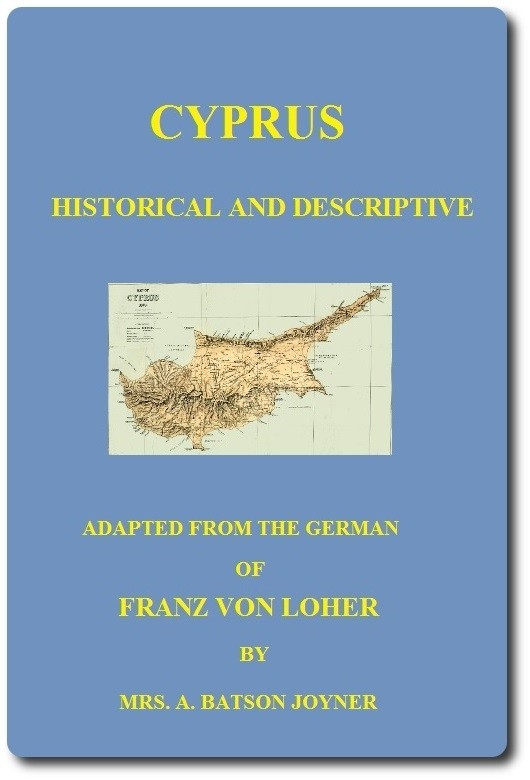
On account of its many capes the map of old Cyprus somewhat resembles a horned head, and the very peculiar narrow peninsula, along which the northern chain of mountains is continued may be compared to the tongue, with which it seems to be licking the corner, between Syria and Asia Minor.
The extensive plains have been celebrated from the remotest antiquity for their gardens and cornfields. On the slopes, around the coast, and in the deep valleys among the hills, may be found all the plants and trees that are met with in Europe, Western Asia and Egypt; these thrive prodigiously indeed.
In former years, the island was celebrated for its valuable copper mines, hence is supposed to be derived its ancient name χυπρος, from which we get Cyprus. The most important copper mines were formerly at Tamassus, in the centre of the island; at Soli, on the north coast; and Amathus and Cyricum on the south coast. Gold and silver were occasionally found. Salt is still made in large quantities, and coal is found occasionally. Volcanic eruptions, which were formerly not infrequent, have not occurred for many years; the island is, however, subject to earthquakes. Precious stones in great varieties, including the diamond, emerald, jasper, opal, and agate, were formerly found in this island. Yellow ochre and amber are also amongst the mineral productions. Baffo produces a very superior kind of asbestos, which is known as “stone-cotton” in Cyprus. It is quite white and as flexible as silk. The ancients made it into cloth, which was incombustible. This manufacture is still carried on in some parts of the island, where the cloth is employed to make the sacramental robes of the priests.
CHAPTER XXV
NATURAL PRODUCTS.
We will now give our readers a general sketch of the rise and decline of Cyprian agriculture under different rulers.
For nearly three hundred years the dynasty of Lusignan ruled over a flourishing and important country. Monks, knights, merchants, and priests thronged to its hospitable shores, on their way to and from adjoining countries, and many fair dames were conducted so far, and found pleasant refuge in Cyprus, whilst their chivalrous husbands journeyed farther east, to assist in the vain attempt to obtain possession of the tomb of Christ, and earn either an early grave, or return covered with wounds and glory. Towns sprang up in all directions. Wine, oil, silk, cotton, the carob-tree (Ceratonia siliqua), and the various plants used for the famous Cyprian dyes, were again largely cultivated, and in the overflowing markets of the towns upon the coast, ships in adjacent seas found the readiest means of victualling for distant voyages. Mining operations were recommenced with ardour, and Cyprian merchants again sent forth the rich products of the island into all parts.
We have still to notice what was the fate of the island, under Venetian and Turkish domination. The Venetians, anxious to derive every possible emolument from their possessions, urged the population to the most strenuous efforts, in the culture of the land, and when the weary labourers sank under the burden and heat of the day, used every incentive, and even punished them, in order to increase their exertions in bringing their fields and gardens to the required perfection. There is still a tradition in the island that the Venetians paid a zechin for every olive-tree that was planted. Generation after generation, however, the population degenerated, and became weaker and more idle.
The Venetians would appear to have considered the island in the light of a great and valuable farm, which they endeavoured to make as productive as possible. They appointed three governors, two treasurers, a superintendent with two thousand men under him, placed a captain and a company of soldiers in each of the twelve districts into which the land was divided, who kept everything in order, and took care that the fields and gardens were well cultivated, and the taxes regularly paid. After deducting all expenses, Cyprus yielded to Venice a clear yearly profit of two millions of ducats (golden dollars). The Italian revenue officers seem not to have been much trusted in their dealings with the Cypriotes, and were changed every two years.
When the Sultan of Egypt subsequently took Cyprus, the yearly tribute exacted amounted to eight hundred thousand ducats (golden dollars); it now produces only seven millions of marks, a very small sum, in comparison with what it produced to its Venetian masters.
During the fifteenth century, the blighting influence of successive wars was keenly felt, and the best energies of the Lusignans were devoted to warding off the repeated attacks of the Mussulmans. Since the New World had arisen in the West, strong and vigorous immigrants no longer lent their aid to prop a declining state. The conquest of Cyprus by the Turks cost the island the last remnant of its industrious, enterprising, and independent inhabitants, and the bloodstained and desolate country was no longer cultivated. The Turks, always passionate admirers of flowers, introduced a few tulips and hyacinths, and planted date-palms in the spots they occupied; but the soil was not congenial to them, and in Cyprus the date-palm rarely produced its sweet and highly-prized fruit.
The tobacco plant was also introduced at this period, but its cultivation was never carried on to any great extent, owing to the necessity of planting it in gardens surrounded by high walls, in order to protect the plant from the depredations of the locust. No attempt was made on the part of the Turkish Government to rouse the dying energies of the people; slowly, but surely, every art and industry declined, and the locust swarmed over the barren and neglected country.
Thus, in ancient times, we see that the island of Cyprus was celebrated for its varied vegetation, but of the plants that once grew there, many are totally lost, others are now cultivated with difficulty, and very few new ones are added to the list. The vegetation of Cyprus, like its history, seems to have undergone many changes, and from the nature of the soil, is very diversified in different parts of the island. At the present day, corn is still extensively cultivated; wheat, barley, oats, and beans flourish well. Upon the mountains grow fir and pine-trees, and in the valleys we find fine oaks, ashes, orange, fig, citron, date, walnut, and a great variety of other trees. Overhanging shrubs crowd the deep dells and precipitous cliffs, and amongst them grow the oleander, myrtle, arbutus, juniper, and mastic. Not less striking is the lovely carpet of flowers, which clothes the face of the country with ever-varying beauties. Roses and jasmine, tulips, hyacinths, narcissus, and anemones, are but a few of those that I might enumerate.
In Cyprus the use of manure is unknown, but nevertheless there is but little change in the luxuriant fertility of the soil, and wherever the earth is sufficiently supplied with moisture, a thousand plants spring up in rich profusion. One of the principal difficulties in the field is to keep the corn from being smothered by weeds. This task of weeding falls entirely to the lot of the women.
Olive-trees were formerly very numerous, as is proved by the large reservoirs for oil to be seen near Larnaka. The trade was at one time very extensive, but the island now consumes all that it produces. This decline would appear to date from the era of Venetian rule, when the trade in oil was almost ruined, and the cultivation of the olive abandoned for that of cotton. Saffron, rhubarb, and many other natural and valuable productions are also neglected.
Cyprus had once a lucrative trade with Syria, in the oil extracted from the seed of the jujube tree. Oil of glasswort was also formerly extracted. Cucumis colocynth, from the pulp of which colocynth is made, is also largely cultivated: this plant grows like the water-melon, and belongs to the same family. The cotton-plant, which was formerly so important a production, is now comparatively but little cultivated. The seeds of the cotton-plant are sown early in April, three or four being planted together, at equal distances. When the shoots appear above the ground, the strongest plant alone is allowed to remain, the rest being weeded out. The plants are hoed in June or July, and the cotton collected in October and November. The cottons of Cyprus, which are of four qualities, are much esteemed on account of their whiteness and the thickness of their texture; a fifth quality, called scovazze, is entirely consumed on the island. The total export of cotton in 1871 was 770,850 lbs.
During the time when the silk trade flourished, mulberry trees were objects of most careful attention, and still abound upon the island. The finest and whitest silk is now obtained from the neighbourhood of Famagusta, and Karpasso; the lemon, or sulphur-coloured, comes from Citereau, and most of the northern villages, whilst that made about Baffo is of a golden colour.
The Greek females of some of the towns and villages work exquisite embroidery, and make a kind of silk net, which will bear comparison with the finest European lace. On the west side of the island the peasants distil rose, orange, and lavender water, and myrtle and ladanum oil.
Amongst the birds, snipe, pheasants, partridges, quails, and thrushes are very abundant, as are also most of the birds of passage that make Africa their home during the winter.
Until the commencement of the seventeenth century 150,000 kilderkins of wine were annually produced; whilst at the beginning of the present century, only a sixth part of that quantity was made. The manufacture of wine has considerably increased in the last few years, but principally for foreign consumption. The lower order of Cypriotes find their wine too strong for their heads, and too dear for their pockets, and drink little or none. The taxes upon wine are at present very heavy.
The utilisation of the fruit of the island, as a means of profit is now never thought of; even the celebrated vegetables of Cyprus are now almost unknown, and the inhabitants content themselves with gathering wild cresses, artichokes, purslane, and asparagus. The olive-tree, however, as we have said, is still largely grown, cultivated we cannot call it, as not only the planting, but the gathering the fruit, and expressing the oil, are carried on in the most careless manner. Without the olive, however, sorry indeed would be the fare of the Cypriotes.
Potatoes flourish in the mountainous districts and kolokasia in low-lying regions. Melons, pumpkins, and gherkins are also found in great profusion. During the last forty years, Greek and French enterprise has made various efforts to bring about a better state of things. What may not now be hoped for when this luxuriant island is again under a paternal dominion and the safety of individual rights secured?
At all times, snakes, which, however, are not dangerous, tarantulas, and venomous spiders abounded in the island, and Dr. Clarke gives a forcible description of its insect pests. Speaking of the tarantula, he describes one species of about an inch long, as having “a body of bright yellow, and beset with long and prickly hairs. It runs with prodigious swiftness, and thus more easily escapes its destruction, in which mankind are interested; its bite being very dangerous, and its venom very subtle. The parts which are attacked by it swell in an instant, and occasion excessive pain, followed by death if certain remedies be not speedily applied.”
The cultivation of the sugar-cane is now quite unknown in Cyprus, and the cotton-plant is only grown in a few districts.
It has been erroneously stated that the natives will not touch the flesh of the ox, from the idea that it would be cruel to eat the companion of their labours. Numerous small, but fat cattle are fed on the plains, and their beef enjoyed as much by the Cypriote as by an Englishman. Great numbers of sheep and goats are also reared. The mutton is juicy and tender.
CHAPTER XXVI
ST. NICHOLAS AND LIMASOL.
Whilst I was in Kolossin I learnt that some fine marble pillars, which lay outside in the court-yard, had been brought from the Abbey of St. Nicholas, which was only some few leagues off, upon the neighbouring peninsula. Everything I heard of this interesting ruin made me more desirous of inspecting it. Visions of European abbeys floated before my eyes, and I determined to start at once to view this Cyprian reality.
Next morning I sent on my dragoman and horse-boy to Limasol, with orders to try and get lodgings for me in the Franciscan cloisters, and then rode forward with Hussein on the way to St. Nicholas. After about an hour and a half’s hard riding, we reached the south portion of the peninsula. The spot was a bare, open plain, and the water by which it was surrounded, full of reeds. We had scarcely reached our destination, than torrents of rain began to fall, and we were forced to take shelter under a ruined wall, standing our horses in front of us, to prevent our being literally washed away. Happily, the storm was only of short duration, and the ground was soon dry again, and we could continue our investigations. The little church of St. Nicholas, which was evidently built in the fifteenth century, is in good condition, and stands in the midst of the ruined abbey, the rectangular walls of which surround it. On closely examining the church it was easy to trace the solid foundations of the ancient temple, on the site of which it had been built. Rows of broken pillars, some extending along the hinder walls, indicated what had once been a covered walk for the monks. Over the doorway was a huge marble tablet, on which five coats-of-arms were chiselled. The ancient temple which preceded the abbey had evidently been very extensive, and I could trace its foundations for some feet beyond the cloister walls. In one corner stood what had been an altar, and near it a very deep cistern. The old walls here, which are as hard as iron, had been taken in large masses to form, evidently, the abbey walls. Marble pillars lay in all directions, but I saw none as fine as the two that had attracted my attention in the inn yard at Kolossin. No trace of the abbey garden was left, beyond some olive-trees, the roots of which were buried quite impartially under the ancient and mediæval walls. A few goats were wandering about, and gave a touch of animation to the melancholy and deserted scene. The water about this peninsula is as rich in salt as is that near Larnaka.
I mounted a neighbouring eminence, but could see no trace of life. Not a ship, or boat, appeared upon the bosom of the sea beyond, and I could not help asking myself, as I descended, if this whole country was destined to remain desolate for ever, or if we could hope that, under a new government, it might attain fresh vitality, and again take its place as one of the animated spots of the earth.
The road from the ruins of the temple and monastery upon the southern peninsula, a distance of about three and a half hours’ ride, winds around the salt marsh, and then turns towards the sea. Limasol is more European in its appearance than any other town in Cyprus. Houses built of clay and stone predominate here, more especially in the part inhabited by the Turks.
Clay and wood seem, at the present day, to be the favourite building materials of these people, and it is the same wherever they settle. Even a small party of Turkish women that we encountered, were making a house exactly as in Smyrna or Constantinople. When these women see a stranger approaching at a distance, they cover themselves up, but as he draws nearer, the pretty ones always draw their veils a little aside, so that he may have a peep at their fresh, smiling faces. This use of the veil appears general throughout Turkey, and was practised even during the time of the Crusaders.
We rode through a long street, and as we approached a stately-looking house, Hussein called my attention to a flag emblazoned with the German eagle, which floated over the roof; with delight I recognised it, and read the familiar inscription. I then rode on to the Franciscan convent, where the little monk, who stood before the door, came forward to receive me with every demonstration of joy and fatherly welcome. Hardly had I refreshed myself with a cup of excellent coffee, than he arose and insisted upon my following him to my chamber and resting myself after my fatiguing journey. He afterwards came to fetch me, in order that he might show me over the convent. From the terrace we had a noble prospect, looking towards the mountains which, although bare, rose grandly above the surface of the plain. Behind the garden, we found a little sequestered churchyard. The small number of graves, indicated that during a long period only two or three of the brotherhood had here found their resting-place. It would seem that these monks had been placed here, more to watch over the place, than for any pastoral service. For the purposes of worship a new and very beautiful church was in course of erection; the money to build this had come from Rome, where gold is always forthcoming to build churches with, in any part of the world where Roman Catholics are to be found.
After we had returned to the dining-hall, there entered a very smart merchant from Tyre, who, like myself, was a guest in the convent. This man offered me a gem that he said he had just found, for which he asked an enormous price. He was not at all abashed when I told him the value of the article might possibly be a couple of piastres. The manufacture of these pretended antiquities is carried on in Smyrna, Beyrut, and Jerusalem on an extensive scale, and appears to be very profitable.
And now the German consular agent appeared with his cavass, dragoman, and staff of officers, to greet me on my arrival, and when they departed, Hussien marched after them, and thus they paraded about the town, and through the bazaar. People are very fond of show and parade of this description, a passion doubtless derived from the customs of the Romans and Byzantines. The German resident in Limasol seemed somewhat disappointed because we had passed his house without calling, and urgently insisted on my accompanying him home, where, he said, everything had been prepared for my reception. The little priest, however, had laid an embargo on my person, and declared that such an affront should not be offered to his convent. The Italian consul also paid me a visit, and also the master of the Greek school, and I was highly amused, knowing, as I did, that all these pressing invitations were given with the full knowledge that the next steamer for Constantinople left Larnaka in three days, and that there was no chance of my waiting a whole week for the next. I then in company with the Greek schoolmaster, took a walk through the town, and inspected the bazaar, the schools, and the church. In the higher school there were about twenty scholars, in the lower upwards of a hundred; their number increases rapidly from one half year to another. Behind the school I noticed a column, the capital of which was very handsome, and which I was told had been brought from the monastery of St. Nicholas. The interior of the town has a very European appearance; it is, indeed, principally modern, and has been built—a good augury for Cyprus—in consequence of the increased export of wines grown in the country.
Limasol at the present day contains about six thousand inhabitants, of whom one-third, and these the poorest, are Turks. Among the Greek population there are already several well-to-do merchants, who trade in flax and wool.
In the evening, a visit to our consular agent enabled me to observe the domestic economy of the Cyprians, in a Greek house of some pretensions. The agent himself is a young man of polished address and very engaging manners, the mistress of the house charmingly beautiful. There was also a lady whose bright and sparkling eyes gleamed with intelligence and persevering energy. Her family belonged to the oldest nobility of the island, and yet had not been resident there for more than a century and a half. Under Turkish rule families do not easily attain to nobility or distinction. It may also be remarked that of late years the higher Turkish officials, who came from Constantinople, were seldom people of such refined manners as their predecessors. How can it be otherwise, seeing that money is now the only key whereby admission to office can be obtained? Even the multitude of green-turbaned descendants of the Prophet, are quickly disappearing. In China they manage better. After the imperial family, ranks that of Kung-fu-tso (Confucius), and there are about ten thousand living descendants of the sage—but it is only the real lineal head of the family, the Prince Kung, who is benefited by the renown of his ancestry. In Turkey, on the contrary, the canker-worm has been long devouring the whole ancestral tree, root and branch. The curse of the country is, that dignity and work are thought to be incompatible with each other, and the descendants of the Prophet consider themselves too illustrious to do anything.
About ten o’clock we sat down to table, and our first glass was dedicated to our country’s noble flag, which waved above the roof of the house. At this time, however, there were few Germans in Limasol, and during the whole year but two or three German vessels had cast anchor in the roadstead.
I am, however, pretty well convinced that a good trade might be established here, even if the cargoes consisted entirely of wine. The conversation turned principally on the population and revenue, and I succeeded in making a few additions to my knowledge concerning the statistics of the country. As regards the population of Cyprus, I was told that the Turks numbered about 200,000, and Greeks 100,000. An European observer, who was long a resident here, reckoned 100,000 Greeks, 40,000 Turks, and 1000 Maronites and Roman Catholics; most probably, however, if we estimate the total at 150,000, of whom about a third are Turks, we should not be far from the truth.
Equally at variance with each other were the accounts that I received concerning the revenue, although my questions were only put to persons who, ex officio, were able at least to give approximate information. The revenue derived from the customs and taxes, was estimated by one at thirty-five millions of piastres, by another at thirty millions, and by a third at twenty-four millions; the figures set down in the following Table are, however, probably nearer the mark:
| piastres | |
| Tithes upon all income | 7,000,000 |
| Tit”heup”onland | 400,000 |
| Land tax (tolls upon product) | 5,000,000 |
| Military taxes upon Christians | 550,000 |
| Head money upon sheep | 700,000 |
| Weighing taxes upon sales | 300,000 |
| Customs upon salt | 1,500,000 |
| Cus”toms u”onwines | 1,000,000 |
| Cus”toms u”onexported silk | 200,000 |
| Cus”toms u”onfish | 20,000 |
| ————— | |
| Total | 16,670,000 |
Truly, for a country so large, so luxurious, and so rich (when we consider the small value of the piastre), this is but a sorry income. From this, moreover, must be deducted the cost of the mosques, Mohammedan schools, and other similar institutions, which even in Cyprus are distributed over a considerable portion of the island. These are placed under the superintendence of the Mohammedan priesthood, and there is a proverb which says, “Sooner will the eyes of the dead shed tears, than priests give up money.” In Cyprus it is well understood that, of all these taxes, not above two or three millions of piastres find their way to Constantinople; nay, that the inhabitants have, in addition to these imposts, to pay considerable sums to the Turkish officials to keep them in a good humour. Moreover, the Turks are constantly obliged to bribe one another, in order to keep themselves in office, and to maintain the dignity of their position. The sums expended upon roads, bridges, and public buildings, are of very trifling amount. Even the cost of the military establishment is exceedingly small. The population is too weak and too lazy to require much of a garrison, and the Turks come willingly from other places, to fulfil the military duties in so quiet a spot.
CHAPTER XXVII
AMATHUS.
Next morning we journeyed onwards towards Amathus. The day was lovely, one of the most exquisite I have ever experienced in any climate, and as we galloped along, my veins seemed to dance with every breath I drew. At such moments one readily comprehends why the inhabitants of Cyprus have never taken any high place in the fields of literature and art, and why its seductive and enervating air has always proved attractive to the Turks, as it did formerly to the ancient Romans. Our road lay through waving cornfields, the rich golden hues of which were finely contrasted with the deep blue waters of the sea, which in many places reached the very borders of the fields. Suddenly a change arose, the sun mounted high into the heavens, and beat down upon us with such fiery force and fury, as caused me fully to appreciate the appropriateness of the symbol stamped upon the ancient coins of Cyprus, namely, a devouring lion, backed, in some instances, by an image of the sun’s rays. Terrible, indeed, is the destruction worked by the ravening jaws of Phœbus Apollo, upon the fruitful gardens and flowery plains of this fertile island. At these seasons, only such fields as lie close to the sea can resist the parching blight; in these tracts on the shore, plants of all kind flourish luxuriantly, drawing the moisture which supports them from the refreshing dews borne to them from the neighbouring waves. In such of these cultivated portions of the coast as also enjoy the moisture brought by the smaller streams, as they discharge themselves into the sea, the harvests and crops are still more luxuriant. Not only the country near to Limasol, over which I was now riding, but the coast about Episkopi, Kition, Larnaka, Famagusta, besides the north coast near Morphu and Lagathos, and other places, possess many of these most valuable agricultural districts. Much land has already been reclaimed for the purposes of cultivation, and there is no reason why so successful an experiment should not be attempted upon many other parts of the coast.
After about two hours’ riding, we reached what appeared to me to be the ruins of a church, standing close to the shore, and beside these a heap of ancient hewn stones, lying ready to be shipped for Port Saïd, where they were to be employed in the construction of a new harbour. On our left rose a mountain, with fields of corn extending to a considerable distance up its slopes. My dragoman was most desirous to ride on, without my lingering to investigate the spot, and when I assured him that this mount was certainly the site of the ancient Amathus, positively asserted that not a trace of anything was to be seen. I believe the rascal was afraid he should again get more climbing than suited his indolence, for he declared in piteous accents that it would take us fully an hour to reach the summit. By this time, however, I knew the gentleman I had to deal with, and persisted in my determination to make the attempt. Our road was certainly of the steepest, but the way was short, and in about fifteen minutes we were at the top. Much did I rejoice that I had persevered in my own course, for before me lay the spot that I had sought. The mount was indeed a natural fortress of the first order, and must have afforded most secure refuse during the disturbed periods of the island’s history. On the side facing the sea, by which we had ascended, I could trace the foundations of an ancient rampart. On the other three sides, such protection had been quite unnecessary, as the rock rose sheer, and almost perpendicularly from the fruitful valley at its base. Here had once stood a large city, founded by the Phœnicians, which is still called in Hebrew, Hamath, or the fortified city. The building appears to have covered the eminence, and from thence extended to the shores of the sea. Tacitus, and other ancient writers, speak of Amathus as the oldest city in Cyprus; at the present day, it may be described as the one of which the traces have been most ruthlessly destroyed. With the exception of the shattered pieces of a gigantic vase, of which I shall speak presently, and the ruined church upon the coast, no trace is left of its former greatness. From the top of the mount to the very shores of the sea, every sign has been removed, beyond that afforded by heaps of broken stones and potsherds.
Twelve years ago, the last valuable was removed by French antiquarians. This relic was one of two gigantic vases, finely shaped in solid stone, with sides almost a foot in thickness, and ornamented with four gracefully arched handles, decorated with palm branches, and adorned upon its sides by the images of four bulls. The interior of this delicately chiselled but gigantic vase, was about ten feet in diameter, and so deep that an ordinary man standing within could just have looked over its edges. At the time this spot was visited by the French travellers we speak of, one of these two precious relics stood above ground, and was quite perfect, whilst the other was partially buried in the earth. Disgraceful as it may appear, the fact is certain, that when the French officers, who were overlooking the removal of the perfect vase, found that its companion, embedded in the earth, was somewhat in their way, they at once ordered the sailors who were with them to smash it to pieces. This fact was related to me by a gentleman of high position in Limasol, who was an eye-witness of this act of wanton destruction. My zaptieh, Hussein, it afterwards appeared, had been present with his master, my friendly pacha, whilst this monster vase was being pulled down the mountain, and spoke with enthusiasm of its enormous size and beauty. He also informed me that the French frigate, “La Perdrix,” commanded by Comte de Vögue, had a small steamship to assist in conveying the valuable relic. I found pieces of a handle of the broken vase lying strewn about the mountain.
For a thousand years, these giant mementos of a former age had stood upon these mountains, to record the grandeur of past ages, and would have remained untouched by the wear and tear of centuries to come, had it not been for the barbarous Vandalism of a handful of French officers. What may have been the use of these magnificent vessels, is quite uncertain; the oxen sculptured upon them would appear to give them a religious significance, and we know that similar vases stood without the Temple at Jerusalem. It is most probable they were in some manner connected with the numerous sacrifices that formed so large a part of the religious ceremonies to Venus.
On these heights, the feasts in honour of Adonis were held. This beautiful youth, the beloved of Venus, is said to have met his death in the Idalion forest between Larnaka and Famagusta, where, according to heathen mythology, he was killed by a wild boar he had wounded. Anemones are said to have sprung up from the ground that was moistened by his blood. These feasts to Adonis, which were first celebrated at Byblos, in Phœnicia, were afterwards introduced to Greece and Cyprus. In the latter country they lasted eight days, of which the first four were spent in howling and lamenting, and the four last in joyful clamours, as if Adonis had returned to life. The orgies, in connection with these feasts, were immoral in the extreme, and we are told that Pygmalion, the celebrated statuary of Cyprus, was so disgusted by the profligacy of the women of Amathus, that he resolved never to marry. The affection he had denied to the other sex, he, therefore, liberally poured forth upon the creation of his own hands. He became enamoured of a beautiful marble statue he had made, and at his earnest request and prayers, the Goddess of Love changed the favourite statue into a woman, whom the artist married, and by whom he had a son named Paphos, who founded the city of that name in Cyprus.
The ascent of Amathus would well repay any one who would attempt it, if only for the magnificent view presented from its summit. On one side lies a broad expanse of blue sea, and on the other a semicircle of dark heights and peaks, whilst between the two extends the gay and luxuriant valley, stretching its fruitful fields and gardens to the shore.
“Under the Ptolemies,” says Cesnola, “and in the later history of Cyprus, Amathus appears to have lost the ancient importance which it enjoyed, when ruled by its own kings, and when its natural allies, the Persians, were all-powerful.”
“On the hill on which it stood nothing is now visible but a vast amount of stones, plaster, and broken pottery. Even the hill itself is fast losing its form, while the rock of which it is composed is being cut away, to be shipped at Port Saïd, bringing to the merchants of Limasol a profitable return. From the great amount of débris which covers the surrounding fields, for the most part untilled, Amathus, it would seem, though small in area, must have been a thickly populated city. Originally the upper part of the hill had been encircled by a wall, remains of which are now scarcely perceptible; portions, however, of another wall of a later period may especially be observed on the southern side looking towards the sea, and following the sinuous windings of the hill. I found imbedded in this wall pieces of terra-cotta jars and fragments of granite columns, which had been used as building materials. On the southern side, portions of it ran as far as the shore. It is probable that the square built ruin, at the southern end of the hill, formed a gateway, since, between the city and the sea-shore, there was, and still is, the high road to Paphos. On the crest of this hill I dug at several places, until I came to the solid rock, but failed to discover any sculptured remains of importance. I found, however, sufficient evidence to convince me that most of the building materials of what I call the Phœnician city, had been used for the construction of the later Greek buildings.”
“Amathus, when subsequently inhabited by a Greek population, spread itself in a more south-easterly direction, and nearer to the sea-shore, protected by the second wall, which I spoke of, and though at the time of its destruction by King Richard of England, it was still the seat of the last Duke of Cyprus, Isaac Comnenas, it had already lost most of its splendour and importance.”
“It was on the top of this hill, that M. de Vögue discovered the large stone vase which is now deposited in the museum of the Louvre. Near the same spot, there are fragments of what seems to have been a similar vase. In the immediate vicinity of the site where these vases were found, I dug up, on a former excursion, three large shafts of columns, of a hard bluish stone, resembling granite. I left them half-buried in the soil, with the intention of examining them on a future occasion; but when I returned, the columns had disappeared, having been broken up for building purposes. There are thousands of stones on the top and sides of this hill, which would equally well suit the purposes of these workmen, but it seems that they are possessed by some infatuation or evil mania for destroying whatever bears the traces of man’s handicraft. It is the more to be regretted, since among the ruins very few architectural or sculptured remains are now found.”
Far away in the distance, is the town of Limasol, washed by the waters of its beautiful and rounded bay, behind this again a long line of coast, and then the eye just discerns the promontory of Curias, stretching its length far into the sea, where it terminates in Capo delle Gatte. Cesnola gives an amusing account of the origin of this name, which is too interesting to be omitted. “On one occasion,” he says, “my mule was terrified by a sudden leap from a bush, of what appeared to me to be a cat; my guide assured me that both at this cape, and near to Acrotiri, there are wild cats, which hunt and destroy the asps abounding there. I at once recollected having read that the ‘Caloyers’ of the convent of Acrotiri raised and trained a superior breed of cats, which they imported from Constantinople, to kill the asps in their neighbourhood. That at the tolling of a particular bell in the convent, these cats would come in to be fed twice a day, and then return to their work of destruction. I suppose that it is called Capo delle Gatte in reference to these cats.”
When we had descended the mountain and were once more on the shore, I observed a number of black and half-black Egyptian sailors, all in rags, who were busily employed in carrying stones to their ships which were anchored in the roads. Their captain looked on, smoking his pipe, and shaded from the sun by a small tent. Stones from the oldest city in Cyprus, going over to Port Saïd, to help in the construction of the newest town on the opposite continent, near which a harbour is in course of construction, destined to receive the ships coming from every quarter of the globe; whilst here at my feet lay the ancient harbour of Amathus, of which nothing remains but its natural basin, formed by rocks which extend some distance into the sea.
CHAPTER XXVIII
KARUBIEH AND MAZOTOS.
When we left Amathus, our road lay over a barren mountainous tract, entirely destitute of every charm, but as we reached Cape Karubieh, a scene of great beauty opened up from the left to our view. Before us lay a little town, looking as fresh and bright as if but quite recently built, with houses that appeared much more stately and substantial than any I had yet seen in Cyprus. To our surprise these attractive-looking residences were closed and untenanted, and not a human creature was to be seen, except a solitary negro at a small inn where we got a cup of coffee. I afterwards learnt that the inhabitants of Karubieh, which number about one thousand only, return to their homes in August. At this season many ships anchor here to take in large cargoes of fruit for Trieste, Marseilles, Smyrna, Odessa, and St. Petersburg. The fields, from which all this superabundant harvest is produced, cover all the declivities of the sea-shore from Limasol to Mazotos. The once despised carob-tree (Ceratonia siliqua) is now much esteemed, and the fruit, which was formerly only used either as food for cattle, or occasionally eaten during seasons of fasting, has become of great value. Of late years it has been discovered that the fruit is highly valuable for the making of excellent brandy, and the tree is therefore cultivated throughout this district with the utmost assiduity. About April the branches are lopped off; numerous shoots from fruitful trees are grafted on the trunks, and in a very short space of time the tree is covered with succulent pods. I mention this interesting fact, to prove of what this once fertile island is capable, when its products receive the necessary attention. In this instance, as in many others, gold is literally lying on the ground in Cyprus, ready to be picked up by those who have enterprise and energy.
Our road from Cape Karubieh presented nothing of interest. The mountains gradually receded inland, and the eye found nothing to relieve the monotony of the bare expanse of coast, until at length our further progress in a direct line was stopped by a rocky promontory, which projected far into the sea. We were now obliged to turn inland, and soon reached higher ground, from whence we once more obtained a good view of the purple and deep blue mountains, and could see their tints gradually deepen under the shadow of approaching night. It was late before we reached Mazotos, and I at once endeavoured to obtain a lodging, in the house of some well-to-do farmer, from whom I might hope to learn many interesting particulars concerning the manners and customs of the people. As we entered the town, I observed a court-yard leading from a stable to a small house within. At the left-hand side was a flight of stone steps, conducting to an upper chamber, which, it being harvest time, was now filled with corn.
Opposite this was the large roomy apartment, that served for living and sleeping room to the whole family. The floor was covered with tiles, and the room divided in the centre by an arch. A stone ledge of imposing appearance projected from one of the walls, and was well garnished with household utensils, whilst upon the whitewashed walls, hung the clothes, nets, hammocks, and long baskets belonging to the family. Large pitchers of red clay, and numerous calabashes, stood about, filled with bread, eggs, fruit, maize, and vegetables. The kitchen was outside in the yard, and I could not avoid noticing the cheerful alacrity and skill displayed by our worthy hostess, whilst she prepared our evening meal. Servants she had none, everything in the interior of the house being done by the members of the family, whilst out of doors they were assisted about the farm and garden by day labourers. In Cyprus, the soil is so light that a farmer will readily plough over thirty acres of ground with one yoke of oxen, and see his land reward his labours by bringing forth its fruits thirty fold. The processes of sowing and reaping are equally carelessly performed, and when this is over, but few farmers touch the fields again. For this reason, without a farmer has really extensive property, he does not incur the expense of board and wages to regular men. During the harvest time a day labourer receives three shillings a day and three meals. Should a farmer not be inclined to comply with their demands, he will stand, as with us, a very good chance of having his corn spoilt, before he can get it into his barns. At other seasons the men cannot obtain more than from elevenpence to one shilling and threepence, and the women from about fivepence to eightpence per day. Small as is the sum, it amply suffices to provide all that the lower class Cypriotes require, sleeping as they do for nine months of the year in the open air. Food, such as they principally consume, is extremely cheap, and we have it upon the authority of a gentleman who knows the island well, Consul Lang, that a family of six persons can be maintained in perfect health and activity on an allowance of forty pounds of flour and three pounds of olives per week. In ordinary seasons the cost of this quantity of provisions would not exceed three shillings and sixpence. Cesnola mentions that he has frequently seen Greek priests in Cyprus working in the fields like common peasants.
Contrary to all my experience in Cyprus, when we quitted the farmer’s house, the worthy host at once complied with my request, that he would make some charge for our accommodation. This I accounted for by the fact, that the house standing on the highway between Limasol and Larnaka, would probably attract the attention of more strangers than could be comfortably entertained without proper remuneration. A present to the poor, if your resting-place has been a convent, or a little remembrance to the children of a family, is the most that is expected throughout all those parts of the East through which I have travelled, whilst should your entertainer be a man of position and means, you cannot, without giving offence, do more than offer a “pour boire” to the four or five men-servants who will appear at the door to see you start.
Our last day’s journey, which was short but delightful, lay over a wide tract of cornfields, in traversing which we passed the village of Kiti, with its little church, embowered in fruit trees, and not far from it another church standing on a piece of barren ground, without a shrub or tree near it. On our left towered a magnificent mountain, which rises abruptly to a height of two thousand feet, and bears upon its summit the once celebrated monastery of the Holy Cross, or Hagios Stavros. This building, which is rarely or never obscured by clouds or fog, can be seen from a considerable distance at sea, and has long been known to sailors as a landmark. St. Helena is supposed to have presented this cloister with a valuable relic, which brought many pilgrims and gifts to the brotherhood. This was a piece of wood, about as long as a finger, fashioned like a cross, mounted in silver, and had the reputation of being a veritable portion of the Saviour’s cross.
Whilst it was still light, we came in sight of Larnaka, the cornfields were crowded with labourers gathering in the harvest, and these, being principally Greeks, and therefore very conversational, we could hear a lively hum of many voices long before we reached the spot. We dined under the shadow of a large fig-tree, which grew upon the brink of a rippling stream. Numerous cranes, and whole hosts of beccaficos, came within such tempting reach of our guns, that, as soon as our repast was over, we started after them, over fields where horses and camels were grazing, and over marshy ground, until we reached the rolling, glittering sea. Our sport was excellent, for my dragoman knew every call and wile by which the birds could be allured, and it required some determination when it was time to return, to quit our delightful but peculiar shooting-ground.
On my return to Larnaka I had the luck to chance upon some dear friends, with whom I supped. Our host produced the best his cellar contained, in various sorts of wine, winding up with a bottle fifty years old, most delicious, but so strong that discretion only permitted us to taste it in thimblefuls.
Next day I paid many visits in the town, and was amused to find with what astonishment the history of my little journey across the island was received. I really believe that at that time there was not a single person in the island who had seen as much of Cyprus as myself.