
The Project Gutenberg eBook of D'Orsay; or, The complete dandy
Title: D'Orsay; or, The complete dandy
Author: W. Teignmouth Shore
Release date: February 16, 2018 [eBook #56581]
Language: English
Credits: Produced by Clarity and the Online Distributed Proofreading
Team at http://www.pgdp.net (This file was produced from
images generously made available by The Internet
Archive/Canadian Libraries)
D’Orsay
BY THE SAME AUTHOR
A Soul’s Awakening [Crown 8vo, 6s.
Times.—“Mr Teignmouth Shore has captured our sympathy for his characters in an unusual degree.”
Morning Post.—“A charming and pathetic melody.… A tenderness that is infinitely moving.”
Punch.—“Powerful and pathetic. This truly charming story.”
Above All Things [Crown 8vo, 6s.
Daily Telegraph.—“All small investors in a hurry to make much out of little should read this novel, for it puts plainly and precisely before them some of the methods by which a swindler may, with seemingly virtuous intentions, appropriate, with perfect safety, other people’s money.”
Yorkshire Post.—“The people of his fiction play their parts so naturally and so simply that we sympathise almost as humanly with their troubles and joys as we might with those of our personal friends.”
Bookman.—“Delicate and unobtrusive art.”
Creatures of Clay
Recently published.] [Crown 8vo, 6s.
JOHN LONG, LIMITED, LONDON
Art Repro. Co.
Count d’Orsay
After a painting by Sir Francis Grant, P.R.A.
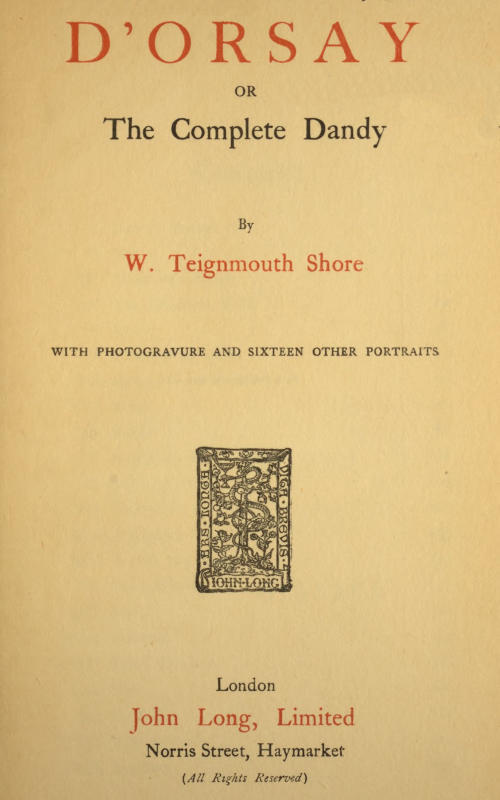
D’ORSAY
OR
The Complete Dandy
By
W. Teignmouth Shore
WITH PHOTOGRAVURE AND SIXTEEN OTHER PORTRAITS
London
John Long, Limited
Norris Street, Haymarket
(All Rights Reserved)
First Published in 1911
Contents
| PAGE | ||
| I. | Jocund Youth | 15 |
| II. | She | 24 |
| III. | Mars and Venus | 35 |
| IV. | The Primrose Path | 42 |
| V. | Byron | 48 |
| VI. | Pilgrims of Love | 53 |
| VII. | Marriage | 65 |
| VIII. | Rome | 76 |
| IX. | Paris | 81 |
| X. | A Solemn Undertaking | 92 |
| XI. | Seamore Place | 100 |
| XII. | Handsome is— | 116 |
| XIII. | A London Salon | 135 |
| XIV. | Round the Town | 145 |
| XV. | Gore House | 157 |
| XVI. | Stars | 172 |
| XVII. | Company | 174 |
| XVIII. | More Friends | 189 |
| XIX. | Nap | 195 |
| XX. | W. S. L. | 216 |
| XXI. | The Artist | 225 |
| XXII. | Letters | 235 |
| XXIII. | Exchequer Bonds | 245 |
| XXIV. | Sundry Festivities | 255 |
| XXV. | Sunset | 270 |
| XXVI. | The End of Gore House | 280 |
| XXVII. | Paris for the Last Time | 284 |
| XXVIII. | D’Orsay in Decline | 289 |
| XXIX. | Death | 302 |
| XXX. | What Was He? | 311 |
List of Illustrations
| Count d’Orsay | Frontispiece |
| After a Painting by Sir Francis Grant, P.R.A. | |
| FACING PAGE | |
| Lady Blessington | 28 |
| From a Water-colour Drawing by A. E. Chalon, R.A. | |
| St James’s Square in 1812 | 36 |
| Lord Byron | 50 |
| By D’Orsay. | |
| D’Orsay, 1830 | 96 |
| 10 St James’s Square | 100 |
| Seamore Place | 114 |
| Crockford’s | 150 |
| Gore House | 160 |
| From a Water-colour Drawing by T. H. Shepherd. | |
| The Countess Guiccioli | 164 |
| By D’Orsay. | |
| Edward, First Baron Lytton | 176 |
| From a Painting by A. E. Chalon, R.A. | |
| Carlyle in 1839 | 188 |
| By D’Orsay. | |
| Napoleon III. | 206 |
| By D’Orsay. | |
| Lady Blessington | 234 |
| From the Bust by D’Orsay. | |
| Hyde Park Corner in 1824 | 250 |
| Garden View of Gore House | 280 |
| Mausoleum of Lady Blessington | 288 |
| From a Photograph by D’Orsay. |
Dandiacal
What a delightful fellow is your complete dandy. No mere clothes’ prop he, the coat does not make the dandy; no mere flâneur in fine garments; far more than that is our true dandy.
Though there is not any authority for making the statement, we do not think that we are wrong in asserting that on the day when Adam first complained to Eve that she had not cut his fig-leaf breeches according to the latest fashion dandyism was born. It is not dead yet, only moribund, palsied, shaking and decrepit with old age, blown upon by an over-practical world of money-spinners and money-spenders. Joy seems to have become a thing of which it is necessary to go in pursuit; in the golden days of the dandies it was a good comrade which came almost without hailing to those who desired its company. A real dandy would wither and wilt in a world where joy is so much of a stranger as it is now to most folk.
It is curious that there does not exist any history of the Rise, Decline and Fall of Dandyism, a subject fit for the pen of Gibbon. But the reason is, that to write it with anything approaching to accuracy and completeness, or with sufficient sympathy and insight, would stagger the painstaking pedantry of a German philosopher and tax the wit and wisdom of George Meredith. Perhaps some day the University of Oxford or of Cambridge, when it has finished trifling with ponderous records of kings and queens, of statesmen and soldiers, of men of science and of writers of books, will gather together a happy band of scholars and men of the world, and will issue to us a joint-stock history of Dandyism. Reform is in the University air; let us hope. Might not the Academic authorities go even further with profit to themselves and to the nation? Ought they not to found and well endow a Chair of Dandyism? Should there not be a Professor of Dandyism to teach the young idea how to distinguish between dress and mere clothes? Between those two there is as great a gulf fixed as between the gentle art of the gourmet and the mere feeding of the gourmand. To teach also the art of living and the history of dandies and of dandyism? In these prosaic days we are only too ready to learn how to obtain the means of living without acquiring also a knowledge of how to use those means to good purpose. The Universities should likewise institute scholarships of dandyism, to encourage the study of dandyism in our Public and Board Schools, in both of which it is so grossly neglected. These scholarships must not be of meagre twenties and thirties of pounds, but of several hundreds per annum, so as to enable the scholar to practise the arts that he studies. We commend this outlet for money to millionaires of a practical turn of mind. The future happiness of our race depends upon its dandyism.
The dandy has played a conspicuous part upon the stage of history: Alcibiades, Marc Antony, Buckingham, Claude Duval, Benjamin Disraeli prove the truth of this statement. It would be a nice point to decide how far their dandyism was part and parcel of their equipment for attaining greatness. At one period of English history the whole population of the country was divided between dandies and anti-dandies, Cavaliers and Puritans, the former dandified in dress, religion, methods of fighting and in morals. They were great dandies those martial Cavaliers, and so were a few of their successors, who flirted and frivoled at Whitehall under Charles II.
The literature of dandyism is varied, vast and interesting, but space forbids our doing more than briefly alluding to two of its lighter branches in English letters. The drama—or rather the comedy—of dandyism holds a very high place in the history of the British Stage. Lyly, the Euphuist, was a literary dandy of the first water, and his euphuism the height of dandyism in literary style. Shakespeare in Love’s Labour Lost has given us a whole comedy of dandyism, and in Mercutio a portrait of the complete Elizabethan dandy. But the comedy of dandyism was at its zenith in the days of Charles II. Congreve and Wycherley were its high priests, who preached through the mouths of their brilliant puppets the gospel of joy which the Court so ably practised. We have in The School for Scandal another bright flash of dandyism, though Charles Surface has too much heart for a true and perfect dandy.
In fiction we have many striking examples of dandiacal literature, notably Vivian Grey and Pelham, both written by dandies.
Dandies vary in kind as well as in degree, there being some who play at dandyism in the days of their youth, such for example as Disraeli; others who are pinchbeck dandies, falling into the slough of overdressing, such for example as Charles Dickens, who was a mere colourist in garments. There are the born dandies, Brummel, D’Orsay, George Bernard Shaw for examples, the last of whom was born at least 200 years behind his time; he would have been delightful at the Court of Charles the Merry. It is not necessary to be in the fashion to achieve the dignity of dandyism; G. B. S. sets the fashion himself and is the only one who can follow it.
The psychology of the dandy has been much misunderstood, probably because it has been so little studied. What dandies have done has been told to us in many a biography, but what they have been—upon that point silence reigns almost supreme. Yet the mind of the complete dandy is well worth plumbing. Those who know him not will perchance advance the theory that a man possessed of a mind cannot be a dandy; as a matter of fact the reverse is the truth; he must possess mind, but not a heart.
Even so profound a philosopher and student of human nature—the two are seldom found in conjunction, which accounts for the inefficacy of most philosophy—as Professor Teufelsdröckh of Weissnichtwo has defined a dandy as “a Clothes-wearing Man, a Man whose trade, office and existence consists in the wearing of Clothes. Every faculty of his soul, spirit, purse and person is heroically consecrated to this one object, the wearing of clothes wisely and well: so that others dress to live, he lives to dress.”
Which proves that though undoubtedly German philosophers know most things in Heaven and on Earth they do not know all, though they themselves would never make this admission. Teufelsdröckh’s definition of a dandy is preposterously incomplete, showing that he did not possess insight into the heart and soul of dandyism. He perceived the clothes, but not the man.
The proper wearing of proper clothes is but part of the whole duty of a dandy-man. A complete dandy is dandified in all his modes of life; his sense of honour and his conceptions of morality are dandified; he is an epicure in all the arts of fine living, in all forms of fashionable and expensive amusement, in all luxurious accomplishments. He must be endowed with wit, or at least gifted with a tongue of sprightliness sufficient to pass muster as witty. He must be perfect in the amiable art of polite conversation and expert in the language of love. He must own “the courtier’s, soldier’s, scholar’s eye, tongue, sword”; he must be “the glass of fashion and the mould of form, the observed of all observers.”
How far did D’Orsay fulfil these requirements? It is the aim of the following pages to answer that question.
D’Orsay
I
JOCUND YOUTH
It is the habit of historians to pay little heed to the childhood and the training of the kings, conquerors, statesmen and the other big folk whose achievements they record and whose characters they seldom fathom or portray. But perhaps they are right just as perhaps sometimes they are accurate. It is easier to judge correctly and with understanding the boy and what really were the influences that affected his development, when we know the performances of his maturity, than it is to trace in the child the father of the man. By what the man was we may know what the boy had been. Which brings us to this point, that we need not very deeply regret that the records of D’Orsay’s early years are but scanty. Such as they are they suffice to give us all that we require—a fugitive glimpse here and there of a childhood as great in promise as the manhood was in performance.
Gédéon Gaspard Alfred de Grimaud, Count d’Orsay and du Saint-Empire, Prince of Dandies, was born upon the 4th of September, in the year 1801. Whether or not he came into the world under the influence of a lucky star we can find no record; upon that point each of us may draw his own conclusion in accordance with his judgment of D’Orsay’s career and character.
He sprang from a noble and distinguished family, his father Albert, Count d’Orsay, being a soldier of the Empire and accepted as one of the handsomest men of his day, Napoleon saying of him that he was “aussi brave que beau.” It has been written of the son, “Il est le fils d’un général de nos armées héroiques, aussi célèbre par sa beauté que par ses faits d’armes.” Alfred inherited his father’s good looks and his accomplishment with the sword.
Writing in 1828, Lady Blessington says: “General d’Orsay, known from his youth as Le Beau d’Orsay, still justifies the appellation, for he is the handsomest man of his age that I have ever beheld…;” and Lady Blessington was an experienced judge of manly beauty.
His mother, a beautiful woman, was Eléanore, Baroness de Franquemont, a daughter of the King of Würtemberg by his marriage with Madame Crawford, also needless to say a beautiful woman; also apparently dowered handsomely with wit and worldly wisdom. Her marriage with the King who, it has been neatly said, “baptised with French names his dogs, his castles and his bastards,” was of course a left-handed affair, and on his right-handedly marrying within his own rank, she retired in dudgeon to France. Later she married an Irishman of large means, a Mr O’Sullivan, with whom she resided for some time in India, surviving him and dying at the advanced age of eighty-four, full of youthfulness and ardour. The grandson inherited her accomplishment in love.
So alluring, indeed, were her charms, that on her return from the East one of her many admirers presented her with a bottle of otto of Roses, outdone in sweetness by the following Mooreish compliment:—
The fragrance of the otto has long departed but that of the compliment remains. A pretty compliment deserves to attain immortality.
When in Paris in 1828 Lady Blessington was upon terms of intimacy with the D’Orsays, and was greatly impressed by la belle Sullivan, or, as she preferred to be called, Madame Crawford. She visited her in a charming hôtel, “entre Cour et Jardin”; and decided that she was the most “exquisite person of her age” that she had ever seen. She was then in her eightieth year, but we are told that she did not look more than fifty-five, and was full of good-humour and vivacity. “Scrupulously exact in her person, and dressed with the utmost care as well as good taste, she gives me a notion of the appearance which the celebrated Ninon de l’Enclos must have presented at the same age, and has much of the charm of manner said to have belonged to that remarkable woman.”
There is considerable mystery about this good lady’s career.
It was a foregone conclusion that a woman of this style would dote upon and do her best endeavour to spoil a bright, handsome boy such as was her grandson Alfred. Being an only son, an elder brother having died in infancy, the child was made much of on all sides. His good looks, his smartness, even his early developed taste for extravagant luxuries, charmed his accomplished grandmother, whom when later on he entered the army we find presenting him with a magnificent service of plate, which brought upon him more ridicule than envy from his brother officers.
In 1815 Paris was in a ferment of excitements and entertainments, all the great men and many of the great ladies of Europe were there gathered together—where the spoil is there shall the vultures be gathered together. Young D’Orsay, mere lad though he was, came very much to the front; even thus early his immaculate dress was noticeable; his spirited English hunter and his superb horsemanship attracted attention. Though he probably did not particularly relish the occurrence, he was presented to the Duke of Wellington. A great meeting this, the conqueror of the men of France and the future conqueror of the women of England.
Lord William Pitt Lennox, himself only sixteen, relates that he met D’Orsay in Paris in 1814, and he goes on to state that “in the hours of recreation, he showed me all the sights of the ‘City of Frivolity,’ as Paris has been not inaptly named.” Pretty good for two such mere lads!
“One of our first visits was to the Café des Milles Colonnes, which was, at the period I write of, the most attractive café in Paris. Large as it was, it was scarcely capable of containing the vast crowds who besieged it every evening, to admire its saloons decorated with unprecedented magnificence.…
“Wellington had a private box at the Théâtre Français, which D’Orsay and myself constantly occupied to witness the splendid acting of Talma, Madame Georges, Mademoiselle Duchesnois in tragedy, and of that daughter of Nature, Mademoiselle Mars, in comedy.…
“Upon witnessing Perlet in Le Comédien d’Etampes, D’Orsay said—
“‘Is not Perlet superlative?’”
In another of his numerous voluminous and often highly entertaining memoirs, Lord William writes of this same visit to Paris:—
“One youth attracted great attention that day”—it was a royal hunt in the Bois de Boulogne—“from his handsome appearance, his gentlemanlike bearing, his faultless dress and the splendid English hunter he was mounted upon. This was Count Alfred d’Orsay, afterwards so well known in London society. De Grammont,[1] who some few years after married his sister, had sent him from England a first-rate Leicestershire hunter, whose fine shape, simple saddle and bridle contrasted favourably with the heavy animals and smart caparisons then in fashion with the Parisian Nimrods.
“The Count was presented to Wellington and his staff, and from that moment he became a constant guest at the Hôtel Borghese.…”
Of another hunt, or rather of the return from it, we read:—
“Nothing occurred during the day’s sport to merit any particular comment; perhaps the most amusing part of it was our ‘lark’ home across the country, when myself, Fremantle, and other attachés of the English Embassy, led some half dozen Frenchmen a rather stiffish line of stone walls and brooks. Among the latter was D’Orsay, who, albeit unaccustomed to go ‘across country,’ was always in the ‘first flight,’ making up by hard riding whatever he may have lacked in judgment; he afterwards lived to be an excellent sportsman and a good rider to hounds.”
As became the son of his father, though scarcely fitting in the grandson of a king, D’Orsay was ever a staunch Bonapartist, feeling the full strength of the glamour of Napoleon. But the Emperor and the Empire vanished in cannon smoke; the Bourbons occupied rather uncomfortably the throne of France, and D’Orsay, much against the grain, entered the King’s garde-du-corps. But so ardent was his devotion to Bonapartism, that when the new monarch made his state entry into his capital, the lad refused to be a witness of his triumph, would not add his voice to the general acclamation, and indulged in the luxury of tears in a back room.
His inherited instincts and his education gave him a taste for all the fine arts of life, and Nature endowed him with exceptionally good looks. An upstanding man he became, over six feet in stature; broad-shouldered and slim-waisted; hands and feet of unusual beauty; long, curly, dark chestnut hair; forehead high and wide; lips rather full; eyes large, and light hazel in colour. Though there was something almost femininely soft about his beauty he was nowise effeminate; in fact, he was a superb athlete, and highly skilled in almost every form of manly exercise and sport. We are told that he was a wit; a capital companion at all hours of the day and night; a quite capable amateur artist, who, as is the way of amateurs, received assistance from his professional friends, and—which is unusual at any rate among amateurs in art if not in sport—took pay for his work. In short, he was a very highly-gifted and accomplished young man.
D’Orsay was born in an age when the atmosphere was electric with adventure; when nobodies rapidly became somebodies, and many who had been brought up to consider themselves very considerable somebodies were shocked at being told that in truth they were nobodies, or at best but the thin shadows of great names. It was an age when even the discomforts of a throne were not an unreasonable aspiration for the most humbly born. With his beauty of face and figure, fascinating manners and high family influence, young D’Orsay must have looked upon the world as a fine fat oyster which he could easily open and from which he could pluck the pearl of success. He possessed a winning tongue that would have made him a great diplomat; the daring and skill at arms that would have stood him in good stead as a soldier of fortune; a power of raising money in most desperate straits that would have rendered him an unrivalled minister of finance. From all these roads to distinction he turned aside; he was born to a greater fate; his was the genius of a complete dandy. Few great men have been able so justly to appraise their abilities; still fewer to attain so surely their ambition.
During his short service in the army he proved himself a good officer and made himself popular with his men by looking to their comfort and welfare. Naturally he assumed the lead in all the gaieties of the garrison town, the assemblies, the dances, the dinners, the promenadings, but how petty they must have been to him, and how often he must have wistfully repined for Paris. He could not play his great part on so circumscribed a stage and with so poor a company of players. But if he could not find sufficient social sport, he could fight, and did. On one occasion the cause of the duel was noteworthy. It happened only a few days after he had joined his regiment that at mess one of his brother officers made use of an offensive expression in connection with the name of the Blessed Virgin. D’Orsay, as became a devout Catholic gentleman, expostulated. The offence was offensively repeated, upon which D’Orsay, evidently feeling that a verbal retort would not suffice to meet the gravity of the occasion, threw a plateful of spinach in the face of the transgressor. Thereupon a challenge and a duel fought that evening upon the town ramparts. With what result? Alas, as so often upon important affairs, history holds her tongue. The historic muse is an arrant jade, who chatters unceasingly upon matters of no moment, and is silent upon points concerning which we thirst for information. That is one of the ways of women.
On the occasion of a later duel, D’Orsay remarked to his second before the encounter:—
“You know, my dear friend, I am not on a par with my antagonist; he is a very ugly fellow, and if I wound him in the face he won’t look much the worse for it; but on my side it ought to be agreed that he should not aim higher than my chest, for if my face should be spoiled ce serait vraiment dommage.”
A dandy with a damaged nose or deprived of one eye would be a figure of fun.
From remote ancestors D’Orsay inherited the spirit of chivalry, setting woman upon a lofty pedestal and then asking her to step down and make love to him. He was always ready to rescue a woman—not merely a beauty—in distress, of which a fine example is an event which befell while he was living out of barracks in apartments, which were kept by a widow, who had one son and two daughters. The son was a muscular young man of robust temper, and attracted—or rather distracted—one day by the sounds of tumult rising from below, D’Orsay hastened downstairs to find this youth employed in bullying his mother. The blood of D’Orsay was inflamed; the dandy thrashed the lout, promising still heavier punishment should occasion arise.
II
SHE
Even the ardent D’Orsay, while he was thus preparing himself for his life-work and laying the foundation upon which he was to raise so superb a fame, could not in the hours of his highest inspiration have dreamed that Fate was deciding his future in the person of a lovely Irish peeress, the cynosure of London society. Such, in fact, was the case. In the year 1821 he visited England and met with the woman who held his fortunes in her beautiful arms.
Margaret, or as she preferred to be called, and when a lady expresses a preference that should suffice, Marguerite Power was born at Knockbrit, near Clonmel, on the 1st of September 1789, being the third of the six children of Edmund Power, a Tipperary squireen of extravagant propensities and of a violent temper and overbearing tyranny which rendered him a curse to his family. He was a good-looking, swaggering fellow, with a showy air, fond of fine clothes, fine wine, fine horses, and various other fine things, indulgence in which his income did not justify. His were a handsome set of children: the two sons, Michael and Robert, attained the army rank of captain; Marguerite—and two sisters, Ellen and Mary Anne; the eldest child died young. Of a quieter disposition than her brothers and sisters, Marguerite as a child was rather weak and ailing, sensitive and reflective. At that time of her life her beauty was not obvious; indeed few then seem to have realised that there was any charm in the soft, round, clear-complexioned face, with its pretty dimples and large, grey eyes shielded by long, drooping lashes. Her voice was low, soft, caressing; her movements unstudiedly graceful. A dreamy child, who lived in fancy-land; strange to her comrades, who awarded her little else than ridicule and misunderstanding.
In 1796 the Powers moved into Clonmel, which change was welcomed by all the family save Marguerite, who looked forward to it with a foreboding that was only too fully fulfilled. In some ways this move wrought good for the child, awakening her to the realities of life, arousing an interest in the ways and doings of the society into which she was thrown; her health improved, and with it her spirits, both mental and physical.
Her father’s pecuniary affairs now went rapidly from worse to much worse, and his adventures in politics rendered him highly unpopular with those of his own rank and station. He was a hospitable soul in his reckless, feckless way while he had a penny to spend, and often when he had not, filling his house with guests, many of whom were military men, and emptying his purse.
When only fifteen years old Marguerite began to go out into society, as did her sister Ellen, her junior by more than a year. The rackety society of a small, Irish garrison town can scarcely have been wholesome for a young, impressionable girl, and to its influence may be attributed the development in Lady Blessington’s character of many evil traits which healthful surroundings and judicious restraint might have held in check. The two graceful, pretty children quickly became popular.
Among the familiar guests at the father’s house in 1804 were two officers of the 47th Regiment of Foot, then stationed in Clonmel, Captain Murray and Captain Maurice St Leger Farmer, the latter a man of considerable means, which was quite sufficient in Power’s eyes to make him an excellent match for Marguerite, to whom both the officers were paying attention. Though Farmer was young, good-looking, plausible, the child’s fancy turned toward his rival, who wooed and would have won her had a fair field been granted him. He warned Marguerite that Farmer had proposed for her hand to her father, the news coming to her entirely unexpected, most unwelcome, difficult to credit. But in a few days the information was proved conclusively to be true, her father informing her that Farmer had approached him in the matter, and that he had given his cordial consent to his addresses. Marguerite was dismayed, at first stunned. She fully understood the strong inducements which the prospect of her marriage with Farmer had for a man in her father’s embarrassed circumstances, and knew only too well from bitter experience how intolerant he was of opposition to any of his whims or wishes, and how little weight the desires of any of his children bore with him. From her mother she expected some sympathy, but to her dismay received scant consideration for her plea to be spared, her unwillingness being counted the romantic notion of a child too young to be able to form a right judgment of the advantages offered by this proposed marriage. Tears and entreaties availed not, and the child was married to a man whom she held in detestation and in fear.
That the outcome of this inhuman mating was misery is not wonderful; there was not in it any possibility of happiness. The one a very turbulent man who, though not actually insane, was subject to paroxysms of rage that were terrifying; the other a child not yet sixteen years of age, with a nature very sensitive, impressionable, and with that intense longing for love, sympathy and understanding so common among Irish women and men. We know what Marguerite Power did become; it is idle to conjecture what she might have been had not this abominable marriage been thrust upon her.
From her own account, which seems trustworthy, we learn that her husband treated his child-wife outrageously, not even refraining from physical violence. Her arms were meanly pinched till black and blue; her face struck. When he went abroad, not infrequently he would lock her into her room, sometimes leaving her for hours without nourishment.
Three months after their marriage Farmer was ordered to rejoin his regiment at Kildare, and his wife took the bold, determined step of refusing to go with him. A separation being arranged, Marguerite returned to her father’s house, where she received a welcome the reverse of kind. Home was made utterly distasteful to her, and sympathy—the one thing that might have saved her—was withheld by her father and mother. It was given to her from an alien quarter, and she accepted the “protection” offered to her by Captain Thomas Jenkins of the 11th Light Dragoons, a Hampshire man of considerable property. The astonishing thing is that she acted on the advice given to her by Major, afterwards Sir Edward Blakeney, her supposed friend and well-wisher. Meanwhile Farmer had gone out to India in the East India Company’s service.
When Lord Mountjoy, better known as Lord Blessington, first met with the fascinating Marguerite is not quite clear, but in all probability he did so in or about 1804, when serving as Lieutenant-Colonel of the Tyrone Militia when stationed at Clonmel.
Blessington plays a considerable and mysterious part in the life of D’Orsay. His father, the Right Hon. Luke Gardiner, was born in the year 1745, and did his duty by his country and possibly by his conscience in various ways. He married the daughter of a Scotch baronet, who presented him with several daughters and two sons, one of these latter dying in infancy, the other, Charles John, entering the world on July 19, 1782. He was educated at Eton and at Christ Church, Oxford, and succeeded his father in the titles of Viscount and Baron Mountjoy in 1798. In 1809 he was elected, upon what qualifications it is difficult to imagine, a representative peer of Ireland, and in 1816 was created Earl of Blessington. In this same year we hear of his visiting Marguerite in Manchester Square, London.
Lady Blessington
(From a Water-Colour Drawing by A. E. Chalon, R.A.)
[TO FACE PAGE 28
As far as wealth was concerned Blessington certainly was granted a fine start in life, but it may well be doubted if he were well endowed or endowed at all with brains of any value, though we are informed by a lukewarm but still possibly too warm biographer that he was “possessed of some talents.” Let us hope so; but if so, he contrived with great skill to bury them. We do hear of him speaking in the House of Lords in support of a motion for a vote of thanks to Lord Wellington, and as a specimen of his eloquence we quote:—
“No general was better skilled in war, none more enlightened than Lord Viscount Wellington. The choice of a position at Talavera reflected lustre on his talents; the victory was as brilliant and as glorious as any on record. It was entitled to the unanimous approbation of their lordships, and the eternal gratitude of Spain and of this country.”
It is also recorded that his lordship spoke but seldom, which may be counted to him for a saving grace.
He seems to have been more at home in the green-room than in the neighbourhood of the woolsack. He was very wealthy, very prodigal, vastly futile. Byron relates of him:—“Mountjoy … seems very good-natured, but is much tamed since I recollect him in all the glory of gems and snuff-boxes, and uniforms and theatricals, sitting to Strolling, the painter, to be depicted as one of the heroes of Agincourt.”
In another portrait he appears as Achilles, dragging at his chariot-tail the body of Hector, a friend “sitting” for the corpse. Physically he was vigorous; a tall, bright-looking man; a capital companion, when only good spirits and a strong head unadorned with brain-sauce were called for.
In 1808, or 1809, Blessington—then mere Mountjoy—fell in with a very charming and well-favoured lady named Brown, but there were “some difficulties in the way of the resolution he had formed of marrying the lady, but the obstacles were removed.” The obstacle was the mere trifle of her already being possessed of if not blessed with a husband, Major Brown, who, however, discreetly and considerately departed this life in 1812, thus enabling Blessington to legalise the lady’s position in his establishment, the outcome of his connection with her having already been that she had borne him two children, Charles John and Emilie Rosalie. This lady subsequently presented him with two further pledges of her fond affection, Lady Harriet Anne Frances Gardiner, born in 1812, and Luke Wellington, afterwards by courtesy Viscount Mountjoy, born in 1814. On the 9th of September of this same year she died.
Blessington was gifted with a penchant for losing his heart to ladies possessed of “obstacles” in the way of his complete happiness, for, as has been noted, he was in 1816 vice Jenkins befriending Marguerite Farmer. Again fortune smiled on his desires, Farmer dying of injuries received during a drunken frolic in October 1817. On 16th February of the following year his widow became Lady Blessington, she then being in her twenty-ninth, he in his thirty-seventh, year.
Her beauty had ripened into something near akin to perfection, a bright and radiant spirit shining through the physical tenement. Hers was a vivid, compelling loveliness, supported by a vivacious good humour. Her figure, though somewhat tending toward over-fullness, was moulded on exquisite lines and of almost perfect proportions; her movements still graceful and free, as they had been when she was a child; her face—now pensively lovely, now suddenly illuminated with a joyous fancy that first expressed itself in her sparkling eyes; pouting lips; a clear, sweet-toned voice; the merriest of merry laughs. In sober truth, a very fascinating woman.
This wild Irish girl, for certainly she had been a leetle wild, had climbed high up the social ladder. Without any other fortune than her face and her winsome ways she had won a peer for her lord, who if not highly endowed with ability possessed fortune in abundance, which for the purposes of her contentment was even more to be desired.
The fond pair paid a visit to my lord’s estate in County Tyrone, and also to Dublin, where the appearance of my lady created no small stir. From the first day of their marriage Blessington exhibited a sumptuous extravagance in providing luxuries for Lady Blessington, who herself records:—“The only complaint I ever have to make of his taste, is its too great splendour; a proof of which he gave me when I went to Mountjoy Forest on my marriage, and found my private sitting-room hung with crimson Genoa silk velvet, trimmed with gold bullion fringe, and all the furniture of equal richness—a richness that was only suited to a state-room in a palace,” or to any other room seldom used or seen.
The wilds of Ireland, however, were not a fitting stage for one so ambitious to charm as was Lady Blessington, so after a short sojourn in Tyrone she and her husband returned to London, where they took up their residence at 10 St James’ Square, a house that had been dignified by the occupancy of Chatham and was to be by that of Gladstone.
Lady Blessington was as blest as was to be the Duke of Leeds’ bride, of whom the rhyme ran:—