
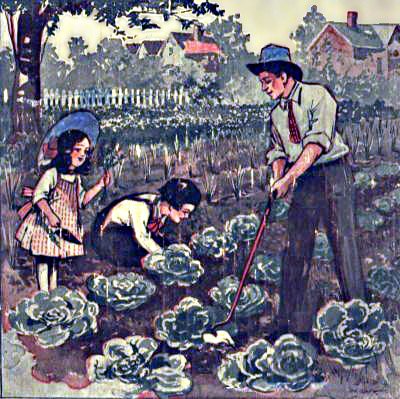
Hal and Mab hoed and raked their gardens. When it did not rain they watered their corn and beans, and they were anxious for the time to come when they could really eat some of the things they had grown. Daddy Blake said Mab's beans might be ready to pick green, so they could be boiled, in about six weeks, but Hal's corn would not be ready for ten weeks. Then the ears would be filled out enough so they could be boiled and eaten with salt and butter. Corn grows more slowly than beans.
"When will we have anything to eat from our garden?" asked Mother Blake one day, when the Summer sun had been beaming down on the green things for a week.
"Well, we'll see," said her husband. "Come with me, Hal and Mab. I'll take you to the garden and we'll see what we can find."
"My beans aren't ready yet," said Mab.
"And there are only little, teeny ears of corn on the stalks in my garden," Hal said.
"We'll see," said Daddy Blake.
He led the children to a plot of earth he himself had planted. Hal and Mab saw some dark green leaves in long rows.
"Pull up some of them," directed Daddy Blake.
Hal did so. On the end of the leaves, growing down in the ground, was something round and red.
"It's a little beet!" cried Mab, clapping her hands in delight.
"No, they're radishes!" exclaimed Hal. "Aren't they, Daddy?"
"Yes, those are red early radishes. Here are some white ones over here for you to pull, Mab. They are called icicles."
Mab gave a cry of delight as she pulled up some long, white radishes. They did look a little like icicles.
"Radishes grow very quickly," said Daddy Blake. "They are ready to eat in about five weeks after the seeds are planted—sooner even that the quickest beans. But of course radishes do not keep over winter. They must be eaten soon after they are pulled, and they make a good relish with bread and butter. We'll have some for dinner."
And the Blakes did. It was the first thing they had from their new garden, and Hal and Mab, who were allowed to eat a few, thought the radishes very good.
Just as the children were getting up from the table one morning, to go out and hoe a little among the corn and beans before going to school, they heard a barking, whining, growling noise out in the yard, and the voice of Sammie Porter could be heard crying:
"Oh, stop! Stop! Go on away! You're bad! Oh, come take him away! Oh! Oh!"
"Something has happened!" cried Daddy Blake, jumping up from his chair. "I hope Sammie isn't hurt!"
CHAPTER V
THE POTATOES' EYES
Hal and Mab ran after their father as he hurried out into the yard. They could hear Sammie crying more loudly now, and above his voice sounded a growling and barking noise.
One part of the fence, between the Blake yard and that where Mr. Porter had made his garden, was low, so that the two children could look over. They saw Sammie standing near the fence, greatly frightened, and looking at a tangle of morning glory vines in which something was wiggling around and making a great fuss.
"Oh, what is it?" asked Hal.
"It's a—it's a lion!" cried the frightened Sammie. "A great—great big lion, all fuzzy like!"
"Oh, it couldn't be a lion, Sammie," said Mr. Blake. "Tell me what it is that scared you."
"'Tis a lion," said Sammie again. "He ran after me an' I ran an' he ran in the bushes an' he's there now. He barked at me!"
"Ho! If he barked it's a DOG," cried Hal. "Where is he, Sammie?"
"In there," and Sammie pointed to the tangle of morning glory vines. Just then Mab saw something that made her call out:
"Why it is a dog. It's OUR dog—Roly-Poly!"
"Are you sure?" asked her father. "Roly is over at Mr. Thompson's house you know," for the little poodle had been sent away while the garden was being made. Mr. Thompson had planted nothing, having too small a yard.
"I don't care!" exclaimed Mab. "I DID see Roly. He's in the bushes there—under the morning glories."
"Well, if it's your dog Roly I would not be so frightened of HIM," said Sammie. "Only I thinked he was a LION."
"Here, Roly! Roly-Poly, come on out!" cried Hal, and out came a very queer-looking dog indeed. It was Roly, but how he had changed. He was all stuck over with leaves, grass and bits of bark from the trees. He certainly did "fuzzy," as Sammie had said, and not at all like the nice, clean poodle he had been.
"Oh, whatever is the matter with him?" cried Mab.
"He's got a lot of leaves stuck on him," added Hal. "Come here, Roly, and I'll pull 'em off for you."
Roly came running over to Hal, but when the little boy tried to get the leaves, grass and bits of bark off his pet he found out what was the matter.
"Roly's all stuck up in fly paper!" cried Hal. "Look!"
"In fly paper?" asked Mr. Blake. "Are you sure?"
"Yes, he must have sat down in some fly paper, and it stuck to him all over, and then he rolled in the leaves and grass," answered Hal.
"And then the leaves and grass stuck to the fly paper," added Mab. "Oh, you poor Roly-Poly!"
The little poodle dog must have known how he looked, and he must have felt quite badly, for he just stretched out at the feet of Hal, who had jumped over the fence, and he howled and howled and howled, Roly-Poly did.
"I wonder how it happened?" asked Mr. Blake. "But we must take Roly-Poly in the house and wash him. Then he'll feel better and look better. Did he scare you very much, Sammie?"
"A—a little bit. When I saw him in our yard, all fuzzy like, I thought sure he was a lion."
Mrs. Porter came out, having heard her little boy crying, and when she saw Roly-Poly she laughed.
Then she said:
"You poor dog. Come over and I'll squirt the hose on you. That will take off some of the fly paper."
"Oh, let me squirt it!" cried Hal. "Roly loves to be squirted on! Let me do it!"
"I'm going to help," added Mab.
"An' me, too!" called Sammie.
"They'll drown the poor dog," spoke Mr. Blake, laughing. "I guess I'd better take a hand in this myself."
"What's the matter?" asked Aunt Lolly from the back steps. "Is the house on fire?" She was always afraid that would happen.
"No, it's just Roly-Poly and some sticky fly paper," answered Mr. Blake. "He must have run home to get a bath after he got all tangled up in the sticky stuff at the Thompson house."
By using the hose, and by greasing the fly paper, which really loosened it more than water did, and then by using soap suds and a brush, Roly-Poly was finally cleaned. Then on their way to school Hal and Mab stopped at the Thompson home to find out what had happened.
"Roly-Poly was very good, all the while he was here," said Mrs. Thompson, "though at first he was lonesome for you. He would have run back to your house if I had let him out, but I knew he might make trouble in your garden so I kept him here.
"This morning I put some of the sticky fly paper around the house and left a window open in the room where Roly was sleeping. The wind must have blown the sticky paper on his curly coat of hair and this so frightened him that he jumped out of the window and ran back home to you."
"Only he went in the yard next door, instead of in ours," said Mab, "and he hid under the morning glory vines."
"And on his way," added Hal, "he rolled in dried leaves and grass until he was all covered, and he looked twice as big as he is now."
"And Sammie thought he was a lion," went on Mab.
"Are you going to bring Roly-Poly back to me to keep?" asked Mrs. Thompson.
"Thank you, no," answered Hal. "Daddy says our garden is growing so well now that Roly can't do much harm. Besides we're going to teach him he mustn't dig holes, to hide his bones, in places where we have things planted. So we'll keep Roly now."
"And we're much obliged to you for being so nice to him," added Mab, "and we're sorry he spoiled your fly paper."
"Oh, I have plenty more fly paper," laughed Mrs. Thompson. "I'm only sorry poor Roly was so stuck up. Good-bye!"
Hal and Mab hurried on to school, laughing over what had happened to their pet poodle. When their lessons were done they went back to their garden, anxious to see if Roly had been good, and had not dug up any corn or beans.
"Everything is all right," said Mab, as she looked at her bush beans, which were now in blossom. Soon the blossoms would drop off and in their places would come tiny bean pods.
"Oh, see Uncle Pennyweight!" cried Mab, when she had found that Roly was peacefully sleeping on the shady porch. "What's he doing?"
"Planting something, I guess," replied Hal after he had looked at his growing corn, and hoed around a few hills.
"And Aunt Lolly is working in her part of the garden," went on Mab. "I wonder if they'll win that ten dollar gold piece prize, Hal?"
"I hope one of us wins it, Mab. If I win I'll give you half."
"And I'll give you half if I win, 'cause you helped me hoe my beans one day when there was so many weeds in 'em."
Daddy Blake had put the ten dollar gold piece in a little box on the dining room mantle, and every day Hal or Mab looked to make sure the prize was there.
"What you doin' Uncle Pennywait?" asked Mab as she and her brother went over to the vacant lot next door, where part of the Blake garden had been planted.
"I'm taking the eyes out of the potatoes," answered Uncle Pennywait.
"Eyes out of potatoes!" cried Hal. "I didn't know they had any."
"Of course they have!" laughed his uncle. "Else how could they see to get out of their brown skin-jackets when they want to go swimming in the kettle of hot water?"
"Oh, he's only fooling us; isn't he Aunt Lolly?" asked Hal. His aunt was hoeing some weeds away from between the hills of cucumbers she had planted, for she was going to raise some of them, as well as pumpkins, which last had been planted in between the rows of Hal's corn.
"Well, Uncle Pennywait may be fooling you a little," said Aunt Lolly, "but I did see him cutting some eyes from the potatoes."
Hal and Mab looked at one another. They did not know what to think now. It was seldom that both Aunt Lolly and Uncle Pennywait joked at the same time.
"Come over here and I'll show you," called Uncle Pennywait when he had laughed at the funny looks on the faces of the two children. "See," he went on, "these are the 'eyes' of the potato, though the right name, of course, is seeds."
He pointed to the little spots you may see on any potato you pick up, unless it is one to small to have them. The spots are near the ends and in the middle, and they look like little dimples. Some of them may look very much like eyes, and that is what most gardeners and farmers call them, but they are really the potato's seeds.
Mab and Hal watched what Uncle Pennywait was doing. He had a basket in which were some large potatoes and these he was cutting into chunks, letting them fall into another basket. In each chunk their uncle cut the children noticed several "eyes."
"What are you doing?" asked Hal.
"I am getting ready to plant a second crop of potatoes," said Uncle Pennywait. "The first ones I planted in my garden were early ones. Soon we will be eating them on the table. They are not the kind that will keep well all winter, and I am planting that kind now. I am going to win the ten dollar prize by raising a bigger crop of potatoes than you can raise of corn or beans, little ones," and he smiled at Hal and Mab.
Then he went on cutting the eyes out of the potatoes, while the children watched him. They saw that each potato chunk had in it two or three of the queer dimple-spots.
"A potato is not like other things that grow in the garden," said Uncle Pennywait. "It does not have its seeds separate from it, as beans have theirs in a pod, or as corn has its kernels or seeds on a cob, or a pumpkin or apple has seeds inside it. A potato's seeds are part of itself, buried in the white part that we cook for the table, and each potato has in it many seeds or eyes.
"Of course I could plant whole potatoes, one in each hill, but that would be wasting seed, so I cut the potatoes up into chunks and plant the little chunks, each one with two or more seeds in it."
"And do you only plant one chunk?" asked Mab.
"No, I drop in two or three, according to the size and the number of eyes. This is done so that if one set of seeds doesn't grow the other will. Now you watch me."
Uncle Pennywait had smoothed off a nice bit of his garden where, as yet, he had planted nothing, and into the long earth-rows of this he now began to plant his potato seed. He walked along the rows with a bag of the cut-up pieces hung around his neck, and as he dropped in the white chunks he covered them with dirt by using a hoe.
"When my potatoes grow up into nice green vines, and the striped bugs come to have a feast on them, you may help me drive the bad creatures away," said Uncle Pennywait to the children. "In fact some of my early potatoes need looking after now."
"Are there bugs on them?" asked Mab, when her uncle had finished his planting.
"Indeed there are! Come and I'll show you."
Over they went to the early-potato part of Uncle Pennywait's garden. There, on many of the green vines, were a lot of blackish and yellowish bugs, crawling and eating the leaves.
"We'll just give them a dinner of Paris Green," said Uncle Pennywait, "and they won't eat any more of my vines."
"What's Paris Green?" asked Mab.
"It is a deadly poison, for grown folks or children as well as bugs, and you must never touch it, or handle it, unless I am with you, or your father is near," said Uncle Pennywait. "Here is some of it."
He showed the children a bright, green powder, some of which he stirred into a sprinkling pot full of water. This water he sprayed over the potato vines.
"The poison in the water goes on the potato leaves," explained Uncle Pennywait, "and when the bugs eat the leaves they also eat the poison, and die. We have to kill them or they would eat away the leaves of the vines until they all died, and we would have no potatoes. The potato bugs are very harmful, and we must get rid of them."
Then he let Hal and Mab sprinkle the potato vines with the Paris Green, afterward making the children carefully wash their hands so there would be no danger.
"Is that the only way to drive away the potato bugs?" asked Hal.
"Sometimes farmers go through their potato field and knock the bugs from the vines into a can full of kerosene oil," said Uncle Pennywait, "or they may use another poison instead of Paris Green. But the bugs must be killed if we are to have potatoes."
Just then Mab saw Aunt Lolly going into her garden with a bottle in her hand.
"Are you going to poison bugs too?" asked the little girl.
"No, I am going to make a cucumber grow inside this," was the answer.
"Make a cucumber grow in a bottle?" exclaimed Hal. "Why, how funny!"
"Let's go see!" cried Mab, and together they ran over to Aunt Lolly's garden.
CHAPTER VI
THE CORN SILK
"Maybe this is another joke, like the eyes of the potatoes," said Hal to his sister, as they ran along.
"That wasn't a joke—the eyes were REAL, though they couldn't see nor blink at you," Mab answered.
"The potato eyes must see a little, else how could they find their way to grow up out of the dark ground?" Hal wanted to know.
"Well, my beans didn't have any eyes, and they grew up," Mab answered. "Even if they did grow upside down, or I thought they did," and she laughed. "But let's see what Aunt Lolly is doing."
Uncle Pennywait's wife was out among the cucumber vines now. She had planted them about the same time Hal had put in the five kernels of corn in each hill.
Aunt Lolly's cucumber seeds had also been planted in hills, so there would be a raised mound of earth for the roots to keep moist in, and in order that the vines, at the start, would be raised up from the other ground around them. Now the cucumber plants were quite lengthy, running along over their part of the garden, and in some places there were growing tiny little pickles—or they would be pickles, when put in salt, vinegar and spices.
"Are you really going to make a cucumber grow in a bottle?" asked Mab as she saw her aunt, with a bottle in her hand, stooping over one of the vines.
"I really am," was the answer. "It is only a little trick, though, and really does no good. But I thought you children would like to see it."
"How are you going to do it?" asked Hal.
"You see this little cucumber, or pickle," spoke Aunt Lolly, and she showed one to Hal and Mab. "Well now I'm going to slip it inside this bottle, but not pull the pickle from the vine. If I did that the cucumber would stop growing and die."
She had a bottle with a neck large enough so the pickle would go in it. The bottle was an odd shape.
"The pickle will grow large and completely fill the bottle," went on Aunt Lolly. "It will grow because it is not broken off the stem, and the bottle, being glass, will let in the sunshine. The neck is also large enough so air can get in, for without air, sunlight and the food it gets through the stem the pickle would not live.
"But as it grows it will swell and fill every part of the bottle and it also will grow just to the shape of the bottle, so that in the Fall, when it can't grow any more, because of the strong glass, I can break the bottle and I will have a pickle shaped just like it, curves, queer twists and everything else."
"Oh, how funny!" cried Hal "I wonder if I could grow an ear of corn in a bottle?"
"No," answered his aunt. "An ear of corn has to grow inside the husk, and you could not, very well, put a bottle over that."
"Could I over one of my beans?" asked Mab.
"Well, you might, but it would have to be a very long and thin bottle, for a bean is that shape when it has grown as large as it will ever get. So I don't believe I'd try it, if I were you. Ill let you each have one of my pickles to grow inside a bottle."
Hal and Mab thought this would be fun so they found other bottles with which to do the funny trick of making cucumbers grow inside the glass.
"I wish Daddy would give a prize for the funniest shaped cucumber," said Mab, when she had fixed her bottle with a pickle inside it.
"Maybe he will," spoke her brother. "We'll ask him."
But when Daddy Blake came home that evening he had a package in his arms, and the children were so interested about what might be in it that they forgot to ask for the cucumber prize.
"What are you going to do now?" asked Mab.
"I'm going to take you and Hal down to the garden and show you how to set out cabbage plants," said Daddy Blake.
"But we've got some cabbage plants!" cried Hal.
"Yes, I know. But these are a kind that will get a head, or be riper, later in the Fall. This is Winter cabbage that we will keep down cellar, and have to eat when there is snow on the ground, for cabbage is very good and healthful. We can eat it raw, or made into sauer-kraut or have it boiled with potatoes. We must save some cabbage for Winter and that is the kind I am going to plant now."
"And may we help?" asked Mab.
"Yes, come on to the garden."
Daddy Blake had asked Uncle Pennywait, that day, to smooth off a plowed and harrowed place ready for the cabbage plants to be put in that evening, and the long rows, dug in the brown soil, were now waiting.
"Where did you get the cabbage plants?" Mab wanted to know. "Did you grow them in a little box down at your office, Daddy, as we did the tomatoes here?"
"No, Mab, not quite that way, though I might have done that if I had had room. I bought these cabbage plants in the market on my way home. Some farmers, with lots of ground, plant the cabbage seed early in the spring in what are called 'hot-frames.' That is they are like our tomato boxes only larger, and they are kept out of doors. But over the top are glass windows, so the cold air can not get in. But the warm sun shines through the glass as it did through our tomato box, and soon the cabbage seeds begin to sprout.
"Then the plants grow larger and larger, until they are strong enough to be set out, as the tomatoes were. In this way you can grow the vegetables better than if you waited until it was warm enough to put the seed right out in the garden, and let the plants grow up there from the beginning. Putting the seeds in the hot frame gives them a good start. Now we'll set out the cabbage plants, and you may both help."
Daddy Blake gave Hal and Mab each a small handful of the little cabbage plants, some of which had two and others three light green leaves on. There were also small roofs, with a little wet dirt clinging to them, from where they had been pulled out of their early home in which they first grew.
"Oh, Hal! That isn't the way to do it!" cried Daddy Blake, when he had watched his little boy walking along the cabbage row for a while, dropping the plants, the roots of which were afterward to be covered with the brown earth.
"Why not?" Hal asked.
"Because you must only drop ONE plant in a place. You are letting two and three fall at once. You mustn't make a bouquet of them," and his father laughed. "Only one cabbage plant in a spot."
"Am I doing it right?" asked Mab, who was on the other side of the cabbage plot.
"Well, not exactly. Hal dropped his too close together and yours are too far apart. The cabbage plants ought to be about two and a half feet apart, in rows and the rows should be separate one from the other by about twenty inches. Here, I'll cut you each a little stick for a measure. You don't need to worry about the rows, as Uncle Pennywait marked them just the right distance apart as he made them."
So after that Hal and Mab measured, with sticks Daddy Blake gave them to get one cabbage plant just as far from the one next to it in the row as Daddy Blake wanted. Then, with a hoe, the children's father covered the roots with dirt and the cabbages were planted, or "set out," as the gardener calls it.
"Now let me take a look at your corn and beans," said Mr. Blake to the two children, when the cabbages had been left to grow. "I want to see who has the best chance of winning that ten dollar gold prize."
"Hal's corn is very nice," said Mab.
"And so are her beans," added Mab's brother kindly. "I guess maybe she'll get the prize."
"Well, it will be quite a little while before we can tell," spoke Daddy Blake. "Corn and beans will not be gathered until Fall, though we may eat some of Hal's corn earlier, for he has some rows of the sweet variety which can be boiled and gnawed off the ears."
Daddy Blake found a few places in Mab's bean patch where the useless weeds needed hoeing away, so they would not steal from the brown earth the food which the good plants needed.
"And one or two of your corn hills could be made a little higher, Hal," said his father. "If you look at the corn stalks you will see, down near where they are in the ground, some little extra roots coming out above the earth. In order that these roots may reach the soil, and take hold, the dirt must be hoed up to them."
Mr. Blake showed the children what he meant, and Mab cried:
"Those roots are just like the ropes we had on our tent when we went camping."
"That's it," said Daddy Blake. "These roots keep the tall corn stalks from blowing over just as the ropes keep the tent from falling down."
"Oh, look!" cried Mab, as she passed one stalk of corn that was larger than any of the others. "There's something growing on this that's just like my doll's hair. I'm going to pull it off."
"No, you mustn't do that," her father said. "That is corn silk."
"Oh, I know what it is," said Hal. "It's brown stuff and sometimes when you're eating corn it gets in your mouth and tickles you."
"Corn silk isn't brown until it gets old and dried," said his father. "At first it is a light green, like this. And the silk is really part of the corn blossom."
"I didn't know corn had a blossom," said Mab.
"Yes," said her father, "it has. Part of the blossom is up top here, on these things that look like long fingers sticking out," and he pointed to the upper part of the stalk. "On these fingers grows a sort of fine dust, called pollen, and unless this falls down from the top of the corn stalk, and rests on the silk which grows out from the ear, there would be no more corn seed. Or, if corn seed, or kernels, did form on the ear, they would be lifeless, and when planted next year no corn would grow from them. The pollen dust and the silk must mingle together to make perfect ears of corn, so don't pull off the silk, even if you do want to make it into hair for your doll."
Mab promised she would not, though she loved the feel of the soft corn silk. Then she and Hal noticed where some of the light yellow pollen had already been blown by the wind down on the silk to help make the perfect ear of corn.
As the children walked along through the garden with Daddy Blake they heard voices over the fence where Mr. Porter lived. Then they heard Sammie calling:
"Oh, Daddy! Look what I got! It's a big green bug, an' Roly-Poly is barkin' at him! Come quick!"
"I hope Roly-Poly isn't making any more trouble as he did with the fly paper," said Mr. Blake as he walked toward the fence.
CHAPTER VII
EARLY TOMATOES
"What's the matter, Mr. Porter?" asked Mr. Blake, looking over the fence where Sammie's father was working in his garden. "Has our little poodle dog been scratching up your plants?"
"Oh, no. Roly is very good. He seems to know we want the thing's in our gardens to grow, and he only walks carefully between the rows, and doesn't scratch a bit," answered the neighbor.
"What is he barking at now?" asked Mab, for the little poodle dog had crawled under the fence and had gone next door, as he often did. He was standing near red-haired Sammie now.
"He's barkin' at a big, green bug," said the little boy.
"A green bug; eh?" spoke Mr. Porter. "Maybe we'd better see what it is," he added, speaking to Daddy Blake.
"I rather think we had. There are so many bugs, worms and other things trying to spoil our gardens, that we must not let any of them get away."
"He's a awful big bug, almost as long as Roly's tail," called Sammie from where he stood near a tomato plant.
"Well, Roly's tail isn't very big," laughed Daddy Blake. "But a bug or worm of that size could eat a lot of plant leaves."
"Don't touch it—Daddy will kill it!" called Mr. Porter to his little boy. But Sammie had no idea of touching the queer bug he had seen, and at which the poodle dog was barking.
"Oh, it's one of the big green tomato worms!" exclaimed Mr. Blake when he saw it. "They can do a lot of damage. I hope they don't get in my garden. We must kill as many as we can," and he knocked the worm to the ground and stepped on it. Roly-Poly barked harder than ever at this, thinking, perhaps, that he had helped get rid of the unpleasant, crawling thing.
"We'll look over your tomato patch and see if there are any more worms," suggested Mr. Blake to his neighbor.
"Yes, and then I'll come and help you clear your plants of the pests," said Mr. Porter. "We want to have our gardens good this year, so we won't have to spend so many of our pennies for food next Winter."
A few more of the green worms were found on the tomato vines, and there were more on Daddy Blake's. So many were found that he could not be sure he had knocked them all off.
"I think I will have to spray the plants with Paris Green as I did the potatoes," he said. "The tomatoes will not be ready to pick—even the earliest—for some weeks and by that time the poison will have been washed off by the rain."
"Making a garden is lots of work" said Hal, next day, when he and Mab had helped their father spray the tomato plants.
"Yes, indeed," agreed Mr. Blake. "But, like everything else in this world, you can't have anything without working for it."
"I thought all you had to do in a garden," said Mab, "was to plant the seed and it would grow into cabbage, radishes, corn, beans or whatever you wanted."
"You are beginning to learn otherwise," spoke her father, "and it is a good thing. Mother Nature is wise and good, but she does not make it too easy for us. She will grow beautiful flowers, and useful fruits and vegetables from tiny seeds, but she also grows bad weeds and sends eating-bugs that we must fight against, if we want things to grow on our farms and gardens. So we still have much work before us to make our gardens a success."
"We haven't had much to eat from them yet," said Mother Blake, who had been hoeing among her carrots. "I hope we can pick something soon."
"We had radishes," said Hal.
"And well soon have tomatoes," added his father. "Now that I have driven away the eating worms the vines will grow better and the tomatoes will ripen faster."
A week later on some of the vines there were quite large green tomatoes. Hal and Mab watched them eagerly, noting how they grew and swelled larger, until, one day, Mab came running in, crying:
"Oh, one tomato has a red cheek!"
"That's where it got sunburned," said her father with a smile. "That shows they are getting ripe. Soon we will have some for the table."
In a few days more tomatoes on the vines had red, rosy cheeks, some being red all over. These Daddy Blake let Hal and Mab pick, and they brought them in the house.
"Oh, we shall have some of our own tomatoes for lunch!" cried Mother Blake when she saw them. "How fine! Our garden is beginning to give us back something to pay us for all the work we put on it."
"But these are Daddy's tomatoes," said Hal. "He had the first thing, after the radishes, for the table from his garden, and Mab and I haven't anything. Daddy'll get his own prize."
"No, I promise you I will not take the prize for these tomatoes, even if I did raise them in my part of the garden," said Daddy Blake with a smile. "And I won't count the radishes we had before the tomatoes were ripe, either. Those belonged to all of us.
"The prize isn't going to be given away until all the crops are harvested, or brought in, and then we'll see who has the most and the best of things that will keep over Winter."
"Can you keep tomatoes all Winter?" asked Mab of her father.
"Well, no, not exactly. But Mother can put them into cans, after they have been cooked, and she can make ketchup and spices of them—chili sauce and the like—as well as pickles, so, after all, you might say my tomatoes will last all Winter.
"Sometimes you can keep tomatoes fresh for quite a while down in a cool, dry cellar, if you pull the vines up by the roots, with the tomatoes still on them, and cover the roots with dirt. But they will not keep quite all Winter, I believe. At any rate I'm not going to keep ours that way. We'll can them."
Mother Blake sliced the garden tomatoes for supper. She also made a dressing for them, with oil, vinegar and spices, though Hal and Mab liked their tomatoes best with just salt on.
"Tomatoes are not only good to eat—I mean they taste good—but they are healthful for one," said Daddy Blake. "It is not so many years ago that no one ate tomatoes. They feared they were poison, and in some parts of the country they were called Ladies' or Love Apples. But now many, many thousands of cans of tomatoes are put up every year, so that we may have them in Winter as well as in Summer, though of course the canned ones are not as nice tasting as the ones fresh from the garden, such as we have now."
It was not long before there was lettuce from the Blake garden, and Mother Blake said it was the best she had ever eaten. Lettuce, too, Daddy Blake explained, would not keep over Winter, though it is sold in many stores when there is snow on the ground. But it comes from down South, where there is no Winter, being sent up on fast express trains.
"Lettuce is also as good to eat as are tomatoes," remarked Daddy Blake. "It is said to be good for persons who have too many nerves, or, rather, for those whose nerves are not in good condition."
One day, when Hal and Mab came home from school, they hurried out, after leaving their books in the house, for they wanted to play some games."
"Aren't you going to work in your gardens a little while?" asked their mother. "Daddy is out there."
"Is he?" cried Hal. "Did he come home early?"
"Yes, on purpose to hoe among his tomatoes, I think he is cutting down the weeds which grew very fast since the last rain we had."
"Our parts of the garden are all right," said Hal. "My corn doesn't need hoeing."
"Nor my beans," said Mab. "But let's go out and see Daddy, Hal. Maybe he'll tell us something new about the garden."
"Well, where are your hoes, toodlekins?" called Daddy Blake, when he saw the two children coming toward him.
"There aren't any weeds in my corn," said Hal.
"Nor in my beans," added Mab.
"Not very many, it is true," said Daddy Blake. "But still there are some, and if you cut down the weeds when they are small, and when there are not many of them, you will find it easier to keep your garden looking neat, and, at the same time, make sure your crops will grow better, than if you wait and only hoe when the weeds are big.
"Gardens should be made to look nice, as well as be made free from weeds just because it is a good thing for the plants," went on Daddy Blake. "A good gardener takes pride in his garden. He wants to see every weed cut down. Besides, hoeing around your corn and beans makes the dirt nice and finely pulverized—like the pulverized sugar with which Mother makes icing for the cakes. And the finer the dirt is around the roots of a plant the more moisture it will hold and the better it will be for whatever is growing, as I have told you before."
"Well, we'll hoe a little bit," said Hal.
He and his sister got their hoes and soon they were so interested in cutting down the weeds in between the rows that they forgot about going off to play. Hal noticed that the ears of corn on his stalks were getting larger inside the green husk that kept the soft and tender kernels from being broken, as might have happened if they were out in the air, as tomatoes grow.
And so the gardens grew, just as did that of "Mistress Mary, quite contrary," about whom you may read in Mother Goose, or some book like that. Sometimes it rained and again it was quite dry, with a hot sun beating down out of the blue sky.
"If we don't get rain pretty soon we shall have to water the gardens," said Daddy Blake one night after about a week of very dry weather. Around the roots of the many plants the earth was caked and hard, so that very little air could get down to nourish the growing things.
"What do people do who have gardens where it doesn't rain as often as it does here, Daddy?" asked Mab.
"Well in very dry countries, such as some parts of ours near the places called deserts," said Mr. Blake, "men build large dams, and hold the water back in big ponds or lakes so it will last from one rainy season to another. The water is let run from the lake through little ditches, or pipes, so that the thirsty plants may drink. This is called the irrigation method, for to irrigate means to wet, soak or moisten with water. Each farmer or gardener is allowed to buy as much water as he needs, opening little gates at the ends of the main ditches or sluices, and letting the water run over his dry ground, in which he has dug furrows to lead the water where he most needs it.
"And sometimes, when there is too little water to use much of it this way, the gardeners do what they call intensive cultivation. Those are big words, but they mean that the man just hoes his ground every day around his plants, instead of perhaps once a week.
"You know there is moisture in the air, and at night dew falls. This wets the ground a little, and by digging and turning over the earth around the roots of his plants, the gardener makes it very fine so it holds the moisture longer. In this way a little bit of rain, or dew, lasts a long time. Come out now, and I'll show you something you perhaps have not noticed."
Daddy took Hal and Mab to the garden, and with a hoe he pointed to a place around Hal's corn stalks where the dry ground was hard, and baked by the sun.
A few strokes of the hoe and Daddy Blake had turned up some of the underlying earth. Hal and Mab saw that it was darker in color than that on top, and when they put their hands down in it the earth felt moist.
"What makes it?" asked Mab.
"Because the underneath part of the ground held the moisture in it. The top part was baked dry and the moisture had all gone away—evaporated in the sun, if you want to use big words, just as water dries in your hands after you wash them, even if you do not soak it up with a towel."
"Does a towel soak up water?" asked Mab. "I thought it just wiped it off our hands."
"No, the towel is like a sponge," said Daddy Blake. "The fuzzier the towel the more like a sponge it is. Each little bit of linen or cotton, is really a tiny hollow tube—a capillary tube it is called—and these tubes suck up the water on your hands as the same fuzzy capillary tubes in a piece of blotting paper suck up the ink. A towel is a sponge or a blotter. And the earth is a sort of sponge when it comes to sucking up the rain and dew. It also holds the water near the plant, when the ground is finely pulverized, so the tomato vine, the corn stalk or the bean bush can drink when it gets thirsty."
"My! There's a lot to know about a garden; isn't there?" said Mab with a sigh.
"Yes, there is," agreed Hal. "I don't s'pose we'll ever know it all."
"No," said his father, "you will not. There will always be something better to learn, not only for you but for everyone. But learn all you can, and learn, first of all, that plants must have sunshine, air and water to make them grow. Now we'll water the garden."
There were no signs of rain, and though the ground was a little moist in some parts of the garden Daddy Blake thought all the growing things would be better for a wetting from the hose. So he attached it to the faucet and let Hal and Mab take turns sprinkling. As the drops fell on the thirsty ground there floated up a most delicious smell, like the early spring rain, which helps Mother Nature to awaken the sleeping grass and flowers.
"I guess my corn is wet enough," said Hal, after a bit. He had only been sprinkling a little while when he heard one of his boy friends calling him from the street in front.
"Oh, your corn isn't half wet enough," laughed Daddy Blake. "It is almost better not to water the garden at all than not to give it enough, for it only hardens the dirt on top. Give the corn a good soaking, just as if it had rained hard. A good watering for the garden means about two quarts of water to every square foot in your plots. Don't be afraid of the water. Your plants will do so much better for it. But don't spray them too heavily, so the dirt is washed away. Let the hose point up in the air, and then the drops will fall like rain."
Hal kept the hose longer, giving his corn a good wetting, and he could almost see the green stalks stand up straighter when he had finished. They were refreshed, just as a tired horse is made to feel, better, after a hot day in the streets, when he has a cool drink and is sprinkled with the hose.
"Roly, get out the way or you'll be all wet!" cried Mab, as the little poodle dog ran around her beans when she was watering them.
"Bow-wow!" barked Roly, just as if he said he didn't care.
"Well, if you want to get wet—all right!" laughed Mab. "Here it comes!"
She pointed the hose straight at Roly and in a second he was wet through.
"Ki-yi! Ki-yi! Ki-yi!" he yelped as he ran out of the garden. "Bow-wow! Ki-yi!"
"Well, it will cool him off, and I guess he wanted it after all," said Daddy Blake. "But Roly is a good little dog. He only dug once in the garden since he came back, but I tapped him on the end of his nose with my finger, and scolded him, and he hasn't done it since."
The next day Daddy Blake took Hal and Mab to the garden again, and showed them how he was building little wooden frames under his tomatoes to keep the red vegetables off the ground where they might lie in the mud and sand and get dirty.
"The frames help to hold up the vines so they will not break when the tomatoes get too heavy for them," said Mr. Blake.
"Plants have lots of trouble," said Hal. "You have to put their seeds in the ground, keep the weeds away from them, hoe them, water them, and keep the bugs and worms away. Is there anything else that can happen to things in a garden, Daddy?"
"Yes, sometimes heavy hail storms come and beat down the plants, or tear the leaves to ribbons so the plants die, and bear nothing. This often happens to corn, which has broad leaves easily torn by hail."
"What is hail?" asked Hal.
"Well, it's a sort of frozen rain," said Daddy Blake. "Often in a thunder shower the wind plays strange tricks. It whirls the rain drops about, first in some cool air, far above the earth and then whips them into some warm air. The cool air freezes the rain, and when it falls it is not in the shape of beautiful crystals, as is the snow, but is in hard, round balls, sometimes as large as marbles. Often the hail will break windows."
"I hope it doesn't hail in our nice garden," said Hal.
"It will hurt your corn worse than it would my beans," said Mab. "I hope it doesn't hail, too, Hal."
But two or three days after that, one evening when the Blakes were sitting on the steps after having worked in the garden, there came from the West low mutterings of thunder. Then the lightning began to flash and Daddy Blake said:
"We are going to have a shower, I think. Well, it will be good for the garden."
And soon the big drops began splashing down, followed by another sound.
"Oh, it's hailing!" cried Aunt Lolly. "Hear the hail stones!"
"I love to see it!" exclaimed Mab. "But I hope it doesn't hail very big stones."
However the stones from the sky—stones of ice that did not melt for some time after they rattled down—were rather large. They bounced up from the sidewalk and on the path around the Blake house.
"Where's Hal?" suddenly asked his father. "I want to show him and Mab how the inside of hail stones look. I'll run out and get some as soon as the shower slackens a little."
It was raining and hailing hard now, and the lightning was flashing brightly, while the thunder was rumbling like big cannon.
"Hal was here a minute ago," said his mother. "I wonder if he could have run out in the storm?"
Just then, from his porch, Mr. Porter called something to Daddy Blake. All Mab and her mother could hear was:
"Hal—hail—umbrella!"
"Oh, I hope nothing has happened to him!" said Mrs. Blake. "You had better go look for him, Daddy!"
CHAPTER VIII
THE CHILDREN'S MARKET
Daddy Blake caught up an umbrella from the hallway and ran out into the storm, going around the side path toward the back yard and lot where the children had made their gardens.
"Where is he going?" asked Mab.
"To look for Hal," answered her mother.
"Where is Hal?"
"He must have gone out in the storm to see what made it hail, I suppose."
"Oh, if one of the big hail stones hits him on the end of his nose he'll cry!" exclaimed Aunt Lolly.
"Well, he'll know better than to do it again," said Uncle Pennywait "Listen to Roly-Poly howling!"
The little poodle dog was afraid of thunder and lightning, and every time there was a storm he used to get in the darkest corner of the house and howl. He was doing this now as Daddy Blake ran to the garden to find where Hal was.
"He's back there—out where his corn is planted!" called Mr. Porter to Hal's father as Daddy Blake ran around the house. "I saw him from our kitchen window, and I thought I'd tell you."
"I'm glad you did!" shouted Mr. Blake. Both he and Mr. Porter had to shout to be heard above the noise of the storm; for the thunder was very loud, and the patter of the rain drops, and the rattle of the hail made a very great racket indeed.
When Daddy Blake turned around the corner of the house and started down the main path that led through the vegetable garden, he saw a strange sight. There stood Hal, in the midst of his little corn field, out in the pelting rain and hail, holding the biggest umbrella over as many of the stalks of corn as he could shelter. And Hal himself was dripping wet for the rain blew under the umbrella.
"What are you doing?" cried Mr. Blake.
"Keeping the hail off my corn," answered Hal. "You said the hail stones would tear the green leaves all to pieces and I don't want it to. Can't Mab come out and hold an umbrella, too? You've got one, Daddy, so you can help."
Mr. Blake wanted to laugh but he did not like to hurt Hal's feelings. Besides he was a little worried lest Hal take cold in the pelting storm. So he said:
"You must come in, Hal. Holding an umbrella over your corn would only save one hill from the hail and saving that one hill would not make up for you getting ill. We shall have to let the storm do its worst, and trust that not all the corn will be spoiled."
"Is that what the farmers do?" asked Hal, making his way between the rows of corn toward his father.
"Yes. They can't stop the hail and they can't cover the corn. Sometimes it doesn't do a great deal of damage, even though it tears many of the green leaves. This storm is beginning to stop now, so you had better come in."
"I didn't want my corn to be spoiled, so I couldn't win the prize," spoke Hal, as he went back to the house with his father, walking under the umbrella. "That's why I came out to keep off the frozen rain. It came down awful hard."
"Yes, it was a heavy storm for a few minutes," said Mr. Blake. "But it will soon be over, and the rain will do the gardens good, though the hail may hurt them some."
By the time Hal and his father reached the porch the hail had stopped and it was only raining. Mrs. Blake, Aunt Lolly and the others were anxiously waiting.
"I thought maybe he had been struck by lightning," said Mab.
"Pooh! I wasn't afraid!" boasted Hal.
"I guess you were thinking too much about your corn," said his father with a laugh. "It was very good of you, but you mustn't do such a thing again. Now you'll have to get dry clothes on. But wait until I show you how a hail stone looks inside."
Daddy Blake ran out into the storm and came back with a handful of the queer, frozen stones. He let Hal and Mab look at them, and then, taking a large one, he held it on top of the warm stove for a second, until the chunk of ice had melted in half.
"See the queer rings inside it," Daddy Blake said to the children and, looking, they noticed that the hail stone was made up of different layers of ice, just as some kinds of candy are made in sections.
"What makes it that way—like an onion," asked Hal, for the hail stone did look a bit like an onion that has been sliced through the centre.
"It is because the hail is made up of different layers of ice," answered Daddy Blake. "It is supposed that a hail stone is a frozen rain drop. In the tipper air it gets whirled about, first going into a cold part that freezes it. Then the frozen rain drop is tossed down into some warm air, or a cloud where there is water. This water clings to the frozen centre and then is whirled upward again. There is another freeze, and so it goes on, first getting wet and then freezing until, after having been built up of many layers of ice and frozen rain, the hail stone falls to the ground."
"My!" exclaimed Mab. "I didn't know hail stones were so wonderful."
"Neither did I," added Hal.
When Hal had changed his clothes he told how it was he happened to run out into the garden during the heavy hail storm. He had seen the big frozen chunks of rain coming down, and he remembered what his father had said about it spoiling garden and farm crops. So Hal, when no one was looking, got a big umbrella from the rack and went out to hold it over his corn. Mr. Porter happened to see him and told Mr. Blake.
The shower did not last very long, and when it was over Daddy Blake took Hal and Mab into the garden to see what damage had been done. The ground was so muddy they had to wear rubbers.
"Oh, a lot of my beans are beaten down!" cried Mab, as she looked at her bushes.
"They'll straighten up again when the sun comes out," said her father. "If they don't you can hold them up with your hand and hoe more dirt around their roots. That's what I shall have to do with my tomatoes, too. The fruit is getting too heavy for the vines. However no great harm will be done."
"A lot of my corn is torn," said Hal. "It's too bad!"
"Not enough is torn to spoil the ears," said Daddy Blake. "A gardener must expect to have a little damage done to his crops by the storms. Of course it isn't nice, but it is part of the garden game. Sometimes whole orchards, big green houses and large fields of grain are ruined by hail storms. We were lucky."
"What does a farmer do when his whole crop is spoiled by a big storm?" asked Hal.
"Well, generally a farmer raises many crops, so that if one fails he can make money on the others. That is what makes it hard to be a farmer, or, rather, one of the things that make it hard. He never can tell whether or not he is going to have a good crop of anything. Sometimes it may be storms that spoil his wheat or hay, and again it may be dry weather, with not enough rain, or bugs and worms may eat up many of his growing things. So you see a farmer, or a man who has a larger garden, must grow many crops so that if he loses one he may have others to keep him through the Winter, either by selling the things he raises, or by eating them himself."
The next day there was no school, and Hal and Mab spent much time in their garden. The sun came out bright and warm, and the children said they could almost SEE the things growing. Mab declared that her bean vines grew almost an inch that one day, and it may be that they did. Beans grow very fast. If you have ever watched them going up a pole you would know this to be true.
With their hoes the children piled more dirt around the roots of the garden plants where the rain had washed the soil away, and thus the bushes and stalks were helped to stand up straighter. Some straightened up of themselves when they had dried in the sun.
"Well, I think we are going to have some good crops," said Daddy Blake when he went to the garden with Hal and Mab a few days after the storm. "In fact we are going to have more of some things than we can use."
"Will we have to throw them away?" asked Hal.
"No indeed!" laughed his father. "That would be wrong at a time when we must save all the food we can. But we will do as the farmer does who raises a large crop of anything. We will start a little store and sell what we do not need."
"A REAL store?" cried Mab, with shining eyes.
"And sell things for REAL money?" asked Hal.
"Of course!" laughed their father, "though you may give your friends anything from your garden that you wish to."
"Where will we keep the store?" asked Hal. "And who will we sell the things to?"
"And what will we sell?" asked Mab. "What have we too much of, Daddy?"
"My! You children certainly can ask questions!" exclaimed Mr. Blake.
"Now let me see! In the first place I think if you keep the store out on the front lawn, near the street, it will be the best place, I'll put an old door across two boxes and that will be your store counter. And you can sell things to persons that pass along the street. Some in automobiles may stop and buy, and others, on their way to the big stores, may stop to get your vegetables because they will be so fresh. The fresher a vegetable is the better. That is it should be eaten as soon as possible after it is taken from the garden, else it loses much of its flavor."
"But will people give us real money for our garden truck?" asked Hal. He had heard his father and Uncle Pennywait speak of garden "truck" so he knew it must be the right word.
"Indeed they'll be glad to pay you real money," said Mr. Blake with a smile. "Persons who have no garden of their own are very glad to buy fresh vegetables. You'll soon see."
"But what are we going to sell?" asked Mab.
"Oh, yes, I forgot your question," said her father. "Well, there are more tomatoes than your mother has time to can, or make into ketchup just now. She will have plenty more later on. And I think there will be more of your beans, Mab, than you will care to keep over Winter, or use green. So you can sell some of my tomatoes and some of your beans."
"My corn isn't ripe yet," said Hal. "The ears are awful little."
"No, you must wait a while about your corn. But Mother's carrots are ready to pull, and she has more than we will need over Winter. You may sell some of those, Hal."
"Oh, won't it be fun—having a real store!" cried the little boy. "Come on, Mab, we'll get ready! I'm going to pull the carrots."
"And I'll pull the beans!" cried Mab. "Will you get the tomatoes, Daddy?"
"Yes, but you had better let me show you a little bit about getting the things ready for your market store. The nicer your vegetables look, and the more tastefully you set them out, the more quickly will people stop to look at them and buy them. Wise gardeners and store-keepers know this and it is a good thing to learn."
So Daddy Blake first showed Mab how to pick her string beans, taking off only those of full size, leaving the small to grow larger, when there would be more to eat in each pod. The beans were kept up off the ground with strings running to sticks at the of each row.
"If the beans touch the ground they not only get dirty," Mr. Blake, "but they often are covered with brown, rusty spots and they soon rot. Persons like to buy nice, clean beans, free from dirt. So have yours that way, Mab."
Mab put the beans site picked into clean strawberry boxes, and set them in the shade out of the sun until it was time to open the store on the lawn near the street.
Hal's father showed how to pull from the brown earth the yellow carrots from Mother Blake's part of the garden. Only carrots of good size were pulled, the small ones being left to grow larger. The carrots were tied in bunches of six each, and the bright yellow, pointed bottoms, with the green tops, made a pretty picture as they were laid in a pile in the shade.
"Now I'll pick some tomatoes and your garden store will be ready for customers," said Daddy Blake.
His vines were laden with ripe, red tomatoes and these were carefully picked and placed in strawberry boxes also, a few being set aside for lunch, as was done with Mab's beans and Mother Blake's carrots.
A little later Hal and Mab took their places behind a broad wooden counter, placed on two boxes out in front of their house. On the board were set the boxes of red tomatoes, those of the green and yellow string beans and the pile of yellow carrots.
"Now you are all ready for your customers," said Daddy Blake, as he helped the children put the last touches to their vegetable store.
"Oh, I wonder if we'll sell anything?" spoke Mab, eagerly.
"I hope so," answered Hal. "Oh, Look! Here comes a big automobile with two ladies in it, and they're steering right toward us!"
"I hope they don't upset our counter," said Mab slowly, as she watched the big auto approach.
CHAPTER IX
SAMMIE PLANTS TOMATOES
"Look at the lovely vegetables!" exclaimed one of the ladies in the automobile, as she glanced at what Hal and Mab had spread out on their store counter—the old barn door set on the two boxes.
"Are they nice and fresh, children?" asked the second lady, as she put a funny pair of spectacles, on a stick, up to her nose, and looked at the string beans through the shiny glass.
"Oh, yes'm, they're very fresh!" answered Hal. "Daddy and us just picked 'em from our garden."
"We have more than we can eat, and mother hasn't time to can the tomatoes," explained Mab, for their father had left them alone, to say and do as they thought best.
"They certainly look nice," went on the first lady, "And how well the children have arranged them."
"Like a picture," added the other. "See how pretty the red, green and yellow colors show. I must have some tomatoes and beans."
"And I want some of those carrots. They say carrots make your eyes bright."
Hal and Mab thought the ladies eyes were bright enough, especially when the sun shone and glittered on the funny stick-spectacles. The automobile had stopped and the chauffeur got down off the front seat behind the steering wheel and walked toward the children's new vegetable store.
"How much are your tomatoes?" asked the lady who had first spoken.
"Eight cents a quart," answered Hal, his father telling him to ask that price, which was what they were selling for at the store. "And they're just picked," added the little boy.
"I can see they are," spoke the lady. "I'll take three quarts, and you may keep the extra penny for yourselves," she added as she handed Hal a bright twenty-five-cent piece.
Hal and his sister were so excited by this, their first sale, and at getting real money, that they could hardly put the three quarts of red tomatoes in the paper bags Daddy Blake had brought for them from the store. They did spill some, but as the tomatoes fell on the soft grass they were not broken.
"I want some beans and carrots," said the other lady, and the chauffeur helped Hal and Mab put them in bags, and brought the money back to the children. The beans and carrots were sold for thirty cents, so that Hal and Mab now have fifty-five cents for their garden stuff.
"Isn't it a lot of money!" cried Hal, when the auto had rolled away down the street, and he and his sister looked at the shining coins.
"Well get rich," exclaimed Mab, gleefully.
A little later a lady in a carriage stopped to buy some beans, and after that a man, walking along the street, bought a quart of tomatoes. Later on a little girl and her mother stopped and looked at the carrots, buying one bunch.
"I want my little girl to eat them as they are good for her," said the lady, "but she says she doesn't like them, though I boil them in milk for her."
"But they don't taste like anything," complained the little girl.
"Our carrots are nice and sweet," said Mab. "You'll like these. My brother and I eat them."
"They look nice and yellow," said the little girl. "Maybe I will like these."
Hal and Mab had sold several boxes of beans and tomatoes and about half a dozen bunches of carrots, in an hour, and now they began putting their store counter in order again, for it was rather untidy. Daddy Blake had told them to do this.
Once or twice the children could not make the right change when customers stopped to buy things, but Aunt Lolly was near at hand, on the porch, and she came to their aid, so there was no trouble.
It was rather early in the morning when Hal and Mab started their store, and by noon they had sold everything, and had taken in over two dollars in "real" money.
"Isn't it a lot!" cried Hal, as he saw the pile of copper, nickle and silver coins in the little box they used for a cash drawer.
"A big pile," answered Mab. "We'll sell more things to-morrow."
"No, I think not," spoke Daddy Blake, coming along just then. "We must not take too much from our garden to sell. But you have done better than I thought you would. Over two dollars!"
"What shall we do with it?" asked Hal.
"Well, you may have some to spend, but we'll save most of it," his father answered. "This is the first money you ever earned from your garden, and I want you to think about it. Just think what Mother Nature did for you, with your help, of course.
"In the ground you planted some tiny seeds and now they have turned into money. No magician's trick could be more wonderful than that. This money will pay for almost all the seed I bought for the garden. Of course our work counts for something, but then we have to work anyhow."
Hal and Mab began to understand what a wonderful earth this of ours is, and how much comes out of the brown soil which, with the help of the air, the rain and sunlight, can take a tiny seed, no larger than the head of a pin, and make from it a great, big green tomato vine, that blossoms and then has on it red tomatoes, which may be eaten or sold for money. And the beans and carrots did the same, each one coming from a small seed.
Sammie Porter came out two or three times and watched Hal and Mab selling things at their vegetable store. The little boy seemed to be wondering what was going on, and Hal and Mab told him as well as they could.
"Sammie goin' to have a 'mato store," he said when the two Blake children had sold all their things, and were moving their empty boxes and door into the barn. "Me goin' to sell 'matoes."
"I wonder what he will do?" said Mab.
"Maybe he'll take a lot of things from his father's garden," suggested Hal. "We better tell him not to."
"Well, Mr. Porter is working among his potatoes so I guess Sammie can't do much harm," Mab said.
A little later she and Hal happened to look out in front and they saw a queer sight. Sammie was drawing along the sidewalk his little express wagon, in which he had piled some tomatoes. They were large, ripe ones, and he must have picked them from his father's vines, since he could not get through the fence into the Blake gardens.
"Oh, Sammie!" cried Mab, running out to him, "What are you doing with those tomatoes?"
"Sammie goin' have a 'mato store an' sell 'em like you an' Hal. You want come my 'mato store?" he asked, looking up and smiling.
"No, I guess we have all the tomatoes we want," laughed Hal.
Sammie did not seem to worry about this. Maybe he thought some one else would buy his vegetables. He wheeled his cart up near his own front fence, on the grass and sat down beside it.
"'Mato store all ready," he said. "People come an' buy now."
But though several persons passed they did not ask Sammie how much his tomatoes were. They may have thought he was only playing, and that his tomatoes were not good ones, though they really were nice and fresh.
"We'd better go tell his father or mother," suggested Mab to her brother. "I don't believe they know he's here."
"Guess they don't," Hal agreed. "Come on; he might get hurt out there all alone."
Brother and sister started into the Porter yard. They did not see Sammie's mother, but his father was down in the back end of his lot, weeding an onion bed.
"Hello, children!" called Mr. Porter. "Did you come over to see how my garden is growing?"
"We came to tell you about Sammie," said Mab. "He's out—"
"Hello! Where IS that little tyke?" cried Mr. Porter suddenly. "He was here a little while ago, making believe hoe the weeds out of the potatoes. I don't see him," he added, straightening up and looking among the rows of vegetables.
"He's out in front trying to sell tomatoes," said Hal.
"Oh my!" cried Sammie's father. "I told him not to pick anything, but you simply can't watch him all the while."
He ran out toward the front of the house, Hal and Mab following. They saw Sammie seated on the ground near his express wagon, and he was squeezing a big red tomato, the juice and seeds running all over him.
"Sammie boy! What in the world are doing?" cried his father.
"Sammie plantin' 'mato," was the answer. "Nobody come to my store like Hal's an' Mab's, so plant my 'matos."
Then they saw where he had dug a hole in the ground with a stick, into this he was letting some of the tomato juice and seeds run, as he squeezed them between his chubby fingers.
"Oh, but you are a sight!" said Mr. Porter with a shake of his head. "What your mother will say I don't dare guess! Here! Drop that tomato, Sammie! You've got more all over you than you have in the hole. What are you trying to do?"
"Make a 'mato garden," was Sammie's answer as his father picked him up. "I put seeds in ground and make more 'matoes grow."
"But you musn't do it out here," said Mr. Porter, trying not to laugh, though Sammie was a queer sight. "Besides, I told you not to pick my tomatoes. You have wasted nearly a quart. Now come in and your mother will wash you."
Into the house he carried the tomato-besmirched little boy, while Hal and Mab pulled in the express wagon with what were left of the vegetables. Sammie had squeezed three of the big, ripe tomatoes into a soft pulp letting the juice and seeds run all over.
"And a tomato has lots of juice and seeds," said Mab as she and Hal told Daddy and Mother Blake, afterward, what had happened.