
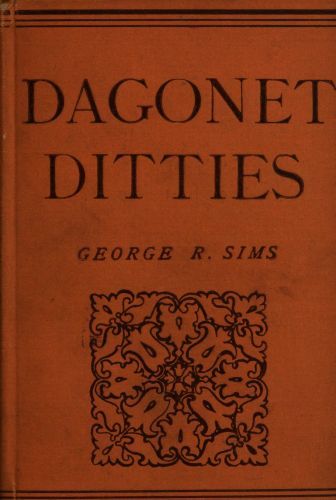
The Project Gutenberg eBook of Dagonet Ditties
Title: Dagonet Ditties
Author: George R. Sims
Release date: November 7, 2018 [eBook #58246]
Most recently updated: January 24, 2021
Language: English
Credits: Produced by Chuck Greif, deaurider and the Online
Distributed Proofreading Team at http://www.pgdp.net (This
file was produced from images generously made available
by The Internet Archive)
DAGONET DITTIES
WORKS BY GEORGE R. SIMS.
Post 8vo., illustrated boards, 2s. each; cloth limp, 2s. 6d. each.
ROGUES AND VAGABONDS.
THE RING O’ BELLS.
MARY JANE’S MEMOIRS.
MARY JANE MARRIED.
TALES OF TO-DAY.
DRAMAS OF LIFE. With 60 Illustrations.
TINKLETOP’S CRIME. With a Frontispiece by Maurice Greiffenhagen.
Crown 8vo., picture cover, 1s. each; cloth, 1s. 6d. each.
HOW THE POOR LIVE; and HORRIBLE LONDON.
THE DAGONET RECITER AND READER: being Readings and Recitations in Prose and Verse, selected from his own Works by George R. Sims.
THE CASE OF GEORGE CANDLEMAS.
London: CHATTO & WINDUS, 214, Piccadilly, W.
DAGONET DITTIES
[FROM ‘THE REFEREE’]
BY
G E O R G E R. S I M S
AUTHOR OF ‘HOW THE POOR LIVE,’ ‘ROGUES AND VAGABONDS,’ ETC.
SECOND EDITION
London
CHATTO & WINDUS, PICCADILLY
1891
C O N T E N T S.
Dagonet Ditties.
London Day by Day.
The fever fiend takes larger tolls,
And sin a fiercer grip of souls,
In London day by day.
And Eiffel houses block the light,
And make a town of dreadful night
Of London day by day.
The outcast foreign harlots meet,
While Robert smiles upon his beat,
In London day by day.
With foulest words from wanton’s tongue,
And oaths yelled out with leathern lung,
In London day by day.
While thousands, poor and penniless,
Starve in the mighty wilderness,
Of London day by day.
While Right’s sad eyes with tears are red,
And sluggard Justice lies abed,
In London day by day.
Rides buoyant on the rolling wave,
And Liberty makes many a slave
In London day by day.
And God’s fair dowers from above,
Still find a branch, like Noah’s dove,
In London day by day.
For E’er and Hair.
“We must start on our journey at ten”—
She was up in her bedroom adorning,
She’d been there a goodish time then;
And she answered me tenderly, “Poppet,”
As she came to the top of the stair,
“If you see a cab pass you can stop it,
For I’ve only to finish my hair.”
As I sat and looked glum in the hall,
And I offered to wager her evens
She would never be ready at all.
I counted the half and the quarters—
At eleven I ventured to swear;
Then she answered, like one of Eve’s daughters,
“All right, dear—I must do my hair.”
I waited till darkness began,
Upbraiding myself for complaining
Like a selfish and bad-tempered man.
But when midnight rang out from the steeple
I ventured to whisper a prayer,
And she answered, “I hate surly people;
You must let me finish my hair!”
I took off my coat and my hat,
I held her fair hand and I kissed it,
And I curled myself up on the mat.
And when I awoke on the morrow,
I cried, “Oh, where art thou, my fair?”
And she answered, “Oh, run out and borrow
A hairpin or two for my hair.”
The winters have melted to springs;
My patience is shivered to splinters,
And still, as she “puts on her things,”
My sweet, though I’m weary of waiting,
And groan in my bitter despair,
Contents herself simply by stating
“She’s just got to finish her hair.”
And lists to the last crack of doom,
She will watch our poor planet diminish
From the window upstairs in her room.
And when the last trumpet is blowing,
And the angel says, “Hurry up, there!”
She will answer, “All right, sir, I’m going,
But you must let me finish my hair!”
The Artist’s Dilemma.
When his vessel turned upside down,
And his body was blown by the autumn breeze
To the shores of a seaside town.
The fisher-folk spied him miles away,
And, raising a hearty cheer,
They rowed the lifeboat across the bay,
And shouted that help was near.
He’d a shark on his starboard tack,
But he looked on the boat with a look sublime,
And he told them to take it back.
“My bones may bleach in the mermaid’s cave,
But to art will I e’er be true,
And never a man my life shall save
In a boat of that vulgar blue.”
It lay on the briny beach,
But he soon got better and stole away
To the house of a local leech.
He took a draught, and he went to bed
In a garret that was to spare;
And when he awoke his host had fled,
For the place had begun to flare.
And a fire had broken out,
The flames about him were broad and high,
And he heard the people shout.
“Oh, come to the window!” the people cried,
As they bellowed a mighty cheer;
“You’d better come down before you’re fried,
For the fire-escape is here.”
Back through the flame and smoke—
For the fire-escape the light revealed—
And then to the crowd he spoke:
“I’ll leap in the jaws of the flames that gape,
For I’d rather be picked up dead
Than save my life in a fire-escape
That is painted a vulgar red.”
From the pavement where he fell,
And they sent for the undertaker’s man,
And they toll’d him a passing bell.
They gave him a funeral plain but good,
And out of the local purse
They bought him a coffin of polished wood,
Which they put in a pair-horse hearse.
And it lifted the coffin-lid
While the horses lazily jogged along,
And out of the hearse it slid.
It raised its body and yelled a curse,
And it shouted and cried “Alack!
I’m blest if I ride in a beastly hearse
That is painted a vulgar black.”
A Domestic Tragedy.
A well-conducted, modest girl;
Her dress was always neat and trim,
She never sported fringe or curl.
She did her work, and kept her mind
Intent upon her household cares;
One fault alone there was to find—
She left her dustpan on the stairs.
She held her master in respect;
Her grief the hardest heart would touch
When they’d occasion to correct;
But still, in spite of all they said—
In spite of scolding and of prayers—
Ah, me! to what at last it led!—
She left her dustpan on the stairs.
And glancing at the Morning Post,
She heard a wild and sudden “Oh!”
That made her drop her buttered toast.
She heard a heavy fall—and groans;
The master, taken unawares,
Had slipped and broken sev’ral bones—
She’d left the dustpan on the stairs.
They fetched in haste Sir Andrew Clark;
But master’s sufferings soon were o’er—
That night he sat in Charon’s barque.
Now in a cell at Colney Hatch
A gibbering housemaid groans and glares,
And tries with trembling hands to snatch
A ghostly dustpan from the stairs.
MORAL.
The Pick-me-up.
(WRITTEN AFTER ONE BOTTLE.)
If you’re dull, my cockalorum,
Never heed the censor morum,
But just brew yourself a jorum,
In a beaker or a cup,
Of this stimulating liquor,
Which, when life begins to flicker,
And your soul grows slowly sicker,
And you feel a bucket-kicker,
Is a patent pick-me-up.
That in modern London lingo,
With a face like a flamingo,
Said a friend of mine, “By Jingo!
What a wretched wreck you are!”
I replied, “I’m melancholic,
And my pains are diabolic.
I, who once was frisk and frolic,
Now am glum and vitriolic—
Every nerve is on the jar!”
Beamed about his brow Byronic,
And he said, “This is masonic,
But I think you want a tonic—
Try the famous (something) wine.”
And he further said with unction
That I need have no compunction
In obeying his injunction,
’Twould renew each vital function,
And just suit a case like mine.
Quite refreshed and grown defiant;
All my limbs are free and pliant,
And now neither May nor Bryant
Can supply a match to me.
Now my pen again grows graphic,
And my verse is strictly sapphic,
And my tricycle in traffic
I can ride with smile seraphic,
From all nervous tremors free.
And enjoy a book from Mudie;
I am spick and span and dudey,
And I freely spend my scudi,
And I feel that I could fly.
I’ve a bearing that is regal,
All my acts are strictly legal,
And I’ll wager that an eagle,
Though he’d taken Mother Seigel,
Couldn’t show as clear an eye.
If you’re dull, my cockalorum,
Never heed the censor morum,
But just brew yourself a jorum,
In a beaker or a cup,
Of this stimulating liquor,
Which, when life begins to flicker,
And your soul grows slowly sicker,
And you feel a bucket-kicker,
Is a patent pick-me-up.