
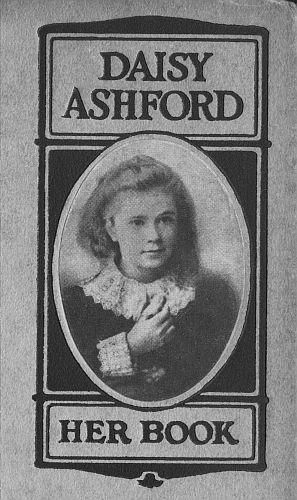
The Project Gutenberg eBook of Daisy Ashford: Her Book
Title: Daisy Ashford: Her Book
Author: Daisy Ashford
Angela Ashford
Commentator: Irvin S. Cobb
Release date: May 31, 2008 [eBook #25658]
Most recently updated: January 3, 2021
Language: English
Credits: Produced by David Garcia, Emmy and the Online Distributed
Proofreading Team at https://www.pgdp.net
DAISY ASHFORD: HER BOOK
DAISY ASHFORD:
HER BOOK
BY THE AUTHOR OF
"THE YOUNG VISITERS,"
TOGETHER WITH "THE JEALOUS GOVERNES"
BY ANGELA ASHFORD
WITH A PREFACE BY
IRVIN S. COBB
| NEW | YORK | |
| GEORGE H. DORAN COMPANY | ||
By George H. Doran Company
Printed in the United States of America
PREFACE
By Irvin S. Cobb
To your true discoverer the compensations of his trade come when he points with pride to the continent or the great natural fact or the new author he discovered and cries aloud before all creation: "See what I have found!"
So, aside from the compliment and the honor of it, I feel added gratification and added pleasure that I should be invited to write a foreword for the first American edition of Miss Daisy Ashford's second book. You see, I claim the distinction of having been the first person in America other than its publisher and my friend Mr. George H. Doran to read the manuscript of that immortal work "The Young Visiters." If I did not actually discover Miss Ashford, at the age of nine when she wrote "The Young Visiters"—for indeed no one appears to have discovered her then excepting perhaps her parents—at least I had a hand in discovering her on this side of the Atlantic ocean at a time when mention of her name, which now is so famous a name, meant nothing to the casual hearer.
After the lapse of nearly a year the event stands in my memory as marking one of those hours of pure and perfect joy which come but too rarely to human beings. At the request of Mr. Doran I read the manuscript which he had just brought with him from Europe. I read the story itself first and afterwards the preface, or foreword. This, I think, was as it should be. By rights a preface however sprightly and well done—and a preface by Sir James Barrie would have to be well done—should be served with a book as cheese is served with a dinner: at its finish and not at the beginning.
When I had read the story through to the last delicious sentence of the last delectable paragraph and when I had caught up with my breath which I had lost by laughing or rather when my breath had caught up with me, I sapiently said to him:
"Publish it? Of course you ought to publish it. Aside from such sordid considerations as the profits which are certain to accrue you owe it to yourself as a responsible member of the human race to give this glorious thing circulation among the reading public of North America. If I were you I'd print thirty thousand copies in the first batch before I released any copies among the reviewers or sent any copies as samples to the trade. And after that I'd keep the presses running steadily in the hope of being able to keep up with the demand which is sure to follow on the heels of publication. This is almost the funniest book that was ever written and it is all the funnier because the writer was so desperately in earnest, so tremendously serious all the while she was writing it."
"It has made a big hit in England already," he said. "But over there some people are saying that the author must have been a grown-up person—that no child of nine could have written such a thing. The suggestion is even being advanced that Barrie himself wrote it. I know better, because I have seen the original script in a child's handwriting on old and faded paper, and I met Miss Ashford some weeks ago in London and I have had all the proof one needs that this is the authentic product of a nine-year-old mind."
To which I said:
"No doubt some people will be saying the same thing over here and they'll be wrong just as these English skeptics are and if they'll only stop to think for a moment they'll know why they're wrong. No grown person, not even the creator of a Wendy and a Peter Pan, could have done this thing. It exhales the perfume of an authoritative genuineness in every line of it. It had to be a child who wrote it—a child with a child's imagination and a child's viewpoint and a child's ignorance of the things she wrote about. In a way of speaking it is like those unintentionally humorous obituary poems which appear in the papers. No professional humorist can hope to equal them because when he writes one he does it with deliberate intent to be funny and invariably he betrays his hand. It is when some poor mourning amateur dips a 'prentice pen in the very blood of his or her heart and writes such a poem that it becomes so pathetically and so tragically side-splitting."
This was what I said. Not in these words exactly, but to this effect.
Mind you, I am not proclaiming that I am the only person who has said this. Between chuckles thousands and thousands of others since that day have thought and have said it. What I am proud of is that I was the first person in America to say it, and so to this extent I count myself a discoverer and I feel a sort of proprietary sense in being permitted here to introduce "Daisy Ashford: Her Book." I am mindful of the distinction because of the reason I have just stated and because also in a way of speaking it qualifies me for some sort of literary kinship with Sir James M. Barrie.
Even so I do not aspire to the presumptuous hope that any one may say "Well, I see this man Cobb is doing for Miss Ashford's second book what Barrie did for her first one." I have no such ambition. A minnow always errs when he undertakes to swim in the company of a whale. If he tries to swim alongside he is unnoticed; if he swims in the wake he is swamped. He makes other minnows jealous or contemptuous as the case may be, and he is properly ignored by the whale.
Miss Ashford's own preface, accompanying this volume, gives the chronological sequences of its contents. The first story of all, "A Short Story of Love and Marriage," she wrote when she was eight years old. "The True History of Leslie Woodcock" was written three years later, after "The Young Visiters" had been written. "Where Love Lies Deepest" trickled from the busy pen of the young person when she was twelve years old; and "The Hangman's Daughter," the most pretentious of them all and to my way of thinking the best of her preserved works next only to "The Young Visiters," was undertaken when she was about thirteen, she says, and finished in the following year. Also included in this book is a story by Miss Ashford's sister Angela, done at the age of eight and entitled "The Jealous Governes; or The Granted Wish." In this we learn the real facts regarding the coming of babies. Babies are not fetched by storks. Medical men bring them in boxes and afterward render bills for the same, as note the following: (page 330) "Miss Junick Dr. to doctor Paulin for one baby delivered as per agreement £1," a low enough price truly. If a child of eight (who in point of years is so very much closer to being a baby than most of the writers on the subject are) cannot be trusted to recall the circumstances of this mystery, who can? We can only regret that a second sister, Vera, the artist of this talented nursery, did not save her one contribution to the literary output of the Ashford family. It was entitled "Little Mary and The Angle." Angle did not refer to a worm but to a visitor from a celestial domain; we have the word of Miss Daisy Ashford for it that this story was of a pious character. What a wonderful household the Ashford household must have been with Daisy and Angela writing romances and Vera illustrating them and between times doing a bit of writing herself. Can't you see the pencils flying? Can't you see three little pink tongues sticking out from between three pairs of purposeful lips and wriggling in time to the pencils? Can't you see the small brows furrowed with thought? And the proud parents? And the startled nursemaid?
To my mind the very finest thing about Miss Daisy Ashford's present book is the opportunity it gives us, reading it, to follow the growth of her genius for observation. For surely the faculty to observe and, having observed, to set down in words the results of that observation is a genius. It is more than that, it is two phases of genius harmoniously coupled.
At the age of eight, as we shall note, she begins her career as a writer by knowing very little of certain phases of life largely dealt with by older writers; and this little she knows by reason of what she has read or by reason of what she has heard read. Rapidly, though, she progresses to the point where, along with these borrowed second-hand impressions, she incorporates impressions which are all her own. Reading what she wrote in the first year of her authorship, we can figure, approximately, when she learned her first French word; when to her there came those vague appreciations of the Roman Catholic faith which are so fascinating to the children of non-Catholics—or perhaps the Ashford family were Romanists. Influenced by these alluring ecclesiastical mysteries, we find her causing a prospective bridegroom to address the Rev. Father Fanty as "your kindness" and begging the reverend gentleman "to excuse my craving for matrimony." Through these pages one sees how travel broadened the young person's fund of experience, which in her favored case meant her fund of material, for unlike many writers, old enough to know better, little Miss Ashford was, by the virtue of a miraculous intuition, inspired to write, sometimes at least, of things that she actually knew about, rather than to deal exclusively with topics which other writers before her had professed to know about. Early in her opening story she speaks of "Cracknels." Reading this word, my memory ran back to my own childhood when we knew but three standard varieties of crackers—soda-crackers, animal crackers and cracknels which last were round, slickish objects rather like glazed oak-galls, somewhat dusty to the taste and warranted to create a tremendous thirst for licorice water and lemonade. I had entirely forgotten cracknels until Miss Ashford came along yesterday and reminded me of them.
In "A Short History of Love and Marriage"—and how woefully short sometimes is the history of a love and how short too, perhaps, the history of a marriage!—she shows to us that for all its admitted shortness the narrative is properly rounded out. For on page 24 we learn that the happy couple went on a bridal tour to India and "seven hours after they got there had two twin babies." Seven hours and two twin babies, a magnificent showing surely and the prevalent rage for shortness maintained to the very end! Page 24 is one of the very best pages in this book, containing, as it also does, a painstaking description of perhaps the most striking and interesting marriage-morn costume worn by any bridegroom in the Christian era.
It is not my intention to quote over-liberally from the contents of this volume. To my way of thinking the trick of inserting copious extracts from a novel into the foreword of that novel is as great a mistake as though I invited you to my house for dinner and before dinner gave you tidbits and choice bites from each course. I should merely be dulling your appetite, without satisfying your hunger.
My aim is to direct your attention, if I may make so bold, to certain pages, specifying them by their numbers and trusting that when you have progressed so far you will, in the reading of them, find the same joy and the same zest that I have found there. For example, on page 46 I respectfully invite your consideration to the pains taken in enumerating the various articles of one Sylvia's running-away or elopement trousseau. There was a thorough young woman for you, and a provident.
On page 87 occurs mention of two sisters and here, despite my promise of two paragraphs ago, I cannot resist the temptation to quote one short but tremendously illuminating line. The author is speaking now of two sisters and of the elder she says, she "was by no means beautiful but she was intensely good." How often it happens that those who are by no means beautiful are intensely good—how often and sometimes oh, how easy for them to be so good. But most of us, even those who educate our faculties of observation the better to earn a living thereby, are very much older than eleven years before we discern this great truth.
I think the brightest gems of all this collection are to be found, in the greatest profusion, in "The Hangman's Daughter." The ill-fated gentleman hangman, Mr. Winston, who moved to Kenelham "where only about two people were hung a year" is in my opinion worthy to be rated with the deathless and ever-to-be glorious Mr. Salteena. Miss Ashford says she was shocked when her brothers on hearing the trial scene read (pages 150, 151, 152) laughed at what she had conceived to be a tragic and dramatic passage in the action of her tale. Later, no doubt, she has come to realize how dangerous a thing it is for one to acquire, either intentfully or otherwise, the reputation of being a humorist; for when he who has been branded as a humorist says a thing with desire to be serious his friends laugh at it as a most rare whimsicality and when, on the other hand, he deliberately sets out to be humorous, his enemies very likely will declare that never before in all his life was he quite so serious. And had her brothers been older, had they been of an age to appreciate the unconscious comedy that marked the Dreyfus trial, say, or had they ever had opportunity to hear the proceedings in sundry murder trials in America, when learned counsel was asking questions and learned alienists were making answers, they would have been able to appreciate the fact that no burlesque description of a murder trial can ever be quite so utterly comic as a real murder trial sometimes is.
A flashing jewel of dramatic intensity awaits you (pages 229 to 234 inclusive) when you come to read of the rescue of Gladys and Helen from the grasp of the murderer of Helen's own dear father and of the method employed by Gladys' heroic brother for detaining the miscreant Likewise, I pray you, reader dear, that you linger on page 257 wherein the "menu of the table d'hote" which was "of nightly recurrence" at Lord Beaufort's castle, is printed in full. In my mind's eye I see little Miss Daisy Ashford, twelve years old going on thirteen, carefully bearing away with her the card of the first meal she ever ate in a regular restaurant and taking it home and treasuring it up against the time when she might insert it into her greatest story, then in process of incubation, at exactly the appointed spot to create the most telling effect, under the most appropriate possible circumstances. Could a proper respect and a proper instinct for local color rise to greater heights? I deny it. So too will you deny it when you arrive at page 258 and read the words emphasized by being displayed in capitals that are on that page at the end of the menu.
Personally I do not think that as a whole this book is equal to "The Young Visiters." Only once in a decade or so is it vouchsafed the writing craft that one among us shall create a masterpiece, destined in time to become a classic and a thing immortal. Only once in an eon or so is it vouchsafed a writer to write a masterpiece at the age of nine years. Very few among us ever produce a second perfect work on top of a first one. But this I will say—every line in this book is worthy to have been written by the same hand that wrote "The Young Visiters" and that, I think, is praise enough for any writer.
New York, April, 1920.
AUTHOR'S FOREWORD
"A Short Story of Love and Marriage," I wrote at eight years old. It was dictated to my father, who took it down faithfully word for word. My very first story, "Mr. Chapmer's Bride," which was also dictated, is among those that have been lost. "The True History of Leslie Woodcock" was a later production, and was written at about the age of eleven as a surprise for my mother on her birthday—it was originally entitled "The Q. I. B." (our family word for a secret)—but after the secret was out I changed the title. "Where Love Lies Deepest" was written when I was twelve, and dedicated to our governess of whom I was very fond.
"The Hangman's Daughter," started at the age of about thirteen and finished the following year, I always consider the greatest literary achievement of my youth, for the reason that I put so much more effort into it than any of the others. By this time I had really determined to become an authoress (an ambition which entirely left me after my school days), and I put solid work into "The Hangman's Daughter" and really tried to write well. I shall never forget my feeling of shock when I read it aloud to my brothers and they laughed at the trial scene! A great friend of mine whose Christian name was Helen, was the heroine (Helen Winston) of this story. She was really a little younger than I was, but was far more "grown-up" in every way, a fact of which I was secretly rather "jellus," and it did not require much imagination on my part to picture what she would be at nineteen. I told her she was to be the heroine of my new novel, which I truly thought would thrill anyone, and I must say she was as excited as I could have wished. She will be amused now when she reads this book!
My sister Angela's story, which she wrote at the age of eight, will certainly be voted the most amusing of this collection. It was the first she ever wrote, and it was followed by "Treacherous Mr. Campbell"—another lost manuscript. A great deal of "The Jealous Governes" she wrote herself, as will be noticed by the spelling. Other portions were dictated to my father and mother, and I think the nurse had a hand at it too.
My second sister, Vera, was the artist of the nursery, and drew a wonderful poster to the only play I ever wrote, "A Woman's Crime." She wrote one story, however. It was of a pious nature, profusely illustrated, and entitled "Little Mary and the Angle."
Since the publication of "The Young Visiters," I have often been asked if I don't myself think it funny. When I first discovered it—not having seen it since it was written—I certainly did. That is one of the most curious things about it—to be able to laugh at what one wrote in such solemn seriousness—and that is why I can never feel all the nice things that have been said about "The Young Visiters," are really due to me at all, but to a Daisy Ashford of so long ago that she seems almost another person. It has all been like a fairy tale, from the accidental finding of the original note book to the day when, at her request, I left a copy with my friend Miss Margaret Mackenzie, for it is to her I really owe the publication of the book. She showed it to Mr. Frank Swinnerton, and thus I was lucky enough to have it brought to the notice of my present publishers in England and America.
But the real success of the book I owe to the great kindness of Sir James Barrie in writing such a wonderful preface, and I am glad to have this opportunity of thanking him publicly. His name gave "The Young Visiters" a send-off and a reading which it could not have gained on its own account and of this fact I am most deeply appreciative.
CONTENTS
| PAGE | |
| Preface by Irvin S. Cobb | v |
By DAISY ASHFORD | |
| Author's Foreword | xxi |
| A Short Story of Love and Marriage | 15 |
| The True History of Leslie Woodcock | 27 |
| Where Love Lies Deepest | 67 |
| The Hangman's Daughter | 105 |
By ANGELA ASHFORD | |
| The Jealous Governes, or the Granted Wish | 303 |
A SHORT STORY OF LOVE
AND MARRIAGE
CHAPTER 1
LOVE
Mr. Molvern was a red haired quick tempered gentleman, with very small grey eyes and a clever looking pink face. He would always wear brown suits, but as everybody said he looked much better in black. Mrs. Molvern was quite on the contrary. She had indeed a quiet temper, with a pale delicate looking face with large brown eyes that looked at people with great interest, and her fair hair glistened in the sun. She usually wore half dirty white dresses, and in going out she wore a dark blue velvet jacket with black fur and a brown hat with red poppies. She never wore gloves except on Sundays and then she wore yellow cotton ones.
At the present time they had a young gentleman staying with them, who lived in the neighbourhood. He was sitting in his room waiting for the town clock to strike four, because when it did he had to go out and meet his truelove, whose name was Edith Plush. His own name was Thomas Henrick, but he was known as Burke in that family. At last hearing the hour strike, he snatched up a felt hat, and putting it on his greasy head started off to meet his truelove.
When he reached Mionge Lane he met his pretty truelove skipping along most lady-like and primly. She was dressed in a light blue dress with a white sash tied at the side in two knots. Her long fair hair hung down her back tied with a pink ribbon, and her fringe was fluttering in the breeze. Behind her fringe she wore a wreath of green ivy. In one hand she carried a leghorn hat with red and blue ribbon, and in the other a silken bag filled with a threepenny bit and two biscuits, and her age was nineteen.
"Well my pretty bird," she said as she approached Burke, "I hope you will like to 'manger' a biscuit with me," (I may add that she was fond of French).
"Thank you Edith," he said, "I will have one if it is a cracknell."
Then Edith burst into a fit of tears and howled out, "Oh but they are Osbornes."
"Well to dry up those moist tears, I will eat one," said Burke.
"You dear!" said Edith like sunshine after rain, for the smiles had come on her face, as she opened her silken bag and popped one into his blistered hand. After this Burk and Edith walked along down the lane, which I forgot to say was shaded by trees all along.
"Burke," said Edith after a long pause, "you have talked often enough and said we shall be married one day, but when it is going to come off I am sure I don't know."
"Well my dear Edith you must recollect I am not a good dancer and have no nice suits, and you must recollect my people are not in this neighbourhood and I can't write marriage letters, and to begin with I don't think my people would like me to be married just yet as I am not quite twenty nine."
"Well it is silly of you," said Edith, "after having talked to me so often about it, and bothered to come into my house, and sat on the drawing room sofa to make arrangements, and now you seem not to care for it a bit, just because your people are not in the neighbourhood; and besides I was getting quite excited about it!"
"If you had only a little more reason in you," said Burke, "you might take it all in and understand a bit, but you are such a great stupid, so I must leave it alone and wait till I get a chance to speak to Mrs. Molvern about it—she has got a bit of sense in her if you haven't," and his revengeful face made poor little Edith shudder. Indeed she was now too frightened to answer, and she kept on trying to go home every time she got a chance, but Burke's quick eye caught her every time.
Edith walked on slowly in front thinking what was the best way to cheer Burke out of his most moodful mind. At last she hit on a plan. "Burke," she said "I have painted such a pretty little tray, it will just hold a cup of tea and a plate of toast and the paint is quite dry now, if you will come in and have a cup of tea with me to-day, I will gladly show it to you."
This short but cheerful conversation of Edith's, made Burke quite forget their quarrel, and he turned round and said, "I will willingly come Edith, I know your good painting,—hark, there is four o'clock striking now."
"So it is," said Edith pulling her hat more over her fringe.
Burke and Edith walked down the quiet little village in which both their houses stood. At last they arrived at Edith's house which was much prettier than Mrs. Molvern's.
"Don't you think," said Burke as he advanced to it with firm stride, "that you had better ring the bell, as you have a visitor with you?"
"Oh, no," said Edith "my mother would be sure to say if she knew it was I, that I was never to ring again, giving all that trouble to the servants; it isn't as if you were alone."
"Very well," said Burke, "I only thought perhaps it was best."
Edith smiled at him as she went up the front door steps. She led him into her pretty little bed-room to take off his things while she took off hers.
"How very comfortable all looks" said Burke, "I feel quite inclined to write a note at that pretty little table there."
"Oh indeed but you shan't," said Edith just beginning her snappy temper, but Burke forgot to reply to her.
They then went down and had some tea and Burke much admired the pretty tray of Edith's. They had for tea some cold ham (the remainder of the luncheon) some toasted buns, a sago pudding, a dried bloater and a couple of shrimps.
After this Edith threatened to hate Burke if he would not arrange about the marriage.
"Look here, I wish you would talk of something else," said Burke, "I have a good mind not to marry you at all."
But at this Edith clung so wretchedly to his knees that he had to say, "well, to-morrow morning."
So that next morning Burke walked along down the village trying to make out where his own dear Edith could be.
Just as he was thinking of going up to her house he saw Norah Mackie and Evelyn Slattery coming along together.
"Your friend," they said chaffingly, "is picking some old geraniums in the front garden."
Burke stared at them straight and putting out his tongue once or twice, walked on to find his darling pet.
"I wish my sister Mary was here," echoed Evelyn, "she would soon strike out at you." And they walked on grumbling at his impudence.
CHAPTER 2
MARRIAGE
"Well pretty dear," said Burke as he approached Edith's garden.
"Angel! I have been waiting for you to come and talk about the wedding."
"Yes I am perfectly settled," said Burke, and he began: "I have written to my people and they have written back to say yes I may marry you, and kind Mrs. Molvern is having such a nice wedding suit made for me, and I think we will be prepared to receive the Sacrament of Matrimony next Thursday."
"Thank you so much," said Edith "suppose we talk about it now here on this sunny bench."
Burke lifted up his coat tails and squatted himself down. "The first thing to find out about," he said, "is about asking Father Fanty to marry us."
"Yes, now I have hit upon a plan this very minute," said Edith, "you will write a letter to him. I have got a rather crumpled bit of paper in my pocket, and as most men have got a pen in their pockets most likely you have got one."
"Indeed I have," said Burke, "and a threepenny blotter too."
As for ink, Edith had a halfpenny bottle in her pocket. So Burke began like this:
"Dear Rev. Father Fanty,
I hope your kindness does not mind marrying us Miss Edith Plush and myself. We are both capable of receiving the Sacrament of Matrimony on Thursday next if quite convenient to you. Hoping you will excuse my craving for Matrimony,
Thomas Henrick."
Burke told Edith's maid to run to the Presbytery with the letter and wait for an answer. About a quarter of an hour afterwards this exquisite and most graceful letter came from Father Fanty.
"Most dear T. Henrick,
On Thursday I am free from all engagement and am most willing to marry you, and give a charming wedding breakfast in my lovely harmonium room. So with my best congratulations on your coming marriage,
Your affectionate priest,
Father Fanty."
So on the following Thursday Burke and Edith were dressed as I shall mention now. The timid darling lady had on a most lovely sky blue coloured dress with a high bustle, and it was blossomed over with sham daisies tied on with green ribbon. On her head she wore a wreath of yellow roses, and her white veil reached down to the top of her stays. White kid gloves, and as the sleeves of her dress were rather short, her red beef coloured hands showed between. She had pretty white velvet boots with grass green buttons, and washed out red stockings. In her hand she held a bunch of green ivy.
The strong and bold bridegroom wore a red swallow tailed coat, with a green silk sash tied in front. He had black knickerbockers and white woollen socks, and black dressing slippers, and he carried a bowler in his hand.
When they arrived at the church the marriage was splendid, but the bare legs of Burke were not much appreciated.
For the wedding breakfast they had several cups of Bouillon Fleet, and eight of Bovril. They had six Vanilla cream puddings and strawberry ices by the score; but they kept the blinds drawn down in case vulgar little boys should loom in and say "give us a slice," while the leg of pork was being cut.
For their honeymoon, they went to the south of India, and seven hours after they got there they had two twin babies, a boy and a girl which they called Abraham and Sarah, because they were fond of those holy saints.
So we will say goodbye to this two chaptered story.
THE TRUE HISTORY OF
LESLIE WOODCOCK
DEAREST MOTHER
FROM
DAISY ON HER BIRTHDAY
CHAPTER 1
INTRODUCING THE FAMILY
"Coming" answered the child for so she was always called by her Uncle Richard although in years she was close on 19.
And she turned to obey the summons, a deep flush mounted to her usually too pale cheeks, and lighted up her whole countenance.
Sylvia Monton was little more than a baby when her parents were both drowned whilst on their way to India where Captain Monton was to join his regiment. So little Sylvia was left an orphan and her mothers only brother Richard Earlsdown came forward to take charge of her being a bachelor and possessing no children of his own.
At the time our history opens Sylvia was a tall thin girl with a fair and saddened face, which was only enlivened by the sky blue of her eyes—she had golden hair which she wore combed back from her white and noble forehead and arranged in heavy waves round her small and shapely head—a small rosebud mouth which when wide open displayed 2 rows of pearly white teeth. Small white hands adorned by 3 golden rings and a tiny round nose which she daintily touched now and again with a lace hankerchief.
It was 3 oclock on a dismal afternoon late in February and the place was on the boarders of the Sussex downs.
"What a rainy day for our walk Uncle" sighed Sylvia as she approached her uncle who was still waiting in the hall.
"I wish it were finer my dear" said Mr. Earlsdown opening a large unbrella manfully.
Mr. Earlsdown was an elderly man between 50 and 60, he had iron grey hair and a long bushy beard to corrospond, sharp grey eyes and a would be handsome face but for a stern forbidding expression it habitually wore. He was broad and stout and had a manfull way of carelessly swinging his arms that gave him many friends. Not only this but he had a loud hearty voice that he knew how to use with a will.
Here Mr. Earlsdown proceeded to turn up his trouser tips and offering his large umbrella to his niece cried in his hearty voice "let us brave the storm."
Just then a gust of wind blew Sylvia's dainty toque down a side street. "Oh uncle" she gasped dropping the gingham in her dismay "do go and fetch it," but ere she uttered the words a tall handsome fellow approached bearing his head and displaying the lost hat in his hand.
"Oh thank you" cried Sylvia a beautiful blush mounting her fair cheeks "I am so very grateful to you."
"I am afraid it is rather dusty" said the newcomer taking out a lovely silk hankerchief and preparing to wipe the charming object
"Don't trouble sir" said Mr. Earlsdown and taking out a large red kerchief he seized the hat in his huge hand and pounded it vigorously. "Oh uncle gently" cried Sylvia "you will spoil my feathers
"I know what I am about my dear" said Mr. Earlsdown "and you sir come and see us to-morrow, my child will be glad of a caller."
"Oh indeed I shall" cried Sylvia blushing.
And Leslie Woodcock, for that was the handsome fellows name raised his hat and bowed low saying "I shall be delighted my dear sir, but might I ask what your address is.
"Certainly my man" exclaimed Mr. Earlsdown as with a hearty laugh he produced a little card on which was written
Yellowflower Hall
Mayfield Sussex
Leslie bowed once more and taking the card moved gently away. What took place after this will be reserved for our next chapter.
CHAPTER 2
LESLIE WOODCOCK
Leslie Woodcock was about 6 feet in his stockings and fine and well built. He had very dark brown hair neatly parted at one side, a curly moustache of the same shade and deep brown eyes always half shut. He had a large straight nose and mouth to correspond and white well shaped hands and feet, that set off this good looking young man.
It was about half past 3 oclock on the following afternoon when Leslie Woodcock dressed in a light grey suit and crimson tie, black felt bowler and fur lined overcoat, started for Yellowflower Hall.
Sylvia who had been expecting him all the morning was pleased to hear the front door bell ring, and hurried to the window to wave her hand, as she knew it must be the good looking stranger.
Just then the drawing room door was flung open and the butler announced Mr. Woodcock "Oh good afternoon" said Sylvia rushing from the window to greet the visitor "how good of you to come in all this pouring rain."
"It was a bad day to come, but I was true to my word" answered our hero warmly shaking hands.
"Yes indeed how wet you must be" said Sylvia and then turning to the butler she added "Johnson inform Mr. Earlsdown that Mr. Woodcock is here."
In about 3 minutes a heavy step was heard and Mr. Earlsdown came bounding into the room laughing loudly.
"How do Mr. Woodcock" he gasped between his peals of laughter "I didn't at all expect you, in fact I forgot all about you" and here he sank into a chair and offered a snuff box to his friend.
"Thanks" said Leslie streching out his long thin fingers and taking a small pinch which he silently dropped on the floor as being so young he was afraid it would make him sick.
"You'll stop to tea wont you?" asked Sylvia arranging the folds of her green silk dress.
"Thank you I will if it is no trouble" said Leslie and a smile passed over his thin lips.
In a few moments Johnson and another footman brought in tea from the conservatory on a silver tray.
"Now Mr. Woodcock please to help yourself" said Mr. Earlsdown offering him three or four plates of sugar and other cakes. Leslie took a small jam wafer and proceeded to nibble it quietly. "How far did you come?" asked the girl as she was busy pouring out tea.
"Not very far" responded Leslie lifting his full brown eyes to her face. "I live in Astma House upon the high road.
"Oh I see" replied Sylvia with a nod of her fair head, "you have sisters and brothers then? for I have seen them coming in and out."
"I have two sisters and a cousin" replied Leslie.
"Oh what are their names? asked Sylvia who had a very curious nature.
"My sisters are Violet and Hilda and my cousin is Albert Morris."
"Oh what sweet names" cried the girl "I wish you would bring them here some day."
"Perhaps I will" said Leslie "but Albert does not care for calling he is a very quiet fellow.
"I am sure I should like him. I love boys" said Sylvia.
Here Leslie thought he had better be going so taking his hat and gloves he shook hands after first promising to bring his family the next time he came.