
WeRead Powered by ReaderPub
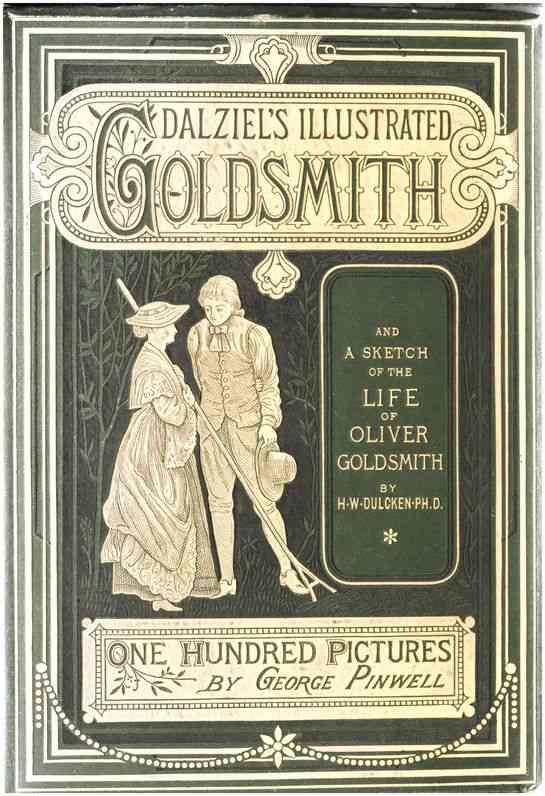
Dalziels' Illustrated Goldsmith cover

Dalziels' Illustrated Goldsmith

Chapter 43: ACT III.
Open in WeRead

About This Book

An illustrated anthology begins with a concise biographical sketch and then assembles major prose, poetry, and dramatic pieces by the author, including a sentimental novel about a rural family's misfortunes, comedies that pit social pretension against rustic candor, reflective and pastoral poems on travel and village decline, a short oratorio, and a range of lyrics, satires, and theatrical scenes. The selections display a mix of humor, moral observation, and nostalgic reflection, while engraved illustrations accompany the texts to enhance the reader's encounter with the varied forms and tones collected here.

ACT III.

FIRST PRIEST.
Recitative.
Yes, my companions, Heaven's decrees are passed,
And our fix'd empire shall for ever last;
In vain the madd'ning prophet threatens woe,
In vain Rebellion aims her secret blow;
Still shall our name and growing power be spread,
And still our justice crush the traitor's head.
Air.
Coeval with man
Our empire began,
And never shall fall
Till ruin shakes all.
When ruin shakes all,
Then shall Babylon fall.
FIRST PROPHET.
Recitative.
Air.
Ye wretches, who by fortune's hate
In want and sorrow groan,
Come, ponder his severer fate,
And learn to bless your own.
You vain, whom youth and pleasure guide,
Awhile the bliss suspend:
Like yours, his life began in pride;
Like his, your lives shall end.
SECOND PROPHET.
Behold his wretched corse with sorrow worn,
His squalid limbs with ponderous fetters torn;
Those eyeless orbs that shock with ghastly glare,
Those unbecoming rags, that matted hair!
And shall not Heaven for this avenge the foe,
Grasp the red bolt, and lay the guilty low?
How long, how long, Almighty God of all,
Shall wrath vindictive threaten ere it fall?
ISRAELITISH WOMAN.
Air.
As panting flies the hunted hind,
Where brooks refreshing stray;
And rivers through the valley wind,
That stop the hunter's way:
Thus we, O Lord, alike distress'd,
For streams of mercy long:
Those streams which cheer the sore oppress'd,
And overwhelm the strong.
FIRST PROPHET.
Recitative.
CHORUS OF CAPTIVES.
Down with them, Lord, to lick the dust!
Thy vengeance be begun:
Serve them as they have served the just,
And let thy will be done.
FIRST PRIEST.
Recitative.
All, all is lost. The Syrian army fails;
Cyrus, the conqueror of the world, prevails!
The ruin smokes, the torrent pours along,—
How low the proud, how feeble are the strong!
Save us, O Lord! to thee, though late, we pray,
And give repentance but an hour's delay.
FIRST AND SECOND PRIESTS.
Air.
O happy, who in happy hour
To God their praise bestow,
And own his all-consuming power,
Before they feel the blow.
SECOND PROPHET.
Recitative.
Now, now's our time! Ye wretches bold and blind,
Brave but to God, and cowards to mankind,
Ye seek in vain the Lord, unsought before:
Your wealth, your pride, your kingdom are no more!
Such be her fate! But hark! how from afar
The clarion's note proclaims the finish'd war!
Our great restorer, Cyrus, is at hand,
And this way leads his formidable band.
Give, give your songs of Zion to the wind,
And hail the benefactor of mankind:
He comes, pursuant to divine decree,
To chain the strong, and set the captive free.
CHORUS OF YOUTHS.
Rise to transports past expressing,
Sweeter by remember'd woes;
Cyrus comes, our wrongs redressing,
Comes to give the world repose.
CHORUS OF VIRGINS.
Cyrus comes, the world redressing,
Love and pleasure in his train;
Comes to heighten every blessing,
Comes to soften every pain.
SEMI-CHORUS.
Hail to him, with mercy reigning,
Skill'd in every peaceful art;
Who, from bonds our limbs unchaining,
Only binds the willing heart.
LAST CHORUS.
But chief to Thee, our God, defender, friend,
Let praise be given to all eternity;
O Thou, without beginning, without end,
Let us, and all, begin and end in Thee.

Dr. Goldsmith and some of his friends occasionally dined at the St. James's Coffee-house. One day it was proposed to write epitaphs on him. His country, dialect, and person furnished subjects of witticism. He was called on for retaliation, and at their next meeting produced the following poem.

Of old, when Scarron his companions invited,
Each guest brought his dish, and the feast was united;
If our landlord[4] supplies us with beef and with fish,
Let each guest bring himself, and he brings the best dish.
Our Dean[5] shall be venison, just fresh from the plains;
Our Burke[6] shall be tongue, with a garnish of brains;
Our Will[7] shall be wild-fowl of excellent flavour,
And Dick[8] with his pepper shall heighten the savour;
Our Cumberland's[9] sweet-bread its place shall obtain,
And Douglas[10] is pudding, substantial and plain;
Our Garrick's[11] a salad; for in him we see
Oil, vinegar, sugar, and saltness agree:
To make out the dinner, full certain I am
That Ridge[12] is anchovy, and Reynolds[13] is lamb;
That Hickey's[14] a capon, and, by the same rule,
Magnanimous Goldsmith a gooseberry fool.
At a dinner so various—at such a repast
Who'd not be a glutton, and stick to the last?
Here, waiter, more wine! let me sit while I'm able,
Till all my companions sink under the table,
Then, with chaos and blunders encircling my head,
Let me ponder, and tell what I think of the dead.

4. The master of the St. James's Coffee-house, where the poet, and the friends he has characterised in this poem, occasionally dined.

5. Dr. Barnard, Dean of Derry in Ireland.

6. The Right Hon. Edmund Burke.

7. Mr. William Burke, late secretary to General Conway, member for Bedwin, and afterwards holding office in India.

8. Mr. Richard Burke, collector of Granada; afterwards Recorder of Bristol.

9. Richard Cumberland, Esq., author of the "West-Indian," "Fashionable Lover," "The Brothers," "Calvary," &c., &c.

10. Dr. Douglas, Canon of Windsor (afterwards Bishop of Salisbury), an ingenious Scotch gentleman, who has no less distinguished himself as a citizen of the world, than a sound critic, in detecting several literary mistakes (or rather forgeries) of his countrymen; particularly Lauder on Milton, and Bower's "History of the Popes."

11. David Garrick, Esq.

12. Counsellor John Ridge, a gentleman belonging to the Irish Bar.

13. Sir Joshua Reynolds.

14. An eminent attorney.

Who mix'd reason with pleasure, and wisdom with mirth:
If he had any faults, he has left us in doubt;
At least, in six weeks I could not find 'em out;
Yet some have declared, and it can't be denied 'em,
That Sly-boots was cursedly cunning to hide 'em.
Here lies our good Edmund, whose genius was such,
We scarcely can praise it or blame it too much;
Who, born for the universe, narrow'd his mind,
And to party gave up what was meant for mankind.
Though fraught with all learning, yet straining his throat
Who, too deep for his hearers, still went on refining,
And thought of convincing, while they thought of dining:
Though equal to all things, for all things unfit,
Too nice for a statesman, too proud for a wit;
For a patriot, too cool; for a drudge, disobedient;
And too fond of the right to pursue the expedient.
In short, 'twas his fate, unemploy'd or in place, sir,
To eat mutton cold, and cut blocks with a razor.
Here lies honest William, whose heart was a mint,
While the owner ne'er knew half the good that was in't;
The pupil of impulse, it forced him along,
His conduct still right, with his argument wrong;
Still aiming at honour, yet fearing to roam,—
The coachman was tipsy, the chariot drove home:
Would you ask for his merits? alas! he had none:
What was good was spontaneous, his faults were his own.
Here lies honest Richard, whose fate I must sigh at;
Alas! that such frolic should now be so quiet!
What spirits were his! what wit and what whim!
Now breaking a jest, and now breaking a limb![16]
Now wrangling and grumbling, to keep up the ball!
Now teasing and vexing, yet laughing at all!
In short, so provoking a devil was Dick,
That we wish'd him full ten times a day at Old Nick;
But missing his mirth and agreeable vein,
As often we wish'd to have Dick back again.
Here Cumberland lies, having acted his parts,
The Terence of England, the mender of hearts;
A flattering painter, who made it his care
To draw men as they ought to be, not as they are.

15. Mr. Thomas Townshend, member for Whitchurch.

16. Mr. Richard Burke. This gentleman having fractured an arm and a leg at different times, the Doctor has rallied him on these accidents, as a kind of retributive justice for breaking his jests upon other people.

Dr. Goldsmith and some of his friends at the
St. James's Coffee-house.
p. 219.

His gallants are all faultless, his women divine,
And Comedy wonders at being so fine;
Like a tragedy queen he has dizen'd her out,
Or rather like Tragedy giving a rout.
Of virtues and feelings, that Folly grows proud;
And coxcombs, alike in their failings alone,
Adopting his portraits, are pleased with their own.
Say, where has our poet this malady caught,
Or wherefore his characters thus without fault?
Say was it, that vainly directing his view
To find out men's virtues, and finding them few,
Quite sick of pursuing each troublesome elf,
He grew lazy at last, and drew from himself?
Here Douglas retires from his toils to relax,
The scourge of impostors, the terror of quacks:
Come all ye quack bards, and ye quacking divines,
Come, and dance on the spot where your tyrant reclines:
When satire and censure encircled his throne,
I fear'd for your safety, I fear'd for my own:
But now he is gone, and we want a detector,
Our Dodds[17] shall be pious, our Kenricks[18] shall lecture;
Macpherson[19] write bombast, and call it a style;
Our Townshend make speeches, and I shall compile:
New Lauders and Bowers the Tweed shall cross over,
No countryman living their tricks to discover;
Detection her taper shall quench to a spark,
And Scotchman meet Scotchman, and cheat in the dark.
Here lies David Garrick, describe him who can,—
An abridgment of all that was pleasant in man;
As an actor confess'd without rival to shine;
As a wit, if not first, in the very first line:
Yet, with talents like these, and an excellent heart,
The man had his failings,—a dupe to his art.
Like an ill-judging beauty, his colours he spread,
And beplaster'd with rouge his own natural red.
On the stage he was natural, simple, affecting;
'Twas only that when he was off he was acting:
With no reason on earth to go out of his way,
He turn'd and he varied full ten times a day:
Though secure of our hearts, yet confoundedly sick
If they were not his own by finessing and trick:
He cast off his friends, as a huntsman his pack,
For he knew when he pleased he could whistle them back.
Of praise a mere glutton, he swallow'd what came,
And the puff of a dunce, he mistook it for fame;

17. The Rev. William Dodd.

18. Dr. Kenrick, who read lectures at the Devil Tavern, under the title of "The School of Shakspeare."

19. James Macpherson, Esq., who lately, from the mere force of his style, wrote down the first poet of all antiquity.

Who pepper'd the highest was surest to please.
But let us be candid, and speak out our mind,
If dunces applauded, he paid them in kind.
Ye Kenricks, ye Kellys,[20] and Woodfalls[21] so grave,
What a commerce was yours, while you got and you gave!
How did Grub-street re-echo the shouts that you raised,
While he was be-Roscius'd, and you were bepraised!
But peace to his spirit, wherever it flies,
To act as an angel and mix with the skies:
Those poets who owe their best fame to his skill
Shall still be his flatterers, go where he will;
Old Shakspeare receive him with praise and with love,
And Beaumonts and Bens be his Kellys above.
Here Hickey reclines, a most blunt pleasant creature,
And slander itself must allow him good-nature;
He cherish'd his friend, and he relish'd a bumper;
Yet one fault he had, and that one was a thumper!
Perhaps you may ask if the man was a miser?
I answer, No, no, for he always was wiser.
Too courteous, perhaps, or obligingly flat?
His very worst foe can't accuse him of that.
Perhaps he confided in men as they go,
And so was too foolishly honest? Ah, no!
Then what was his failing? come, tell it, and burn ye!
He was—could he help it?—a special attorney.
Here Reynolds is laid, and, to tell you my mind,
He has not left a wiser or better behind;
His pencil was striking, resistless, and grand;
His manners were gentle, complying, and bland;
Still born to improve us in every part,
His pencil our faces, his manners our heart;
To coxcombs averse, yet most civilly steering,
When they judged without skill, he was still hard of hearing:
When they talk'd of their Raphaels, Correggios, and stuff,
He shifted his trumpet,[22] and only took snuff.

20. Mr. Hugh Kelly, author of "False Delicacy," "Word to the Wise," "Clementina," "School for Wives," &c., &c.

21. Mr. William Woodfall, printer of the "Morning Chronicle."

22. Sir Joshua Reynolds was so remarkably deaf, as to be under the necessity of using an ear-trumpet in company.

(After the fourth edition of this poem was printed, the publisher received the following epitaph on Mr. Whitefoord,[23] from a friend of the late Dr. Goldsmith.)

Here Whitefoord reclines, and deny it who can,
Though he merrily lived, he is now a grave[24] man:
Rare compound of oddity, frolic, and fun;
Who relish'd a joke, and rejoiced in a pun;
Whose temper was generous, open, sincere;
A stranger to flatt'ry, a stranger to fear;
Who scatter'd around wit and humour at will;
Whose daily bons mots half a column might fill:
A Scotchman, from pride and from prejudice free;
A scholar, yet surely no pedant was he.
What pity, alas! that so lib'ral a mind
Should so long be to newspaper essays confined!
Who perhaps to the summit of science could soar,
Yet content "if the table he set in a roar;"
Whose talents to fill any station were fit,
Yet happy if Woodfall[25] confessed him a wit.
Ye newspaper witlings! ye pert scribbling folks!
Who copied his squibs and re-echoed his jokes;
Ye tame imitators, ye servile herd, come,
Still follow your master, and visit his tomb:
To deck it, bring with you festoons of the vine,
And copious libations bestow on his shrine;
Then strew all around it (you can do no less)
Cross-readings, Ship-news, and Mistakes of the Press.
Merry Whitefoord[26], farewell; for thy sake I admit
That a Scot may have humour: I had almost said wit—
This debt to thy mem'ry I cannot refuse,
"Thou best-humour'd man with the worst-humour'd Muse."

23. Mr. Caleb Whitefoord, author of many humorous essays.

24. Mr. Whitefoord was so notorious a punster, that Dr. Goldsmith used to say it was impossible to keep his company without being infected with the itch of punning.

25. Mr. H. S. Woodfall, printer of the "Public Advertiser."

26. Mr. Whitefoord had frequently indulged the town with humorous pieces, under those titles, in the "Public Advertiser."

SONG.
"AH ME! WHEN SHALL I MARRY ME?"
INTENDED TO HAVE BEEN SUNG IN THE COMEDY OF "SHE STOOPS TO CONQUER."
Ah me! when shall I marry me?
Lovers are plenty, but fail to relieve me.
He, fond youth, that could carry me,
Offers to love, but means to deceive me.
But I will rally, and combat the ruiner:
Not a look, nor a smile shall my passion discover.
She that gives all to the false one pursuing her,
Makes but a penitent, and loses a lover.

THE HERMIT.

A BALLAD.
"Turn, gentle hermit of the dale,
And guide my lonely way
To where yon taper cheers the vale
With hospitable ray.
"For here forlorn and lost I tread,
With fainting steps and slow;
Where wilds immeasurably spread,
Seem lengthening as I go."
"Forbear, my son," the hermit cries,
"To tempt the dangerous gloom;
For yonder faithless phantom flies
To lure thee to thy doom.
"Here to the houseless child of want
My door is open still;
And though my portion is but scant
I give it with good will.
"Then turn to-night, and freely share
Whate'er my cell bestows:
My rushy couch and frugal fare,
My blessing, and repose.
"No flocks that range the valley free
To slaughter I condemn;
Taught by that Power that pities me,
I learn to pity them.
"But from the mountain's grassy side
A guiltless feast I bring;
A scrip with herbs and fruits supplied,
And water from the spring.
"Then, pilgrim, turn, thy cares forego;
All earth-born cares are wrong;
Man wants but little here below,
Nor wants that little long."
Far in a wilderness obscure
The lonely mansion lay;
A refuge to the neighbouring poor,
And strangers led astray.
No stores beneath its humble thatch
Required a master's care;
The wicket, opening with a latch,
Received the harmless pair.
And now, when busy crowds retire
To take their evening rest,
The hermit trimmed his little fire
And cheered his pensive guest;
And spread his vegetable store,
And gaily pressed, and smiled;
And skilled in legendary lore
The lingering hours beguiled.
Around, in sympathetic mirth,
Its tricks the kitten tries;
The cricket chirrups in the hearth,
The crackling faggot flies.
But nothing could a charm impart
To soothe the strangers woe;
For grief was heavy at his heart,
And tears began to flow.
His rising cares the hermit spied,
With answering care opprest:
"And whence, unhappy youth," he cried,
"The sorrows of thy breast?
"From better habitations spurned,
Reluctant dost thou rove?
Or grieve for friendship unreturned,
Or unregarded love?
"Alas! the joys that fortune brings
Are trifling and decay;
And those who prize the paltry things,
More trifling still than they.
"And love is still an emptier sound,
The modern fair one's jest;
On earth unseen, or only found
To warm the turtle's nest.
"For shame, fond youth, thy sorrows hush,
And spurn the sex," he said:
But while he spoke, a rising blush
His love-lorn guest betrayed.
Surprised he sees new beauties rise,
Swift mantling to the view;
Like colours o'er the morning skies,
As bright, as transient too.
The bashful look, the rising breast,
Alternate spread alarms:
The lovely stranger stands confest
A maid in all her charms!
And "Ah, forgive a stranger rude,
A wretch forlorn," she cried;
"Whose feet unhallowed thus intrude
Where heaven and you reside.
"But let a maid thy pity share,
Whom love has taught to stray;
Who seeks for rest, but finds despair
Companion of her way.
"My father lived beside the Tyne,
A wealthy lord was he:
And all his wealth was marked as mine;
He had but only me.
"To win me from his tender arms,
Unnumbered suitors came,
Who praised me for imputed charms,
And felt or feigned a flame.
"Each hour a mercenary crowd
With richest proffers strove;
Among the rest young Edwin bowed,
But never talked of love."

"Turn gentle hermit."—p. 226.

Secluded from domestic strife,
Jack Bookworm led a college life;
A fellowship at twenty-five
Made him the happiest man alive:
He drank his glass and crack'd his joke,
And freshmen wonder'd as he spoke.
Such pleasures, unalloy'd with care,
Could any accident impair?
Could Cupid's shaft at length transfix
Our swain, arrived at thirty-six?
Oh, had the Archer ne'er come down
To ravage in a country town!
Or Flavia been content to stop
At triumphs in a Fleet-street shop!
Oh, had her eyes forgot to blaze!
Or Jack had wanted eyes to gaze!
Oh!——But let exclamations cease:
Her presence banish'd all his peace.
So with decorum all things carried,
Miss frown'd, and blush'd, and then—was
married.
Need we expose to vulgar sight
The raptures of the bridal night?
Need we intrude on hallow'd ground,
Or draw the curtains closed around?
Let it suffice that each had charms;
He clasp'd a goddess in his arms;
And though she felt his usage rough,
Yet in a man 'twas well enough.
The honey-moon like lightning flew;
The second brought its transports too;
A third, a fourth, were not amiss;
The fifth was friendship mix'd with bliss:
But, when a twelvemonth pass'd away,
Jack found his goddess made of clay;
Found half the charms that deck'd her face
Arose from powder, shreds, or lace;
But still the worst remain'd behind,—
That very face had robb'd her mind.
But dressing, patching, repartee;
And, just as humour rose or fell,
By turns a slattern or a belle.
'Tis true she dress'd with modern grace,—
Half-naked at a ball or race;
But when at home, at board or bed,
Five greasy nightcaps wrapp'd her head.
Could so much beauty condescend
To be a dull domestic friend?
Could any curtain lectures bring
To decency so fine a thing?
In short, by night, 'twas fits or fretting;
By day, 'twas gadding or coquetting.
Fond to be seen, she kept a bevy
Of powder'd coxcombs at her levy;
The squire and captain took their stations,
And twenty other near relations:
Jack suck'd his pipe, and often broke
A sigh in suffocating smoke;
While all their hours were pass'd between
Insulting repartee and spleen.
Thus, as her faults each day were known,
He thinks her features coarser grown;
He fancies every vice she shows
Or thins her lip, or points her nose:
Whenever rage or envy rise,
How wide her mouth, how wild her eyes!
He knows not how, but so it is,
Her face is grown a knowing phiz;
And, though her fops are wondrous civil,
He thinks her ugly as the devil.
Now, to perplex the ravell'd noose,
As each a different way pursues,
While sullen or loquacious strife
Promised to hold them on for life,
That dire disease, whose ruthless power
Withers the beauty's transient flower,—
Lo! the small-pox, with horrid glare,
Levell'd its terrors at the fair;
And, rifling every youthful grace,
Left but the remnant of a face.
The glass, grown hateful to her sight,
Reflected now a perfect fright;
Each former art she vainly tries
To bring back lustre to her eyes;
To smooth her skin, or hide its seams;
Her country beaux and city cousins,
Lovers no more, flew off by dozens;
And ev'n the captain quit the field.