
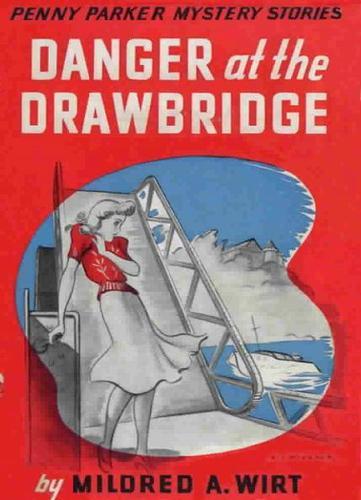
“If Jerry is still waiting at the drawbridge, I’ll ride home with him,” she told herself. “Otherwise, I’m out of luck completely.”
The path which Penny followed brought her toward the rear of the house. As she drew near, the kitchen door suddenly opened and a stout woman in a blue uniform came outside. In her arms she carried two large paper sacks which appeared to be filled with garbage for the bottoms were moist.
Just as the woman reached Penny one of the bags gave away, allowing a collection of corn husks, watermelon rinds and egg shells to fall on the sidewalk.
“Now I’ve done it!” she exclaimed crossly. “Splattered my stockings too.”
“Oh, that’s too bad,” said Penny, pausing.
“This is the only place I ever worked where the cook was expected to carry out the garbage!” the woman complained. “It makes me good and mad every time I do it.”
“I should think a house of this size would have an incinerator so that the garbage could be burned,” Penny remarked.
“Say, this place doesn’t have any conveniences for the servants,” the cook went on. “You’re expected to work, work, work from morning to night.”
She broke off quickly, regarding Penny with a suspicious gaze. “You’re not one of Miss Sylvia’s guests?” she demanded.
“Oh, no, I only came here on an errand. I wouldn’t repeat anything to the family.”
“That’s all right then,” the woman said in relief. “I liked my job here well enough until lately. All month it’s been one dinner party after another. Then we spent days getting ready for the wedding feast and not one scrap of food was touched!”
“But I suppose Mrs. Kippenberg pays you well.”
“Listen, she didn’t give me one extra cent for all the work I did. Mrs. Kippenberg always has been real close, and she’s a heap worse since her husband went away. Another week like this last one and I quit!”
“Well, I can’t say I blame you,” Penny said, leading the woman on. “I suppose Miss Sylvia is as overbearing as her mother?”
“Oh, Miss Sylvia is all right, as sweet a girl as you’ll find anywhere. I felt mighty sorry for her when that no-account man threw her over.”
Penny knew by this time that she must be talking with Mrs. Latch, for the footman had mentioned the cook’s name. As the woman walked on with her bundles of garbage she fell into step with her.
“It was strange about Mr. Atherwald’s disappearance,” she remarked. “I hear he came to the house and then went away just before the wedding.”
“I can tell you about that,” replied Mrs. Latch with an important air. “Yesterday morning a boy came to the back door with a letter for Mr. Atherwald. It’s my opinion he sent it to himself.”
“Didn’t the boy tell you where he had obtained the letter?”
“He said it was given to him by one of Mr. Atherwald’s friends. A man in a boat.”
“Oh, I see,” said Penny, making a mental note of the information. Realizing that the cook had told everything she knew about the matter, she quickly switched the subject. “By the way, who is the head gardener here?”
“Do you mean Peter Henderson?”
“A fairly old man,” described Penny. “Gray hair, stooped shoulders, and I might add, an unpleasant manner.”
“I guess that’s Peter. He’s not much of a gardener in my opinion. And he feels too high and mighty to associate with the other servants. He doesn’t even stay here nights.”
“Is he a new man?”
“Mrs. Kippenberg hired him only three days before the wedding. I don’t think he’s done a lick of honest work since he came here.”
“And Mrs. Kippenberg doesn’t mind?”
“She’s been too busy and bothered to pay any attention to him,” the cook declared. “But she always has time to boss me. I tell you, if dishes aren’t prepared perfectly she raves!”
“No wonder Mr. Kippenberg was forced to leave home,” Penny interposed slyly. “You can’t blame him for running away from a violent temper.”
“Oh, the Kippenbergs never had any trouble,” Mrs. Latch corrected. “Mr. Kippenberg would just laugh and not say a word when she jumped on him. They were never heard to quarrel.”
“Then it seems odd that he went away.”
“Yes, it does,” agreed the cook, frowning. “I never did understand it. And then the way Mrs. Kippenberg changed all the servants!”
“You mean after Mr. Kippenberg went away?”
“She fired everyone except me. I guess she knew she couldn’t get another cook half as good if she let me go. Right away I struck for more money and she gave it to me without a whimper. But since then she works me like a dog.”
Mrs. Latch clattered the lid of the garbage can into place and turned toward the house. But as Penny once more fell into step with her, she paused and regarded the girl with sudden suspicion.
“Say, why am I telling you all this anyway? Who are you? You’re not one of those sneaking reporters?”
“Do I look like a reporter?” countered Penny.
“Well, no, you don’t,” admitted Mrs. Latch. “But you’re as inquisitive as one. You must be the girl who brought Miss Sylvia’s new dress from the LaRue Shoppe.”
Penny hesitated too long over her reply, and the woman gazed at her sharply.
“You are a reporter!” she exclaimed with conviction. “And you’ve been deliberately pumping me! Of all the tricks! I’ll tell Miss Kippenberg!”
“Wait, I can explain.”
Mrs. Latch paid no heed. With an angry toss of her head she hastened into the house.
“Overstepped myself again,” Penny thought in dismay. “I’ll be getting away from here while the getting is good.”
Turning, she ran down the walk toward the river, only to stop short as she reached the boat dock. The drawbridge was in open position and the old watchman did not appear to be at his usual post. She had no way of reaching the mainland.
CHAPTER
12
FISHERMAN’S LUCK
Penny looked anxiously about for a means of crossing the river. There were no small boats available and the only person who stood on the opposite shore was Jerry Livingston. The other reporters and photographers, evidently tiring of their long vigil, had gone away.
She cupped her hands and shouted to Jerry: “How am I going to get over there? Can you lower the bridge?”
“The mechanism is locked,” called back the reporter. “And the watchman won’t be back for an hour.”
Penny walked a short distance up the shore searching for a boat. The only available craft was the large launch which she could not hope to operate. She might return to the house and appeal to Miss Kippenberg but such a course was not to her liking.
As she considered whether or not to ruin her clothing by swimming across, Jerry called her attention to a small boat some distance up the river. The boy who was fishing from it obligingly rowed ashore after Penny had signaled him.
“I’ll give you fifty cents to ferry me across,” she offered.
“I’ll be glad to do it,” he agreed.
Penny stepped into the boat and then asked: “Aren’t you the same lad I saw here yesterday?”
The boy nodded as he reached for the oars. “I remember you,” he answered.
“You seem to fish here nearly every day.”
“Just about. I caught some nice ones today.” Proudly he held up two large fish for her to see.
“Beauties,” praised Penny. “I take it the motor boats haven’t been bothering you as much as they were.”
“It’s been pretty quiet on the river today,” the boy agreed. “Want to see something else I fished up?”
“Why, yes. What did you hook, a mud turtle?”
The boy opened a large wooden box which contained an assortment of rope, fishing tackle and miscellaneous articles. He lifted out a man’s high silk hat, bedraggled and shapeless.
“You fished that out of the water?” Penny demanded, leaning forward to take the article from him. “Where did you find it?”
“Up there a ways.” The boy motioned vaguely toward a point on the Kippenberg estate.
Penny turned the hat over in her hand, examining it closely. She found no identifying marks, yet she believed that it had belonged to Grant Atherwald for he had worn similar headdress. The point indicated by the boy was not far distant from the Kippenberg lily pool.
“How would you like to sell this hat?” she asked.
“Why, it’s not worth anything.”
“I’d like to have it,” said Penny. “I’ll give you another fifty cents.”
“It’s a deal.”
Penny offered the boy a dollar bill, and a moment later he beached the boat. Jerry was waiting to help her ashore. His alert gaze fastened upon the hat which she hugged close, but he withheld comment. To the boy he said:
“Son, how would you like to earn five dollars?”
The boy’s eyes brightened. “Say, this is my lucky day!” he exclaimed. “What doin’?”
“It’s easy,” Jerry told him. “All you need to do is to be here for a couple of days with your boat. You’re not to allow anyone to use it except me.”
“And me,” added Penny. “I’ll need taxi service myself if I come back here.”
“That’s all right,” agreed the boy.
“Here’s a dollar on deposit,” Jerry said. “Now remember, be here tomorrow from eight o’clock on, and don’t hire out to any other person.”
“I won’t,” the boy promised.
Jerry took Penny’s elbow and escorted her to the press car.
“So you found Atherwald’s hat?” he asked without preliminaries.
“It resembles the one he wore. The boy fished it out of the river.”
“Then that looks as if the fellow really was the victim of a plot!”
“I’ve thought so all along,” Penny declared soberly.
“What else did you learn? You seemed to be very chummy with Miss Kippenberg.”
“I’ll not be from now on,” Penny returned ruefully.
As Jerry backed the car around in the dusty road, she told of her meeting with Sylvia Kippenberg and the ensuing conversation.
“So Miss Kippenberg doesn’t like questions?” Jerry asked. “And she refuses to notify the police? Well, after we publish our story in the Star it won’t be necessary. The police will come to do their own investigating.”
“I can’t really believe she is trying to deceive the authorities,” Penny said thoughtfully. “She seems to have a sincere regard for Grant Atherwald.”
“It may be pretense.”
“She wasn’t pretending the day of the wedding. Atherwald’s disappearance was a great shock to her.”
“Well, even so, she may know a lot more than she’s putting out.”
“I think that myself. She closed up like a clam when I talked about her father.”
The car came to the main road and a short time later entered the town of Corbin. As they stopped for a red light, Penny touched Jerry’s arm.
“Look over there,” she directed. “See those two men standing in front of the drugstore?”
“What about them?”
“They’re G men who attended the Kippenberg wedding. Salt pointed them out to me.”
“You don’t say! Maybe we can learn a fact or two from them.”
Jerry parked the car at the curb and sprang out. Penny saw him walk over to the men, introduce himself and show his press credentials. She was too far away to hear the conversation.
In a few minutes Jerry returned to the car looking none too elated.
“You didn’t learn anything, did you?” Penny inquired as they drove on again.
“Not very much. Government men never will talk. But they did admit they were here trying to locate James Kippenberg.”
“Then they think he is in the locality.”
“They had an idea he would show up at his daughter’s wedding. But it didn’t turn out that way.”
“Did you say anything to them about Grant Atherwald’s disappearance?”
“Yes, but they wouldn’t discuss it. They said they had nothing to do with the case.”
Penny lapsed into reflective silence as the car went on toward Andover. Mentally she sorted over the evidence which she had gathered that day, trying to fit it into a definite pattern.
“Jerry,” she said at last.
“Yes?”
“You’ll probably laugh at this, but I have a theory about Grant Atherwald’s disappearance.”
“Go ahead, spill it.”
“Yesterday when Salt and I were waiting at the drawbridge we saw a motorboat cruise down the river. It was driven by a burly looking fellow who paid no heed when we tried to hail him.”
“You’re not suggesting that the man may have had something to do with Atherwald’s disappearance?” Jerry questioned, mildly amused.
“I knew you would laugh.”
“Your theory sounds pretty far-fetched to me, I’ll admit. It happens there are any number of burly, tough looking boatmen on the Kobalt. You can’t arrest a man for a crime just because of his appearance.”
“All the same, there is supporting evidence. Mrs. Latch told me that Atherwald’s note had been handed to her by a boy who in turn received it from someone in a boat.”
“Boats are rather common too. Your theory is interesting, but that’s all I can say for it.”
“All right,” said Penny. “I was about to tell you another idea of mine. Now I won’t do it.”
No amount of coaxing could induce her to reveal her thought, and the remainder of the drive to Andover was made in silence. It was well after five-thirty when the car finally drew up in front of the City Club.
Penny was not surprised to find the doors locked and no sign of Louise or Miss Frome.
“I thought they would go home without me,” she said to Jerry. “I only wanted to make certain.”
For many miles the road led through pleasant countryside and then swung back toward the Kobalt river. The sun had dropped below the horizon by the time the automobile sped through the town of Claxton.
“Thirty miles still to go,” Jerry sighed. “I’m getting hungry.”
“Two souls with but a single thought,” remarked Penny.
Directly ahead they noticed an electric sign which drew attention to a roadside gasoline station with an adjoining restaurant. Jerry eased on the brake.
“How about it, Penny? Shall we invest a few nickels?”
“I could do with a sandwich,” Penny agreed. “Several, in fact.”
Not until Jerry had parked the car did they notice the dilapidated condition of the building. It stood perhaps fifty yards back from the main road, its rear porch fronting on the Kobalt.
“Strange how one is always running into the river,” Penny remarked absently. “It seems to twist itself over half the state.”
Jerry had not heard her words. He was gazing at the restaurant with disapproval.
“This place doesn’t look so good, Penny. If you say the word we’ll drive on.”
“Oh, I’d brave anything for a beef barbecue,” she laughed.
Through the screen door they caught a discouraging glimpse of the cafe’s interior—dingy walls, cigarette smoke, a group of rough looking men seated on stools at the counter. Upon the threshold Penny hesitated, losing courage.
“Let’s not go in,” Jerry grunted in an undertone. “They’ll probably serve cockroaches in the sandwiches.”
Penny half turned away from the door only to stop short. Her attention focused upon two men who were sitting at the far end of the cafe drinking coffee from heavy mugs. In the indistinct light she could not be absolutely sure, yet she was instantly convinced that the heavy-set fellow in shirt sleeves was the same boatman who had been seen near the Kippenberg estate.
To Jerry’s surprise, Penny resisted the tug of his arm as he sought to lead her toward the car.
“This place isn’t half bad,” she said. “Let’s try it and see what happens.”
Boldly she reached for the knob of the screen door and entered the cafe.
CHAPTER
13
TWO MEN AND A BOAT
Penny ignored several empty tables at the front of the dreary restaurant and selected one not far from where the two men sat. As they glanced at her with insolent, appraising eyes, her pulse quickened. She was almost certain that the heavy-set man was the same fellow she had noticed near the Kippenberg estate.
A waiter in a soiled white apron shuffled up to take their order.
“Hot roast beef sandwich and coffee,” said Jerry. “With plenty of cream.”
“Make mine the same,” added Penny without looking at the menu.
All her attention centered upon the two men who were now talking together in low tones. After the first glance they had taken no interest in her and were unaware of her scrutiny. The heavy-set man bent nearer his companion and with the point of his knife drew a pattern on the tablecloth.
“What do you think of this route, Joe?” he asked.
“Too risky,” the other muttered. “Once we start we got to make a quick shoot to the sea.”
“Any way we take we might run into trouble. Y’know, I wish we had never agreed to do the job.”
“You and me both!”
“Dietz ain’t to be trusted,” the heavy-set man said and his shaggy eyebrows drew together in a scowl. “He’s thinking first and last of his own skin. We’ve got to watch him.”
“And the girl, too. She’s a dumb one and plenty apt to talk if the going gets rough.”
Penny lost the remainder of the conversation as Jerry spoke to her.
“We couldn’t have picked a worse place,” he complained. “Look at all the breakfast egg on the tablecloth. I’m in favor of walking out even now.”
“I’m not,” replied Penny.
“Say, what’s got into you anyway?” Jerry demanded. “You’re acting mighty funny.”
“Notice those two men at the last table,” she indicated.
“What about them?”
“See that heavy-set fellow with the tattooed anchor on his arm? Well, I’m satisfied he is the same boatman who cruised near the Kippenberg estate yesterday afternoon.”
“It might be,” Jerry agreed, unimpressed. “The Kobalt is only a stone’s throw away. And this place seems to be frequented by rivermen.”
“You didn’t hear what they were saying?” whispered Penny. “Listen!”
Jerry immediately fell silent, centering his attention upon the two men. But by this time they had lowered their voices so that only an occasional word could be distinguished.
“What were they saying anyway?” Jerry asked curiously.
Before Penny could answer, the proprietor came from the kitchen bearing two plates of food which he set down before them. The sandwiches were covered with a dark brown, watery gravy, potatoes bore a heavy coating of grease and the coffee looked weak.
“Anything more?” the man inquired indifferently.
“That’s all,” Jerry replied, with emphasis. “In fact, it’s too much.”
At the adjoining table the two men abruptly hauled to their feet. Paying their bill they quitted the restaurant.
“Let’s leave, too,” suggested Penny. “I should like to see where they go.”
Jerry pushed his plate aside. “Suits me,” he agreed. “Even my cast-iron stomach can’t wrestle with such food as this.”
He paid at the cash register and they went out into the night. Penny looked about for the two men and saw them walking toward the river.
“Hold on,” said Jerry as she started to follow. “Tell me what all the excitement is about.”
Tersely, Penny repeated the conversation she had overheard.
“They’re tough looking hombres all right,” Jerry admitted. “Likely as not mixed up in some dirty business. But to say they’re involved in the Kippenberg affair—”
“Oh, Jerry,” Penny broke in impatiently, “we’ll never learn anything if we take that attitude. We must run down every possible clue. Please, let’s see if they go down to the river.”
“We ought to be getting our story back to the office,” Jerry reminded her. “If we miss the last edition there will be fireworks.”
“It will only take a minute,” Penny insisted stubbornly. “If you won’t come with me, then I’m going alone!”
She started away and the reporter had no choice but to follow. A narrow, well-trod path led down a steep slope toward the river. Long before they came within sight of it they could hear the croak of bullfrogs and feel the damp, night mists enveloping them like a cloak.
Drawing closer to the two men, Penny and Jerry slackened pace and moved with greater care. But if they hoped to learn anything from the conversation of the pair ahead they were disappointed. The talk concerned only the weather.
Reaching the banks of the river, the two men boarded a sturdy cabin cruiser which had been moored to a sagging dock.
“It’s the very same boat,” Penny whispered jubilantly. “I knew I wasn’t mistaken.”
“Even so, what does that prove?” demanded Jerry. “It’s no crime to run a motorboat near the Kippenberg estate. The river is free.”
“But you must admit there is other evidence. Oh, why can’t we follow them? We might learn something really important.”
“We’re not going off on any wild chase tonight,” stated Jerry sternly. “Come on, it’s home for us before your father sends a police squad to search for his missing daughter.”
“You’re losing a golden opportunity, Jerry Livingston.”
“Listen, by the time we located a boat those men would be ten miles from here. They’re leaving now. Use your head.”
“Oh, all right,” Penny gave in. “We’ll go home, but I’ll bet a cent you’ll be sorry later on.”
She waited until the cruiser was lost to view in the darkness and then allowed the reporter to guide her back up the steep path.
“At least let’s try to find out who the men are,” Penny urged as they came near the cafe. “The restaurant owner might know.”
More to please her than for any other reason, Jerry said that he would inquire. He re-entered the cafe, returning in a few minutes to report that the proprietor had never seen either of the men before.
“And now let’s be traveling,” he urged. “We’ve killed enough time here.”
During the remainder of the ride back to Riverview, Penny had little to say. But long after she knew Jerry had forgotten the two boatmen she kept turning their conversation over in her mind. She only wished she might prove that her theories were not ridiculous.
Presently, the automobile drew up in front of the Parker residence.
“Won’t you come in, Jerry?” Penny invited. “Dad may wish to talk with you about the case.”
“I might stop a minute. I have a question or two to ask him.”
The door of the house swung open as Penny and the reporter crossed the front porch. Anthony Parker stood framed in the bright electric light, a tall, imposing figure.
“That you, Penny?”
“Yes, Dad.”
“I’m glad you’re home safe,” he said, not trying to hide his relief. “Mrs. Weems and I have both been worried. It’s going on nine o’clock.”
“So late? Didn’t Louise telephone you?”
“Yes, she said you had gone on to the Kippenberg estate. Knowing you, I worried all the more. What mischief did you get into this time, Penny?”
“None. Jerry took care of that!”
Mr. Parker held the door open for his daughter and Jerry to pass through. “Have you had your dinners?” he asked.
“We stopped at a roadside cafe, Dad. But the food was horrible. We didn’t even try to eat it.”
“Mrs. Weems can find something for you, I’m sure. She’s upstairs.”
“Don’t call her just yet,” said Penny. “First, we want to tell you what we’ve learned.”
Mr. Parker listened attentively as Penny gave a detailed account of her visit to the estate, the finding of the silk hat, and finally of her encounter with the two boatmen at the river cafe.
“I might have learned a lot more if only Jerry hadn’t played grandmother,” she said crossly. “He refused to follow the boat down the river—said it would only be a wild chase.”
“Jerry, I’m glad you had will power enough to overrule her,” declared Mr. Parker. “The possibility of those men being connected with the Atherwald case seems very vague to me.”
“Dad, you should have heard what they were saying! The one man drew a design on the tablecloth and asked his companion what he thought of the route. They talked about a quick get-away to the sea.”
“The men may have been fugitives,” Mr. Parker commented. “But even that isn’t very likely.”
“They spoke of being uneasy about a certain job they had agreed to do,” Penny went on earnestly. “They mentioned a girl and said that a fellow named Dietz would bear watching.”
Mr. Parker leaned forward in his chair. “Dietz?” he questioned. “Are you certain that was the name?”
“Yes, I heard it clearly.”
“I don’t see how there could be any connection,” Mr. Parker mused. “And yet—”
“Where did you hear the name before, Dad?” Penny asked, all eagerness.
“Well, DeWitt has been digging up all the facts he can about James Kippenberg. As it happens, the man once had a business associate named Aaron Dietz who was dismissed because of alleged dishonesty.”
“Then there must be a relationship!” Penny cried. She whirled triumphantly to face the crestfallen reporter. “You see, Mr. Jerry Livingston, my theory wasn’t so crazy after all! Now aren’t you sorry?”
CHAPTER
14
THE STONE TOWER
Louise Sidell was washing the breakfast dishes when Penny walked boldly in at the back door.
“Don’t you ever answer doorbells, Lou?” she demanded. “I stood around front for half an hour, ringing and ringing.”
“Why, hello, Penny. I didn’t hear you at all,” apologized Louise. “The radio is on too loud. I see you reached home last night.”
Penny picked up a towel and began to dry dishes. “Oh, yes, and did I have a day!”
“What happened after you left Andover?”
“It’s a long story, so I’ll begin at the end. Last night, coming home with Jerry we stopped at a cafe along the river. Guess whom we saw!”
“Knowing your luck, I’d say Charlie Chaplin, or maybe the Queen of England.”
“This particular cafe wasn’t quite their speed, Lou. Jerry and I saw that same boatman I told you about!”
“The fellow you saw cruising about the Kippenberg estate? What’s so remarkable about that?”
“It just happens I’ve dug up other evidence to show he may know something about Grant Atherwald’s disappearance,” Penny revealed proudly. “Jerry and I overheard a conversation. It seems this man and a companion of his are mixed up with another fellow named Aaron Dietz.”
“Which doesn’t make sense to me,” complained Louise, scrubbing hard at a sticky plate.
“Aaron Dietz was a former associate of James Kippenberg. Dad said he probably knew more about the Kippenberg financial affairs than any other person. Oh, I tell you, Jerry feels pretty sick because we didn’t follow the men last night! Dad assigned him to try to pick up the trail today. He’s chartered a motor boat and will patrol the river.”
“If you don’t mind,” said Louise patiently, “I’d like to hear the first part of the story now. Then I might know what this is all about.”
Talking as fast as she could, Penny related everything which had happened since she had taken leave of her chum at Andover.
“Which brings me to the point of my visit,” she ended her tale. “How about going out there with me this morning?”
“To the Kippenberg estate?” Louise asked eagerly.
“Yes, we may not be able to get across the river, but I mean to try.”
“You know I’m wild to visit the place, Penny!”
“How soon can you start?”
“Just as soon as these stupid dishes are done. And I ought to change my dress.”
“Wear something dark which won’t attract attention in the bushes,” advised Penny. “Now get to working on yourself while I finish the dishes.”
Louise dropped the dishcloth and hurried upstairs. When she returned ten minutes later, her chum was swishing the last of the soapsuds down the sink drain. Another five minutes and they were in Penny’s battered car, speeding toward Corbin.
The sun rode high in the sky by the time they came within view of the drawbridge. Noticing that a press car from a rival newspaper was parked at the end of the road, Penny drew up some distance away. She could see two reporters talking with the old watchman.
“Evidently, they’re having no luck in getting over to the estate,” she remarked.
“Then what about us?”
“Oh, we have our own private taxi service,” Penny chuckled. “At least I hope so.”
Taking a circuitous route so they would not be noticed by the bridgeman, the girls went down to the river’s edge. Far up the stream Penny saw the familiar rowboat drifting with the current. At her signal the small boy seized his oars and rowed toward shore.
“I was here at eight o’clock just as you said,” he declared. “That fellow up there by the bridge offered me a dollar to take him across the river. I turned him down.”
“Good,” approved Penny.
“Do you want to go across the river now?” the boy asked.
“Yes, please.” Penny stepped into the boat and made room for Louise. “Keep close to the bank until we are around the bend. Then I’ll show you where to land.”
“I guess you’re afraid someone will see you,” the boy commented.
“Not exactly afraid,” corrected Penny. “But this way will be best.”
The boat moved quietly along the high bank, well out of sight of those who stood by the drawbridge.
“The cops were here this morning,” volunteered the boy as he pulled at the oars.
“You saw them visit the estate?” Penny questioned.
“Sure, there were four of ’em. They drove up in a police car and they made old Thorndyke let the bridge down so they could go across.”
“Are the policemen at the estate now?”
“No, they left again in about an hour. What do you suppose they wanted over there?”
“Well, now, I couldn’t guess,” replied Penny. “Like as not they only wished to ask a few questions. Are the Kippenbergs at home?”
“I saw Mrs. Kippenberg drive away right after the police left.”
“And her daughter?”
“I guess she must be still there. Anyway, she wasn’t in the car.”
The boat rounded the bend, and Penny pointed out a place on the opposite shore where she wished to land.
“Shall I wait for you?” the boy asked as the girls stepped from the craft.
“Yes, but not here,” directed Penny. “You might row back to the opposite shore and keep watch from there. We ought to be ready to leave within at least an hour.”
The roof top of the Kippenberg house could be seen towering above the tall trees. But as the two girls plunged into the bushes which grew thickly along the shore they lost sight of it entirely.
“I hope,” said Louise uneasily, “that you know where you are going. It would be easy to lose one’s self in this jungle.”
“Oh, I have my directions straight. We should come out near the lily pool at any minute.”
“What do you hope to gain by coming here, Penny?” Louise inquired abruptly.
“I thought I would try to talk with Miss Kippenberg again. There’s an important question I forgot to ask her yesterday. Then I wanted to show you the estate, especially the lily pond.”
“Is there anything unusual about it?”
“I’ll let you be the judge,” Penny answered. “We’re almost there now.”
They came in a moment to a path which made walking much easier. Penny went in advance of her chum. Suddenly she halted.
“See what is ahead, Lou! I never saw that thing before.”
She stepped to one side so that Louise might see the tall stone tower which loomed up against a background of scarlet maples.
“How curious!” murmured Louise.
“This isn’t the only queer thing I’ve found on the estate.”
“What purpose could the tower have?” speculated Louise.
“Decoration, perhaps,” replied Penny, moving forward again. “Or it might have been built for a prison.”
“Listen, you have too many different theories about Grant Atherwald,” laughed Louise. “Why don’t you get one and stick to it?”
“My mind is always open to new possibilities and impressions.”
“I’ll say it is,” agreed Louise. “I suppose you think Mrs. Kippenberg is keeping young Atherwald a prisoner in yonder tower?”
“Well, no, but you must admit it would make a lovely one. So romantic.”
“Are you trying to kid me?” Louise demanded.
Penny smiled broadly as she stared up at the tower which rose perhaps twelve feet. Like every other building on the estate it had been built to resist the ages. High above her head a circular window had been cut in the wall and there was a heavy oaken door.
Reaching for the knob, Penny turned it. Then she pressed her shoulder against the door and pushed with her entire strength.
“Locked!” she announced.
“Then we won’t learn what is inside after all.”
“Yes, we will,” declared Penny. “You lift me up and I’ll peep in the window.”
“You only weigh a ton,” complained Louise.
She obligingly raised Penny up as high as she could.
“Look fast,” she panted. “What do you see?”
“Not much of anything.”
“I can’t hold you forever,” Louise said, and released her hold. “Didn’t you see anything at all?”
“Just a lot of machinery.”
“Tools, you mean?”
“No, an electric motor and something which looked like it might be a pump. Oh, I get it now!”
“Get what?” demanded Louise.
“Why, the idea of this tower. It must be used as a pump house. I wondered how the lily pool was ever drained and this must be the answer.”
“You didn’t see any prisoners chained inside?” Louise teased.
“Not one. Well, let’s be getting on to the lily pond. It must be somewhere close.”
Louise could not understand why her chum was so determined that she should see the pool. But since Penny seldom did anything without a purpose, she speculated upon what might be in store. She knew from the girl’s manner that certain facts had been withheld deliberately to make this visit the more impressive.
“Here we are,” said Penny as they came to the clearing. “What do you think of it?”
Louise was aware of a deep sense of disappointment as she gazed at the lily pool.
“I really don’t see anything so remarkable about it, Penny.”
“This was the place where I found the wedding ring. And there were footprints indicating that a struggle probably took place.”
“I read all that in the paper,” Louise said. “From the hints you’ve been passing out, I thought you brought me here to show me something mysterious.”
“Go close to the pool.”
“What for, Penny? You want to push me in?”
“Oh, you’re too suspicious! Go on and look.”
Louise went to the edge of the pool and peered down into the water.
“I don’t see anything.”
“You will in just a minute. Keep looking.”
Louise was more than half convinced that Penny meant to play some prank, but she dropped down on her knees so her eyes would be closer to the water.
“Why, I do see some large object on the floor of the tank!” she exclaimed after a moment. “What is it, Penny?”
“An alligator.”
Louise gave a smothered scream and drew back from the pool’s edge.
“I—I might have fallen in. You ought to be ashamed of yourself!”
“I only wanted you to get a nice thrill,” Penny grinned. “Pretty fellow, isn’t he?”
“I didn’t really see him,” Louise admitted.
Overcoming her fear, she again leaned over the edge of the pool but with great caution. This time she could make out the alligator’s form distinctly.
“Horrible!” she shuddered. “I wish you hadn’t brought me—”
Her words ended in a little wail as a tiny object splashed into the water directly beneath her.
“My cameo pin!” she cried. “Oh, Penny, it slipped from my dress and now it’s gone!”