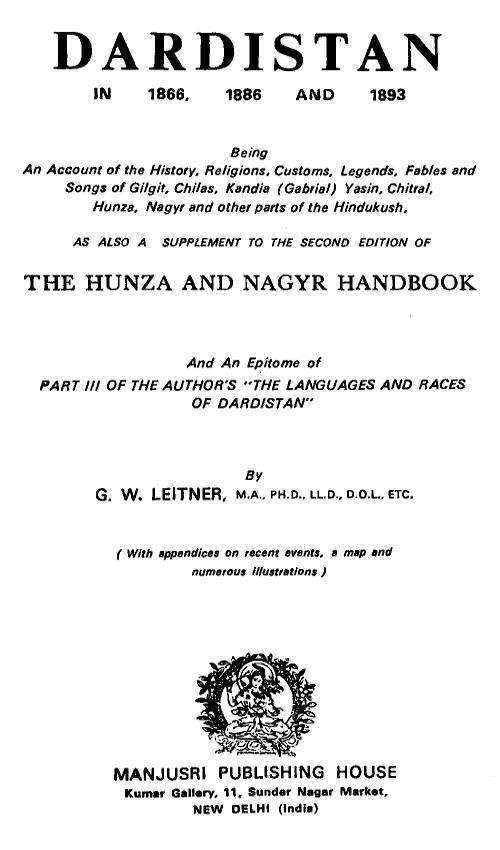
Dardistan in 1866, 1886 and 1893 / Being an account of the history, religions, customs, legends, fables, and songs of Gilgit, Chilas, Kandia (Gabrial), Dasin, Chitral, Hunsa, Nagyr, and other parts of the Hindukush, as also a supplement to the second edition of the Hunza and Nagyr handbook and an epitome of part III of the author's "The languages and races of Dardistan"
Explore more books like this:
About This Book
This work compiles travel-based observations and local lore from mountain regions of the Hindukush, combining historical narrative, genealogies, and accounts of conflicts with extensive documentation of rituals, beliefs, festivals, songs, riddles, proverbs, fables, and legends. It describes everyday customs including birth, marriage, and funeral rites, communal amusements, beverages, habitation patterns, and the social organization of divisions and castes. Substantial appendices present linguistic and ethnographic notes, anthropological measurements, itineraries and maps, illustrations, and reports on recent events. The tone is descriptive and evidentiary, recording oral traditions, customary practices, and regional historical episodes for comparative and documentary purposes.
About the Author