
The Project Gutenberg eBook of Dead Men Tell Tales
Title: Dead Men Tell Tales
Author: Harry Rimmer
Release date: September 23, 2021 [eBook #66366]
Most recently updated: October 18, 2024
Language: English
Original publication: Wm. B. Eerdmans Publishing Company, 1939
Credits: Stephen Hutcheson and the Online Distributed Proofreading Team at https://www.pgdp.net
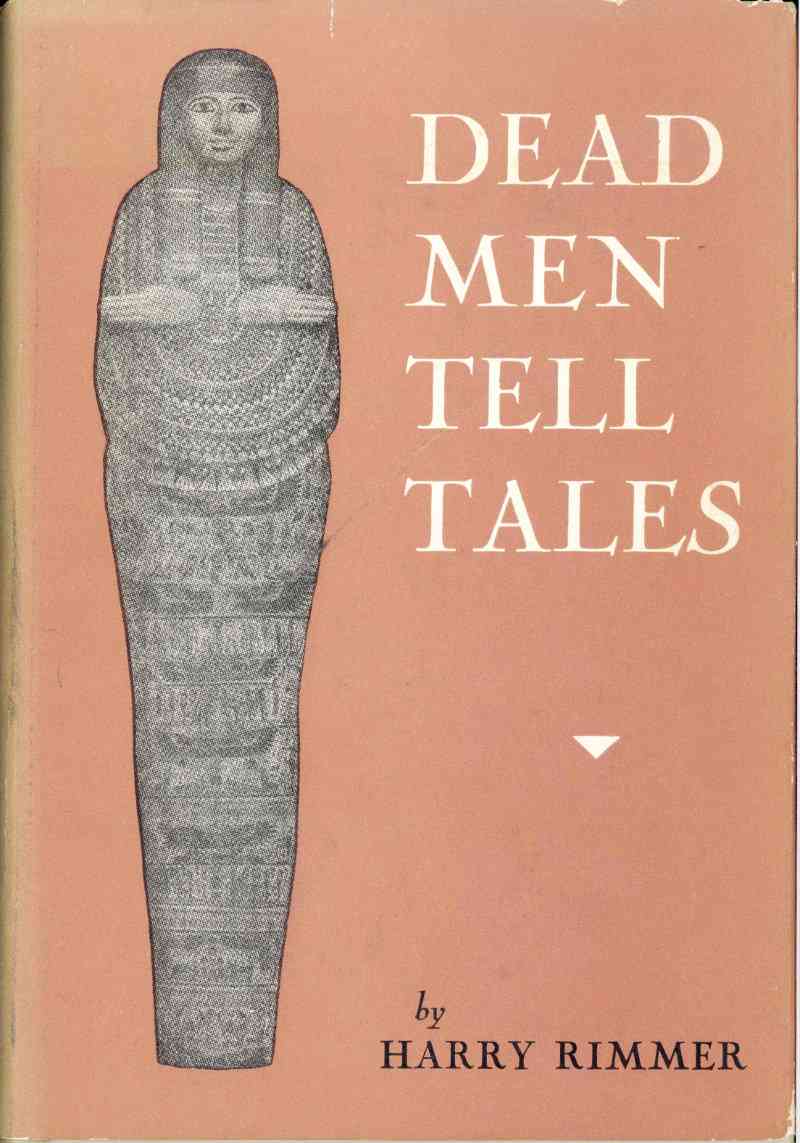
Anthropoid Sarcophagus, or Cartonnage
Dead Men Tell Tales
by
HARRY RIMMER, D. D., Sc. D.
With 37 Plate Illustrations in the Text
Eleventh Edition
Wm. B. Eerdmans Publishing Co.
Grand Rapids, Michigan
Dead Men Tell Tales
BY HARRY RIMMER, D.D., SC.D.
Copyright 1939 by
Research Science Bureau, Incorporated
Printed in the United States of America
All rights in this book are reserved
No part of the book may be reproduced in any manner whatsoever without written permission.
For information address the publishers.
ELEVENTH EDITION
FOREWORD
In an older generation, especially among the writers of the more lurid types of fiction, it was an accepted axiom that “Dead men tell no tales!” But this was before the great era of modern archeology had impressed its findings on the general public, and indeed before most of those discoveries had been made.
Our generation knows better. Dead men do tell tales, and marvelous and wonderful are the stories they bring to us. By means of an archeological resurrection, the great men of antiquity are with us again. Once more we hear the accounts of their fascinating lives and adventures, and read again the records of their culture. The tongueless tombs of the distant past have suddenly become vocal, and this mighty chorus of the dead great has forced us to revise many of our once cherished opinions.
Nowhere is this more strikingly true than in the case of the coincidence of these old ages with the page of the Holy Bible. The richest finds of archeology come to us from the very periods of history that are dealt with in the pages of Holy Writ, and names that were known only from the record of the Scripture are now the common possession of the scholarly world. So much is this the case, that we have a new technique of Bible study in our day. Just as the microscope is the instrument for the study of biology, and the spectroscope has become the means of study in physics, so the Bible is best read today in the light that is reflected upon its pages from the blade of a spade! This, of course, is intended to apply to the historical sections of the Book, and refers to the problem of its authenticity and historicity. It still remains true that spiritual understanding of its message can be derived only from study that is supervised and directed by the Holy Spirit.
This volume, the fourth in the promised series to be known as the
“JOHN LAURENCE FROST
MEMORIAL LIBRARY”
will deal with some of those fascinating discoveries that bear particularly on the problem of the Old Testament. The succeeding and companion volume, which will be entitled “Crying Stones,” will deal in like manner with the records of the New Testament.
The material contained in this apologetic is derived from various sources. Much of it came from records in the famed British Museum, in London, England. This marvelous storehouse of treasure from the most remote antiquity is the greatest collection of evidence bearing upon these questions, that is at present in the possession of man. There is scarcely a section of the Bible that does not receive some authentication from the limitless wealth of this noble treasury.
A great deal of the remainder of this information and proof has been derived from other museums, such as the Egyptian Museum at Cairo, Egypt, and the Museum of the University of Pennsylvania. Much of the contents of this book has come from the excavations now in progress in Egypt, and from the ruins at Sakkara, Luxor, Karnak, Iraq, and other centers of present activity. The earth seems eager indeed to offer its treasures of proof concerning the Word of God.
The author is especially grateful for the help accorded to him in Egypt by Mr. and Mrs. Erian Boutros of Cairo, and by certain officials of the Egyptian government, chief of whom in helpfulness was M. Abdul Nabi, and the Egyptian Tourist Bureau, whose gracious efforts on our behalf won us many privileges from the Department of Antiquities.
The illustrations used in this volume are largely from the author’s own photographs of exhibits and evidences, made by him and presented with the assurance that they are not retouched or altered in any manner. In the course of his studies and travels in search of this material, he made hundreds of negatives, only a few of which appear in this work. The exceptions to this are noted where they appear. The zinc etchings are made from original drawings by Miss Elizabeth Elverhoy from our photographs, and are authentic in all details.
We hand you now Tales of Dead Men, rendered by Men Long Dead, as they unconsciously accredit the sacred page of the Word of God. If you have a tithe of the pleasure and profit in the reading of these pages that we have experienced in the gathering of their contents, we shall be repaid for the labor involved.
CONTENTS
- Chapter I The Premise Stated 13
- Chapter II The Tides of Culture 37
- Chapter III Converging Streams of Revelation and History 55
- Chapter IV Modern Science and the Ten Plagues of Egypt 85
- Chapter V Sources 125
- Chapter VI Fragments 163
- Chapter VII The Rebirth of an Empire 195
- Chapter VIII The Resurrection of Edom 225
- Chapter IX The Brazen Shields of Rehoboam 247
- Chapter X Mingled Voices 269
- Chapter XI Vindication of Daniel 317
- Bibliography 349
LIST OF ILLUSTRATIONS
- Anthropoid Sarcophagus, or Cartonnage Frontispiece
- Egyptians at a wine orgy Facing Page 32
- Crude hieroglyphics on an ancient statue 33
- Example of embellished statue 40
- Colossi at Luxor 41
- The Sheltered Wife 41
- Khnum and Thoth in Creation Tradition 56
- Colossi of Karnak 64
- Colossi of Luxor 64
- Colossi of Amen-Hetep III guarding Valley of Kings 65
- At Tomb of Tutanhkamen 65
- Open burial 72
- Mural from an ancient tomb: Butchers at work 73
- The god Hapi drawing the Two Kingdoms into one 73
- Mace-head in British Museum 128
- Cuneiform writing and sculpture on stone weapon 129
- Ancient seals depicting historic events 136
- Section of funerary papyrus, showing progress of the soul 137
- Herds of cattle, such as Hyksos kings possessed 160
- Ancient mural: Slaughter of cattle 161
- Papyrus showing capture of quail 161
- Cartonnage in the anthropoid sarcophagus 168
- Outside and inside writings and decorations on anthropoid sarcophagus 169
- Detailed study of outside and inside of anthropoid coffin 176
- Outside of rectangular coffin covered with writings 176
- Murals and frescoes from tomb walls 177
- Commemorative stele 184
- Ancient boundary markers 185
- Stone ouches, or door-sockets 192
- The famed Black Obelisk, which confirmed record of Jehu 193
- Hamath inscription 195
- Small ivory lion from Ahab’s palace 200
- Fragmentary frieze showing ancient chariots 201
- Hittite inscription 208
- Egyptian funerary papyri 209
- Monuments of Petra, showing ruins from one direction 216
- Monuments of Petra, looking in opposite direction 217
- The rough approach to Petra 240
- Approaching Petra by way of the main siq 241
- “El Kahzne”, the Temple of the Urn 248
- Building carved from living stone 249
- El Deir 256
- Additional view of El Deir 257
- En route to the “High Place” 264
- The Altar of Sacrifice 265
CHAPTER I
The Premise Stated
In the romantic vocabulary of the twentieth century few words are more potent to arouse the interest of the average man than the fascinating word “archeology.” A flood of volumes has come forth from the press of our generation covering almost every phase of this now popular science. After one hundred years of steady plodding and determined digging, this school of research has at last come into its own and today occupies deserved prominence in the world of current literature. This science, which deals exclusively with dead races and the records of their conduct is, to many, the most fascinating field of investigation at present open to the inquiring mind of man. Nothing is of such interest to the human as is humanity. The study of the life and record of our own kind rightly means more to us than can most other subjects.
But the true appreciation of the value of the contribution of archeology to our modern learning can be appreciated only by those who grasp an outstanding fact that should be self-apparent, but is so often overlooked: Namely, these records derived from musty tombs and burial mounds constitute the daily events in the lives of human beings! The folks who left these records were ordinary people such as make up the nations of the earth today. They are not merely names on tablets or faces carved in stone. They were actual flesh-and-blood individuals with all that this implies. In hours of merriment they laughed, and they shed tears in moments of sorrow. They hungered, and ate for satisfaction; they drank when they were thirsty. They loved and they hated; they lived and they died. Pleasure and pain were their alternating companions, while ambition, aspiration, and hope drove them on the endless round of their daily tasks.
In a word, they were real. Their life was as important to them as is your life, and they lived it in much the same way. Therefore, the records written by humans and studied by their kind, who now live these thousands of years later, constitute the source of the most human science with which our generation has to deal.
The contributions of archeology have reached almost every branch of study, but to no particular group of people have they been more timely and valuable than to students of the Bible. The hoary antiquity of the Book which has been received in every generation by the intelligent and the discerning as the Word of God, has its roots in the same generations that archeology is investigating today. It is inevitable that much of the material being recovered by modern excavations shall have important bearing upon the various questions skepticism may raise concerning the text of the Scripture.
To the open-minded scholar who approaches this subject without prejudice, the science of archeology has a twofold contribution to make. Some of the evidences derived from digging are (a) of incalculable value in illuminating the text of the Scripture, and are (b) equally priceless when viewed as a body of indisputable evidence. Under this latter heading the proofs would come into four classifications:
1. The historicity of the text
2. The accuracy of the account
3. The authenticity of the record
4. The inspiration of the whole
By way of illustrating the manner in which the Scripture may be illumined by the findings of archeology, we would introduce a semi-humorous and partially tragic event that occurred in the dim and distant days of our own earlier studies. During a short term spent at a well known California college, we were specializing in the field of history. The teacher of this course, Professor Rosenberger, was one of the ablest pedagogues who ever wasted her life in the more or less important task of teaching a rising generation how to think! At the end of the first few weeks in a class in English history, she informed the student group that the following day we would be privileged to have a test in this particular subject. When the class gathered for the happy event, there were twenty questions written on the board which were to constitute our examination.
The first question was something like this, “What new treaty had just been signed between France and Spain at this particular period?”
The next question had to do with the political commitments of the Holy Roman Empire.
The third question took us into the Germanic states, and in all of the twenty questions not one word concerning England was mentioned!
As the class sat with the usual and habitual expression of vacuity which generally adorns the countenance of a college student facing a quiz, the Professor said, “You may begin.”
Some hapless wight procured the courage to protest, by saying, “But you said this was to be an examination in English history!”
The Professor replied, “Quite so! This is English history!”
Then leaning forward over the desk she said, in impressive tones, “How can you expect to know what England is doing, and why, if you do not know the pressure upon her of her enemies and friends at that particular period?”
A long distance back in our mental vacuum a dim light began to glow, and we never were caught that way again! When the teacher said French history, we read everything else! When she said German history, we specialized on the surrounding countries. One day as we were thinking over this helpful technique of understanding, the idea began to grow that if this was the proper way to study secular history, it ought to apply to Bible study as well!
There is an illumination that brightens the meaning of the Sacred Text when read in the light of collateral events that can come no other way. As an instance of this, we will remind the reader of the background of Isaiah. When this prophet first began to write, there was trouble between Israel, the northern confederation, and Judah, the southern kingdom. The king of Israel at this time was Pekah, the son of Remaliah, and although his people were numerically superior to Judah, he was fearful that he might not be strong enough to overcome the southern kingdom in the threatened war. Therefore, he made a close alliance with Rezin, the king of Syria, promising him all the spoils of the battle, if he would aid with his army and strength. The Syrian king hastened to accept this offer, and signed the required covenant. When this alliance became known in Judah, a natural alarm spread throughout the tiny kingdom. Realizing that they were incapable of resisting the strong forces of Israel and Syria which had combined against them, the princes of Judah desired outside help. The only apparent source of such assistance was Egypt. So in the court of Ahaz, the king of Judah, a strong party began agitating for a military alliance with Egypt. That being the only apparent aid within any reasonable distance, it seemed natural to turn to them for a military alliance.
The prophet Isaiah, who was a strong force and exercised a vital influence in the policies of Judah, began to object most strenuously. In the light of this background, we can understand such outbursts of Isaiah as are found in the thirtieth chapter of his prophecy, verses one to three:
“Woe to the rebellious children, saith the Lord, that take counsel, but not of me; and that cover with a covering, but not of my Spirit, that they may add sin to sin:
“That walk to go down into Egypt, and have not asked at my mouth; to strengthen themselves in the strength of Pharaoh, and to trust in the shadow of Egypt!
“Therefore shall the strength of Pharaoh be your shame, and the trust in the shadow of Egypt your confusion.”
His protest seems to reach a climax in the thirty-first chapter in that magnificently written plea for faith in God which we find in these graphic words:
“Woe to them that go down to Egypt for help; and stay on horses, and trust in chariots, because they are many; and in horsemen, because they are very strong; but they look not unto the Holy One of Israel, neither seek the Lord!
“Yet he also is wise, and will bring evil, and will not call back his words: but will arise against the house of the evil doers, and against the help of them that work iniquity.
“Now the Egyptians are men, and not God; and their horses flesh, and not spirit. When the Lord shall stretch out his hand, both he that helpeth shall fall, and he that is holpen shall fall down, and they all shall fail together.”
All through this period of prophecy, Isaiah’s voice is aggressively raised against the folly of trusting Egypt. His protest is, “Since God redeemed us once from bondage in that land, why put ourselves back again under their yoke?”
The princes replied in some such terms as this: “The objection is o. k. in principle; as a basic thesis we will admit that it is safe to trust in God. But right now we need real help and we need it in a hurry.”
The prophet cried out in response, “God will send the help that you need!”
The natural question was “Whence? Syria and Egypt are the only two powers near us. One is arrayed against us and the help of the other you forbid us to seek. Whence then is the aid that God will send?”
The prophet’s reply was short and terse, “God will send aid from very far off.”
The reluctant court agreed to take a chance on Isaiah’s insistence, and so to trust their cause to the God of Israel. Quickly, then, upon the heels of this decision, as we learn from the records of archeology, there came one of the earlier battles that were fought at Charchemish.
The rising power of Assyria first made itself felt in that engagement. As a result, Syria was shattered and Israel made captive. The help that God had promised did come, and now the definite prophecy of Isaiah, in chapters seven and eight, may be correlated into this simple summary; and against this background we can understand the vehemence of Isaiah in crying out against an alliance with Egypt.
It is not too much to say, as we shall later show in detail, that in our present possession there is sufficient knowledge derived from the monuments and records of antiquity to authenticate every prophecy that Isaiah made concerning Egypt, Israel, Syria, and Assyria. Thus the text of the Old Testament is illumined, and a floodlight of understanding thrown upon its prophetic utterance by the findings in this field.
Even more striking is the contribution of archeology in the second field, that of evidence in defense of the accepted text. The museums, monuments, and libraries of the world are teeming with such evidences, and it shall be the purpose of this volume to condense, epitomize, and present much of that evidence in a simple and readable form, divorced from technical obscurities. Right here, however, we offer just one simple illustration under each of the subdivisions suggested in the paragraph above.
To demonstrate the evidence of the Bible’s historicity, we shall offer the illustration made famous by the late Dr. Robert Dick Wilson, as to the record of the forty-seven kings of antiquity. It is probably known to the reader that the historical sections of the Old Testament contain the names of forty-seven kings, aside from the rulers of Israel and Judah. These foreign, or Gentile kings, have been known by name for many centuries to every reader of the Old Testament.
The odd thing is that until comparatively recent times, these names had been dropped out of secular history. Mighty as these men had each been in his day, they were completely forgotten by posterity and for some twenty-three hundred years their names were unknown to the scholars of secular events. For this reason the learned leaders of “higher criticism” relegated these forty-seven monarchs to the columns of mythology. They were grouped among “the fables and folklore of the Old Testament” which this deluded school mistakenly taught was one of the basic weaknesses of the text. Then one after another these disputed monarchs began to rise from the dead in an archeological resurrection. In some cases a burial mound was uncovered; in others, an annalistic tablet, a boundary marker, or a great building inscribed with the monarch’s name. Now, all forty-seven of these presumably fabulous characters have been transferred from the columns of “mythology” to the accepted records of established history.
In forty-seven specific instances, as these kings rose from the dead past, they were recognized, as their names were not strange to true historians. Each was remembered from his appearance in the page of the Old Testament which had preserved his memory with accuracy. Thus, in this simple instance there are forty-seven definite and specific evidences of the complete historicity of the text.
To stress this point, the accuracy of the record, we shall cite a semi-humorous illustration. The great Greek historian, Herodotus, who is supposed to be the “Father of History,” wrote some more or less accurate observations concerning the land of Egypt. Among other things, he said that the Egyptians grew no grapes and drank no wine.
There was another ancient who preceded this historian by many centuries, who also wrote voluminously about Egypt and her customs. This was the man Moses, who being reared in the bosom of the royal family as the crown prince and heir apparent, might be presumed to know considerably more about Egyptian customs than any casual visitor. Moses stated that the Egyptians did grow grapes and that they did drink wine. In fact, he recounts that Joseph was in jail with the chief cupbearer of Pharaoh, the butler whose business was the purveying of wine to the royal table. It may be remembered that in the butler’s dream he saw himself standing by the vine, squeezing the grapes into the cup.
This brought these two authorities into sharp opposition. Since Herodotus was supposed to be the final authority on matters of antiquity, the critics fell upon this discrepancy with considerable glee. The argument might still be going on, if it were not for the discovery of an unquestionable bit of evidence among the frescoes that decorate the tombs of Egyptian antiquity. These frescoes showed the Egyptians engaged in the art of viticulture. In some of these pictures they were dressing and pruning the vines, cultivating and tending their crop. In others of the pictures they were seen to be gathering the grapes and conveying them to the press. The ingenious method of extracting the juice was clearly portrayed in these illuminating frescoes, which showed the juice being stored in stone jugs, clay pots, and skin bottles for future use. Since the ancients called any fruit juice that was used for drinking purposes by the name of wine, whether it was fresh or sweet, it is highly probable that some of this juice was drunk in an unfermented condition.
However, one of the murals depicted an Egyptian party gathered around the banquet board, making merry with the juice of the grape (See Plate 1). The incidental evidences show very clearly that the juice was fermented. Off in the corner, the picture depicts a noble lady who is portrayed with her slave holding a silver bowl, while she gave up the excess fluids that had evidently disagreed with the more commendable parts of the banquet! Another of these murals showed the morning light coming into such a banqueting hall, as the slaves were all carrying their masters home; with the exception of one inebriate who had slid under the table and had evidently been overlooked in the excitement!
Did the Egyptians grow grapes and drink wine?
Herodotus said “No.”
Moses said “Yes.”
The critics, to their later embarrassment, lined up solidly with Herodotus.
But since archeology has accredited the accuracy of Moses, this argument is no longer heard in the halls of learning.
When we come to the question of authenticity, we shall later give many evidences that none of the records of the Bible, either the Old Testament or the New, are, in any sense of the word, forgeries. They are uniformly authentic in that they were written by the men whose names they bear.
A classical illustration of this is found in the fact that Sir William Ramsay, one of the greatest archeologists of our generation, began his work in his early days under the bias of the critical position that Luke was not the author of either the Gospel that bears his name or the book of the Acts of the Apostles. After forty years of research in Asia Minor, Sir William Ramsay himself discovered the evidence that converted him personally to the orthodox and historical view, and demonstrated conclusively that Luke unquestionably wrote the two books that are accredited to him. As we shall deal with this matter more extensively in the fifth volume of this series, we pass on to the present cause of modern controversy, namely, the inspiration of the text.
The fact of inspiration is stated so often by the writers of the Scripture that we must accept their explanation of the origin of these pages, or else classify them as the most consistent liars that humanity has ever produced. They claim a supernatural guidance by the Holy Ghost which has kept their records free from error or discrepancy. For one who has examined and analyzed the Scripture in the unprejudiced light of archeology, this claim is vindicated at every turn of the spade.
A simple illustration of the manner in which our science does show the inspiration of the Scripture, may be found from the prophetic sections of the Old Testament. In the days of Isaiah and his fellow prophets, the capital of Egypt was the city of No. It is also called Amon, and sometimes, No-Amon. It was a populous city of wealth and culture, being the center of learning, as well as the seat of government. In a day when Egypt dominated the world and No-Amon was the mistress of antiquity, obscure Hebrew prophets raised their voices in denunciation of No in such arbitrary and extreme statements as are found in the thirtieth chapter of Ezekiel. Denouncing the sin of Egypt and their repeated betrayals of Israel, Ezekiel warns Egypt that her land shall be overrun with fire and sword, and that No-Amon shall be desolate and forsaken.
There must have been a strong element of humor in all of this outcry to the proud mind of the Egyptian of that day! No-Amon, also called Thebes, spreading out on both banks of the Nile, in complacent, serene command of the ancient world, apparently had nothing to fear from the bitter cries of a prophet of Israel. Yet today the visitor to the site of Thebes, or No-Amon, to use the more ancient name, is faced with a scene of desolation that is utterly devoid of any human habitation.
Since it is impossible for the human mind to pick up the curtain of time and peer ahead into future events, prophecy can derive only from the Holy Spirit. The work of archeologists in identifying the bleak and barren site of No-Amon portrays the inspiration of the Scripture. The proud city is forgotten except for its inscriptions on records of antiquity and the denunciations to be found in the Word of God. Thus we have simply illustrated how this dignified and sober science is bringing to us illumination of the text, together with the evidences of the HISTORICITY, ACCURACY, AUTHENTICITY, and INSPIRATION of the Bible.
This is eminently fitting, since this peculiar science is most intimately concerned with the problem of the credibility of the Bible. The unique and heavenly nature of the Book is in itself a divisive factor. Multitudes of men and women love it and would die for its preservation. Indeed, it is no exaggeration of fact to say that multitudes have died in its defense. There are others who hate the Book and would go to any length to discredit it, except the extreme length of martyrdom. It is very natural for men to die for what they believe, but few men will surrender their lives for what they disbelieve!
This division is decidedly fitting and proper. Men and women who are saved by the grace of God recognize the supernatural nature of the Book that is the means of their redemption. Men and women who are lost, resent the honesty of that Book in that it condemns their sin and iniquity.
In our day and age, infidelity has, under the guise of an attempted scientific refutation, directed its chief argument against the integrity of the Scripture. Living in an age of science, when all things are again evaluated in the light of man’s technical knowledge, it is inevitable that the Bible should come in for this type of investigation. No exponent of Scripture would wish it otherwise. If the Bible is honestly examined without prejudice, under any system of truth, it will maintain its integrity and establish its own supernatural character.
The so-called scientific investigation of the Scripture, however, has not been made on the basis of credible science. Rather, the prejudiced enemies have sought to gather from pseudo-scientific claims such help and hope for their opinions as would bolster their failing school. We frankly admit that the text of the Bible does refute the fallacies of men of science. There is a great deal of theoretical speculation indulged in by men who call themselves scientists, and who march under the banner of technical learning. In every age, when such fallacious theories are current, the Bible is necessarily repudiated by the exponents of those false ideas. Few such men, however, know the Bible, and their opposition has no lasting effect. This Book does not stand in any age by human consent, but has been able to maintain itself in every age by the inherent power of its supernatural character.
The science of archeology has played a great and leading role in demolishing these fallacies of a pseudo-scientific generation.
As an instance of this, we may note that the theory of organic evolution is unquestionably incompatible with the record of the Scripture. In the “dark ages” of biology which began to draw to a close at the beginning of this present decade, the thoughts of men were so darkened by the general acceptance of the baseless and unscientific theory of man’s animal origin, as sadly to handicap capable research and frustrate the pursuit of real knowledge. We see again, however, that truth, though crushed to the earth, will rise again. For certainly no one who is within ten years of being up to date in the facts of biology and the discoveries of archeology, will contend any longer for the animal origin of the human species.
The theory cannot be harmonized with the record of the Scripture. Therefore, in the days of blindness, when this particular theory possessed the imagination of men, it was used as an argument against the integrity of the text of the Word of God. This whole problem simmers down to a simple illustration. In dealing with the origin of man, there are two horses. The problem of every man is to decide which one he shall ride. One horse is known by the name of “specific creation,” and the other is called “organic evolution.”
It is impossible to ride them both at once. In riding two horses at one time, it is necessary to keep them close together and both going in the same direction. There is no record of anyone who successfully rode two horses simultaneously when they were headed in opposite directions!
These two premises are irreconcilable. The first is that man was created in perfection. In the moment of his fiat origin, he was formed by the hand of God, gifted with all the arts and cultures by a process of involution. The word “involution” simply means “to come down into.” That is to say, all of the graces and abilities possessed by man were imparted by creation.
The second theory is that “man has himself consummated a gradual ascent from a brutish state to our present high and civilized condition.” (If there were room in such a work as this for sarcasm, we might say that this is another way of noting that we have left the arrow and the club for heavy artillery, poison gas and aerial bomb. If one were to wax facetious, one might be tempted to suggest that if the present condition of international hatred, mass murder, violated treaties, forgotten honor, and civilian extermination in the holy name of war, are the best that evolution can accomplish, we should hand the whole mess back to the monkeys and ask them to stir up another batch!)
But to remain upon the sober grounds of scientific inquiry, it is not too much to say that the archeologist speaks upon this problem with absolute finality. There is nothing theoretical about archeology. What you dig up with your own hands, you are inclined to believe.
Some years ago we had a college lad on one of our expeditions who was strongly addicted to the theory of organic evolution. At the beginning of the work the lad showed some disposition to argue, and was somewhat disappointed that we refused to enter into debate with him upon our differing theories. As day followed day, however, and we got into the rich contents of burial mounds containing a fabulous amount of ossi, this lad became deeply concerned with the discrepancies between his textbook learning and what he saw in his own personal recoveries of ancient skeletons.
Every time he came to us with some bone that did not fit in with his classroom theories, we would laugh and say, “Don’t bother us. You dug that up. This poor bone never read your textbook and it doesn’t know how you want it to be. Now, which are you going to believe? The schematized drawing in a textbook written by some professor who never saw a burial mound, or this evidence that you yourself have acquired by your own labor?”
At the end of that one summer, this student returned to the campus an ardent and bitter anti-evolutionist, denouncing the false teachings which had misled him by means of the printed page.
In a word, other sciences may speculate, theorize and deduce, but archeology delves and demonstrates. Some of these demonstrations will be seen in the contents of the following pages. We say some: for if all the evidence from the realm of archeology were massed into one great volume, no derrick ever built by man could lift its tremendous bulk and weight. In such a work as this one we are handicapped and embarrassed, not by the paucity of evidence, but rather by its over-abundance.
Plate 1
Egyptians at a wine orgy
Crude hieroglyphics on an ancient statue. Depicting the early development of art and writing
It shall be the purpose of the following pages to cull and summarize some of the striking facts of archeology, which demonstrate beyond question that the Book which men call the Bible is historically credible, scientifically accurate, and has been derived by inspiration from the Spirit of God.
CHAPTER II
The Tides of Culture
In almost every branch of this fascinating science, archeology has been the handmaid of revelation. Even more, it has acted as a beacon to illuminate the pathway to God, which men call the Bible. The problem of the antiquity and culture of man was the battleground of infidelity which the skeptical chose to demonstrate the fallacy of the Bible’s claims to supernatural origin.
If it can be proved by the aid of science that the human race is older than is implied by the Genesis account of creation, and if it can be shown that man has ascended from a dim and brutish ancestry, instead of being created perfect by the hand of God, the foundation would admittedly be swept from beneath the Scripture, and the entire structure of revelation collapses. However, this unwarranted attempt to confuse the issue and refute the Scripture, is manifestly unfair to science. It is not too much to say that this is a debasing of the highest labors of human mentality. Research, in the exact sense of the word, cannot be used legitimately to establish a pet theory to which the advocate clings without regard to evidence in the case. The attempt to demonstrate the organic evolution of man belongs in the realm of philosophy and not of science. The work of science is the correlation of facts. The sphere of philosophy is the interpretation of facts. In all of this controversy, we are not debating the facts of humanity, but are at odds concerning the application of those facts. The real issue then is not the antiquity of man, but the origin of man!
In the hope of obscuring the manner of origin, the enemy of our faith has sought to raise the dust storm of antiquity. It is here more than anywhere else, that archeology has been such a tremendous aid to the establishment of the truth. This science has demonstrated the premise of the Scripture, namely, the fixity and origin of our species. As far back as the spade has been able to thrust the history of humanity, we find the same types and varieties of the human family that exist upon the earth today. Since we are covering this problem of antiquity and origin in the sixth volume of this series, we will hasten on with this brief statement of the issue involved. We will later show that all of the statements made in the text of the Scripture concerning the degeneration and moral collapse of humanity have been abundantly demonstrated in the realm of archeology. Further, the claims that we make as to the historicity of the Bible can be demonstrated satisfactorily in one single field; namely, the recording of the story of man and the care used by the Scripture writers in the exactness of their statements. In this display of historical accuracy, the writers of the Bible have incidentally repudiated the entire philosophy of organic evolution. It is not too much to say that no single evidence derived in the entire realm and history of archeology has sustained the theory of organic evolution. Remember that we are dealing specifically with evidence. If the evidence is rightly interpreted and honestly implied, item by item and in the aggregate mass, it refutes the entire fallacy of this weird philosophy.
Since it deals with the realm of human history, archeology is the final voice as to the antiquity and culture of man. No race of man has ever lived upon the face of this earth and failed to leave some relics or evidences of its existence and culture.
The science of anthropology postulates the beginning of the human family somewhere in Mesopotamia. The Bible is a little more specific, in that it states that it was in that portion of Mesopotamia which lies between the two rivers, the Tigris and the Euphrates. The oldest relics of man, however, are not found in Mesopotamia. This is due to the climatic conditions in certain parts of that ancient land. The rainfall is heavy. We have ourselves suffered great inconvenience, delay, and loss by being isolated from our objective in Mesopotamia by floods that filled the wadies and gullies and made travel impossible. Also, the outlying country is underlaid to a great extent by water. When excavators dig but a short way into the strata of that land, they are handicapped and hindered by seepage. Because of this excess moisture, some of the oldest relics of our race have been destroyed by the ravages of time and the power of the elements.
The situation in Egypt, however, is quite the opposite. In most of that land there is no rain and in no part of that bleak country do we experience frost. The climate is dry to the utmost extreme, and the soil is largely sand. Due to this natural condition, the oldest records of the human race are found in Egypt. The oldest records of man and the most complete records so far recovered of his early existence have been preserved for us by this combination of climate and soil. Since the Egyptians buried in sand or in stone tombs, the deposits being protected from the elements, man was the only destroyer. Even though there has been a sad record of vandalism, as ruthless hands of the ignorant have despoiled magnificent tombs of priceless records and information, there is much that remained undisturbed. The people of Egypt built for endurance. The mighty pyramids, from Sakkara to the Great Pyramid; the Colossi at Luxor and the awe-inspiring ruins of Karnak, are present evidences of the durability of their labors. (See plates 2, 3 and 4.) Because of the strange beliefs concerning the life after death, these people also buried for eternity. We shall later consider, in the light of their customs and religious practices, the tremendous value that modern civilization has derived from this ancient fact. We have mentioned this fact now merely to note that the greatest treasure trove of preserved antiquity is found in the land of Egypt.