
Through the timbers cautiously stole the guide; he was now approaching the Indian in the rear. He had formed so true a calculation of the spot upon which sat the Crow chief, that, after five minutes’ continued progress he could distinguish the dusky figure on the outskirts of the timber.
“Thar’s the red devil!” muttered the hunter. Just then he happened to step upon a dried twig, which snapped beneath his tread. Noiselessly and with the quickness of the lightning’s flash, the “Crow-Killer” sunk at full length upon the ground.
The quick ear of the Indian caught the sound of the breaking twig, and he lazily turned his head in the direction of the noise. The action was prompted by curiosity only, not alarm, for he had no suspicion of danger; he looked for the foe before not behind him.
A moment or two the Indian kept his eyes fixed in the direction of the “Crow-Killer.” All was still, however, no sound came from the little thicket.
The Indian, at last satisfied that the noise came from some little animal or bird within the thicket, again resumed his watch down the river.
“Wal,” the “Crow-Killer” whispered, “that were a narrow escape. If that Injun had as much sense as a pig, he’d have found out what made that ’are noise. Bah! talk ’bout Injun sense and skill! Thar never were an Injun yet that could come up to a white man trained in their ways; they ain’t got the head on their red bodies for to do it. A moment ago, I thought it were a difficult question to decide, whether he’d take my top-knot or I’d take his’n, but thar ain’t any doubt ’bout it now; he’s a gone sucker, as sure as my name’s Abe.”
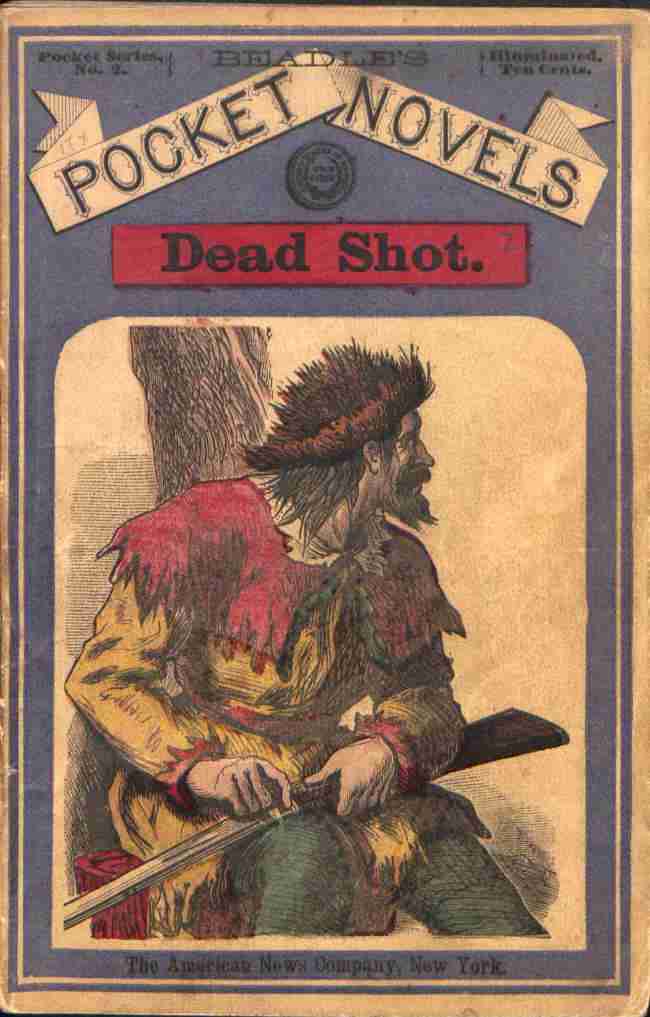
Then drawing his keen-edged hunting-knife, with a stealthy step the old hunter crept upon his foe. The Indian, unconscious of danger, and wearied from the toil of last night’s fight, sat upon the grass, idly reclining upon his elbow, his carbine by his side, his eyes fixed vacantly upon the open prairie
With a spring like that of the panther leaping upon his prey, the old hunter sprung upon his foe, and while one broad hand, clutching the brawny throat of the savage, stifled his cries, the other drove the broad-bladed knife deep into his bosom. A single convulsive movement of the savage’s limbs, a stifled gasp in the throat, and the soul of the Crow chief had fled to the happy hunting-grounds. Another brave of the Crow nation had fallen by the hand of the Avenger.
A strange expression was in the eyes of the old “Crow-Killer” as he knelt by the side of the dead warrior.
“A young brave,” he muttered, gazing on the features of the Crow—tinted with the gay war-paint—that a few moments before had been radiant with life, health and strength, yet now were rigid in death. “Probably this was his first expedition,” he continued, “the first time that he has decked his face with the war-paint and gone on the war-trail ag’in’ the whites; yet I don’t know that; the ‘White Vulture’ isn’t much older than this chap, an’ he has seen many a bloody fight. ’Tain’t for nothing that they call him the ‘greatest fighting-man of the Crow nation.’”
The scout took another long look at the youthful features of the dead warrior, from the wound in whose breast the blood was streaming freely.
“It seems a pity to kill the red devils arter all; yet when I think of the wrong they have done me, cuss ’em!” and the guide shut his teeth together vindictively. “When I think of my father, dead, killed by these red dogs—when I think of my little Injun wife that they stole away from me, an’ then, when I think of my two boys, my twin boys—if they had lived they’d have been about the age of this feller now—it makes me feel so bitter, that I really believe if I had the power I could wipe out the whole durned Crow nation, with as little remorse as I would feel for killin’ a wolf. One of these days, I ’spect I’ll find the truth about my wife and those twin babies. It makes me feel right bad sometimes, when I think that, maybe, the Crows didn’t kill my two boys, but have reared ’em up an’ made ’em Crow warriors, taught ’em to fight ag’in’ their father, an’, some day, I may meet an’ kill ’em or they me. I think I should know ’em though, ’cos they must look like the mother an’ something like me.” And then the old hunter was silent for a moment; then he took the body of the Indian, placed it carefully with its back against a tree, facing it toward the prairie.
“Thar,” said Abe, “if any of the red skunks on the prairie pass by they’ll think he’s on his post, all right; they won’t see that he’s done fer unless they come mighty close. Now then,” he said, picking up his rifle from where he had laid it in the thicket, “now I think I can walk right into the Crow camp without any trouble; I must be careful, though, I don’t stumble on ’em afore I know it, ’cos a fight is the last thing that I want to git into now.”
CHAPTER IX. THE CROWS IN COUNCIL.
The “Crow-Killer” now made his way again to the river-bank, struck the stream at the place where he had left it, descended under the bank and then turned up the current—his footprints being in water, of course were soon washed from sight.
“Thar,” he thought, with a sly chuckle, “I guess the Crows will have some difficulty to foller me. If they find the dead Injun, then they’ll track me to the river an’ then they’ll be bothered. They won’t think for a single moment that I’ve gone up-stream right into their camp, ’cos that’s foolhardy, but, bless their stupid souls, the bold game is the one that wins in the long run. No, of course they’ll imagine that I’ve gone down the river an’ they won’t dare to track me very far in that direction for fear of gettin’ within range of our rifles. I think I’ve fooled ’em ’bout as cute as it can be done. They’ll get sick of tackling the ‘Crow-Killer’ ’fore long, I reckon; if they don’t, they’re bigger fools than I take ’em to be.”
So up the river, hid by the overhanging bank, cautiously went the “Crow-Killer.” It was necessary to again ascend the bank in order to get within ear-shot of the Indians; but how to do it without leaving the marks of his feet upon the soft clay bank was a puzzle. Circumstances favored him. Right before him a stunted oak grew out of the bank and overhung the stream; grasping the trunk with his hands, light and quick as a cat, Abe lifted and swung himself up over the bank, his feet finding a resting-place on the bottom of the tree-trunk and thus leaving no mark.
The bank thus again gained, he plunged once more into the thicket.
After advancing a few steps, he heard the sound of horses pawing the ground, a sure proof that he was near the camp.
Cautiously he stole forward a few steps more, when the thicket ended suddenly, and before him extended another little glade, not tenanted by a single savage as was the other, but by a score or more of the red braves. Extending himself flat on the ground, the guide, snake-like, wormed himself forward among the tangled underbrush, until he arrived at the very edge of the thicket, where he could not only command a full view of what was going on, but could hear nearly every word that was said. As he conjectured, he looked upon the main camp of the war-party.
On the prairie, close to the timber, the horses of the party, the wild Indian ponies, hardy and savage as their masters, the red chiefs, were tethered.
Some thirty warriors were in the little glade; the rest of the party, as the scout had surmised, were watching the camp of the emigrants.
All of the thirty warriors, excepting some eight, who appeared to the practiced eyes of the “Crow-Killer” to be the principal chiefs, were scattered over the prairie edge of the little glade near the horses, nearly all reclining on the ground.
The eight chiefs, among whom was the “White Vulture,” were seated near the middle of the glade in a circle, apparently holding a council. So the scout judged, and also that the council had just commenced, as the calumet, from which the smoke lazily curled, was being passed from mouth to mouth.
“Now then,” thought the guide, “we’ll see what the red devils are arter.” Then his eyes wandered anxiously over the Indians near the horses.
“What on earth have they done with the little gal? I can’t see her anywhar. Can the red-skins have murdered her?” and used as the “Crow-Killer” was to scenes of blood, he shuddered when he thought of Leona lying dead on the prairie and the beautiful red-gold hair hanging at the belt of some savage chief as a trophy of victory.
The pipe was passed around, and when it had completed the circle, the old warrior, the uncle of the “White Vulture,” who was called the “Thunder-Cloud,” spoke.
“My brothers are in council; their hearts are brave like the great white bear; their tongues are straight as the arrow. Will the chiefs of the Crow nation attack the white wagons again, or will they go to their lodges in the great mountains?”
Then up rose a brawny savage, hideously streaked with black paint. It was the same Indian who had, on the previous night, captured the hapless Leona. He was known among the Crows as the “Black Dog.”
It was very evident to the scout, from “Black Dog’s” speech, that he was a rival of the “White Vulture.”
The “Black Dog” advocated an immediate descent upon the train—declared that the whites were whipped and would fly before another attack—in a covert way insinuated that the chiefs in favor of returning home were cowards—a course which gained the “Black Dog” no friends, but made him enemies, for the majority of the Crows were fully satisfied that the emigrants, headed by the dreaded “Crow-Killer,” were more than a match for them.
Then the “White Vulture” spoke.
“My brothers,” he said, “have listened to the words of the ‘Black Dog’; he has said that some of the hearts of the Crow chiefs were white—that they feared the pale-faces. My brother, the ‘Black Dog,’ is a great warrior, a great chief,” and the lip of the “White Vulture” curled in scorn. “While the other chiefs of the Crow nation can show wounds from the fight with the white wagons, my brother, the ‘Black Dog,’ can show none. He has no wounds, but he has a pale-face squaw, that he took in single fight. My brother is a mighty warrior.”
It was evident that all the chiefs sided with the “White Vulture,” as a sneer was upon every lip. The “Black Dog’s” brows were dark with rage. In a voice trembling with suppressed passion he answered the “White Vulture.”
“The ‘White Vulture’ speaks with a forked tongue; his heart is black toward his brother. The ‘Black Dog’ has no wounds because the Great Spirit smiled on him and the pale-faces could not harm him. Though he has no wounds, yet he gave wounds; the white-wagon braves shrunk before him like the grass before the wind. The ‘Black Dog’ is not a snake; he crawls not on the ground; but his way is like the eagle. The ‘Black Dog’ is not blind like an owl, he would not have run his head against the white wagons to slaughter the braves of the Crow nation. The ‘White Vulture’ is a great chief; the snakes that crawl in the grass and the dogs that lick the hand that feeds them, say he is the ‘great fighting-man of the Crow nation;’ yet the squaws at our lodges, at the great mountains, will mourn for the braves that fell by the hands of the white warriors, by the Yellowstone, when the ‘White Vulture’ led them.”
Astonishment was visible upon the faces of the other chiefs, the “White Vulture” alone excepted, at this speech. The face of the “great fighting-man of the Crow nation” was like marble, no trace of anger appeared upon it at the bitter speech of his foe. The “Crow-Killer” watched the scene eagerly.
“He’ll give the ‘Black Dog’ a lick under the short ribs, the fust thing he knows on. He a fighter, wah!” and the expression of contempt was evidently intended for the Dog chief. “If the ‘White Vulture’ goes for him, I’ll bet my pile on him every time.”
The “White Vulture” arose from his seat to answer the speech of the “Black Dog”; all the chiefs looked on with evident anxiety; that a storm was brewing that might end in blood was evident to all.
“The ‘White Vulture’ has listened with his ears open to the words of the ‘Black Dog’,” began the chief. “The chief has said that the ‘White Vulture’ led the braves of the Crow nation to death: what is death to a warrior? Nothing! Does the ‘Black Dog’ know the reason why the braves of the white wagons beat the red chiefs? If not, the ‘White Vulture’ will tell him. The red braves were to creep upon the white wagons as the panther creeps upon his prey; then they were to spring upon the whites as quick as the forked light comes from the hand of the Great Spirit—the red chiefs were closing in upon the white wagons, but they were not ready for the attack, when the squall of a squaw, the mighty capture of the ‘Black Dog,’ gave warning to the whites that their foes were near. If the ‘Black Dog’ had not captured the white squaw the Crows would have beaten the pale-faces.”
A low murmur went round the circle; all agreed with the “White Vulture,” save, of course, the “Black Dog,” who, with his hand clutched instinctively on his knife, glared upon his foe.
“My brother talks straight!” said the “Thunder-Cloud.”
Then, calm as a statue, the “White Vulture” went on in his speech:
“My brothers gave me the command of the expedition; it was good; they are great chiefs, as brave as the white bear and wise as the beaver.”
All the chiefs bowed assent; the compliment pleased them. Human nature is the same, whether embosomed in the red breast or the white. The “Black Dog” alone looked surly; he saw clearly that the chiefs were all against him, and his heart swelled with rage to see his foe triumph.
The “White Vulture” continued:
“The ‘Black Dog’ has said that the squaws of the Crow nation will mourn and sing the death-song for the young braves that the ‘White Vulture’ led to their graves. The ‘Black Dog’ lies!” and the accusation came forth with terrific force from the lips of the chief. “The squaws in the Crow lodges by the big mountain will mourn for the braves slaughtered by the ‘Black Dog’ for the sake of the white squaw.”
The face of the “Black Dog” was purple with passion. In a voice hoarse with rage, and drawing the sharp scalping-knife from his girdle as he spoke, he addressed the “White Vulture”:
“If the great fighting-man of the Crow nation does not fear, he will follow the ‘Black Dog’.”
And with a stately step the warrior, knife in hand, marched toward the thicket wherein the “Crow-Killer” was concealed. The “White Vulture” understood the challenge to mortal combat, and drawing his knife he followed the “Black Dog.” The rest of the chiefs remained seated in the circle awaiting the result.
The “Black Dog” headed directly for the spot where the “Crow-Killer” lay.
“Jerusalem!” muttered the “Crow-Killer,” as the warriors came toward his hiding-place, “if they keep on, they’ll settle me. I’ll kill that skunk first any way, an’ save the ‘White Vulture’ the trouble.”
The scout drew his knife, but the “Black Dog” turned off abruptly to the right and entered the thicket not far from where the scout was ambushed. Behind stalked the “White Vulture.”
Some thirty feet from where the “Crow-Killer” lay, was a little space unincumbered by bushes. To this spot the “Black Dog” led the “White Vulture.”
The “Crow-Killer,” from his hiding-place, commanded a full view of the scene, by merely turning his head.
“Sho!” he muttered, “it will be as good as a circus; but if the ‘White Vulture’ don’t settle that fellow’s hash, I ain’t any judge of fighting,” and then with eager eyes he looked upon the scene.
The two chiefs surveyed each other for a moment, their long, keen-edged blades glittering in their hands. Then the “Black Dog” advanced upon the “White Vulture” and began the attack. A moment they swayed from side to side, like pugilists, the glittering eyes watching for a weak spot in their opponent’s guard; then suddenly the “Black Dog” made a desperate hinge at the breast of the “White Vulture.” The chief avoided it by skillfully jumping back, and before the “Black Dog” could recover himself, with a quick downward motion he slashed the “Black Dog” across the face, cutting a terrible gash from the forehead to the chin, from which the blood streamed freely. Maddened with the pain and blinded by the blood which streamed into his eyes, the “Black Dog” made a desperate push on his nimble opponent as if to crush him by his weight; the “White Vulture,” quick as a cat, avoided the thrust, by stepping to one side, and then, as the “Black Dog” passed by him in his mad rush, he lunged at him and made a terrible wound in his side. The “Black Dog” fell on his knees, the blood streaming from the two wounds; his strength was going fast—the wound in his side was mortal. Twice he attempted to rise and twice he sunk back on his knees. The “White Vulture” stood at a little distance with folded arms and regarded him with a calm smile. A third time the “Black Dog” essayed to gain his feet, his eyes still glaring vengeance upon his foe. With a mighty effort the chief arose and stood erect. A single instant only did he keep his feet; and then his strength failing, the knife dropped from his nerveless hand and he sunk to the ground, dead.
For a few moments the “White Vulture”—who had not received even a single scratch in the encounter—regarded the foe who had fallen by his arm. Calmly he looked upon him, then approached, took the body of the dead Indian in his arms, carried it to the river’s bank and committed it to the waters, then he carefully washed off the blood-stains caused by handling the body, from his hands and breast, cleaned his knife and returned to the camp.
“He’s chain-lightning!” said Abe, who had not lost a single incident of the exciting scene.
The “White Vulture” strode into the circle of chiefs, and took his former seat. They all surveyed him earnestly, but no trace of the deadly conflict through which he had just passed was upon his person.
“Brothers, listen,” he said, as he resumed his seat. “The Great Spirit is angry with the ‘Black Dog’ for having caused so many young braves to be slain by the white-wagon braves; the ‘Black Dog’ fell into the swift waters and the Crow nation will see him no more. The ‘White Vulture’ will take the pale-face squaw of the ‘Black Dog,’ and he will give his brothers his share of the fur-wagons. Is it good?”
The chiefs gravely nodded assent; it was not well for any of the braves of the Crow nation to cross the will of the “White Vulture.”
The scout in his hiding-place was struck with a sudden idea.
“Durned if I don’t believe he picked the quarrel with the ‘Black Dog’ just to get hold of this ‘white squaw’; that’s why he wiped him out. He’s a cute Injun,” soliloquized the guide. “The ‘white squaw’ must be Miss Leona, ’cos thar ain’t any other female missing. I’m afraid that the ‘Black Dog’ won’t be the only man he’s got to wipe out afore he can have the ‘white squaw.’ But, whar on earth is the gal? I can’t see her anywhar. She must be in the timber.”
And so the “Crow-Killer” watched the Indians eagerly, keen to discover their plans.
CHAPTER X. OLD ABE ON A CRUISE.
After a very brief debate, the Crow chiefs decided to give up the attack on the wagon-train and return to their homes, being fully satisfied there was but little chance of success in continuing the fight with the pale-faces.
Not a single word was said respecting the fate of the “Black Dog”; all accepted the story of the “White Vulture” that the Dog chief had fallen into the swift waters; and though of course the braves were too sensible not to know that the “White Vulture” must have had some agency in the matter, yet the explanation was reasonable and probably would satisfy the friends and relatives of the dead brave at home.
The council broke up, and braves were dispatched to call in the warriors to prepare for the march. Hardly had they departed when two mounted Indians, bearing the body of the young brave slain on his post in the little glade by the “Crow-Killer,” dashed into the camp.
The warriors crowded around and examined the body with wonder. That a foe should dare to slay one of their pickets, and accomplish it, too, without exciting the slightest alarm, was a puzzle to them.
The old chief, the “Thunder-Cloud,” carefully examined the body; he could see no other wound save the single knife-thrust through the heart—a blow evidently driven home by a powerful and practiced arm.
There was silence in the throng.
“The ‘Crow-Killer’!” said the old chief. He had often seen the deadly effects of the old Indian-fighter’s arm, and rightly guessed who had slain the young brave.
Within half an hour, the “Crow-Killer,” from his hiding-place, had the satisfaction of seeing the red braves gather in their warriors, mount their horses and depart, taking a course that led to the west; but no sign did he see of Leona. Yet it was evident from the words of the chiefs, that she was a prisoner in their hands.
“I’m sart’in that she’s in their hands,” he reflected, as the last of the red chiefs disappeared from the little glade and was hid from his eyes by the thicket which cut off his view of the distant prairie to the west. “Now, the best thing I can do is to get back to the wagons as soon as possible. I’ll send Dave on with the train to Montana, and then I’ll trail the red devils an’ try an’ sneak the little gal out of their clutches. That will be no easy matter, I’m afeard; but, thar’s nothin’ like tryin’. I’ve been wanting to go to the Crow nation for a long time; now hyar’s a chance. First, to rescue the little gal; second, to find out ’bout my Injun wife. The sooner I’m off for camp the better.”
Carefully through the timber the guide retraced his steps.
When the “Crow-Killer” reached the glade where he had slain the Crow warrior, he halted for a moment in the timber at its edge.
“’Pears to me,” he said, talking low to himself, as usual, “that the other side of this leetle opening in the timber would be just the place for Dave to ambush himself. I’m downright sorry that I hain’t had a chance to lead a dozen or so of the red devils into his fire, but, what can’t be cured must be endured, as I’ve hearn say. Guess I’ll find out whether Dave’s thar or not.”
Putting his hands to his mouth, Abe gave a short quick bark like a coyote.
In a second the bark was repeated on the other side of the glade from the thicket.
Fearlessly the “Crow-Killer” stepped from the timber into the open space, and as he did so, Dave, rifle in hand, stepped from among the bushes on the opposite side of the glade while behind him appeared some four of the emigrants.
“Are the Indians near?” questioned Dave, as he met the “Crow-Killer” in the center of the little opening and wrung him warmly by the hand.
“Nary Injun,” responded the old hunter. “They’ve taken the back track an’ gone off, bag an’ baggage, for the mountains.”
“And Leona?” anxiously questioned the young guide.
“I hain’t seen her,” said Abe.
The expression of disappointment upon the manly features of Dave was painful to behold. The old guide hastened to relieve his mind.
“Don’t look or feel downhearted, man. Though I hain’t seen her, yet I’ve hearn of her.”
“You have?” cried Dave, eagerly.
“You bet! But ’tain’t much consolation for you. She’s in the hands of the Crows, an’ they’re carrying her off for the mountains.”
Then the “Crow-Killer” told Dave all that he had witnessed from his hiding-place. When he had finished his story, Dave for a few minutes was silent, apparently in deep thought.
“Abe, what shall I do?” he asked, at length.
“I s’pose you want my honest advice,” said the “Crow-Killer.”
“Yes,” responded the young guide.
“Wal, the case is jist hyar; the Crows are carrying the gal off to their lodges in the mountains, in the Crow nation, probably to the village of the ‘Thunder-Cloud.’ When they get thar, of course they’ll celebrate their capture of the fur-wagons; then they’ll probably marry the little gal to the ‘White Vulture’; that’s the programme, I think.”
“But, if we with a small party follow them instantly, we might be able to rescue Leona from their hands,” said Dave, eagerly.
“Small chance of that, Dave,” replied the “Crow-Killer,” shaking his head gravely. “The Injuns are sixty or seventy strong, an’ they won’t let the grass grow under their feet now, till they reach home. If we follered an’ come up with ’em, the chances are, ten to one, that we’d all be wiped out. Besides, Dave,” and the “Crow-Killer” laid his hand on the young man’s shoulder, “you forget the wagon-train. We’ve pledged our word to take the train safe to Montana, to guide it an’ fight for it, an’ you know, Dave, a man ain’t got much left in this world arter he loses his word. It’s a hard thing, I know. You love the little gal, an’ it’s a hard thing to go on an’ leave her helpless, as it ’pears, in the hands of these red devils; but, thar’s women and children in that ’are train, an’ our word is pledged to put ’em through to Montana.”
“I know it! I know it!” cried the young man, wrestling with the agony of pain that thrilled through his heart, as he thought of the peril of his Leona, the only woman in the world that he had ever loved. “I know our word is pledged, but, to think of Leona being borne away helpless in the hands of these red demons! Oh, Abe! show me some way that I can at least risk my life in an attempt to save her.”
“Don’t take it so hard, Davy, lad,” said the “Crow-Killer,” in a voice that showed his deep feeling for the young hunter. “I’ve got a plan in my head that I think will help us a little. Two days’ travel due north will bring the train to Fort Benton. At Fort Benton you can get guides to take our places. Now, this is the way we’ll fix it. I’ll speak to the emigrants, explain how the matter stands, an’ ask ’em to let me off now. I don’t think they’ll hesitate for a minute to do it; then I’ll foller the Crows. I know the country as well as I do my own hand; I’ve been in the village of the ‘Thunder-Cloud’ before, though it were years ago. You carry the train on to Fort Benton, get the guides thar for ’em, then strike down the Missouri. The Injun village is ’bout a hundred miles, as the crow flies, from the fort; it lies in a leetle plain, between the Missouri and the mountains. The country is all timbered and fine for scouting. It will take you two days to reach Fort Benton, an’ then two days more to get to the Injun village. When you get near the village, you foller the river all the time. Jist hide your horse in the timber an’ scout in on foot. I’ll keep a look-out for you. Now, what do you think of the plan? My idea for you to go on with the train an’ let me foller the Crows is ’cos I know the country out thar so much better than you do, an’ I can see exactly how things air, afore you come.”
“I agree with you!” cried Dave, shaking the old hunter’s hand warmly. “I will go on with the train, and then will join you on the Missouri. I feel sure we shall save her from the hands of these red devils.”
“Yes, an’ cunning alone can do it, for in that country of theirs, the Crows can whip ten times their number easy; but if we use our heads I think we can flax ’em.”
To the men of the train, Abe briefly explained his plan to rescue Leona from the hands of the Crows. The emigrants willingly gave their consent to his departure, for not a man was there—Dick Hickman alone excepted—but would have risked their lives for the captive girl. So the wagon-train again proceeded on its march for golden Montana.
With a hearty shake of the hand, Abe and Dave parted—Dave riding on with the train, and Abe, mounted on the trusty roan mare, heading westward on the trail of the Crows.
“Guess I needn’t to hurry myself much,” said the “Crow-Killer,” as, holding his steed by the spot where the Indians had been camped, he watched the white-topped wagons as they disappeared in the distance over the rolling prairie.
Finally the last one was lost to sight, and he remained alone upon the prairie.
“I reckon I shan’t bother myself much to foller their trail,” soliloquized the old guide. “The Injuns, of course, are going to the village of the ‘Thunder-Cloud,’ an’ I think I could find that in the darkest night I ever did see. So I’ll ride on slowly an’ not worry myself. It’s ’bout two days’ journey, if the Crows travel fast, an’ I kinder think they will. So, old hoss, you an’ I will take it easy.”
And so the hunter journeyed on leisurely. For the first five miles the trail led by the bank of the Yellowstone; then the river turned abruptly to the south, and the trail, parting from it, led across the prairie, westward.
At sundown the hunter selected a convenient clump of timber, let his horse feed on the fresh young prairie-grass, made a scanty meal from a store of sun-dried beef and some hard crackers that he carried, soldier-fashion, in his saddle-bags; then, after a careful survey of the country around, went to sleep.
Early at sunrise on the following morning the “Crow-Killer” awoke, made another scanty meal, mounted his horse and again rode on the trail.
The savages had not even taken the trouble to conceal their tracks, confident, doubtless, in the number of their band and the improbability of any one following in pursuit. So the old hunter had but little trouble in following the plainly-defined trail.
On the evening of the second day, thinking that he was within ten miles of the Indian camp, the old guide dismounted and halted for the night.
The third morning’s light found him again in the saddle.
The surface of the country had greatly changed, and showed that he was at the base of the Rocky Mountains; though on the east bank of the river, beyond the timber that fringed the stream, commenced the vast prairie that extended eastward to the junction of the Yellowstone and the Missouri rivers, and which is commonly called the valley of the Yellowstone, as fertile a spot of land as the sun ever shone upon.
The “Crow-Killer” recrossed the river, made a circuit around the Indian village so as to approach it from the north, as Dave would come up the bank of the river from the north and it would clearly be an impossibility for the guide to meet him if he remained south of the Indian village.
The “Crow-Killer” accomplished his purpose; he could easily tell the position of the village, by the smoke arising from it and floating on the clear mountain air.
The guide carefully hid his horse in a thicket on the river’s bank, some three miles from the Indian settlement, and then carefully approached it on foot.
The country was rough and uneven, and, as the “Crow-Killer” had said, excellent for scouting. The village lay in a little hollow, near the Missouri, surrounded on all sides, except the one washed by the river, by hills heavily timbered.
The scout had got within a mile or so of the village—he could tell its position by the smoke—and was proceeding cautiously along through a little glade between two rocky hills, when he was suddenly startled by a noise in the shrubbery right before him. Hardly had he stopped, and before he could turn to retreat, forth from the thicket came a huge grizzly bear, who made directly for the hunter. Abe did not dare to use his rifle, for the report would bring the Indians upon him—flight was his only hope, for a man stands but little chance for his life in a close encounter with the brown monarch of the Rocky Mountains.
Luckily a tree was near at hand, a good-sized oak. Dropping his rifle, the “Crow-Killer” sprung for the tree, and soon ensconced himself in its lower branches.
The grizzly came to the foot of the tree and looked upward; then, to Abe’s dismay, forth from the thicket marched dismay, forth from the thicket marched another grizzly, if any thing larger than the first.
“Wal, I’m in for it!” thought Abe. “I’d rather fight the Injuns than these durned brutes. If I ain’t in a pesky difficulty then my name’s not Abe.”
The second grizzly joined the first at the bottom of the tree, and then both beasts looked up at the hunter and licked their jaws as if they expected he would soon fall into them.
Luckily for the man, as it proved, the oak was a small tree, and but one of the bears could ascend it at a time, for the grizzly is a tree-climber as well as his brother, the black bear.
Abe watched the grizzlys closely; he knew their habits well; these were evidently hungry, and would soon ascend the tree for their prey.
How repulse the attack of the brutes? All of the bear kind have very tender noses; the grizzly ascending the tree could not very well begin an attack until he reached the limbs. So the hunter drew his sharp knife, cut a heavy club from a convenient branch, and trimming it of its limbs, awaited the bear’s approach.
Bruin stood upon his hind legs a moment, and then, hugging the tree-trunk in his strong paws, began his slow ascent.
As the ugly creature came within reach, Abe dealt it a terrific blow with the club on the tender snout, that brought a howl of agony from the mountain king and drove him back. Again he came on; again the strong arm of the “Crow-Killer” brought the heavy club down upon his nose; this time a shower of blows followed the first, and the bear, howling with agony, relinquished the assault and descended hastily to the ground, where he rolled around and rubbed his nose with his great paws, evidently in extreme pain.
The hunter chuckled with delight.
Then the second bear, not understanding the cause of his companion’s defeat, ascended the tree; the same reception that the first bear met with was accorded to the second, and he, too, speedily retreated from the shower of blows rained down upon his tender snout.
The two bears held a sort of a consultation at the foot of the tree, rubbing their noses in a comical way, and evidently greatly astonished at their defeat, and then, as if fully satisfied, they trotted off to the thicket from which they came, and left the “Crow-Killer” master of the field.
The guide had great difficulty to refrain from saluting the departing brutes with a yell of triumph, but the near neighborhood of the Indians checked him.
After being fully satisfied that the grizzlys really had retired, Abe descended from his perch, picked up his rifle, and again resumed his advance toward the Crow village.
CHAPTER XI. A RAID INTO THE CROW VILLAGE.
Three days had passed since the “Crow-Killer” had arrived at the Indian village. On the afternoon of the second he was joined by Dave, who had ridden night as well as day from Fort Benton.
The two scouts had taken up a position in a thicket, on one of the hills overlooking the Crow village, and distant from it about a half a mile. From their post they could see all that passed in the Indian town.
From the strict watch kept around one of the lodges apart from the rest in the northern section of the village, and from the fact that the “White Vulture” seemed to be the only chief that visited it, the “Crow-Killer” came to the conclusion that Leona was there confined.
The Indians had celebrated their capture of the fur-wagons in their usual manner, and it was evident that with the furs they had also captured some “fire-water,” for half the braves were crazy drunk, and several murderous affrays already had taken place between the drunken savages. It had required all the efforts of the “White Vulture” and the older chiefs to prevent a general fight taking place.
“Well, Abe,” said Dave, as the evening of the third day drew on, “have you devised any plan yet, so that we can penetrate into the village and at least make an attempt to rescue my poor Leona?”
“Go easy, Dave,” said the “Crow-Killer,” in his usual calm way; “I ain’t a-goin’ only to attempt to rescue the little gal, but I’m a-goin’ to do it—that is if Heaven is willin’, an’ I don’t know why it shouldn’t be, when the object is so good. If you’ve noticed, the ‘White Vulture,’ jist ’bout dusk, generally walks along past the lodge—where I think the little gal is—an’ goes into the woods beyond it. I s’pose he likes to get away from the rest of the drunken crowd. Now, my idea is, we’ll leave this ambush, steal down an’ hide in the thicket jist beyond the lone lodge; when the ‘White Vulture’ comes into the thicket, we’ll jump upon, gag and bind him, taking care not to let him cry out; then we’ll strip him of his toggery, an’ you put it on. You look so much like him, now that he’s got the war-paint off, that with a little red daubed on your face—an’ we’ll be apt to find that in his pouch—none of the red devils will detect you. Then I’ll put on his blanket, which will hide me, fix my face up a leetle, and we’ll walk bold as can be, right into the camp. You shall walk right into the hut; I’ll foller you; the braves at the door will take you for the ‘White Vulture’ an’ they won’t say nary word. When he goes within the lodge, I notice the guards always go away, and so we’ll have the coast clear. We’ll not wait, but take the gal and break for our horses. The Crows won’t be apt to discover that thar’s any thing wrong, for an hour or two, an’ by that time we’ll be in the saddle, goin’ down the Missouri like lightning, how’s that?”
“Excellent!” cried Dave. “It can not fail!”
“Don’t be too sure. I’ve seen the best laid plans fail; thar’s a good deal in luck, arter all,” said the “Crow-Killer,” sagely.
Cautiously the two left their ambush, and by a circuitous route, gained the timber on the north of the village.
A little path from the open glade, wherein the huts were located, into the thicket, went some thirty or forty feet and there stopped, as though the person or persons that made it had been in the habit of going so far and no further.
“You see,” said the “Crow-Killer,” pointing to the little path, “hyar’s where he comes. All these big chiefs go away from the rest at times; the other Injuns think that they go into the woods to talk with the Great Spirit, but, that’s all humbug. Now, we’ll put ourselves jist inside the thicket, an’ when he comes, we’ll jump for him. Now for a gag.” Then the old hunter took a small piece of wood, tore a piece of flannel from his shirt, and wound it round the wood, thus forming a ball; then, with his knife he cut a long strip from the tail of his hunting-shirt. “That will do to bind it in his mouth. Now for our ambush.”
Then the two men hid themselves carefully in the thicket—one on each side of the little path.
Just as the shades of night were descending over the Indian village, the two guides in ambush heard the sound of approaching footsteps.
A second more and the tall form of the “White Vulture” entered the little thicket.
Three steps he made within the wood; then, with the lightning dash of the panther, the “Crow-Killer” sprung upon and bore him over backward upon the earth, his broad hand clutching him by the throat and checking his utterance; but the “White Vulture,” though taken by surprise and unarmed, showed no disposition to cry for help. A moment he struggled with his foe, but the iron weight of the “Crow-Killer” was upon him, and then, after this brief effort, as if satisfied that resistance was useless, he lay motionless and silent, while the two guides stripped off his hunting-shirt—which was curiously trimmed with the fur of the grizzly bear—and his leggins from him; the gag had been placed in his mouth and firmly secured there; then they bound his arms and legs together tightly with their belts.
The warrior bore the treatment without resistance.
The “Crow-Killer” wrapped himself in the blanket of the chief. Dave put on the hunting-shirt and leggins. In the Indian’s pouch, as the guide had anticipated, they found red paint, with which they stained their faces, each acting as artist to decorate the other.
Casting a final glance at the prostrate warrior, the two whites left the little thicket and stalked toward the village. Dave had placed the head-dress of the “White Vulture” upon his head, when he became a perfect likeness of the Crow chief.
On went Dave with a slow and stately step, followed by the “Crow-Killer.” They reached the little isolated lodge. The braves, mistaking Dave for the “White Vulture,” took but little notice of him, and left their post as soon as he entered the little lodge. The “Crow-Killer” quickly followed, as if by order of the chief.
By the dim light of the fire that blazed fitfully in a corner of the lodge, Dave discerned a female figure reclining on a low couch of bear-skins; the face was hidden by the hands, but the red-gold locks, that hung down over her shoulders, told who the female was.
She raised her head, hearing his approach; and beholding, as she thought, the hated painted face of the “White Vulture,” she shrunk from him.
“Leona, do not scream!” said Dave, in a voice tremulous with emotion.
She did not scream, but murmured, “Saved—saved!”
“Yes, if human aid can save you,” said Dave, earnestly, pressing her to his breast.
“Come,” commanded the “Crow-Killer”; “no time to lose.”
No time indeed! for an Indian whoop rung out on the still air. Dave started, and Leona clung tighter to the breast of her lover.
Then there was a rush of footsteps by the lodge.
“Shall we venture?” said Dave.
“We mought as well,” replied Abe.
Then again came another prolonged whoop, this time answered by a dozen others, seemingly in rage.
“By ginger!” and the “Crow-Killer” started in astonishment, “the ‘White Vulture’!”
“Impossible!” cried Dave; “he could not have got the gag out of his mouth. Let us make the attempt to escape at once.”
“All right,” replied Abe; “come on.” As he lifted the skin, another series of war-whoops, coming from the north, from the direction of the little thicket where they had left the “White Vulture,” caused him to pause.
“What is the matter?” asked Dave, in alarm.
“Matter enough!” said the “Crow-Killer,” earnestly. “The path between us an’ the thicket is filled with the red-skins.”
“Do you think they have discovered the ‘White Vulture’?” cried Dave.
“I don’t know,” replied Abe, despondingly, “but I’m afeard they have.”
“Oh, Dave!” cried Leona, clinging to her lover, “will they separate us? Oh, I would rather die than lose you!”
“Hope for the best, Leona,” said Dave, softly, yet in a voice tremulous with emotion.
“Do you think we can escape?” she asked, looking up into the guide’s face with those large blue eyes, so beautiful, so full of love and trust.
“I don’t know,” said Dave, sadly, “Heaven alone knows. We’ll do the best we can; but, if the red-skins have discovered us, I’m afraid that nothing on earth can save us.”
The “Crow-Killer” had been listening anxiously at the door of the lodge. The war-whoops had ceased, and a dead silence reigned in the Indian camp.
“Well, Abe?” questioned Dave.
“I don’t hear any thing more,” said Abe. “After all, maybe it was only some of the Injuns in one of their drunken sprees; but what they were doing up hyar, beyond the lodge, puzzles me. At present they’re right between us an’ the wood; so we can’t stir without running into their clutches.”
Just then another chorus of yells rung out on the air; the Indians were apparently approaching the lodge, as the yells were getting nearer and nearer every moment.
“Dave!” cried the “Crow-Killer,” “I’m afeard we’re gone up; the Injuns are coming nearer every moment.”
“Can we not fight our way through them?” cried the young guide, in desperation.
“Nary chance for that,” and the “Crow-Killer” shook his head sagely. “If we are discovered, better not make any resistance; we shall only enrage ’em without doing us any good. If we fight ’em, we’re sure to be overpowered, ’cos they’re a hundred to one; they’ll only kill us outright; while, if we submit, they’ll shut us up as prisoners, till they get ready to torture us, and we then stand some chance of escaping. Just think, Dave, you an’ I dead, what will become of the little gal?”
Then came on the night-air the sound of hurried footsteps, approaching closer and closer.
“They’re coming!” cried the “Crow-Killer.” “I’m afeard, Dave, that it’s all up with us; the devils seem to be heading right for the lodge.”
“Can we not cut a hole and escape through the back of the lodge?” said Dave, eagerly.
“That’s jist what I were a thinking ’bout; but the cussed red-skins seem to be all around us. I guess we mought as well keep quiet awhile, ’cos they may not be after us, arter all—thar’s no tellin’. Maybe it’s only some of the drunken Injuns.”
But, as if to give the lie to the hunter’s words, the Indian war-whoop rung around the lodge, showing it to be completely surrounded by the Crow warriors; then came the sound of many footsteps approaching the door of the wigwam. The “Crow-Killer” stepped back a few paces, folded his arms and waited for the entrance of the foe.
Dave was in despair; he had dared every thing to save the girl he loved, and now, at the very moment of success, after penetrating to the Indian village—after gaining access to the prison of the captive girl—to be baffled by the red-skins was terrible. Oh, how he wished for a giant’s strength to crush the yelling red demons that surrounded him! But, no avenue of escape was open; resistance was useless; fate was against and had crushed him.
A few minutes the scouts waited in breathless suspense; they could hear the footsteps of the Indians as they moved around the lodge, but as yet they had not attempted to enter.
“The red sarpints are mighty afeard, I should think, if they have discovered us, not to come an’ go for us,” said Abe, listening to the sounds without.
“Pray Heaven!” exclaimed Dave, “that they do not suspect that we are here.”
“Wal, if they don’t know that we are hyar, I would like to know what in thunder they’re cavorting round hyar for.”
Another torrent of yells broke forth upon the air.
Leona clung tighter to her lover’s breast.
“Oh, they will kill you,” cried the poor girl, more eager for her lover’s safety than for her own.
“We must all die some time, Leona,” said Dave, sadly, imprinting a farewell kiss upon her lips, now colorless with dread.
Again the yells echoed around the lodge and footsteps approached the door.
“They’re comin’, sart’in,” said the “Crow-Killer,” coolly.
Then the skin that served as a door was torn away, and the tall form of the “White Vulture” stalked into the lodge, followed by the Crow braves.
As the hunter had thought, the “White Vulture” had contrived to slip the gag from his mouth, and it was his war-whoop summoning the Crows to his assistance that had first startled the guides.
The “White Vulture” surveyed the scene before him for a few moments in silence.
The guides, on their part, spoke not. The “Crow-Killer” stood, with folded arms, and looked upon his foes, while Dave supported the slight form of Leona.
“The ‘Crow-Killer’ is a great warrior, to dare to come into the lodges of his foes,” said the “White Vulture.” “The Great Spirit has given him into the hands of the Crow nation, and he shall die like a chief.”
Then, at a motion from the “White Vulture,” the Indians proceeded to bind Dave and the “Crow-Killer,” who submitted without resistance—which would, indeed, have been hopeless. Leona, almost fainting, was taken from Dave’s side, and then the two whites were removed to another lodge, near the center of the village, and placed under a strong guard.
CHAPTER XII. “THUNDER-CLOUD’S” REVELATION.
“Wal, we’re in for it,” said the “Crow-Killer,” philosophically. “But, if they will only give us time, we may trick ’em yet,” he said.
“Yes, but they will not give us time; they are too afraid of us to linger in their vengeance.”
“You’re right, Dave; I expect they’ll settle our hash in short order. Wal, I’ve been fighting the Crows ’bout twenty years now; I’ve shed the life’s blood of many a Crow chief, and they can only take my life in return; so the odds are on my side,” said the “Crow-Killer.”
At that moment the old chief, the “Thunder-Cloud,” followed by two other warriors entered the lodge.
“Take the young brave to the lodge of the ‘Thunder-Cloud.’” The Indians assisted Dave to rise from the skin-couch upon which he had been placed.
“Let the ‘Crow-Killer’ open his ears and hear the words of the Crow chief,” continued the old brave.
The two Indians conducted Dave from the lodge, through the village, to the hut of “Thunder-Cloud.” Just at the entrance, the party was met by the “White Vulture,” who looked at the warriors in astonishment.
“Who has dared to take the pale-face from the lodge where the ‘White Vulture’ placed him?” questioned the chief, angrily.
“The ‘Thunder-Cloud’ would talk with the ‘Crow-Killer’ alone,” responded one of the Indians; “he has a secret to tell the pale-face that will make the great chief howl like a dog.”
“It is well; the ‘Thunder-Cloud’ is a great chief; let my brothers go on,” replied the “White Vulture” as he walked away. The Indians placed Dave in the lodge and left him to solitude and the bitterness of his own reflections.
The “White Vulture” walked slowly through the village, paused at the hut wherein was confined the “Crow-Killer”—listened for a moment at the door, and then as if hearing something to excite his curiosity, he noiselessly stole round to the back of the lodge, extended himself upon the ground and listened to the conversation going on within.
After the Indians had departed with Dave, the “Thunder-Cloud” gazed with a look of curiosity upon the massive form of the great enemy of his nation—the famous “Crow-Killer”—as he lay extended on the bed of bear-skins.
The hunter’s face was stoically indifferent as he gazed upon the old chief.
After a long silence, the old chief stirred up the little fire burning within the lodge, which threw a glimmering, uncertain light around.
“The ‘Crow-Killer’ is a great chief,” said the old warrior, breaking the silence.
“What does the ‘Thunder-Cloud’ want with the ‘Crow-Killer’?” asked the guide, speaking in the Crow tongue.
“Many braves of the Crow nation have been sent to the happy hunting-grounds by the knife and the bullet of the ‘Crow-Killer.’”
“The ‘Thunder-Cloud’ speaks truth,” replied Abe. “I’ve done for enough Crows to keep the race on short allowance for braves.”
“The ‘Crow-Killer’ is a great warrior; he steals like a snake into the lodges of the Crows and he overcomes the great chief, the ‘White Vulture,’ in single fight; the blood of the Crow braves is red upon his hands; their spirits cry from the white clouds for vengeance. It is good; the chiefs of the Crows listen; their ears are open, they hear the wail of their slaughtered brothers; the ‘Crow-Killer’ is a great chief, he will die before the sun comes over the big river.”
“The chief speaks with a straight tongue; the ‘Crow-Killer’ has done all that the chief has said; he is a great warrior and the Crows are dogs that howl and run before him; no Crow chief dares to meet the ‘Crow-Killer’ in single fight. He has slain every Crow warrior that has faced him. The ‘Thunder-Cloud’ had a brother; that brother, the ‘Rolling Cloud,’ fell by the knife of the ‘Crow-Killer’; he stole away the singing bird of the Crows, and the ‘Little Star’ sung many moons in the wigwam of the white chief. The ‘Crow-Killer’ does not fear death; he is not a dog to howl with fear; he will be tied to the torture-stake and he will laugh at the Crow warriors that run from him when he is free and dance around him when he is tied. The Crows are dogs and the ‘Crow-Killer’ spits upon them!”
The veins upon the forehead of the Indian swelled purple with rage, as he listened to the taunts of the demon of his race—taunts hurled at him in his own tongue. At last, the Warrior found his voice:
“The ‘Crow-Killer’ talks big; let him open his ears and the ‘Thunder-Cloud’ will speak words that will make him howl like a dog. The ‘Crow-Killer’ will not die like a chief at the torture-stake; he will die here in the wigwam of the Crow—die by the knife of the ‘Thunder-Cloud’; but, before the red chief strikes the pale-face, he shall listen to words that kill.”
The “Thunder-Cloud” approached nearer to the “Crow-Killer,” and then, with a glance of deadly hatred, he spoke again:
“The ‘Crow-Killer’ has said that he stole away the ‘Little Star’ and that she sung many moons in his wigwam by the big river. The white chief speaks truth. He did steal the singing bird of the Crow nation; she sung in his lodge, and when the ice in the big river melted, the ‘Little Star’ gave the ‘Crow-Killer’ two young braves. The white chief was proud of his pappooses, but the Crows had not forgotten the singing bird, and when the leaves and grass began to die, the ‘Thunder-Cloud’ led the warriors of the Crows to the big river to the lodge of the ‘Crow-Killer’ and took his squaw and his two pappooses. Then they traveled to the Crow villages, but when all was dark they halted by the bank of the big river; there the Blackfeet surprised the Crow camp; the Crow braves fought like the white bear, but the Blackfeet were like the blades of grass on the prairie and took the ‘Little Star’ and the two pappooses of the ‘Crow-Killer’; but the blue-coated white braves came upon the Blackfeet and took their scalps. Then the Blackfeet warriors, flying with the ‘Little Star’ and the pappooses, were set upon by the Crow braves, who again took the ‘Little Star’ and the young braves but, after the fight, one of the pappooses was gone.” The old hunter started in astonishment.
“Either the Blackfeet braves or the blue-coated whites had taken one of the pappooses, but the Crows had the ‘Little Star’ and the other pappoose. They carried them to their lodges by the big mountains. The ‘Little Star’ would not marry the ‘Rolling Cloud,’ and she was killed by the Crow nation; but the young pappoose—the pappoose of the ‘Crow-Killer’ and the ‘Little Star’—was reared and made a warrior of by the Crows. He is now the ‘great fighting-man of the Crow nation.’ Does the ‘Crow-Killer’ understand? the ‘White Vulture’ is his son! That son, to-night, has given him into the hands of the Crows. The ‘Crow-Killer’ has killed many a young warrior of the Crow nation, but the red chiefs will be avenged, for the ‘Crow-Killer’ will die and know that his son is a great Chief of the Crow nation, and that son hates and will kill the whites. Has my brother heard?”
And the old chief looked down upon the guide with a glance of triumph. Busy thoughts were in the mind of the ‘Crow-Killer.’ He replied not to the Crow, and looked at him with an expression of contempt.
“My brother is silent. Have the words of the ‘Thunder-Cloud’ taken away his tongue? Let the ‘Crow-Killer’ listen again. When the light comes over the big river, the ‘Thunder-Cloud’ will come back, and the knife of the Crow chief will drink the blood of the ‘Crow-Killer.’ The chief has said; it is good.” Saying which, the Indian stalked from the lodge.
In a few minutes Dave was brought back by the two guards, and again placed within the hut; then the Indians withdrew and laid themselves down before the door.
The “Crow-Killer” repeated the story of the “Thunder-Cloud” to Dave; the mystery of the birth of the young guide was all made plain, as well as the wonderful resemblance between him and the “White Vulture”; they were brothers!
“Wal, it’s fate,” finally exclaimed Abe; “I don’t rebel ag’in’ it. I confess, though, I’d like to have a chance to tell the Crows what I think about ’em afore I die. It kinder makes me feel proud to think, too, that a son of mine is their great chief. Blood will tell; the white blood, my blood, has made him what he is—the biggest fighting-man in all the Crow nation.”
“We have not many hours before us,” said Dave.
“No, our time is ’bout up; the old chief don’t dare to let us die in public, now that we know this secret. He’ll probably send the Indians that guard the lodge away on some pretense, an’ then quietly finish us.”
And so we’ll leave the two guides to their reflections and return to Leona. The poor girl was in despair; she thought to herself that she alone was to blame for the danger of her lover, for, if it had not been for her, he would never have come, and would have escaped the certain death that now awaited him.
“Oh!” she cried, in agony, “why did I ever see him—why should I cost him his life?”
Some time had passed since the Indians had removed the two guides from the lodge; she dreaded every moment lest she should hear the sounds that would announce to her the death of her lover; but, the Indian village was still as death.
Suddenly the poor girl heard the sound of footsteps approaching the lodge; ’twas but a single man; the skin of the doorway was presently pushed aside, and the tall form of the “White Vulture” stood before the helpless maid. In terror she gazed upon the Indian; by the dim light of the flickering fire she could distinguish his features, now utterly divested of paint, and for the first time she noticed the wonderful resemblance that the Indian chief bore to her lover.
“Why does the Singing Bird weep?” asked the “White Vulture,” in soft tones, and speaking English plainly, and with a very slight Indian accent.
“Because I am unhappy,” truthfully answered the maiden.
“Why? No harm shall come to the white squaw.”
Leona shook her head sorrowfully, as if in doubt.
“The wigwam of the ‘White Vulture’ is empty; will not the white bird come and sing in the lodge of the Crow chief?”
“What, I?” For the first time Leona guessed the fate that was intended for her, and her heart sunk within her at the very thought.
“Yes, you! The ‘White Vulture’ is a great chief of the Crow nation; he loves the Singing Bird of the whites; he would take her to his wigwam; she shall not work like the red squaws: she shall be the Singing Bird of the greatest chief in the Crow nation. Will the white squaw come?”
“No! no! I can not!” cried Leona, looking pleadingly into the face of the “White Vulture.”
“The Singing Bird loves another?” asked the “White Vulture,” in his calm, clear tones.
“Yes,” replied Leona.
“Is the Singing Bird sure that she loves another?” continued the chief.
“Yes, I am sure,” said Leona, wonderingly.
“The white squaw loves the young guide who looks like the red chief, and is a prisoner in the village of the Crows?”
“Yes,” answered Leona, mournfully but firmly.
“It is good; does the white hunter love the Singing Bird?” said the chief.
“Yes, loves her as his life.”
“Does the white squaw know that the young hunter will die by the hands of the Crows before the sun rises over the big river?”
Leona hid her face in her hands, sobbing.
“The Singing Bird says she loves the white hunter; if she loves him, will she save him from death?”
Leona, through her tears, gazed in astonishment up at the stolid features of the Indian.
“I save him? How?” she cried.
“The white hunter’s life belongs to the ‘White Vulture.’ If the ‘White Vulture’ says ‘Go free,’ no warrior in the Crow nation will dare say ‘No.’ If the Singing Bird will promise to come and sing in the lodge of the ‘White Vulture,’ the white hunter shall return to his people.” And the Indian bent his full, dark eyes upon her as he spoke.
A few moments Leona hesitated; she could save her lover’s life by sacrificing her own, for she knew full well that death would soon claim her as his own should she remain in the wilderness. Her lover had risked his life and was now to fall a sacrifice in endeavoring to save her; she could save him, and as she loved him better than she did her own life, she resolved upon her own sacrifice.
“Set him free and I promise to do whatever you will.”
“The Singing Bird is wise,” responded the “White Vulture,” in the same calm tone as before; no trace of feeling could be discerned upon his face. “Let the Singing Bird follow me.”
Then from the Indian lodge went the “White Vulture,” and Leona followed him.
The chief led the way through the village, which seemed deserted, as it really was—as all the braves, with the exception of the two who watched the lodge wherein the whites were confined, were assembled at a grand council at the upper end of the tillage.
The chief, passing the lodges, reached the little thicket where the “Crow-Killer” and Dave had captured him a few hours before.
“The Singing Bird will wait for the chief’s return and not stir?” questioned the “White Vulture.”
“Yes,” replied Leona, now passive in her agony.
“It is good—wait!” responded the chief.
Then the “White Vulture” left the girl, walked back through the village and halted at the door of the lodge wherein were confined the two guides. The two braves on watch at the entrance drew off to a respectful distance as the chief entered the hut.
The two hunters, by the dim light thrown from the fire, could discern who their visitor was, and they exchanged a glance of meaning as the elder looked upon his son and the younger hunter upon his brother.
Noiselessly and without a word the “White Vulture” drew his keen-edged scalping-knife, stepped across the lodge and slit the skins that formed the back of the lodge so as to make a passage through them; then passing through, he beckoned the hunters to follow. Their hands alone were bound; they obeyed the gesture in wonder. The “White Vulture” cautiously led the way back of the lodges to the outskirts of the village to the little thicket; there he halted and brought Leona forth from the wood; with a cry of joy she rushed to her lover’s side, clinging to him in a passionate frenzy.
“The Singing Bird has saved the life of the white hunter by consenting to sing in the lodge of the ‘White Vulture.’”
“Never!” cried Dave. “I will not accept life on such conditions!”
The “Crow-Killer” regarded the “White Vulture” with a puzzled look.
Without a word, the Indian chief removed the thongs that bound the arms of the whites.
“The ‘White Vulture’ is the great fighting-man of the Crow nation; he has heard the words of the ‘Thunder-Cloud’—his ears were open; father! brother!” and as he spoke he clasped them by the hand. “‘Little Star’ looks down from the happy hunting-grounds upon her son. See!” and he led the way, followed by all, to one side of the thicket where stood three horses. “Mount and ride for the Big Fort. The ‘White Vulture’ will die a Crow, but he will never more shed the blood of the whites. Will my father, my brother, think of the chief sometimes, and will the Singing Bird, when she sings in the happy wigwam of my brother, think of the ‘White Vulture’ who is desolate and alone? Away! Ride fast, for the Crow braves must not know that I have saved my father, my brother, and the Singing Bird.”
Soon all were mounted, and walking their horses at first, till they got beyond ear-shot of the village, they then pushed the animals to their utmost speed, taking the hiding-place of the “Crow-Killer’s” roan mare and Dave’s horse on their way.
The “White Vulture” watched them until they disappeared in the distance; then he turned and retraced his steps through the village, entered the lodge by the slit he had cut in the rear, and then went out through the door, passing the two braves, who still kept watch.
When the “Thunder-Cloud” entered the lodge to execute his vengeance upon the hunters, he found, to his astonishment, that they had disappeared!