
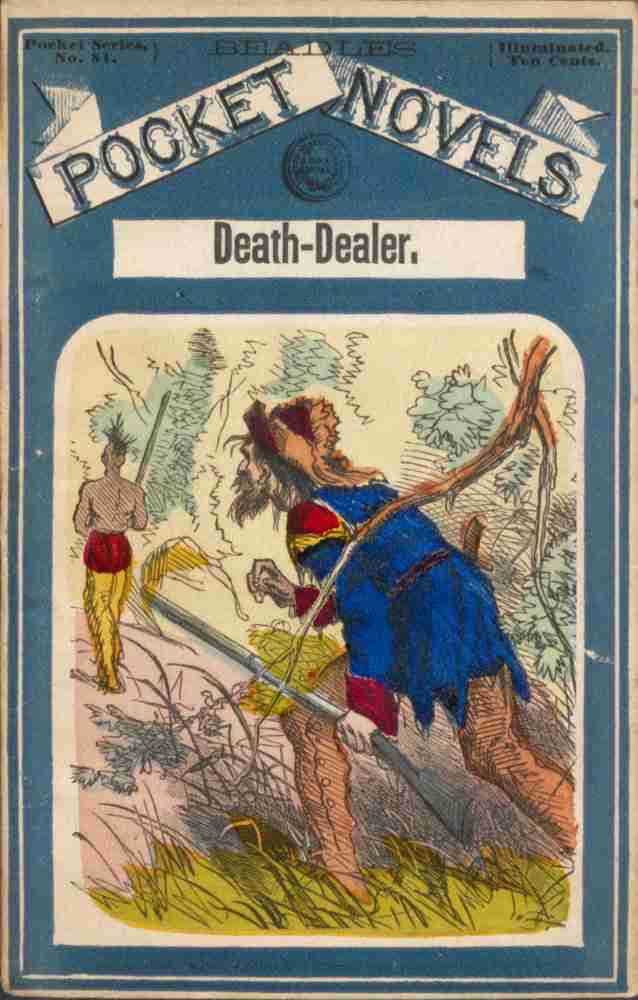
At that moment from some cause or another, a bright flame shot up from the smoldering embers, illuminating the scene about it.
It did not have the effect of awakening the surviving savages, but the next moment a voice exclaimed, in startling tones:
“Jerusalem and the Prophets! What in nater is going on here, I’d like to know!”
The voice was that of Peleg Parker, and so shrill was it, that it brought each of the surviving savages to his feet.
The scout saw his danger, and inwardly cursed the unlucky tongue of the Yankee. But with the rapidity of lightning he sprung upon the nearest warrior and plunged his knife into his heart.
With a howl the Indian fell backward to the earth, with the knife still in the wound, for the scout could not spare the time to withdraw it.
The next instant a tomahawk whistled past his head, so close that it seemed as though it had grazed the skin, but left him unharmed.
Quick as thought he brought his rifle to his shoulder and pulled the trigger.
Quick as his aim had been, it proved a true one, and the red-skin fell with a bullet through his brain.
One only of the seven was left, but at a glance he had taken in the fate of his comrades, and as if struck with horror and the certainty of his own death did he stay to do battle with the terrible Death-Dealer, he turned and fled.
A shout of exultation broke from the lips of the scout as he saw himself thus master of the field, and it was echoed in glad tones by the captives, who were thus assured of their deliverance from the hands of their enemies.
At this moment the moon which had risen some time before, now managed to throw a flood of silver light down through the branches overhead, so that the spot where the scout stood was brilliantly illuminated, and they were able to recognize him and to see the work he had performed.
“Thank Heaven, it is the scout!” cried Mrs. Wilson, as he advanced toward the spot where they stood, after he had assured himself that the fleeing savage meant to make them further trouble. “Oh, if Ruth was only with us now, how happy I should be. But, alas! I fear that I shall never see her more in this world.”
“And I guess you will if you only live long enough,” said the scout, as he cut the cords and set her free. “I’ll have the gal out of the clutches of Rushing Water afore I’m two days older, or else I shall never go for another red-skin.”
“God grant that you may!” exclaimed the parents and Ned in a breath.
“And I say amen to that,” said the Yankee. “But look here, mister, jest cut these ’tarnal strings, will ye? They’ve nigh about cut into the bone, I du believe.”
“You said amen afore you ought to jest now,” muttered the scout, as he paid his attention to the thongs that bound Ned. “You had ought to wait till you get through afore you call out. If you had done it a minute sooner you would have spoiled the whole.”
“Jerusalem and the Prophets, who could help it?” cried Peleg. “I should as quick have thought of seeing Satan himself there among the red-skins as you at that time. But du cut these ’tarnal bonds, will ye? I’m mighty anxious ’bout my pack thar. I’m afraid the varmints carried off something that belonged to me.”
“I guess thar didn’t more than one of ’em carry any thing a great ways. But I do believe that if the red-skins were a-scalping ye, you would want to save yer pack in some way; and I guess it is a darned sight more precious than your body. If it ain’t, it ain’t worth much.”
Despite the entreaties of the Yankee, he was the last one he freed from his bonds, and no sooner were his limbs at liberty than he started off at once for the spot where the pack was lying, so eager was he to be assured that nothing had been taken therefrom. There couldn’t have been very well, for his eyes had been upon the savages at the time they had been engaged in looking it over, though he had been obliged to hold his tongue for fear that he might lose his scalp.
The joy of the captives at their escape was great; but their hearts were sad when they thought of Ruth, who was being hurried along by her savage captor toward the lodges of his tribe, even if by this time they had not already arrived there.
In response to their inquiries, the scout told them of his motions since he had parted with them, which are already known to the reader, and then he demanded to know why it was that Rushing Water had separated them from Ruth.
In a few words they told him of their surprise and capture; of the death that threatened them, and how it was averted by the promise of Ruth, and also of the pledge the chief had given. But as they went onward toward the Indian village he seemed to repent of the promise he had made, and at last determined at least that they should not go thither. Neither would he set them at liberty, for fear that they might try to rescue Ruth.
They were almost sure that they heard him give orders for their destruction, and then Ruth was torn from them, and they went their respective ways.
Hope of escape they had none, for they thought that unaided, he would be powerless to afford them assistance, even if he had escaped, which they were by no means sure of. Aid they could expect in no other way, as they could do nothing of themselves, and hope had well-nigh deserted them.
While these several narrations had been going on the Yankee had carefully examined his pack, and now, with it upon his arm, he approached the spot where they were standing.
“The darned snips didn’t get any thing,” he said. “I ’spected nothing but what I was ruined when I see ’em afoul of it. I’m mighty glad they’ve gone under for they had no business to meddle with what didn’t belong to ’em.”
“I’m glad for your sake,” said Ned, trying, but not succeeding, in restraining the look of scorn upon his face, which the moonlight might reveal to the Yankee. “I’m glad it’s all right, for you seem to think more of it than you do of your life, or all of us put together.”
“Wal, I can’t say but what I do. In there is every darned cent I’m worth in the world, unless it is my part of the old rocky farm in New Hampshire. Thar’s about a hundred acres of that, but when the old folks drop off, it’s got to be divided between thirteen of us. Thar’s Stephen, Solomon, Daniel, Joshua—”
“Don’t go any further!” cried Ned. “I don’t wonder you want to keep your pack. Stick to it as long as you live, and I hope it will be the making of your fortune. But now, Dick, what is to be done? We’re wasting time here. I’m anxious to be at work.”
“So am I,” exclaimed Peleg. “I’m losing more’n a dollar a day. Thar ain’t any trade in any of ye, and I shall be glad when I get back, so that I can be earning an honest penny. I wish to gracious that I was in Smith’s Settlement this very minute.”
“So do I,” cried the scout, angrily, “or anywhere else where I should never hear that tongue of yours ag’in. Won’t you try if you can, and keep it still for five minutes?”
Peleg gave a low whistle and was silent.
“Yes, Ned, you are right,” said the scout. “We are losing time here. We’ve got now to find the other trail, and do our best to get the gal out of the clutches of Rushing Water. I ’spects we’ve got a ticklish job to do it, ’specially if he gets her to the village afore we come up with ’em. But we’ll do it, or the folks on the river sha’n’t see our faces ag’in.”
“I hope we may,” said Sam Wilson. “But I know that we’ve got no easy task before us. If she was only with us now, there is nothing in the world that I would not give.”
“Or I,” said Ned.
“But wishing won’t bring her here,” said the scout. “It will take strong blows like them I’ve give to-night to fetch her, and I wouldn’t wonder if as many more red-skins had to go under as you can see stretched out there. Rushing Water has set his mind upon the gal, and he’ll keep her if he can. But he’ll find trouble in doing it or I miss my guess. But there’s danger to the gal, too, that she don’t know of. That red gal, who has a claim on him, will do all she can to get her out of the way.”
Mrs. Wilson shuddered, and uttered a cry of grief and alarm, at these words of the scout. In the hurry and excitement of the last twenty-four hours she had forgotten this danger of which the scout had spoken, when he had first warned them of their danger. To save her from this they must rescue her before she should enter the lodge of the chief.
“What do you propose to do now?” asked Sam Wilson, anxiously.
“Start off at once, and hit the other trail as soon as we can. But I’m mighty ’fraid that we shall miss it, with only the moonlight to show it to us. If we do, nothing can be done till daylight, and by that time they will have got to the village.”
“Then let us start at once. Every moment we linger here makes the odds greater against us.”
“I’m ready,” replied the scout. “I wish, marm, that you were safe at the settlement, but you ain’t and so will have to go with us. But we will do our best to take care of ye. If the woods wa’n’t full of savages you and the peddler might try and get thar, but I’m afraid for ye to try it.”
“So am I,” said the Yankee. “But I’m losing money every step I follow ye round. This ’ere scrape will be the ruination of me as sure as preaching.”
The scout muttered something beneath his breath, the burden of which was, that he hoped it would, and then he turned to Sam Wilson and said, half-hesitatingly:
“I have half a mind that you leave Ruth to Ned and me, and make the best of your way with your wife and this fellow here to the settlements. If you kept a sharp look-out I think that you could do it, and perhaps it would be best all round in the end.”
“No; I can not go back and leave Ruth in the hands of these red-skins. I must do what I can to help to save her. Don’t ask me to do this. Lead the way on at once, and if we are of no service to you, we will be no drawback.”
“That we will not,” said Mrs. Wilson. “If I only had a weapon, I think I could strike a blow for her deliverance myself.”
“You may have one of my pistols, marm, if you want it,” said the Yankee. “I can’t use ’em both at once, and I’m always ready to oblige.”
No reply was made to this generous offer of Peleg. Hardly a dozen more words passed between them, and then the scout led the way again through the moonlit forest. The task of rescuing Ruth had begun.
CHAPTER X.
IN THE SHADOW OF DEATH.
Hope fairly abandoned the heart of Ruth when she was separated from her friends, and obliged to go on her way with Rushing Water with none of them beside her.
In vain it was that she had implored him not to separate her from them; to remember the promise he had made her, when they had fallen into his hands.
Her prayers and entreaties had no effect. He had promised, he said, that their lives should be spared them, and he had kept his word.
He had not said that they should remain in her company, and it was not his will that they should do so, any longer.
He wished for none but her whom he had chosen for his bride beside him, so he had sent the others away.
A terrible fear took possession of her mind that he had sent them apart to take their lives, that it might not be done before her very eyes.
Filled thus with terror and despair, she went onward, while every step her strength seemed to fail her, while her heart lay like lead in her bosom.
Through the rest of the day until night came on, she managed to keep her feet, but when the shadows gathered thick in the forest she sunk down upon the earth and declared that she could go no further.
A short halt was made here, in which some food was prepared and offered her; but she could not eat a mouthful.
It seemed to her that it would have choked her, but she attempted to swallow a morsel.
Finding that it was in vain to urge her to do so further and seeing also that she was unable to proceed of herself, the chief raised her in his own strong arms, and again they went forward.
He would not feel sure of his bride until he had her in his own lodge and among his own people.
So long as they were in the forest, there was a chance that she might be wrested from him.
He knew and feared the Death-Dealer, and it was in part to mislead him that he had divided the party.
He knew that the dreaded scout was a host in himself, and that his deadly blows fell ofttimes where and when they were the least expected by his enemies.
Once among his own people and in the heart of their village, he felt that he would be safe from him, and that there would be no one who could wrest his chosen bride from him.
So all through the first hours of the night he hurried onward. The moon rose and climbed high into the heavens and when it had reached the zenith, the village was gained, and with his almost unconscious burden in his arms he stood before his lodge.
No human being save his companions were stirring about him, and with a word he sent them to their several lodges, and then lifting the skin that hung in the doorway he bore Ruth within his own.
A lamp of rude construction, swinging from the roof, and which emitted a pale light, half dispelled, half revealed the darkness which filled the lodge.
Squatted almost beneath it, and apparently buried in slumber, though gently swaying back and forth, was an old Indian woman; Nekomis by name, who for many moons had kept the lodge of the chief and prepared his food, when he was not absent in the chase or upon the war-path.
Approaching a couch which lay in one corner of the apartment, the chief placed his almost unconscious burden upon it, and then stepping to the side of the Indian woman he said, as he touched her upon the shoulder:
“The fingers of sleep must be heavy upon the eyes of Nekomis, that she hears not the footsteps of the chief when he comes. Let her awake, for he has need of her.”
The old squaw awoke with a start and staggered to her feet.
“You were sleeping soundly, good Nekomis,” he said. “But wake. The chief has work for you to do.”
“The spirit of sleep was heavy upon the eyelids of Nekomis, and her ears were dull that she heard not the footsteps of Rushing Water. But she is awake now and ready to do his bidding. There is plenty of maize and venison in the lodge and it shall soon be ready so that the chief may break his fast.”
“Rushing Water is not hungry. It’s not to prepare him food that he has roused Nekomis from her sleep. It is that she may care for his pale-face bride whom he has brought hither.”
The old Indian woman gave a great start, and her eyes followed the direction of his outstretched hand, as he pointed toward the couch upon which Ruth lay. He did not see her features as her eyes rested upon the form of the girl. If he had he would have seen a look of most malignant hate resting there, which could not help having awoke suspicions and alarm in his breast, and made him fearful for the life of her upon whom he had set his affections.
She did not speak, but stood with her eyes fixed upon Ruth, as motionless as a statue.
Again the words of the chief fell but half heeded upon her ear.
“Let Nekomis wait upon her, and see that she has every wish. Let her watch by her side until the morning comes. Let her stir not from the lodge, for she must answer for the maiden with her life.”
Again that look of hate came over the face of the Indian woman. But it was gone in a moment as she answered:
“Nekomis will watch and care for her well. When the chief comes in the morning he shall find her here.”
“It is well,” answered the chief. “The eyes of Rushing Water are heavy for want of sleep. He will lie down in the outer room till the sunlight comes again. The couch of Nekomis will to-night be as soft to him as his own.”
He lifted the curtain which connected the two apartments, and passing out, let it fall behind him. It was the one usually occupied by old Nekomis, and throwing himself upon the couch it contained, he was soon buried in slumber.
The old Indian woman stood where he had left her in the main apartment. Her eyes were fixed upon the form of Ruth, and she never stirred in her tracks more than though she had been made of stone. But a fierce emotion shook her frame, and it was evident that she was laboring under great excitement. But the look upon her face as her eyes rested upon the form of Ruth, told plainer than words could have done the terrible hate with which she regarded her.
At length she turned her face away, and muttered to herself so low that it would have been impossible for her words to have reached the ears of Ruth, even had she been trying to have caught the burden of them.
“The pale-face bride of the chief must die. Before the light of the morning sun, she must be in the spirit-land. Never will Nekomis see her in the lodge of the chief. Minora is the bride the tribe has chosen for him, and none other shall take her place. She is of the same blood of Nekomis, and she shall never stand aside for one of a hated race. She has willed it to be so, and the great Medicine of the Rocks has furnished the deadly draught. Before the morning light, the pale-face maiden shall have taken it, and shall lay yonder, as pale and white as the winter’s snow.”
The deadly light in her eyes grew brighter as she muttered this to herself. Evidently she rejoiced in the work of death and vengeance she had before her.
Glancing about again toward her victim, she saw that Ruth had rallied from the stupor which she had seemed to be in, and was now glancing about the lodge as though in search of some one.
It might have been the chief she missed, and she waited for her to speak if she would.
At length her eyes became fixed upon her, and she could see that she was gazing upon her curiously.
As though emboldened by the sight of one of her own sex, Ruth raised her hand and motioned for her to approach.
She obeyed her, and approaching the couch she squatted down by her side.
“Where am I?” said Ruth, with wild eyes, as though she hardly comprehended her situation.
“The pale-face maiden is in the lodge of the great chief. Rushing Water has sought her in her home, and brought her hither to be his bride.”
Ruth covered her face with her hands. She remembered all now. What upon her first awaking from the sort of swoon that oppressed her, had seemed a dream, was reality now. She was hopelessly in the hands of her enemy.
She was silent for a few moments, and then hope whispered again to her heart. Was it not possible that she might escape him even now? Would not her companion listen to her entreaties, and being melted thereby, help her to escape? The hope was a faint one, but there could be no harm in trying. If it amounted to nothing, her situation would be no worse than it was now.
Turning eagerly to the old woman, she said, as she laid her hand upon the brown and wrinkled one of her companion:
“The Indian woman likes not the pale-faces. That the white maiden can see in her eyes. She had rather that the chief of the tribe would bring to his lodge one of his own race. It is only right that she should. Let her help the white maiden to fly. She wishes not to mate with the chief. There is one among her own people to whom she has given her heart. Have mercy and save me from the fate Rushing Water has in store for me.”
This appeal she had uttered in a low but earnest tone, as though she was fearful that the sound of her voice might reach the ears of the chief, and now that she was through she gazed up with such an appealing look into the face of her companion that it would seem that none but a heart of stone could resist it.
But it had no effect upon the heart of the wrinkled squaw. She knew that there was no way for her to escape the fate she dreaded, except by that to which she had doomed her. Death would relieve her from it, and that alone. Had she been so disposed she could not have assisted her to escape. The eyes of the chief would have been upon their movement and he would have brought her back, while she would have been doomed to death for her treachery. No. There was only one way by which Rushing Water could be foiled in his purpose, and that was that the white maiden should die.
“Nekomis has heard the words of the white maiden. She has spoken the truth. The Indian woman does not like the pale-faces. Their heart is black and evil is in their thoughts. She would see them scalped and their lodges burned above their heads.”
So fierce was her looks, and so wild her gestures, that Ruth almost drew back in alarm. But she was glad it was so, for perhaps now she would help her. The Indian woman noticed her start of alarm and she softened a little in her speech.
“The chief has chosen a pale-face for his bride, but the tribe like it not. There are maidens fairer among them, than she. If she were gone, the heart of Rushing Water might turn again to them.”
“The words of the Indian woman are those of truth,” exclaimed Ruth, hopefully. “Help me to escape and all may be well.”
“The eyes of Rushing Water are sharp, and his ears are open to the slightest sound. His anger is like the tempest when it is abroad in the forest, and nothing can withstand its fury. But let the white maiden content herself. She shall never become the bride of the chief.”
Could Ruth have seen the malevolent look that was upon the face of her companion at this moment, she would have been struck with horror. But her face was averted, and she thought only of the promise her words implied. The hope so faint within her grew stronger, and she exclaimed excitedly:
“Heaven bless you for your words,” she said. “But let us lose not a moment’s time. Let us flee from this spot while we can.”
“The pale-face maiden can not stir forth to-night. Morning will come too soon, and the chief would be upon her track. When all is well, Nekomis will do what she can for her.”
Though disappointed, Ruth would fain accept this promise. The Indian woman alone could help her now, and she must cling to her, and the hope she gave her, and wait until such time as she should set for her to try for her escape.
“Let the white maiden seek slumber now. She needs it to make her strong. Nekomis will watch by her side and see that no harm shall come to her.”
Ruth sunk down wearily.
“I must trust you,” she said. “I do need sleep, and will try to seek it. But first give me some water. I am very thirsty.”
The old woman arose and turned away from the couch. The moment for which she had waited, had come. The fatal draught which the Wizard had prepared could be given now.
Her hand trembled as she took the vessel that contained it, and brought it forward to the couch. Ruth rose up and took it from her hand. Her mouth was parched and dry, and she drained it eagerly to the very dregs. Could she but have seen the look upon the face of the Indian woman she would have dropped it as a thing of death. A look so exultant, and so full of gratified rage would have struck terror to her very soul.
But she saw it not; handing back the vessel to her attendant, she sunk down again upon the couch, where she lay as motionless as one dead.
Not once thereafter did she move so much as a hand; but sunk into a deep, unbroken slumber, from which no sound or word could have awakened her. The old Indian woman sat by her side with her sharp, snake-like eyes fixed upon her face. Little by little her breath grew fainter, until at last it seemed to have left forever her pallid lips. The fatal draught had done its work, and she lay as cold and motionless as though formed of ice.
Then with an exultant look upon her face, the Indian woman arose, and with noiseless steps glided forth from the lodge.
CHAPTER XI.
WHAT WILL HE DO WITH HER?
Once out into the night, she hurried to another lodge standing but a short distance away. Arrived at the entrance she lifted the curtain and entered without ceremony.
It was so dark within that she could see but little; but she appeared to be familiar with the way, and a few steps brought her to the side of a couch upon which the dim outlines of a form could be seen lying.
Stooping down she whispered a single word: “Minora.”
In an instant the Indian girl was upon her feet confronting her.
“Has the white maiden come?” she demanded.
“The pale-face maiden is lying this moment in the lodge of Rushing Water.”
“When did she come?”
“Only a little ago.”
“She has come to her death. She must not see the light of the morning’s sun. Far better for her that she had died beneath the knife with kindred. Let the fatal draught be given her at once.”
“The hand of Nekomis has already held it to her lips, and she has drained it to the very bottom.”
“The heart of Minora is glad. She will soon be in the spirit-land.”
“She is there already. Even now she is lying on the couch of the chief, as pale and cold as the snow in winter.”
“Nekomis has done her work well. Minora will not forget what she owes to her when she goes to live in the lodge of the chief. Does Rushing Water know that the white maiden has left him forever?”
“No. He’s dreaming of her now in his sleep. He must not know it until the Wizard is told, and has come hither. Minora remembers the words he said. Let her fly to his home among the rocks and tell him that the white maiden is dead.”
“Minora will go like the wind. Her heart is light now, and her feet will be as fleet as those of the deer. In a little time she shall dwell in the lodge of the chief where she has long wished to be.”
The two women passed out into the night, and while Nekomis returned to watch by the side of her lifeless charge, Minora sped away through the forest toward the dwelling-place of the Wizard among the rocks.
Her footsteps in due time brought her to the abode of the Wizard, and the sentinel owl at once gave notice of her approach. No one that ever visited the Wizard, be it by night or day, ever found him asleep, and the Indian girl descried him standing at the entrance of his cavern as though he had not stirred from the spot since her last visit to the place.
She saluted him with profound reverence and then waited for him to speak.
“What has brought the Red Rose to the dwelling-place of the Medicine? Has any of the tribe need of his skill to-night?”
“The Red Rose has come because the great Medicine bade her do so when she could bring tidings of the pale-face maiden.”
“And can she to-night?” asked the Wizard, hurriedly.
“The Red Rose has said as much. The pale-face maiden lies in the lodge of Rushing Water.”
“Has the fatal draught been given her?” he demanded, quickly.
“Nekomis gave it to her with her own hand. The white maiden drank it to the dregs and she now lies cold in death upon the couch of the chief.”
“And does Rushing Water know that he has been robbed of his bride?”
“No. The chief sleeps a deep sleep and will not wake until the rays of the sun are again streaming through the forest. He gave the pale-face maiden to the charge of Nekomis and bade her watch her through the night.”
The Wizard was silent for a moment and then he spoke out hastily:
“Let the Red Rose return at once and say to Nekomis, as soon as the darkness has fled away let her call the chief to the couch of the white maiden, that he may see that her spirit has fled to the Shadowy Land. Let her tell him that she knew nothing of her illness till she saw her lying dead; but supposed that a heavy sleep was upon her. Then will the chief want the Medicine, and he will be close at hand so that he will not have to send hither for him. When the Red Rose has told Nekomis this, let her go to her own lodge. The chief must not know that she has been abroad to-night, or he may think she has had a hand in this.”
“The ears of the Red Rose have heard, and her fleet footsteps shall carry the message to Nekomis.”
She turned at once and bounded away through the forest, anxious to reach the village before the day should begin to break.
The gray light of the morning had begun to show in the east when she summoned Nekomis from her watch beside the couch of the dead.
Hastily telling her the message the Wizard had sent, she retreated to her own lodge, fearful that the chief might awake and find her there.
Nekomis went back to her place beside the couch and looked upon the pallid face of her victim once. Then she turned away, and lifting the curtain that divided the two apartments, she stood beside the still sleeping chief.
Only for a moment did she hesitate to awaken him, and then she touched him on the face, speaking his name at the same moment.
He awoke with a start, and in a moment was upon his feet, while an anxious look took its place upon his countenance.
“What is it that Nekomis wishes?” he said. “No harm has come to the pale-face maiden, for if there has she shall pay for it with her life.”
“Let the chief come out and look upon her. Nekomis thinks that her heart is broken, and that her life has fled away to the spirit-land. She did think that her eyes were closed in slumber, until the light of the morning came, and showed her as pale and cold as the sun when the winter is here.”
Pushing her aside with a force that almost sent her from her feet, the chief sprung into the apartment and to the couch on which lay the lifeless form of her who was so dear to him, and upon whom he had set the highest wish of his heart. One glance at her pallid face told him that Nekomis was not mistaken. Kneeling down by her side he felt that there was no sign of life there. The prize that had cost him so much to obtain, had slipped through his hands when he thought he had it surely in his grasp.
Springing to his feet again, he drew his knife and turned it threateningly upon Nekomis.
“You let her die,” he said, “and you shall follow her to the spirit-land. Had you watched her as the panther does its young, you would have seen when the death-sleep began to grow upon her. But you did not, and now the worthless life of an old squaw shall follow hers.”
Nekomis folded her hands upon her breast and gazed without fear upon him.
“Nekomis is ready to die,” she said. “But let the chief make haste to send her to the spirit-land. Then he can send for the great Medicine, who, it may be, can bring her back to life.”
The hand that held the weapon fell down to his side.
“The great Medicine shall come,” he said. “Nekomis shall live until he has done his best to bring her back to life. If he can not she shall die then.”
He rushed forth from the lodge, and sped away toward the edge of the forest in the direction of the Wizard’s dwelling-place. But he had not gone far before to his joy he saw the Medicine coming toward the village. In a moment he was at his side urging him to hasten his footsteps.
In answer to his inquiries, he told him the state of affairs, and then eagerly demanded if there was a chance to hope.
“The Great Spirit holds the life of the red-man and the white in his hand, and he calleth them away whenever he chooses. The Medicine will do all that he can to bring the pale-face maiden back to life. He knows many charms that work well, and it may be that he can save her. But if the Great Spirit hath taken her away the Medicine can avail her nothing.”
They found Nekomis at the side of the couch when they entered, and she stepped back at their approach. Had the chief been less excited he might have noticed a look of intelligence which passed between them. But he did not, and the Medicine approached and bent above the form of his victim.
For the space of two minutes there was a breathless silence within the lodge.
Then the Wizard straightened up and looked into the face of the chief.
“The Medicine is not sure, but he thinks that the life of the pale-face maiden has gone to the spirit-land. If he had her in his cavern among the rocks he might work some charms upon her that might bring her back to life. The way thither is long, but if the chief will bear her there, he will do his best.”
“The arms of Rushing Water are strong and his steps are fleet. He will bear her to the home of the Great Medicine, if he will do what he can to restore her to him again. The warriors are not yet astir, and it may be well that the tribe knows not of this. Nekomis will keep the secret, or the knife of the chief will find a way to make her do it.”
He gazed threateningly at her as he said this, and then stooping down he raised the form of Ruth in his arms. He shuddered as her lifeless form touched his breast, and then he bore his burden out into the morning air.
There was indeed no one stirring as yet about the village, and they were enabled to gain the cover of the forest without being observed. Thence onward they went as fast as they were able, and by the time the sun was an hour high, they stood before the huge pile of stone that marked the home of the Wizard.
The foot of no savage save his own had ever crossed the threshold, and the chief looked into his face as though to ask if he would be allowed to bear his burden in, and thereby catch a glimpse of its mysteries. But this he evidently would not admit for he held out his arms, saying:
“Let the chief give the pale-face maiden into the keeping of the Medicine. He will work his strongest charms and do all that he can to bring her back to life. Let him come hither on the morrow at this time, and he shall know whether the Great Spirit has claimed her for his own.”
He took the cold and rigid form of Ruth in his arms, and the chief watched him until he had disappeared within the rocks. Then he turned his back upon the spot, and bent his steps once more toward the village.
CHAPTER XII.
WINDING UP THE WEB.
Let us now return to the scout and his companions, and see how it has fared with them since we parted company at the spot where Dick had dealt the blows which delivered his friends from the savages.
The reader will remember that they had turned their backs upon this place; and had set out to endeavor to find the other trail in the moonlight, in the hopes of following it on, and overtaking Rushing Water before he could reach the Indian village with his captive.
But that they had not succeeded in coming up with them, the reader already knows, for he has seen what passed in the lodge after they had gained it.
Aided by the moonlight, Dick had struck the trail without much difficulty, and they had followed on, as fast as they could under the circumstances.
But the chief and his companions were so far in advance that they stood no show of coming up with them.
In fact the night was far gone when they drew near the Indian village.
Long before they reached this point, the scout had become satisfied that they were too late, and that if they accomplished their object they had got to do it under more difficulties than had yet beset them.
They had got to penetrate into the very lodge of Rushing Water, which stood perhaps in the very heart of the village.
There would not be time to accomplish this to-night, even if it could be done successfully.
They must lie quiet somewhere in the depth of the forest and wait until the darkness of another night.
They followed the trail almost to the verge of the village, so impatient were his companions to rescue Ruth if the thing lay in their power; and then convinced that it did not, in the remaining hours of that night at least, they were ready to comply with what the scout had to propose.
This was that they should retire back from the village for something like a mile and lie through the day in some darksome covert, where there would be little likelihood of their being discovered by the savages.
This plan was now carried into effect and by the time the day had fairly broke they were snugly ensconced in their hiding-place.
The sun rose above the tree-tops, giving promise of a beautiful day, and over and over again did they wish that Ruth was with them that they might be hurrying toward a place of safety instead of lying idly there.
Fears that she would never be restored to them oppressed the heart of the mother. The chief had her now securely in his power and how were they ever to tear her from his clutches?
It seemed impossible to her that so few of them could do it.
Yet they were determined to accomplish the task before them, or lose their lives in the attempt.
The scout knew that it could not be done by mere strength of arms alone; but more than once had he accomplished his ends by outwitting the savages and he meant to succeed in this way now.
Slowly the minutes went on and higher and higher the sun rose up into the cloudless sky.
Suddenly the sound of a footstep struck upon the watchful ear of the scout.
Glancing hastily out from their hiding-place, he saw a savage slowly advancing toward the spot where they lay.
He did not seem to be seeking for any trail; but his head was bowed and his eyes fixed upon the earth as though some grave subject occupied his mind.
Sam Wilson’s gaze fell upon him a moment after, and as it did so he gave a great start.
“It is Rushing Water,” he exclaimed in surprise. “Where is Ruth? What could he have done with her?”
“You are right,” exclaimed the scout in a whisper. “It is the chief himself. Now, boys, he must not leave us alive; but we must get him into our hands unharmed, if the thing can be done. When he is close to us we must spring out upon him. If we can get hold on him we are all right. Stand by me, and I guess there is enough of us here to match any savage that ever burned a cabin.”
Slowly the savage came on, apparently in deep thought, and unconscious of all that was passing around him. They could see a look upon his face that told something pained and troubled him.
Nearer and nearer he came, and at last the instant arrived for them to act.
Noiselessly they crept forth from their hiding-place and approached their intended victim.
Had he raised his eyes he must have seen them, but he did not.
With a spring like that of a panther the scout bounded upon him, and his enemies followed his example.
The struggle was a short one.
With the odds against him, and taken thus by surprise, the chief could make but slight resistance.
In a minute’s time he was thrown to the earth and his hands and feet firmly secured with strong thongs which the scout produced from about his person.
Not a word did the scout utter until this was accomplished, and the wily savage lay a helpless prisoner before them.
Then with his knife held menacingly above his breast, the scout demanded, while the rest of the party with eager looks gathered about them:
“Where is the pale-face maiden? Speak! and let your words be true ones, or you die at once.”
“Rushing Water is not afraid to die. The words of the Death-Dealer can not frighten him. He will speak the same as though they were not sounding in his ears. The Death-Dealer is a great warrior, but the chief is not a squaw that he should be afraid of his words.”
Mrs. Wilson knelt down by his side and cried, appealingly:
“Where is my daughter? Tell me that she is unharmed, and restore her again to my arms, and no harm shall come to you. Only give her back to us, and we will forgive you the loss of our home, and all else that you have done to us.”
“The pale-face mother can not have her child again. The chief has not the power to give her again into her arms if he would. The Great Spirit has called her home.”
“Oh, Heaven!” cried the agonized mother. “You do not mean to say that she is dead? that you have killed her?”
Ned Tapley drew his knife, and with a face as pale as death, would have sprung forward and plunged it into the heart of the savage, had not the strong arm of the scout held him back.
“Let him speak, youngster,” he said. “If he has harmed so much as a hair of her head, we will have vengeance.”
“The white maiden did not die by my hand,” said the chief, calmly. “The Great Spirit himself called her home. When the daylight came, she lay upon her couch as white and cold as the snow of winter. The Great Spirit himself knows that Rushing Water harmed her not.”
A wail of agony broke from the lips of the parents, and Mrs. Wilson staggered and would have fallen to the earth had not her husband supported her.
“But you killed her as surely as though your hand had plunged a knife into her heart, and for this you shall die!” cried Ned, as he made another effort to deal the helpless savage a blow with his knife. But this he was again prevented from doing by the scout, who exclaimed:
“But where is the white maiden lying now? We would look upon her, that we may know that your words are not lying ones.”
“The form of the White Rose lies in the cavern of the great Medicine, beneath the rocks. Rushing Water has carried her there to see if she can not be brought back to life.”
“I know the spot,” cried the scout. “Let us go there at once, and see whether this red-skin is lying or not. He’s bound so securely that he cannot escape us, and we shall find him here when we come back. Let him live till then, that we may know how to deal with him. If by his means Ruth has died, a dozen deaths would not be enough for him.”
Ned was the last to assent to this. He was fearful that in some way the chief might escape him. But he agreed to it at last, after he had seen the savage gagged, so that it was impossible for him to call any one to his assistance.
With hearts oppressed by sorrow and grief they hurried away toward the dwelling-place of the Wizard. Arrived there, they found that his brute sentinel had given notice of their approach, and that he was standing in his accustomed place to receive them.
His astonishment was great when he saw who his visitors were, and their errand he divined at once, before the scout could open his lips.
“The pale-faces have come for the white maiden,” he said. “It is well. The Medicine is glad to see them. When the sun is half-way home in the sky, she shall go with them.”
A cry of joy and gladness broke from the lips of all.
“Thank God! my child is then alive,” cried Mrs. Wilson, in a tone of joyous thankfulness.
“The white maiden lives, but her strength has not come back to her yet. But let the pale-faces enter so that the eyes of the red-men may not see them. Then the Medicine will tell them all.”
They followed him into a sort of outer cavern, which was partly illuminated by a small fire that was burning in one corner. Another passage led further into the rocks, but thither they were forbidden to go. A panther sat therein as though to guard the mysteries that lay beyond, and who growled savagely at this unwonted intrusion, while perched upon a projecting point of rock over his head was a huge owl who looked down upon them with his great staring eyes, and who ruffled its feathers as though it, too, did not like the appearance of the strangers.
At a word from the Wizard, his companions were mute and motionless; and then he turned toward a couch in one corner, which, owing to the darkness, they had not perceived until this moment.
Stretched thereon was the form of Ruth, and no sooner did Mrs. Wilson behold it, than she sprung forward and clasped it in her arms.
“Ruth, my Ruth!” she cried. “Speak to me.”
“Mother,” said the girl, faintly. “Oh, I am so glad that you have come,” and she twined her arms about her neck.
Each one of the party now presented themselves, and a scene of joyous greeting followed that our pen can not describe.
“How is this?” demanded the scout, turning upon the Wizard. “With my own ears I heard you promise the Indian girl that little Ruth here should die, should Rushing Water bring her to his lodge.”
“And so she has to them,” answered the Wizard. “I worked for the good of my people and that of the pale-faces at the same time. I knew that the red-men wanted not the chief to take a pale-face for a bride; but he was so set upon it that he would have his own will. I prepared a potion for her, that I knew would make her seem as though the Great Spirit had called her home. Nekomis, the old woman that cares for the lodge of the chief, gave it to her, and then called upon him to look upon his dead bride. He was well-nigh stricken with grief, and came for me to try to restore her to life. I had her brought hither, and when he had gone, not to return until the morrow, I gave her another potion which restored her to life. In a little while she will be as strong as ever again, and then you must fly with her, before the chief comes.”
“Jerusalem! I guess that won’t be till somebody lets him loose,” exclaimed the Yankee, who had been staring about him with all his eyes, and who for a wonder had maintained silence until this.
“What does the pale-face mean?” demanded the Wizard. “The white warriors have not harmed him?”
In a few words the scout told him of the condition in which they had left the chief, and then added, that he desired the Wizard to set him free when it could be done in safety to themselves.
“The white warriors have done well,” he said. “The Medicine will see to him. The white maiden shall be as dead to him, and by and by he will wed with Minora, the Red Rose of the tribe, and happiness will come to his lodge again.”
“Wal, I swan you’ve got a long head on yer shoulders,” exclaimed the Yankee. “You’ve planned matters pretty shrewd, I’ll be darned if you ain’t. But, say, how’ll you trade that owl of your’n for some of the notions in my pack? I should like to have him stuffed, and kerry him home as a sort of trophy of this ’ere scrape.”
This proposition for a trade, on the part of Peleg, the Wizard declined, and he now turned his attention to the further recovery of Ruth; and so successful was he that in a couple of hours her strength was in a great measure restored to her, and she declared that she was able to commence her homeward journey at any time, when they were ready to depart. This they were glad to do at once, and taking leave of the Wizard, with many thanks on their part for his kind offices, they went forth from the cavern, and set their faces once more toward the settlement.
An hour after their departure, the Wizard stood by the side of the captive chief. He had no difficulty in finding the spot, for the scout had described it so that he could not miss it. He looked up in the face of the Medicine as he cut the bonds that held him, mutely asking the question, the answer he so much feared to hear.
“The white maiden is gone, and none of the arts of the Medicine can bring her back,” he said, simply.
“And the pale-faces, her friends—where are they?”
“Bearing her back to their home that the chief made desolate, that she may be near them.”