
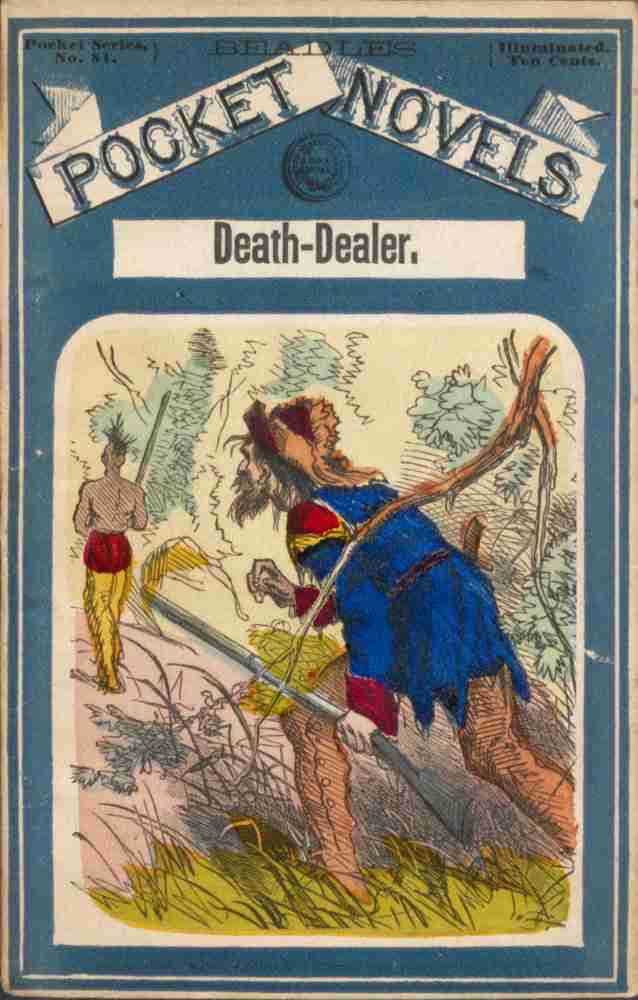
He was moving slowly forward, half-bent to the earth, seeking for their trail.
A better chance for a shot a man never had; and remembering the injunction of the scout, he raised his rifle and took deliberate aim upon the savage.
The next instant he pulled the trigger, and the sharp report of his rifle startled the echoes of the forest while the bullet sped on its deadly work.
It did it well, for the savage gave a leap into the air, and then fell forward to the earth, where he lay as motionless as a log.
Another instant, and a second report mingled its echoes with that of the first.
The eyes of the scout had singled out another enemy, and another bullet had sped forth on its deadly mission.
But an exclamation of chagrin fell from his lips a moment after.
“I believe I’ve missed him. What’s the matter with you, Susannah? But like’s not the fault’s in me. He was some ways off and the moonbeams danced so that I wa’n’t over sure of my aim. But I’ll have him yet. It won’t do to let him bring the rest of ’em here. Keep on arter the rest of ’em, youngster. I’ll be back in a minute.”
Hastily reloading his rifle he sprung in the direction of the spot where he had seen the savage, leaving Ned standing in his tracks putting another charge into his rifle.
When he neared the spot where the savage had stood, he found that it was untenanted.
But a glance upon the earth told him that his shot had not been so poor a one as he had thought.
The leaves were covered with blood, telling that he had wounded him.
As he saw this he felt better in his mind.
It was seldom he missed an object he took aim upon, and he was fearful he was losing his art.
“He bleeds like a stuck bison,” he muttered, to himself. “He can’t have gone a great ways. I’ll make sure of him anyway.”
A bloody trail led away from the spot, and along this he hurried.
For some twenty rods he had no difficulty in keeping it, and then the moon went under a cloud and he was at fault.
Impatiently he stood still, waiting for it to show its face again.
Five, ten minutes passed, and it gave no symptoms of doing so.
He began to grow impatient, and to think if he had not better turn back and rejoin his friends, and hurry them onward as fast as possible.
“Let him go,” he muttered, to himself. “I guess he’s done for, so he won’t trouble us again. But I would like to have made sure of him.”
He gave one more glance up to the clouded sky, and then along the way the wounded savage had gone. Then he turned upon his heel and set his face once more in the direction of the spot where he had left the fugitives.
But he had not taken ten steps in that direction before he gave a sudden start and then stood as though rooted to the spot.
As well he might, in the alarm and surprise he felt.
A fierce war-whoop, breaking as from a score of throats, resounded through the arches of the forest.
It came from the direction of the very spot where he supposed his friends must now be.
The next moment he had sufficient proof that in this he was not mistaken.
A wild cry of terror and alarm, followed the shout of the savages, and then the report of a rifle, and soon after, that of a pistol.
The cry came from the lips of Mrs. Wilson and Ruth, and the shots must be fired by the settler and the Yankee.
The main body of the red-skins must have passed on before so noiselessly that they had not been observed, and these had lain in wait for the fugitives, who, all unsuspicious of danger in that direction, had walked directly into the ambush thus prepared for them.
For only a moment did the scout stand riveted to the earth, as though turned to stone by the knowledge of the fearful danger his friends were in.
The next, he had shot forward as straight as an arrow from a bow, directly for the spot from whence the tumult arose.
He heard the report of another rifle, which he doubted not was that of Ned, and then two or three in quick succession, which he thought must doubtless be in the hands of some of the savages.
The tumult continued until he was almost to the spot from whence it came, and then it suddenly ceased.
“What could this mean?” he asked of himself, as he came to a sudden halt.
Could it be that the red-skins had slain them all thus quickly?
A fear took hold upon his heart that this was so.
A moment more and his fear was confirmed. Another war-whoop rung out, and went echoing away through the forest-aisles.
It was a shout of triumph.
There was no mistaking that.
It told the scout so, plainer than words could have done.
His worst fears were realized.
All the trouble and fatigue they had undergone that night had been for naught. Their bright hopes of escape were at an end.
Rushing Water had secured the prize he coveted, and a worse fate than that of death was in store for Ruth.
Still, it might be death after all, for had not the Indian girl made a league with the Wizard to accomplish that end?
All these thoughts ran quickly through his mind as he stood there uncertain what to do.
In times gone by he had accomplished much with fearful odds against him; but what could his unaided arm do now against so many?
Perhaps all his friends but Ruth had fallen; but if they had, he would not abandon her. So long as she lived he would work for her deliverance.
But he would not take that shout of triumph as evidence that all was lost.
Something might be done yet, and he would see with his own eyes how matters stood.
So he passed slowly onward, keeping a sharp look-out for the enemy.
The moon and clouds favored him, for no ray of light shot down into the forest.
Noiselessly and with the utmost caution he crept onward, until at last he was close to the spot from whence the various sounds had come.
At that moment the moon broke forth from behind the clouds with a splendor almost like that of the sun.
Hardly a dozen yards before him, he beheld a number of figures clustered together.
By sight he could not tell whether they were all savages or not; but he heard the voice of a woman weeping as though in the depths of despair. But he was not destined to gaze long upon the scene! Hardly had he taken it in, when an arrow, whizzing close to his head, told him that he was discovered.
He gave one of the savages the contents of his rifle, and then turned and fled, muttering, as he did so:
“I’ll leave ye now; but the Death-Dealer ain’t done with ye yet. He’ll ye pay dearly for this night’s work.”
CHAPTER VII.
THE MAIDEN’S DOOM.
We will now go back for a few minutes, and note how it was that Ruth and her friends fell into the clutches of the savages.
It will be remembered that the scout told them to move slowly onward in the direction they were going; while he and Ned Tapley attended to the savages whom he had seen hanging in their rear.
These orders they had obeyed, keeping a sharp look-out about them for danger, until the moment when they had been startled by the shots fired by their friends behind them.
Ruth, in spite of herself, uttered a cry of terror at the sound, fearful that one of the reports might announce the death of her lover.
“Hush!” exclaimed her father, warningly. “Be calm, Ruth. You know that Dick warned us not to speak above our breath.”
They were passing now through a little thicket of evergreens, whose branches were so thick above their heads that the rays of moonlight could not penetrate to the earth.
It was as good a place as the savages could have selected for an ambush; but that there was really danger there, not one of them suspected.
That, they were looking for in their rear, where the rifle-shots told them that their friends had already encountered it.
Suddenly the settler, who was leading the way, recoiled as though he had received a blow.
As if by magic, a savage sprung up before him, directly in his path.
The next instant a cry of fear broke from the lips of his wife and daughter.
On either side the forms of a half-dozen savages sprung up so close to them that they could almost have touched them by reaching out their hands.
Unmindful of the hopelessness of their situation, the settler raised his rifle and discharged it at the breast of the savage before him.
But the bullet went wide of its mark, for as he pulled the trigger, a savage upon his right caught hold upon it, and attempted to wrest it from his grasp.
But this he did not succeed in doing, and pulling it from the clutches of the savage, the settler brought it down with such force upon his head as to stretch him senseless upon the earth.
Another savage had sprung upon Peleg Parker, and with one hand had grasped his pack on his back, while the other he entwined in his long hair, and attempted to pull him to the earth.
But the Yankee had no notion of parting with the former, even if he lost his hair, and drawing a pistol he endeavored to shoot down his opponent. But by some mischance it exploded, before he had taken aim, and throwing it to the earth he had recourse to his fist.
“Take that, you thieving varmint!” he cried, as he dealt him a blow between the eyes, that would have felled an ox; “I’ll l’arn ye how to hanker arter other people’s property.”
The savage went down like a log, but he had so good a hold in the hair of the Yankee that he took him along with him, and they both rolled upon the earth together.
Peleg struggled hard to rise; but before he could do so another savage was firmly planted upon his breast.
Meanwhile Sam Wilson had been assaulted by three or four of the enemy and was at last borne to the earth; and one of them, catching him by the hair, circled his scalping-knife above his head as though he would rob his victim of his scalp, even before he took his life.
But, with a cry for mercy, Ruth threw herself beside the savage, and implored him not to do the fatal deed.
“Take my life, if you will,” she cried, “but spare my father. He has never harmed a red-man, and do not have his blood upon your hands.”
It was Rushing Water himself to whom she appealed, though she did not recognize him in the darkness.
“And what will the white maiden give if no harm shall be done to her friends?” he said, in a low tone.
Ruth felt a ray of hope steal into her heart at these words.
“Any thing she has,” she replied. “If Rushing Water has not a heart of stone, let no harm be done to any.”
“The will of the white maiden is law to Rushing Water. The lives of her kindred shall be spared as she asks. But let her remember the promise she has made. The chief will claim it soon.”
He spoke a word of command, and coming at that moment it saved the life of at least one of them. An instant later, and the Yankee would have had no further use for his pack in this world. An arm was even at that moment raised to take his life.
“Do not save me by any such promise as you have made,” cried her father. “Think what it is that the chief will require of you. There is but one thing he desires, and that is to take you to his lodge. Let us rather die where we are, than this fate should be yours.”
Ruth felt her heart sink like lead in her bosom. But her promise had been given and she would not revoke it. Of what use would it be for her to do so. She was completely in his power, and he would do with her as he chose, even though she stood out against him. Now she had his promise that the lives of her friends should be spared, and that was more than she had hoped for.
At this moment there was the report of another rifle, and a bullet whistled above their heads.
Our friends knew well it came from Ned’s rifle, and that he was rushing upon his own destruction.
But there was no help for it. Even before they had a chance to think, he had dashed wildly in among them, dealing blows right and left with the breech of his rifle.
But his career was of short duration. Valiant as he was, he could not successfully contend against such fearful odds, and in less time than it takes to tell it, he was thrown to the earth, where his limbs were secured in such a manner that he was entirely powerless.
His life would have been taken in an instant, had it not been for the promise the chief had given to Ruth, and who eagerly reminded him of it when she saw the fearful danger her lover was in.
“Thank God, Ruth, you are alive,” cried the young man, as he hopelessly wrestled with his captors. “I was fearful that you all had perished.”
“But we are unharmed, Ned. The chief has promised that for the present, at least, our lives shall be spared. Therefore, make no more resistance as it will only be worse for us all.”
Sam Wilson heaved a groan.
“But she throws herself away, Ned, to save us. Better by far that we never move from this spot. Oh! that I should have ever lived to see this hour when my child sells herself to save the lives of her friends.”
Ned Tapley started up, and strained at the bonds that fettered his limbs with all his strength.
“What do you mean?” he cried. “Ruth, what is it that you have promised?”
“Let the white maiden be still. Rushing Water will answer the pale-face’s words. She is to be the bride of the chief. When the Indian village is gained, she will go to his lodge. Let her pale-face friends keep as silent as the dead if they would live. If they do not, the chief may forget his promise and slay them now. The white maiden will be his all the same.”
Our friends knew by the tone in which these words were uttered, that the chief meant what he said, and that he would not hesitate a moment to carry out his threats. Therefore, they thought silence on their part was the best thing for them now. It was hard for the settler, or Ned, to contain themselves, yet they saw that they must if they would save their own lives. Something might turn up before the Indian village was reached which would help them to make their escape. As yet the scout was free, and they hoped he would remain so; for it might be that he could achieve their deliverance. If man could do it, they knew he would.
Each silently prayed that he might make good his escape, instead of coming to their assistance now. He could do no good at present, and should he fall into their hands his doom was sealed at once. No power on earth could prevent their taking summary vengeance upon him. The Death-Dealer had sent too many of their braves to the spirit-land, for them to spare him, should they once get him into their clutches.
The work of securing their captives had hardly been completed, when one of them caught a glimpse of the scout surveying the scene before him.
His form was too well known to them; too strange and uncouth to be mistaken, and a flight of arrows was at once sent in his direction, while they bounded forward toward the spot where he stood. A parting shot from him, which made one of them bite the dust, was what they received in return, and then he fled away, while they followed on for awhile, in what they knew, from past experiences, would be hopeless pursuit.
Meanwhile those that remained behind carefully secured those of their prisoners that as yet had remained unbound.
Peleg Parker submitted to his bonds with very ill grace. With his hands bound tightly behind him he felt that he had not so good a hold upon his pack as he could have desired.
In fact now it was at the mercy of the savages whenever they saw fit to explore its mysteries.
That they would find an opportunity to do so sooner than he liked he had no doubt.
He had first tried to coax and then to hire the savages not to bind him.
He was magnanimous enough to offer them two dollars “and the darndest best chance to trade they ever had in their lives” to let him go, but it had no effect upon their hardened natures.
They kept at their work as unconcernedly as though he had not been talking to them as fast as his tongue could run.
At first it had been in a low tone, but as he found he made no impression upon them, he kept raising his voice, until at last it became a whining sort of a howl.
At last Rushing Water thought it was about time for him to stop, and striding up to where he lay he shook his knife threateningly at him.
“Let not the pale-face whine like a licked cur,” he said. “If the chief hears more, the coward shall have a knife in his heart.”
Peleg thought it best to keep quiet, though he was half tempted to ask him how he would trade the knife he held in his hand for one that he carried in his pack. But the moonlight was shining upon the face of the savage and he saw a look in his eye which told him that it would require but little to make him put his threat into execution.
None of them had been spared the bonds. Even Mrs. Wilson and Ruth were secured the same as their male friends, though perhaps their bonds were a little softer and not drawn quite so tightly. Evidently Rushing Water did not mean that any of his captives should escape him through any fault of his.
In less than half an hour, those who had gone in pursuit of the scout, returned. As their chief expected they came empty-handed. None of them were fleet enough to overtake the Death-Dealer. They had tried that game with him before and had always failed. There was not a savage on the river who could keep pace with him when he done his best.
It was now near daylight. A little longer and the short summer night would be gone and the East would grow gray with the coming morn.
The night had been one of toil and excitement to both parties and they felt the need of rest. But Rushing Water decided that they could not have it here. No time should be lost in getting away from the neighborhood of the settlements, where danger might be apprehended should the whites get a clue to what had been going on that night. Once at the Indian village in the stronghold of his tribe he would defy any force that might be sent against him.
Therefore he gave orders for them to start at once, and closely surrounding their prisoners so that there might be no loophole of escape, they set forth upon the long, wearisome way that lay before them.
Rushing Water walked by the side of Ruth and her mother. He did not mean to leave sight of her who had cost him so much trouble.
To the great delight of Peleg, he was made to carry his own pack. One of the savages tried it but found it too heavy for his comfort. But the Yankee would have borne double its weight rather than to have been separated from it.
CHAPTER VIII.
THE TRAIL DIVIDED.
Leaving the savages to conduct their captives along the toilsome way that led to the Indian village, let us return, and for a time follow the movements of the scout.
Turning his back upon the spot where misfortune had overtaken his friends, he struck off at a round pace through the forest, with the red-skins following at his heels.
He had little doubt but that he would be able to distance them in the race, though he was by no means so fresh as he might have been.
Since morn of the previous day, no food had passed his lips, and as the reader is aware he had undergone a great deal of fatigue.
Still he did not doubt but what he could easily leave the savages behind him.
And this he did. Before twenty minutes had passed he had left them so far in the rear, that he could hear nothing of them, though he paused and listened several times for the sound of their footsteps.
“You ain’t got the Death-Dealer into yer clutches yet,” he muttered to himself. “He’s going to live to stop a good deal more of yer deviltry. You’ve done pretty well to-night, but you ain’t out of the woods yet. You’ve got a good deal of trouble still, afore you settle down to housekeeping, Mister Red-skin. I don’t know but what I am mistaken, but I think I shall have a hand in settling your hash myself. I’ve only turned my back on ye for a little while. I shall be in yer company ag’in full as soon as you’ll want me I guess.”
Thus communing with himself he went on slowly, stopping every now and then to hearken for his pursuers. But there was no sign of them now.
Evidently they had given over the race, and returned to the spot from whence they started.
Though assured of this the scout went on still further. He went on aimlessly. He was bound for no particular place. He only wanted to get so far from the savages that there would be no danger of their coming up with him, while he stopped and refreshed himself. Though he had been up thus much of the night he did not feel the want of sleep, for he had got enough of that the day before. But he did begin to feel a little hungry, and this demand of his appetite he determined to gratify as soon as he should be at what he considered a safe distance from his enemies.
With this object in view, he went on for more than a mile from the spot where he had seen the last savage. By this time daylight was breaking, and he felt safe in setting about the work he had in hand. Keeping his eyes about him, he soon caught sight of a noble deer, attempting to flee away before him. Raising his rifle he brought it down before it had taken a dozen leaps; and then reloading his piece, he approached the spot where it had fallen.
To set a fire brightly burning, and to flay the deer, were but the work of a few minutes with him; and in a little while he had a huge slice of it roasting over the coals, the smell of which would have been grateful to any man even if he had not broken his fast for the last twenty-four hours.
All the while he kept a sharp look-out about him for danger. He did not know but the report of his rifle might attract the savages toward the spot, though he felt very sure that those in pursuit of him had long since turned back. But there might be others prowling around in that section, who might seek to find out who it was that had fired the shot.
But no one came to disturb him while he ate his fill of the venison; and when his hunger was satisfied he cut other large slices from the deer, which he proceeded to roast in the same manner he had the other. When he had quite a quantity prepared in this way he made it into a compact parcel, and bestowed it about him, so that he would have something by him to appease his hunger, should he be placed in such a way that it would be next to impossible for him to procure it as he had now done.
It seemed too bad to leave the remainder of the deer there for the wild beasts to feast upon, but there was no help for it. So he consoled himself with the thought, that there were plenty more of its like in the forest, so that none need suffer for the needless waste he had made, and then bethought himself of what was next to be done.
For a little time he hesitated which of two courses to pursue, in the work he had laid out for himself.
It was no slight task as he knew to wrest the captives out of the clutches of Rushing Water, with none but his own arm to aid him.
Yet this he was firmly determined to do.
Many were the conflicts he had had with the red-skins, and as yet he had always come out victorious in the end.
He knew very well that Rushing Water would set out at once for the dwelling-place of his tribe, and he hardly thought that he would pause until he got there, so anxious would he be to place Ruth where there could be no possibility of her escaping him.
He knew, also, that he must rescue her between now and the time she should reach there, if he did so at all.
Once there and a new danger would threaten her.
The Indian girl, in her jealous rage, would soon find some way to administer to her the deadly potion the Wizard had promised to prepare for her.
He knew well the way to the Indian village, and the point he was now trying to decide in his mind was this:
Should he hurry on before them for a considerable distance, and lay in wait for their coming? or, had he better now take the trail and follow on behind them, watching for the opportunity he sought?
The latter they might mistrust he would do, and so some of the red-skins lay in ambush for him.
For some time he revolved this question in his mind, and then decided upon the latter course.
He thought this the best way to accomplish his purpose, and he would keep his eyes open for danger.
He knew that they stood in fear of the Death-Dealer, and that they would give him a wide berth, unless by their numbers they hoped to match his cunning and the strength of his arm.
His course decided upon, he leisurely took his way back in the direction he had come.
He was in no hurry to reach the spot of the recent conflict, for he knew that even though they had three or four hours the start of him, he could easily come up with them before nightfall, until which hour he knew that nothing could be done.
So he went on at a slow pace, and the sun was nearly three hours high in the heavens, when he arrived at last at the spot where he had last seen his friends in the hands of the red-skins.
He did not expect to find a living soul there, and in this he was not mistaken.
The spot was as silent as the grave.
But he had had his fears that he might find the mangled remains of some of his friends lying there, but to his joy he found that this was not the case.
All of them had been spared for a short time at least.
A trail as plainly perceivable as the sun in the heavens, led away from the spot, and he lost but little time in setting off upon it.
From the appearance of the ground he had made up his mind that they had not tarried long on the spot after they had secured their captives, and therefore they had several hours the start of him.
But this did not disturb him any. He knew they could not hurry the women along very fast, so it would be an easy task for him to overtake them by the time he desired to do so.
So he struck out upon the trail at his usual gait, feeling sure that by the time the sun went down he would have come up with them.
He had no difficulty in keeping the trail. It lay broad and plain before him. The red-skins had made no effort to conceal it. Perhaps they thought they could not hide it from him if they tried to do so; and then they may have thought that there would be little likelihood of his attempting to follow them. He had fled away before them, and they could hardly think that he would have the hardihood to return and contend with the odds against him.
Only once during the day did he pause for a little rest. On the bank of a small stream he sat down when the sun was at its meridian and partook of a portion of the food he had prepared that morning. As yet he had found no sign where the savages had paused for rest or refreshment, and he knew that the captives must be well-nigh worn out for want of both.
The sun was hardly more than two hours high when suddenly the scout paused, and looked about him with a puzzled look. The trail parted here.
This was something that he had not counted on. What reasons could the savages have had for parting? Could it be that fearing pursuit from him, they had done so for the purpose of misleading him?
Or did Rushing Water wish to separate Ruth from her friends?
The scout was puzzled to decide which, but so long as it was done it did not matter so much why.
Carefully he examined the ground for a short distance along either of the branches of the trail, and at last he was able to determine how the prisoners had been divided between them.
The largest body had taken along with them all save one.
This the footprints showed to be a woman; and was either Ruth or her mother.
He at once decided that it was the former.
A sudden suspicion occurred to his mind.
Had not Rushing Water separated them for some fell purpose of his own?
Though he did not know it, yet he felt sure that Ruth had purchased their lives, by some promise she had made the savage.
Had she not done so, they would most assuredly have slain them all, as soon as they had them in their power.
That this was the intention of the chief, he knew from what he had heard the Indian girl confess to the Wizard.
Now, instead of taking them to the village, he had separated them from Ruth, but for what purpose?
He had a strong presentiment that they were led away for sacrifice.
The more he thought on the subject the more convinced he was that he was right, and the stronger were the fears he felt for their safety.
For a few minutes he hesitated, unable in his mind to decide what course to pursue.
He wished to follow on, and try and rescue Ruth before she should reach the Indian village; but if he did this he must abandon the others to their fate.
He knew that she was not in immediate danger, while the others might even now be falling beneath the blows of the savages.
He hesitated no longer.
It was his duty to try and succor those in the most imminent danger, first.
After all it might prove that he was mistaken, but it was impressed upon him that he had decided right.
With one more glance at the trail plainly marked by the footprints of Ruth, he took the other, and hurried on at the top of his speed.
He felt now that the lives of at least three depended upon his movements, and that it was no time to let the grass grow under his feet.
The sun sunk lower and lower as he bounded onward, and at last it was hidden by the treetops.
Night was now fast coming on, and the trail would be hidden from his gaze.
Little more than a half-hour of daylight remained to him, and every instant of the time must be improved, if he hoped to accomplish the work he had laid out for himself.
As soon as the darkness was down it would be impossible for him to follow the trail.
He would have to wait until the moon rose, and even then it would be uncertain if he could keep it.
And then when he should come up with them it might be too late for him to strike a blow in their behalf.
The sun went down, and the last rays of its light died out of the forest.
The dusky shadows of evening took their place, stealing upon him almost before he was aware of their presence.
It was all that he could do to mark their footsteps now, among the withered leaves.
For once in his life the scout felt nervous, and fearful that he should not accomplish the work he had laid out for himself.
“I’d give a good deal for one more hour of daylight,” he muttered, to himself, as he made sure that he was going right by bending down close to the earth.
“Consarn it all, I bothered too long this morning. If I had thought that the red-skins had been up to this game, I would have been upon their heels before now.”
He went on, but slowly, until at last the darkness was so great that it was impossible longer to make out the trail.
“I’ve got to wait till the moon rises,” he said to himself. “’Tain’t no use to try and get on in this way. But what is that? A light ahead, as sure as I’m alive. Fortin ain’t deserted ye yet, Dick. But ye’ve got to keep yer eyes and ears open. You’ve got a work afore ye that it won’t do to blunder in. The red-skins will give more for yer scalp than they will for any other on the Scioto. You’ve got to mind, Dick, and keep it under yer cap and then it will be safe.”
Communing thus with himself, the scout moved cautiously forward toward the spot from whence the light proceeded.
It was on the line of the trail he had followed, and there was no doubt in his mind that it marked the spot where the savages were.
With footsteps so light that they gave out not the slightest sound, he approached to within a half-dozen rods of the spot from whence the light proceeded.
Here he paused and took in the scene which lay before him.
In a little hollow a camp-fire was kindled, and about it he counted seven savages.
The body of a deer lay beside it, and they were engaged in cutting huge slices therefrom and roasting them over the fire.
The light of the fire flashed out upon either side, but to the dismay of the scout, he could see nothing of the captives on either hand.
A sudden fear took possession of his mind.
Could it be that he was too late?
Had the red-skins already accomplished their terrible work?
Had they slain the captives before they had reached this spot, and had he passed them in the darkness?
He shuddered at the thought and glanced behind him as though he was almost fearful that they might be lying close beside him.
But he saw nothing.
They had disappeared, but where?
With the utmost caution he crept nearer to the fire, keeping well in the shadows of the trunks of the trees which stretched out like giants on either hand.
Hardly a dozen yards now lay between him and the nearest savage.
Suddenly a well-remembered voice broke upon his ear, dispelling all his fears at once.
“Jerusalem and the Prophets, but this is a hard one! I wish to mercy I was to hum in New Hampshire. I’m as hungry as a ba’r, and that ’ere meat smells as good as aunt Nancy’s baked beans used to, when I was a boy. Don’t you think they mean to give us a mouthful?”
The scout glanced toward a spot where the shadows fell the thickest about the fire, and there he saw the outlines of his friends’ forms, bound to the trunks of the saplings standing there.
CHAPTER IX.
THE DEATH-DEALER AT WORK.
The scout had never fancied the voice of the Yankee or what he had to offer; but now it was real music to his ears, for it told him that his fears were groundless, and that his friends were yet alive.
He stood motionless trying to catch what might be said in answer to this complaint on his part, but the rest of the captives were silent.
“Have all of ye lost yer tongues?” he exclaimed, a minute later, “and ain’t ye got any appetite? I declare I’m as hungry as a mill-saw. Say, Mister Red-skin, ain’t you going to share that ’ere meat with us? Do the fair thing by us, and I’ll give ye a good trade arterwards. I’ve got some ’tarnel nice things in my pack, jest what you want for yer wives and sweethearts. It’ll make their eyes stick out to see the ribbons and beads I’ve got. Be kinder naberly now and give us a hunk of that. I swan it makes my mouth water to look at it.”
“How can you think of eating, when you know not but what this may be the last hour we’ve got to live?” said the voice of Sam Wilson. “From what the chief said when he parted us from Ruth, I do not think that they mean for us to see the light of morning. I wish that we had died fighting for our lives when they first came upon us, instead of trusting to the promise of a savage. Ruth, then, would at least have died with us, and so been saved from a fate far worse than death.”
A sob of anguish from the lip of a woman, told the scout how the heart of Mrs. Wilson was torn with fears for her child.
“Now you don’t really believe they mean to kill us, do ye?” cried the Yankee. “I guess if wuss comes to wuss, I kin hire ’em not to. I believe if I had a chance to show ’em what there is in my pack, I could bribe ’em to let us go. But I declare if I was going to be killed I should rather have the job done on a full stomach. Oh, dear! why in creation did I ever come out into this heathen country. I shall be ruined, I know I shall, afore I get out of it.”
“And I hope you will, you ’tarnal fool,” muttered the scout to himself. “At any rate, I hope that pack of his will go under. I do believe he’d rather see ’em all murdered than to lose that.”
The wish of the Yankee was gratified at length. After eating their fill, the savages offered a portion of what was left to the captives. Mrs. Wilson could not touch a morsel, and her husband and Ned partook but sparingly. But the Yankee made up for them. He ate all that was offered him, the moment his hands were set at liberty so that he could do so, and begged that which they refused. When at last he was through he declared that he felt better, and that if any of them wanted to trade, he was ready for them. But for this the savages were not apparently inclined, and his arms were at once secured behind him in the same manner as before, much to his discontent and disgust, especially when he saw one of the savages lay hands upon his pack, and bringing it close to the fire, undo it, and begin to display its contents to his comrades.
In vain it was that he called upon them to desist. They were deaf to his entreaties, and when at length his voice was raised to a high pitch, one of the savages sprung from the earth, and grasping his tomahawk, he whirled it about his head, threatening him with instant death if he made again the slightest sound.
After this the agony of the Yankee was ludicrous to behold. He dared not speak, and as he saw his treasures one after another in the hands of the savages, there was the most doleful expression upon his face imaginable. Of his own safety and that of his companions he gave not a thought. He could think of nothing but the financial ruin to which he would be subjected, did he lose his stock in trade, as he was apparently about to do.
All this that was passing about the fire was observed by the scout. Nothing escaped his eye from the place of his concealment behind the trunk of a giant tree. There, silent and immovable as the tree itself, he stood waiting for the moment to come when he could strike for the deliverance of the captives. To him, each savage about the fire was doomed. In his own mind he had surely decreed their death.
His plan for their destruction was laid, and when the proper moment came, he had no fears but what he should carry it into execution.
More than the number now before him had died by his unaided arm, on occasions before this.
The minutes glided on and told the hours, and at last the evening was well advanced.
Satisfied at last with their inspection of the peddler’s pack, the savages replaced its contents—much to the relief of the Yankee—and after assuring themselves that the captives were firmly held in their thongs, they gathered about the fire for rest.
From his hiding-place behind the tree, the Death-Dealer watched their every movement.
He saw that the moment for action had nearly come—the time for the deliverance of his friends was close at hand.
He knew that the savages had been without sleep the night before, and when once they were buried in slumber they would not easily awaken.
Minute after minute went by, and at last the savages were as motionless as though they were held in the icy fetters of death. Then, with his rifle in his left hand, and his knife firmly clenched in his right, he glided from his hiding-place behind the tree, and moved noiselessly toward the camp-fire.
Only a pale light flashed out from it now. The flames had gone down, and a few smoldering embers alone marked the spot where it had been, revealing but partly the forms of the savages outstretched beside it.
The forms of the captives were hidden in darkness, but he had marked well where they were, and could have laid his hand upon them with his eyes shut.
Closer and closer he crept toward the unconscious savages.
He had doomed them all to death, and he was fearful lest some one of them should escape him.
When within a couple of yards of the spot where they lay, the one nearest to him stirred.
In an instant he was as motionless in his tracks as though he had been turned to stone.
Could it be that the savage was awake, and that his quick ear had detected his footsteps?
But no; the savage only turned a little, and then lay as motionless as before.
Two more strides and the Death-Dealer stood by the side of his victim.
His right arm was upraised, and the next instant it descended, and the knife was driven to the hilt in the breast of the red-skin.
Not so much as a groan escaped his lips. There was a slight convulsive motion of his frame and then all was still.
The Death-Dealer had struck his first blow strong and well.
Stepping over the body of the lifeless savage, the scout aimed a blow at the next who lay beside him.
His aim was as true as the other had been, and the spirit of the savage followed that of his companion to the happy hunting-grounds of his tribe.
Still not one of the warriors stirred. Buried in deep sleep they lay unconscious of the presence of their terrible enemy.
Another blow descended, and another savage went the way of his dead companions.
Three had fallen, while the remaining four still lay unconscious of their fate.
Once more the knife descended to its deadly work and another savage was numbered with the slain.