
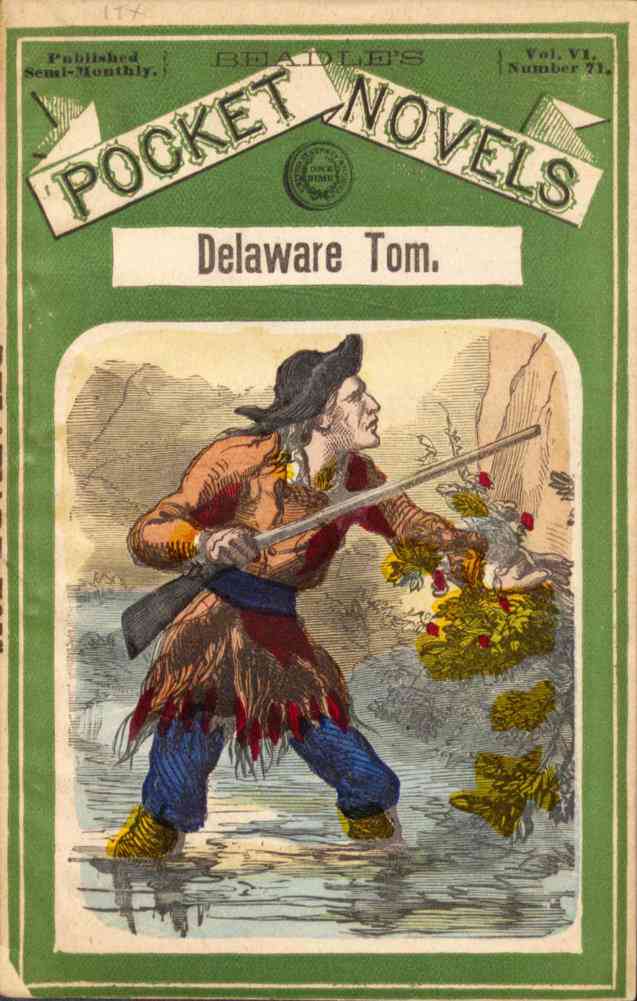
As Tom had anticipated, the unexpected shot had so startled the red-skins that they sprung up from their coverts and glared wildly around in search of their hidden foe. Cries of wondering fear broke from their lips.
Then a spout of flame shot forth from the line of bushes upon the hillside, and a second messenger of death sped upon its way; another of the savages reeled wildly, and then fell to the ground, the hot life-blood gurgling from his chest.
Delaware Tom snatched his revolver and discharged it, uttering a wild yell—the war-whoop that had more than once carried terror and confusion into the hearts of his foemen. Though this shot did not seem to have taken effect, the bold fellow sprung forth from the water, and pealing forth his yell, sprung toward the surviving Arapahoes, firing as he came.
Simultaneously, there echoed back a hoarse cheer from the hillside, and Travers sprung into view, his revolver echoing back the quick reports from that in the hands of the Delaware.
As yet the Arapahoes had not burned a grain of powder, so greatly were they confused by this sudden and deadly onset. The two men dashing toward them, with rapidly detonating pistols, were magnified ten-fold, and, as with one accord, the survivors turned and fled from the spot of death, with wild screeches of dismay and terror.
“Hurrah, Tom! spot them—they’re ours!” shouted Travers, wild with excitement, as his revolver sent a bullet crashing into the brain of a third red-skin. “Don’t let one get away!”
Loud and clear came the answering yell of the Delaware, as he sprung forward in hot pursuit of the fleeing foe. He only thought that his enemies were before him, and his heart was filled with ferocious hatred.
The foremost Arapahoe reached the horses, and it seemed as though the secondary object of the two scouts would be defeated, after all; but the frantic haste of the savage favored them, unexpectedly. In his terror, he made a quick grasp at the trailing halter; but his foot slipping upon the damp grass, he fell to the ground, even as his fingers tightened upon the plaited rope.
The sudden jerk added to the mustang’s affright, and caused him to rear violently back, half-raising the Indian to his feet; but then the hand slipped from the smooth rope, and thus freed, the terrified horse turned with a shrill scream and dashed madly up the valley, followed by its companions.
A faint cry broke from the lips of the Arapahoes, at this new misfortune, but they dared not pause. Close behind them they could hear the heavy tramp of their enemies, and then came two more shots.
Without pausing a moment, the savages dashed on, while the one whose haste had wrought them such harm, scrambled to his feet. But no sooner was he up, than he was down again.
Delaware Tom, with a shrill scream of frantic fury, pounced upon his back, hurling the red-skin violently forward, his face plowing up the decayed grass and soft dirt. Half-senseless from the shock, he offered but feeble resistance to his powerful enemy.
Delaware Tom dug his knees violently into the back of the Arapahoe, while one hand clutched his neck with the force of a vise. Then the empty revolver was upraised, for a moment remaining motionless to gather momentum; then the heavy, brass-bound butt fell with a sickening thud full upon the bared head of the ill-fated savage.
Another yell broke from Tom’s lips, as he dashed the clotted blood and brains from his eyes, and sprung to his feet, glaring ferociously around in search of another victim. But the carnage was over.
The two surviving Arapahoes had vanished among the shadows, and Travers was returning from the pursuit. But Tom darted forward, his eyes glowing with a diabolical fire.
“Stop, Tom,” cried the soldier, as he grasped his comrade, “where are you going? They’ve got clear off by now. You couldn’t find them in the dark, anyhow.”
“Let go—me kill Arapahoe debble!” snarled the Delaware, struggling fiercely in the powerful grasp of the captain.
“No, they’re gone. Don’t be a fool, man. There’s four scalps, if you want them. That’s enough for once. Do you hear?”
The savage suddenly ceased his struggles, though with a ill-grace. But then his face brightened as he glanced back upon the ghastly forms of the fallen red-skins.
“Come, help me catch their horses, first, Tom,” said Travers. “If we don’t mind they’ll give us the slip altogether.”
Without a word the Delaware followed his companion up the valley, where they could hear the frightened horses, still snorting wildly. The soldier began to fear they would experience not a little trouble in effecting their capture.
But both he and the Delaware were old hands among the horses, and Tom set out to gain the further side of the animals, in order to prevent their flight. This was quickly accomplished, and then, while Travers stood still, the Delaware slowly advanced toward the trembling group.
They permitted his approach without a motion, save to huddle closer together, until nearly within arm’s length, but then they dashed off toward the soldier. Travers stood still with outstretched hand, and, after a few minutes’ delay, one of them came close enough for him to secure the halter.
Then it was an easy task to collect the others, which once accomplished, the two men returned down the valley where had taken place the deadly surprise. The four dead forms presented a ghastly sight, and even Travers could not repress a shudder, as he recalled the frightful scene.
“Take their scalps, if you will, Tom,” he said, as the Delaware drew his knife. “But be quick about it. And then tumble their bodies into the creek, before we call the lady. The sight would be horrible enough to kill her.”
“Squaw no so soft like dat,” laughed the Delaware, as he shook the first trophy to free it from the gouts of blood, before securing it to his girdle. “Stan’ big heap, dey kin. No kill ’um so easy, like dat.”
“Hurry up—don’t be so long, Tom. There’s a long trail before us, and not much time to lose. It’s nearly daylight now.”
But the Delaware seemed to find a peculiar pleasure in his revolting task, and took his own time about it. This was the reward of his tedious exercise of Indian tactics.
But then the job was completed by dragging the mutilated dead to the stream, and casting them in, when the current quickly swept them away. As the last corpse disappeared, Travers raised his voice and bade Clara come down; that all danger was past.
But there came no reply. Again he called, louder than before. Still the silence, save in the echoes of his own voice among the hills.
Travers wondered at this, though he did not think of any serious wrong. He believed that Clara, frightened by the wild struggle, had not yet recovered sufficiently to recognize his voice.
“Here, Tom, hold the horses, and I will go up after her,” said Travers, a little impatiently. “She’s afraid to come down alone.”
Muttering at the foolish squeamishness of the white squaw, the Delaware did as bade, and then the soldier lightly bounded up the steep hillside. As he neared the line of bushes, Travers called again:
“Miss Calhoun—Clara, come out. It is all over, and the road is free for us. Come.”
Still no answer, save in the echoes of his own voice as before. A strange fear seized upon the strong-hearted soldier.
Why this continued silence? Why did not the maiden answer him? Could it be, that, frightened at the scene of death and bloodshed, she had fainted?
Believing this the true solution of the dead stillness, he sprung forward and parted the bushes. A wild cry broke from his lips.
The covert was empty—unoccupied, save by the still and lifeless form of the Arapahoe, who had fallen by the strong hand of Delaware Tom. Where was Clara?
“What fo’ you mek holler like dat? Where squaw?” called out the Delaware from below.
“My God! Tom, she’s gone! She is not here!” gasped Travers, in wondering alarm.
CHAPTER IX.
BOUND TO THE STAKE.
The situation of old Tom Maxwell, was not one to be envied. Lying helplessly bound, surrounded by a score of yelling, exultant red-skins, who showered kicks and cuffs upon him with merciless celerity.
Taken in the very act of slaying one of their comrades, he could expect but little mercy at their hands; indeed he felt some surprise that they spared his life even for those few moments.
Suddenly a tall, powerful form strode through the corral, rudely elbowing the braves aside, all resistance ceasing as they caught sight of the one who handled them so unceremoniously. Evidently the new-comer was one high in rank among them, judging from the deference with which he was regarded.
Waving back the red-skins, he stood over the form of the captive scout, gazing keenly at his upturned features. A quick and powerful change passed over his face, and a hoarse cry broke from his lips, while one hand nervously clutched the tomahawk that hung at his side.
“Ugh! Three Scalps!” he uttered in his native tongue; and even then there seemed to be a tinge of respectful admiration in his voice.
“Yas, so they call me in your lingo, ’Rapahoe,” coolly returned Maxwell, as he gazed fixedly at the face of the savage. “I s’pose you know how you arn’t the name, don’t ye?”
“Yeh, me know. Big warrior, you. Kill heap Arapahoe. Won’t kill no more, dough. Git kill self, bumbye. How like dat, eh?” added the Indian, with a leer of ferocious joy upon his features, as he crouched over the captive pale-face.
“Don’t know, chief, ontel a’ter I’ve tried it a time or two. Reckon I’d like it fust rate, soon’s I git kinder used to it a bit. But you’re jokin’, ain’t ye, now?”
“Jokin’—wha’ dat?”
“Foolin’—makin’ b’lieve—sorter throwin’ dust in a feller’s eyes, like, ye know, so to speak. What fer do you want to kill me? I hain’t done nothin’ much, onless it is killin’ a few dozen ’Rapahoes, fer which you’d orter thank me, ’stead o’ holdin’ any grudge,” and the reckless old scout chuckled grimly.
“You kill Arapahoe—Arapahoes kill you. Kill Cagoula here, kill oder brave ober dere. You die fo’ dat.”
“What other? You ain’t goin’ to blame a feller fer what ain’t his fault, be ye? Ef I tuck a notion to shoot out here at a bunch o’ grass, an’ one o’ your durned copper-skins runs ag’inst the bullet, be I to blame? But I didn’t do it—you cain’t prove ’at I killed any other skunk ’cept this ’ere one.”
“Kin too, me tell. Kill ’noder brave down dere—in water—stick one wid knife. Den run ’way like de debble,” angrily added the chief.
“When—where was that?” asked Maxwell, a sudden hope springing up in his breast at the last words of the Indian.
“S’pose you tek good hoss—ride like debble—mek hair all wet on hoss. Dat long, mebbe,” tersely replied the Arapahoe.
Maxwell’s form quivered with a new-born hope. He knew that the time metaphorically stated by the chief, would be about that which had transpired since the alarm had arose, so closely following the desperate venture of Buenos Ayres. Could it be that he had been deceived—that the young man had indeed eluded the vigilance of his enemies, and was still at liberty?
For some moments Tom dared not trust himself to speak. He dreaded lest the swarthy Hercules should suspect the truth from his tones.
“You mean the feller who tried to stop me down thar? In the water?” he said, at a venture.
“Yeh.”
“You fellers didn’t see me, then, as I swum back up the river?”
“No. You do dat way?” eagerly asked the chief.
“In course. You hunted fer me, didn’t you? Ef I’d ’a’ stayed thar you’d ’a’ found me, wouldn’t ye?”
“Yeh, me see now. Injun he big fool dat time, but got you now. Keep you, too. Tek scalp bumbye. How you like burn at stake, eh? Laugh plenty loud, den, eh? T’ink so?” and the chief chuckled diabolically.
“Me—burn me? Git out—you’re crazy, Injun. Cain’t do that. Won’t burn; ’d putt the fire all out. I’m all frozen water, I be. Tell you what I’ll do. Bet ye my hat ’at I kin stan’ fire longer ’thout sizzlin’ ’n you kin. Thar now, what sez ye?”
The savage laughed a little at the sublime impudence of his captive, but then turned away and entered into conversation with several of the more prominent braves.
Maxwell had an object in view in thus chaffing with his captor. He felt assured now that Buenos Ayres had indeed succeeded in passing the cordon in safety, and that he was even then far away in search of help.
Thus, every moment of time gained was invaluable to his comrades. If he could delay an attack until daylight, he believed that the train would be saved, as the Indians would scarcely brave an assault in broad daytime, knowing the great loss they must suffer in such a case.
Hoping to learn something definite regarding the red-skins’ plans, Tom keenly strained his ears to catch the words of those who were collected around the chief, at but a few yards from where stood the captive scout. His partial knowledge of the dialect stood him in good stead here.
He heard his own name—or the sobriquet given him for a deed of peculiar daring some years before, Three Scalps—coupled together with the emigrant train; and then another name met his ear. That of Dusky Dick.
His suspicious, then, were only too true. This desperate attack was indeed the work of the Traitor Guide. These savages were under his orders; then where was he?
But soon other interests riveted his attention upon the savages, once more. They were debating upon him—settling the mode and time of his death.
Despite his hardihood and great bravery, the old guide shuddered as he caught the words of the chief. To die—and by such a death—was horrible!
“His hands are red with the blood of the Arapahoe—he must die! But he is a great brave—his name is Three Scalps. Do you know how he gained that name? Listen! Four Arapahoe braves attacked him upon the prairie and shot his horse: he was alone. They were good braves and skillful warriors, but they were no match for him. He killed and took the scalps of three—the other fled, with a bullet through his breast. He gained the lodges of his people, and told his story; then he died. We called the white warrior Three Scalps.
“He is a great brave, but he must die. He has fallen into our power at last—but the death of a man awaits him. He shall die by fire—the wolves must not pick his bones. Wapashaw has spoken!”
“The chief is wise,” slowly uttered one of the elder braves. “But does he not forget? What will the white chief say? He bade us capture this man and keep him so that he might slay him with his own hand.”
“Wapashaw is a chief. Who shall say he does wrong? Not a pale-face, with blood like water. Is the White Snake greater than a chief of the Arapahoes? No! He does not dare speak hot words to Wapashaw. He knows that my arm is strong and my tomahawk sharp. Three Scalps must die—I have said it!” sternly added the chief, as he turned away.
Where was Dusky Dick? Why did he not put in an appearance, now that one of his bitterest enemies was helplessly a captive? This fact puzzled Tom not a little. But then he thought of the imminent peril that threatened himself.
“Durned consolin’, that is—I guess not!” muttered Tom, disgustedly. “S’pose I’d orter feel proud, but I don’t—not a mite. B’lieve I’d ruther they’d think I was a pesky coward, ef so be they’d think I wasn’t wuth sizzlin’. Ugh! it makes the sweat come, jest to think on it! What’ll it be then, though? Oh, Lord!”
He watched the movements of the savages with anxious eyes. Although as brave as most men, there was something fearful in contemplating this mode of being sent out of the world.
“Wonder ef it’ll hurt much. Bet it will; know it, ’most. Ef ’twouldn’t, I wouldn’t keer so much. Wish to ge-mineezers ’at I’d stayed in the corral,” grumbled Tom, as he tugged desperately upon his bonds.
But this effort was in vain. The hide-thongs had been applied by too careful a hand, for him to slip them from his wrists, and the tough cords only sunk deeper into the yielding flesh, with each succeeding effort.
It was quite evident that whatever scruples a few of the elder braves might have entertained as to the advisability of such a decided course, were quickly overruled by the stern-willed chief, Wapashaw, and then the necessary preparations for the feast were speedily under way. A score of savages dashed away toward the timber belt, with drawn hatchets, and then came the quick, heavy strokes, telling that wood was being collected.
Maxwell noted their movements with naturally troubled feelings. He saw his fate was sealed beyond a doubt, unless he could effect an escape.
But this seemed impossible. Alone, he was helpless as an infant. There was nothing for it but to watch and wait.
In a short time the savages returned from the timber-belt, bearing huge back-loads of dried wood, which, at a word from Wapashaw, they carried over to the hill, near whose top it was heaped. There was a double meaning in this selection of the spot for the sacrifice.
Of a necessity, there must be a number of braves left around the corral to guard against another messenger venturing forth, and these would wish to witness the sport. Did it take place upon the hillside, they could do so as well as those within the corral.
The hill, too, was beyond reach of rifle-shot, and so the bright light could not serve to guide an avenging bullet. For these reasons had the hill been selected by the astute chief of the Arapahoes.
Then the form of the old guide was lifted from the ground by several brawny warriors, and borne toward the rudely-improvised stake. Tom’s heart sunk anew, for he hoped to be able to break away from his captors, during the walk to the hill. But Wapashaw knew too well the nature of the man he had to deal with, to run any unnecessary risks.
Maxwell uttered a bitter curse of rage as he realized this. But a savage leer upon the countenance of Wapashaw revealed the delight his chagrin gave the rascal, and Tom smothered his emotion, until he gave no outward sign of feeling his position, though his teeth were firmly clenched and his breath came hard and strong.
In a few minutes the hill was gained, and the old scout was placed with his back against the firmly-planted stake. Not until a strong lariat was twined around both his body and the post, were his feet freed from their bonds, his hands still remaining tied.
“Ugh!” grunted Wapashaw, as he stood ordering the proceeding, addressing Maxwell. “Three Scalps no ’feared now? Holler plenty loud, by-’m-by, when fire burns. T’ink so?”
“Not much, chief. You’ll only git fooled ef you ’xpect me to holler. Fire cain’t burn me—it cain’t. I’m proof ag’in’ lead an’ steel, too. Didn’t know that afore, did ye? Why you mought stan’ thar an’ shoot your rifle plum ag’in’ my face, an’ the bullit ’d jest bounce back ag’in, like it hed hit a rock. Your hatchet ’ed break jest like a piece o’ ice, ef you was to hit me, hard. It would so!” earnestly responded Tom. “S’pose you try it an’ see, now, jest fer fun.”
Wapashaw gazed steadily at the old guide for a moment, but then a grim smile swept athwart his countenance. He divined the motive that actuated his captive, but was far from willing to gratify him.
“S’pose you t’ink Arapahoe chief he big fool, talk like dat? S’pose shoot—hit ’um wid tom’hawk, den ’um go dead, quick. Den no git burn. Three Scalps brave, plenty cunning, but so Wapashaw. No git fooled dis time,” and the chief chuckled sardonically.
“Ah, git out! Think ye’re some, don’t ye? Durned smart, you be—whar the hide’s rubbed off. Fool nothin’—cain’t spile a rotten aigg, you durned gumphead, you,” retorted Tom, with an angry glare in his eyes.
He had indeed strove to induce the chief to end all at one blow, by his boasting, for he had racked his brain in vain to devise some other mode of escaping the horrible death. Feeling assured that his time to die was at hand, he wished it over at once.
Though Maxwell spoke boldly enough, there was a dull, heavy sinking at his heart, as he noted the preparations for his torture. He knew that mortal man could never endure that fearful trial, without giving utterance to his agony.
He knew that death would come, but it would be lingering; before oblivion, he must suffer ten thousand deaths. That is what he desired to escape.
The dried fagots were piled around at a few yards’ distance from the stake, so that death should not too quickly claim its victim. Time must be given them to do ample honor to the great bravery and prowess that Three Scalps had so frequently displayed, greatly to their harm.
Tom could look down upon the corral, though it was but faintly outlined in the dim light, for the moon had sunk low down, and daybreak was close at hand. He knew that his comrades must be cognizant of his capture, whether they also knew of his threatened doom or no.
But he could expect no assistance from them. They would have enough to do in guarding themselves, and the dear, helpless ones depending upon their strong arms for safety.
Then Wapashaw took a torch that had been hastily kindled by one of the warriors, and holding it to the dry kindlings, the pile of fagots was soon in a blaze, shooting up from a dozen different points. And around the funeral pyre danced the yelling and screeching red-skins, apparently half frantic with demoniac joy.
CHAPTER X.
THE WINDING TRAIL.
At this wild cry from Captain Travers, Delaware Tom abandoned the horses they had secured after so much trouble and danger, and darted up the hill-side toward the spot where such a startling discovery had been made by the soldier. It did not seem possible, and the Indian evidently believed that Travers had made some mistake in the spot.
But then he also saw that Clara was gone from the place where she had been left but a few short minutes before. Gone—where? Why had she fled? Or had some enemy spirited her away?
These were the questions that poured from the lips of the soldier, as his comrade gained his side. For a time Tom made no reply, and bent low down over the ground, as if trying to read the truth by some sign left there.
“She gone—dat all we know now,” grunted the Delaware, as he rose erect. “Don’t know how—mebbe tell bumbye, when light comes ’g’in.”
“Do you think that any one has carried her off, Tom?” asked Travers, agitatedly.
“Mebbe so—mebbe not so. Don’t know not’ing, me say. Too much dark—can’t see. She gone, dat all me kin tell now,” persisted the Delaware, doggedly.
Travers glanced anxiously up at the heavens. The moon had rolled on, until the cliff above their heads shut off the light from the hill-side.
All there was dim and indistinct; light enough to distinguish forms, but not sufficiently so to trace out a trail, especially when left upon the rocky ground by so light a foot as that of the missing maiden. As Tom had said, the truth could not be learned until the day had dawned.
Fortunately, this period was not far distant. A couple of hours, at most, and the sun would make its appearance.
But in that length of time, what might not happen? If the maiden was in the hands of an enemy, she would be conveyed far beyond their reach before they could strike the trail.
And then there was danger to themselves, too, as well. The messenger who had been dispatched for help, hours before, by the Arapahoes, might return at any moment, bringing a force that they could not hope to cope with successfully. Or the two savages who had fled the massacre of their comrades might chance upon friends, and gathering courage from that fact, return to avenge the slaughter of their brethren.
All these thoughts agitated the minds of the two men, as they stood gazing gloomily upon each other. That they were puzzled was plain; equally plain was it that not for even a moment did either think of abandoning to her fate the maiden who had so strangely been thrown upon their protection, and for whom they had already dared so much.
“What must we do now, Tom?” muttered Travers, speaking mechanically; not that he hoped to gain any thing by the reply.
“Do not’ing now—bumbye do somefin. When light come ag’in, we take trail—foller up till fin’ squaw.”
“But do you think we can?”
“Know so—almost. Got eye plenty sharp, Tom. Foller trail in water, ef try hard. Me foller trail—Cap’n ride hoss. Den we git her—go back camp—laugh like de debble, ’cause skeered when squaw git lost.”
“But she may have been carried off?” suggested the soldier, taking the gloomy side of the question as the true one.
“No—don’t t’ink dat. Injun grab her, squaw holler so loud—squeal all some like pant’er. Den we hear, sure. No holler loud—den Injun no take. She git skeered, mebbe, ’cause ’um kill Arapahoe. Don’t know much when skeered. No see straight—t’ink mebbe a frien’ git kill—not bad Injun. Den ’fraid dey git her, too, so run ’way off, plenty fast. Me t’ink dat,” succinctly stated Tom, with the argumentative air of a lawyer summing up his case.
“Do you think so?” eagerly cried Travers. “Then she may be hidden somewhere near here. Surely she could not run far, she was so weak from her fall. If you call, she may hear and answer.”
“You holler, if you like. Me go git horses ’g’in. Don’t like much walk, when kin ride. Plenty better, dat,” grinned the Delaware, who begun descending the hillside toward the captured animals, who had stood still on being left.
Travers acted upon this supposition, making the hills echo with the sound of his voice calling aloud the maiden’s name as clearly as possible. But there came back no answering call.
If the Delaware’s supposition as to Clara’s voluntary flight was true, then she must have run to a great distance, or she could not have failed hearing the cries. At length the soldier ceased in despair. There was nothing for it but to await the coming day before proceeding further.
Tom secured the horses to a bush, and then taking a philosophical view of the matter, comfortably seated himself in a mossy nook, lighting his pipe and smoking with the gusto of an epicure. But Travers could not content himself thus.
Though he had known the maiden but a few brief hours, as time is usually computed, that seemed most like a year of ordinary time, so full of adventure had it been. The bright eyes and sweet face of Clara Calhoun, had made a vivid impression upon his heart, and he felt this suspense very keenly.
No doubt he would have laughed to scorn the idea of his being in love with her, had it suggested itself, but truly, the feeling he now experienced was not unlike the first dawning of that subtle sentiment called love. Honestly, the gallant captain was in greater danger then, than he had ever been before in the whole course of his eventful life, had he but known it.
Travers, in his anxiety to be doing something, scaled the hill and kept a close look out, to guard against being taken by surprise, in case the Arapahoe’s messenger should return. But Tom sunk into a peaceful doze beside his rock, no doubt living over again in his dreams the glorious sport he had so lately had, in outwitting and putting to rout his foes, the Arapahoes.
But all things must have an end, and that eventful night was no exception to the general rule. With the first golden rays of the rising sun gilding the eastern hill-tops, Travers descended to where Delaware Tom was awaiting his coming.
Their preparations for the coming campaign were necessarily very brief. A long draught from the creek, constituted all their breakfast for the nonce, as the last bit of food had passed their lips on the preceding night.
Then while the soldier secured the horses for marching, Tom quartered the ground adjoining the covert, where still lay the slaughtered Kisch-kouch, searching for the trail of the missing maiden. In a few minutes his glad cry echoed forth, and Travers knew that the quest had been successful.
As he hastened to the spot, his eyes, though keen, were at fault, though Tom declared the trail was remarkably plain—that Clara had passed over the ground at a rapid pace, though alone. A joyous cry burst from the captain’s lips at this welcome announcement, for now he did not doubt of being successful in finding the girl in a very short time.
It also confirmed the supposition of the Delaware, that she had taken affright at the wild tumult attending the surprise, and perhaps had fancied her friends were being overpowered. But now Tom stood upon his dignity as chief trailer, and motioned Travers back, to act as rear-guard.
The trail led down the hillside for some little distance, then crossed the ridge and descended into the level prairie beyond. Now even Travers could easily note the dainty footprints upon the dew-dampened ground.
He also saw with pleasure, that its course was one heading almost directly toward the camping-ground of his own train, so that they were in reality losing but very little time. This he rejoiced in, for he knew that his men would be uneasy at his long absence, as they had not intended stopping out over night.
For several miles the trail continued, not in a direct line, but zig-zag hither and yon, as if the girl had become confused and wandered aimlessly in a roundabout manner. And while Tom traced this out, step by step, Travers, seated upon a horse, gazed keenly around in every direction, hoping to thus gain sight of the wanderer, sooner than otherwise.
And his search proved successful, for, just as Tom uttered a cry of surprise, Travers caught sight of a human form, upon the swell of a hill, perhaps a mile away. Then the figure abruptly disappeared from view.
“Ugh! look dere!” muttered Tom, as he came to an abrupt stop.
Travers followed the direction indicated by the outstretched finger. The trail they were following suddenly became a double one!
CHAPTER XI.
REUNITED.
It was well-nigh daydawn, and Buenos Ayres trudged wearily on, foot-sore and almost exhausted by his severe toil. His mind was filled with doubt and fear.
He believed that he had more than covered the distance mentioned by Tom Maxwell, as intervening between the corral and the Main Trail, but yet he had not observed any trace of it. Could it be possible that he had crossed the Trail, unknowingly? He feared greatly that he had done so.
“It will not do to turn back on an uncertainty,” he muttered, as he paused to glance around him once more. “And yet, a mistake, now, would be awful! If I only knew the country better!”
But then once more he pressed on, keeping as direct a course as lay in his power. And as he gained the next ridge he again paused, hoping from its summit to discover the desired landmark.
But if he did not see what he sought, another object met his gaze. One that caused his heart to leap to his very throat, while his brain grew dizzy with a wild, delirious hope.
Upon a crest to his left, Ayres beheld a human form, that, in the grim, gray light, was indistinct and phantom-like. But still he believed that he could discern the flowing drapery of a woman!
Ayres had learned a lesson by that night’s events, and still uncertain that the distant figure was not that of an enemy, he sunk down into the tall grass, and then peered keenly toward the spot where the vision had appeared. And, as he awaited, he saw that it was approaching, and was indeed a woman.
How his heart leaped, then! A woman—might it not be his lost love, who had so strangely disappeared from their midst?
And yet, how could it be? Clara had ridden away on her horse; this woman was on foot, many miles from the spot where he had last seen his friend.
Though the coming sun gilded the eastern horizon, the swale in which the woman now was, still gloomy, and only with the greatest difficulty could Ayres discern her shape at all. But then she began ascending the hill, almost directly toward him.
Trembling in every fiber of his being, the young man awaited the result, fearful lest his new-born hope should be dashed to the ground, after all. It did not seem possible that this could be Clara.
But then a glad cry—a cry so full of joy and heartfelt exultation—broke from his lips. The light fell full upon the features of her who approached, and Ayres knew that he beheld his lost love, Clara Calhoun!
She evidently heard the cry, for she paused and half-turned as if to flee. Then he sprung up, calling aloud her name, as he darted toward her trembling figure.
She stood as if petrified, then, with a glad cry, sunk to the ground, laughing and weeping at the same time. Her overtasked powers now seemed to give way before this unexpected happiness, and she sunk into a deathlike swoon, as her lover clasped her to his broad breast, covering her pale and haggard face with passionate kisses.
For a moment Buenos acted like one demented, but then as he found she did not return his caresses, a great fear assailed him; he feared she was dead. And indeed, her looks favored this supposition.
So pale and ghastly, lying against his heart like one utterly devoid of life. But this great sorrow was spared the young man.
Soon, beneath the fervid pressure of his lips, the color and warmth came back to her face, and then her eyes opened. The wild, hunted look quickly disappeared from them, and with a low, glad cry her arms wound around his neck.
“Thank God! you have found me, Buenos!” she murmured, faintly.
“But where have you been, darling? Why did you leave us so strangely?”
Whereupon Clara briefly detailed her adventures of the past night, adding:
“I saw them all together, shouting and screaming, shooting at each other, and it frightened me terribly. What could these two men, though so brave, do against six great Indians? I believed they must both be killed, and then as I thought of how the savages would hunt for and find me, it seemed as though I would go crazy! I would rather die than fall into their hands, and yet I knew that they would capture me if I should stay there until it was all over.
“So I turned and fled, not knowing whither I went, but only thinking to escape from these dreadful savages. I ran on until I fell from weakness, but then, as I fancied I could hear them coming after me, I arose and kept on, only knowing that I was running away from them. I did not know where I was, nor whither I was going, and I believe that I must have died had not you found me, dear Buenos,” she added, with a hysterical sob.
“Poor Clara—how you must have suffered!” murmured Ayres, pressing his lips to her brow.
“Indeed I have—more than words can tell. But I knew you would come for me—I felt sure you would not leave me to die here all alone. Poor father—how he must have suffered from my thoughtlessness!”
“My God! I forgot—and here I have lost over an hour!” exclaimed Buenos, springing to his feet in dismay at his remissness.
“What—what is it, Buenos?” inquired Clara, in vague alarm.
“The train—I was sent for help. The Indians, under Dusky Dick, attacked it last night, and I fear my thoughtlessness will be their ruin,” agitatedly added Ayres.
“He was with those after me,” shuddered Clara. “But help—where can you find it here? We are alone—God only knows where!”
“There was a government train close behind us, when we left the Main Trail, and I was searching for them, but—”
“He belonged to one—Captain Travers, I mean. It can not be far away from here. Ah, if we can only find it!” hastily cried Clara.
“Do you know in what direction? Did you hear him say where it was?”
“No—or if I did, I forgot. I was so badly frightened, you know.”
“We must find it—I must. But you—my poor darling—you are too tired to walk so far and fast.”
“No—I am strong now, since you have come. I can walk, oh, so far; never fear. Besides, it is for father—and our friends. And I could not stay here—I should die of fear. They would catch me, I know!”
“Well, we must try it. Remember that your father’s life may depend upon your own, Clara, and bear up if you can. It will be hard—I wish I could spare you—but there is no help for it.”
The sun was now quite high above the hills, for young Ayres had lost a good hour by listening to Clara’s story, and now they pressed on at a fair pace, though ignorant whether they were pursuing the right course or were going widely astray.
But they were destined to meet with another interruption, right speedily. They had just gained the next ridge when Clara suddenly uttered a little cry of affright.
“Ah! Buenos—look there—the Indians! My God! we are lost!” she gasped, as, with outstretched hand, she guided the gaze of her companion toward the ridge they had just left but a few moments before.
One quick glance satisfied Buenos of the correctness of her fears. He saw a little group of horsemen, that he believed were mounted Indians.
“Quick! stoop down Clara! They have not seen us yet, and if we hide they may pass by without noticing our trail. Follow me—quick!” Ayres hissed, as, crouching low down, he half-led, half-dragged his companion down the hill-side, making toward a small clump of timber growing in the bottom of the vale.
Toward this they ran at full speed, and had barely gained its shelter when the horsemen reached the ridge they had just left. A wild cry came to the ears of the fugitives, and then they saw the horsemen dash furiously toward their refuge.
“Keep behind me, Clara,” muttered Ayres, as he closely examined the condition of his revolver. “They will not find us tame victims. They must pay a price for our lives.”
“There are only two—perhaps they are—”
“See the other horses—four of them? They must have riders, who are hiding behind their bodies. Look, they stop! I’ll—”
“No—no; don’t shoot, Buenos,” cried Clara, as she seized the already-leveled revolver. “See, they are friends—Captain Travers and the Delaware, who saved me from the Indians!”
“Are you sure, Clara?” doubtfully replied Ayres; but then a cry from one of the men settled this doubt, most agreeably.
“Miss Calhoun, you know us; we are friends. Who is that with you? If an enemy, we will rescue you from him.”
Clara and Buenos stepped forth from the cover, and then there ensued a warm greeting between the quartette, for even the Delaware appeared overjoyed at beholding the pale-faced squaw, once more.
“Buenos, tell this gentleman—I know he will help us,” eagerly uttered Clara, thinking first of her father’s peril.
In a few brief words Ayres stated the position of affairs at the emigrant train, as he had left it, and implored assistance. The captain, though experiencing a momentary sensation something akin to jealousy, at seeing how confidingly Clara clung to the young man—was greatly excited, and promptly offered his aid in the matter.
“Certainly I will. My old commander in danger! Good Lord! how strange! Quick—help the lady to mount; there’s plenty of horses, fortunately. The camp is only about two miles away, now. We’ll get there almost before you know it; and then for these red-skinned devils. No offense, I hope, Delaware?”
“No—me all white man, now. Cuss Injins all want, plenty bad, you like—all but Delaware,” grunted Tom.
Buenos quickly lifted Clara upon one of the horses, and then, following suit, the quartette were speedily dashing over the prairie, under the guidance of Delaware Tom, with the two extra horses following closely in their wake.
The spirits of the two lovers rose with every long leap of their mettlesome horses, though Buenos Ayres could not repress certain misgivings as he thought on the length of time that had transpired since he left the emigrant party. Could they have held out through the long, fearful night?
He feared they could not have done so; something seemed to tell him that the rescuing party would arrive only in time to bestow upon his late comrades a Christian burial. And beneath his breath he swore a deep and fearful vengeance, should such indeed be the case.
They had ridden but a short distance, when Delaware Tom uttered a low whoop, and pointed before them, though he did not slacken his pace. Thus directed, the eyes of all noted the presence of a small body of horsemen, just rising the second ridge from them, who had evidently caught sight of the quartette, at the same time, for they suddenly drew rein.
“Don’t stop—they’re friends,” cried Travers. “I can tell my boys as far as eye can reach. They’re out after me, I don’t doubt; we stayed so much longer than expected.”
At about the same time, the soldiers evidently made the same discovery, for they gave their horses free rein and dashed forward, with loud cheers. A smile rested upon the captain’s lips, at this. One could easily see that he was a beloved leader, and proud of his boys in blue.
“Well Morris,” he said, as the leader of the dozen men saluted, “glad to see you. How’s all at the camp?”
“All well, sir, but very anxious because you stayed out so long. I made bold to take a few of the boys and ride out to see if we could be of any use,” respectfully replied the sergeant, curiously eying the horses and the two extra riders.
“There’s work cut out for you, and hot work, too, if I mistake not. But I know that that is no drawback,” laughed Travers, as the party again broke into a rapid gallop.
“Indeed it ain’t, cap’n. Injuns—if I may ask?”
“Yes. They’ve attacked the train this lady and gentleman belong to—the one that passed us at Dutchman’s.”
In a few minutes more the party had reached the camping-ground of the government train, where now was all excitement, for the news quickly spread, and was greeted with loud, hearty cheers, for ’twas not every day that the boys got a pleasure ride, and a brush with the Indians to wind up with. The only fear they had, was that, as some must remain behind to guard the train, they might be the unlucky ones.
“Boys,” said Travers, riding out a little from the rest, “how many of you wish to take a skurry after the Indians this morning?”
With loud cheers, every man, soldiers, teamsters and all, flocked forward, each striving to be foremost. A glad smile played around their leader’s lips.
“Good! though it’s only what I expected from you. But you can’t all go. Sergeant Morris?”
“Here, sir.”
“Pick out thirty men, and see that they’re ready in ten minutes. Never mind rations; take only arms and plenty of ammunition.”
“Yes, sir. Half the time’ll do.”
“Now, Miss Calhoun, if you will come with us, I will see you more comfortably placed than on that horse. The sutler’s family is with us, and will see that you have all that you require.”
“Thank you, captain, but it is needless; I am going to my father, with the rest of you,” firmly replied the maiden.
“But think—how we must ride, to do any good, and then there will probably be hard fighting at the end of it,” he urged, perplexedly.
“I have thought. Father is in trouble—perhaps dead or badly wounded, and I not there! I must go!”
“Clara,” said Buenos, riding to her side, “listen to me. You are nearly sick now, with what you have passed through. Such a trial as this will be, would prove your death. You would die before you got half-way. You must stay here—for my sake, if not your own.”
“No—I will go!”
“Clara, you must not. Don’t oblige me to use compulsion, but I know that you could never stand the ride. You must stay. I will either come or send you word, as soon as it is all over.”
With a hysterical sob, the maiden gave way, and allowed the captain to lead her to the wagon set apart for the family of the sutler. Leaving her in charge of the worthy wife, he hastened back to the men, who were now in readiness.
From the description of the spot, as given by Ayres, Delaware Tom declared that he knew it well, and could guide the party directly there, as the crow flies. And then they set off upon their mission, at a pace that satisfied even Ayres, urgent as was his haste.
“Keep up, boys,” shouted Travers. “We’re riding for life or death, now, and if your horses can’t stand the pace, follow on the best you can. You may be in at the death, anyhow.”
They numbered some thirty-five, all told, and not one felt a doubt as to how the affair would turn out, provided the emigrants were still holding out, when they arrived. But Buenos had grave fears upon this point.
And still on they thundered, no longer in a compact body, but strung out at short intervals, as the better or more speedy horses took the front. At their head rode Ayres, Travers, and Delaware Tom, the former mounted upon one of the captured mustangs; a noble brute.
On until the head grew dizzy with the swift motion; until the foam dropped from the horses’ lips and flecked their counters; until their glossy coats were darkened with sweat, together with the dust cast up by the trampling hoofs.
It was a wild, fearful ride, and the brains of the men seemed intoxicated, so wildly did they whirl. Even their horses seemed to catch the infection, for they thundered on as if mad, snorting and fretting, with eyeballs wildly staring, fiery and bloodshot.
Then Delaware Tom abruptly jerked his horse up, casting him upon his haunches. A motion of his hand checked the others.
Soaring to their ears, borne upon the light air, came the confusedly-mingled sounds of rifle-shots, shrill yells and hoarse shouts, from beyond the swell of the prairie. The cause was but too evident.
The savages were desperately attacking the emigrant train. Then all was not yet over—they might still be in time!
“Wait until all come up—then one steady charge, and they’re ours!” whispered Travers to the impetuous Ayres.