
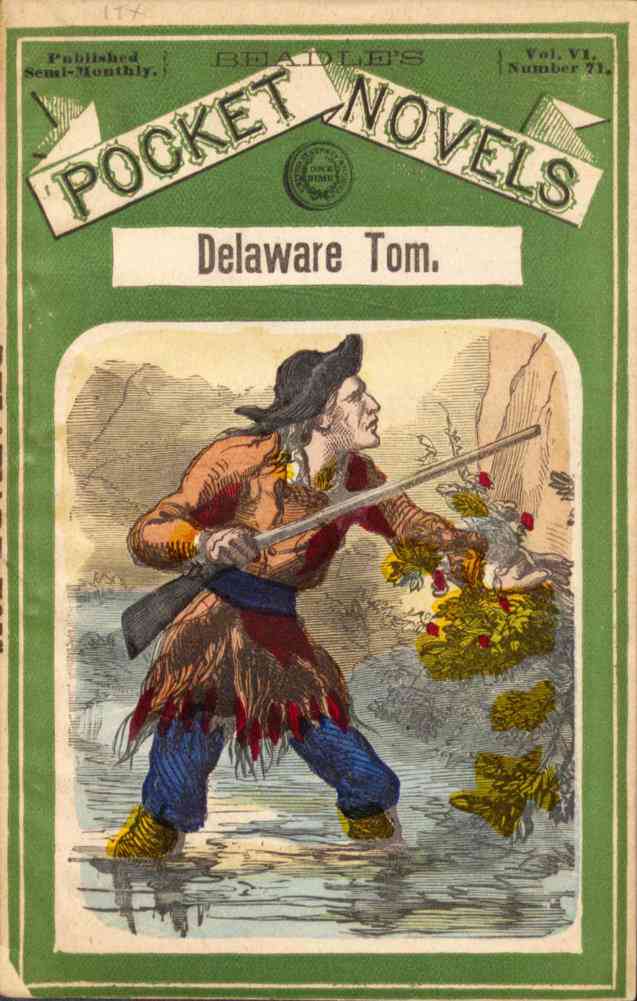
The Project Gutenberg eBook of Delaware Tom; or, The Traitor Guide
Title: Delaware Tom; or, The Traitor Guide
Author: Jos. E. Badger
Release date: September 6, 2021 [eBook #66227]
Most recently updated: October 18, 2024
Language: English
Original publication: United States: Beadle and Adams, 1876
Credits: David Edwards, Stephen Hutcheson, and the Online Distributed Proofreading Team at https://www.pgdp.net (Northern Illinois University Digital Library)
DELAWARE TOM;
OR,
THE TRAITOR GUIDE.
BY HARRY HAZARD,
AUTHOR OF THE FOLLOWING POCKET NOVELS:
No. 38. The Heart Eater,
No. 43. The White Outlaw,
No. 54. Arkansas Jack,
No. 66. Rattling Dick.
NEW YORK:
BEADLE AND ADAMS, PUBLISHERS,
98 WILLIAM STREET.
Entered according to Act of Congress, in the year 1872, by
FRANK STARR & CO.,
In the office of the Librarian of Congress, at Washington.
CONTENTS
- I An Altercation 9
- II The Storm-Cloud Breaks 19
- III A Wild Race 30
- IV The Forlorn Hope 34
- V Delaware Tom 43
- VI Tom Maxwell Turns Indian 50
- VII A Tangled Trail 59
- VIII Savage Tactics 68
- IX Bound to the Stake 77
- X The Winding Trail 83
- XI Reunited 88
- XII Dog Eat Dog 96
DELAWARE TOM;
OR,
THE TRAITOR GUIDE
CHAPTER I.
AN ALTERCATION.
Mid-afternoon of an oppressively hot and sultry day, in the year ’54.
We call the reader’s attention to a scene, that, if not romantic, is at least attractive and interesting; a wagon-train of emigrants, as is attested by the quantity of driven stock—horses, cattle and sheep. The presence of women and children is still further evidence.
It moved slowly and drearily along over the vast, almost barren stretch of level plain, as though the nearly spent day had been one of hard and unremitting toil. The horses or mules, their heads hanging down, with drooping ears and tails, their hides damp with sweat and covered with the fine sand cast upon the air by the trampling hoofs, or the slowly revolving wheels, scarcely heed the stinging lash or the impatient exclamation of their drivers.
The loose stock move dejectedly along, cured of their morning propensity of running from the trail to snatch a mouthful of grass, or nip the tops of a bush, while more than one of the boys, whose duty it is to keep them within proper limits, dozes in their hard saddles.
But there are three persons who appear full of life and free from the general weariness of mind and body. There: one of them a woman—a girl; the others men.
The first, who rode at several hundred yards in advance, if closely scrutinized, proves to be an old man, who has numbered his half-century, or perhaps nearly a decade more. A close scrutiny, we say, for his figure was as erect and vigorous, his motions as free and supple, the fire of his keen gray eye as clear and penetrating as a generation since.
His hair and long flowing beard were gray, although the thickly clinging dust effectually disguised this. From his position, his arms, his actions, it was plain he acted as guide to the wagon-train.
The next figure, about half-way between this man and the foremost wagon, was also a man, and merits a brief description at our hands for more than one reason.
In stature he was about the mean hight, of a rather slight figure, but with a muscular and active development, clothed in a plain and well-worn suit of gray. His dusky, olive complexion, black hair and eyes like a sloe, had given him the sobriquet of “Dusky Dick,” a name that was already famous throughout the West.
Although not much, if any beyond his third decade, Richard Rouzee, or “Dusky Dick,” had followed the calling of a guide for a number of years, and gained the repute of being peculiarly unfortunate, having lost one-half the trains he had acted as pilot for, and rarely escaped without at least one fierce and desperate struggle.
More than one dark rumor had been put in circulation, and some more boldly declared that he was in league with the red-skins, and only acted as guide, the more surely to compass his purpose. But this was only conjecture, and could not be substantiated by any valid proof.
The third person, who rode at some little distance to the right, so as to escape the annoying dust, was a young woman of more than common grace and beauty, although the latter quality was somewhat obscured by the long, weary day’s travel.
Rather above the medium hight, of a superbly rounded and developed form, that was admirably displayed by her neatly-fitting riding-habit of black, she sat her horse with the ease and grace of an accomplished equestrienne, although he chafed and fretted at the restraint of a tightly-drawn rein, caracoling and prancing in proud strength and spirit.
It was a clear-cut profile and beautiful complexion that Dusky Dick beheld from the corner of his dark, sinister eye, that glared with a fire of unusual admiration. But this his slouched hat concealed, and his smooth, beardless face gave no outward sign of the dark and troubled thoughts that filled his brain.
Then he pricked his half-wild mustang viciously with his spur, and darted suddenly up beside the lady, who uttered a half-suppressed exclamation of annoyance, and made no attempt to conceal the expression of dislike and impatience that clouded her usually sunny features.
“It has been a wearisome day, Miss Clara,” began the guide, speaking in a low and remarkably musical voice although his eyes flashed as he noticed her evident aversion. “But we are almost at the end of our day’s journey. See—that long dark line yonder, a little to the left, is our stopping-place, beside a clear and beautiful stream. I know the spot, well.”
“So we camp there? Well, I am glad of it, for more than one reason,” replied the lady, in an impatient tone.
“And may I ask why so?”
“Do you wish to know the truth?” asked Clara, with a slight emphasis.
“Certainly; the truth will be doubly pleasant, coming from such winsome lips,” Dusky Dick returned, with a half-mocking bow and smile.
“Well then, the main reason is that once there, you will have other things to attend to, and will not have so much leisure to annoy others by impertinent and unwelcome attentions,” curtly replied Clara, urging her high-mettled horse ahead, as if desirous of escaping the company of the swarthy guide.
“And another reason is—that a certain baby-face, Buenos Ayres by name, will not be long in feeding his horses, and then, of course, will hasten to pay his respects to the belle of the wagon-train,” sneered Dusky Dick, keeping close to Clara, whether she rode fast or slow.
“Mr. Rouzee,” at length exclaimed Clara, her eyes flashing angrily, and her cheeks flushing, “your place as guide is yonder, along with Tom Maxwell, and not out here. If I appear rude, you force me to be so.”
“A guide’s place depends greatly upon circumstances, Miss Calhoun; and just now I prefer this position.”
“Then occupy it alone; I will go back to the wagon,” she added, reining in her horse.
“Stay, Miss Clara,” cried Rouzee, his black eyes glittering. “Keep your place, but mark me, the time will come—and soon too—when you will repent these haughty airs, and solicit as a favor, what you now affect to scorn. I tell you that the time is not far distant when you will crouch at my feet—when you will hang around me for a word—a smile; when you will call me master. Do you hear?”
“And I tell you, sir, that when we camp to-night, you will have to answer to the charge of being drunk while upon duty,” haughtily retorted Clara, her eyes flashing. “Will you go, sir, or must I appeal to my father?”
The guide did not reply, but plunging his long, cruel spurs into the flanks of his mustang, he dashed rapidly up alongside of the old borderer, Tom Maxwell, who received him with a cold, half-suspicious start. Evidently there was little love lost between the two men.
Just before sunset, the long line of trees was reached, that bordered upon a small stream, and preparations were immediately begun for encamping, while Dusky Dick and Tom Maxwell galloped off to hunt for “sign.”
The mules and horses were ungeared and turned loose, after being hoppled, and the wagons were formed into a rude sort of corral, one line covering the joints in the other. All was bustle and apparent confusion, although each person knew his duty and busied himself about that alone.
Fires were built, and over them stooped the women, preparing supper for the different messes; while the children brought wood and water, or else rolled and tumbled over each other with merry shouts, in their play, little recking what the morrow might bring forth.
To one of these fires, a little apart from the remainder, we now turn. Over it was bending the form of an old negro woman, whose wrinkled features and gorgeous red and orange head-gear, looked weird and wild through the flame-tinted smoke.
A little to one side of this sat three persons, or rather half reclining against the moss-covered roots of the gigantic oak tree, idly watching the motions of “Aunt Medora,” as she turned the hissing bacon, or the nicely browning “hoe-cake.” One of these was Clara Calhoun; the others were men.
The eldest one—tall, portly and of a soldierly bearing—was her father, the leader or captain of the wagon-train. Of perhaps fifty years in age, his muscular frame gave no evidence of decay, and the fire of youth still seemed to shine in his large dark eyes. The heavy, grizzled mustache and beard, gave a somewhat stern cast to his features, that were massive and regular, and his voice, used to command, enhanced this idea; but at heart he was kind and gentle.
The other was a young man, between his fifth and sixth lustrum, with a handsome, manly face and form; with a calm, steadfast look in his gray eye that instinctively commanded one’s respect, and told that he could be depended upon in any emergency, however dangerous or trying.
His garments were plain and almost poor, but there was an air of conscious independence and freedom in his bearing and demeanor, that attracted one, despite himself.
“Father, do you know that I think you made a great mistake in hiring this Dusky Dick, or whatever may be his name, to act as guide?”
“Why so, Clara?” asked her parent, with an air of surprise.
“Well, you may laugh at me, or call me visionary, but I shudder whenever he comes near me. I believe he is a traitor, and that he has some deep purpose of his own that means danger to us all. If you ask my reasons, I can only say what I have; I only feel that he’s not what he seems, and I shall never rest easy until we are well rid of him.”
“I don’t like him overly well, myself,” slowly replied Calhoun, “but still, I think he is honest and trustworthy.”
“Then why does he not attend to his business, instead of intruding where he can’t help but see his presence is unwelcome?” warmly cried Clara.
“Why, daughter, what do you mean? What has he been doing?”
“Just this. I can’t stir a step from the wagons, but what he is at my side, with his disagreeable smile and worse compliments. At first I did not appear to mind them, but of late he has grown still more impudent, and the worse I rebuff him, the more he persists, until now, unless it is put a stop to, I will feel obliged to keep within the wagon all the time.”
“You never spoke of this before, Clara,” uttered Calhoun, slowly. “If he has troubled you so much, why not have told me?”
“Because I thought he would desist, and then there would be no trouble. But to-day he grossly insulted me.”
“Stay, Buenos,” commanded the major, placing a hand upon the young man’s arm, as he made a motion of anger—“let me settle this. He insulted you, Clara?”
“Yes. He told me that the time was not far distant when I would crouch at his feet, and be glad to call him master!” exclaimed the maiden, her eyes flashing.
“But what led to this?”
“I hardly remember, but I told him he had other duties to perform, that would become him better than forcing his company upon those to whom it was unwelcome. I had tried to leave him by riding faster, to one side, or by falling back; but he kept close beside me.”
Major Calhoun arose and glanced around upon the animated scene. The two guides had returned, and were awaiting supper, meanwhile smoking their pipes.
“Tom Maxwell, come here for a moment,” called the leader, and the tall guide sprung nimbly to his feet and approached the group, doffing the dirty felt hat, with an almost reverential bow to Clara.
“Maxwell, my man, I wish to ask your advice, and I trust you will be plain and candid, in your reply,” began Calhoun.
“Maje, I’m Tom Maxwell, an’ you’ve hearn tell o’ me afore now; but did you ever hear ’at I lied, or made a practyce o’ any sech a dirty, sneakin’ business? The truth is a mighty broad an plain trail, boss, to them which is clear in the sight, an’ my ol’ mother l’arnt me to squint true ’long that trail, tellin’ me—‘Now, sonny, jest foller your nose, an’ go ahead!’ An’ ever sence then, I’ve did so, on’y, mayhap, steppin’ a lettle to one side in the matter o’ a red-skin, or sech like; but I al’ays tuck it up jest whar I left it. I’ll tell you the truth ef it bu’sts me—go on!”
Calhoun appeared used to the somewhat rambling style of the old guide, and resumed:
“We were just talking about this Dusky Dick, as you call him; what is your opinion of him, Tom?”
“H-u-m! As a guide, or a man?”
“Well—both.”
“Ya—as,” drawled Maxwell, smoking rapidly. “Fust, as a guide. He’s quick an’ sharp-witted, knows a buffler-chip from a ant-hill; he is dead shore on a trail or fer sign; a bully shot, rider, an’ all that; kin tell you, or mark down like a printed map, every river, crick an’ waterhole that is atween here an’ Salt Lake. Or to sum it up, as the lawyers o’ St. Louey ’d say, he knows every feet o’ the trail, kin tell whar to ixpect Injuns, or not to ixpect ’em, ekil to anybody what lives an’ breathes.”
“You praise him up very highly, Tom,” remarked Buenos Ayres.
“Do I, then? That’s jest as folks thinks. But honest, I don’t know a single man ’at I’d ruther hev along ’th me, ’n this very Dusky Dick, pervidin’, mind ye, thet he hed some strong intrust in the train’s gittin’ through right side up, all hunky. But ef so be he hed a spite ag’inst anybody, then I’d ruther hev the devil hisself fer a chum,” he said, earnestly.
“Well, as a man,” added Major Calhoun.
“Wal, fust; he shoots off his mouth too durned much; he’d talk the ha’r off ’m a buffler bull’s hump, an’ not more’n hafe try. He’s wuss ’n old Daddy Lapyear, the preacherman which used to keep camp meetin’ nigh to whar I lived when a little shaver; an’ more’n that couldn’t be said. Look at his eyes—look at his face—look at his motion; look at him all over, well. The hull outfit sais snake, jest as plain as geese-goose; an’ the wust kind o’ sarpint, too—the ongainly, sneakin’ copperhead.
“Ef he tuck a dislike to a feller, would he come right out flatfooted an’ tell him so? Nary time—not muchly! He’d lay low an’ bite ’em in the heel. He’s pizon, I tell ye, pizon from head to toe, an’ sartin death. Ef he gives you a black look, jest putt your heel on his head an’ squash it. But look to your boots, fust. Gi’ me a match, youngster.”
Calhoun then repeat the threats of Dusky Dick, he had that day addressed to Clara, and then awaited Tom’s reply, in some anxiety of mind.
“An’ he said that—he did?” slowly returned Maxwell, his brow knitting, as he puffed furiously at his relighted pipe.
“Those words, or to the same effect.”
“Wal then, thar’s snags ahead, boss, you kin jest bet your high old ocean ware!” exclaimed Tom. “What’re you goin’ to do ’bout it?”
“I don’t know, just yet. That is what I asked your opinion for.”
“Wal then, ef he said them words, he meant somethin’. He ain’t the sort o’ feller to shoot his mouth off at nothin’, when he’s mad, jest fer the fun o’ hearin’ hisself talk. Look here—do you know ’at he’s lost four trains in the last two years? an’ that one more jest got through by stud-hoss luck, a’ter two days’ hard fightin’? I don’t say ’at he’s in cahoot ’th the reds, not a-tall; but ef I hed a spite ag’in’ this ’ere train, an’ wanted to git it wiped out, I’d jest go to Mister Dusky Dick, Esquire, an’ say—whar’s the brigynees, Dick?” significantly replied Tom, tapping one horny finger against the other palm.
“Then what do you advise, Maxwell?” somewhat anxiously asked Major Calhoun, deeply impressed by the earnest words of the veteran guide.
“What do I ’vise? Now thar you’ve got me, as Joe Nerr said to the whale when he sucked him in. What d’you think?”
“I thought some of discharging him,” was the thoughtful reply.
“The very wust thing you could do! ’Cause why. Ef he is a runnygade, thet is jest what he’d choose hisself, an’ then he’d hold high, low, jack in his hand, ’th a fa’r show o’ ketchin’ the game, to boot. No, sir! You must keep him, an’ say nothin’ to make him ’spicious, an’ then—watch ’im. You’ll watch—the young feller, he’ll watch, an’ I’ll watch, an’ it’s hard but what we kin manidge to keep him in trim.”
“’S—st!” cautioned Ayres, rising erect, with hand upon his ready revolver. “So, Mr. Dusky Dick, this is a specimen of your manners, is it? Eavesdropping!” he added, as the form of the guide stepped out from behind the tree beneath which the party were sitting.
“Should the criminal be absent when he is being tried?” sneered Rouzee, with a slight emphasis on the word italicized. “I was passing by—I heard my name coupled with treachery—and so I paused.”
“Jest so—I was hungry—I saw a fat goose—I stole it, said the fox!” murmured Tom, carelessly hitching his belt around. “I told you he was a snake!”
“And what did you hear?” demanded Calhoun, arising.
“I heard myself accused of treachery—of being a renegade, and in collusion with the Indians. If not in so many words, at least plainly enough to be understood,” said Dusky Dick, deliberately.
“Well then—what is your answer?”
“What can it be! You are dissatisfied with me, and condemn me unheard. I will not serve any man who does not trust me fully. Tom Maxwell, yonder, knows the route quite as well as I do, and is capable of acting alone. I will bid you good-by, now.”
“You mean to leave us?”
“Yes.”
“If you heard so much, Mr. Rouzee, as you say, surely you heard Maxwell’s last words?” coldly added Major Calhoun. “We prefer not to part with you; at least, not until we have reached a safer portion of the country than this is.”
“True as preachin’!” softly interjected the old guide.
“Do you mean to detain me against my will?” said Dusky Dick, stepping back a pace.
“If necessary—yes.”
“By force?”
“By force, if you compel us to adopt harsh measures,” impatiently exclaimed the major.
“Now look here, Mr. Calhoun,” began Rouzee, in a firm tone. “I’m a free man, and not bound to you in any way. I have honestly performed my part of the contract, thus far, and if I choose to leave you now, all you can do is to retain my wages. Do this if you will, but I’ll not stay with you any longer.”
“Ef I hed a jass-ack what wouldn’t go, d’y’ think I’d wallop ’im?—bet your monkey-musek I would!” gently whistled Tom Maxwell, eying Dusky Dick with a benignant smile from beneath his battered slouch hat.
“You are but one—we are three—or if but one word is spoken aloud, fifty.”
“And I am Dusky Dick!” cried the guide, in a defiant tone. “You have heard of me before now, but you will know me, if you persist in this outrage. I tell you that I will go, and there is but one thing that can stop me—death!” and as he spoke, he leaped back so as to place the trio in front of him, and drawing a brace of revolvers, he cocked them with a clear, significant click.
“That long-legged beauty yonder told you that I could shoot true, and for once he told the truth. You may keep me here, but it will not be while I can draw trigger or sight along a barrel. Stop!” he added, sternly, as the three men made a motion toward advancing. “The first weapon drawn, or the first step toward me, will be the death-warrant of Miss Clara yonder! Before God, I will shoot her, if I am molested!”
They saw that he was in terrible earnest, and instinctively shrunk back.
“Shell I take him, maje—shell I take him?” hoarsely whispered the old guide, his form crouching and trembling with anger, at the rebel’s audacity.
“No—no, don’t stir, Tom—for your life, don’t!” cried Calhoun, fearfully. “The devil will shoot her if you do! Go, then, if you wish it, but if you harm one of the party, I will hunt you down like a dog! Go, while you can,” he added, bitterly.
“Ha! ha!” laughed Dusky Dick, “you are very generous, Major Calhoun, and I congratulate you upon the facility with which you reverse your decision. I will go, but you may expect me again, very soon. I love Miss Clara too greatly to abandon her so abruptly, for good.”
“Shoot him, father!” cried Clara, as she sprung up behind the huge tree-trunk. “Never mind me—don’t let him brave you so!”
The three men abruptly turned around at this sudden interruption, and then as they saw that the maiden’s maneuver placed her in comparative safety, they quickly drew their weapons; but the guide had vanished, and his taunting laugh of defiance echoed back through the woods.
“After him, Tom—Buenos! and shoot him like a wolf, if you find him!” shouted Calhoun, as the three men dashed through the timber, in the direction from whence had come the insolent laugh.
But their efforts at Dusky Dick’s capture were all in vain, although the majority of the now fully aroused campers set out in pursuit of the fugitive; and one by one they returned to their now cold supper, silent and filled with a dim foreboding of impending peril.
“It’s a bad job, maje, a pesky bad job,” quoth Tom Maxwell, as he helped himself to a fresh supply of the rude but wholesome viands; “an’ I’m dub’ous that it hain’t all over yit. He never shed ’a’ got away—never! But who under the sun would ’a’ thunk he’d ’a’ p’inted them pistils at Miss Clary? The dratted sarpint! Burnin’s too good for sech as he is! Lord—Lord! what’s this world a-comin’ to, when sech pesky critters is made?”
Double guards were posted that night, and an unusually strict watch was kept, but the long night passed by without further event worthy of record, and as the sun arose, it shined down upon the party slowly trailing along their weary way.
CHAPTER II.
THE STORM-CLOUD BREAKS.
The next day and the next passed by without any event other than such usually attendant upon an emigrant’s daily toil along the almost endless trail, and the majority of the party were inclined to laugh at the parting words of Dusky Dick, as mere vaporings, proceeding from chagrin.
But not so with all. Tom Maxwell did not take this view of it, nor did the major or Buenos Ayres, and a steady, unremitting watch was kept up, both night and day, while great precautions were used in selecting the nightly encampment.
Toward night of the second day succeeding the departure of Rouzee, the veteran guide paused until the wagon driven by young Ayres, in which also sat Major Calhoun, came up beside him.
“What’s up now, Max?”
“Nothin’, maje, as I knows on,” replied Tom. “But look yonder—d’ y’ see them ’ar trees, jest beyon’ that peint o’ risin’ ground?”
“Certainly.”
“Well, that’s the place to camp to-night. Plenty of wood, water an’ grass.”
“Well?” queried the leader, seeing that something lay beyond the guide’s words.
“I don’t know, boss, but what you’ll laugh at me, an’ think I mought be in better biziness, but—” hesitated Tom, a little nervously.
“Why should I, Tom? I certainly should not if you are in earnest. But what’s the matter?”
“Jest this: you hain’t forgot what Dusky Dick said, nor hain’t I n’ither. It’s be’n a-runnin in my mind all day, an’ I can’t help thinkin’ that thar’s so’thin’ in it. You know he said that we’d see him ag’in, an’ his eyes said, jest as plain as a nigger’s heel, that if we did, it would not be alone.”
“Then you think—?”
“I reckon; leastways I ’spect so. Ef you ax what, why I’ll bet a buffler’ hump ag’in’ a turkey buzzard, that we’ll ’ither see or hear so’thin’ o’ Mr. Dusky Dick, afore another sun. I feel it all over me.”
“What are you going to do?” somewhat impatiently asked Major Calhoun.
“First, I’m goin’ to scout ’round ontel dusk. I know the lay right well around here, an’ it’s jist the out-doin’est place you ever did see, for ’bushments and Injun deviltries. It’s a plain shoot for the river thar, an’ you won’t need me for that.”
“Well, don’t be gone long, nor run any more risk than is absolutely necessary, Maxwell,” earnestly added Calhoun; “for you are our only dependence, now. I don’t believe there is one of us all that has the slightest idea of where we are, or the road necessary to take, in order to reach safety.”
“Maje,” slowly said the old guide, “I’m a rough old coon, what ain’t o’ much a’count one way nor t’other; I hain’t got no kin, nor ’lations livin,’ as I knows on. I never hed a wife—leastways, nobody ’cept it mought be a squaw, now an’ then, for a week or so, an’ I never hed a child who could call me pap; but for all that, I know how you must feel when you look at Miss Clary, an’ think ’at she’s in danger.
“I ain’t o’ much a’count, as I said, for I’m old an’ most wored out, but still I’d fou’t as hard as the best, for the few drops o’ blood in my karkidge, an’ I say sooner than let her get hurt, even to her teentiest finger, why I’d be shot, burnt, cut to pieces an’ then swallered hole! I would, by ge-mently!”
“I believe you, Tom, but I hope there’ll be no call for your doing all that,” laughed Calhoun.
“Wall, jist follow your nose, an’ stop yonder ontil I git back,” and then loosening the tightly drawn rein against which his half-wild mustang was chafing, the grizzled old guide sped swiftly away from the wagon-train.
Once beyond sight of the trail, Maxwell proceeded more slowly and with greater precaution. Veering to the right, so as to embrace as much ground as possible in his contemplated detour, he closely scrutinized the ground for sign, while keeping a wary look-out upon either hand and in front, not caring to run blindfold into an ambush should there in reality prove to be enemies in his vicinity.
He was proceeding thus, when his horse suddenly gave a snort and stood still in his track. Quickly raising his eyes from the ground, the old guide sent a keen glance around him, and then uttered a long, low whistle, as he perceived the evident cause of his animal’s alarm.
Just debouching from the hills, or rather from behind them, was a large body of horsemen, and though at nearly a mile’s distance, he had no hesitation in pronouncing them to be Indians, from the long spears and various trappings, together with their peculiar style of riding. They were to the right, and at the same time a little in his front, being nearly in a direct line with himself and the place where the emigrants intended to camp for the night.
They had evidently observed him, and had paused, as if in irresolution, thus allowing Maxwell a moment for deliberation.
They might be friendly, but he did not believe it, and felt little inclined to cultivate their close acquaintance. Still he did not like to run, for he well knew the truth of the old adage—a fleeing form invites pursuit—and that should he flee, the rogues would assuredly chase him.
Then were they hostile, as he more than suspected, the emigrants would undoubtedly be the sufferers, as they had not yet had time to encamp and corral the wagons, in order of defense. Outnumbered and taken by surprise, they would be massacred without mercy.
Tom Maxwell did not believe that their exact position was known by the Indians, from the unguarded movements of the latter, and resolved to draw them away, if possible, or at least detain them until the emigrants would be better prepared for the meeting.
“Come, Ebenezer,” he muttered, drawing up the reins and settling himself firmly in the deep saddle; “you hain’t any much tired as yit, an’ kin hold your own with these scalawags, for a bit, anyhow. Now you jest git up an’ git!”
As he spoke, Maxwell urged the sturdy mustang onward, uttering a wild yell and bending low down.
As if decided upon their course by the old man’s action, the Indians dashed after him, in silence. The look of anxiety upon Maxwell’s face deepened, as he noted this fact, for it served to confirm his already strong suspicions.
He knew that only some great and powerful motive could induce an Indian to suppress the vindictive, exultant yell usual when their foe and an anticipated victim is before them; and what could that motive be, unless it was a desire not to alarm the company of emigrants whom he had been guiding? More than ever he believed that Dusky Dick was connected with this new phase, and if so, he would need to be doubly wary and foresighted.
Instead of riding direct toward the camp, Maxwell pursued a course that would carry him past it, at about a mile’s distance, with a considerable ridge intervening, intending to draw the savages entirely away from the wagon-train, if possible, but at any risk to protract the race until a more favorable moment.
His thorough knowledge of the surrounding country now stood him in good stead. The hills loomed up before him, and the valley he was now in appeared to extend clear through beyond the high ground, but in reality, it ended in a cul de sac, from which escape would be almost impossible.
Veering a little to the right, he dashed on, with an occasional glance back at his pursuers. He was gratified to see that he at any rate had maintained his vantage-ground, and, barring an accident, he felt confident of baffling pursuit until the shades of night afforded him secure cover.
Maxwell knew that by rounding the now near hill, he would find a clear route to the plains beyond, whose small mottes of timber were scattered at short intervals. Close along the further side of these hills, the river ran; then making an abrupt turn, flowed through the level ground.
Maxwell was much attached to “Ebenezer,” his horse, but when it was placed against the welfare of the train, and that of Clara Calhoun, for whom he had taken a deep and fervent liking, he did not hesitate. He resolved to abandon the mustang, and trust to good fortune to recover him again.
Still, at nearly a mile in advance of his pursuers, the guide rounded the hill, and reached the river side. Dismounting, he struck the horse a sharp blow, and thus turned him loose. True to his plans, Ebenezer dashed madly away up the river, toward the nearest clump of timber, with a wild snort of alarm and pain.
Running along a few yards in an opposite direction, Maxwell crouched down in a rocky hollow, with a fast-beating heart and an anxious face. He knew that, was his ruse discovered too soon, his life would be forfeited, beyond all doubt. True, he still held his rifle and revolvers, but what would his one arm avail against those of over three-score savages?
He saw the mustang disappear behind the motte, at full speed, and hoped that his pursuers had not yet gained a position from whence they could note the absence of its rider. If they had not, then he felt that he was safe.
Then the enemy spurred swiftly by, following keenly upon the plain trail, without a pause or single glance around the point. Then they, too, passed behind the timber island.
Chuckling heartily, Tom arose and entering the water, ran lightly along its edge, until he came to a small log, lying upon the shore. Rolling this into the water, the guide secured his rifle upon it, and then entering the swift current, swam rapidly down-stream, pushing the float before him, thus keeping his gun and powder dry.
As he came in view of the wagon-train, he uttered a loud, clear shout, and leaving the water, ran lightly toward the camp, which was all confusion.
“What is it, Tom? Where’s your horse?” excitedly asked the major, as he met the old scout.
“Boun’ for Salt Lake, takin’ a wheen o’ pesky red-skins to visit ol’ Brigham!”
“What do you mean?”
“Jest what I say. But we hain’t got no time to talk now—thar’s work to be did. Dusky Dick an’ a wheen o’ red imps is on the rampage, red-hot fer ha’r, an’ ’ll pay us a visit afore sun-up to-morry.”
“How do you know?” anxiously queried Calhoun.
“’Ca’se I see’d ’em. Don’t jabber—work!” impatiently added Tom, as he entered the little corral.
He glanced around, anxiously taking in every detail, and then added, in a voice of disgust:
“What on airth was you fellers a-thinkin’ about, anyhow? Don’t you see you’d orter bin out yander, away from the river? They kin swim down in the dark, an’ take us in the r’ar, now. But it’s too late to mend that now, so do as I do. They’ll be here in less’n a-nour now, fer they’ll know we’re on the look-out, soon’s they find Ebenezer.”
The corral had been formed close to the river-bank, in a half-circle, and in the usual manner; that is, in two rows of wagons, the one covering the joints in the other. By Tom Maxwell’s directions, the wheels were let down in holes hastily dug, so that the axles rested upon the prairie, and the openings were still further barricaded by articles taken from the wagons.
The fires were extinguished and the women and children stowed away in as perfect security as could be obtained, in the inner tier of vehicles. But while doing so, a startling discovery was made.
There was one missing—Clara Calhoun was in no place to be found! A few minutes’ quest showed them that she was not within the corral!
And then Maxwell found that his horse was also missing from the others. In an agony of apprehension, Calhoun hastened to and fro, eagerly questioning each one as to when they had last noticed her.
All he could learn was simply this: Clara had been riding, as usual, and at some little distance to one side of the train, just before Tom Maxwell started out on his reconnoissance. During the confusion anent the encamping, she had been lost sight of. No one could say more than this.
“What can we do, Tom?” anxiously asked Calhoun, to the gloomy guide.
“Not much, onless she comes in o’ herself. The reds is snoopin’ ’round, an’ ’ll be most sartin to gobble up any as goes out to hunt fer her. But I’ll resk it, anyhow, fer a bit. Keep the boys to work, an’ don’t git fooled, ’fore I come back.”
Then the old guide left the corral and hastened along the back trail, soon disappearing amid the fast-gathering shadows. And thus an hour passed by, when the whistle of Maxwell was heard, followed in a few moments by himself; but he was alone.
“Where is she, Tom?”
“The good Lord on’y knows, boss. Leastways, I don’t. Didn’t see hide nor ha’r o’ her. But the reds is a-comin’.”
“Do they know where we are?”
“Reckon so; but ef not, they’ll soon find us.”
“If they do find us, how do you think it’ll end, Maxwell?” queried an emigrant, in a tone of anxiety.
“I kin tell better a’ter it’s over, fri’nd,” dryly replied Tom, with a significant shrug. “But ef they don’t git no more to help ’em, why we stand a fa’r show. They’re on’y three to one.”
“Only! And isn’t that enough, for conscience sake?”
“Fri’nd, where a feller is fightin’ fer his wife an’ lettle ones, he’s ekil to four, what’s on’y themselves,” and then silence once more reigned throughout the corral, at least so far as conversation was concerned.
But as may be imagined, the suspense and misgiving of the father, with others, was terrible, when they thought of what might have befallen the missing maiden. It was well that the welfare of the train helped to divide their thoughts. Without some such duty, their thoughts would have been doubly distracting.
It was plain that nothing more could be done, until after the threatened peril had passed. Until then, they could only hope and pray that no serious evil might befall the wanderer.
Thus far, nothing had been seen or heard of the savages, and a number of the emigrants half-believed that the old guide had been deceived, and that the party of red-skins had been peaceable ones, who had no designs upon the train.
The sky was clear and unclouded, and the full moon had already arisen. Whether this last fact was a blessing or otherwise, was an open question to the emigrants, for if it served to betray the enemy in case they attempted a surprise, it would likewise furnish sufficient light by which the death-dealing bullet, or the scarcely less to be dreaded arrow, could be directed with almost the certainty of one at midday.
As an off-set to the error in corraling the wagons upon the river-bank, there were no trees or bushes within short gunshot of the encampment, while the plain was level and smooth almost as a floor, so that, for over an hundred yards, the savages would be forced to advance right in the teeth of their enemy.
Old Tom Maxwell was regarded by all as a sort of leader, and each word he spoke was earnestly listened to, and every hint or direction promptly obeyed, without a murmur or a protest.
It was some two hours or more, after the moon had arisen, that the first sign of the enemy’s presence was observed, and only the well-trained eye of the old guide could at first discern the suspicious object. He quickly glided from man to man, whispering to each:
“Thar’s a red out yon’, snoopin’ ’round, to diskiver ef so be we’re on the look-out. Now don’t spile it all, but take it cool an’ do jest as I say. Ef he on’y keeps to the outside, why let ’im go, but ef he a’tempts to enter, then wipe him out as quickly as you know how. Don’t make no n’ise, nor don’t let him make none, nyther.”
As he returned to his post, old Tom saw that the spy had drawn considerably nearer, until the paint-bedaubed face could be distinctly seen, as the moon’s bright rays streamed full upon the cautiously uplifted head.
The eyes of the veteran scout began to glisten, and his hands nervously clutched at his rifle, as though eager to put a final period to the night-prowling of the painted demon, but then his habitual coolness returned, and he calmly awaited the denouement.
The spy gradually drew nearer to the double row of wagons, and paused close beside the outer line, just in front of Maxwell. He uttered a low grunt as of disgust, as he found that the beds were almost upon a level with the ground, and that he could not pass beneath them, as he evidently intended.
Then he turned aside and slowly began skirting the corral. Although it was a trying ordeal, the emigrants obeyed their leader’s orders to the very letter, even suspending their breath as the spy gently stole along the line.
Apparently this worthy became fully convinced that the emigrants were soundly sleeping in false security, for he at length began to climb over the barricade. Perhaps he was after plunder, or mayhap he was a young brave, burning to distinguish himself and to win a name among his people, by taking the first scalp.
But if so, he was doomed never to realize his dream, for as he leaped lightly to the ground, a pair of strong hands were instantly twined around his throat, effectually checking all outcry, while another of the emigrants plunged a keen knife deep into the broad, swelling chest. One faint, gurgling groan, a convulsive quiver, and the spirit of the red-man fled from the ghastly wound and took up the trail to the happy hunting-grounds.
Tom Maxwell glided quickly to the scene of death, and bent eagerly over the corpse, scanning its features closely by the clear moonlight.
“It’s a dratted ’Rapahoe, boys, but I don’t know him. You did it up slick, but it’s on’y jest a beginnin’; they’ll send out another, when he don’t come back on time, to l’arn what’s up. So hunker down an’ wait. Don’t one o’ you fire, though, ontel I give the word.”
Perhaps another half-hour slowly dragged its weary length along, before any thing more occurred to break this painful suspense, and then another dusky form was observed coming from much the same direction as that followed by the ill-fated spy. They all knew that the crisis was now close at hand, and every nerve was steeled, and though many a heart beat faster than usual, there was none that fluttered with fear.
The second spy had advanced to within a dozen yards of the corral, when one of the eagerly watching emigrants fell forward, and accidentally touched the trigger of his cocked rifle. The sharp report rung out upon the still night-air, sounding to the startled men like the roar of artillery.
At the same moment the spy arose to his feet and turned to flee, uttering a wild whoop of alarm. But it was his last cry upon earth, for the quick eye of Maxwell directed the unerring rifle, and at the red skin’s second leap, the quick report rung out, and the second victim of the list that was yet to follow, died without a groan.
Like an accompaniment to the double shot, there came a blood-curdling chorus of yells and whoops, and a horde of dusky fiends were seen to spring up as if from the bowels of the earth, upon the level plain beyond.
“Look out, boys! here they come!” yelled old Tom, as he sprung to his feet and began rapidly reloading his rifle. “Take it cool, but gi’e them h—l. It’s fer life, now!”
As the dusky fiends swarmed close to the barricade, a blinding flash rose along the line, and at such near quarters, the effect was deadly in the extreme. Shrill cries of agony were blended with yells of rage, as a number of assailants fell, dead or dying, before the scathing volley.
The savages paused, as if in stupor, and then as the terrible quick-repeating revolvers began to play upon their crowded ranks, their ardor suddenly cooled, and as if by magic they disappeared, leaving their fallen as they lay, upon the field. A wild exultant shout followed them, for it seemed as if the repulse was complete.
“Save your breath, boys,” said the veteran guide, with a silent but joyous laugh; “fer you’ll need it, every smich, afore day. This is on’y the primin’, an’ the rail airnest work is yit to come. Fodder up an’ look out fer breakers!”