
“Then you think they’ll make another attack?” anxiously queried Major Calhoun, who stood beside Maxwell, reloading his weapons with the rapidity of an expert.
“Bet Ebenezer ag’in’ a jack-rabbit—which is long odds—that they will. They didn’t know we was ready for ’em, but they’ve l’arnt a lesson now, an’ they never need more’n one o’ thet kind to open thar eyes.”
This was probably the reason of the strange recklessness and want of caution that the Indians had exhibited, for such is not their usual nature. They most likely believed that the shots had been fired by an alarmed sentinel, and then made their quick rush, hoping to overpower the startled and bewildered emigrants before they were well awakened and aware of the real facts.
And then, when greeted in such a deadly manner, they perceived the error they had fallen into, fleeing in confusion and momentary dismay. But as the old guide had predicted, the worst was yet to come, and the savages would be doubly desperate now, from the heavy loss they had experienced.
Their approaches now would be all the more to be dreaded, because they would be conducted with all caution and subtleness.
During the entire assault and repulse, the savages had scarce fired a dozen shots, and not one of the emigrants was harmed, so well were they sheltered. But one of the horses, who had all been tethered at either end of the barricade, near the banks of the river, had been struck by a random bullet, and killed.
As it alarmed the others, by Maxwell’s direction, the body was pushed over the bank into the river. And then each man returned to his post, while those detailed to watch the water side, retained their position.
CHAPTER III.
A WILD RACE.
Meanwhile, where was the missing maiden, Clara Calhoun? Let us glance back and learn.
The information gleaned by Major Calhoun from the emigrants was correct, so far as it went. Clara had been riding, as usual, and when she had learned the spot chosen for the encampment, which she could already locate by the neighboring grove of trees, she resolved to enjoy a little gallop ere night fell, and by this means she would also avoid much of the disagreeable noise and confusion attendant upon halting.
So she bore abruptly to the right, and with loosened rein dashed merrily away, the proud mustang tossing his head gladly, at this unusual relaxation. But Clara’s little ride was destined to be carried out upon a scale of far greater importance than she had anticipated, and ere it was ended, she was fated to undergo a season of peculiar trial.
From before her horse’s feet there sprung up a rabbit—one of that overgrown breed popularly known as “jack-rabbits,” which, if not often palmed off on greenhorns as full grown mules, as Westerners frequently assert, are sufficiently large to astonish those used only to the more diminutive species common to “the States”—and dashed away over the short grass, clearing fully half a score yards at each jump.
Clara’s eyes sparkled, and bending forward she spoke to her horse in a low tone, gently touching his flanks with her switch. The game creature bounded forward with a wild snort, while the maiden laughed long and loudly at this unique race.
The jack-rabbit, like his more diminutive brother of the States, invariably resorts to one ruse, in order to escape an enemy. It will flee for a considerable distance in a direct line, but then will “double,” and return by a detour to near the starting-point.
And this one was not an exception to the general rule. For fully a mile it leaped ahead, with astonishing speed, leaving Clara far behind, and then doubled.
But Clara did not detect this last move, and urged her horse on at full speed. Then, however, having lost sight of the animal, she drew rein and turned as if to retrace her steps.
She glanced around, but the point toward which she believed was the camping-ground was bare and like that upon either hand. Not a tree was to be seen. The plain was nearly level, but she was now in a slight depression, that was from right to left, like the trough between two huge waves.
“Come,” she said, us she twitched the reins and turned the mustang’s head toward the crest, “we must hurry, or we’ll be too late for supper. It’s almost sundown.”
But then, as she paused upon the ridge, a wild cry broke from her lips. A startling sight met her gaze.
Before her, at not more than one-half mile distance, were a number of horsemen, coming toward her at full speed. And even her untrained eyes could tell that they were Indians; their trappings and peculiar manner of riding, outlined upon the red sky beyond, as they crossed a slight swell, told her that.
“My God! I am lost!” gasped Clara, for she believed that these forms were directly between her and her friends, unknowing how the chase after the rabbit had caused her to deviate from a true line.
But then as a shrill cry came to her ears, borne over the intervening space by the light breeze, she wrenched her horse’s head around and dashed down the slope at a break-neck pace. Only one thought possessed her now: to increase the distance between her and these dusky fiends, of whose daring she had heard so many frightful incidents.
And now the race was begun in sober earnest. It was no longer one of mere sport; freedom, perhaps even life depended upon her retaining the vantage-ground thus fortunately gained.
The truth may be told in a few words. These savages were but part of the band that had pursued old Tom Maxwell, who, after discovering the riderless horse, had suspected the ruse, and were searching for the emigrant train. They had caught sight of Clara, just after she set off in pursuit of the rabbit, and a band of them immediately spurred forth to effect her capture.
There was one circumstance in Clara’s favor, though she did not think of it then. The sun had already sunk behind the western horizon, and in a short time more, the shades of night would hide her from her enemies, provided she could elude their clutches for so long.
But then she knew not whither she was going. Ignorant of what lay before her, in a strange and wild region, what hope was there for her?
Even supposing she should escape these enemies, how could she subsist in that wide prairie, destitute of food, or even the means of procuring any? She would only starve to death, die by slow degrees!
And thus she sped on, carefully assisting her noble horse, as he labored on. Fortunate indeed it was for her that he was a mustang, prairie born and bred; tough and hardy, though not remarkably fleet at a short stretch.
But one of this race will easily tire out and even kill one of the larger breed from the States, and yet, after a short rest and mouthful of short grass, be as well and fresh as ever. For hours they can be urged on at full speed, without giving way beneath the strain.
And so, though beneath the saddle well-nigh that entire day, Clara’s horse sped on without flinching, and the maiden saw with joy that she was nearly, if not quite, maintaining her vantage ground.
But still, of what avail? How would it all end? She was fleeing further with each moment, from her friends, and in trying to avoid one death, seemed but rushing upon another, scarcely less terrible.
For fully an hour the race swept on, without any great change in the relative positions. The shades of night were now upon the prairie, and the moon not yet having risen, all around was dark and gloomy.
Clara could see that she was nearing high ground, but as she looked to see if she could not skirt it, the dim outlines of a long range met her eye, extending for miles upon either hand. Though fearful of losing ground, there was nothing for it but to dare the steep ascent.
In a few minutes more, the fugitive was at the base of a rugged hill, and then as the shrill yells of exultation came up from the pursuers behind her, Clara urged her laboring horse up the steep ascent.
It was hard work for the already overtasked animal, but it nobly responded to the call, and although more than once stumbling, it struggled on until the extreme crest was gained. But then as it dashed down the steep declivity, the mustang’s hoof rested upon a loose stone, and it pitched forward, head-first, flinging its rider violently to the ground. Then arising, it still kept on, snorting wildly.
Clara felt a shock, then that she was falling—falling down what seemed an interminable depth, and then, with a frightful shock her downward course seemed to be checked. This; and then followed a blank.
A blank, so far as any definite sensation was concerned, and yet not entirely one, either. For it seemed—faint and indistinct, as in a dream—as though she was shortly afterward surrounded by phantom figures, and a far-away hum as of human voices in consultation, was also in the vision, if vision it was.
The figures seemed to raise her from the ground and then convey her gently through the air for what seemed an almost interminable length of time. Then she was placed upon the cool ground beside a murmuring rivulet, when cool water was sprinkled over her face, while warm, soft hands chafed her own.
Then with a feeble cry she started up and gazed wildly around her. The phantom forms were now more substantial—the voices sounded more clearly upon her ear, and she knew that the visionary dream had been a reality.
Then she uttered a feeble cry and sunk back, with a convulsive shudder. Before her she beheld a hideous face, dusky, it seemed, with nodding plumes surmounting it, that she knew could only belong to an Indian!
She felt that she was lost—that her pursuers had overtaken her, and that now she was helpless in the power of the merciless fiends!
CHAPTER IV.
THE FORLORN HOPE.
“Do you think that Dusky Dick is with them, Maxwell?”
“I would sw’ar it, boss, ef that wasn’t ag’in my natur’,” promptly replied the old borderer, as he seated himself beside his loop-hole, and coolly began cutting a plug of tobacco into bits, to fill the pipe that he held in his mouth, as he spoke. “But I tell you he’s thar. I didn’t see him when those galoots was a’ter old Ebenezer, but they was in a crowd, an’ I didn’t hev time to look good. But I kin smell him, now.”
“Smell him!” echoed Calhoun, somewhat astonished at the positive tone of the old guide.
“Yas, sir,” quoth Tom, cramming the tobacco into the pipe-bowl. “You know thar is sech a thing as smell, don’t ye? Wal, then, one thing smells like somethin’ else, an’ then ag’in another don’t. See?” selecting a match from a small pocket-safe.
“You won’t risk a light here, now, Tom?”
“No danger, boss, fer as you’ll see, when I make a light, thar hain’t a smich o’ light to be see’d; that is, onless you look whar it is, an’ then you won’t see it, nuther,” laying his old slouched hat upon the ground, over the handle of his knife.
Then he lay down, protruding his pipe-bowl beneath the hat, and striking a match, ignited the pipe without betraying a light larger than that of a glow-worm.
“You see, some things kin be did ’s well ’s others, ef so be you know jest how to do it. But as I was sayin’, I kin smell that pesky varmint, Dusky Dick. Dif’rent folks is dif’rent, you know, but then they’re all alike, too, a’ter all. Now then thar’s Miss Clary; she smells jest like a gre’t big bnn’le o’ posies, figur’tively speakin’, in course. Then thar’s you—sorter like a persimming. Ef a feller bites you at the wrong time, why he’d a heap ruther squat down bar’-legged onto a big ho’nets’ nest than to do it ag’in. But ef the sign is right, then it’s jest like b’iled honey, unly more so. Then ag’in, furder an’ more so, thar’s Jack Wilson. He smells jest like a bottle o’ pepper-sass. A lettle is mighty good, but ef you gits too much, why you’re boun’ to sneeze an’ go a-milkin’. So Dusky Dick smells like a copperhead or a rattler. I tell you he’s thar, all ready for bitin’, for I smells ’im!” earnestly declared Maxwell, smoking vigorously.
“Look out yonder, Tom, where that little ridge of sand ends,” suddenly whispered Calhoun, touching the old guide upon the shoulder. “What is that long, dark thing?”
After a moment’s scrutiny of the suspicious-looking object, Maxwell replied:
“It looks su’thin’ like a chunk cut out o’ a black cloud, don’t it? Reckon ’tain’t, though, come to think. Would be a Injun ef ’twasn’t somethin’ else. ’Sides, it’s too big an’ too long an’ too much so all over, for a red. ’Tain’t a canoe, nuther, ’cause thar hain’t no water thar. I’d go out an’ ax its name, on’y I’m ’feered it’d rare up an’ onsettle my supper,” slowly drawled the old guide, evidently talking from mere force of habit, without heeding what he said.
“It surely moves—see! It’s closer now than when I first noticed it!” anxiously added Calhoun, nervously handling his rifle.
“Easy—easy, boss, or you’ll skeer the durned thing so bad it’ll run off, right spang-a-diddle through us,” continued Tom, the while keenly eying the nondescript. “It does move, by ge-mently! but I don’t see no legs, an’ it ain’t no sarpint, ’less it’s swallered its own head an’ tail. Mebbe it’s a whale?”
One of the emigrants now came up beside them, and called their attention to a similar object at a little distance to the left, that had puzzled the others in the same manner.
“Good gracious, boss,” exclaimed Tom, in a vexed tone, “thar’s jest the biggest set o’ fools ’round these diggin’s as was ever got together in one heap, I jest bet my pile! They was fools for thinkin’ they could fool us with them, an’ we was bigger fools for gittin’ fooled by them dratted fool logs! It’s the beatin’est foolery ’at I ever knowed!”
These words explained the mystery, and the others were as greatly surprised as had been the old scout, that they had not penetrated the ruse sooner.
The Indians had procured a number of logs, and were now busied in rolling them up toward the corral, evidently hoping to thus gain a position from whence they could securely pick off the defenders of the wagon-train at their own leisure.
“What is to be done, now, Tom?” and the major could not entirely conceal his uneasiness as he spoke.
“Why, jest kill a dozen o’ them loggerheads, an’ then the others’ll take the hint an’ leave.”
“But how?”
“Shoot ’em, in course. You don’t s’pose they’ll let you git cluss enough to do any thin’ else, do ye?”
“But they’re hid behind the logs.”
“Ef they keeps hid all the time, they won’t do overly much damage a-shootin’, shore. No, sir! When a feller shoots, his head hes got to be as high as the bar’l, an’ ef it’s atop o’ the log, why don’t you see? his head must be thar too, in course, onless he’s cross-eyed an’ kin shoot roun’ the corner,” argued Tom.
“Then you mean to—?”
“I reckon. We’ll try it, anyhow, jest for beans. You feller, go an’ send Wilson an’ Texas Joe here, quicker!”
In a few moments the two men designated were at hand, and then Maxwell directed them what to do. The logs were now within fifty yards of the outer wagons, and were still drawing yet nearer, though slowly.
“Hunker down here, boys, an’ see that you’re well kivered. Ready? Now one o’ you fire to’rds that log afore us. Don’t make no differ’ whether you aim at it or that big star yonder, jest so you shoot; an’ then dodge down, quick.”
The gun was discharged as directed, at one of the stationary logs, and instantly there came a return shot, evidently aimed at this flash, for the bullet plowed up the dirt in close proximity to the men.
Then like an echo the rifle of the guide spoke, and was blended with a wild yell of death-agony, that told it had not been discharged in vain, while a dark figure sprung high up into the air, and falling, lay motionless upon the ground, out in the open moonlight.
“See, boss,” exultantly cried Maxwell, rolling quickly aside from his loop-hole in time to avoid a return shot. “I told you ’at something could be did ’s well ’s others, an’ now you see they kin, an’ better, too!”
A chorus of vindictive hoots and cries announced that the enemy were any thing but pleased at the working of their scheme, and then a general volley was fired from behind the logs.
This time a cry uprose from the interior of the corral, and then the word was passed around that one of the men was killed. At this calamity—the first one of any importance—a heavy gloom settled over the spirits of the defenders, for they knew not but that ere the morning’s sun should arise, they would all have met the same dread fate.
But their attention was speedily diverted from this sad thought, and their every energy required to avert the threatened doom. The cry went up that another onset was at hand.
With the never-failing yells and screeches, the foe sprung up from behind their coverts, and swarmed forward like so many phantoms of death; and then the air was filled with the hissing bullets and hurtling arrows.
As before, a dazzling line of flame shot along the entire length of the barricade, and so deadly was its effect that the desperate onslaught was momentarily checked. Only momentarily, though, and then there came a simultaneous shock against the outer row of wagons, as the assailants gained this shelter.
Then the enemies were separated by only a few feet, and for a few fast-fleeting seconds there was a pause. It was broken, however, by a shot from the corral, and as an Indian uttered the death-shriek, his companions strove desperately to scale the barricade.
Did they reveal their persons to the keen eyes of the besieged, a bullet was speedily sent upon its deadly mission; did they essay to crawl beneath or over the wagons, they were met by pistol-shots, knife thrusts or clubbed rifles.
Nor were the defenders unscathed. More than one still and ghastly form incumbered the interior of the corral, while here and there writhed one in mortal agony, shrieking aloud, but with fast weakening accents, the names of his loved ones; of those, who were even then, perchance, praying for his safety, that he might pass that terrific ordeal unharmed.
Although old Tom Maxwell and Major Calhoun were desperately busy, their voices were silent. There was little need of orders then, for each man was nobly doing his duty, and that lay plainly before him.
Then there came a loud shout from those men who were stationed close to the extremities of the barricade, so as to overlook the water’s surface. A cry that announced some new peril threatening their safety; a cry that was echoed exultantly back by the demons in front, who now seemed to redouble their efforts to scale the barrier.
Maxwell quickly gained one end of the corral, and beheld the river’s surface above their position, as well as directly in front, close to the water’s edge, dotted with sundry black objects that needed but one glance to be recognized as logs, bearing the firearms of savages, who were evidently sheltered behind them, but at the same time drawing nearer to their anticipated prey.
Those who exposed themselves first, on going to the shore, were instantly saluted with a deadly volley of pistol-balls, and for a brief space, the others hesitated, as if disconcerted. They had evidently counted upon effecting an entrance into the corral by surprise, while the emigrants were engaged in repelling the attack of the main body, and then overpowering their obstinate foes, but the forethought of the veteran guide had baulked them.
Then rallying, they made a desperate rush, gaining the shore, and several of them actually gaining the bank, entering the corral, only to be hurled back, dead or dying, into the water. For a brief space, it was a wild, horrible melee, desperate and bloody.
The report of fire-arms—the occasional ringing of steel against steel, as two foemen met in close contest—the confused trampling to and fro—the shrill yell, either of rage or else of death-agony—the defiant shouts and hoarse oaths—the affrighted screams of the snorting horses—or the wail of some terrified infant, all combined into one fearful tumult!
Then there came a long-drawn, quavering cry, and as if by magic the savage assailants vanished, like hoar-frost before the sun’s warm breath. But there followed no exultant shout from the emigrants.
As they glanced fearfully around upon the forms of their dead and dying comrades, their hearts were rent with anguish and apprehension. They saw but too plainly, that another such triumph would be almost equivalent to a defeat.
While the majority still retained their posts, keenly vigilant, others of the little band removed the dead into one place and ministered to the wants of the wounded, to the best of their ability. It was a sad and heart-rending task, but their own peril was such that they had no time for bewailing their comrade’s sad fate, and then once more they returned to their posts.
For nearly an hour all was silence within the little corral, and even the sorely wounded, despite their agony, heroically suppressed their moans of pain, lest they should tend to weaken the nerves of the defenders still left. And the latter were far too deeply occupied with their own thoughts upon the impending peril to feel like conversing.
But, at the end of this time, there was one who could maintain silence no longer—the old guide, Tom Maxwell. A voluble talker, he seemed totally at a loss while his tongue was idle, and, unlike most people, he appeared to think better and more closely while dilating upon some entirely foreign subject.
Upon one side of him was stationed Major Calhoun; upon the other, the young man, Buenos Ayres. It was with them, either or both, that he spoke.
“Wuss’n a Quaker meetin’, this is, ’specially a’ter sich lively doin’s as was jist now. ’Pears like I’d bu’st ef I was to hold in any longer; the words scroudge each other so’t they hain’ got room to kick in. What d’you think o’ the sitivation, any how, boss?”
“It’s bad—very bad!” gloomily responded Calhoun.
“That’s true as gospil; but then ’tain’t quite so bad as it mought be ef it was wuss, anyhow, which is a gre’t consolation. I thought I was once in the wuss fix ’at ever could be hatched up, when I was in the middle o’ a bayou, down in Texas, with a passel o’ red-skins on ’ither hand, an’ three in a canoe, cluss ahind me. But then a corntwisted alligator poked his nose right up from the water, against mine, which mixed things up a little more so.
“But I div’—the canoe ran smack inside the critter’s mouth—thar was a scrunch, an’ then mebbe thar wasn’t some splashin’! I swum in ’mongst the reeds, while the reds was flustrated, an’ so fooled ’em. All of which goes to prove that we ain’t cotched yit.”
“Are you sure that Dusky Dick is with these devils, to-night? I have neither seen nor heard him.”
“Bet yer life he is. But he hain’t nobody’s fool, an’ knows well enough that ef he should show his ugly mug, it’d bring a dozen bullets a’ter it. Most like, he’s painted up like one o’ the rest; but he’s thar, shure. I smell him, I tell ye.
“You never heerd tell o’ two sech attacks as them, right tergether, ’thout somebody hed a partic’lar grudge to work out, or objeck to gain. ’Tain’t Injun nature, it ain’t. Most like they’re a gang o’ outcast an’ vaggarbonds as he’s picked up somewhars, to do his dirty work, an’ this ’ere ain’t the fust time, nuther, you mark me. No wonder he’s called an unlucky guide fer the trains,” added Maxwell, significantly; and then he proceeded once more to fill his pipe.
“I had hoped he was not with them, for then I should not feel so uneasy about the result. I think we can beat them off once more, anyhow, and if they were only after plunder, their loss would soon sicken them. But if he is there, I fear the worst,” added Calhoun, thoughtfully.
“Jest so; you talk right to the spot, you do—a’ter my own style. Never did fancy them fellers what jabbered so much ’mongst sech a heep o’ words; ’t stands to reason thar must be some lyin’; an’ I hate a liar like all ge-mently—I do so!”
“It was a sad mistake, our leaving the regular trail,” observed young Ayres.
“As it turns out, yes. But ’twar fer the best, then. Water’s sca’ce on that route this dry weather. We did it fer the best. But why so?”
“Because we might hope for help from some other train. As it is, we’re too far off for them to hear the fuss.”
“Yas; thar ears hain’t long enough. Ketch a lot o’ jack-rabbits an’ chouge ’th ’em. Mules, too. Lord, yas!”
“Why, Maxwell, what do you mean?” and Calhoun gazed anxiously at the old scout, whose eyes appeared fixed intently upon a bright star, while a vacant stare rested upon his countenance.
“Don’t—let him alone, major,” whispered Buenos. “He don’t know he’s talking. I believe he sees some way to fool these devils, and is settling the details.”
And such was indeed the case. The words of Ayers had given a hint to the quick-witted guide, that he was not slow to take hold of. From mere force of habit, his tongue shaped words of which he was unconscious.
“Thar! I’ve got it! We’ll fool the imps yit, by ge-mineezers! That is, we will ef we do; an’ ef we don’t, why, we will, anyhow. No use talkin’—we must do it,” and the guide uttered a deep sigh of relief, as he glanced, first at one, then at the other, of his companions.
“Do what? What do you mean, Tom?”
“Lis’en. I said we’d fool them imps, an’ I b’lieve we kin do it. I don’t say we kin, fer shore, but I think so. A feller mustn’t—”
“But your plan—what is it?” impatiently interrupted Calhoun. “There is no time to lose.”
“Thar’s another day a-comin’, boss,” coolly added Maxwell, his tones telling that his mind was still busied with the details of his plan. “No need to be in a hurry. Know’d a feller to die, onc’t, ’cause he was in too big a hurry. Got lost thar—starved to death afore he could find his way out. Thar, it’s did—now listen.
“Fust, we’re here—they’re thar, an’ somebody else is in t’other place. We must find that t’other somebody. See?” hastily spluttered Maxwell.
“But how?”
“You ’member the train we left at Dutchman’s Crick—the sojer one? It couldn’t travel much faster ’n we did, so it must be not very fur away now, on t’other trail. We must get word to them. Now fer the how.
“One o’ us—a volunteer ef thar is one—ef not, I’ll try it—must drop over thar in the drink, an’ swim down ontel he kin git out ’thout the reds seein’ him. Then he must putt out, hot fut, an’ not stop fer nothin’ ontel he strikes t’other trail Then ef the big train hes goed by, he must ketch up ’th it. Ef not, then he must go t’other way ontel he finds it. That did, he’ll tell o’ our sitivation an’ bring help—twenty sojers ’ll do, ’th what we hev here. See?”
“But can the trail be found, Tom? Won’t whoever attempts it, get lost?”
“Thar’s the no’th star—he kin keep that on his right shoulder. He cain’t miss it—the trail runs from eend to eend—onless he goes t’other way. You stay here, an’ I’ll go see what the boys say ’bout it.”
“No need of that, I will make the venture,” said Buenos, calmly.
“You—no, lad. I’d ruther go myself. It’ll be resky—no two to one a feller’ll git through. Think o’ Miss Clary,” earnestly responded Maxwell.
“I do—I have. She is lost, and every moment that we let go by but adds to the danger of our never finding her. The sooner we are free to search for her, the better her chances are. I will not lose any time, and the thought that I am working for her, will help me through.”
“He is right, Tom,” answered Calhoun. “He can do this as well as you can, and besides, he can hardly fill your place here. We need some one who is up to the dodges of the red devils, or we are lost indeed. You must stay.”
“You’re right, but I don’t like it. Still, it may be best. I’d ruther trust him then ary other one as would go, now Texas Joe is rubbed out.”
“Have you any further instructions to give?” asked Ayres, as he tightened the belt around his waist.
“No—on’y take keer o’ yourself. ’Member that the life o’ the hull pack o’ us—and mebbe that o’ Miss Clary, too—depends on your gittin’ through all hunky. It’d be too late to try a-nother one, ef you—thunder! you won’t git rubbed out! Ef you do, durned ef I don’t jest up an’ swaller every pesky red-skin out yender, alive, an’ then send Dusky Dick down a’ter, to keep ’em stirred up lively. I will so!”
“Well then, I’ll go now. I wouldn’t tell the boys how it is, till you know whether I get through safe or not.”
“Leave your rifle here—tie a ’volver on top o’ your head, so it’ll be dry an’ ready fer use, ef you should chaince to run ag’in’ any o’ the varmints. Swim cluss to the bank, whar it throws a shadder, an’ take your time ontel you git a safe distance. Then let your legs went. Don’t stop to look ef you’re goin’ to tread on ary bug or nothin’—let ’em squ’sh ef they don’t git outen the way. Onderstand?”
“Yes. Good-by.”
“Good-by, and God bless and protect you, my boy,” uttered Calhoun, chokingly.
“Thar—git out! You’ve filled my eyes full o’ bugs or so’thin’, a’ready. Ef the reds come now, I couldn’t shoot a mite. Thar—now you’re gone,” and the old guide pressed the young man’s hand warmly, while he brushed one sleeve across his eyes, now dimmed by a suspicious moisture.
Cautiously Ayres glided along the barricade, and slipping down the bank—here several yards high—entered the water. Then sinking low down, and keeping within the narrow belt of dark shadow, he slowly floated down-stream, fairly bound upon his truly perilous mission.
And with painfully-throbbing hearts the two men listened, dreading lest there should come to their ears with each passing moment, the exultant shout of their savage foes, announcing the discovery of the young man, thus foiling their last hope—a truly forlorn one!
CHAPTER V.
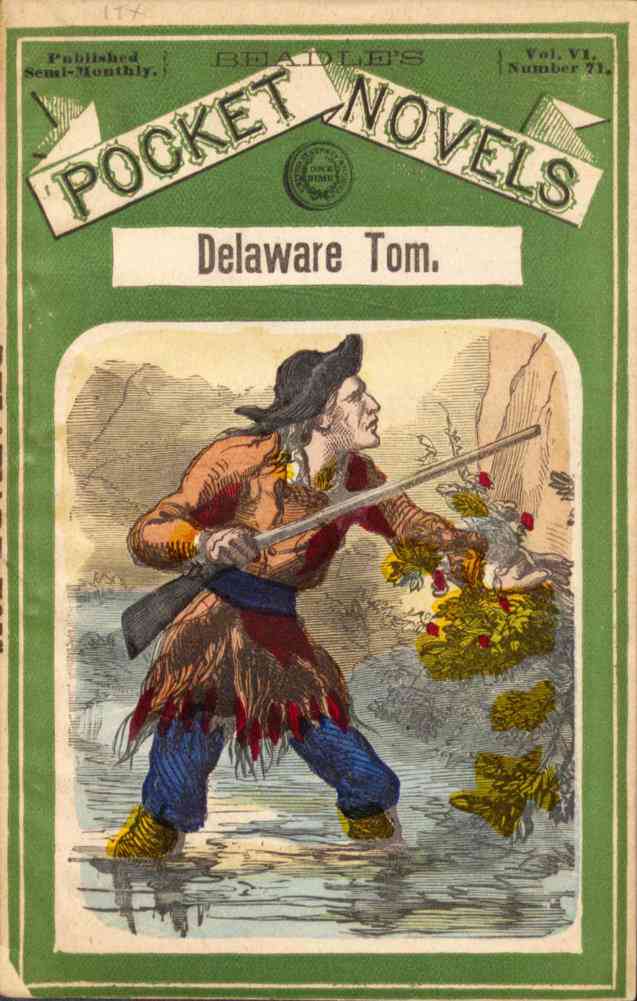
DELAWARE TOM.
Clara uttered a wild cry, and sunk back, with a shudder. She believed her pursuers had overtaken, and now held her captive; but in this she was mistaken.
“Do not be alarmed, lady,” uttered a low voice, close beside the maiden. “You are among friends here, who will protect you with their lives, if there be any need.”
“But he—he is an Indian!” half unconsciously murmured Clara.
“True, but he is far different from those who were chasing you. He is a true friend, and would fight in your defense quite as readily as I would.”
“Bes’ git back little furder. Injun shoot plenty straight by dis light. Ketch hoss—den be back, bumbye. Bes’ hide in bushes up dere, den Injun go by—won’t see um,” interrupted a guttural voice, evidently proceeding from the lips of the Indian alluded to.
“You’re right, Tom. They’ll be apt to follow back on their own trail, to see where she gave them the slip. Do you think you can walk, Miss?” he added, turning toward Clara; “or shall I carry you? There is danger in lingering here.”
“Thank you—I will walk. If you lend me your arm I think— Ah!”
Clara rose to her feet by clinging to the strong arm of her new-found friend, but then, with an agonized groan, she would have fallen to the ground, had not his arms encircled her fainting form. The violent fall had evidently injured the maiden far more severely than she had at first believed.
“Lead the way, Delaware,” muttered the man, as he raised the girl in his arms. “Quick!”
The Indian turned and glided along the level plat for a few yards, then began ascending a steep incline. Up this for a considerable distance; then he paused before a dense growth of bushes, that seemed to shoot out from the very face of the bank.
The man bearing Clara was quickly beside his red companion, and then they all entered the bushes, disappearing from sight.
This spot was upon a hillside, at whose base ran a clear stream of water. Beyond this, again, was a level strip of ground, studded thickly with little clumps of trees and undergrowth.
The three persons were ensconced within the bushes, close against the rocks, that uprose, bare and gray, for nearly a dozen yards, sloping so that a stone dropped from the escarpment above, would touch the ground several yards out from the base. This cliff, however, only extended for a short distance upon either hand; then it ran out into a steep hillside, down which, on one hand, Clara had been cast by the stumbling of her horse.
“How do you feel now?” asked the white man, after a moment’s rest.
“Better, though still faint and dizzy. But how— I remember falling, and then all is blank. How did you find me, and where am I? There were some Indians chasing me; where are they?” confusedly asked Clara, in a faint tone.
In a few quick words the stranger explained the part he had played in the adventure.
He was an officer of a Government train of supplies, and had started out on a scout, together with one of their guides, an Indian named Delaware Tom, but had become belated while following up a trail. They had resolved to encamp for the night, when they were aroused by wild yells and the sound of hoof-strokes.
Then they saw a woman rise the hill’s crest, and almost immediately fall from her horse, as it stumbled. He sprung forward and caught her, while Delaware Tom crept to the hill-top to learn what had so alarmed her.
He soon made out the figures of the pursuing savages, and then the two scouts had hidden in the bushes, with the unconscious maiden, until the war-party had thundered by, in hot pursuit of the riderless horse. Then they had hastened with Clara to the creek, where they succeeded in restoring her to consciousness, by the plentiful use of water, aided by a stronger fluid incased in a flask carried by the captain.
And then Clara briefly detailed her portion of the adventure, adding:
“If I do not thank you for this service, it is because I can not find words to express my feelings. I would rather die than fall into their power!”
“Thanks are not needed, believe me. I am amply repaid already for the trifle I was enabled to do, by knowing you are safe from those fiends. But you spoke of your father—is it possible that he is my old commandant, Major John Calhoun?”
“He served in Mexico, and his given name is John.”
“It must be the same, then! Did you never hear him speak of Harold Travers? He saved my life at Cerro Gordo,” eagerly added the captain.
“Indeed I have; he often mentions your name. And now you repay that debt by saving the life of his daughter. He has often wondered where you were, and it will be a happy meeting; one that I trust will take place very soon.”
“Bes’ not mek talk now,” interrupted Indian Tom, significantly. “’Rapahoe he come back plenty soon. Find hoss—mad like de debble ’cause don’t fin’ squaw, too. Hunt fo’ her heap, mebbe. Won’t git her, dough, ’less kin whip us.”
“You’re right, Delaware. I can hear the sound of their horses’ hoofs on the rocks.”
“Are they coming? My God! I thought I had escaped them for good!” moaned Clara, fearfully.
“Have no fear, Miss Calhoun,” returned Travers. “They shall not harm you, even if they chance to discover us. There are only half a dozen in all, and surely we two can manage them. Can’t we, Delaware?”
“Yeh, fo’ sure. Don’t know much how mek fight, ’Rapahoe. Big cowards, dey is. Got white man ’long, dough.”
“Are you sure, Tom?”
“See um. Know um, too. Name Dusky Dick. Big decoy. White Injins—plenty bad—more so dan oders. Play snake fo’ train, so Injin git ’em,” tersely added the Indian.
Clara uttered a faint cry of apprehension, at the sound of his name, for she knew that now indeed she was in danger. The threats of Dusky Dick came back to memory with renewed force, and knowing, as he must, that she was astray in the mountains, he would spare no pains in order to make his words good.
“I see you know him, too; but never mind now. We must not converse any more. See! the devils are in sight, down yonder by the creek.”
Cautiously peering through the leafy screen before them the three fugitives could just distinguish the faint, shadowy outlines of a number of horsemen, down in the valley. These soon crossed the creek, and then one being left in charge of the horses, the rest—six in number—dismounted and began quartering over the ground, like hounds searching for a lost scent.
The soldier tightly compressed his lips, and grasped his rifle with deadly determination. He saw that the enemy had evidently divined the manner in which their anticipated victim had escaped them—at least in part—and believed she was still hiding in some place in the vicinity.
It was not probable they were aware of the presence of other foes in the neighborhood, else they would have displayed more caution. Evidently they believed Clara had abandoned her failing horse, and sought safety by lying in concealment.
The moonlight was too faint and uncertain for the savages to learn aught from a trail upon the rocky ground, and that fact was in favor of the fugitives. Still, there could be no denying that they were in imminent peril of their lives.
The Arapahoes scattered and began a close and systematic search of the ground, peering behind each bowlder, into every bush and cranny where a human form might possibly have sought refuge. The six were widely scattered, the better to compass their purpose.
Upon the movements of one of the savages in particular, was the attention of the three friends riveted. He alone of the party was in close proximity to the hidden prey.
He was a large, brawny warrior, and was now gliding along the hill-side, gradually approaching the covert of our friends, carefully scrutinizing every yard of ground as he proceeded. Presently he paused and glanced keenly around him. Then his piercing gaze rested fairly upon the line of bushes that screened the base of the cliff.
His tall, muscular frame, drawn rigidly erect, in all the pride of war-paint and plumes, looked grandly terrible in the glimmering moonlight, and even the eyes of Delaware Tom emitted a momentary gleam of admiration as they dwelt upon the perfect figure. But then this gave place to a glare of deadly hatred as if he recognized a bitter personal enemy in the warrior.
The Arapahoe stood thus for a moment, and then began gliding up the hill-side, his eyes seeming to pierce through and through the screen, so keen was their glance. He saw that this was a good cover, and believed or hoped that the fugitive had taken refuge there.
Travers crouched down and drew his revolver, with a stern demeanor, but then a light touch upon his shoulder caused him to turn his head. The Delaware made a peculiar gesture, and then hissed:
“No shoot—mek too much noise. Let Delaware tek him. Know um—he kisch-kouch—big t’ief—me kill him heap sure. Tom’hawk mek no noise.”
“You’re right, Tom, I forgot,” muttered Travers, below his breath; and then fearing to say more, they watched the red-skin’s progress in perfect silence.
The Arapahoe did not pause, but kept on until he could touch the bushes with his outstretched hand. Evidently he did not dream of danger to himself, for he believed the fugitive maiden was alone.
Then he reached out and parted the bushes. This he did at a point some yards to the left of where the trio were concealed, and a grunt of disappointment broke from his lips, as he discovered nothing but bare rocks.
Then he moved nearer, parting the bushes at each step, steadily nearing those which concealed the three friends. His hand rested upon them, and then they were gently pressed aside.
The Delaware was prepared for this move, and as the moonlight shot into the aperture his uplifted hand fell, clutching the heavy tomahawk, whose keen edge alighted fairly upon the bowed crest of the savage. The blow was delivered with a sure aim, and was deadly in its effects.
But as the left hand of Delaware Tom shot out to clutch the throat of the Arapahoe, to check any outcry, the stricken savage bounded back and uttered his thrilling death-cry. This was done so quickly that it could not be prevented.
But then, ere the lifeless body could touch the ground, it was seized by the Delaware and pushed into the bushes. Then, for a moment, all was still.
Only for a moment, however, for then the comrades of the slaughtered brave took up the yell, and echoed it long and loud, as they intuitively drew together, in wondering alarm. They well knew it was a cry from death-stricken lips, but what had caused it, or from what direction it had come, they knew not.
The cry had echoed through the hills, sounding from several different points, and no two of the party could agree upon which one was the right. A glance told them that one of their number was missing—the best and bravest warrior among them all.
They were within fair view of the spot where the brave had met his death, although, of course, ignorant of that fact, and had the fugitives deemed it prudent, they could easily have sent a brace of rifle-bullets into the little crowd. But, as long as the savages did not molest them, Travers was willing to do likewise, now that a helpless woman was under his protection.
Though he did not greatly fear the result of a collision with the six, he did not deem it prudent to invite such, under the circumstances. A random shot might work incalculable harm.
Clara shuddered convulsively as a peculiar sound met her ear, from where Delaware Tom was crouched. She knew he was scalping the dead brave, although she could not see the action, as the thick-matted screen of bushes effectually shut out the light of the moon.
With a grunt of satisfaction, Delaware Tom affixed the reeking trophy to his girdle, and then turned toward the soldier. Side by side, they peered out upon their foes in the valley.
“Big fools plenty skeered,” chuckled Tom, as he noted the irresolute air of the enemy. “Little more mek ’um run like de debble. S’pose shoot one, two time, dey run way off. Git scalp, too. Kin hit ’um from dis,” he added, eagerly fingering his rifle as though longing to begin the affray.
“No, Tom, you mustn’t do it. It would not be safe. Were we alone, I wouldn’t care how soon you began it, but now we have another to look out for, besides ourselves. She might get hurt.”
The Delaware did not reply, but he was evidently dissatisfied. He had tasted blood, and it had aroused all the worst passions of his half-tamed nature.
The savages appeared to be undecided as to the course best for them to pursue, and for several minutes conversed earnestly together, closely watched by their hidden foes. But then there was a decided move on the part of the former.
One of their number moved toward the horses, and, mounting, rode rapidly off up the valley, soon disappearing from view.
Travers and Toni exchanged glances. Right well they divined the meaning of this move, and it evidently caused them not a little uneasiness.
“He’s gone after help,” muttered the soldier.
“Yeh. Dat’s it. S’pose we stay here, den dey ketch us all, same like buff’lo. S’pose we don’t like dat, den we mus’ git ’way, ’fore dey gits back ag’in. Dat right, eh?”
“Yes; we must make a move. Surely we can manage those fellows, yonder. If we do, and can catch some of the horses, we can ride back to camp to-night. But how shall we do it, Tom?”
“Stop—me t’ink a little. Plenty time—no hurry,” and then the Delaware appeared deep-buried in thought.
CHAPTER VI.
TOM MAXWELL TURNS INDIAN.
Major Calhoun and Tom Maxwell “listened with all their ears,” for a sound they fervently hoped would never come—the wild yells of exultation, telling that their messenger had been captured by the Indians, and the dissipation of their last hope.
And thus they remained for several minutes, without a sound to greet their hearing, save the usual ones of the night. But then, just as they were congratulating themselves upon the complete success of the venture, their blood was fairly curdled and their hearts wrung by a startling alarm.
From some distance came the noise, then arose a wild tumult and outcry, as of human voices, the owners of which were engaged in a bitter struggle for life and death. And then from the prairie around the beleaguered train, there sounded the shrill cries and signals of the aroused warriors, followed by the rapid tread of several horses in full gallop, all tending toward the point below, where had first sounded the alarm.
“My God! Tom, the boy is lost!” groaned Calhoun, agonizedly, as he sunk back and covered his face with his hands.
“I’m feared he is, boss, but look up. Don’t give way now, jest when we need our wits the wust. What’s did is did, an’ cain’t be ondid, nuther. Think o’ the rest—o’ Miss Clary—an’ ’member ef we go under, so’ll she, ’thout a doubt. Ha! look—they’re comin’!” he added, suddenly, as several figures appeared in view upon the prairie beyond. “Look out, boys—gi’ the pesky imps a lettle thunder, jest to let ’em know what they’ve got to ixpect herea’ter!”
As he yelled these words, Maxwell discharged his rifle at a prominent Indian, who suddenly paused in his onward career, tottered for a moment, then fell heavily forward upon his face. And along the line of smoke-begrimed wagons there was another flash, like those which had preceded it, with a like deadly effect.
But the one volley was all that was needed, for then the savages appeared to melt away and disappear from view. This had evidently been no concerted assault, but the red-skins had rushed forward, alarmed by the tumult below, no doubt fearing their intended prey were attempting to escape by way of the river.
When the temporary confusion had in a measure subsided, the two men listened anxiously for some sound from below, to tell them of the probable fate of their messenger, but all was still. The event had evidently decided, in one way or another, during the brief assault.
And they naturally dreaded the worst. The first yells told them that Buenos Ayres had been discovered, and had been engaged in a death-struggle with the enemy. He could scarcely have escaped.
“Now we are indeed lost,” bitterly uttered Calhoun, to the old guide.
“It looks dub’ous—durned dub’ous, I must say. But then mebbe ’tain’t so bad as it looks. We may fool ’em yit. It’s my turn, now,” added Tom, with a sudden increase of confidence.