
“What? you would not be foolish enough to attempt that? They will be watching the river so close after this that a fish could scarcely pass their lines. It would be suicide, man!”
“Jest so; ef I tried it—which I don’t ’tend doin’. No sir, I ain’t sech a fool—yit!”
“Then what do you intend doing?”
“Walkin’ out thar an’ j’inin’ them imps,” coolly returned Maxwell.
“This is no time for fooling, Tom. Our situation is far too serious to admit of that. Such a move would be even worse than the other.”
“Not much. Anyhow, I’m goin’ to try it. They cain’t do much more’n kill a feller, anyhow, an’ ef we stay here they’re bound to do it, shore. So what matter? I’m goin’ out thar, an’ they hain’t a-goin to hurt me, nuther,” confidently added the scout.
“But how—what do you mean?” asked Calhoun, seeing that his companion was undoubtedly in earnest in what he said.
“I’m goin’ to turn Injun fer a bit, jest to see how that pesky Dusky Dick must feel. But don’t talk. Watch the perayrie cluss—watch fer both on us, fer I cain’t do my shar’ now.”
The old scout left the side of the puzzled soldier, and glided toward a pile of dead savages, who had been carelessly heaped together, after the second assault, so as to clear the way. These comprised all those who had fallen inside the corral.
As he rudely turned these over with his foot, Tom uttered a grunt of approval, and then catching one of the dead braves by the arm, he dragged it to the spot where crouched Calhoun.
“What are you going to do with that, Tom?”
“Goin’ to skin it, fust. Then putt on the hide an’ walk out yender an’ tell those imps as how I was dead, but hev come to life ag’in,” chuckled the old guide.
Calhoun uttered an exclamation of disgust.
“Don’t git huffy, now, boss, ’cause I speak sorter mixed-up like. You know my way, or had orter by this time. But lis’en an’ you’ll see what I mean. You see this ’ere carr’on is—or was, I’d orter say, mebbe, seein’ as he’s dead—a Delaware Injun. That proves what I said ’bout Dusky Dick’s hevin’ picked up a band of runnygades to do his dirty work, fer thar is ’Rapahoe, Cheyenne, Pawnee, an’ Delaware ’mongst them dead critters over yon.
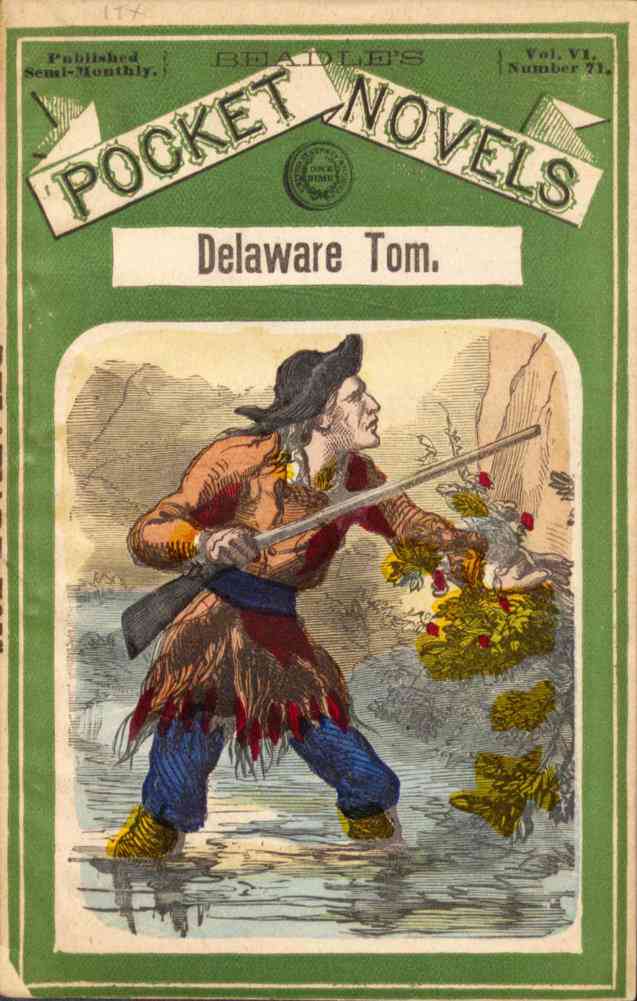
“Now I kin jabber a lettle o’ most all o’ them, but better Delaware, fer as you may know, I hed one—Delaware Tom they called the cuss—fer a pardner, well-nigh two years. So as the lad—durn the luck!—hes got rub—inter trouble I mean, an’ cain’t go fer help, why I ’termined to try an’ sneak through them imps thar. I knowed thar was no use tryin’ to play the runnygade as he did, fer the imps’ll be on the keen look-out thar, an’ this was the only chaince. An’ a durned slim one, too, but better’n stayin’ here.”
“We will try, but I fear ’tis a hopeless case. If they make another steady rush, we must go down before it. If we do, and you get free, Tom, promise me one thing: that you’ll not forget Clara? You’ll hunt for her?”
“No, I won’t, nuther.”
“What!”
“Jest so. Give a fool answer fer a fool question, is my motter, al’ays. Ain’t I a man—a white man, too, ef so be you rub a lettle o’ the outside dirt off? Then in course I’ll do it—I ain’t a dog nor nothin’, I reckon. But don’t fret. We’ll all hunt together. I’ll git you free. See ef I don’t, now.”
As he spoke, the old guide glided toward the river, accompanied by Calhoun. But as he hung his legs over the edge of the bank, Maxwell suddenly added:
“Look here—ef you see or hear a feller shoot this-a-way, from out thar, nigh to the river, don’t you shoot back, onless you aim at that big star, yonder. Mought hurt somebody, ef you did. He’s a powerful poor shooter, that fellow’ll be, when he minds to. Shouldn’t wonder ef he’ll miss the hull intire train, wagons an’ all,” chuckled Tom.
“You mean you’ll fire from there?”
“Yas. Must throw dust in the red-skins’ eyes, ye see, or else they’ll some on ’em be snoopin’ ’round to see who I be, which moughtn’t be pleasant. Ef they see me a-shootin’ this-a-way, they’ll natur’lly s’pose it’s one o’ themselves, slid out to play a lone hand. See?”
“Yes—I understand.”
“Then keep my rifle. I cain’t han’le it the way I must go; ’volvers must sarve me. But don’t let nobody tetch it. I’d be plum lost ef any thin’ was to happin to it; I would so!”
Then Maxwell slid down into the water, that here was but little over knee-deep, and crouching low down he glided rapidly up the river, bound upon a mission that could scarcely succeed, now that the enemy had their eyes opened by a somewhat similar attempt. And once more Calhoun went back to his post, with a heavy gloom resting upon his heart.
Tom stealthily pursued his way up-stream until he was fully a hundred yards above the corral, when he gained the spot for which he had aimed. This was a little depression that ran from the water’s edge, some few yards into the level prairie.
Here he hesitated for a moment. He glanced along in the direction he had been pursuing, and debated earnestly in his own mind whether it would not be better for him to keep on, and by thus rounding the hill, avoid a probable meeting with those beleaguering the corral.
But this hesitation lasted only for a moment. He saw that the contemplated change was now impossible. That the savages had guarded against any such attempt upon the part of their intended victims.
His keen eye caught sight of several dusky figures that he felt assured were none other than Indians, who had been detailed to guard the stream above. And this was not all.
He also saw enough of their movements to tell that he was discovered; that his progress had not been so cautiously made as to escape the prying eyes of his enemies. A quiver agitated his frame, and for a moment his heart was sick within him.
Not with personal fear, however. There could scarcely be found one who was more utterly reckless of his own life than this same guide. For nearly two score years he had lived with his life in his hand. At dawn he knew not whether he would ever again look upon the setting sun.
And all this had rendered him utterly reckless and devoid of fear, so far as he was concerned alone. But now he had others to think of and work for. Upon the success of this venture probably hung the lives of the entire company of emigrants. Were he slain or captured, he believed that ere the sun arose all would be over; that his friends would be swept from the face of the earth.
For a moment he half resolved to spring to his feet and dash swiftly away over the plain, trusting to his great endurance and fleetness of foot to escape. But then this idea was as quickly discarded.
He knew that such an action would but too surely betray his identity, and that a cry would be raised and immediate pursuit instituted. Pursuit, too, upon horseback; fleet though he undeniably was, and long of wind, he could not hope to cope successfully with the fiery, half-wild mustangs, especially when bestrode by those rare jockeys, the Prairie Indians.
Maxwell resolved upon a bold course of action; or rather fell back upon the old plan. Its success mainly depended upon one thing.
How long had the red-skins been watching him? Had they observed his leaving the interior of the corral? If so, then his fate was indubitably sealed.
But had they only noted him recently—as he hoped; for he had been careful to keep low down within the dense shadow of the bank of the river, where the moon’s rays could not reach him—he thought he might yet succeed in deceiving them. And upon this hope he acted.
With one glance behind him, at the dim, phantom-like figures that were still stealthily approaching him, Maxwell emerged from the hollow, upon the side toward the corral, and, upon his hands and knees, began crawling quite rapidly toward the wagon-train. Then he dropped down quite flat upon his face, casting a glance behind him as he did so.
The red-skins in pursuit had just crossed the ditch, and were crawling after him. They had gained rapidly in the last few minutes, and their dress, as well as weapons, could now quite plainly be seen.
Then Tom leveled his revolver toward the corral, taking care to aim above it, so that the bullet could by no possibility inflict harm upon any of his friends, he fired. Almost like an echo, there came a return shot from the train, and Tom fairly chuckled with delight.
This was just what he had hoped for, though he feared Calhoun would not risk a shot, knowing the circumstances, at least in part. But now, nothing could be better calculated to allay any suspicions the red-skins behind him might have entertained.
Tom glanced backward, beneath one arm. To his delight, he saw that the Indians had paused, and were now closely hugging the ground, evidently trying to lessen the mark their bodies presented, lest a bullet from the corral should bury itself beneath their precious hides.
“Ef that much works so well, reckon I’ll go a leetle furder ’th it, though it ’d jist be partic’lar ge-mineezers ef some o’ the boys should shoot me fer a red. But I reckon the boss ’ll look out fer that. Anyhow, I must shake off them pesky imps. Let ary one o’ them git a glimpse o’ my mug, an’ it’ll be all night ’th this coon, shore!” muttered the old guide, as he gradually worked himself still nearer the corral.
This move, though not a little hazardous to himself, had the desired effect, and as he once more glanced back, Tom saw that his red-skinned followers had retreated, and were hidden from view. He now fired again, and while reloading the empty chambers, he busied himself by peering keenly around him, to discover, if possible, some point through which he could pass with the least delay, and consequently peril, to himself and important mission.
He dared not dally long, for the night was rolling on apace, and he must be miles away from this spot ere the sun arose above the eastern hill-tops. Then, with sternly-compressed lips and finely-strung nerves, he started anew upon his errand.
He turned, and still crouching far down, with head bowed so that the dried grass was blended with his hair and long beard, completely hiding his features, he glided slowly away from the corral, shaping his course so as to carry himself to one side of the main body of Indians, as he calculated.
Already a chuckle of delight was tickling his throat, as he saw how finely he was progressing, for he believed that his ruse would succeed, when an incident occurred which changed his exultation to angry apprehension.
From a dense mass of dried grass, almost directly in his path, there uprose the figure of a stalwart savage, who had doubtless been observing the scout’s movements. He was now so close that Maxwell could not avoid him without exciting suspicion, which would bring with it investigation and consequent discovery.
So he kept on in his course, that would carry him a few feet to one side of the Indian. But the other did not seem disposed to allow his seeming ally and brother to pass by unquestioned.
He spoke in a harsh voice that also expressed suspicion. The words were uttered in the Arapahoe dialect, with which Tom was sufficiently conversant to comprehend their purport. But he well knew that this knowledge was not perfect enough to carry him through a conversation with a native undetected, and so he replied in Delaware:
“I am wounded. The accursed pale-faces saw me as I crept up out yonder to try and kill them, and shot me. The bullet made me sick,” he said, in a husky tone.
“Where were you going?” demanded the other, also using the dialect.
“I was hunting the medicine-grass,” added Tom, fearing to lose any more time, and again crawling forward.
“Stop! Let me see your hurt. I may stop the blood, and then I will find the grass for you,” added the Arapahoe, in a kind voice, evidently swallowing the lie, and feeling no further suspicion concerning the identity of his seeming ally.
And, then, in the kindness of his heart, he strode forward and placed his hand upon the disguised scout’s head. The act was a fatal one; the fastenings of the grass head-dress became unloosened, and the mass came off in the Indian’s hand.
A wild cry broke from the red-skin’s lips, as the bright moonlight fell fully upon the features of the guide. There could be no possibility of mistaking them for other than those of a white man.
But that cry was his last upon earth; for, with an angry howl of furious rage, Tom Maxwell sprung erect, and grappled with his foe. His powerful arms bore the savage to the ground like an infant, while his hands were clasped tightly around his throat.
As they fell heavily to the ground, the warrior appeared to recover from his surprise, and struggled desperately for dear life. His arms were wound around the scout’s body with crushing pressure, and he writhed like a wounded snake in the endeavor to turn his foe.
Tom dared not relax his grasp upon the throat of the Arapahoe, lest he should cry out and give the alarm, to bring an overwhelming force upon him; then his fate would be assuredly sealed. And thus he could only try to throttle his enemy in time to flee from the spot before any other should be alarmed by the struggle.
For several seconds this continued; but then, to his horror, Tom heard a wild cry, and then the rapid rush of many feet, plainly coming toward him. He knew that the savages were alarmed, and had caught sight of the struggling foemen.
With a howl of rage, he freed one hand, and drew his knife. Then it glowed for a brief instant in the bright moonlight before falling with a heavy thud, sinking to its very haft in the broad chest of the Indian.
But still, even in the throes of death, those muscular arms held him firmly, despite Maxwell’s efforts to break the grip. With a desperate effort, Tom sprung to his feet, lifting with him the dead man, whose horribly-convulsed features stared him full in the face.
Then, with a fierce curse, Tom wrenched free, and made a step forward as if to flee. But he was too late.
The enemy were upon him, and the tall scout was cast heavily to the ground, with a dozen hands clutching him. A brief, furious struggle, and the savages arose, while the counterfeit Indian lay beside the body of his dead foe, a helpless captive.
CHAPTER VII.
A TANGLED TRAIL.
Buenos Ayres had not overestimated the danger and peril that would attend his effort to pass by the vigilant red-skin, on his journey toward the Main Trail, in quest of help for the beleaguered emigrants.
And then, under the circumstances, he was about the last person who should have been chosen as the forlorn hope, although he was undeniably brave, and usually, keen-witted and far-seeing. But now these latter qualities were in a measure overpowered by the anxiety he felt to perform his mission with the least delay possible, in order that a thorough and systematic search might be made for the missing maiden, Clara Calhoun, and, to this desire, he sacrificed prudence and caution to a degree nearly fatal.
He swam rapidly down-stream, though the water was not waist-deep, but, in this manner he could proceed more silently than by wading. He lay low down in the water, that he might present a less fair mark for prying eyes to rest upon, and, hidden in the shadow, he believed that he could succeed in passing the lines of the enemy, unseen.
In this manner he had gained the edge of the timber, before-mentioned, that extended nearly to the verge of the river-bank. But then he suddenly paused in his advance.
Before him lay something dark, evidently resting in or upon the water, and at only a few yards’ distance. For a moment Buenos believed that this was the head of a man, whose body—like his own—was covered in the water.
But then a movement on the part of the object undeceived him. It slowly swung around, as though under the influence of the feeble current, and he could see that it was a log; evidently one of those upon which the savages had descended the river, in order to gain and attack the rear of the emigrants.
With a low laugh at his unnecessary fright, Ayres advanced, swimming rapidly, intending to use the log in his further progress. But he speedily saw that this action had been made too quickly for his own safety.
His keen eyes detected a suspicious circumstance connected with the log, and he instantly paused. From the further side of the stick he beheld an object that had escaped his eyes before, or else had recently made its appearance there.
There seemed to be a roundish knob or protuberance upon the side of the log. True, this might possibly have been beneath the water until then, and was only revealed by the rolling of the log, but Ayres felt confident that the log had not rolled. He could tell that from the quiet water.
Then it must be— So far he had reasoned, but then, quick as thought, he ducked his head beneath the water.
A sudden movement beside the log had caused this. He beheld the round object raise still higher, and then with an abrupt movement a dark tube was whirled around from the top of the log, until its muzzle pointed toward the young adventurer’s head.
The knob was the head of a savage—the tube was a rifle, and Ayres knew that he was discovered. All this flashed athwart his mind like a revelation of light, and, as he dove beneath the surface, his plan of procedure was fully determined upon.
He must dispose of this enemy or die. The alarm once given, escape would be almost impossible, and with his capture, the hopes of the emigrants would be crushed.
Then he must silence this foe before he could fire his rifle or give the alarm otherwise. But could he do it? That was doubtful; still, as a last hope, he resolved to attempt the feat.
As he sunk beneath the surface, Buenos drew his knife, and then swam with swift, strong strokes toward the spot where he knew the Indian must be crouching. And his calculations proved correct.
His head struck violently against the half-submerged log, and springing up he dashed the water from his blinded eyes.
The savage was taken by surprise, and evidently had not expected such a bold move. Quite likely he had been in doubt whether the advancing figure was that of an enemy or a friend, as the small bundle fastened upon Ayres’ head, added to the gloom, rendered it impossible for a glimpse to be obtained of his features. His action in throwing forward his rifle-muzzle, had simply been one of prudence, in case it was really an enemy who approached.
Then when the young man sprung up so suddenly before him, the log being driven against his body with considerable violence, the savage gave vent to a grunt of mingled surprise and bewilderment. But from this he quickly recovered.
Buenos—his first thought being to prevent an alarm—seized upon the rifle-barrel, and with an adroit movement, wrenched it from the grasp of his foe, with the same gesture casting it out into deep water. Then his left hand shot out and clutched the throat of the red-skin with a grip strengthened by the great interests at stake.
But the Indian was a brawny fellow, and as he grappled fiercely with his foeman, he freed his throat sufficiently to emit, loud and clear, the thrilling war-whoop of his tribe. With a curse of bitter vexation, Ayres wrenched his right arm free, and then dealt the savage a swift, vicious blow with the heavy knife.
It penetrated deep, but the wound was not mortal. Once more the shrill yell resounded through the air, awaking echoes far and wide; once again the crimsoned steel rose and fell, with a dull, sickening thud.
With a wild shriek of mortal agony, the death-stricken savage sunk backward, but still his bony fingers clutched the white man with a grip nerved by death. And from the prairie beyond, Ayres could hear the shrill cries of the alarmed red-skins, and then the rapid thud of horses’ hoofs approaching the spot at a full gallop.
Then he plunged over the log, head-foremost, and sunk in the water. This action freed him from the dead Indian, and then arising to the surface, Buenos swam for dear life, down-stream.
But he knew that did he continue on in this course, he must be discovered by the rapidly approaching red-skins, and so he turned toward the bank, half resolved to enter the timber and seek safety in flight by land. In this, however, he was disappointed.
Scarcely had he touched shore, when his quick eye detected several dusky figures upon the bank, near the spot where he had slain the Indian. He knew they were the dead man’s comrades; one glance told him that.
And the same glance also showed him the form of the dead Indian, his face, horribly distorted with the last agony, upturned toward the star-studded vault of heaven, slowly floating down with the stream, nearing its slayer, with each passing moment. Then there uprose a wild cry from those upon the shore, telling that they, also, had discovered the slain man.
It now seemed as though the fate of the young man was indubitably sealed. Escape from being discovered seemed impossible, and to be captured now, with that terribly significant witness of his deeds lying there before the eyes of all, meant death.
Several heavy splashes were heard, and Ayres saw that while some ran along the bank toward him, others had entered the water, to drag forth their dead comrade. And now the corpse was within a few yards of where he crouched, while almost directly over his head he could hear the heavy tramp of other foes.
Ayres shrunk back against the bank, where the water was still several feet deep. He clutched his knife with desperation, resolved to sell his life dearly, should he be discovered. But then his heart thrilled with a gleam of joy.
In the bank beside him was a small hole or depression, that had evidently been washed out by the action of the water. Instantly one hand was extended to ascertain its size.
It only reached a few inches above the surface, and was over a foot in depth, running back into the bank. Below, it was still larger, and Ayres believed that by its aid he could still escape his foes.
All this occurred in a breath of time, and the water was still agitated by the heavy plunges, when Buenos glided back and into the fortunately discovered refuge. By crouching almost double, he managed to stow his body away in the hole, with his legs doubled beneath his body.
A quick gesture daubed his face with the soft black mud, and then Buenos awaited the result in painful surprise. For not only did his own life depend upon it, but, in all probability, those of his friends in the besieged corral, as well.
His head was drawn back into the hole, so that his nose was barely above water, and his face beyond the surface of the bank. The mud had rendered his features the color of the dirt surrounding, and only by touching him, could the savages have discovered the difference.
Through his half-closed lids, Buenos watched the movements of the savages, now almost directly opposite him. A shower of dirt rolled down from above, telling that those he had noticed on shore were still near at hand.
Then a new and startling sound came to the ears of the young adventurer. He heard the shrill yells—the wild outcry—the rattling of rifles, all telling of another deadly assault upon the wagon-train.
The savages in the water paused as if startled, and then hastily grasping the body of their dead comrade, they swam rapidly ashore with it, landing just below where crouched the young man. Words passed between them and the others, the purport of which Ayres could only guess, owing to his complete ignorance of the dialect.
Then the corpse was handed up the bank, and shortly afterward Buenos heard the quick trampling of feet, as a number of Indians dashed away toward the train. He believed they were all gone, and made a movement as though he would have left his covert, in order to continue his journey, without any more loss of time.
But fortunately for him, Ayres recognized the folly of such precipitation, before it was too late. From almost directly above him, he heard the low sound of voices, and knew by it that his enemies had not yet given up the search for the slayer of their friend.
With wildly beating heart Buenos listened to the progress of the struggle above; but it speedily died away, and then all was still. The absence of the red-skins’ yells of triumph, told Ayres that his friends had successfully repulsed the onset, and his heart lightened considerably.
Had he only been at liberty to resume his journey, all might yet be well. But though he could no longer hear the sound of voices, Ayres felt assured that the red-skins were still upon the watch.
They must know that an enemy had stricken them a bitter blow near that spot, and would reason that he could not have gotten far away, before their arrival. That he was still hidden somewhere in close proximity to the spot of death.
As time passed by, Buenos began to grow still more uneasy. Every moment was valuable now, and he should even then be miles away upon his important mission.
But what if these savages should keep up the watch until day dawned? Then they would assuredly unearth him.
Not only would he be doomed, in such a case, but the last hope of the besieged emigrants would be dashed to the ground. Unassisted, they must soon succumb to the overpowering force of the red-skins.
A desperate resolve began to shape itself in the mind of our young adventurer. He would dare all, and emerge from his covert. It could be but death, at the most, and that risk he would rather run, than longer endure this horrible, agonizing suspense.
Still he could hear no sound of his enemies, and as the moments passed on, Ayres made the desperate move. Were the Indians still lying in wait for some such movement on the part of their unknown enemy, he knew that he was lost.
They could scarcely fail to hear him, or discover his motions. The line of shadow was fearfully narrowed, and at but a short distance ahead, where the belt of timber came to an end, the bright moonlight revealed every inch of the water’s surface.
Just as he had straightened out his limbs, preparatory to emerging from his uncomfortable hiding-place, Ayres paused. Another alarm rung out upon the air, from beyond the wagon-train.
Then came a single shrill war-whoop, that he had so often listened to on that eventful night, followed by wild shouts from the Indians, telling of some important discovery. And then, from almost directly above his head, there sounded a guttural exclamation, closely followed by the tramp of human feet.
Ayres shuddered convulsively as he realized the extent of the peril he had so nearly brought upon himself, by his rash action. He knew now that the red-skins had indeed been lying in wait for him, and only for this strange diversion, would inevitably have made the desired discovery.
Though sadly puzzled to account for the outcry—for Ayres well knew that the latter cries were those of exultation—the young man dared not dally longer, but slipping forth from his hiding-place, he swam rapidly down-stream for a few yards, until near the end of the timber-belt furthest from the corral.
Then he cautiously scaled the bank, and entered the dense undergrowth. Pausing, he hearkened intently.
All was still in his immediate vicinity, although from near the wagon-train he could hear an occasional rifle-shot, telling that his friends were still upon the alert. And then he glided stealthily forward until at the edge of the prairie.
Cautiously peering forth upon the vast, level expanse thus spread before him, Buenos saw with delight that as far as his eye could reach, there was not a single living form to be seen. The road appeared open before him, and he was about to enter upon it, when a sudden recollection caused him to pause.
The revolver was still strapped upon his head, according to the advice given him by Tom Maxwell, but it was far from being in a condition fit for use. The sudden dive, on seeing the savage beside the log, added to several immersions since, had pretty thoroughly saturated it.
Not knowing at what moment he might be called upon to make use of this, in order to preserve his life, Ayres’ first move was to draw the bullets, and wiping the chambers dry, he carefully reloaded them. Then fitting on the water-proof caps, he replaced it in his belt, and once more stepped forth upon the prairie.
Had he not already lost so much time, Buenos would probably have exercised more precaution than he was now using. But, racked with anxiety and the dread of being too late to aid his comrades in peril, rendered him half wild.
Crouching low down, he ran at a rapid pace out over the level prairie, in the direction he must follow in order to strike the Main Trail, which they had so unfortunately—as it proved—deviated from, a couple of days previously. The moon still shone brightly, and there was great danger of his being discovered by some of the lynx-eyed savages, who surrounded the wagon-train.
But this, Ayres resolved to risk, rather than lose any more time, although he knew that, in case he should be seen, there could be but one ending to the affair.
Fortunately for him, perhaps the suspicions of the red-skins had been lulled by the recent capture of Tom Maxwell, for they believed him to be the one who had slain their brother below the corral, as well as the one beside whose body he had been captured. Thus they did not dream of another foeman being at liberty so near them.
As Ayres glanced back over his shoulder, a shudder crept over his frame, for he now realized the full extent of the great peril he was daring. Behind him he could quite plainly distinguish the dark corral, and still nearer, the numerous figures, dusky and phantom-like, moving restlessly hither and yon, that he knew were none other than savages.
It seemed as though they could not fail of seeing him, and as he once more sped on at an accelerated speed, Buenos listened with painful intentness, expecting each moment to hear the shrill war-cry peal forth, telling that the bloodthirsty demons were upon his trail.
But then he crossed the slight rise, and the fear-inspiring sight was hidden from his view. Then breathing more freely, he took the pole-star for his guide, and dashed on at break-neck speed, every nerve strained to its utmost tension, and his heart wildly throbbing with renewed hope of success.
For well-nigh an hour he maintained this killing pace, but then Nature forced him to slacken his gait, and proceed with more prudence. His eyes were roving upon every side of him, trying to recall some landmark, though he well knew he was yet far from the Main Trail—the object of his quest.
He crossed a slight swell and trotted down the opposite slope, into a sort of valley, if it may be called such. Then he began ascending the next rise.
Suddenly he paused. A suspicious sound saluted his hearing; the thud—thud—of a horse’s hoofs beating upon the hard turf in a full gallop.
And this, too, he soon found was approaching him, for the trampling grew louder and more distinct. But it was not coming from the direction of the corral, though this was Ayres’ first thought. Instead it was coming from directly in his front.
Buenos glanced hurriedly around for some cover within which to ensconce himself, but no such sight rewarded his search. There was not a bush or bunch of grass to be seen, within reach.
And at that moment the figure of a horse and rider loomed up, clear and distinct, upon the ridge, almost directly before the young man. As by an impulse, Buenos dropped flat to the ground, and drew his revolver, ready for use in case he was discovered.
Then the horseman came thundering on, seemingly about to ride directly over the prostrate form. A collision appeared inevitable, and Buenos, with tightly-compressed lips, cocked his pistol.
On thundered the horse, and was within a score of yards of the young man, when, with a wild snort, it turned to one side, then dashed on with accelerated speed, in its passage flinging a tiny shower of dust and sand over Ayres. A hoarse cry broke from the lips of its rider, as he swayed in his seat, but he did not appear to notice the cause of his animal’s affright, for he did not once glance around or backward, but rose the swell and disappeared beyond its crest with the same mad, reckless gallop.
Ayres rose with a cry of astonishment, as the man vanished from sight. A puzzled look rested upon his face.
In the brief glance he had obtained of the rider’s features, he knew that it was a white man but wonder had checked the cry of greeting, he would otherwise have uttered. Buenos did not know that the mad rider was none other than Dusky Dick, the traitor guide and black-hearted renegade; but such was indeed the case.
Had he known it, Ayres would have sent a revolver bullet hissing after the villain, on the instant, instead of now gazing at the little cloud of dust that was all there was left to indicate the swift passage. But then Buenos once more returned his way, with quickened steps.
CHAPTER VIII.
SAVAGE TACTICS.
“Look, Tom!” abruptly muttered Travers, gently touching the shoulder of his ruminating companion. “The red rascals are moving!”
The Delaware turned his keen eyes toward the valley and gazed for a moment in silence. Then he answered, in a slightly vexed tone:
“Yeh, dey go hide, now. Skeered plenty bad, dey is. Don’t know what to mek ’cause Kisch-kouch git killed. T’ink spirits here, mebbe. Go hide—den watch plenty sharp. Dat’s it.”
“But that will not do, Tom,” added Travers, vexedly. “They will keep us here all night, then. If we venture to move, they’ll pick us off, one after the other. I wish we had fired at them as they stood out there—but it’s too late now.”
“Yeh—see—dey hide now. Ought to shoot den—now can’t. Shoot—kill one, two, den oders run ’way off, like de debble. Cap’n he say no—see now dat Delaware was right,” tersely replied the savage.
“But what shall we do? That fellow has gone for help, no doubt, and when he comes back they’ll soon make this place too hot for us. As it is, those devils can hold us here as long as they feel like it. We can’t move without bringing out a rifle-bullet. Come, find some way, Tom,” impatiently added Travers, who evidently relied far more upon the cunning and resources of his companion in times of difficulty like this, than upon his own powers.
“Me do it. Skeer Arapahoe bad, dis time. Git scalp, too, ef don’t look out. No fun, dough, skeer dem—git skeered too easy—den run plenty fast. Got long legs, dem Arapahoes,” chuckled Tom, as he drew his knife from the belt at his waist.
“What do you intend doing, Delaware?”
“Keep eyes open wide, den mebbe so you see,” grunted the savage, who evidently felt his importance in no small degree.
With his knife he cut several scrubby bushes, and then bound them around his head and shoulders, but in such a manner that they would not interfere materially with his sight. This accomplished to his satisfaction, he turned toward Travers, who was now dividing his attention between his companion and the valley below, where the red-skins were hidden.
“Now you open ear—me tell. Injuns down dere—you here—me go some oder place. Den me shoot Arapahoe—de oders dey jump up, all same like rabbit—don’t know where me be—den you shoot—kill ’noder. Den me holler loud—you holler—dey holler an’ run like de debble, ’way off. See?” hurriedly explained Tom.
“You mean to crawl around them?”
“Yeh—dat’s it.”
“Then shoot one—”
“You shoot ’noder—den dey run ’way off.”
“I believe they would,” thoughtfully said Travers. “But it will be dangerous for you. Can you get down without their seeing you? If they do, you’re a dead man sure!”
“No—dey shoot, but can’t hit Delaware. Can’t hit—don’t know how shoot, dem Arapahoe. Hit hill, mebbe, not’ing else,” laughed Tom, a low, gleesome laugh, full of joy at the prospect of outwitting his hereditary foes.
“I know you think an Arapahoe is fit for nothing but crow-bait, Tom, but you may get fooled. Some of them are brave and cunning warriors—”
“No—no, Arapahoe squaw—all squaw!” angrily hissed the Delaware.
“Well, have it your own way. But be careful. Don’t be foolhardy, man, and throw away your life uselessly. Better go now; it’s growing late and there’s no time to lose.”
The Delaware turned away without a word, and passing his companion, he disappeared among the bushes beyond. Though he affected to laugh at the danger of his venture, nevertheless it was a perilous one, and one, too, that would require not a little caution and skill to carry out successfully.
As stated, the line of bushes fringed the base of the cliff, and then ran out, leaving the hillside bare and devoid of cover, except a few small bowlders and patches of stunted grass. For nearly fifty yards this stretch lay beneath the full vision of the warriors hidden below.
But Delaware Tom felt assured that he could accomplish the feat, and truly, he, if any one, could do so. Those who were with Kearney in California can bear me out in this assertion.
Aided by the leafy screen upon his head, and the bowlders scattered around, he hoped to pass over this open space unobserved, and this once done, he would have the best of cover for his further operations. As for the rest of the programme, he considered that the same as settled.
He knew that most, if not all the six Indians were Arapahoes, and as seen, he looked upon them with supreme contempt. He believed that at his shot, they would act much as he had said, and the way be easily cleared for his friend’s departure for the camp.
When he gained the end of the bushes, Tom paused and peered keenly out upon the valley below. But even his sharp eyes could not detect the presence of a foe, save in the riderless horses that were feeding on the bank of the creek.
Still, he knew pretty well where the savages were hidden, and acted accordingly. Now he was forced to “crawfish,” or in other words, to crawl backward, as his head and shoulders were the only parts of his person concealed by the bush.
By so doing he calculated upon reaching a little gully that ran down to the creek, unobserved, as the bush would seem to stand still, from where the Indians were hidden, for to gain this ditch, Tom would be forced to back directly from their position. All this had been foreseen by the Delaware and calculated upon when he spoke so confidently of success in his bold ruse.
Slowly and carefully he proceeded—or receded—crouching low down, keeping the leafy head-dress as steady as possible under the circumstances. His eyes were riveted upon the spot where he believed the Arapahoes to be hidden, his muscles in readiness to avoid a shot, should such be threatened, by a sudden spring.
But that shot did not come, and it was plain that the savages either did not notice, or else believed the bush to be a natural one. It would have required a long and careful scrutiny from the point where they were lying hid, to tell that the bush moved, for Tom was retreating in an almost direct line from them. Besides, the moonlight was deceitful and favored the working of the ruse.
Then Tom gained the edge of the gully, and gently backed over it, alighting upon his feet in the soft dirt and debris that covered the bottom. He listened intently for a moment, but all was still.
A glow of grim delight swept athwart his features at this, for he knew that the enemy were still ignorant of the plan on foot to circumvent them. The Delaware, now that the most difficult portion of his task was accomplished, felt no doubt but the rest would end as happily.
With the friendly twigs still upon his head, he turned and glided down the gully, after unslinging the rifle from his back, and carefully inspecting the cap. From seeing the enemy disappear, Tom had formed a pretty accurate idea of where they were hid.
He knew that they had not recrossed the creek, and consequently they only had an oblong circle of some two score yards diameter, in which to conceal themselves. Inside this, then, Tom knew he must find his game.
Gliding along, crouching so that his head was below the level of the bank, the Delaware soon gained the bank of the creek, and pausing, he peered cautiously toward the suspected spot. A low grunt of disgust broke from his lips, as he saw that a little ridge hid the Indians from his view, while standing in the gully.
Then his eyes roved around, restlessly. A brief moment sufficed to form his plans.
Removing the revolver from his girdle, he entered the stream, and then holding the weapon above the water, he glided slowly along toward the enemy, hidden, as before, by the bank. As many minutes sufficed to carry him over the few yards necessary to traverse, and then, confident that he had gained a point whence he could spot the red-skins, Tom prepared for action.
The revolver he cautiously shoved upon the edge of the bank, beside a small bowlder, and then followed it with the muzzle of his rifle. But then, with a sudden recollection, he paused.
Along the bank, for a number of yards, there was not a bush or shrub of any kind to be seen. Although he affected to despise the Arapahoes as warriors, the Delaware knew right well that the sudden appearance of a bush where none had grown before, could scarcely escape their keen eyes; and, under the peculiar circumstances, its appearance would most probably be greeted with a rifle-ball.
So he noiselessly untied the thongs that secured the leafy head dress in place, suffering it to drop into the water, and float away with the gentle current. Then he slowly raised his eyes to a level with the bank.
For a full minute nothing suspicious rewarded his gaze; but Tom was by far too cunning a scout and warrior to risk the success of his plans by a precipitate movement. Then his eyes slowly roved over each inch of the ground, again and again.
The wisdom of this caution was soon apparent. Beside a goodly-sized bowlder, the Delaware now discovered a portion of a red-skin’s body, though at first it had appeared part and parcel of the stone.
This was enough. Tom knew that sufficient was revealed to bury a bullet in, so that it would touch the seat of life, and that by waiting for a better target, he might spoil all.
Slowly and deliberately, as if aiming at a target of wood, the rifle drew upon the unsuspecting savage, and the black eye of the Delaware flashed along the dark tube with a deadly glare. And then his finger tightened upon the trigger.
The whip-like crack rung out with startling clearness; but it was blended with a horrible yell of agony, as the stricken savage writhed upon the ground in his death-throes. Delaware Tom seldom found it necessary to fire twice at the same object.
As the sounds broke the air, the horses, that had been quietly cropping the rich grass, snorted with affright, and after turning their heads wildly, sprung off a few yards; then stood with trembling limbs, eying the strange scene.