
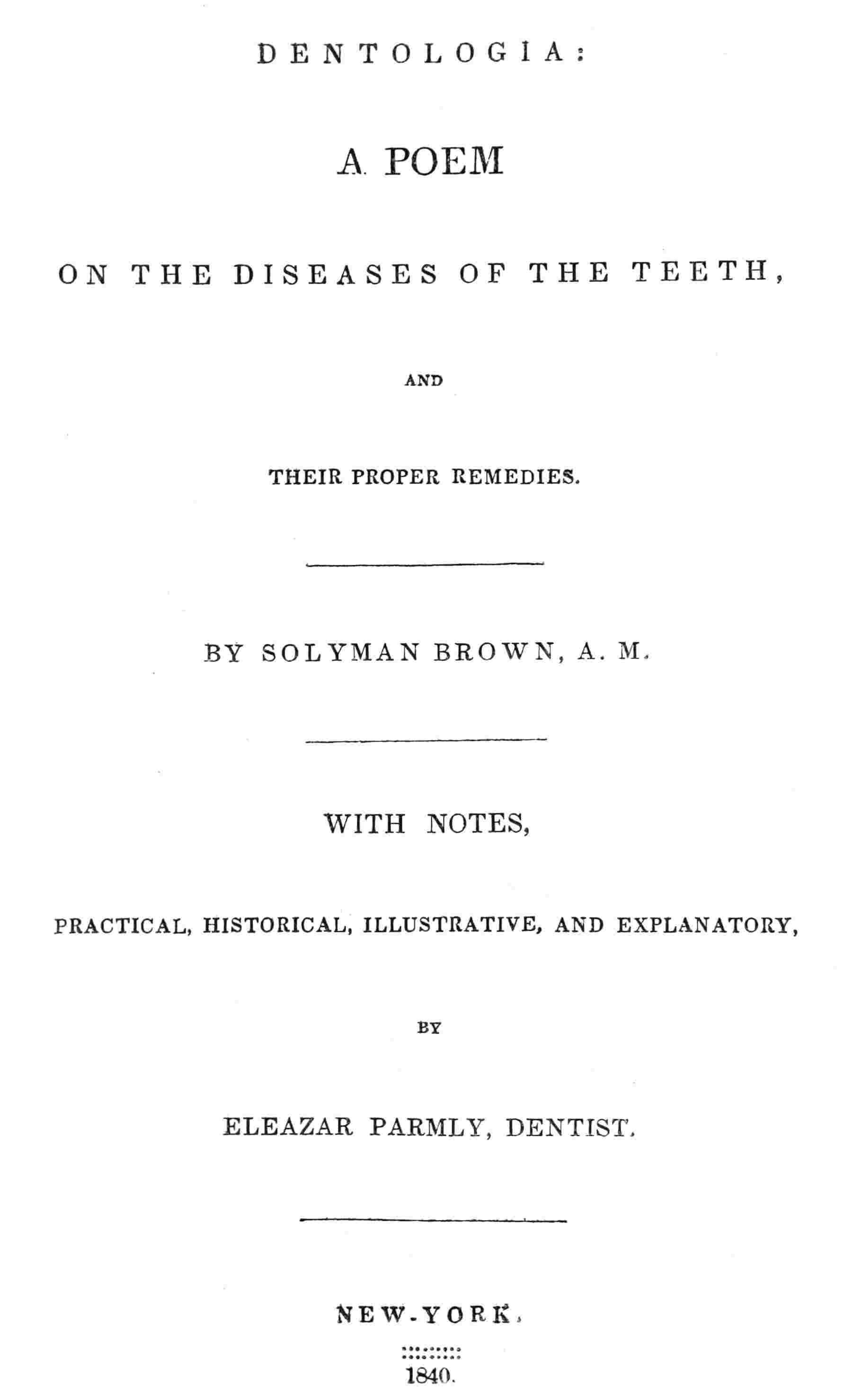
NOTES.
(1) But lo! their art survives to bless the world.
Hippocrates, a lineal descendant of Esculapius, the first accurate observer, and the first eminent physician of which we have any definite account, flourished in Greece, about four hundred and sixty years before the Christian era. He describes in various parts of his works, as well the functions and period of appearance of the several teeth, as their principal diseases, and the plan of treating them, both by manual operations and by dentrifices.
At the commencement of the Christian era, we find in the writings of Celsus, a celebrated physician of Rome, very explicit instructions on the subject of several important operations on the teeth; and during the recent excavation at Pompeii and Herculaneum, several dental implements have been discovered, much resembling some of those in use at the present day.
Celsus treats of scarifying the gums, of extracting, scraping, and even of stopping teeth; and fixing loosened teeth with gold wire;—indeed, this last practice is alluded to in the twelve tables of the Roman laws.
The Latin poet, Martial, makes habitual allusion to artificial teeth, as worn by the ladies of Rome in his time.
The celebrated Arabian surgeon, Albucasis, in the tenth century, enters very extensively into descriptions of dental operations, and gives drawings of a great number of instruments, used in his time for extracting, scraping, loosening, and even of filing the teeth, a practice which had been introduced more recently than any of the others.
It was not till the seventeenth century that we have authentic records of the exercise of the profession of dentistry distinctly from that of surgery. Gillies, and other practitioners in France, received the title of surgeon dentists as early as 1622.
In the year 1700, persons destined for the dental profession were compelled, in France, to submit themselves to a regular examination; and it is from this period that we must date, in modern times, the regular establishment of this art, as a distinct branch of surgical practice.
Among those who distinguished themselves as dentists during the last century, were Berdmore, Fauchard, Gerauldy, Larini, Bunon, Mouton, Leclure, Bourdet, Aitkin, De Chemant, Ray, Moore, and Talma; and it is to the undivided attention of such men as these, that we must attribute the vast additions made during that period, to our knowledge of the structure and diseases of the teeth.
Of the authors who have written on the subject during the present century, it will be sufficient to mention here, Blake, Fox, Duval, Le Forgue, De la Barre, Beaume, Maury, Bell, Koecker, Fitch, and Hare.
There are many others whose experience would enable them to produce works highly useful to the world, and particularly to young practitioners.
Mr. Cartwright, of London, with whom I have the pleasure of a personal acquaintance, is known to be the most celebrated dentist now in Europe, but has not as yet made public his views, in relation to his practice. It is most earnestly to be hoped that he will shortly publish his opinions.
Mr. John Waite, who, for many years, not only had the most extensive practice, but was the best practitioner in London, died without leaving any thing behind him in the way of writing.
We have cause also to regret that the late Dr. Hudson, of Philadelphia, did not, during his life time, embody his professional principles for the benefit of his contemporaries, and those who shall succeed him in dental operations. I may say, without fear of contradiction, that he has left behind him no one in this country so able to instruct, and so well qualified, from observation and experience, to be useful to the student. I am well pleased to learn that he left a large collection of notes and memoranda on his practice, and critical remarks on the writings and practice of other dentists, all of which have fallen into the hands of Doctor Trenor, of this city, to whom the profession is already indebted for several very valuable papers on subjects connected with his profession. With so valuable help as the papers of Doctor Hudson, so able and zealous a compiler as Doctor Trenor may well encourage the profession to expect a work of great value to all who wish to become thoroughly acquainted with the theory and practice of dental surgery. I cannot forbear making an extract from an article published in one of the Philadelphia papers, from the pen of my highly esteemed friend, Doctor Fitch, author of the most comprehensive work on the teeth ever published in this country. The extract which follows, is a just tribute of respect to the memory of departed worth, and alike creditable to the feelings and liberality of the author; and I believe every dentist who had the slightest acquaintance with Dr. Hudson’s practice, will cheerfully admit the propriety of Doctor Fitch’s eulogium.
“Some abler pen—some nearer friend, may tell his merits as a parent, a husband, and a citizen. The writer of this will presume only to speak of him as a professional man. Those only who have carefully attended to the subject, can have any adequate idea of the benefit the labors of Doctor Hudson have conferred, not only upon the people of this city, but of every part of the United States.
“When he commenced his practice here, he found the profession, generally, at a very low ebb, usually exercised by mechanics. Those great principles which elevate dental surgery from an art to a science, were almost entirely overlooked or unknown. To remove this mass of rubbish—to obliterate bitter and widely extended prejudices, was the task of Doctor Hudson. How well he performed this duty can only be estimated by a reference to the state of the profession at the time he commenced his practice, and when he was taken from it by the hand of death.
“Previously to his time, nearly all the talent among the dentists of this country was directed to the making and insertion of artificial teeth. Doctor Hudson taught the possibility and the immense advantage of preserving the living teeth, instead of suffering their loss, and resorting to artificial ones. He taught that, by strictly attending to the dentition of children, all the irregularities and deformity of the teeth might be prevented; and that by continuing our attentions, and performing timely operations upon any of those which might become defective, these useful organs may be preserved in perfection during our whole lives.
“Founded upon these principles, and recommended by his admirable operations, the practice of Doctor Hudson soon became the praise and admiration of all who witnessed or experienced its beneficial effects. His name was soon placed as first amongst all those who practised dentistry in this country. This reputation he always retained.
“In another way his superior system of practice has conferred an amount of benefit which can never be fully appreciated. It is, that his excellent and highly finished operations have long been models of imitation to other dentists. For a great many years, to equal his operations has been the highest ambition of other practitioners; none expected to excel them.
“The gentlemanly deportment of Doctor Hudson to his patients and patrons, his urbanity, his mildness, pointed him out as a model to all surgeon dentists.
“Finally: he ever sustained the dignity and respectability of the profession, inspired confidence in its capabilities, and demonstrated its claims to a high standing among those professions which contribute to the well being and happiness of the human family.”
I have lately been informed that Doctor Flagg, of Boston, a gentleman well known for his professional ability, is now preparing a work of considerable extent, designed for the student and profession at large. Mr. Arnold, also, of this city, a well educated dentist, is translating a popular French work.
(2) The teeth, deciduous, totter and decay.
“The teeth are composed of two very distinct substances. The internal is called the osseous part, or rather ivory, and forms the greatest part of a tooth; the external, which envelopes the former like a thin incrustation, on all that part which is out of the sockets from the commencement of the roots, is the enamel.
“At the extremity of each root there is a very small hole, by which the blood vessels and a nervous filament penetrate, destined to give it life and nourishment. The nerve and the blood vessels continue their course in a narrow canal, with which the root is provided, and form, in the interior of the tooth, a pulpy mass, composed of a gelatinous substance, contained in a very thin mucous membrane, formed by the development of the nerve and its vessels. It is by means of this membrane, that the tooth forms and nourishes itself, and acquires its increase.” (Gerbaux on the Teeth, Edinburgh Edition, 1817, pp. 34, 35, 36.)
(3) Would shield defenceless infancy from harm.
“The teeth furnish very considerable characteristics of scrofulous habits. Either they are badly formed as to their common outline; their surfaces are corrugated and discolored; or, if they be well shapen individually, their enamel is very thin, and preternaturally white; and the spaces between the teeth are unusually wide. It is a wise precaution to observe the teeth of nurses; for I should always question the fitness of a wet nurse, with a bad set of teeth, however other circumstances may be in her favor.” (View of the Alimentary Organs, by Thomas Hare, London, 1821, p. 228.)
(4) And patient merit never want a friend.
“It is to be hoped, that in time, patients will be able to discover that educated men are successful in a far greater number of instances than even the most fortunate of advertising empirics. But it is an old complaint, and, unhappily, though old, not an obsolete one, that ignorant pretension, especially when wrapped in mystery, is more attractive to the million, than modest ability. It is consoling however, to the respectable practitioner to know, that while empirical trickery may confer an evanescent fame, sound scientific acquirement is the only basis on which can be founded a reputation solid, progressive, and enduring.” (Snell on the Teeth, 1882, p. 164.)
(5) And seeks from science her appointed part.
“Infants have been born with one or more teeth; this was the case with the great monarch, Louis XIV., in whom the presence of a tooth at his birth, seemed the presage of his future greatness;—Polydore Virgil also mentions a child that was born with six teeth; but towards the end of the first year is the most usual time for the teeth to appear, and about the thirtieth month they are all cut, to the number of twenty: they are called milk teeth, either because they cut while milk is the only nourishment, or because they equal that fluid in whiteness. They are also called primitive or casting teeth: they are ten in number in each jaw; four of which are incisors, two canine, and four grinders. The incisors of the lower jaw appear first, then those of the upper jaw, afterward the canine, or, more frequently, the grinders.
“Every thing here appears to be for the advantage of the infant; an interval of a month or six weeks, between the cutting of each tooth, seems designed to calm the irritation which generally accompanies this evolution; for it is rare to cut these teeth, and particularly the canine, without a swelling in the gums, heat of the mouth, salivation, and redness of the cheeks. This is the way that dentition usually proceeds; sometimes it is so calm and easy, that the tenderest mother has no reason to fear, while at other times it is so laborious, and attended with so many accidents, as to put the life of the child in jeopardy; in this latter case, whatever be the cause, the effects are sufficiently obvious; they have been observed from the earliest times, and almost in every country, and accord with the observation of Hippocrates: ‘Those,’ says he, ‘whose teeth are on the point of cutting, are affected with itching of the gums, fevers, convulsions, diarrhœas; especially in cutting the canine teeth, and in those children which are fat, and of a constipated habit of body.’—(Aphor. sec. III. 25.) To add to this picture, would be to augment that dread of dentition which sensible mothers feel but too acutely at present; without being able to foresee or to combat those causes, which often render it violent, and sometimes mortal. But to dissemble, and to say that dentition is never difficult and perilous, would be to consign too many mothers to a perfidious security, and one day they would have but too much reason to complain of this silence.” (Dentiste de la jeunesse, by Duval, Atkinson’s translation, pp. 29, 30, 31.)
(6) And flooding tears, in sad succession rise.
The first set of teeth begin to protrude generally about the sixth or eighth month; but in some cases the teeth have been known to make their appearance as early as the fourth or fifth month; and sometimes, on the contrary, not until the fourteenth or fifteenth. The period of teething does not depend on the health and strength of the child, as this process sometimes seems slowest with the strongest children.
The two incisors of the under jaw are the first which make their appearance; and are followed, in about three weeks or a month, by similar teeth in the upper jaw. The lateral incisors of the under jaw are the next which follow. Nature then interrupts this uniformity of progress, and instead of the canine teeth, which are the next in situation, the anterior molares of the under jaw make their appearance, and are succeeded in a short time by those of the upper. The canine teeth and larger molares then follow to complete the set, which is generally effected in about two years and a half. Deviations from this order are occasionally met with, and, in some instances, children have been known to be born with the two front incisors of the lower jaw; but as such premature growth cannot be perfect, and as such teeth occasion much pain and inconvenience to the child, it is always advisable to extract them. The first dentition is a critical period in the life of a child; and the mortality from this cause is clearly ascertained to comprise more than half of those that die under the age of two years. The efforts which the teeth make to unfold themselves, naturally produce a powerful tension and pressure on the gums; and this gives rise to irritation and pain. The gums become swelled and inflamed; the saliva is constantly discharged from the mouth, and the whole frame seems to labor under the influence of fever.
It is proper, therefore, that every parent should be aware of the consequences that may ensue, in order to resort to those means which experience has found to be most successful in affording relief. This can be obtained only by lessening the pressure of the tooth on the gum. To accomplish this, the child is generally allowed some hard substance to rub thereon; but this, although it may give temporary relief, tends in the end to increase the irritation. Gentle friction with the finger will be found to afford more relief, and may be rendered still more effectual by the use of a little fine salt, or any other substance which will cause a discharge, and therefore reduce the inflammatory action of the vessels. Scarification, however, seems to be the safest experiment that can be employed. This is performed, by the point of a lancet, pressed down upon the tooth, until the gum and the investing membrane be fully divided. The pressure being by this means taken off, the child will experience instantaneous relief. Parents should be cautious how they give way to any vulgar prejudice against an operation by which many have been freed from the most dangerous symptoms.
The use of the coral has been recommended by persons totally ignorant of the disorders of dentition, in opposition to the opinions of those who have made the teeth their exclusive study. I am decidedly in favor of the theory of Doctor Blake, who says “The coral is a most dangerous weapon, put into the hands of children to destroy themselves; for as the teeth arise and become slightly elevated above the edge of the socket, those hard bodies press and bruise the gum between them and the sharp points or edge of the tooth underneath; inflammation and its consequences undoubtedly follow; and in this way, I am firmly persuaded, the lives of thousands of children have been lost.”
Dentition is often accompanied by a fever of an inflammatory nature; the cheeks become flushed; the eyes heavy and the skin hot and parched; the rest is broken and the appetite lost; and if timely assistance be not obtained, convulsions sometimes suddenly supervene, and not unfrequently terminate fatally.
The mildest effort which marks the interposition of nature, is the appearance of numerous eruptions of the skin; the period of dentition marks their true nature, they are never removed nor cured until the cause ceases to exist.
(7) And neither wound too little nor too much.
“As far as my experience has taught me,” says Dr. John Hunter, “to cut the gum down to the tooth, appears to be the only method of cure. It acts either by taking off the tension upon the gum, arising from the growth of the tooth, or by preventing the ulceration which must otherwise take place. It often happens that the gum will re-unite over the tooth; in which case the same symptoms will be produced, and they must be removed by the same method. I have performed the operation above ten times upon the same teeth, when the disease had recurred so often, and every time with the absolute removal of the symptoms. The gums may bleed a little, which may be of service in taking off the inflammation. I never saw a case where the bleeding either proved inconvenient or dangerous.”—(Hunter on the Human Teeth, pp. 240, 243.)
(8) Let unobstructed nature do the rest.
“If we consult the tables of mortality in the towns and villages, the number of the victims of dentition, will certainly appear appalling; and they are always found to be more numerous in the former than in the latter. Happy villages! Your industrious inhabitants, with usages as ancient as their manners, raise their little ones in a manner more conformable to nature; they do not offer, in their cares, the spectacle of that refinement, which the mothers of the city, with more appearance of sensibility, have drawn from the theories of education, which do not acknowledge experience for their base.” (Atkinson’s Duval, p. 36.)
(9) Descends lamented to an early tomb.
“Since in childhood the first sufferings begin, in childhood also the foundation of a good or bad constitution is laid. It is at this critical time that the greatest attention should be paid to the state of the gums, to mark the protrusion of the teeth, as well as the after changes; for it is only by knowing the steps and order of their progress, that proper aid can be given to the efforts of nature, during the years of childhood.” (L. S. Parmly’s Lectures, pp. 34, 35.)
(10) In one, deformity;—the other, pain.
This deformity generally arises from inattention during the time of shedding teeth. The remedy consists in removing the causes, of which there are many. The first is when the growth of the jaw is insufficient for the new set, and thus forcing them to crowd and overlap each other, by which the central incisors of the upper jaw are pressed forward, and thus forming what has been termed, from its shape, “a rabbit mouth.” In such cases, the extraction of one or more of the bicuspides from each side of the mouth is absolutely necessary, in order to bring the incisors into a regular arrangement, which, after this operation, is easily effected, by the occasional pressure of the thumb and finger, or by a judicious application of silken ligatures.
It is sometimes, however, necessary to apply gold plates, springs, and other mechanical contrivances, to bring them into a regular arrangement.
A second irregularity arises from supernumerary teeth. This takes place, most frequently, in the front teeth of the upper jaw, and thus gives it a most unseemly appearance. In this case it is likewise necessary to have recourse to extraction as soon as possible.
A third irregularity, and one of frequent occurrence, arises from one tooth projecting beyond another. This is easily remedied by removing the projecting part with a proper instrument.
A fourth irregularity consists in the teeth having formed themselves into ragged edges: and a fifth, in their having received fractures from blows or falls. The last two irregularities are principally confined to the front teeth, from their frequent action against each other, more especially when the back ones have been lost; and from being, by their situation, more exposed to accident. These irregularities are likewise remedied by removing portions from their cutting edges. This operation is not only one of the most useful, but it is often absolutely necessary; for diseases of the tongue and cheek are sometimes occasioned by projecting, or badly formed teeth: and it not unfrequently happens, that very useful teeth are extracted, to the future inconvenience of the patient, when the judicious removal of portions only would have answered every purpose; and that a partial loss of enamel from the cutting edges never produces decay, while the natural cavity in the tooth remains untouched, is evident from the well known practice of savage nations, who cut their teeth into various shapes without incurring any disease. When fractures are too extensive to be remedied by the above treatment, various circumstances, particularly the age of the person, must influence the mode of proceeding. If the fracture be of one tooth, and the person has not arrived at the age of maturity, the extraction of the fractured tooth, by giving the adjoining ones the opportunity of approaching each other, will render the defect but inconsiderable. When, however, such accidents occur at an advanced period of life, this kind of treatment can hardly be expected to be entirely successful; but as there is no other means of remedying the defect, unless it be the insertion of an artificial tooth, the earlier assistance is procured, the greater will be the chance of success. A tooth that has been knocked out without injury to its socket, will fasten again, if immediately returned and secured in its place.
Mr. Duval has the following judicious remark on this subject:—“It is from the age of six years to that of fourteen, being the usual period of the second dentition, that the teeth require the greatest care. When there is any disposition to irregularity, they ought to be inspected once or twice a year by the surgeon dentist, who can in almost all cases ensure a regular arrangement.” (page 27.)
(11) Avoid the danger, or repair the ill.
The protrusion of the second set of teeth is, in general, attended with no pain or uneasiness. This set, when complete, consists of thirty-two teeth, being twelve more than the first set. But though the regular number of the second set of teeth is thirty-two, a deficiency of this number sometimes occurs, and this deficiency is generally confined to the dentes sapientiæ, or wisdom teeth. Sometimes the lateral incisors, and not unfrequently one or both of the upper canine teeth, are found wanting; the protrusion of the dentes sapientiæ, at times, does not take place till the fortieth year, and, in some instances, not even then.
There are cases recorded of persons never having any teeth; one case of this kind has come under my own observation, and in that instance the gums were sufficiently callous to answer every purpose of mastication. I have frequently been informed that there is a family living in South Carolina, several members of which have no teeth, where the processes and gums are so perfectly well formed and elongated, as to make the defect hardly perceptible.
The removal of the temporary teeth is a curious operation of nature. The fangs being absorbed, they loosen by degrees, and are pushed from their situations by the pressure of the second set. But there are instances in which this absorption does not take place, and, consequently, the second set not being permitted to come forward in their proper places, become irregular and deformed. The only means of preventing this irregularity and deformity, is timely extraction.
(12) Should meet resistance from opposing force.
There are instances, and those not a few, when relief can be afforded by no other means than by extraction; for this operation I prefer the improved forceps, in all cases where they can be safely applied, as being the best and safest instruments that can be used; but if the tooth is so much decayed as to render it likely to break where the points of the forceps embrace the tooth, I uniformly use a small key instrument, with the improvement I made on it many years ago, which is now in very general use, in England and in this country.
In order to do myself justice, I shall here make a short extract from Mr. Snell’s work, lately published in London, the author of which, in speaking of the instrument, forgot to make mention by whom the improvement was made. “The moveable bolster,” says he, “when in apposition to the gum, retains its relative situation, and the fulcrum of the instrument moves upon it; this I consider one of the most important improvements of the key instrument; its superiority over the old one is so evident, as to need no farther explanation.”—(page 100.)
On the subject of this improvement, Dr. Thomas Hare, of London, as early as 1821, in his celebrated treatise on the “Stomach and Alimentary Organs of the human body,” thus speaks: “The instruments hitherto in use for the extraction of teeth, have, to my apprehension, been deficient of that neatness and convenience for adaptation, which every operation on the human frame so justly demands. Besides his finished qualifications as a dentist, therefore, it gives me great pleasure to notice the merits of Mr. Eleazar Parmly, in contriving an instrument, admirable for its simplicity, which completely sets aside these obvious disadvantages.” (Pages 295, 296. London Edition, 1821.)
I make the following extract from Mr. Koecker’s work, to show that many persons have an unwarrantable antipathy to extraction; and that parents are frequently more in fault than their children, when resistance is made to the necessary performance of operations on the teeth. A want of decision on the part of parents, often subjects the child to serious injury, and the operator to many inconveniences, not the least of which is loss of time, which might be wholly avoided, if parents would send their children to the dentist with directions for his government, or submit them entirely to his management, when placed in his hands for the benefit of his advice or operations.
It is the case of a child about ten years of age. “I discovered,” says this writer, “several of her teeth to be carious, and proposed to remove the caries with a file, and to extract the first four large grinders, in order to prevent a recurrence of the disease, which had arisen from some irregularity of the teeth, owing to their crowded state.
“The poor child was greatly alarmed at this advice. Her eyes filled with tears, although her sisters, who were more familiar with the operation, where whispering her to be of good cheer. The affectionate mother was much grieved at the discovery, and the struggle between her good sense on the one hand, and her parental anxiety on the other, was so affecting, that I proposed another plan, by which I should be able to save all the teeth of her daughter. But to this proposal she would not consent, declaring that she was convinced my first advice was the best, and adding that she and her daughter would submit to the operation first proposed; desiring only a little time for preparation.
“About a week afterwards the little girl called upon me in excellent spirits; and after expressing her sorrow for not having submitmitted to the operation immediately, stated that her reluctance had principally resulted from the alarm of her mother, who had continued, ever since I last saw her, to express her wish that the operation should be performed, but had not courage enough to agree to its performance. She, the daughter, therefore, had at last resolved to come to me, without the knowledge of her mother; and having acquainted me with the circumstances, she sat down with sparkling eyes and a smiling countenance, and said: ‘Now, if you please, sir, I am ready!’
“I shall not attempt to describe my feelings on this occasion; but merely state, that, in less than five minutes, the four permanent first large grinders, the largest teeth in her mouth, were wrapped up in a piece of paper, and she went away with them in her hand, rather dancing than walking, to surprise and relieve her anxious mother from fear and apprehension.
“I leave to parents, and particularly to mothers, to judge of the mother’s feelings for so amiable a daughter.”
“It is remarkable,” says Mr. Fox, “but not less true, that there is scarcely any pain to which the human body is subject, that is so much under the influence of fear and hope, as the tooth-ache. This is experienced by almost every patient, and as constantly observed by every surgeon, by the pain generally leaving that individual who is under the immediate expectation of having the tooth extracted.
“Empirics are not wanting, who take advantage of this circumstance, and pretend to cure tooth-ache by certain charms and nostrums: indeed, at the moment, they appear to be successful, from the passions of fear or hope causing a temporary suspension of pain.
“The burning of the Antihelix of the ear, in order to relieve this complaint, must be ranked amongst the above methods of cure; it is one not worthy of notice, had it not been formerly a very popular remedy, and lately recommended in a periodical publication.
“The slightest knowledge of the distribution of the nerves to the teeth must convince every one, that a division of any part of the ear cannot separate the connexion that subsists between the teeth and the principal branches that go to the brain; and, therefore, no more benefit can be derived from this formidable operation, than may be attributed to the influence of fear.” (Fox on Human Teeth, Part II., p. 38.)
(13) For healthy action on the general frame.
If we may judge from the opinions of the most able physicians and surgeons, it is evident that the digestion of our food depends greatly on the quantity of saliva which is elicited from the glands and mingled with it, and to its being properly masticated by the teeth, before it descends into the stomach. From this view we are led to consider the teeth as essential instruments in preparing our food. The front teeth are intended to take hold of and divide the food, and those placed back in the jaws to grind or comminute it, in which state only it is fit to pass into the stomach.
Digestion, then, is performed first by the action of the teeth, during which process the saliva is elicited from the glands in order to be mixed with it, and, as it is comminuted, descends into the stomach along with this powerful solvent, for its assimilation. It is there mixed with the gastric juice, and receives the other changes which convert it into nutritive matter.
If the teeth, then, are incapable of performing their office, the process of digestion must be imperfectly carried on, and the health of the individual suffer in proportion. The supply of nourishment to the system is the first and great function of life; and the health of the teeth, so essential to it, cannot claim too much attention from every individual.
(14) Disgusting objects of deformity!
“The influence which the teeth exercise over beauty, justifies the pre-eminence which I attribute to them over all the other attractions of the countenance. This ornament is equally attractive in both sexes: it distinguishes the elegant from the slovenly gentleman, and diffuses amiability over the countenance, by softening the features. But it is more especially to woman that fine teeth are necessary, since it is her destiny first to gratify the eyes before she touches the soul, and captivates and enslaves the heart.” (Dict. Sci. Med. Paris.)
(15) And spreads delight through all its wide domain.
“Some idea of the rapid motion of the blood may be formed from the following calculation: the heart propels, at each pulsation, about one ounce of blood, and when it makes eighty pulsations in a minute, of course three hundred pounds of blood must pass through it in an hour, which is about twelve times the whole mass of blood in the body; and this rapid action is incessantly going on, night and day, through life.” (Fuller on the Teeth, p. 47.)
(16) And hence, defective, only from abuse.
“The following is the composition of the teeth, as given by Berzelius, whose analysis appears to have been more elaborate than that of any other chemist. It will be found to record the occurrence of several substances as existing in the bone and enamel of the teeth, the presence of which has not been detected by others. According to this celebrated chemist, the enamel of the adult teeth contains, in one hundred parts:—
| “Phosphate of lime | 85.3 |
| Fluate of lime | 3.2 |
| Carbonate of lime | 8 |
| Phosphate of magnesia | 1.5 |
| Soda and muriate of soda | 1 |
| Animal matter and water | 1 |
| 100 |
“The bony substance is stated, by the same authority, to contain:—
| “Phosphate of lime | 62 |
| Fluate of lime | 2 |
| Carbonate of lime | 5.5 |
| Phosphate of magnesia | 1 |
| Soda and muriate of soda | 1.5 |
| Gelatine and water | 28 |
| 100” |
(Bell on the Teeth, pp. 6, 7.)
(17) Assigned these organs in the frame of man.
“The teeth, which are the only hardened parts of the animal frame exposed to the influence of air, to the influence of invasive fluids, or called upon to exercise any sort of mechanical power without the intervention of membranous or other protection, and without the aid of lubricating fluid proper to themselves, or being placed beyond the mutilating influence of chemical agents, are of a more dense, refined, and minute crystalline texture externally, than any other of its objects; but this natural advantage of texture has become progressively lessened with the advancement of civilization.” (Hare on the Stomach, p. 51.)
To the foregoing remarks of my distinguished friend, I will add, that the teeth are the hardest and most compact parts of the human frame, as is evident from their being found after interment in a perfect condition, after all the other bones have mouldered away.—Hence we may reasonably conclude, that, from their formation, they are little liable to decay; and that the inattention of the individual, and the action of extraneous matter upon them, are the chief causes of those diseases with which they are oftentimes affected.
Though to a superficial observer the teeth may appear to be a part of the body which is little deserving of regard, yet, those who consider the many functions which the teeth have to perform, must allow that their claims on our attention are as many and as strong as those of any other part of the human frame. Those means should be studied, therefore, which tend to preserve them in their original perfection; and every argument used, to impress upon the attention of society at large the importance of resorting to those means, whenever circumstances may require their aid.
(18) A greedy vampyre, feasting on his heart!
“The Brazilians, when first discovered by the Europeans, lived the most natural, original lives of mankind, so frequently described in ancient countries, before laws, or property, or arts made entrance among them; they lived without labor, farther than for their necessary food, by gathering fruits, herbs, and plants; they knew no drink but water; were not tempted to eat or drink beyond common thirst or appetite; were not troubled with either public or domestic cares, nor knew any pleasure but the most simple and natural.” (Sir John Sinclair’s Code of Health, Vol. IV. p. 333.)
“The chief food of the Japanese is rice, pulse, fruits, roots, and herbs; but mostly rice, which they have in great plenty and perfection, and dress in so many different ways, and give to it such variety of tastes, flavor, and color, that a stranger would hardly know what he was eating.” (Mod. Universal History, Vol. IX. p. 62.)
“The philosophers of India eat nothing but rice, fruits, and herbs.” (Bartolomeo’s Voyages, by Johnson, p. 287.)
“The four most ancient orders of priests, the Rahans, the Bramins, the Magi, and the Druids, confined themselves to vegetable food, as did also the Athenian prince, Triptolemus, who established the Eleusinian mysteries, and prohibited by law all injury to animals.”—(Monthly Magazine, February, 1812, p. 21.)
If it should be deemed necessary to explain my motives for any seeming digression from my subject, in introducing matter that will no doubt be considered by some as wholly unconnected with the duties of a practical dentist, I would say, that it is my settled opinion, that whatever affects the general condition of the system, must, in a greater or less degree, affect the health of the teeth.
I have myself suffered much, in former years, from debility and other forms of indisposition, induced, I am persuaded, by gross and improper diet. For the last year I have abstained from all exciting drinks, have utterly relinquished the use of tea and coffee, have abstained from animal food of every name and nature, and by this course of conduct have found my health to be so much benefitted, that I feel it a duty as well as a pleasure, to endeavor to impress upon the reader the necessity of living more frugally, if he wish to enjoy that health of body and that tranquillity of mind which none can enjoy, for any great length of time, but such as live in accordance with the rules prescribed by all profound philosophers, both of ancient and modern times.
On this subject, and for the foregoing reasons, I have selected such passages from various distinguished authors as I have found true by experience, in the hope that this cloud of witnesses in behalf of temperance, health, and happiness, may influence some of my readers to sacrifice at least one debasing appetite on the altar of truth and reason.
(19) Compared, intemperate luxury! with thine.
“The throat has destroyed more than the sword.”
Martial.
“The nations that subsist on vegetable diet are of all men the handsomest, the most robust, the least exposed to diseases and violent passions; and they attain the greatest longevity. The Bramins of India, who frequently survive a century, eat nothing but vegetables. From the Pythagorean school, Epaminondas issued forth, so renowned for his virtues; Archytas, so celebrated for his skill in mechanics; and Milo of Crotona, for his strength. As vegetable diet has a necessary connexion with many virtues, and excludes none, it must be of importance to accustom young people to it, seeing its influence so powerfully contributes to beauty of person and tranquillity of soul. The children of the Persians, in the time of Cyrus, and by his orders, were fed with bread, water, and cresses; and Lycurgus introduced a considerable part of the physicial and moral regimen of these children into the education of those of Lacedæmon. Such diet prolongs infancy, and, of course, the duration of human life.” (Bernardin de St. Pierre’s Studies of Nature, Vol. IV. p. 357.)
“As, in every period of history, it has been known, that fruit and vegetables alone are sufficient for the support of life, and that the bulk of mankind live upon them at this hour; the adherence to the use of animal food is no more than a persistance in the gross customs of savage life—and evinces an insensibility to the progress of reason, and to the operation of intellectual improvements.” (Dr. Lambe on Regimen, p. 243.)
“The circumstance of weighing down the stomach with a load of food, particularly where relaxation of the general fibre is favored by inactive habits, must tend by degrees to increase its capaciousness; and in proportion as this increases, the energies of the brain and of all the organs of sense become diminished; the sight, the hearing, and the smell, are less exquisitely acute; the palate is not satisfied with simple viands; and even the sense of touch is rendered less nice.
“It was well observed by the late Dr. Saunders, that we are made gluttons from the cradle by the officiousness of our nurses; a child’s health is disordered by being over fed; it cries and complains from the effects, and with a view to silence it, more and more food is given, so that the evil is increased instead of remedied, and the capacity of the stomach gradually extended far beyond the salutary bounds of nature.” (Hare on the Stomach, p. 134.)
(20) And drains destruction from the circling glass.
“A vulgar error prevails, which is, that strong liquors are essential to bodily strength. This false opinion is partly grounded on the idea of a nutritious property in those liquors, and partly, perhaps, in a logical error in using the word strong, as being necessarily connected with strengthening the animal body. The first notion is entirely wrong; since it is proved, by continual evidence that strong liquors are inimical to animal life throughout the creation, and that no living animal or plant can be supported by such fluids; but that, on the contrary, they all become sickly and perish under their influence. I presume that no person would give a lamb, a calf, a chicken, or a duck, such liquors, with a hope of rendering them sooner fat, and of sweeter flesh, even if such liquors were so cheap as to render it an economical process. Yet many parents do this to their infant children! The fate of those individuals is truly deplorable, who cannot exist without an exhausting stimulus.” (Sir Anthony Carlisle’s Lectures on fermented liquors.)
Dr. Rush observes, that, “since the introduction of spirituous liquors into such general use, physicians have remarked that a number of new diseases have appeared among us, and have described many new symptoms as common to old diseases. Spirits, in their first operation, are stimulating upon the system. They quicken the circulation of the blood, and produce some heat in the body. Soon after they become what is called sedative; that is, they diminish the action of the vital powers, and thereby produce languor and weakness.”