
The Project Gutenberg eBook of Der Ackermann aus Böhmen
Title: Der Ackermann aus Böhmen
Author: von Tepl Johannes
Editor: Johann Knieschek
Release date: November 26, 2014 [eBook #47465]
Most recently updated: October 24, 2024
Language: German
Credits: Produced by Jana Srna, Jim Dishington and the Online
Distributed Proofreading Team at http://www.pgdp.net
The original book had two different sets of footnotes. Notes to the main text were in a separate ‘Anmerkungen’ section. Notes to the ‘Abhandlung’ section appeared at the bottom of each page of that section. For consistency in this e-text, all footnotes have been grouped together, renumbered from 1 to 106, and moved to the end of the book.
Footnote 66 (in the current numbering) had been placed immediately after footnote 62 in the original. A close examination has shown this to be an error, and this footnote now appears in its correct location.
Line numbers at the end of a line in the main text have been retained because they are indispensable for use of the critical apparatus and other references. [Z. 10], for example, indicates the point where line 10 ended in the original text.
A table of contents has been created. The original headings of the major sections (e.g., ‘Abhandlung’, ‘Anmerkungen’) are used for this purpose. The very first section, containing the main text and critical apparatus, did not have a heading in the original book, and therefore the heading ‘Text’ has been created in order to have a complete and consistent structure. For the reader’s convenience a table of contents has been created for the ‘Text’ section and another for the ‘Abhandlung’ section.
The critical apparatus to Chapter 1 points out that the chapter heading ‘Das erst capitel’ is missing. This heading has been added to the e-text version so that it is now like ‘Das ander capitel’, ‘Das dritt capitel’ and subsequent chapters.
This e-text contains many characters that will display only in UTF-8 (Unicode) file
encoding, including but not limited to:
OE ligature: Œ
oe ligature: œ
C-hacek: Č
c-hacek: č
e-hacek: ě
o-hacek: ǒ
r-hacek: ř
S-hacek: Š
s-hacek: š
z-hacek: ž
y-acute: ý
u-ring: ů
e-macron: ē
n-macron: n̄
fraction 1/2: ½
Some devices, especially older ones, may display some or all of these characters incorrectly or not at all. Likewise Greek characters with diacritics may not be displayed correctly. A possible solution in such cases may be to ensure that the character set or file encoding is set to Unicode (UTF-8).
Readers of the HTML version can view a transliteration of the Greek text by hovering over it with the pointing device.
The changes listed in the ‘Verbesserungen und Zusätze’ section have not been incorporated into the text.
Spelling inconsistencies that occur more than once, such as ‘herschen’ beside ‘herrschen’, have not been normalized. Obvious spelling and punctuation errors have been corrected whenever encountered. Several errors in the Greek text have been corrected after consulting authoritative editions; since all involve incorrect diacritics and do not affect the meaning, it has not been thought necessary to list them individually.
In the critical apparatus, references to the line numbers of the text are normally followed by a period in the original, but occasionally they are followed by a comma or no punctuation at all and are assumed to be typesetting errors. Since these inconsistencies are unlikely to cause a misunderstanding, a systematic effort has not been made to find and correct them, although many have been corrected if noticed in the course of transcription.
A list of specific changes that deserve mention is found at the end of the text following the footnotes.
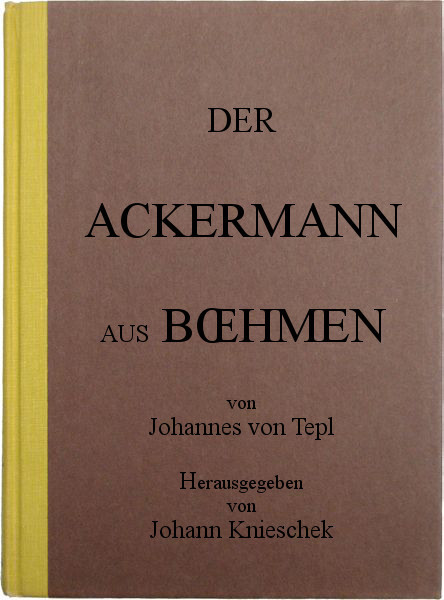
The cover image that appears in e-book versions was created by the transcriber and is placed in the public domain.
BIBLIOTHEK
DER
MITTELHOCHDEUTSCHEN LITTERATUR
IN
BŒHMEN
HERAUSGEGEBEN VON
ERNST MARTIN
MIT UNTERSTÜTZUNG DES VEREINS FÜR GESCHICHTE DER DEUTSCHEN IN BŒHMEN.
BAND II.
DER ACKERMANN AUS BŒHMEN
HERAUSGEGEBEN VON
Johann Knieschek.
PRAG 1877.
Verlag des Vereins, in Commission bei F. A. Brockhaus in Leipzig.
DRUCK DER ACTIEN-GESELLSCHAFT BOHEMIA.
DER
ACKERMANN aus BŒHMEN
HERAUSGEGEBEN
UND MIT DEM TSCHECHISCHEN GEGENSTÜCK
TKADLEČEK
VERGLICHEN VON
JOHANN KNIESCHEK.
GEDRUCKT AUF KOSTEN DES VEREINS FÜR GESCHICHTE DER DEUTSCHEN IN BŒHMEN.
PRAG 1877.
Verlag des Vereins, in Commission bei F. A. Brockhaus in Leipzig.
DRUCK DER ACTIEN-GESELLSCHAFT BOHEMIA.