
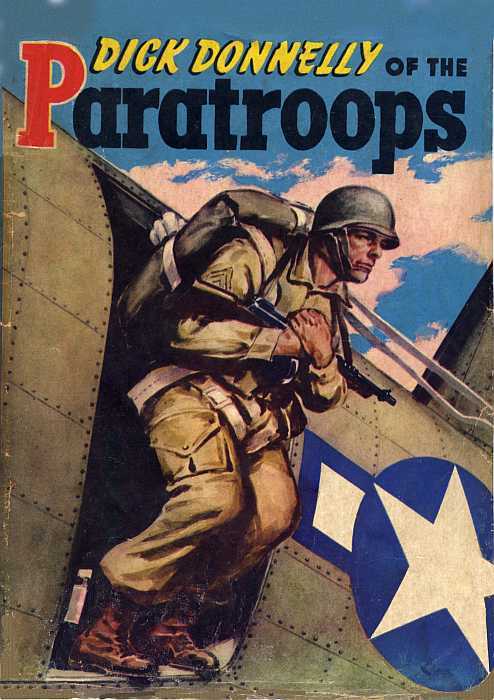
The Project Gutenberg eBook of Dick Donnelly of the Paratroops
Title: Dick Donnelly of the Paratroops
Author: Marshall McClintock
Illustrator: Francis Kirn
Release date: February 10, 2015 [eBook #48226]
Most recently updated: October 24, 2024
Language: English
Credits: E-text prepared by Stephen Hutcheson, Rick Morris, Rod Crawford, and the Online Distributed Proofreading Team (http://www.pgdp.net)
The Project Gutenberg eBook, Dick Donnelly of the Paratroops, by Marshall McClintock, Illustrated by Francis Kirn
| CHAPTER | PAGE | |
| I. | Token Resistance | 11 |
| II. | A Man With Two Names | 20 |
| III. | Wadizam Pass | 37 |
| IV. | Encircled! | 50 |
| V. | Break-Through! | 69 |
| VI. | Special Mission | 86 |
| VII. | Not So Happy Landings | 106 |
| VIII. | Two Visitors to Town | 120 |
| IX. | Uncle Tomaso | 132 |
| X. | The Old Bell Tower | 150 |
| XI. | Fruitless Search | 168 |
| XII. | A Visit to the Dam | 181 |
| XIII. | The Fourth Night | 193 |
| XIV. | Interrupted Performance | 207 |
| XV. | No Calm Before the Storm | 222 |
| XVI. | Zero Hour | 235 |
| XVII. | Aftermath | 245 |
Planes Swept Low Over the Airfield
DICK DONNELLY
of
THE PARATROOPS
CHAPTER ONE
The big transport plane flew out of a cloud just as the sun appeared over the flat horizon of the desert to the east. The rolling hills over which the clouds hung low smoothed out as they met and merged with the flat wasteland. A row of trees, the only ones in sight, lined one edge of a rectangle even flatter and smoother than the land near by. A long, low building near the trees, with two small airplanes in front of it, identified the rectangle as an airfield.
Before the transport reached the field, another slid out of the cloud. Suddenly swift fighter planes darted past them, swept low over the airfield with machine guns splattering their bullets over the hard earth, the two small planes, and the low hangar. They circled swiftly, just as a third transport appeared from the clouds, and roared past the field, on the far side of the line of trees. Long streaks of white smoke poured from them, falling lazily and billowing into man-made clouds as dense as those in which the planes had recently been flying. In five minutes the smoke screen was a wall twenty feet thick and a hundred feet high.
Meanwhile, the first transport had circled the field, dropping lower. Suddenly a figure plunged from the side of its fuselage, hurtled toward the ground, and then checked its descent with a jerk as a white parachute billowed out above. Another figure had dropped from the plane before the first ’chute opened, and now it too floated gently to earth behind the smoke screen. In rapid succession, eighteen men leaped from the plane, which sped back toward the hills as another came in to discharge its cargo of soldiers.
As the first man landed, he rolled over the hard earth, tugging at the lines of his parachute to spill the air from it. In a moment it had collapsed and the man had slipped from his harness. Dropping his emergency ’chute, he unfolded the stock of his sub-machine gun and ran forward, crouching, toward the smoke screen, on the other side of which lay the airfield building.
“Jerry!” a voice called from behind him, and he turned.
“Okay, Dick?” the first man called back.
“Yes, sir,” replied the second, running up. “And here come the rest.”
In less than three minutes the eighteen men from the first plane had gathered near their leader, Lieutenant Jerry Scotti.
“We won’t wait for the heavies,” he said. “I think this is a setup. Come on.”
He turned and ran into the cloud of smoke, followed by the others, who held their guns ready. As they broke out of the cloud on the other side, they dropped to the ground. The hangar was not more than a hundred feet away. There was still no sign of activity in or around it. Not a man had been seen since the planes first came over.
“No cover here at all,” muttered the second man, Sergeant Dick Donnelly.
“No opposition, either,” laughed the Lieutenant. “Can’t see a soul.”
“Think they’ve skipped out?” Donnelly asked his companion.
“No—no place to skip to, except by plane,” Scotti replied. “They must be in the hangar, just waiting. The Major said we might not meet any defense at all. Most of these Frenchmen are mighty happy to have us invading North Africa.”
“Sure, but some of ’em are putting up a fight,” the sergeant said. “They’re good soldiers and if their officers tell them to fight back, they fight back.”
“Get back a bit into the protection of the smoke,” Scotti said, and his men pushed themselves back ten feet. “Now let’s give them a burst and see what happens.”
The silence, broken only by the steady drone of airplane motors in the skies overhead, was shattered by the stuttering explosions of sub-machine guns. The bullets thudded into the thick, hard clay walls of the hangar.
Suddenly three rifles and a pistol were thrust through the windows at the rear of the hangar and they fired repeatedly—into the air! Then a white flag was thrust from the middle window on a long pole, so quickly that it must have been ready for the purpose.
“We surrendair!” called a voice from the hangar. “Les Américains—zey have conquered us!”
“All right,” shouted Lieutenant Scotti, advancing from the smoke screen about ten feet. “Toss all guns out the window.”
“Oui, oui, at once!” came back the voice.
Half a dozen rifles, three automatics, and two light machine guns were thrust from the windows and clattered to the ground. By this time two other groups of American soldiers had appeared, one to the right and one to the left of Scotti’s group.
“It’s all over,” he called to them. “Hold your fire! They’ve surrendered.”
“My golly!” cried a voice from the group on the left. “What did we come along for—just to take a ride?”
But Lieutenant Scotti had turned his attention back to the hangar.
“Now come out that side door,” he called. “One at a time, with your hands up.”
In a moment the side door of the hangar was opened and out stepped a smiling French officer, his hands in the air. His blue uniform was as trim as his tiny mustache, and he walked erect, with dignity and military precision. Just as the other French soldiers came out behind him, three men appeared from the smoke, which now was lifting somewhat, behind Scotti’s group. Dick Donnelly turned from his officer’s side and called to them.
“Take it easy, boys.” he said with a grin. “The heavy machine guns won’t be needed—unless you want a little target practice later just to keep in trim.”
The men, who had quickly assembled a machine gun dropped by parachute from one of the planes, rushed it forward with all possible speed, stopped in their tracks, dropped their heavy burdens, and looked disappointed.
“Aren’t we ever gonna get any fightin’?” grumbled the first man.
“Wasn’t that little business at Casablanca enough for you?” asked Donnelly.
“Sure, but that was three weeks ago!” was the reply.
By this time the French soldiers were lined up alongside the hangar, their hands in the air. There were two other officers, four enlisted men and four men whose overalls showed that they were mechanics.
“We have resisted,” cried the first officer happily. “Did you not see? We fired our guns in resistance against your attack as we have been commanded. But your superior numbairs overcame us. Yes?”
Lieutenant Jerry Scotti grinned and walked forward.
“Sure, I understand,” he said. “You put up a whale of a fight! Lucky nobody was hurt. You can put your hands down now.”
Scotti turned to his sergeant.
“Sergeant Donnelly, you may send up the flares signaling capitulation of the French airfield after a brief but fierce fight. The other planes can come in now.”
As Dick Donnelly, with a few of his men, hurried off to carry out the Lieutenant’s order, Jerry Scotti extended his hand to the French officer, who grabbed it and shook it heartily, mumbling happy phrases all the time in such an outpouring of words and exclamations that Scotti, whose French was limited, could understand nothing of what was said. But he did know that the man was delighted—so delighted, in fact, that a mere handshake would not suffice to demonstrate his enthusiasm. He flung his arms around Lieutenant Scotti, who looked a little embarrassed, especially at the grins of his own men who stood in a circle around him.
“I feel as if I ought to say something important,” he muttered, “like ‘Lafayette, we are here’ or something.”
The other groups of soldiers had gone forward to the hangar, searched the inside of the building, looked over the two obsolete French fighter planes standing in front, and watched Donnelly set off his signal flares. In a few minutes they were looking at half a dozen more transport planes as they circled and came in for a landing on the hard runway of the field. Their wheels had hardly stopped rolling when men in khaki uniforms piled from them, formed lines and were marched to the edge of the field by their commanding officers.
A half hour after the first plane had appeared from the cloud over the hills, there were two hundred American soldiers at the French airfield. In the hangar, Lieutenant Jerry Scotti saluted Captain Murphy, who came in with the air-borne troops, and made his report.
“Good work,” the Captain said, as he sat at the desk and began to look over the papers on it. “The transports will take you and the other parachute troops back to your base at once. They have to get off the field within ten minutes because the fighter squadron will be coming in. We’ve leap-frogged quite a jump this time. Oh yes—see that the French prisoners are taken back to your base, too. And you can tell them they’ll probably be fighting alongside us against the Germans within a few weeks.”
“They’ll like that, sir,” Scotti said. “I’ve talked with a couple of them. I’ve never had anyone so happy to see me as they were. Still, they had to put up that token resistance.”
“Yes, wonderful spirit,” Captain Murphy agreed. “You can inform Captain Rideau, the commanding officer, that his actions when we attacked the field will be relayed to the French authorities who will organize French forces in North Africa to battle the common enemy.”
Within two hours, Lieutenant Scotti, Sergeant Dick Donnelly, and all the paratroopers from their plane as well as the others, were back at the little town which had been their base for the past week. The Frenchmen, technically under military arrest, had the freedom of the town.
At dinner that evening Private First Class Max Burckhardt complained loudly to Sergeant Dick Donnelly.
“What a washout!” he grumbled. “Nothing but a nice plane ride, an easy parachute jump, a little standing around in the hot sun, and then a ride back again. Do they call this a war?”
“Keep your shirt on, Max,” Sergeant Dick Donnelly replied with a smile. “The French want us to come. Just you wait until we make contact with the Germans!”
“Ah—yes!” boomed the burly private. “That’s what I’m waiting for—for a chance at some of those Nazis.”
“It won’t be long now,” mused the sergeant. “It won’t be long.”
CHAPTER TWO
As the days rolled by, the good-natured complaints grew in number and intensity. The men wanted to fight and they were not fighting.
“When I volunteered for the paratroops,” young Tony, the radioman, said one day, “I did it because I like action. I like excitement. I like thrills. Danger—it doesn’t mean much to me. Some day I’m gonna get killed, that’s all. I’m sort of a fatalist, I guess. When my number’s up it’s up, and sitting around worryin’ about it won’t change it. Meanwhile, have a good time, get a kick out of things, and do your darnedest in anything you’ve got to do.”
“I know what you mean,” Dick Donnelly said. “And I feel a little bit the same way—but I don’t believe in not ducking when a shell’s coming over.”
“Oh—I don’t invite death to come see me,” Tony said. “But, as I was sayin’, I thought the parachute troops would be wonderful. And important, too. Droppin’ behind enemy lines, messin’ up their communications, blowin’ up a few bridges, takin’ an airfield—and all this with the enemy all around you! It’s good tough stuff, and that’s what I like. But what happened?”
“Well, what did happen?” Dick smiled.
“I get into the parachute troops after my basic,” Tony said. “And then, first, they teach me how to fall down. As if I haven’t fallen down plenty of times when I was a kid. And from places just as high as they made me jump off of, too. When you’re a kid duckin’ away from the gang from the next block, you know how to climb and dodge—and fall. Then the practice jumps from the tower! What do they need a tower for? Why not just get us up in a plane and toss us out? We’ll learn how to use a ’chute fast enough that way, don’t you worry.”
“But, Tony, you’ve got to remember,” Dick said, “that not everybody is as agile as you are. And they don’t have the same attitude as you. They feel a little funny at first, jumping out of an airplane. And they’re likely to get mixed up and forget which side the ripcord is on. Some people tighten up and get panicky. They’ve got to learn things slowly, get used to them.”
“What’s so hard about it?” Tony demanded. “You jump, and you don’t even have to worry about the ripcord. It’s hooked inside the plane.”
“Well, they’ve got to teach you how to land right,” Dick countered. “Otherwise you might break a leg or get dragged half a mile by your ’chute.”
“Anybody knows he ought to roll when he falls,” Tony said. “And you can see you have to spill the air out of your ’chute and slip out of the harness. It’s easy.”
“For you, yes,” Dick said. “You could scramble up the side of a sheer wall twenty feet high, like a cat. You’d have made a wonderful bantam halfback if you’d ever played football, Tony, the way you can duck and dodge and twist and go underneath or over anything that’s between you and where you want to go. Anyway—so paratroops training was easy for you. Then what?”
“One thing I did like,” the young corporal said, “and that was the conditioning. They decided paratroopers had to be tough and they put us through everything to make us tough. I like that. I like to be hard as nails and in perfect condition all the time. It makes me feel swell. And I liked the chance to learn radio. I’d fooled around a lot with it as a kid. The Army really taught me things about it.”
“And you learned what they taught, too,” the sergeant said. “That’s why you’re a corporal so early in the game, and so young.”
“I don’t care about that,” Tony said. “I want to get fighting. I don’t like this sittin’ around. I thought this North African invasion would really be the works. When we shipped out from home, I knew it was something big. But what have we done?”
“Tough fight when we landed back of Casablanca,” Donnelly said. “That was a good scrap.”
“I Want to Get to Fighting,” Tony Said
“Sure, it started off fine,” Tony agreed. “But then we just sat for three weeks. Sure, we moved forward from one base to another as the ground troops went forward. But no fighting. No parachuting. Nothing. Then today we thought it had come at last. But it was nothing. Just a practice jump.”
“When we reach Tunisia,” Dick said, “we’ll run into some real fighting. By the way, Tony, I suppose you’ve thought some about how you’ll feel fighting Italians. Will you be so anxious to fight them?”
“Well, I’m an American,” Tony said. “I was born in America. I’m fighting for America. But my folks—they were Italian. And their friends, lots of ’em come from Italy. And I’ve got cousins and uncles and aunts there, even visited them once for almost a year when I was about sixteen. But it’s not them I’m fighting. They don’t want this war at all. They’re fightin’ just because somebody is makin’ ’em do it. That’s why they’ve been so lousy during this war. Some people think I must get upset when Italians always run away in battle. No—I like it. It doesn’t mean they’re cowards or bad soldiers. It just means they don’t want to fight this war.”
“Well—I don’t want to fight, really,” Dick said. “And neither do most Americans. What about that?”
“You don’t like to go to war,” Tony said. “Neither do I. But we know what we’re fightin’ for. We know our country’s worth fightin’ for. But what about these Italians—most of ’em? They haven’t got anything to fight for—against us. They love their country, but not their government. And they know they’ll get shot or starved to death, or their kids will get punished some way, if they don’t fight when the government tells them to. So they fight—but without any heart in it.”
“But you may be killing some of them,” Dick said. “Maybe even some of your relatives.”
“That’ll be too bad,” Tony said. “I don’t want to kill anybody, really. But if you’ve got to shoot a few guys, or even a few million, because some louse who wants to ruin the world has sold them a bill of goods or made ’em go out and try to kill you—then that’s just the only way to do what we’ve got to do. When I shoot at the enemy I’m not shootin’ at any one person. I’m just shootin’ at an idea I hate, an idea that will ruin the whole world if it isn’t stopped. If the other guys are supportin’ that idea with guns, then I’ve got to shoot ’em, that’s all. And it doesn’t make any difference if they’re Italians or not. It doesn’t make any difference if they’re Americans. If any Americans try to make our country like Germany, then I’ll shoot them too.”
Max Burckhardt had wandered up and joined them as they sat under the shade of a palm tree.
“Tony’s right,” the big private said. “But I’m itchin’ especially to get at some Germans, even if my folks were German. I won’t be shootin’ Germans—I’ll just be shootin’ the men who are tryin’ to force on me their way of living, a way I don’t like at all. Since the German Nazis did this more than anybody else, they’re the ones I want to get at more than anyone else.”
There was a moment’s pause.
Dick Donnelly sighed. “Well, you’ll have your chances soon,” he said. “Both of you. You’ll be fightin’ Germans and Italians before long.”
“Say—by the way,” Max said, “I found out what Lieutenant Scotti’s first name is.”
“Why, it’s Jerry, of course,” Dick said. “We’ve known that right along. I always call him Jerry, except when a lot of officers are around, and then I’ve got to use sir.”
“Well, Jerry’s just his nickname,” Max said.
“Don’t tell me it’s for Gerald,” Tony said. “It just wouldn’t fit that guy.”
“No—remember his last name,” Max said. “His folks—or at least his father—was Italian back a couple of generations. The name is Scotti. And his first name is Geronimo!”
“Geronimo!”
Both Dick and Tony cried out at once, and sat up, looking with disbelief at Max Burckhardt.
“You’re kidding!” Dick said, shaking his head. “Why, that’s what we yell when we jump—to overcome the sudden change in pressure against our ear drums. And just because the lieutenant’s a paratrooper somebody’s called him Geronimo as a gag.”
“No, it’s really official,” Max insisted. “I was over at headquarters gabbin’ with Joe Silcek while he pecked away at his typewriter. I saw it on an official list.”
“An official list?” Donnelly said, concern wrinkling his forehead.
“Sure—what’s wrong?” Max asked. “I wasn’t lookin’ at anything I shouldn’t. It was right there—everybody’s name on it in our company.”
“Oh, everybody’s,” Dick said, and was silent.
“What’s the matter, Sarge?” Tony Avella laughed. “You act as if you’d been caught travelin’ under a phony name and Max had found you out.”
“Me?” Donnelly tried to laugh it off. “What an idea! You couldn’t travel under a phony name in the Army.”
“Say, I’ve always wondered about that name of yours, anyway,” Max said. “Didn’t want to say anything until I knew you better. But you really look as Italian as Tony here, and I know you speak Italian like a native. How come the Irish name?”
“Well—it is an Irish name!” Dick said. “You see—my mother was Italian.”
“Oh, and your father was Irish?” Max asked.
But the sergeant just grinned. “I might as well come out with it,” he said. “No—my father was Italian, too.”
“Then—where did that name Dick Donnelly come from?”
“It really was Irish in the beginning,” the sergeant smiled. He looked out over the rolling hills and watched the heat waves rising from the flat lands. It was pleasant here under the tree, talking to his friends. The war seemed miles away, and yet the war had brought him friends like this, brought him a whole new life. And now that old life was going to come out. If they all hadn’t been so restless between battles, his old life could have stayed buried. It wasn’t that Donnelly was ashamed of it, but just that he wasn’t sure the others would understand.
He was silent, as he thought about it, and the others waited, knowing he was going to tell them something interesting about himself. Their relationship was not the ordinary one of sergeant and lesser ranks. In the parachute troops, men were often thrown closely together when they worked frequently from the same plane, always in the same group. Commissioned officers were more informal and friendlier with the men under them, too. Lieutenant Scotti and Dick Donnelly, for example, were very close friends. They kept to the formalities only in military matters, but in private they called each other “Jerry” and “Dick.”
Dick Donnelly liked Max Burckhardt and Tony Avella. He had been with them at training camp and ever since. They would be going through a lot more together. So it was natural that he should tell them about his other name, his other life.
“Donnelly’s an Irish name, all right,” he said. “And that was my family’s name originally. You see, there were quite a few Irish settled in Italy a few hundred years ago and they just switched their names to the nearest Italian equivalent. My Italian name is Donnelli, of course.”
“Why did you switch to Donnelly when you came in the Army?” Max asked.
“I didn’t switch then,” Dick replied. “You see, my folks were crazy about it when they first came to America. They made up their minds to become as American as George Washington. So they changed the name back to its old original, Donnelly, because it sounded more like most names in America.”
As Dick talked, Tony Avella was looking at him closely, with a puzzled expression on his face.
“Dick Donnelly,” he murmured to himself. “Richard Donnelly!” And then a light dawned in his eyes and he smiled. “I get it now! I thought your face looked a little familiar. Of course, I’ve seen pictures of you. I’ve seen you—and heard you, too!”
“What is all this?” Max Burckhardt demanded.
“Am I right?” Tony asked, smiling at his sergeant.
“Yes, you’re right, Tony,” Dick answered.
“Say, let me in on the secret,” Max blurted out.
“Sure, Max,” Tony said. “Just translate Richard Donnelly into Italian. Ricardo Donnelli.”
“Sure—sure—Ricardo Donnelli,” Max said impatiently. “That’s obvious, but what does—”
He stopped, and looked at Dick Donnelly in awe. “My golly, are you really—” he mumbled. “Are you the Ricardo Donnelli?”
“I guess I am,” Dick grinned. “I haven’t run into any others.”
“The famous Metropolitan opera star!” Tony cried. “And we’ve never heard you sing a note!”
“Well, I didn’t think many people in the Army would be very interested in the kind of stuff I sing,” Dick said.
“Say—I’ve stood back there with aching feet at the Met so often,” Tony said. “I’ve waited in line for those standing-room tickets just to hear you sing. And now I’ve been your pal for months and you’ve never even warbled!”
“No, I haven’t really felt like it,” the sergeant said. “I started getting upset about this war long before we were in it. My folks hated fascism since Mussolini first started spouting in Italy. I wanted to join the Loyalists in Spain but I was just getting started in my singing career then, and felt I couldn’t do it, after working so hard for the chance I finally got at the Met. I’ve been seeing it coming for a long time, and when I finally got a chance to fight I joined up and forgot everything else. I’m no Ricardo Donnelli any more. I’m Dick Donnelly, paratrooper in the United States Army!”
“You studied in Italy, didn’t you?” Max asked.
“Sure, everybody does if he gets a chance,” Dick said.
“Why is that?” Max asked. “America’s got plenty of good singing teachers, plenty of good music.”
“Sure, but not the way it is in Italy,” Dick explained. “You see, in Italy there are little opera companies all over the place. Every town has its own opera and its own orchestra. They’re not like the Met, of course, but there are dozens of them which give a newcomer, an unknown, a chance to sing. And that’s what counts—plenty of singing in public, on an actual stage, in a real performance. I sang in half a dozen small companies in my two years in Italy. And somebody noticed me and gave me a chance at La Scala in Milan, and there somebody from the Metropolitan heard me and signed me up. Of course, when I had come to Italy to study and sing, it was natural for me to go back to my old Italian name, Ricardo Donnelli. So I’ve stayed Ricardo Donnelli as far as singing is concerned.”
“Why didn’t you ever let on who you really were?” Tony asked.
“Well—several reasons,” Dick said. “As I told you, I’m not concerned with singing now, but fighting. I’m Dick Donnelly. And then if they knew who I was, I’d always be asked to be singing here and there, at shows and camps and such. Then like as not I’d find myself transferred to some morale-building branch of the service just going around building soldiers’ morale by singing operatic arias. And I’d get no fighting done at all. I got into this war to fight. I want to stamp out all the rotten government I saw in Italy when I was there—and its even worse versions in Germany and Japan—and everywhere.”
“I see,” Tony Avella replied. “I feel pretty much the same way, not thinking about anything but this job we’ve got to do. So I won’t go spouting around that you’re Ricardo Donnelli, the great singer. But if we’re ever alone out in the hills at night, will you sing Celeste Aïda some time?”
“I sure will, Tony,” Dick answered with a warm smile. “If I can still sing.”
“I’ll keep my trap shut, too,” Max said. “If you want to be just Sergeant Dick Donnelly, then you can be it. You see, I had an uncle and aunt in Germany that I loved a lot. They didn’t like Hitler and they said so. They were that kind. And they’re dead now—died in stinking concentration camps. So I’m not thinking much about anything, either, until I get even for them. It’s going to take a lot of dead Nazis to make up for Uncle Max and Aunt Elsa.”
“For a bunch of guys who say they want to fight so much,” Dick laughed, “we seem to be taking it pretty easy, sitting here in the shade on a nice afternoon.”
“I Want to Stamp Out the Rotten Government.”
“The whole outfit’s goin’ nuts,” Tony said. “All anxious to get into the thick of it. It seems as if our gang is just about the blood-thirstiest in the Army. That’s why they all joined up with the parachute troops—thought they’d get first crack at the enemy if they dropped behind their lines.”
“We’ve got quite a cross-section in our own plane,” Dick said. “We’ve all got special reasons, the three of us here, for wanting to fight and fight hard. I suppose most of the rest of them have too. There’s Monteau, the Frenchman. He doesn’t say much, but from the look in his eye I’d hate to be a German meeting up with him. And there’s Steve Masjek. He’s a Czech, and you know what those boys think of the Germans. Barney Olson’s got relatives in Norway. And there’s a bunch of just plain Americans with no special ties to the old world who are pretty anxious to fight, and fight some more.”
“But when? When?” cried Max. “I thought I was itchin’ to get at those Nazis, but I guess we’ve got one gent in our outfit that’s more anxious than I am. Did you hear about Vince Salamone?”
“No, what about the home-run king?” Tony asked. “And say—that makes me think, we’ve got a fair representation of boys whose families came from Italy—the lieutenant, Scotti, and Salamone the baseball player, and myself—and now you, Maestro Donnelli.”
“Sure—the Army knows we’re going to invade Italy,” Dick said. “We’re going to come in handy. But what about Vince?”
“He got picked up trying to hitchhike to the front,” Max said. “Just flatly stated that he didn’t want to be a paratrooper any more ’cause he hadn’t had a real chance to fight yet and he had to have it. Other boys were fightin’ up front, he said, and he aimed to help ’em out instead of sittin’ around here waiting for an airplane ride.”
“What did they do with him?” Dick asked.
“Oh, the Major acted sore, of course,” Max said, “because he had to. But he really liked the guy’s spirit. And everybody likes Vince anyway, not just because he’s the best ball player in the world, but one of the nicest guys, too. He got three days in the guardhouse and no furlough for a month, that’s all.”
“Well, he won’t miss anything,” Tony said. “It’s no duller in the guardhouse than here, and there aren’t any furloughs these days, anyway.”
“He’s going to miss something,” a voice said from behind the group chatting in the shade of the tree. They all sat up and turned around to see Lieutenant Scotti. Quickly they jumped to their feet and saluted. Scotti saluted in return and then ambled up to them amiably.
“Yes, Salamone is going to miss a little action,” the lieutenant said, “and you guys who’ve been itching to get into action so badly have at last got a chance to do a little fighting. And—this is for you especially, Private Burckhardt—we’ll encounter a few Germans!”