
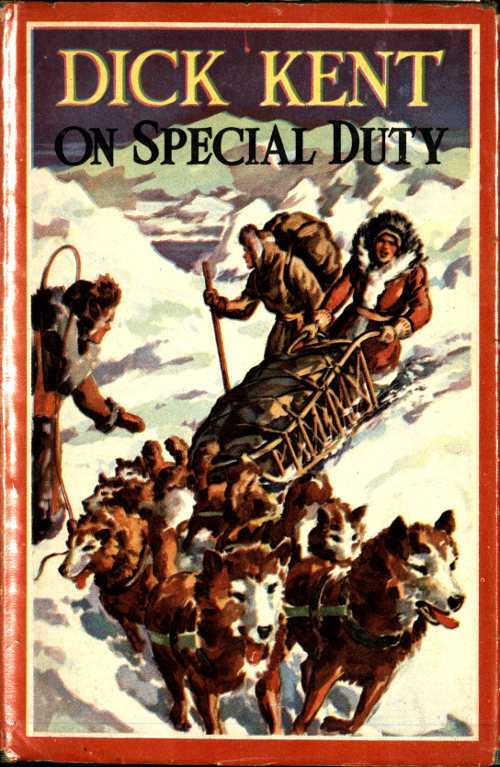
The Project Gutenberg eBook of Dick Kent on Special Duty
Title: Dick Kent on Special Duty
Author: M. M. Oblinger
Release date: October 22, 2015 [eBook #50275]
Most recently updated: October 22, 2024
Language: English
Credits: Produced by Stephen Hutcheson, Rod Crawford, Rick Morris
and the Online Distributed Proofreading Team at
http://www.pgdp.net
“Don’t move,” said a heavy voice. “We got yuh!” (Page 128)
DICK KENT
ON SPECIAL DUTY
By MILTON RICHARDS
Author of
“Dick Kent with the Mounted Police,” “Dick Kent in the Far North,” “Dick Kent with the Eskimos,” “Dick Kent, Fur Trader,” “Dick Kent with the Malemute Mail.”
THE SAALFIELD PUBLISHING COMPANY
Akron, Ohio New York
Copyright MCMXXVIII
THE SAALFIELD PUBLISHING COMPANY
Made in the United States of America
Contents
- CHAPTER PAGE
- I Rand Tackles a Difficult Case 3
- II The Price of Folly 12
- III Three New Recruits 17
- IV Frischette’s Money Box 28
- V A Midnight Prowler 38
- VI New Complications 49
- VII The Mysterious Poke 57
- VIII Corporal Rand Takes Charge 66
- IX Unexpected News 76
- X Conflicting Theories 85
- XI Finding a Motive 93
- XII “Rat” MacGregor’s Wife 103
- XIII On Creel’s Trail 111
- XIV A Meeting in the Woods 121
- XV A Deserted Road-House 129
- XVI Trapped! 134
- XVII A Policeman’s Horse 144
- XVIII A Red Blob 154
- XIX Across Hay River 161
- XX A Thrilling Experience 170
- XXI The Key to the Mystery 180
- XXII Dewberry’s Treasure 188
- XXIII Leaves From an Old Diary 197
- XXIV Carson’s Son 206
- XXV Piecing the Threads 216
- XXVI Dick Rejoins His Comrades 225
DICK KENT ON SPECIAL DUTY
CHAPTER I
RAND TACKLES A DIFFICULT CASE
“Rat” MacGregor dropped to the floor and crawled on hands and knees to the bunk wherein Dewberry, weary after hours of heavy mushing over an almost unbroken trail, now slept the sleep of the just. Dewberry’s raucous snores could be heard plainly. He lay face up, mouth partly open, while one large, hairy arm hung limply over the side of his bed.
MacGregor knew that Dewberry was really asleep. Not only did he know this, but he was cognizant of another fact, of which he alone was the sole possessor. He knew that the big Englishman could not easily be awakened. He was aware that something else besides weariness and exhaustion compelled Dewberry to slumber thus. And he grinned over the thought of it.
Before retiring for the night, the prospector had, following the usual custom, removed none of his clothes. Neither had he troubled to unstrap the money-belt that he wore, and place it in safe-keeping. The money-belt was full, almost bursting with yellowbacks and greenbacks of various denominations. But the thing which interested MacGregor even more, was the small poke, suspended from a moosehide cord, and tied securely about the sleeping man’s neck.
In his present predicament, the prospector would have been easy prey for the figure who crept towards him, had circumstances been a little different. The difference was this: In the room, the large airy room of one “Frenchie” Frischette, keeper of road-houses, were a number of other persons besides MacGregor and the drugged Dewberry.
These persons reclined in various attitudes and conditions of sleep. Not a few of them, including Corporal Rand, of the Royal North West Mounted police, possessed—even in slumber—a sense of hearing exceedingly acute. The creak of a board, a sudden rustling movement—almost any noise at all—would have aroused them at once. No one realized this any better than MacGregor. His job had been only half accomplished a few hours before when, with very little difficulty, he had drugged the man from Crooked Stick River.
The thief rose slowly to a position on his knees. He was so close to his victim that the man’s feverish breath fanned his cheek. He could hear plainly his own heart and the heart of the sleeper, beating in a sort of wild harmony together. His right hand was within eight inches of the rugged prospector, yet he seemed unable, powerless to extend it one infinitesimal part of the distance which separated it from the actual point of contact.
In the dull, red glow of the fireplace he could see the tell-tale bulge on Dewberry’s barrel-like chest. It filled him with a sort of agony to realize that at the crucial moment he lacked the courage and the strength to accomplish his task. Never before had he been so overcome with weakness. A few quick movements only were required to bring wealth into his grasp; yet here he knelt, with a cold dampness suffusing his face and a tingling paralysis of all his muscles.
The prospector groaned and moved slightly, then raised one knee in a convulsive movement of pain. MacGregor shrank back trembling, his eyes darting about apprehensively. In a far corner another form stirred uneasily and a loud, full-throated cough broke across the stillness like a trumpet of doom.
Several minutes elapsed before MacGregor had recovered sufficiently from his fright to attempt another furtive movement forward. This time he summoned to his aid the last remnant of a wilted spirit. His hands went out toward Dewberry’s throat. These clammy physical members found the cord, but his fingers refused to function in his efforts to untie the knot. For a moment he hesitated, then with a low, almost inhuman growl, he tore his hunting knife from its sheath and tried to cut the cord. In his haste, inadvertently the sharp point of the knife pricked the sleeping man’s chest and, to MacGregor’s great astonishment and horror, Dewberry started visibly and opened his eyes.
* * * * * * * *
The aroma of freshly fried bacon filled the room. Standing among his pots and pans, nursing a new-found despair, “Frenchie” Frischette, road-house keeper and gentleman of parts, could hear the approaching figure. The pupils of his eyes were like beads of glass as they encountered the trim, athletic figure of Corporal Rand.
“Oui,” he admitted slowly, “ze beeg prospector ees dead. You saw heem?”
Corporal Rand nodded.
“How many men have already left?” he inquired.
“Zay haf all left,” Frischette shrugged his shoulders regretfully. “Many before dawn. Zay go in ever’ direction—both ze good men and ze bad. How you find heem of ze beeg knife?”
“The man who stabbed and robbed Dewberry will go south,” Corporal Rand stated with conviction. “It is the law of the land. Men, who have money, invariably go south—to spend it. Is there anything more simple than that, Frischette? The rule seldom fails. Adventure goes north and money goes south. I’m taking the trail south.”
The road-house keeper moistened his dry lips.
“I see heem four men go on the south trail ver’ early roun’ five o’clock.”
“Together?”
“Zay went each by heemself.”
“No doubt, one of those four men is the murderer.”
“You t’ink so?”
“Yes,” said the policeman stubbornly, “I’m quite sure the murderer would travel south. At any rate, I’m going in that direction. So long, Frischette.”
Two days later, Corporal Rand was forced to admit that in this case, at least, a precedent had been broken. None of the four men was the murderer. Two were Indians from Lac la Biche; a third, Beckholt, a free trader, a serene, gray-eyed veteran of the North, was above suspicion. Father Marchand, who completed the quartette, could not for one moment be included in any inventory of crime.
Without even taking the time to question one of them, Rand swung about and retraced his way to the scene of the recent murder.
In the policeman’s absence, Frischette had made an important discovery. Eagerly and somewhat excitedly, he told the story in a mixture of poor English and bastard French. Fontaine, a half-breed boy in Frischette’s service, had seen, on the evening preceding the robbery, a tall, furtive-eyed man mix two drinks—one for himself and one for the prospector. In the cup intended for Dewberry, the tall, furtive-eyed man had poured something out of a small bottle. Shortly thereafter, the big prospector had stumbled to his pile of blankets and had fallen asleep.
In doubt, Rand questioned the boy closely. At first, he did not believe Fontaine was telling the truth. Then it became apparent, following a severe cross-examination, that Fontaine had really seen what he had described—was wholly innocent of guile. The description of the furtive-eyed man, his mannerisms, his clothing, the way he walked, had quickly brought a picture to Rand’s mind. There was no possibility of any mistake here. It was MacGregor, “Rat” MacGregor, of the Willow Lake country.
Soberly, the mounted policeman pondered his problem. If “Rat” MacGregor was the murderer, as the cards seemed to indicate, why, with so much money in his possession, had he set out on a trail which led farther into the wilderness? By all the rules of common sense, a person of MacGregor’s caliber would have lost no time in getting back to the gay “outside.”[1] It was inevitable. The desire within him would have been stronger than the will to resist. A powerful influence indeed, that would pull a man north when wealth was burning his pockets.
Ten days later, Rand found MacGregor in a small cabin below the Finley River. First he had seen a man and woman together, then two scrambling forms, a door closed hastily, and presently a gray puff of smoke from a window near the front of the house. The bullet whistled over his head, struck harmlessly in the brush behind him. A second cut into a drift to his right. A third, lilting of death, grazed his shoulder, causing him to sit down very suddenly.
Thereafter, Rand moved slowly and painfully. This time he advanced toward the cabin more cautiously. Fifty feet from his objective, he threw himself down behind a snow-covered log, lit his pipe and dully pondered what he ought to do next. For several hours MacGregor continued to blaze away intermittently from the window. After that darkness came and an interval of silence. The cold had grown more intense, more bitter. By degrees, a peculiar numbness had settled over the policeman’s shoulders and along his wounded side.
A moment later, he struggled to his knees, then rose deliberately and walked ahead in the direction of the cabin. In front of the door he paused, every sense alert. No sound issued from within; nor could he see even a faint glimmer of light. Somewhere inside, Rat MacGregor—true to his name—skulked in the dark—and his wife with him.
The faint outline of a block of wood, lying in the snow at his feet, drew his attention. Acting upon a sudden angry impulse, he stooped forward, picked it up, and raised it high above his head. It catapulted from his powerful arms, striking the window with a resounding crash. A woman screamed. Her terrified cry rang out through the deep hush that ensued and, accompanying its last wailing note, MacGregor’s guns spoke—two fiery flashes, not unlike the red tongue of a serpent—darting out into the gloom.
Shoulders hunched, Rand struck the door with a furious impact, and the bolts gave way. As he fell forward into the room, one hand clutched his gun. Again MacGregor fired; this time wildly, foolishly, for the flash of his revolver indicated only too well his position, and Rand had him almost before the sound of the other’s weapon had become smothered in the deep stillness of the room.
CHAPTER II
THE PRICE OF FOLLY
MacGregor’s resistance had cost him his life. Ten minutes later, in the flickering glow of a wax candle, the mounted policeman looked down at the prone and lifeless form.
“Well,” he said, turning suddenly upon the girl, a rather pretty French half-breed, “where is the money?”
The half-breed grunted and looked sarcastically, indignantly at Rand.
“No have money. No take money. Why you keel my man?” she wailed tearfully. “Mounted police! Bah!”
“Easy,” cautioned Rand. “Where’s that money?” He drew up to his full height. “Better answer me quickly now or I’ll take you along too.”
“No money,” insisted the girl. “He no catch ’em money that time. Beeg prospector wake up. No chance then. My man he come away.”
“Rot!” declared the policeman. “Your man killed Dewberry. Robbed him. Nobody else.”
“Leesen!” MacGregor’s wife plucked at his sleeve. “You think wrong this time. You make heem beeg mistake. My man no rob, no keel—nothing! I prove you find no money here. My man heem try rob, but no get nothing. Otherwise, we go south—Edmonton. No can go without money.”
Although Rand was certain that the half-breed lied, a careful and painstaking search of the premises failed to reveal the hiding place of Dewberry’s gold. Baffled, he was forced on the day following to place the girl under arrest and set out for detachment headquarters, two hundred miles away. There he filled in his report, turned the prisoner over to Inspector Cameron for further questioning.
But to no avail. Invariably the same answer, repeated over and over again:
“My man heem no rob, no keel. No take beeg prospector’s money. Mounted police! Bah!”
From that point it became a baffling case indeed. Corporal Rand, to whom it had been assigned, still believed, in the months that followed, that MacGregor had committed the murder. But where was the money and the poke? Did the girl really know where Dewberry’s gold was? If the theft had actually been committed by MacGregor, why had he broken precedent and remained in the North.
At Frischette’s stopping-place, two miles east of the Big Smoky River, Rand heard again Fontaine’s story of the drugged drink, together with such other information as the two Frenchmen could supply. Both were of the opinion that MacGregor, and no one else, had planned and executed the crime. Frischette’s voice came droning in his ears:
“Zat girl she know well enough where money ees. Not crazy zat girl; ver’ clever, ver’ clever.” His low chuckling laugh gradually grew boisterous. “What you think, Corporal, zat girl foolish enough to tell ze mounted police ever’thing. Mebbe after while she go south too.”
Preoccupied as he was, Rand caught the significance of that last statement.
“Are you going south, Frischette?”
The Frenchman nodded.
“Yesterday I sell my beezness. I haf done ver’ well here, corporal.” Then his voice sank to a confidential whisper. “In ze las’ two, tree, four year I make much money—ver’ much money. Now you wish me ze good luck, corporal.”
“Good luck,” said Rand, his brow wrinkling. “Yes. By the way, whom did you sell to?”
Frischette hesitated, his little eyes gleaming queerly.
“I no sell exactly. I haf too much already—too much money. Fontaine ees a good boy, monsieur. You understand—a good boy. He learn queek. He deserve much from me. For a few hundred I sell heem my beeg beezness.”
Still thinking deeply, Corporal Rand walked outside and sat on a rough bench in the warm spring sun. Why had MacGregor failed to go south if he had really robbed Dewberry of his gold. Men with money travelled south invariably. There was no other rule. It had seldom been broken. Why, Frischette himself, who had made a lot of money during his stay in the North, now contemplated going south to spend it.
With a sudden exclamation, Rand jumped to his feet. No! The rule had never been broken. MacGregor probably killed, but he never robbed Dewberry. He wondered if the man who had robbed Dewberry was inside.
“Frischette,” said the mounted policeman a moment later, “I wish to ask a favor of you.”
“Yes, monsieur.”
“You are going south?”
“Yes, monsieur.”
“How soon?”
“In ver’ few days, corporal. Why you ask.”
“Because I may need your help. I am going to ask you to remain here for a while. I shall ask you to stay here until I have recovered Dewberry’s gold.”
Rand watched the other closely. The eyes of the road-house keeper narrowed slightly—but that was all.
“Et ees as you say, monsieur.”
Then Frischette turned and walked back into the kitchen.
CHAPTER III
THREE NEW RECRUITS
One bright spring morning Corporal Rand arrived at Fort Good Faith. It was somewhat off his regular route, but he had a purpose in mind. There were three young men there he very much wished to see. One of them was Dick Kent, the second, Sandy MacClaren, a nephew of the factor, and the third, a young Indian, named Toma. On many occasions previously the three boys had given unsparingly of their services. The police needed their help now.
Working on the Dewberry case, Corporal Rand had suddenly remembered about the boys and had decided to call upon them for assistance. They could help him in clearing up the mystery. All three were unknown to Frischette. They might be able to secure valuable information he couldn’t obtain himself. So, immediately after his arrival, he summoned the three boys and made known his plans.
“I would suggest,” he concluded, “that the three of you, masquerading as young prospectors, drop into Frischette’s place and remain there several days on some pretext or other. You can say that you’re waiting for supplies, coming in by pack-train from Fort Good Faith. Cultivate Frischette’s acquaintance. Make friends with Fontaine, the half-breed boy in his service. See how much information you can pick up about Dewberry and ‘Rat’ MacGregor.”
“But do you really believe,” Dick asked, “that Frischette knows any more about the murder than he has already given out to you?”
“I’m not sure.” Corporal Rand pursed his lips. “But one thing is slowly dawning upon me.”
“What?” asked Sandy breathlessly.
“That MacGregor’s wife was right, that MacGregor didn’t take Dewberry’s money, or the small poke he had around his neck.”
“But if he didn’t take it, who did?” Dick inquired.
“Frischette himself might have taken it.”
“Surely MacGregor had something to do with it,” argued Sandy.
Corporal Rand rose and walked slowly across the floor to a little table, where he helped himself to a glass of water. He turned and regarded the boys thoughtfully.
“Here is a supposition that may throw a little light on what actually occurred. ‘Rat’ MacGregor, as we have reason to believe, was the first person to have designs upon Dewberry. He planned the robbery. He drugged his victim. Evidently murder did not enter into his calculations. When all was still in the room, MacGregor crept over to Dewberry’s bunk to commit the robbery.
“In some way his plans went wrong. Perhaps the drug had not proved sufficiently potent. While taking the money and poke, let us say, Dewberry woke up. Perhaps Dewberry made some slight exclamation or sound, which terrified MacGregor and which also might have aroused some other sleeper in that room. In desperation, we will assume, MacGregor murdered Dewberry, but is surprised in the act by this other person who had awakened. Just for the sake of my theory, we will say that that person was Frischette, that in some way he got the ‘drop’ on MacGregor, compelling him to hand over the money and poke and then forcing him to leave the place immediately.”
“Yes, that is plausible,” agreed Dick. “But why Frischette? There were other persons in the room beside him. Why do you think that Frischette may be the guilty one?”
“Because Frischette is planning to leave the country. He claims that he had made a lot of money up here, and is now giving his business to the boy, Fontaine, for a small consideration. That in itself is suspicious. Frischette’s determination to go ‘outside’ surprised me because I remember that, less than a year ago, he confided to me his intention to build three new road-houses here in the North.”
“When is he planning to leave?” asked Sandy.
Corporal Rand smiled reminiscently.
“He expected to go this week, but he has changed his mind since my last talk with him. As a personal favor to me, he has consented to postpone his journey until this little mystery has been cleared up.”
“But do you think that Frischette is aware that you suspect him of the theft?”
“No, I believe not. I merely told him that he would be of invaluable assistance to me in solving this case, and that the mounted police would be deeply indebted to him if he would consent to remain here for a few weeks longer.”
Dick and Sandy both laughed.
“I’ll bet he’s worried stiff,” grinned the latter, “that is, if he’s really the thief. By the way, corporal, how much money did this Dewberry have in his possession at the time of the murder?”
“There’s no way of determining the exact amount,” Rand answered. “Probably several hundred dollars in cash.”
“I wouldn’t think that that would be sufficient bait to tempt MacGregor.”
“There was the poke. Don’t forget that.”
“But you said it was a small one. Perhaps there wasn’t more than a few hundred dollars in nuggets and gold dust.”
“I’m not sure that it was gold.”
“What makes you say that?”
“Well, it was a very small poke. That much I know. It was almost too small for a prospector’s pouch. As you have suggested, if it contained nuggets, there would scarcely be a fortune there—hardly enough to tempt MacGregor. MacGregor would never have taken the chance he did for the small amount involved. He was naturally a coward, a sneaking human rat, and only a big stake could have induced him to gather sufficient courage to make the effort. After reasoning it all out, I have come to the conclusion that MacGregor must have known what that poke contained: Something infinitely more valuable than gold.”
“More valuable!” exclaimed Dick.
“Yes. Why not? Precious stones—or a secret of some sort worth thousands of dollars.”
Sandy sat up, clutching the sides of his chair.
“I’ll say this is getting interesting. You’re arousing my curiosity, corporal. I love a mystery.”
“Well, you have one here,” smiled Rand. “The morning after the murder I came to the conclusion that it would not be a very difficult case. However, it seems that I was wrong. Apparently, ‘Rat’ MacGregor is not the only person involved. Before we sift this thing to the bottom, we may discover that many persons are implicated. It is one of the most mysterious, unusual cases with which I have ever had to deal.”
“How do you purpose to work it all out?”
“I’m almost wholly at a loss to know. I haven’t a great deal to go on. It occurred to me that you boys might be able to pick up information that I couldn’t get myself. You may be able to find a clew. In the meantime, I’m going over to Crooked Stick River—the place where Dewberry came from just before the murder—and question some of the people there. Perhaps Dewberry had a friend or two in whom he confided. Certain it is that the contents of that poke has been seen by someone. Otherwise, to use a well known expression, MacGregor never would have been ‘tipped off.’”
“Don’t you suppose that Dewberry might have told MacGregor about his secret?” asked Dick.
“Scarcely likely. MacGregor was hardly the type of person in whom one would confide. He was a notorious character here in the North. He had a very unsavory reputation. At various times he had been implicated in certain questionable undertakings, and once had served a term in jail.”
“You think, then, that MacGregor had been following Dewberry?”
“Yes, awaiting his opportunity. He’d learned of the secret. But I’m positive that Dewberry gave him no information at all.”
Thus far Toma, naturally reticent, had taken no part in the conversation. He sat rigid in his chair, eyes wide with interest, nothing escaping him. Suddenly he drawled forth:
“When you want us go over this fellow Frischette’s place?” he asked.
“Tomorrow, if you will,” answered the corporal. “Arrange to stay there for three or four days. Then come back here to meet me.”
“I know this young fellow, Fontaine, you talk about,” Toma informed them. “One time we pretty good friends. We go to school one time at Mission. If he know anything, me pretty sure him tell Toma.”
“Good!” exclaimed Corporal Rand. “I’m glad to hear that, Toma. Your friendship with Fontaine may be the means of solving this mystery. If Frischette is implicated, Fontaine must be aware of it.”
The policeman rose to his feet again.
“Well, I guess you understand what’s to be done. If you’ll excuse me, I’ll hurry away now. I want to see Inspector Cameron for a few minutes before I go on to the Crooked Stick.”
He turned and shook hands with each of the boys in turn.
“Well, good luck to you. I hope you’ll like your new role of police detectives. When you return, you’ll probably find me here awaiting you.”
On the evening of the following day, the three boys, dressed for the part, arrived at Frischette’s road-house. It had been a warm afternoon and the boys were weary as they rode up to the well known stopping place and slowly dismounted. Sandy paused to wipe the perspiration from his face.
“We’re here—” he announced, “mosquitos and all.” He looked curiously about him. “So this is the famous stopping-place. I’ve often heard of it. It’s one of the largest road-houses north of the Peace River. They say that Frischette is an interesting character. He’s lived in the North a good many years.”
Sandy’s observations were cut short by the appearance of two young half-breeds, who sauntered over in their direction. Toma gave vent to an exclamation, dropped the reins over his pony’s head and advanced quickly to meet them.
“One of them must be Fontaine,” guessed Sandy.
“But he knows them both,” observed Dick.
Immediately Toma and his two friends approached and introductions took place.
“This him fellow,” Toma was explicit, “my friend, Pierre Fontaine. This other fellow, also my friend, Martin Le Sueur. He come long way this morning to be with Pierre. Mebbe after while they be partners an’ buy Frischette’s business.”
Both Le Sueur and Fontaine spoke very little English, so the conversation that ensued, a lively one, was carried on in Cree. While it was taking place, the boys put up their ponies and walked back in the direction of the hostelry. No sooner had they entered, than Frischette, with his usual hospitality, came forward to bid them welcome. As he did so, Dick gave him the benefit of a close scrutiny.
He was a little man, dark, vivacious—typically French. Yet his lively features showed the unmistakable Indian strain of his mixed origin. He conducted the boys to the dining room, talking as he went.
“Very hungry you must be, monsieurs. Sit down for a moment. We have plenty to eat here. I myself will serve you. Baked whitefish from ze water only an hour. Brown bread which I bake with my own hands. Then there ees coffee an’ a sweet pastry, monsieurs.”
“I was hungry, but I’m famished now after hearing all that,” Sandy declared. “You are very generous, Mr. Frischette.”
“Et ees nothing.” The Frenchman waved his arms deprecatingly. “I like et you come here once in a while during thees lonesome summer to make ze company. I am glad to learn that you are friends of thees ver’ good boy, Fontaine.”
Their welcome had been so whole-hearted and spontaneous that Dick did not, even for a moment, believe that Frischette’s manner was assumed. In spite of himself, he was drawn toward the vivacious, hospitable Frenchman. A capital host! It was difficult to see how Corporal Rand could harbor suspicion against such a person. The genial road-house keeper had none of the characteristics nor any of the appearances of a criminal.
That was Dick’s first impression of the man. Nor did he stand alone in this respect. Sandy, too, had been impressed favorably. Just before retiring for the night, the young Scotchman whispered in his chum’s ear:
“Look here, Dick, if you want my honest opinion, I think we’ve come on a wild goose chase. I believe Corporal Rand is wrong. After seeing and talking with this man Frischette, I’m absolutely certain that he’s innocent. Someone else is the guilty person.”
“I can’t help thinking that too,” Dick replied. “If looks and actions are not deceiving, Frischette is innocent. I doubt if he knows any more about the case than he’s already told Rand. Just the same, we’ll remain here and follow the corporal’s instructions.”
“Just wasting time,” grumbled Sandy.
Suddenly, they were aware of a presence near them. Both looked up quickly and a little guiltily, expecting to see Frischette himself. Instead it was Toma—Toma, a curious expression on his face, the light of excitement in his eyes.
“Sandy, Dick,” he announced breathlessly, “you come with me. I find out something important to tell you!”
CHAPTER IV
FRISCHETTE’S MONEY BOX
Toma led Sandy and Dick to the seclusion of a poplar grove, a few rods away from the house. His manner was mysterious. That he had come in possession of information of extreme importance, neither of his two friends could doubt. The young Indian’s eyes fairly snapped, as he motioned Dick and Sandy to be seated, he himself taking a position near them. Sprawling out on the soft turf, he began eagerly:
“I think better we come to this place, where no one hear us. I just find out something about Frischette. Fontaine tell me. Good news for the mounted police.”
“I hope you didn’t tell your friend what we were here for,” interrupted Dick. “We mustn’t take anyone into our confidence.”
“I no tell him that,” Toma assured him. “All I do is ask once in a while few questions ’bout Frischette. Then my friend, Fontaine, him talk. Tell ’em me all ’bout murder. He think MacGregor get money all right, an’ hide it away somewhere before police catch him. Never once it come in my friend’s mind that mebbe Frischette take the money an’ the poke himself. Frischette, he say, is good man, but very queer fellow. Once in a while he do queer things—things Fontaine not understand. Every few days he get out all his money, take it to room where he sleep, lock door, an’ begin count many, many times. Over an’ over he count all his money ’til he get tired, then he take an’ put it back in box an’ walk outside an’ find another good place to hide it.”
“A miser!” gasped Sandy.
“I don’t know what you call him. But Frischette very queer that way. Fontaine ’fraid to ask him any questions or make talk when Frischette like that, because he act like crazy an’ swear an’ beat Fontaine with a big stick if he say too much.”
“The mere fact that Frischette is a miser, Toma,” Sandy pointed out, “doesn’t necessarily imply that he’s also a thief. If he wants to hide his money and gloat over it, that’s his own privilege.”
Toma nodded.
“Yes, I know that. But Fontaine tell me something that make me think that mebbe Frischette steal money too.”
“Is that so? What did he say?”
“He say,” Toma hurried on, “that two times last winter a very queer thing happen. First time he wake up at night an’ hear someone walking in room, where all the men sleep. Next morning one man him say he lost all his money. Frischette feel very bad an’ give man mebbe ten dollars an’ say how sorry he is that once in a while thief comes like that in his house.”
“So next time,” continued the young Indian, “when Fontaine hear someone walk again in middle of the night, he go quick as he can to Frischette’s room, an’ he very much surprise when he see no one sleep in Frischette’s bed. Quick he go back again to room, an’ all at once he meet Frischette coming out.”
“‘What you do here?’” Frischette say.
“‘I hear noise,’ Fontaine tell him, ‘an’ I go to wake you up.’
“‘I hear noise too,’ Frischette say, ‘so I come in here to find out mebbe another bad thief come,’ he say.
“Next morning, sure enough, two men lose all their money, an’ Frischette very sorry again an’ say bad things ’bout thief an’ give each man ten dollars.”
“It does look suspicious,” mused Dick.
“Something of a coincidence,” agreed Sandy.
They sat for a short time deep in thought. Sandy got out his knife and began whittling a stick. Dick’s gaze wandered thoughtfully away to the fringe of woodland opposite.
“It might not be very difficult,” he broke forth suddenly, “to determine beyond the shadow of a doubt whether or not Frischette is a thief. In fact, I have a plan. We might try it.”
“What is your plan?” asked Sandy.
“We’ll lay a trap for him. Between us we can scrape up a little roll of money, and we’ll use that as bait. I’ll pull it out of my pocket when he’s looking, and pretend I’m counting it.”
“Yes, yes! Go on.”
“I’ll return the money to the inside pocket of my coat while he’s still watching me. At night, when he comes into the room, I’ll throw my coat carelessly over a chair.”
“Look here,” objected Sandy, a wry smile on his face, “I don’t think we have fifty dollars between us. Hardly an impressive roll, is it?”
Dick grinned. “I can easily remedy that.”
As he spoke, he pulled from his pocket a number of old envelopes, containing letters, wadded them together and then began wrapping crisp new bills around them. With the acquisition of the bank notes Toma and Sandy gave him, the dummy had grown to noble proportions. The boys laughed gleefully over the subterfuge.
A short time later, returning to the house, Dick awaited his opportunity. Frischette was nowhere to be seen, when first they entered, but presently a noise at the back attracted their attention and immediately afterward Frischette came through the door, leading into the kitchen, carrying a box under his arm.
Dick and Sandy exchanged significant glances. Both recalled what Toma had told them regarding that box. Also they observed the inexplicable change that had come over their host. His animation and vivacity were gone. From under their shaggy brows his dark eyes darted glances from right to left—the look of a maniac or insane person. Without even a nod, he passed by the three boys and entered his own room.
“Got ’em again,” whispered Sandy, much taken aback. “Not a very good time for the working out of our plan, is it? He’s deeply engrossed in that mysterious box by this time.”
“We’d better try it out on him tomorrow,” decided Dick. “He’ll be in there several hours, and it will probably take him another hour to find a new hiding place for his precious treasure chest. It’s getting late now. We ought to be in bed.”
The boys went over and sat down on a long bench near the fireplace and began idly to take mental inventory of the room. Bear skins hung from the wall. In the center of the room stood a long rough board table, covered with a somewhat frayed and tattered cloth. Above the mantel were several firearms of various caliber and design.
Suddenly, Sandy leaned forward and clapped Dick on the knee.
“Dick, I have an idea. Just for the fun of it, let’s follow the old rascal and find out where he hides that box.”
Dick looked at the other dubiously.
“Well,” he hesitated. “I don’t know. It seems like meddling to me—prying into something that doesn’t concern us.”
“Wait a moment, Dick. Is it really meddling? For the sake of argument, suppose that box contained Dewberry’s poke and money. We already have a suspicion that such may be the case. Why wouldn’t we be justified in following him, when he leaves his room, and attempt to find where he hides the box?”
“But surely you wouldn’t open it?”