
Not long afterward a young Indian led a pony over to where Dick and Kantisepa stood and indicated with a gesture that the beast belonged to Dick. Immediately behind, came another youth with a mount for Kantisepa. Soon the cavalcade was formed. At two o’clock they rode forth in the bright glare of October sunshine.
As they went forward in the direction of the little meadow, Dick was conscious of many mixed emotions. He was glad that they had started out on the trek to Mackenzie River, yet the thought of approaching the shattered airplane and taking Stewart’s crushed body north for burial filled him with many unhappy thoughts.
On they went through the beauty of a perfect Indian Summer. The earth was languorous and quiet, wrapped in a blue haze, made resplendent by the vari-colored autumn foliage. Kantisepa, who was riding close beside Dick, presently raised one arm and pointed ahead to where the trees thinned out to form a natural meadow.
“We will be there soon,” he announced.
Dick looked, then turned his head away. He hated the coming ordeal. With difficulty, he steeled himself for the trying experience of approaching the battered plane and removing Stewart from the wreckage. In his weakened, nervous state, he felt unequal to the task. He rode forward, eyes on the ground, feeling sick and unhappy.
They pushed their way to the edge of the meadow, when, suddenly as if by a common impulse, the cavalcade checked itself and a low murmur of excitement, mixed with fear, ran along its entire length.
Dick supposed that the sight of the broken plane had been the cause of the momentary delay. However, when he looked up, he too became excited. A surge of happiness welled up in him. He leaned over dazedly and grasped the pommel of his saddle.
Straight ahead, not far from the ruins of the craft in which he had nearly been killed, stood two gray airplanes, graceful as birds. They had come back to rescue him.
CHAPTER VIII
THE TOLL OF THE NORTH
Corporal Rand’s bloodshot eyes watched the bannock baking before the fire. It was a small bannock, as bannocks go—a few ounces of flour, water and salt, simmering and bubbling there in the bottom of the frying pan. Unsupported by as much as a single pinch of baking powder, this culinary effort of Rand’s wore an appearance of deep and utter dejection. Either as a work of art or as an achievement in cookery the thing was a failure—an unsavory, unappetizing mess. Yet the corporal regarded it with elation in his heart. His mouth watered and his stomach did an acrobatic flip-flop of happy anticipation. It was a wonderful moment for Rand.
Half-starved, almost worn to the bone, in his desperate effort to make Keechewan Mission before the final freeze-up, the young policeman was in dire straits. For several days now he had subsisted chiefly on the dry and withered berries of saskatoon, with an occasional small morsel of bird meat. For hundreds of miles he had trekked along in worn moccasins, flapping miserably about his ankles, the bare soles of his feet pattering monotonously over a rough, difficult, uncertain trail.
Since leaving Mackenzie River barracks one disaster had followed another. First, he had lost his horse and rifle in attempting to ford a difficult river. Three days later, while he slept, there had come in the night a soft-footed Indian prowler who had, without compunction, stolen his only pair of service boots, his shoulder-pack and his revolver.
He had been placed in a terrible predicament. Barefooted, hungry, an unabating rage in his heart, he had struggled on for a distance of nearly twenty miles before luck favored him to the extent of directing him to an Indian encampment, where he ate his first full meal in many days and where, after many threats and much patient dickering, he had been able to purchase a pair of moosehide moccasins.
A few days following this fortunate meeting, he had been reduced almost to his previous condition of want and suffering. Then the tables had turned again. Not more than an hour ago a great good fortune had befallen him.
He had come down into a little valley between two hills; hobbling down on tortured feet to a sizeable grove of poplar and jack-pine. Half-cursing, half-moaning to himself, he had crossed a low ravine, then scrambled up in the mellow afternoon sunlight to the edge of a small natural clearing. His incurious gaze swept the view before him. For a moment he paused, leaning somewhat dizzily against a small sapling before continuing his course southward to the Wapiti River, where he had planned to camp for the night.
In the short space of time in which he stood there, shaking with fatigue, there impressed itself presently upon his vision an object of unusual interest. It was the small stump of a tree—an ancient, weather-beaten stump, probably not more than eight or ten inches in diameter. As Rand looked at it, a half-hearted wonderment stole over him, then a sudden quickening of the heart. Here before him was a man-made stump, the first he had seen in the last two hundred miles of steady travelling through the wilderness.
Someone, perhaps a long time ago, had felled a tree here. The corporal could easily make out the imprint of an ax. And looking farther he had found other stumps, upon which trees had once rested—about thirty of them in all—standing there old and rotten at the heart, like so many dreary sentinels in an unsightly garden of desolation.
Suddenly Rand gave vent to a sharp, quick cry of excitement. In spite of the fact that his feet hurt him almost beyond endurance, he went forward at a run, racing over the thick dry grass. The trees had been cut down for a purpose, as he had surmised. He could see the cabin now, faintly showing through the screen of underbrush on the opposite side of the clearing.
But his heart fell as he came closer to the cabin. A sickening wave of disgust and disappointment swept over him. He could see plainly that no one lived there. The door, partially open, hung loosely on broken hinges, while across the threshold, the grass had woven a tangled mat which encroached a full twelve inches into the dark interior.
Years had passed probably since a human foot had stepped within that cabin. In its present untenanted, dilapidated state it had very little to offer to a man whose stomach gnawed with the irrepressible pangs of hunger. In a fit of sudden despair, he stood and regarded it darkly.
Nevertheless, he strode through the doorway, for no apparent reason that he could imagine, unless it was to satisfy a somewhat morbid curiosity as to what he would find within. In the dim light of the single room, he moved cautiously forward, peering about him with half-frightened eyes. His feet stirred up a choking dust. There was a smell about the place he did not like. It rose to his nostrils—a faintly sickening odor of decayed plants.
A crudely constructed cupboard at one side of the room attracted his attention. He walked over and examined it. The lower shelf contained nothing of interest: a few black, dirty pots, covered with rust. On the second shelf there was a miscellaneous assortment of knives and forks, a small hammer with one of the claws broken, two enamelled plates, chipped badly, but otherwise in fair condition.
The policeman found it necessary to rise on tiptoes in order to reach the third shelf at all; but after a good deal of fumbling and groping about, his hand came in contact with a round object, which he lifted down for better inspection.
The weight of the thing, about six or seven pounds, indicated that it was not entirely empty. It was round and cylindrical in shape and was fitted on the top with an air-tight cover. Rand’s face became damp with moisture as he turned the vessel slowly around in his hands. He shook it several times, listening to the dull thud inside. Then, with a quick in-taking of breath, he placed it hurriedly on the floor and attempted to pry off the lid.
Several minutes later—for the cover was rusted down—he straightened up, gibbering inanely. His eyes were bright with the joy of his discovery. He laughed loudly, gleefully—a hint of madness in his laugh. He stooped forward again, ramming one hand into the cool, white substance. For one delicious moment he pawed around in it.
“Flour! Flour!” he gloated. “This is lucky!”
And so he ate the bannock with thankfulness in his heart. He had used very little of the flour. With careful rationing, it would still last him a long time—perhaps even to Keechewan Mission.
He sat now, staring into the fire, vaguely wondering what the morrow would bring forth. He was in a much happier frame of mind than he had been for many days. Things looked brighter somehow—after that bannock. In the morning he would build a raft and cross the Wapiti. After that there would be fairly smooth and open country until he came to the Little Moose. More trouble there. A day or two crossing the divide—then Keechewan Mission less than thirty miles away.
A short time later, Rand stirred himself and hobbled down to the river. He would bathe his aching feet in ice-cold water before turning in. They were in terrible condition and required immediate attention. If only he could get the pain and fever out of them. Tomorrow morning he would tear up his shirt and make soft cushions to wear inside his moccasins.
For several minutes he sat, dangling his feet in the glistening, gurgling flood of the turbulent Wapiti. It was so dark now that he could scarcely see. It was chilly sitting there on the rock with a north wind whipping across his face and the water, like ice, around his ankles. Much as he hated to admit it, the weather was not promising. In fact, there was an indefinable something in the air, a vague, mysterious portent that caused him to shiver with apprehension.
Suddenly, above the sound of the river and the moaning of the wind, startled and alert, Rand heard a splashing out in mid-stream. A moose or caribou, was his first thought. Too bad he didn’t have a gun. In his half-famished state a moose-steak now would be his salvation.
A human voice carried across the water. Another voice. Rand could not credit his senses. He rose, forgetting about his bare feet, and strained his eyes until they hurt in the hope that he might be able to see something. He was all atremble. It was dark out there, dark as black midnight. The water rippled and the wind moaned in the pines. Surely he was mistaken about those voices. He couldn’t hear a thing now—not even a splash.
“Pull out! You’re gettin’ too close tuh shore,” warned a voice, deep and resonant.
There was no mistaking it this time. Rand’s heart leaped. In the tremendous excitement of the moment he forgot himself completely. Like one daft, he sprang from the rock and raced wildly along the shore, cutting his already bruised and battered feet. He screeched at the top of his voice—one long and prolonged screech that shattered the silence.
“Yip! Yih!” shouted Rand, waving his arms.
“Did you hear that?”—from the river.
“Look out! Look out! You plagued fool. Look out! Now you’ve done it. There!——”
A frenzied splashing of oars, another warning shout—a crash! It was the crumpling impact of wood against rock that Rand heard, followed by the shrieks of two men in mortal terror. Experienced in such matters, he sensed immediately what had occurred. Sweeping down the swift, treacherous current, the boat had veered in too close to shore, had struck a rock and had overturned. The men were in the water. His fault entirely. That foolish screech——
Shouting out his encouragement, the corporal waded out into the stream and, without a moment’s hesitation, dove forward and commenced swimming to their rescue.
CHAPTER IX
CAMERON FEELS THE STRAIN
The advance guard of the Edmonton relief expedition arrived at Mackenzie River two days late. Included among its personnel were Dick Kent, Sandy and Toma and two medical men, Drs. Brady and Mattinson. Joy over the safe arrival of the party was shadowed by the news of the destruction of one of the planes and the death of Stewart, the aviator.
Inspector Cameron began at once to plan two separate itineraries into the stricken areas. One of the physicians, it was decided, would be sent immediately to the country north of the Mackenzie, from whence Davis had brought first word of the epidemic. Another party was instructed to proceed north and east toward the barren lands, over the selfsame route Corporal Rand had but recently taken.
It was while these preparations were being carried out that the three boys, Dick, Sandy and Toma, were called into the presence of the mounted police official. Caps in hand, feeling awkward and ill at ease, they listened to the grave and somewhat impatient voice of the inspector.
“Can’t tell you how pleased I am. Splendid! You’ve done well. Want to thank each one of you. Suppose you think you’re going home now.”
The assertion seemed to require an answer. Sandy twisted his cap into a knot, smiled, cleared his throat and assumed the part of spokesman.
“Yes, sir. We are under that impression.”
Cameron scowled, running his fingers through his rumpled hair.
“Not a bit of it! You’re not! Might as well disillusion you right now. You’re to undertake another errand, equally as important and dangerous.”
“What is it?” asked Dick.
“You’re to lead the way to the barren lands. Escort to Doctor Brady.”
The boys exchanged furtive glances. Cameron continued:
“Dick, I’m placing you in charge. You’re the oldest. Sandy and Toma will be your lieutenants. This expedition must not fail. Nothing must happen to it. I’ll hold you all responsible.”
“Yes, sir,” trembled Dick. “But how do we get there?”
“There’s no trail. I’ll try and find a guide for you. You proceed northeast, cross the Wapiti, the Little Moose, pass over a height of land known as ‘The Divide,’ enter the barren lands and thus eventually come to the Keechewan Mission, an important Catholic missionary center. It’s a hard trip and you’ll never forget it.”
“Are there many people at this mission?” inquired Sandy.
“Yes, there’s a sort of village there—a mission-village: flour mill, schools, hospital and the like. There are always several large Indian encampments close by. The plague has found its way there. Scores have died. As far as I know, no other section of the country is in such dire straits.”
The inspector paused, scowling again and for a moment seemed to have forgotten that he was not alone.
“The epidemic is bad enough,” he resumed, “but to add to the horror of the situation, a revolt has taken place among the Indians. I’ve been compelled to send Corporal Rand up there. You will follow but I doubt if you will overtake him. He’s travelling light, while you will have medicine, supplies, mail——”
“Mail!” interrupted Dick in surprise.
“Yes, mail. All of the mail for the Keechewan Mission comes here and is forwarded, usually through the efforts of the R. N. W. M. P. There will be three large sacks, including one packet of registered letters. Are you willing to undertake this responsibility?”
The boys were a little confused and shy. For a time no one spoke.
“I asked you a question,” persisted the inspector. “Do you or do you not want to take the mail?”
“Yes, sir,” said Dick hurriedly, “we’ll be glad to.”
“All right. Then that’s settled. I’ve given you an idea of the route. Anything you wish to know?”
“It will be necessary to supply us with some sort of transport,” Dick reminded him. “Would you suggest ponies?”
Inspector Cameron smiled.
“I might suggest ponies did I not know the North as well as I do. The season is growing late. It is now the last week in October. The weather has been wonderful—unusual, but we’re due for a change almost any day now. You’ll have to take both ponies and dogs. Just as soon as the first snowstorm comes, you can turn the ponies loose and proceed with the huskies.”
A short discussion then took place. Dick could see that the inspector was very anxious to have them start as soon as possible. For the past few weeks the police head had had much to worry him. That was evident. Deep lines showed in his forehead. At times he was subject to fits of brooding, although the safe arrival of the Edmonton party had considerably cheered him.
Burdened with so many responsibilities, Cameron revealed his state of mind from time to time, either by his expression or by some chance word he let fall. Naturally, the boys supposed that the inspector’s chief worry had to do with the epidemic. They did not know that one of the things that caused the grizzled veteran of police many hours of apprehension and nights of wakeful, intolerable anxiety was Corporal Rand’s hazardous undertaking. He feared for his subordinate’s safety. The corporal had not been vaccinated. He had been sent to a district which festered with the plague.
“Rand has gone up ahead of you,” he told the boys. “When you arrive at the mission, the first thing I want you to do is to look him up. Doctor Brady has my instructions. He’ll vaccinate the corporal if—if——”
He broke off suddenly and his eyes sought his desk. Absently he picked up a letter-file and ran through it. Dick observed that his fingers were trembling.
“If it isn’t too late, Dr. Brady will vaccinate him,” he resumed more calmly. “The thought of his being up there troubles me. Shouldn’t have gone in the first place. Matter of fact, he went against my wishes. Hardly in physical shape. Weak. Been sick a long time with pneumonia. I don’t like it.”
Again the police chief became absorbed in his thoughts. The boys stood undecided, then turned and left the room. Outside, where they would not be overheard, Sandy broke forth:
“Never saw him just like that before. I’d say he’s losing his grip, Dick. Acts queer, doesn’t he?”
“I don’t wonder at it,” Dick came staunchly to the inspector’s rescue. “You must admit his position has been trying enough of late. If I’d been in his place, I’d be a mental wreck by this time.”
Soon after the subject was forgotten in the hurry and interest of their departure. All three had been sent to Dr. Brady and were vaccinated. At three o’clock that same afternoon the cavalcade set out. An Indian guide, who professed to know every foot of the route, had been added to their train at the last moment by Inspector Cameron.
“I’m not altogether sure about this man,” he had told Dick in strict confidence. “Seems intelligent enough, and I’m sure he’s been over the route many times. My only objection to him is his appearance. But one can’t condemn a man on that score. He’ll probably prove invaluable to you.”
Dick glanced at the new recruit and pursed his lips.
“Did he volunteer for this service?” he asked.
“Yes. Seemed anxious to go. Didn’t even want pay for his services. Rather unusual, isn’t it?”
“Perhaps he has relatives or friends at Keechewan he’s been worrying about,” surmised Dick.
“Of course, that may explain it. Still, I can’t say I like his looks. You’d better watch him.”
“I’ll be on my guard,” laughed Dick as he leaned over in his saddle to shake hands. “I’ll do my very best, inspector.”
“I know you will. Otherwise, I wouldn’t have sent you.”
The grim mouth relaxed into a faint smile. Cameron reached up and gripped Dick’s hand.
“Good-bye,” he said simply.
CHAPTER X
THE MUTINEER
Three days out from the mounted police detachment the weather grew suddenly cold and the first snow fell. Without preliminary warning, winter had come. It swept down from the north, a mad trumpeter blowing his blast at the head of a vengeful, icy column. On the morning of the second day after the storm six inches of snow covered the earth.
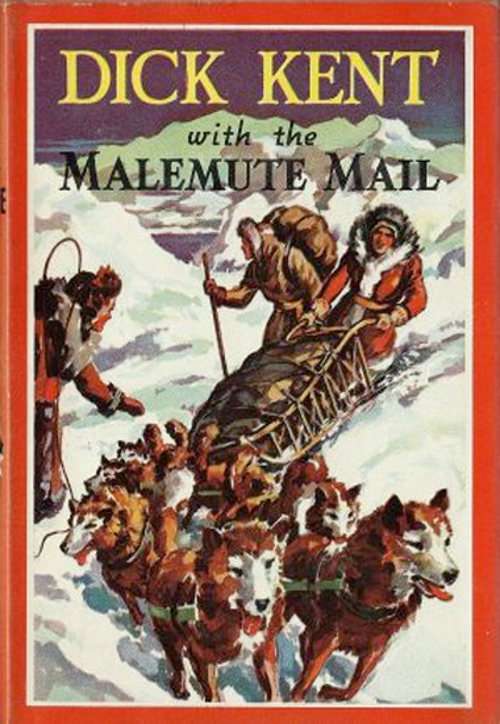
Dick’s first act was to remove the packs from the ponies and place them on the dog sleighs. This task took less than an hour. With the malemute and husky teams transporting their supplies, they pushed on, discovering that, despite the cold, they now made better progress. Dick drove the mail sledge, while Sandy and Toma had charge of the team which conveyed most of the medicine, not to mention the worthy and genial Dr. Brady himself.
Brady was popular with everyone. Always in good spirits, he became known for his wit and humor. Although considerably past middle age, he had never contrived to outgrow the young man’s viewpoint. He felt like a boy again. He talked and laughed and played pranks like a boy. To him this incursion into a vast wilderness region was an experience long to be remembered. He insisted upon doing a share of the work, soon learned to drive a dog team and often took his turn in breaking trail.
For the most part, cloudy weather prevailed, with an occasional light snowfall. The country was new to Dick and he was compelled to leave the charting of their route to the guide who had joined their party just previous to their departure.
The guide’s name was Martin Lamont. He was probably of French extraction, although he claimed to be a full-blood Indian. For a native, his skin was too light, his cheekbones too low, and, what was most incredible of all, his dark hair was curly. His nose was large and unsightly, while his lips were thin—thin and bloodless. A slight cast in one hawk’s eye gave him a peculiar squint.
“He can’t help being so murderous-looking, I don’t suppose,” Sandy declared one morning. “Just the same, that eye of his chills me to the bone whenever he looks my way. And did you ever notice, Dick, that horrible scar on his left cheek?”
“Yes,” Dick replied, “I’ve noticed it. But I think I could endure his looks if only he had a more pleasant disposition. He seldom talks. When he does, it’s usually a grunt or a snarl. A while ago he acted queerly when I asked him to relieve one of the drivers, who was breaking trail.”
Dr. Brady was walking right behind the two boys and evidently had been listening to their conversation, for, at this juncture, he suddenly broke forth:
“He did act queerly—only I think I’d call it defiant. There was a mutinous look in that squint eye of his.”
“It was unprovoked,” said Dick, a little bitterly. “I asked him in a friendly way. It’s only fair that we should all take turn in breaking trail. He’s the only one that seems to object.”
“But what did he say?” Sandy demanded impatiently.
“Nothing,” answered Dick. “Merely muttered something under his breath, glared at me, then walked back behind the last team. He’s sulking there now.”
“I can’t understand it,” Sandy wagged his head. “He volunteered his services and yet doesn’t want to do his part. What would you say is wrong with him, doctor?”
“Haven’t properly diagnosed his case yet,” grinned Brady, “although his symptoms indicate a very serious condition. Offhand, I’d say that he required immediate treatment.”
“He may get it,” Dick hinted darkly.
Sandy laughed. “Places you in a kind of bad position, doesn’t it, old chap? First thing you know, you’ll lose face with the rest of this outfit. That Nitchie is setting a mighty bad example.”
“Exactly what I think,” appended Brady. “You’re in charge here, aren’t you, Dick?”
“Yes,” Dick nodded. “Worse luck. If it comes to a show-down of course, I’ll have the police behind me. Still, I hate trouble. Sometimes I think I’ll let Mr. Lamont have his own way, and again I feel that to do that will only breed discontent among the others.”
Dick turned and looked up into the physician’s face.
“You’re older than I am, doctor. What would you suggest?”
Dr. Brady’s brow puckered.
“I’m sure I don’t know. I hate to advise you, my boy. You might be inclined to follow it.”
“Out with it,” Dick laughed. “You’re putting me off. What would you do if you were in my place?”
“I don’t like him,” said Dr. Brady, “and I never did. I’ve been watching him ever since we left Mackenzie. His actions are suspicious. His disposition is unbearable. He’s a hard and dirty customer. In spite of which—if I were in your place—I think I’d have it out with him. But if you do, I’m afraid there’ll be trouble.”
“You mean he’ll fight?”
“Yes, but not openly. He isn’t that type. He’ll wait his chance to get even. It’s hard to say what he’d do.”
For a time they walked on in silence. Then Dick stepped out to one side of the trail, a grim look on his face.
“Well, we’ll soon find out. I’m going back there now.”
Sandy’s eyes opened wide and his gaze followed his chum as he walked back to the end of the line. Brady chuckled. The driver of the team behind turned his head and grinned.
Lamont’s squint eye gleamed balefully as Dick approached. Probably the man knew why Dick had come, sensed the other’s motive.
“A little while ago,” Dick spoke calmly, “I asked you in a nice way if you wouldn’t help out in breaking trail. Why didn’t you go, Martin?”
“Don’ want to go,” grunted the miscreant.
“Why not?”
“What you think,” screeched Lamont, now in a flaming temper, “me be guide an’ do all the work too? I tell him Mr. Police Inspector I go show you the way. That’s all. No work! No break ’em trail! Nothing! Me big fool if I go break ’em trail like you say.”
“No doubt,” said Dick, endeavoring to control himself. “Just the same, I think you’ll go. All day yesterday you rode on one of the sleighs. You didn’t walk a mile. Is that fair?”
“Sure,” the other answered maliciously. “Me guide here. That’s all I do.”
“And I happen to be boss here with instructions from the man who hired you. Either you’ll do your share of the work or you’ll leave this party. Come now, which is it?”
“Me guide here,” reiterated Lamont. “Sorry you no like it, but I no break trail.”
Dick was in a quandary. He was angry, yet also was he nonplused. He had never encountered a situation like this. He wasn’t quite sure how to proceed. He wished he had Brady at his side to advise him. He was treading on ticklish ground.
“All right, you’ll have to leave the party, Lamont, you understand that.”
Martin grinned across at him, a malevolent, maddening grin. It carried a challenge. Dick’s hand fluttered toward the butt of his revolver, but he caught himself in time.
“Lamont, I’m not fooling. I mean what I say. You’re leaving this party tonight when we make camp. I’ll give you enough rations to take you back to the Mackenzie.”
The guide’s eyes narrowed to two mere slits. There was something venomous, snake-like in his stare.
“I no go back to the Mackenzie,” he retorted quickly. “I go where I wish. That place I go is Keechewan Mission. How you think you stop me go there?”
“Go there, if you like, but you’ll not go with us.”
“Mebbe not,” said Lamont stubbornly. “We see about that.”
Dick left the man and hurried back to the head of the column. His face was grim and set as he rejoined Sandy and Dr. Brady. An angry flush had mounted to his cheeks. His fists were clenched so hard that the nails dug into the palms of his hands.
“Well,” said Sandy, his voice lowered and anxious, “what did he say? What is he going to do?”
Dick could not trust himself to speak. Rage had overcome him.
“I’ll show him! I’ll show him!” the words kept singing through his brain. “I’ll show him!” rang on the vengeful chant. “He’ll not make a fool of me. Guide—paugh! I’ll show him!”
Then, happening to glance up, he saw that Dr. Brady was looking at him—looking at him with friendly and yet appraising eyes. And in that moment he felt somehow that his measure was being taken by that genial but worldly-wise physician.
“He provoked me,” said Dick by way of apology. “Lost my temper. He refuses to break trail, to work—to do anything at all except just loaf around and point out the way to Keechewan Mission.”
“And what did you say to that?”
“I told him that I didn’t propose to put up with it. I said that he’d have to go. Tonight, when we make camp, I’ll give him rations, send him on his way. He’s through.”
“I don’t blame you. I think you’re doing the right thing,” declared Dr. Brady. “We’ll be better off without him.”
“I wish I could believe that,” Sandy suddenly interjected. “You say we’re better off without him—but are we? When he leaves us, who’ll show us the way? Lamont is the only member of this party who has been to Keechewan. There’s no trail. We can wander miles off our course, get ourselves into all sorts of difficulties and dangers—freeze and starve and heaven knows what. The Barrens is a horrible place in winter, a death-trap if you don’t know it. My Uncle Walter has been there and he told me about it. It makes me shiver to think about it. Well named the Barren Lands. An eternity of snow and utter desolation. You simply travel on and on and on—and get nowhere. Twenty years from now some wandering Eskimo will kick your bleached skeleton out of his path.”
“Can’t help it,” said Dick stubbornly. “That man goes.”
“You’re in charge here, of course. I know it’s hard to put up with his insolence and his bad example, still——”
“Yes,” said Dr. Brady, who had become very much interested in Sandy’s point of view, “tell us the rest of it. I’m very anxious to hear.”
“There’s nothing more to tell,” confessed the young Scotchman. “I’m merely asking Dick to think this thing over very carefully before he comes to a decision. Even if we don’t get lost without a guide, we’re certain to be delayed. You know what that means?”
“Delays mean human lives. Is that it? Is that what you’re thinking?”
“Yes. Inspector Cameron wants us to get through to Keechewan as quickly as possible. It’s important. It’s imperative. What if we do have to humor Lamont? Better to let him ride every foot of the way and lord it over us than let all those poor devils die without a chance.”
“Sandy,” declared Dick—and his voice caught—“you’ve won me over. If I dismissed Lamont now I’d—I’d have blood on my hands.”
Dr. Brady did not speak for a moment His face was grave and thoughtful.
“What do you think about it?” Dick asked.
“A peculiar situation,” finally admitted Brady. “Lamont ought to be punished, of course. He’s a miserable bounder, to say the least. But——”
“Sandy’s logic and good sense has convinced you too.”
“Exactly.”
“We’ll have to keep that guide no matter what happens,”
“We’ll have to keep him,” said the doctor.
“Even if I’m compelled to apologize to him,” grimaced Dick, “and cook his meals and wait on him hand and foot, we’ll have to keep him.”
“There’s no other way. You can punish him when you get to Keechewan, of course. I’d suggest turning him over to the policeman up there, your Corporal Rand.”
Silence settled down again, broken only by the cracking of whips and the sharp cries of the dog drivers. The afternoon slowly wore on. An overcast sky brought the darkness early. Yet they pushed on for nearly an hour through the gloom before Dick gave orders to halt and make camp.
“We’ve made a record today,” exulted Sandy, as he came forward to assist Dick in unharnessing the malemutes from the mail-sledge. “We must have come nearly forty miles. With a good snow-crust, we’ll do even better than that.”
Dick was about to answer, when he became aware of a form emerging from the dark. A familiar voice accosted him:
“Is that you, Dick?”
“You bet! Why hello, Toma. Where’s your team?”
“I get ’em off harness already. Feed ’em fish. Bye-’n’-bye they crawl in snowdrift an’ go to sleep.”
“Tired enough to do that myself,” declared Sandy. Toma came closer. He took Dick’s arm.
“You know that fellow, Lamont,” he began eagerly.
“Yes, yes,” said Dick. “What’s he done now?”
“He tell ’em me to give you this,” answered Toma, placing something in Dick’s hand.
A small, flat object of some flexible material, which felt like leather. Dick fumbled in his pockets for a match and struck it. The sudden tiny glare revealed nothing more than a piece of birch bark, blank on one side, a pencilled scrawl on the other. Presently, with the help of another match, he made out two words wholly unintelligible: “god by.”
“God by,” asked Dick perplexedly. “What does that mean?”
“It means,” answered the quick-witted Sandy in a voice that was unusually calm, “that Lamont has left us. Can’t you see? Gone!”
“But this thing—these words, I mean—what——”
“He couldn’t spell. It’s ‘good-bye.’ He’s gone, I tell you.”
Bewildered, weary, disheartened, Dick stared miserably out into the enveloping darkness.
CHAPTER XI
PHANTOMS OF THE STORM
Long before the camp was astir on the following morning, Dick rose shivering, dressed, and made his way to Dr. Brady’s tent. Lamont’s departure had completely upset him. He could think of nothing else. Through the long night he had lain awake thinking unpleasant thoughts, upbraiding himself for his lack of diplomacy and negligence. To a certain extent he and he alone was responsible for the calamity. He had asked Lamont to leave the party and the guide had gone. Now he bitterly regretted the incident. He had been a fool—rash, hasty, unthinking. He had jeopardized the lives, not only of his own party, but, worse still, the lives of scores of others residing in the districts affected by the plague.
Hurrying along through the chill of early dawn, it occurred to him that there might still be some way out of the difficulty. Dr. Brady, who had not yet been informed of the guide’s departure, might be able to suggest something. He entered the physician’s tent and proceeded to wake its occupant. Brady sat up, for a moment stared dully about him.
“Well! Well! So it’s you, after all. When I first opened my eyes here in the darkness and felt you tugging at my arm, I was sure that my time had come. ‘Indians,’ I thought. ‘Brady, you’re about to be scalped.’ Then I remembered that I am bald-headed. They couldn’t scalp me but——”
“I’m in trouble, doctor,” said Dick, Brady’s jocularity failing to draw even a smile from him. “Lamont left us last night.”
The other whistled—a habit he had when surprised or excited.
“What! You don’t say!” the doctor brushed one hand hurriedly across his suddenly furrowed brow, staring straight at his informer. Then:
“So you had trouble with him after all? Was there a fight?”
“No; nothing like that. I hadn’t even talked to him except that once. He left just when we made camp last night. Sent me a sort of message on a piece of birch bark. I would have given you the news before you turned in last night if Toma and I hadn’t gone back on the trail to see if we couldn’t find the place where he’d struck off across country.”
“Strange, isn’t it?” as he spoke, Brady arose, pulling a blanket around him. “Too bad! Too bad! No wonder you’re worried, my boy. Did you sleep any last night?”
“Not much,” admitted Dick. “You can imagine how I feel. It’s all my fault. I really told him to go. It places us in a terrible position, doctor. I’m not sure whether we can find our way to Keechewan Mission or not.”
“We can try,” said Brady. “That, at least, is a comforting thought.”
Dick removed his mittens in order to light a candle. It was very cold inside the tent. Their breath was like vapor.
“I have a plan,” Dick informed the physician. “At first, when I heard that Lamont had left us, it didn’t occur to me. It may be a worthless plan. I’d like your opinion on it. One reason why I came over here so early.”
“What is this plan?” asked Brady.
“To send Toma out to overtake and bring the guide back.”
“What! By force?”
Apparently Brady hadn’t thought of that. He frowned as he began pulling on his clothes.
“Yes, if necessary, bring him back at the point of a gun. Force him to guide us whether he wants to or not.”
“I’m a little in doubt as to the wisdom of that. Toma may be able to overtake Lamont and compel him to return. But what guarantee will you have that he’ll guide us correctly? Don’t you think that there is the danger that in revenge he’ll take us way out of our course entirely, lead us afield? That would be disastrous.”
“He wouldn’t dare. His life would be forfeit. I’ll attend to that,” said the young man grimly.
“Well, at any rate, it’s worth trying. But why don’t you go after him yourself, Dick? Do you think this young Indian will be as apt to find him as you will?”
“Yes, more apt to. You don’t know Toma. He’s a jewel. Clever tracker and all that. Courage like a panther. He’d succeed where I’d fail.”
“I call that a compliment.”
“It is a compliment. He’s wonderful.”
Brady completed dressing.
“Is there anything that I can do to help?”
“Yes, if you will. You might waken the dog mushers and see that breakfast is started while I go over and consult with Toma.”
“I suppose we’ll have to remain in camp here until your friend returns. The delay will be provoking but of course it can’t be helped.”
“I had planned to have the party go on the same as usual,” said Dick. “You see, doctor, time is precious. We can’t afford to lose a minute. Toma will have to take his chance. He knows the general direction in which we are travelling and can easily pick up our tracks.”
Dr. Brady and Dick separated just outside the tent. The wind sent a swirl of snow about their ankles. Already a few of the malemutes could be seen emerging from their snowy dens or standing, gaunt and motionless with raised muzzles, sniffing the frosty air.
Toma was not only awake but had already left his sleeping quarters and, when Dick found him, was squatting Indian fashion in front of a roaring spruce fire, drinking a hot cup of tea. At sight of his chum, he put down the cup, his face lighting with a smile.
“You up so quick,” he greeted him. “I thought mebbe I only one.”
With a sidewise movement of his head, Toma indicated to Dick that he should sit down beside him.
“You drink ’em tea. Make you feel good.”
“No, not now, Toma. I’ll have breakfast later. I’ve come to see you about—about Lamont.”
The quiet eyes surveyed Dick curiously.
“I thought that right away when I first see you. You no like it about Lamont run away?”
“You’ve struck it. I don’t. But it was partly my fault that he left, Toma. I’ve been wondering what we’ll do without a guide.”
“We get along all right mebbe.”