
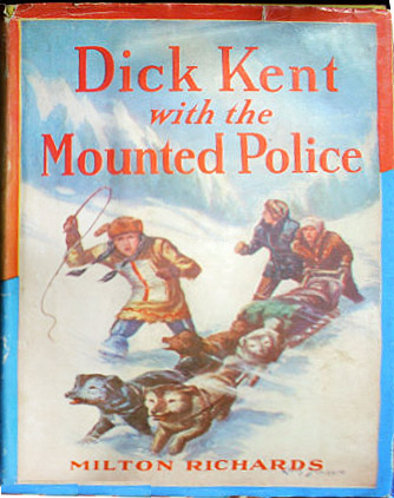
Toma did not fire, however. Instead, without any orders from Dick or Sandy, he made camp in a patch of scrub pine and spruce, where there was plenty of dead wood. Speedily he made a fire. When Dick and Sandy had exhausted their ammunition, and had gone for Corporal Richardson’s revolver, a huge fire was roaring and crackling before the upturned sled, in whose shelter rested the corporal.
The wolves had drawn off out of gunshot now. Some of them were devouring their comrades that had fallen. When darkness crept over the little camp the wolves had completely surrounded it.
“We’ve got to save our cartridges,” Dick said at last. “Toma, how many have you left?”
“Just gun full up,” replied Toma, which meant he had the magazine of his repeater full—eight shots.
Dick was fingering Corporal Richardson’s revolver. He was unaccustomed to handling a revolver and comprehended he could do little real damage with the small arm, having always used a rifle. Sandy was no better than he, and when Dick asked Toma if he could shoot with a revolver with accuracy, the guide shook his head.
“They’re slinking around us in a circle now,” Sandy reported fearfully, as the shadows deepened.
As he had said, now and again a dark, sinister form glided across the snow from shrub to shrub, skirting the firelight. Here and there, one of the pack sat on his haunches, his beady eyes fixed on the camp, while his mouth slavered. Frequently one of the number raised his nose to the sky and sounded the hunger howl.
The wolves feared the campfire, and Toma explained that as long as they could keep the fire going they need not fear any very dangerous attack. And even if the wolves did rush them they could be repelled by fire brands.
“I’m going to see what they do when I throw fire,” Dick said presently. He picked out the nearest shadowy form, and drawing a flaming stick from the fire, threw it at the wolf. His aim was good and the animal snarled horribly as the fire fell within a few feet of its feet.
It was close to midnight when Toma confided to Dick and Sandy what they both feared. The wolves were gaining in number as wanderers joined the pack surrounding them. The places of those they had killed earlier in the day, and the few they had managed to pick off after dark were being filled by other ravenous beasts.
There would be no sleep in the camp that night.
CHAPTER XIX
THE CIRCLE OF DEATH
Toma had cut a huge stack of wood, and it was well he did, for the moment the fire died down the wolves drew closer. In fact they seemed to taunt the boys into using the last of their ammunition in firing at the difficult targets they made.
The one dog was whimpering with fear and cowering under the legs of his masters in abject fear. Sometimes, however, a low whine sounded among the wolves, at which the husky pricked up his ears and did not seem so frightened. Toma tied the dog to the sled with a thong of moose-hide.
As the night wore away, Dick and Sandy risked shot after shot at the wolves, and now and again they dropped a skulking shadow. But usually they missed, since Toma objected to giving up his rifle, and they were forced to use the corporal’s revolver.
“How long do you suppose we can hold out?” Sandy asked in a strained voice.
“I see no reason why we can’t hold out until they leave,” Dick replied with more confidence than he felt. “We’ve plenty of firewood. As long as we have fire to fight with we’re safe.”
“How do we know they’ll leave?” Sandy wanted to know.
Dick shuddered a little, and did not answer. He saw a gray shape loom up at the edge of the firelight, and raising the revolver, fired quickly. He gave a cry of satisfaction as he saw the gaunt beast leap into the air and fall, kicking its last.
There followed a rush of hungry wolves for their fallen companion. Horrified, the boys watched the dead wolf torn to pieces by the pack. Dick emptied his revolver into the writhing mass. He could not help but hit, and he killed another wolf, wounding two others, which the pack finished.
Sandy began throwing burning brands at the wolves, and they drew off once more into the darkness, where they paced nervously back and forth, growling and snarling.
The boys decided that one of them should try to sleep while the other two watched. Dick arranged three twigs in one hand for Sandy and Toma to draw from. The one with the shortest twig, after the draw, was to be the lucky one. Sandy drew the shortest. But after a half hour of futile tossing about, he gave it up.
“No use,” Sandy joined the haggard watchers at the fire. “One of you fellows try it. I couldn’t sleep in a million years with those devils out there waiting to gobble me up.”
“I don’t think I can either,” said Dick. “Toma, you’d better try it. One of us had better get some rest.”
The guide grunted assent, and rolled into his sleeping bag, which once had been his brother’s. In a few minutes Toma was breathing steadily in sound slumber. His calmness gave the boys courage.
“If he can sleep I guess we hadn’t ought to feel so nervous,” Sandy observed.
“I’ve heard old sourdoughs say an Indian never lets the nearness of death trouble him when he can’t get away from it,” Dick related, trying to get his own mind and Sandy’s off their perilous predicament.
“Well, I wish I was an Indian then,” Sandy sighed, “—for the present anyway.”
The renewed and increased restlessness of their dog attracted their attention then, and they watched him straining at the moosehide leash.
Dick caught the dog trying to chew through the thong and spoke sharply.
“Funny why he wants to get away,” Dick mused aloud. “One would think the dog would realize his danger and want to stay near the fire.”
Corporal Richardson’s voice sounded from his blankets. The officer had awakened and had overheard Dick’s remark.
“There’s a female wolf out there—several of them,” the veteran northerner answered Dick. “She’s calling to the dog. It’s the mate call of the wolf and the dog understands it. But only the wisest of she-wolves understand how to use the call to lure meat for their stomachs. That dog wouldn’t last three minutes once he left the fire.”
“How do you feel now?” Dick asked, going to the wounded man’s side.
“Much better,” answered the officer, “but my side is stiff and mighty sore. I’ll be flat on my back for a couple of weeks yet. Couldn’t be worse luck now that the Inspector needs every man of us.”
“Then you really think we have a good chance escaping from the wolf pack?” Dick eagerly seized at a grain of encouragement.
The corporal did not answer immediately. “You’d have a lot bigger chance if you left me here in the morning,” said the corporal steadily.
“Leave you here!” Dick exclaimed. “What do you think we are—cowards?”
“I should say not, Dick Kent,” replied the policeman. “But that doesn’t make me any less a burden. With this wolf pack surrounding you you’ll do well to get away from camp at all, say nothing of hauling me along.”
“But we’re with you anyway,” Dick concluded decisively.
“Oh, well,” the officer turned a little, stifling a groan at the movement, “the wolves may scare up moose or caribou before morning. If they do they’ll soon leave us alone.”
The conversation had weakened the corporal, and Dick soon left him to rest, joining Sandy. The boys discussed the situation, listening to the fearful howls of the wolves, hoping against hope that as Corporal Richardson had said, they might find other game before morning.
After two hours of sound slumber, Toma quietly arose and joined the two at the fireside. He said little, but set to work cutting down more wood, and breaking it up into firewood lengths.
Morning dawned, cold and gray. Dick and Sandy were worn from loss of sleep. Silently they waited for the wolves to depart. But with the sun an hour high the pack still circled the camp, tongues lolling, jaws slavering.
“Will they never leave!” Sandy’s voice faltered.
“Wolf much hungry!” Toma grunted. “Maybe um leave, we start. Sometime they do.” He looked at Dick to see what he thought.
Dick surveyed the menacing circle of wolves. They had grown bolder as their hunger increased. Could they hitch up the dog and break out of that circle of death?
“If you think we have a chance to get out of here, Toma, we’ll try it,” Dick grimly returned a moment later. “Anything but this suspense suits me.”
As the boys packed up the wolves grew more uneasy and shifted closer. Toma scarcely could manage the husky as he hitched it to the sled. The young guide held his rifle in one hand, working at a disadvantage so that he might be prepared to shoot at a moment’s notice. Toma’s was the only rifle left in which there was ammunition, and Dick had shot away all the revolver cartridges during the night.
It was with many misgivings that a few minutes later they took their places for the dash through the wolves.
Toma took the lead, with the rifle, Sandy held the dog, while Dick took up the rear, swinging the camp axe.
Slowly, in grim silence, they pulled away from the fire.
A hundred feet away they discovered they never would get through the circle. For, instead of retreating, the wolves dashed this way and that, then rushed them in a body. Sandy’s cry of terror was drowned by the crack of Toma’s rifle and Dick’s hoarse shout:
“Back to the fire! We can’t make it!”
Then Toma’s rifle was empty, and with clubbed rifle and axe they were left to fight their way back to the campfire. Slashing with razor fangs, the wolves leaped in and out. Dick wrought havoc with the axe, and Toma ploughed his way through the snarling, writhing mass like a Hercules. When the guide broke through he ran to the fire and commenced throwing coals and burning sticks with his mittens, until the air was filled with flying embers. Howls of pain followed as the hot coals burned the wolves. The scent of singed hair and burning flesh arose.
At last the wolves drew off reluctantly, leaving behind them a trail of wounded and dying. In the repulsion of the attack the boys had slain nine wolves and wounded seven. They could see the hairy bodies of the dead lying scattered all the way from where the fight had begun.
“Wood not last much longer,” Toma’s voice startled Dick.
Dick hastily inspected the patch of wood in which they had camped. As Toma had said, they soon would be out of firewood. And the nearest wood was three hundred yards away—outside the circle of death.
Dick and Sandy shuddered; Corporal Richardson stirred and moaned; Toma began quietly gathering the chips and twigs; half buried in the snow.
CHAPTER XX
SANDY DISAPPEARS
Sitting by the fire, conscious presently of a light step at his side and a friendly hand on his shoulder, Dick turned and looked up into Sandy’s face, as his chum spoke in a voice husky with emotion.
“I guess we’ve about played our last card,” said Sandy. “Right now it doesn’t look as if Fort Dunwoody was very close, does it?”
“No, not very close,” Dick was obliged to answer, as his tired eyes swept the narrowing circle of timber wolves.
“We’ve done the best we could anyway,” Sandy went on dejectedly. “I guess my Uncle Walter won’t receive a whole lot of help from us.”
“Sandy, I used to think you were an optimist,” declared Dick, “but now I know you’re a born pessimist. Why don’t you try to cheer up?”
Sandy glanced about at the wolves. A scowl puckered his usually placid brow. “Can’t be very cheerful with those fellows waiting for us,” he said shortly. “Do you know I sometimes think that big one with the shaggy head actually grins at me? If he thinks he’s going to pick a whole lot of meat off my bones he’s badly mistaken.”
Dick grinned in spite of himself. “Exactly what do you mean, Sandy?”
“Well, I’m a whole lot thinner than I was. Toma would make better eating.”
At this juncture, Toma, who had been cutting what little wood remained, strode forward with an almost excited look on his face. “I know what do now,” he announced. “We no got firewood; plenty over by trees.”
“We know that,” Sandy responded impatiently, “but we’re a long ways from being over there.”
“Me ketch um good idea. No can go to wood with wolves there. We move fire to wood; move um little at time, one feet, two feet—bye and bye we get there—mebbe by night we travel fast.”
Toma was right. At nightfall they had accomplished the unusual feat of moving the fire to another patch of wood. And with the first snarling approach of the ravenous wolves a replenished fire sprang up to beat them back. The boys, in exuberance, piled more and more wood on the fire until it leaped five feet into the still, frosty air, and grew so hot it melted a circle of snow about it.
Dick breathed a sigh of satisfaction as he crawled into his blankets hours later. It had been decided that Sandy was to stand first watch with Toma. Tonight, Dick decided grimly, he would make the most of the hours allotted him for sleep. He intended to follow Toma’s example and forget everything in the complete relaxation of weary mind and muscles.
“Got to fight this thing through,” he reminded himself, stretching his long legs out before the campfire and composing himself for sleep. A few minutes later, while watching Sandy nervously pacing to and fro, he forgot all his troubles in a happy loss of consciousness that carried him away to a land where wolves, blizzards and scar faced Indians did not once trouble him.
He was awakened by Toma shaking him by the shoulder. “Big wolf eat you up if sleep like that,” declared the young guide goodnaturedly.
Dick jumped up, once more mentally alert, and shortly piled more wood on the fire, commencing his lonely vigil. He scanned the fringe of the firelight for the skulking shapes, which had become so dreadfully familiar, but he could see none—not a single prowling form anywhere. He decided that the wolves had moved further back from the fire. Several times he believed he heard a deep-throated snarl, but he was not sure.
“I hope they’re gone,” he breathed fervently, “so that we can continue on our way to Fort Dunwoody. We’ve lost too much time already.”
Off to his right a faint glow suffused the east. In another hour, if the wolves really were gone, they might continue their slow progress, and, barring emergencies, might reasonably expect to arrive at the mounted police barracks in about three days.
With the first grin in hours brightening his face, Dick set about preparing breakfast. He had a frying pan over the fire and was melting snow for coffee. It was so quiet around him that he imagined he could hear the low, irregular breathing of Corporal Richardson. Then, presently Toma stirred, stretched out one arm and yawned:
“Guess I get up,” the guide announced.
“When you do,” Dick replied, “I wish you’d go over and wake Sandy. I’ve kept his watch for him, and if I wasn’t so busy getting breakfast I’d go over myself.”
Dick was adding coffee to the boiling water when Toma returned.
“Well, did you wake him?”
The half breed endeavored to speak, but no sound came from his trembling lips.
“What’s wrong?” Dick inquired, trying to be calm.
“Sandy, him gone!”
“Gone!” Dick’s heart took a sickening plunge.
The light was strong enough now so that they could see that the wolves were gone, but this happy discovery was not so encouraging with the disappearance of Sandy.
Horrified at first, at the thought that Sandy must have been eaten by the wolves, Dick and Toma began a minute search of the vicinity. They found tracks, but no sign of Sandy. If the departed wolves had slain Dick’s chum there would have been traces left, at least bits of clothing.
CHAPTER XXI
THE MAN FROM CROOKED STICK RIVER
If, as Dick suspected possible, Pierre Govereau had overtaken them again and somehow made off with Sandy, what then could they do? Corporal Richardson must go on to the post at all hazards. The infection in the officer’s wound would kill him unless medical aid were procured soon. Yet Dick could not leave without knowing what had happened to Sandy, and making a sincere effort to find his chum. And in that strange country he could not find his way without the aid of Toma.
“I’ve a good idea what might have happened to Sandy,” Dick mused aloud a little later.
“What you say?” Toma eagerly asked.
“He’s walked in his sleep two or three times in his life that I know about, and last night he must have done it again. Now I’m sure he left the fire after the wolves were gone. If he did then he might have fallen into Govereau’s hands.” Dick strode back and forth in the snow, almost beside himself.
“Oh! if some friend would only come along on the way to Fort Dunwoody,” Dick exclaimed aloud.
“We take um sick fella to cabin,” Toma suggested. “We leave um there when go look for Sandy.”
At his wit’s end Toma’s suggestion seemed the only way out. Dick felt his duty to Sandy even greater than that to the minion of the northland law, and he would not exactly be deserting the policeman if he left him with food and firewood.
“That’s the thing to do,” Corporal Richardson spoke up from his blankets. “The Indian has it right. The cabin is between six and eight miles from here. You can take me there and come back and take up young McClaren’s trail.”
Dick was glad to hear the officer’s voice, and to learn that he was once more rational, with abated fever.
“If it’s all right with you, corporal, that’s what we’ll do. Toma, let’s hurry.”
In a few minutes the camp where they had been held up a day and two nights had been deserted and out across the vast, endless expanse of snow, Toma and Dick toiled in the dog traces, dragging the wounded policeman.
They had gone some two miles and were resting when suddenly they were startled by the sound of a dog driver’s voice from over the knoll they had just coasted down. Was it friend or enemy? Dick prayed it was a friend as he hurried to the top of the little hill and looked.
A team of eight dogs, followed by a lone man, swinging a long whip, was coming along the trail they had made in the snow. Dick waited till the man had come a little nearer. Then he revealed himself. The man saw him almost immediately, and drew his dog team to a slower pace. The stranger seemed suspicious as to Dick’s identity, but the evident distress of the young man on the hill reassured him. He came on to within hailing distance, and stopped his team, raising his rifle.
“If you’re one of that Henderson gang,” called the man threateningly, “I’ll plug you where you stand.”
Dick breathed a sigh of relief. “We’re bound for Fort Dunwoody,” he replied. “We’ve got a wounded policeman on our sled and have only one dog.”
Satisfied that Dick was telling the truth, the shouted to his dogs and came on. A moment later he joined Dick and Toma alongside the sled.
“By gar, I tink I never get out of dat country.” the newcomer, appearing to be a French-Indian, mopped his brow. “That Pierre Govereau one tough customer. Yah!”
“You came in a nick of time,” Dick returned.
“One of our party has disappeared, we think he’s been captured. Now we’re trying to get a wounded policeman to a place of safety while I and my guide take a look for my chum. My name’s Dick Kent,” he held out his hand.
“Me, I’m Gaston Leroi,” announced the stranger, shaking with French warmth, “that Henderson’s man Govereau kill my partner up on Crooked Stick River. I get away pretty lucky.”
“And it’s lucky for us you got away,” Dick replied with spirit. He stepped to the sled and stopped over the wounded officer. “Corporal Richardson, here’s a man who can help us out,” Dick told the officer.
“Thank God,” murmured the policeman. “What’s his name?”
“Gaston Leroi.”
“Gaston Leroi!” exclaimed the corporal with more strength in his voice than had been there for hours. “Not the trapper Leroi. Hey! Bring him around where I can see him.”
At the sound of the wounded man’s voice the French trapper had leaped forward where he could see the officer’s face.
“By gar!” exclaimed Leroi. “George Richardson! What them fellers do to you, George?”
Dick was overjoyed to discover the men were old friends.
“Gaston, you won’t mind doing something for me?” he heard the corporal saying.
“Sacre diable! Do I mind!” Gaston exclaimed.
“It’s like this,” the corporal went on, “these young fellows want to go back and look for their partner, but they won’t leave me. Could you haul me to the fort?”
The trapper vociferously expressed his willingness to do this for his friend, Constable Richardson.
“They’re out of ammunition too,” revealed the corporal. “Just had a long fight with a pack of hungry wolves. Can you spare some ammunition, Gaston?”
“What kind of gun you got?” the trapper turned to Dick.
“Ross 30.30,” Dick replied anxiously.
Leroi’s face fell. He turned to Toma.
“I got um 45.70 Winchester,” Toma anticipated the trapper’s question.
“Me, I use 45.70!” Gaston Leroi exclaimed with pleasure and turned back to Dick, saying: “I use revolver. Like heem better dan rifle. I take your gun. You take mine. Huh?”
“Suits me,” replied Dick gratefully.
Leroi dived into his packs and soon brought out several boxes of ammunition, with which Dick and Toma filled their pockets.
A half hour later Dick and Toma bid goodbye to Gaston Leroi, and watched his dog team, hauling the wounded corporal, disappear over a long hill. Then the two boys set out over the back trail at a jog trot. They were determined not to rest their heads until they had discovered what had become of Sandy.
“Do you think it was Govereau?” Dick asked Toma as they hurried along.
“I not know,” replied Toma, who was slightly in the lead. “Tracks show only two fella keetch Sandy. Hope snow no more; if not we trail um easy.”
They did not speak again until they had reached the scene of their battle with the wolves, where they picked up the trail.
“They’re going north,” Dick spoke, after studying the tracks. “It must be some of Henderson’s men, though it seems queer Govereau would come this far south.”
“That Govereau, he bad fella; he go everywhere. No ’fraid anybody. Mebbe I see that Many Scar.”
Dick fell silent at the mention of the scar faced Indian. He knew Toma was thinking of his dead brother, and was planning revenge if he met the murderer, who he believed to be the scar faced Indian. Dick knew nothing to say which would change Toma’s mind in this respect, so he said nothing as they forged onward at a mile-eating pace.
They had traveled nearly ten miles into a deeply wooded vicinity, when the tracks began to grow fresher, and they slowed their pace. Presently they rounded a bend, and in a tiny valley, drained by a winding, frozen creek, they came upon an Indian village of a dozen tepees.
Toma seemed as surprised as Dick at the discovery.
“Um war party,” Toma replied immediately. “No good Injun if um fight White Father.”
“How can you tell they’re a war party?” inquired Dick.
“No squaws, no papooses,” replied Toma abruptly.
As Toma had said there were no women or children to be seen in the camp. And at different points along the fringe of trees around the clearing, Dick made out dusky sentinels, armed with long rifles, with feathers in their beaver bonnets.
“The tracks lead down into the village, so Sandy must be there somewhere,” Dick mused aloud.
The larger portion of the party of Indians who had thrown up their caribou hide tepees in the valley, seemed to be absent. Here and there a warrior squatted before a cooking fire, his rifle leaning close beside him.
“Look!” Dick suddenly pointed.
A white man had come out of one of the tepees and was walking slowly toward the creek.
“I see um,” said Toma. “Guess him one Govereau’s men. Huh? Him Henderson got plenty bad Indian work for him.”
“Then Govereau has joined forces with these Indians,” Dick’s spirits fell. “It will be one big job getting Sandy away from him now. I wonder which tepee he is in—er—” he was about to wonder if Sandy was alive, but dared not trust the words on his tongue. It was too horrible to speak of—that Pierre Govereau had murdered his chum.
“We wait till dark,” Toma voiced the resolve of both.
At twilight the boys saw a large party come in from the north, in which there were a number of whites. They were loaded down with furs, which they probably had stolen. Dick thought he recognized the figure of the half-breed Pierre Govereau, but could not be certain at that distance.
Slowly darkness fell and the campfires flung out flickering shadows on the sloping walls of tepees and over the figures of the warriors squatted around them.
“I make believe I one of them,” Toma whispered presently. “I go down—find out where Sandy is.”
“It’s an awful risk,” Dick tried to object, “and you aren’t dressed like they are.”
“I fix that. You wait here—no, you come down closer. Be ready to shoot, you hear trouble. Jump ’round when you shoot. Make um think you whole army. I ketch um Sandy.”
Though Dick feared Toma would come to grief, he could do nothing but let the courageous young guide take the chance, hoping, if worst came to worst, and Toma was discovered, that he might draw the attention of the Indians long enough for his red friend to escape.
Toma crawled off down the slope toward the camp, Dick followed him for a little way, until he reached a heavy copse of brush where he felt he was within good rifle range of the camp. Toma went on and disappeared, Dick’s whispered wish of “good luck” following him.
As Dick lay there waiting he could see on the side of the camp nearest him, the shadowy figure of a warrior sentinel, standing motionless by a tree, silhouetted by the light of one of the fires. Dick raised his rifle and drew bead on the guard. It was this warrior who would discover Toma, if any did, and Dick watched intently for a motion that would indicate the guard had seen something unusual.
He watched for possibly five minutes, when of a sudden another figure arose between him and the shadowy guard. There was a swift movement of the two shadows; they swayed violently, then the guard fell and the other stooped over him. Then both disappeared in the dark underbrush.
Dick held his breath. Toma had attacked the guard and knocked him down. In a flash Dick saw Toma’s plan—the young Indian would change clothes with the warrior and creep into the camp, casually joining the others.
Gripping his rifle, Dick awaited developments. What would happen in the next hour he did not know, but he hoped for the best.
CHAPTER XXII
A SKIRMISH IN THE NIGHT
Dick waited what seemed to him several hours, though it could not have been more than thirty minutes, before he saw a sign of Toma. Then, in almost the exact position the guard had held, he saw a figure rise up which he was almost certain was Toma, though the firelight revealed that the young guide now wore the clothes and head-dress of the sentinel.
“Good for you, Toma,” Dick whispered. “Now if you can only get in among them without them recognizing that you’re not really a member of their band.”
Toma did not enter the camp from that side, however. Once more he disappeared.
A patch of brush to the left caught Dick’s roving eyes, and this he watched, believing Toma would take this means of getting into the camp without attracting attention, since the bushes led up to a point very near one of the tepees.
Dick was right. A few minutes later the bush tops waved a little at the passage of a creeping body. Presently in the shadow of the tepee nearest the bushes, Toma rose and walked slowly toward one of the campfires, where he joined a group. Dick feared Toma might see the scar faced Indian, and that the guide’s desire for revenge might cause him to destroy all his chances for the rescue of Sandy. But as time passed and all went well, Dick felt that Toma must be making good progress in the dangerous mission he had set out on.
A little later Dick saw a figure, which he took to be Toma, break away from a group of natives and saunter toward one of the tepees. Evidently the guide now was either looking for Sandy, or had learned the captive’s exact position from the conversation of the warriors.
Toma stooped into the opening of the tepee and disappeared. Holding his breath, Dick watched. Toma was gone some time, then in the flickering light he appeared again. Would Sandy follow? Dick’s heart beat painfully.
Then he could not suppress a low cry of exultation as Sandy’s bare head came out next and the two slipped into the deep shadows of another tepee. For minutes they did not move, then they suddenly dashed for the patch of brush that had covered Toma’s entrance into the camp. Dick’s finger tightened on the trigger.
There was a commotion among one of the groups about the campfires. A shout sounded, then a rifle shot. The Indians began to run; they had seen Toma and Sandy!
Dick took quick aim and fired. The crack of his rifle in the silent forest startled the camp. Dick shot again, hurrying to another position as Toma had advised. He could see that Toma and Sandy had reached cover, and that the guide was firing on his pursuers.
The whole camp was in a turmoil now; Indians and whites hurrying hither and thither, shooting at the flashes of Dick’s rifle. He could not hear what they were shouting to each other, but he divined they thought he was quite a number of men, so fast was he firing and from so many positions.
“I’ll hurry along toward Toma and Sandy,” Dick muttered to himself, “they’ll know where I am by the sound of my rifle.”
Twenty yards further on Toma and Sandy reached him.
“Thank God you’re safe at last!” Dick embraced Sandy, while Toma kept up rifle fire on the Indians and whites, who were now charging after them.
With a parting salvo at their pursuers, the three made off into the night toward Fort Dunwoody. All night they hurried on, hungry and tired, yet determined to elude Govereau if they dropped in their tracks.
“Him Govereau with Indians,” Toma revealed to Dick. “No see um Many-Scar Jackson. I hear um talk much. Bear Henderson, him make north country big nation all his own. Give Indians back their land. Humph! Bear Henderson crazy—him thief, outlaw. That Govereau bad fella too; keep um police from come up from south.”
It did not take Sandy long to tell Dick and Toma how he had been captured by two scouts of Govereau’s band, who had lain in hiding, looking for a chance to attack. It had been their approach and the appearance of a herd of caribou going south that had frightened away the wolves. Dick had been right in suspecting that Sandy had walked in his sleep. It was almost funny to hear him tell how he had awakened, struggling in the hands of his captors, dreaming they were wolves devouring him.
At dawn the travelers reached the shores of a large lake, whose snow covered ice stretched for leagues and leagues ahead.
“Him Badge Lake,” Toma told them. “We cross um ice, make journey shorter.”
They stopped long enough to steep coffee and make some flapjacks. Dick and Toma had taken very few provisions with them when they left Gaston Leroi, and they now could see that they would have barely enough for another meal.
Still hungry, they set off across the frozen lake with many a backward glance to see if they were followed. But if they were, they saw no sign of Govereau’s band. The silent forest, fading from view as they forged out farther and farther over the ice, disclosed no running figures on their trail.
“We cross um lake when sun set,” Toma said. “Maybe see moose when other side. We eat then.”
It was a long jaunt across the lake. At noon they could see the other shore, dim and hazy to the south. With hunger gnawing at their vitals they trudged the last miles across the ice, hearing now and again, a low rumbling roar as the lake ice cracked open for hundreds and hundreds of yards. Once they were held up by one of these cracks, wider than the rest, which they could not leap over. They had to follow this until it grew narrower. Sandy slipped when they finally jumped the crack, and fell into the niche. At the bottom the fissure came together, and was partly filled with slivers of ice. Dick and Toma pulled Sandy out on the end of a rifle.
Darkness was just falling when they reached the other shore of the lake. It was with groans of thankfulness that they built a fire and dropped down to rest for the night.
“I’m all in,” Sandy sank upon his back by the fire.
“I couldn’t have gone much further,” Dick admitted.
Even Toma seemed tired. They did not bother to get supper, but rolled into their sleeping bags, and fell into heavy slumber, not even keeping watch.
Dawn found them awake. They finished their provisions for breakfast, and again took to the trail on the last lap to Fort Dunwoody. They had no time to hunt, but kept watch among the trees for a ptarmigan or partridge, or bigger game if they ran across it. But they had bad luck and the entire day passed with no more than two ptarmigan to show for their pains.
The birds made a slender meal for the three hungry young men. Toma chopped out some roots that proved succulent when stewed, and they managed to fill their stomachs with this, though within an hour afterwards they were as hungry as ever.
Twenty miles from Fort Dunwoody, at noon of the third day since the rescue of Sandy, they came abruptly upon a friendly Indian village at the edge of a tiny lake.
“Now we’ll eat!” cried the haggard Sandy.
And eat they did, in preparation for the last lap of their eventful journey, for they felt it would be a hard day on the trail.
CHAPTER XXIII
GRAY GOOSE LAKE
“The fort! The fort!” cheered Dick, as the following evening they came to the edge of a vast plain.
Sandy was overjoyed, so much so that he could not speak.
Sure enough, a half mile ahead frowned the stockade of Fort Dunwoody, under the rippling flag of the king. Toma did not express himself in words, but hastened his tireless pace.
Dick and Sandy hurried after the guide, curiously gazing at the fort. Along the top of the stockade they could see a red-coated policeman pacing slowly back and forth.
“Who goes there?” the sentry above the gate called when the worn travelers appeared.
“Friends,” cried Dick. “We’re from Fort du Lac—looking for help at Fort Good Faith.”
“You the lads that helped bring in Corporal Richardson?” the sentry gruffly asked.
“Yes.”
The huge gate swung back immediately, and the young adventurers passed through. The police guard met them as the gate was closed.
“You’ll want to see Inspector Dawson?” asked the guard.
“I think he’s the man we should see,” Dick replied.
Presently they were ushered into the presence of Inspector Dawson, whose grim face, under a thatch of iron gray hair, broke into a smile, meant to be kind.
Dick and Sandy gave the scout salute.
“Ah, ha!” said the Inspector, “I see you’ve been members of the Boy Scouts.”
“Yes sir, first class, both of us,” replied Dick, a little abashed in the presence of so distinguished a man as Inspector Dawson.
“Corporal Richardson told me about you,” went on the Inspector.
“Then the corporal got in all right,” Dick exulted.
“Yes, thanks to you boys and Gaston Leroi,” Inspector Dawson said. “He’ll be up and around in a few days now. I’ve already sent relief to Fort Good Faith,” he concluded.
“Oh!” Dick was both glad and disappointed at once. He had hoped to join the expedition.
“However, an Indian runner came in today saying that Sergeant Brewster and Constable Marden, the two I detailed for Fort Good Faith, were held up at Gray Goose Lake by one of Henderson’s lieutenants and about thirty renegade Indians. I believe the man’s name is Pierre Govereau. He has a criminal record here.”
“Govereau!” ejaculated Dick and Sandy in one voice.
“You seem to have met him before,” the Inspector continued briskly. “But the point I’m getting at is this; I have no men to send on as relief to Gray Goose Lake. I expect one of my scouts, Malemute Slade, in tomorrow morning from Fort du Lac where he has cleared things up.”
At mention of Malemute Slade, Dick and Sandy exchanged significant glances.
“Yes,” the inspector continued. “And I suppose you follows want to go on to Fort Good Faith. You seem to be able to take care of yourselves. Would you like to be special deputies?”
“Would we!” Dick exclaimed.
“Hurrah!” shouted Sandy.
Inspector Dawson could not forbear a smile at the boys’ exuberance. “All right, step forward,” he commanded, arising from his desk.
Dick and Sandy lined up like soldiers while they repeated the oath of allegiance to the law on specials duty for the duration of the Henderson outbreak.
The Inspector made Toma an official scout.
“Now good day, boys,” the Inspector said dismissing them. “Report to me tomorrow morning early. I expect Slade in then.”
Dick and Sandy followed Toma out of headquarters seething with excitement. They felt themselves full-fledged mounted policemen now, and, too, they were to take the trail with Malemute Slade, the famous scout they had met on the Big Smokey. Their only regret was that they could not don the beautiful uniforms they saw everywhere about the post.
They inquired as to the quarters of Corporal Richardson, and had a long chat with the convalescent officer. They secured arrangements to pass the night in the barracks, and once more toasted their shins before a genuine stove.
Bright and early next morning, Dick and Sandy rolled out of their bunks and pulled on their clothes.
“It hardly seems possible we’re at Fort Dunwoody,” Dick declared when they attacked the ample breakfast set before them by the post cook.
Sandy shivered in recalling the narrow escapes they had had and agreed with Dick.
Toma, who had slept before the fire on a bearskin rug, was as silent as he always was when off the trail, but his moon face was split by a continuous smile.