
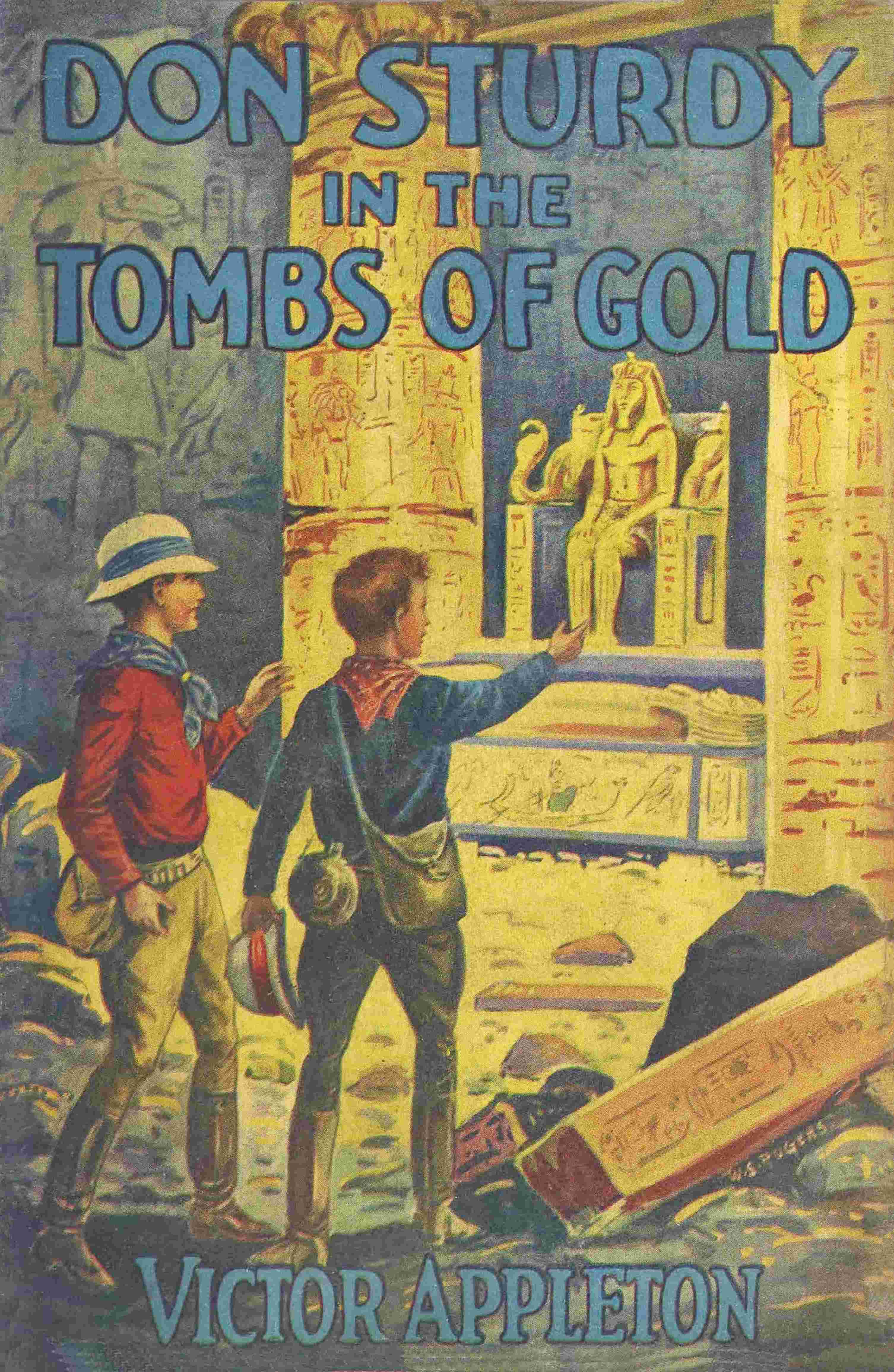
CHAPTER IX
Startling News
“Tezra and Nepahak!” exclaimed Don, the faces of the sinister pair coming up before his memory.
“Those precious rascals!” ejaculated Captain Sturdy, a frown passing over his brow.
“How do you know that they have landed?” asked the professor, settling back uneasily into his seat.
“From a sure source,” replied Phalos. “A friend of mine in Alexandria, whom I took into my confidence regarding my experience on shipboard and who agreed to have a watch kept on debarking passengers, brought me word. He knows the men, and assures me there is no mistake.”
“I had thought that by this time they were below with Davy Jones,” grumbled Teddy.
“No such luck,” remarked Phalos, with a smile that did not conceal the deep anxiety he felt. “They must have made land all right the night they slipped overboard.”
“But how could they have got here so soon?” asked Don, in some perplexity.
“Had the luck to get an English liner that stopped at Gibraltar the day after they had swum to shore,” was the reply. “My friend tells me that it is one of the fastest boats on the line.”
“They say that the Evil One looks after his own,” growled the captain.
“And this is one of the things that seems to prove it,” added Don.
“Well,” said the professor, crossing his legs, “now that they are here, what do you apprehend?”
“That they’ll be up to mischief right away,” replied Phalos. “The experience they’ve been through won’t change the intentions of such calloused scoundrels. They’ll simply attribute that to bad luck and try again.”
“It’s too bad that they have such a grudge against you,” remarked Don.
“It isn’t a grudge,” explained the old Egyptian. “I’ve never done them any harm, and their feeling toward me isn’t prompted by revenge. They simply know that I have a valuable secret, and they are trying to extort it from me.”
There was a dead silence in the group that was in itself a question that all were too polite to ask.
Phalos pondered long before he spoke.
“I have never revealed the secret to a living soul,” he said at last. “But there is something about you that invites my confidence and assures me that it will not be betrayed. Besides I owe you something on the score of gratitude.”
They waved that aside with a gesture of their hands.
“It concerns the tombs of a certain royal family of an old dynasty of the Pharaohs,” Zeta Phalos began, while all listened intently. “I have reason to believe that they exist in the vicinity of the Valley of the Kings and have never been discovered or uncovered.”
“The Valley of the Kings!” exclaimed Don. “Why, that’s where we’re going in search of my father.”
“Exactly,” replied Phalos. “And where I’m going, too, if you are good enough to let me form one of your party.”
“With the greatest of pleasure,” assented Professor Bruce, while the captain nodded his head in vigorous agreement. “Your knowledge of the place will be invaluable to us, to say nothing of the pleasure we will have from your company.”
Phalos inclined his head in courteous acknowledgment.
“But I thought,” said the captain, “that practically all of the tombs of the great rulers of Egypt had been discovered and explored.”
The Egyptian shook his head.
“Not all,” he said. “A great many have been opened by scientists and their treasures lie now in the great museums and libraries of the old world. Others have been broken into by thieves and the tombs despoiled of gold and gems which were sold secretly to whoever would buy. But great treasures still await the excavators, as is proved by the recent discovery of the tomb of Tut-ankh-Amen.”
“Ah, yes,” broke in the professor, “that is the greatest of them all. I am counting on examining that when we get to Luxor.”
“The greatest of them all so far,” qualified Phalos. “But if I am not mistaken, a still greater remains to be discovered. Great heaps of gold and jewels that have dazzled the eyes and the imaginations of the world have been found in Tut-ankh-Amen’s tomb. But they will be surpassed, I think, if we ever discover the Tombs of Gold.”
“The Tombs of Gold!” ejaculated the professor, while Don and Teddy looked at each other significantly. “Isn’t that rather an extravagant description? Do you really mean of gold?”
“Just that,” replied Phalos soberly. “Not the tombs themselves, perhaps, but the coffins and pillars and implements placed there for the use of the dead.”
“Just what monarch was buried there?” asked the professor, with just the faintest tinge of skepticism in his tone.
“You have heard, of course, of Ras-Ameses,” replied Phalos.
“Surely,” replied the professor, with quickened interest. “The richest and most powerful ruler of one of the oldest dynasties who extended his reign over all of Libya and Ethiopia. The one who is supposed first to have worked the mines of Ophir.”
“Yes,” assented Phalos, “the one whose palace was filled with gold and silver ornaments, whose bed was of solid gold and whose barbaric splendor has never had a parallel among the rulers of the East.”
“Gee,” murmured Don, while Teddy’s lips puckered for a whistle which he did not emit.
“And you will remember, too, that his tomb has never been discovered,” continued Zeta Phalos.
“That is so,” agreed the professor. “It has been the dream of archæologists to find it, but all of them have been forced to give it up in despair.”
“That,” pronounced Phalos, with a tincture of pride in the solemnity of his tone, “is the tomb that I expect to find.”
The Americans looked at him, startled, and, despite themselves, were a little incredulous.
“It will be one of the greatest triumphs of modern discovery if you do,” replied the professor, after a moment.
“What makes you think you have a clue to its whereabouts?” asked Don, in deep interest.
“It is a curious story,” replied Phalos, smiling at the boy. “One of the romances of archæology.
“Many years ago, when I was still strong and vigorous, I was riding in a remote part of the Valley of the Kings. Above me towered a great overhanging cliff that cast a grateful shadow over the road and prompted me to get off my horse and rest there while I had my midday meal.
“The place was off from the beaten road of travel, and there was nothing to distract my attention. I lay there after my meal for a while, stretched out on my back, looking up idly at the great face of the cliff. At a height of perhaps three hundred feet, I could make out what seemed to be carvings or symbols of some sort.
“While I was looking, a piece of stone fell off the surface and dropped almost at my feet. I picked it up and saw curious hieroglyphics on it. I was an ardent student of the ancient writings, and had no trouble in making out the name of Ras-Ameses.”
Professor Bruce gave vent to an exclamation.
“That made the blood thrill in my veins,” resumed Phalos. “I knew, of course, the mystery that had always veiled the last resting place of that monarch, and it seemed as though chance had placed the key to the puzzle in my hands.
“Right then and there, I resolved to follow the matter up. I made my way up the almost perpendicular side of the cliff, with only my hands and feet to aid me, until I reached a narrow ledge, where the old stone masons must have stood when they first made the inscription. It was risky work, for a slip would have meant certain death.
“I could copy part of the inscription from there, but a time soon came when I had to have a ladder to climb further. I had to drag the ladder up with a rope and place it in position almost upright on the ledge perpendicularly against the face of the rock. The least little movement on my part would have overbalanced and plunged me outward and down to the foot of the cliff.”
“Risky work!” exclaimed the captain, looking at the old Egyptian with the look in his eyes that one brave man has for another.
“I was young, and perhaps foolhardy, then,” replied Phalos. “I remember one day when I escaped death almost by a miracle. I was on the ladder which I had thrown, equipped with hooks, over a rocky ledge above me. Suddenly the lower part of the ladder broke and I was left clutching the upper part and swinging over the precipice. I had to pull myself up hand over hand on the upper rungs until I reached to the top and safety.”
“A mighty close call!” ejaculated Don, who was following the narration with breathless interest.
“Somewhat,” agreed Phalos, with a smile. “But I finally copied the inscription and brought it home to study it. It proved to be one of the boastful inscriptions of his power and glory that Ras-Ameses had probably composed before his death, leaving orders that it should be inscribed where it would probably endure for ages. The fact that it was in a place where it might never be read made no difference. What he was concerned with was its eternity. The gods at least would have a record of his exploits.
“He enumerates his vast wealth and gives a description of the treasures he had ordered to be placed in his tomb, where other members of the royal family also were buried or to be buried. There were golden chariots, which he expected to drive in the future world. There were golden beds, on which he expected to recline. There were gem-studded vases of alabaster containing precious perfumes and ointments. There was a golden boat that would be used in ferrying him over the dark waters of the underworld. And all of these are described with a definiteness and particularity that carry conviction.”
He paused and looked about him.
“But where are the tombs containing all these treasures?” asked Don breathlessly, before the others, equally excited, could speak.
“As to that I have only indications,” was the reply. “The references to them are vague and mysterious in the inscription. But there is enough to make me feel sure that with patience and the proper assistants I can eventually find them.”
The professor cleared his throat.
“Are you sure that you are the only man alive who possesses these clews?” he asked.
Zeta Phalos was silent for a moment.
“As far as I know, I am,” he replied. “And yet,” he went on, with some slight hesitation, “I have sometimes suspected that one other man might have the key to the secret.”
“Who is that?” asked the captain quickly.
“Richard Sturdy,” was the answer.