
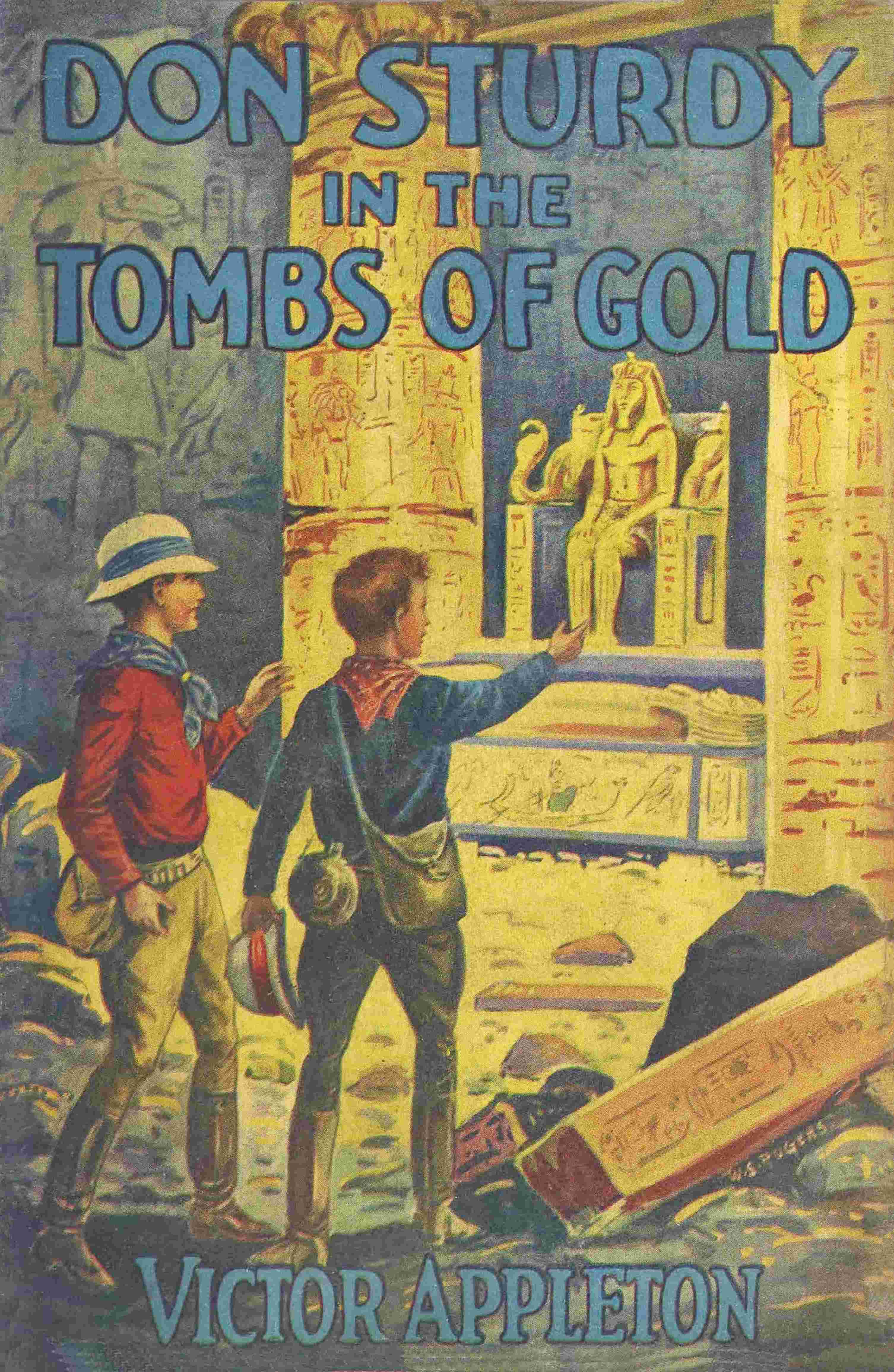
DON STURDY IN THE
TOMBS OF GOLD
CHAPTER I
A Call for Help
“Then, you think Dad really went to Egypt?” asked Don Sturdy, with deep anxiety in his tone, as he stood beside the desk where his uncle, Professor Bruce, was carefully looking over a mass of papers.
“I’m inclined to think so, my boy,” replied the professor, as he sat back in his chair and ran his fingers through his hair. “Everything seems to point that way, though we haven’t a bit of positive proof. But we know, at least, that the idea of going there was in his mind when he rushed out of Clifton’s house in Brazil shouting that he must go to Egypt.”
“Still, that may have been the mere whim of a deranged mind, forgotten almost as soon as the words were spoken,” put in Captain Frank Sturdy, another of Don’s uncles, as he turned from the window through which he had been looking.
“True enough,” assented the professor. “But we know from what Ruth told us that for weeks he had been talking about the Valley of the Kings in Egypt. It was, I believe, a fixed idea that had taken possession of him. And these papers I’ve been looking over explain why he was so deeply interested in that country.”
He picked up the heap of manuscript as he spoke, and selected some papers from the mass.
“There’s no collected story here,” he remarked; “simply a lot of memoranda scribbled on whatever he had at hand, old telegraph blanks, backs of envelopes, and the like. They bear upon a trip that Richard took to Egypt several years ago. The magic of the country seems to have captivated him. But there’s something more than the awakened interest of a tourist in them. They’re aflame with the ardor of a discoverer. He seems to have been right on the brink of some remarkable find—so remarkable, in fact, that he feared to commit it to paper lest it should get into hands for which it was not intended.”
“I remember now,” broke in Captain Sturdy, “that when he got back from that trip he seemed strangely excited. But I could never get much out of him about it. He’d talk about it in a general way, but whenever it came to details he’d change the subject. I gathered that he meant to go back the next year, but the war came and that put an end to his plans for the time.”
“He seemed to have spent most of his time among the tombs,” resumed the professor. “There is one he mentions that was fifty-two feet long, thirty-one feet wide, the sides of which were entirely covered with paintings, while the roof, twenty-four feet high, was adorned with a hundred squares of over a dozen different designs. There’s a diagram of it here.”
“What do you gather from that?” asked the captain.
“Nothing much in itself,” was the reply. “But at the end of the description are the words: ‘This is not the one. Must look further.’ And there are several other descriptions of tombs scattered through the papers, each with this little note of disappointment at the end. It seems clear to me that Richard was hunting eagerly for one particular tomb and desperately anxious to find it.”
“What for, do you suppose?” asked Don.
“What he wanted to find it for or what he expected to find in it I don’t know. It may have been gold or scarabs or alabaster vases or amulets or any of the thousand things that make some of those tombs veritable treasure houses. But whatever it was, his mind was centered on it. It may have become a sort of obsession. Then, when his head was hurt in that accident at the time of the shipwreck, that one overpowering desire to get back to Egypt may have come to the front and been too strong to be resisted.”
“Even if he did go there,” said Don, in perplexity, “it’s strange that nothing has been heard of him. He had to live somewhere, must have registered at some hotel. Yet all the consuls in the various cities have investigated and can find no traces of any one named Sturdy.”
“He may have used some other name,” suggested the professor. “It’s quite possible that he’d forgotten his own. Cases of amnesia are common enough, when a man forgets all his past history, even his name.”
“But if mother had been with him, she’d have set that all right,” objected Don.
“True enough,” replied the professor. “But how do we know that she was with him? All we know is that she ran out after him into the night. We cannot be sure that he didn’t elude her.”
“Oh, shall we ever be able to solve the mystery?” cried Don, in desperation.
“Yes, we will,” declared the captain heartily, as he placed his hand encouragingly on his nephew’s shoulder. “Keep up your heart, my boy. Remember that we found your sister Ruth when we had almost given up hope. And with heaven’s help we’ll find your father and mother too.”
“To be sure we shall, even if we go to Egypt to do it,” chimed in the professor. “We’ll rake that country with a fine-toothed comb before we’ll give up and admit that we’re beaten.”
The sound of the dinner bell broke up the conference, and Don hastened to his room to wash and to brush his hair.
They were served at table by Jennie Jenks, the maid of all work, who in her flittings to and fro that afternoon had caught snatches of the conversation and was bursting with the desire to impart it to Mrs. Roscoe, the housekeeper of the Sturdy home.
“I guess we kin say good-bye to Mister Don an’ his uncles,” she remarked, in one of her migrations to the kitchen. “They’re all a goin’ to the tomb.”
Mrs. Roscoe was so startled that she nearly dropped the dish she was carrying from the oven.
“What do you mean?” she gasped. “Are they sick?”
“You wouldn’t think so if you seen the way they was eatin’,” replied Jennie, shifting her wad of chewing gum. “I mean they’re goin’ to them Egypt tombs, where they’s alligaster vases an’ omelets an’ things like that.”
“Oh, you mean the tombs of the Pharaohs,” said the motherly housekeeper, in great relief. “They’ve been dead a long time.”
“Mebbe,” admitted Jennie. “Though I hadn’t even heard they was sick. But it just beats all the way them men go trampin’ all over the earth when they got a good home like this. Here they jest got back from Brazil, an’ lucky they was not to be et up by golcondas or cannonballs, an’ instead of settlin’ down, thankful like, they must be goin’ off lickety-switch to another of them heathen places. Who knows what’ll happen to ’em? Like as not Mister Don may fall down into one of them Egypt tombs an’ be squashed.”
“Oh, I guess not,” replied the housekeeper soothingly. “He’s been in a good many tight places and has come through all right.”
“Yes,” admitted Jennie. “But the picture that goes to the well too often is broke at last. An’ it jest makes my blood creep to think of them goin’ to that Egypt place, where all them plagues used to be.”
“That was a long time ago,” remarked the housekeeper. “I guess it’s all right now.”
“I don’t know,” said Jennie, renewing her attack on her chewing gum more vigorously and shaking her head. “From all I’ve heard, them Egyptians ain’t any better than they ort to be.”
“Who is?” asked Mrs. Roscoe mildly.
“A feller took me to a movie once that showed all ’bout Egypt,” went on Jennie, ignoring the question. “The big buildings was so dark an’ gloomy they give me the shivers. I ast the feller why they didn’t have electric lights, an’ he tole me that they didn’t need electric lights coz they had so many Israelites. I ast him what they had to do with it, an’ he only laughed an’ said he loved every bone in my head.”
“He had a lot to love, then,” put in Mrs. Roscoe dryly.
“An’ they was a picture of the ocean,” Jennie continued, oblivious of the sarcasm, “an’ the feller that was with me tole me that was Pharaoh an’ his chariots an’ the children of Israel crossing the Red Sea. I said, ‘Where’s the children of Israel, I don’t see any,’ an’ he said, ‘Oh, they’ve gone over’; an’ I said, ‘Well, then, where’s Pharaoh and his chariots?’ an’ he said, ‘Oh, they’ve gone under.’ I s’pose that was the way of it since he said so, but it didn’t seem just right somehow.”
Just then Jennie was interrupted by a call from the dining room and scurried away, saving the housekeeper the necessity of listening to any further details for the moment.
Don finished his dinner and then went out and sat down in a chair on the porch. It was a beautiful summer evening, and in the great old trees about the house the birds were singing their vesper songs.
Ordinarily the charm of the hour would have appealed to Don, but now the outer peace only helped to emphasize by contrast the ferment of anxiety in his mind. Where was his father? Where was his mother? Were they still alive? What fate was keeping him without tidings of his parents, dearer to him than life?
A boy on a motorcycle came at a rapid gait up the road. Don looked at him listlessly as he neared, but with quickened interest when he stopped at the gate.
The messenger opened the gate and wheeled his machine up the path.
“Cap’n Sturdy in?” asked the boy.
“Yes,” replied Don. “Want to see him?”
“Got a cablegram for him,” was the answer.
“Uncle Frank!” called Don. “Will you step here a minute? Something for you.”
The captain came to the door, carrying in his hand the evening newspaper he had been reading.
“What is it?” he asked.
The messenger handed him the envelope he drew from his pocket. The captain signed for it and tore it open.
He ran his eyes over the message, and gave a shout that brought Don to his feet in a twinkling.
“What is it?” he asked in surprise and some alarm. “What’s the matter?”
“Read it! Read it!” cried the captain, shoving the message toward his nephew with a hand that trembled.
Don looked at it, and started as though he had received an electric shock.
“It’s from mother!” he cried. “It’s from mother!”
This was the way the message ran:
“Strange disappearance of Richard. Must have assistance. Cable immediately.
“Alice Sturdy.”