
CHAPTER XIX
The Man by the Stream
Crouching down in the central hall, baffled and defeated in their efforts to find a way out into the world beyond the great cave, Don and Teddy sat for a long time in an attitude of strained expectation. No word was spoken, but each knew what the other was waiting for. They were hungry and thirsty, but if that had been all they would have resigned themselves and tried to forget their misery in sleep.
But there was more than that—the dread of the supernatural!
Very frequently the bravest of men does not care to go through a cemetery at night. He may laugh and make light of his fears. He may summon his common sense to his aid. He may tell himself that only fools fear the dead. Yet, however he may fortify himself, some obscure survival of the fear inherited from generations of superstitious ancestors makes him heartily glad when he leaves the dead behind and finds himself once more in the haunts of the living.
Teddy at last broke the silence.
“Do you think it will come to-night?” he asked, looking around him fearfully, as though his eyes could pierce the darkness.
“I guess not, Brick,” answered Don encouragingly. “I don’t think—”
Just then it came!
Again a weird, blood-chilling shriek rang down the passage, repeating itself in a thousand echoes, and again before the terrified gaze of the boys that frightful figure upreared itself and seemed to advance toward them with waving arms and threatening gestures.
Another long-drawn shriek and the apparition disappeared, seeming to melt at once into nothingness.
The boys clung close together, their hearts beating like triphammers, their minds dazed. Only gradually did they relax, and for a long time they trembled like leaves.
“I—I tell you it is a ghost,” said Teddy, at last, tried beyond endurance.
“And I tell you it isn’t,” retorted Don, who, however, was shaken almost as much as his comrade.
“It is, it is!” reiterated Teddy, covering his face with his hands, as though thus he could shut out the memory of the hideous apparition.
“Oh, if I only had my rifle,” groaned Don, to whom the mere feel of that trusty weapon would have brought strength and comfort.
“It wouldn’t have done you any good if you had had it,” replied Teddy. “You’d have to have a silver bullet in it to kill a ghost.”
Don could not help laughing, and it was amazing how that laugh helped to break the tension.
“Well, you do,” repeated Teddy defensively. “And it has to be blessed by a bishop, too.”
“There isn’t any silver bullet handy or a bishop either,” said Don. “Anyway, lead and steel are good enough for me.
“Now look here, Brick,” he went on. “We’ve got to pull ourselves together and put all that nonsense about ghosts out of mind. We know when we think it over that there isn’t any such thing.”
“But we’ve got to believe our eyes,” insisted Teddy. “We saw it, didn’t we?”
“We saw something. But what it was, we don’t know. But I’m going to try to find out,” and Don rose to his feet with an air of decision.
“Where are you going?” asked Teddy.
“Down that passage,” answered Don, pointing in the direction of the apparition.
“Oh, don’t!” urged Teddy, laying his hand on his arm.
“I’m going,” reiterated Don. “Come along.”
Teddy had the alternative of accompanying his comrade or staying behind, and he chose the former. He had never yet deserted Don in a crisis, and he was not going to do it now.
The boys advanced slowly in the pitch darkness, feeling their way inch by inch. And that caution was justified when Don, putting out his foot tentatively, felt nothing beneath it and hurriedly drew back.
“Back, Teddy!” he warned. “There’s a break here.”
He knelt down and reached his hand over into the opening as far down as he could, without coming in contact with anything.
“I wonder how deep it is,” he pondered. “Oh, if we only had a light of some kind.”
He took a bunch of keys from his pocket and found an old one belonging to the house at Hillville which he could dispense with.
“I’ll throw this in,” he said, “and we can tell from the sound when it strikes how deep the hole is.”
He dropped the key and they listened. The seconds passed. Then far, far down, they heard a faint tinkling, as the key struck a rock.
They recoiled from the brink in consternation.
“Why, it’s almost bottomless!” exclaimed Teddy. “It must be hundreds and hundreds of feet deep!”
“Right you are, Brick,” agreed Don soberly. “If we’d fallen in there, there wouldn’t have been anything left but a grease spot. We can’t go any further, and we might as well go back.”
“That must be where the g—the creature lives,” observed Teddy, as they again reached the large room.
“I’m glad you didn’t say ‘ghost’ that time,” laughed Don. “Yes, that’s the spot it seemed to come from.”
The mere fact that they had tried to “take the bull by the horns,” as Teddy put it, was in itself a bracing element, and they had less trouble in getting to sleep than they had had the night before.
But the morning brought with it the grim fact that they were face to face with actual starvation. Their last morsel of food and last drop of water, miserably insufficient as they were, disappeared. They were suffering intensely, and each was shocked as he looked at the sunken cheeks and hollow eyes of the other.
Their thirst, especially, was overpowering. The tightening of their belts helped in some degree to make them forget their hunger, but no such resource could abate their thirst.
They were tormented with visions of sparkling springs and flowing rivers. Their thoughts went back to that night on the balcony of Phalos’s villa when they heard the tinkling of the fountains in the courtyard and watched the ripples on the surface of the Nile. There, was water in plenty. What would they not have given now for a single drop to moisten their cracked lips and swollen tongues!
“We’ve just got to find our way out to-day, old boy,” said Don in desperation. “Another day or two and we’ll be too weak to do anything but lie here and die.”
They started out, summoning all their energy and examining every room and every passage that seemed to offer the slightest chance of an exit. But the morning dragged away without result, and with every hour they grew more feverish and weak.
About noon, as nearly as they could guess from the light, Don’s eyes lighted on a stone that seemed to have fallen slightly away from its fellows in the corner of a passage. He grasped it, and it gave slightly under his hand.
He shouted to Teddy, and together they pulled and hauled sufficiently to make an opening through which they could pull themselves. They were panting and exhausted when they drew themselves up and looked about them.
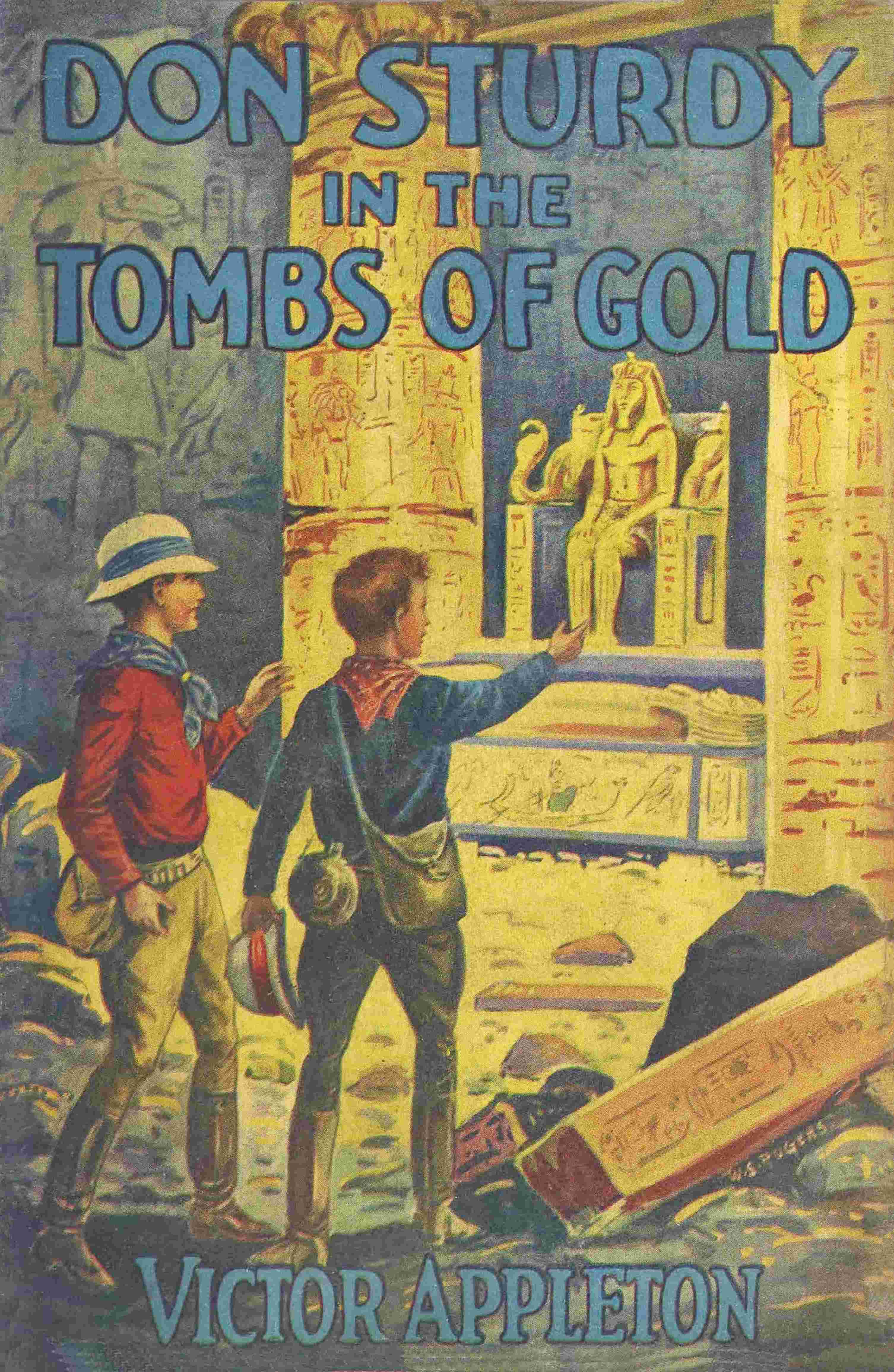
They found themselves in what seemed to have been a receiving vault of the long ago. There were three broad shelves, on which were resting sarcophagi that seemed to have been placed there temporarily, awaiting perhaps a more ceremonious burial later.
Don gave a shout, as his eyes rested on them.
“Gold!” he exclaimed, looking from the lids of the coffins to the slender pillars that adorned the structure. “Gold! Look at them, Brick! As bright and untarnished as the day they were placed here. Brick, old boy, we’ve come across a treasure!”
For a time the lads were filled with a wild elation, and they moved rapidly from one object to another, handling, examining, tracing the curious inscriptions.
Then the stark reality of their situation came back to them. What good was their wonderful discovery, after all? What could it do for them?
Here they had happened on wealth that would buy them the most sumptuous banquets that the world could provide. It gave them everything—and nothing.
“Starving to death with all this gold about us!” muttered Teddy bitterly. “I’d give it all for a cup of water.”
“The poorest beggar with his crust on the steps of a mosque is better off than we are,” agreed Don moodily.
He bowed his head in his hands. Then suddenly he raised it again. What was that he heard?
He listened intently, and hope shot into his eyes. But he had heard of the fancies of the victims of thirst and he was afraid. Was he growing delirious?
“Brick,” he said huskily to his friend, who sat hunched up in a corner. “Listen, and tell me if you hear anything.”
Inspired by the new tone in Don’s voice, Brick sat up.
“It—it sounds like falling water!” he exclaimed, in an awed voice. “Oh, Don, are we going crazy?”
“Come,” cried Don, staggering with weakness, but hurrying as fast as he could in the direction of the sound.
At a sudden turn in a passage the sound grew louder, and an instant later their eyes fell on a small stream of water, dashing over a rocky bed.
With a wild cry of delight, the boys threw themselves on the brink of the stream and plunged their heads into the cooling water. Then they drank avidly until Don, remembering caution, pulled Teddy back with main force.
“Easy, old boy,” he laughed happily. “Take your time. You’ll get into trouble if you drink too much after being without it so long. The stream isn’t going to run away.”
The soundness of this appealed to Teddy, and he refrained for a time. But again and again they plunged their heads into the water, each time feeling new life thrill through every vein.
At last Don sprang up and threw off his coat.
“I’m going in all over,” he cried. “And, oh, what a bath this is going to be! Come along, Brick, and see who’ll be in—”
He stopped as though transfixed.
On the other side of the stream sat a man, looking at him curiously.
A wild cry burst from Don’s lips.
“Father!” he cried. “Father!”