
CHAPTER XXII
A Bewildering Experience
When Don declared that they were in Egypt, Mr. Sturdy looked at his son as if he doubted his sanity.
“What do you mean?” he asked. “Are you fooling?”
“Listen, Father dear,” said Don, with an inward prayer for guidance. “You’ve been ill for a while, very ill, and during that illness you were brought to Egypt. Mother came with you, so that it was all right. And before I say anything else, let me tell you that mother and Ruth are well and happy—that is, they will be perfectly happy when you are with them once again. Won’t that be great, Father, all of us together again in the dear old home at Hillville?”
“But—what—but—” stammered Don’s father, trying to assimilate the new and to some extent terrifying ideas that came crowding in upon him. “Do you mean to say that I have been unconscious all this time?”
“Not unconscious, Father,” replied Don. “But—but in a kind of daze, as it were. And when you got to Egypt you wanted to go on with the work you had been doing before the war—you know, excavating in the Valley of the Kings.”
“The Valley of the Kings!” exclaimed Mr. Sturdy. “Yes, I remember that I did a good deal of work there in the old days. I was looking, I remember, for a special tomb—that of Ras-Ameses. Of course,” he added hurriedly, “I want you to keep that a secret between you and me. Don’t mention that name to anybody. Some day I hope to go looking for it again.”
“You have been looking for it, Father,” said Don gently. “While your mind was in a daze, you know. And I believe you’ve found it. I believe you’re in it now.”
There was such a look of utter bewilderment on his father’s face that Don’s heart ached.
“But don’t try to get the rights of it just now,” went on Don, rising. “There’ll be plenty of time for that. The only thing that counts is that I’ve got you again. Come and look at what Teddy and I found this morning,” he said. “Come along, Teddy,” he added. “And suppose you bring that bag of provisions along with you.”
“Will I?” returned Teddy. “Just watch me! I’ll cling to it like the ivy to the oak.”
As Don, with his heart beating high, walked along beside his father, he was delighted to note the springiness of step and vigor of movement that testified to his parent’s superb physical condition. That, he knew, would be one of the most important factors in restoring him to mental health.
There was the enthusiasm of the skilled Egyptologist in the exclamations with which Mr. Sturdy viewed the wonders that the boys had discovered that morning. His delight was unbounded, and he confirmed without question the boys’ estimate of the wealth of their discovery.
But all the time the battle was going on between the dual personality—the Sturdy of Brazil and the Sturdy of Egypt. It was pitiful, and yet at the same time encouraging, to note the way that trained intelligence of his was trying to reconcile the two and bring order out of chaos.
“Now, Father,” said Don, after a while, “suppose you come to the place where Teddy and I have been roosting while we’ve been here, and lie down and rest. That will give you a chance to think this thing out and get your bearings. Oh, how happy I am to have you with me again!” he added, giving him an affectionate hug.
Mr. Sturdy welcomed the suggestion. What he wanted more than anything else was an uninterrupted opportunity to think. Already he was piecing things together, and under the severe stimulus his mental condition was mending.
All that long afternoon Don’s father lay awake, stretched out on his back, trying to adjust himself to actual conditions. And it was not until the dusk was gathering that Don called him to the simple supper that he and Teddy had quietly prepared.
“I ought to tell you, Father,” said Don, dwelling lovingly on the name that he had so often longed to speak, “that we’ve had an unusual and rather shivery experience each night since we’ve been here,” and he went on to tell of the apparition.
Mr. Sturdy listened with interest.
“I don’t wonder you were frightened,” he said. “It was enough to terrify any one. I’m glad you told me about it. Forewarned is forearmed. It won’t be pleasant to see or listen to, but it’s very different from having it take you unawares.”
But even though prepared, they were all chilled to the marrow when, an hour later, that frightful shriek was heard and they saw the sheeted figure advancing toward them.
Even as they shrank back before the menacing monster, a shot rang out, and the apparition wavered for a moment and disappeared.
The three of them sprang to their feet in wild amazement.
“Who fired that shot?” cried Don. “Did you, Father?”
“No,” replied his father. “I have no rifle. I thought it was you.”
“I haven’t any either,” replied Don. “Uncle Frank! Uncle Frank!” he shouted, in uncontrollable excitement.
There was a shout of surprise from a passage near at hand, and the next moment the captain, with a flashlight in his hand, followed by the professor and Phalos, came rushing up and threw his arms about Don.
“My dear, dear boy!” he exclaimed, with his voice husky with emotion.
“But see, Uncle Frank! Uncle Amos!” cried Don. “Here’s father! Don’t you recognize him? I’ve found my father!”
The scene that took place for the next few minutes beggared description. There were sounds of delight, grasps of the hand, slaps on the back, incoherent questions tumbling over one another. Hardly any one knew what he was doing or saying, but all knew that they were supremely, overwhelmingly happy.
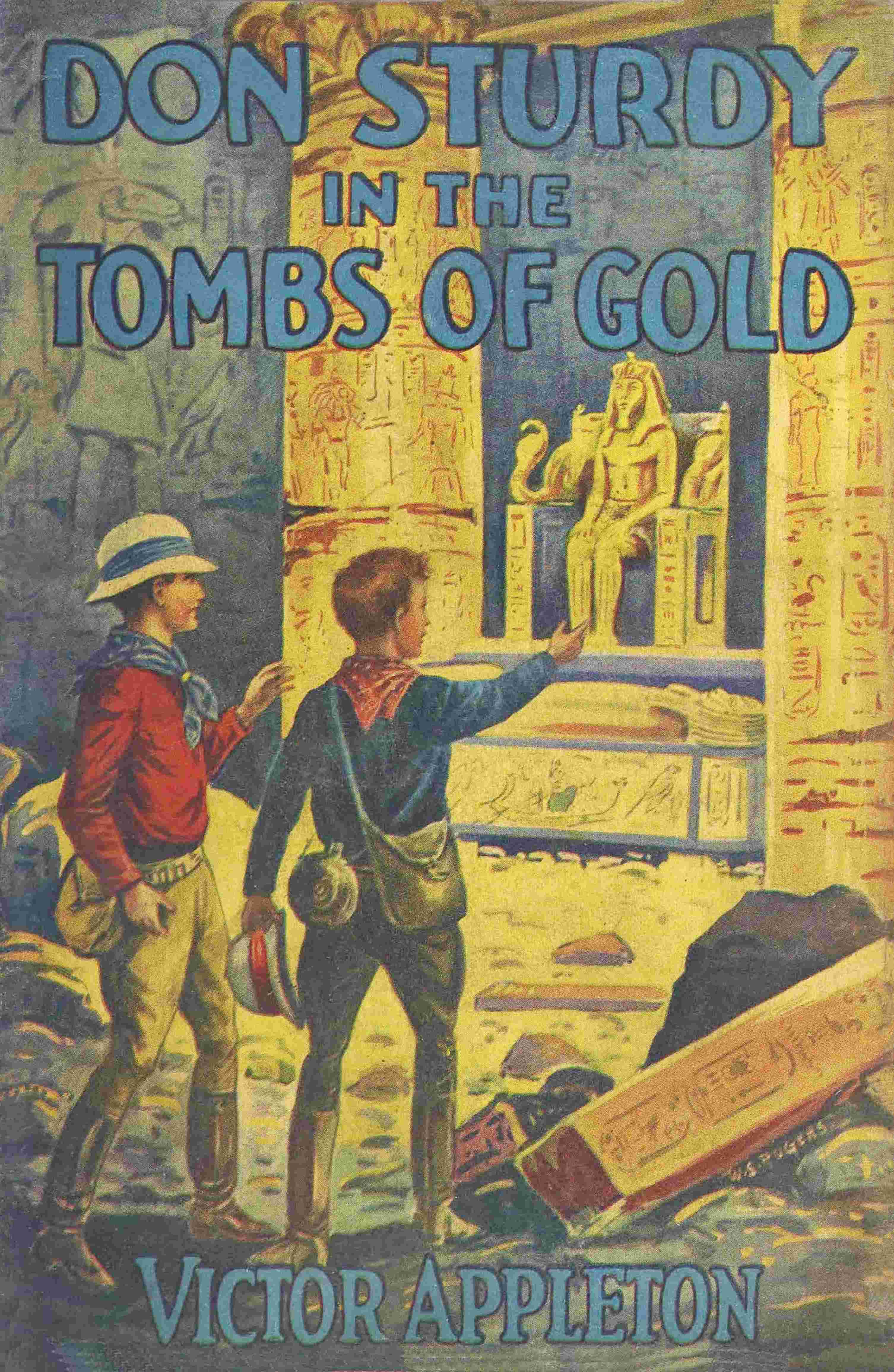
“We’ve found you, Dick, old man; we’ve found you!” jubilated the captain. “And, oh, the luck of it! We’ve found you in the Tombs of Gold!”