
CHAPTER XXIII
Riches beyond Price
It was a long time before the members of the party could settle down to a narration of their respective adventures. A torch was secured from the débris in the room of Horum-Aleb, and by its light they sat in a group, so that they could see each other’s features as they talked.
“How lucky it was that you decided to take a shot at the ghost—or whatever it is,” remarked Don. “If it hadn’t been for that, we might never have got together.”
“I suppose the chief reason I shot at it, was to relieve my feelings,” answered the captain, with a grin. “If it were anything human, it deserved to be shot. If it were anything mechanical, I thought I might disable the mechanism. We hadn’t seen the thing before to-night, but we’d heard it, and I had judged just about where we’d find it, and my guess was good. I’ll take a look around in the morning.”
Don had snatched an opportunity to reveal to his uncles what he had already told his father, and they acted with great tact and judgment in evading risky subjects and yet including him in their expedition, as if he knew all about it.
The elders listened avidly, too, to the boys’ narration of what had happened since they had been separated, and also to their story of the gold objects they had found that morning.
“Those alone would richly repay us for our trip,” observed the professor exultantly, while the face of Phalos flushed with pleasure. “If now we can add to them the things undoubtedly in the tomb of Ras-Ameses—”
“Ras-Ameses!” exclaimed Don. “Do you mean to say that you have found it?”
“Practically sure of it,” asserted the captain. “That’s all the good it does us though, for the present,” he added, his face falling. “It’s so solidly built it would take a charge of dynamite to blow it open.”
“No door or opening of any kind?” queried Don.
“Nothing that we’ve been able to discover so far,” was the reply. “But we’re going at it again in the morning.”
In the jubilation in which they all shared, they put aside for the moment the fact that they were prisoners, doomed to perish inevitably of hunger unless they could find an exit, for which all had hitherto searched in vain. But every little while that grim terror slipped into their thoughts, like a specter at a feast.
They talked until late into the night, and they were delighted to note the rapidity with which Don’s father was beginning to adjust himself to conditions. Yet, every so often, there would be moments of confusion that were baffling and saddening.
The next morning after a hasty breakfast, in which Mr. Sturdy’s stores played the greater part, all went to the supposed mausoleum of Ras-Ameses. They examined every inch of it with the greatest care, but found not the slightest clue to an entrance.
“Suppose you hoist me up to the top,” suggested Don.
They made a back for him, and he swung himself up. The top was flat, and made of the same massive blocks as the sides. Nothing rewarded his search.
His announcement to that effect was received with glum silence. It removed their last hope. They were thoroughly dispirited and disheartened.
As Don rested on the edge, he noticed a fretwork running along the top, the only ornament that relieved the severity of the tomb. He ran his hand along the edge, slowly, carefully, pressing in turn every projection.
Then a thrill ran through his veins. One of them had yielded, ever so slightly, but it had yielded!
He pressed upon it with all his might. And there, before the gazing spectators, who stood spellbound with amazement, one of the great blocks about four feet from the ground swung silently inward, revealing an aperture about three feet in width and height.
With an excited shout, the professor went through the opening, followed one by one by the others, and they found themselves in the tomb of one of the mightiest of the Pharaohs, on which no eyes had looked since it had been sealed thousands of years before.
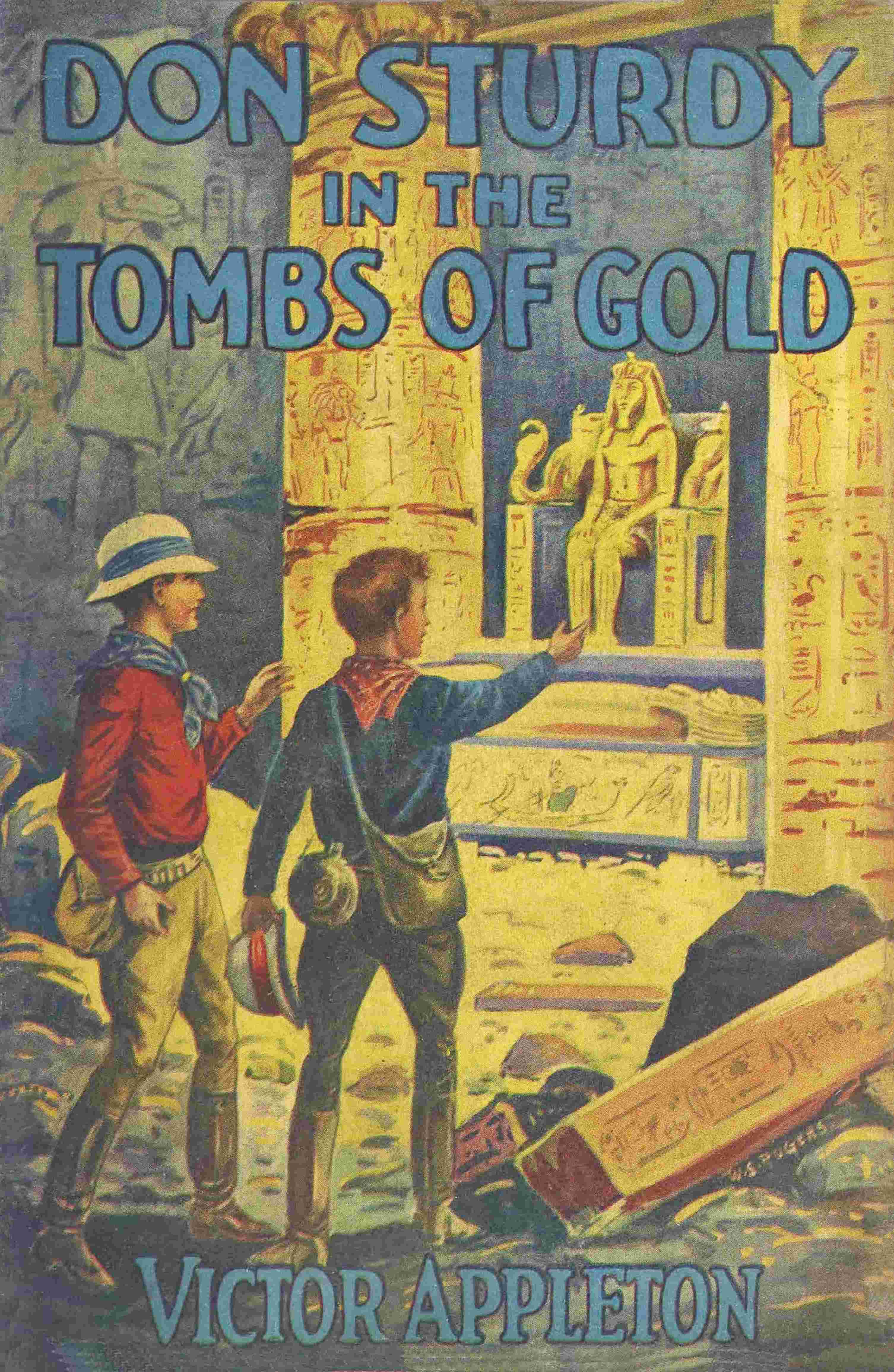
Untold riches dazzled their eyes, as they looked about them. Gold, gold, gold everywhere, in columns and tablets and coffin lids and statues, in beds and chariots and boats and amulets, in chairs and maces and scepters and symbols, gold in a profusion that stunned them and took away their breath. And besides this immeasurable wealth, there were other things quite as priceless, rings, robes, cups, whips, vases, inlaid and encrusted with precious stones. And on a great golden slab lay the sarcophagus of the mighty monarch who once possessed all these treasures and had ordered them to be brought to his tomb as emblems of his boundless wealth.
Hours passed like minutes while the excited group passed from one object to another, hardly daring to believe their good fortune, and half fearing that they would wake and find it all a dream. They had expected much, but this surpassed all their expectations.
It was only weariness that reminded them that they had spent the whole day in rejoicing over their wonderful discovery and suggested the need of food and rest.
“We owe it all to you, Don,” said the professor, as the excited and happy group made their way back to the rendezvous. “If you hadn’t found that spring—”
“Just a bit of luck,” disclaimed Don modestly.
“Was it just luck?” asked the captain pointedly.
“Well, not exactly,” admitted Don. “The fact is, I remembered the way King Cheops concealed the opening into his tomb in the Great Pyramid. I thought the same thing might have been worked here, so I tried to feel for it. But it was just luck I thought of it.”
“Luck!” snorted the captain. “I call it brain. And about the finest specimen of brain I know of is in the headpiece of a certain young fellow named Don Sturdy!”