
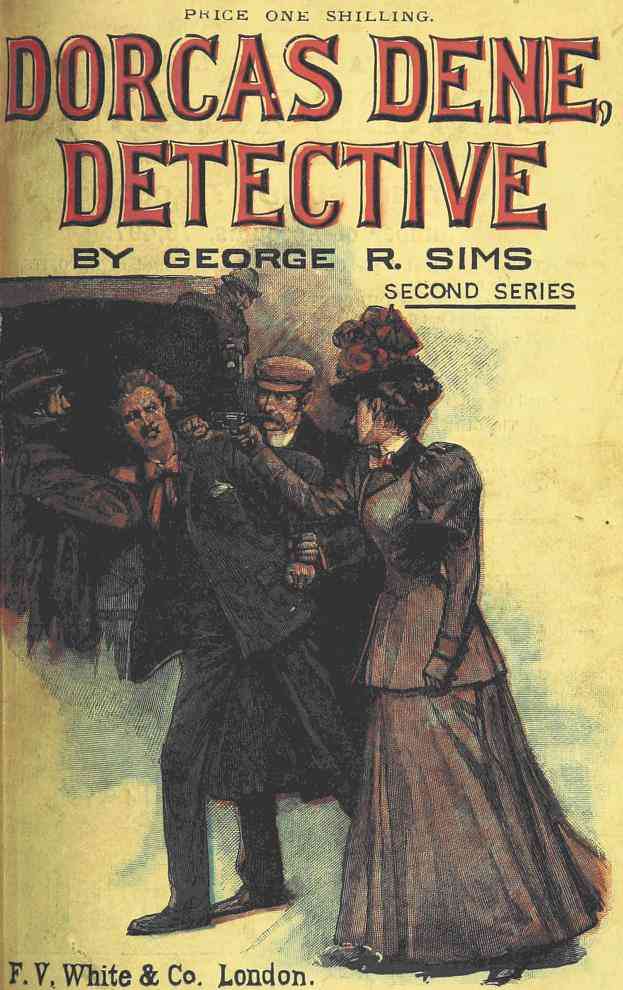
Dorcas Dene, Detective
Her Adventures
Second Series
by George R. Sims
Table of Contents
I. THE MISSING PRINCE
I was talking to Mr. Alfred Moul, the amiable manager of the Alhambra, and complimenting him upon the new decorations of the theatre, but he was not listening to what I said. I saw at once that he had something on his mind, so using the privilege of an old friend I asked him what was worrying him.
"That," he said, pointing to the big box usually reserved for royalty.
"But there's nobody in it."
"Exactly—that's why I'm worried. I received an intimation yesterday that the box was to be reserved for his Royal Highness Prince —— of ——, who is in London for a few days, and it is now a quarter to ten and his Royal Highness has not turned up. The ballet was due to commence at 9.30, and I can't put it off any longer. You'll excuse me, won't you—I must go and tell Jacobi to start the overture—I can't keep a packed house waiting for a foreign prince if he is the heir to a throne!"
Mr. Moul left me, and a few minutes later Mr. Jacobi, all smiles, took the place he has occupied for so many years, and, tapping on his desk, commenced the long-overdue overture to the gorgeous ballet which was attracting all London to the Alhambra.
I had come to see Mr. Moul privately on a matter of business. I had seen the ballet on the night of its production, and so I turned to go away. As I jostled my way through the crowded promenade I felt a tug at my coat sleeve, and looking round I recognised a detective inspector who had assisted Dorcas Dene on one or two occasions, and to whom I had been introduced at Oak Tree Road.
"Mrs. Dene saw you talking to Mr. Moul just now, Mr. Saxon," he said, "and she told me to bring you to her."
"Mrs. Dene here," I exclaimed.
"No—she was, but she left. She's waiting for us at the Cavour. We are going to have some supper, and she hopes you will join us."
A minute later I was seated at a quiet corner table with Dorcas and Inspector Carr, and the smiling and ever courteous Philippe was personally attending to our wants, and impressing upon the waiter who was taking our orders that everything was to be soigné.
"Now," I said to Dorcas, as soon as the menu had been settled and the waiter had brought us the wine, "what on earth were you doing at the Alhambra?"
"I went to see if the Prince was going to occupy his box."
"And he didn't. I really don't see what personal interest you can have in the matter, which after all is not a very remarkable one. Probably his Royal Highness has another engagement and couldn't get away."
Dorcas looked at the inspector, and the inspector replied for her.
"The fact is, Mr. Saxon," he said, "Mrs. Dene and myself are trying to fathom one of the greatest mysteries of modern times, and we've just come to the point where we want the assistance of a linguist. Mrs. Dene, directly she saw you at the Alhambra, said you were the very man to help us."
"I am very much obliged," I replied, nodding gratefully to Dorcas, "but it is evidently a police matter by your being concerned in it, and you have plenty of linguists on the staff at the Yard?"
"Yes, and as a matter of fact they are, most of them, at the present moment busily engaged in trying to solve the mystery for themselves. But I am particularly anxious to score in this matter, and being sure that the others are quite on the wrong scent, I went to Mrs. Dene, for whose talents you know I have always had an intense admiration, and told her the case and my view. She started another theory altogether, and I was so struck by it that I abandoned mine and took hers up. That is why we were together at the Alhambra when we so fortunately discovered you."
"I am a bit of a linguist," I replied when the inspector had finished, "but Greek is not one of my accomplishments, and up to the present, all you have said is Greek to me. Tell me what the case is in plain English."
Dorcas laughed. "In plain English," she said, "his Royal Highness Prince —— of —— left his hotel yesterday evening unaccompanied by any member of the small suite he has with him, and he has not been seen or heard of since."
"A Royal Prince lost in London!" I exclaimed, dropping the piece of grilled fowl which I had just raised on my fork. "Impossible! That sort of thing can only happen in a new Arabian Night."
"There is so little impossibility about it," said the inspector gravely, "that the suite are distracted. The news has been telegraphed to the Prince's relatives, and communications are passing hourly between the secret police of —— and our chiefs. There are twenty detectives at the present moment searching London, in the hope of discovering his Royal Highness's whereabouts. This morning, immediately on receipt of the news, the chief of the police in the Prince's capital, accompanied by half a dozen officers, started for England."
"But there has been nothing in the newspapers?"
"No—so far the secret has been admirably kept. There are strong political reasons why the matter should not be divulged. The Prince is the heir to the throne, and the rumour that he had disappeared might lead to the gravest consequences in his capital."
"But after all," I said, "it may not be serious. The Prince is young—if report speaks truly, he is also flighty, and fond of adventure. He may be amusing himself."
"No," said Dorcas, emphatically, "that story won't hold water for a moment. Had he intended to absent himself for private amusement, he would certainly have communicated with the distinguished officer who is in attendance upon him. He would know that his absence would cause alarm, and lead to police inquiries, and he would not risk that. His Royal Highness is unable to communicate the reason of his mysterious absence, and therefore he must be either lying somewhere too ill to make his identity known, or he must be in the power of those who prevent him from sending a message."
"How did he go out—in what dress?" I asked.
"In ordinary evening dress. He speaks English fluently, and knows London fairly well. Princes do not carry large sums of money about with them, because they are not in the habit of paying cash. His valet declares that he had not more than five pounds in money about him at the most."
"Did he say where he was going when he went out?"
"No. It was ten o'clock. He had dined quietly in his apartments at the hotel—our own Royal Family, you know, are all away from London—and after dinner he said he was going for a stroll through the streets. He did not desire to be accompanied by anyone."
"And no one has seen him since he left the hotel last night?"
"No one, so far as can be ascertained. He is not sufficiently well known to attract special attention as a prince, and in evening dress he would pass easily as an ordinary English gentleman. But from ten last night until the present moment all trace of him has been lost. He has dropped completely and suddenly out of existence."
We had finished our supper, and M. Philippe had ordered us some coffee, and had brought us a bottle of liqueur brandy from the Emperor Napoleon's cellar, and Dorcas had given us permission to light our cigarettes.
"Well," I said, after I had puffed my smoke into several rings, and gazed thoughtfully into the centre of each, "the Prince has disappeared, the entire detective force of London has started in hot pursuit of him, but Mrs. Dorcas Dene and Mr. Inspector Carr are going to find him. When?"
"To-night, we hope," replied Dorcas, shaking her head as the inspector offered to fill her liqueur glass.
"That's all right; and you have done me the distinguished honour of inviting me to join in the search because I speak one or two foreign languages. What language do you want me to speak?"
"None."
I stared in astonishment. "If I am to speak none, what use will my knowledge be to you?"
"You can listen," replied Dorcas, "and tell us afterwards what you have heard. It may be in French, it may be in German, it may be in Italian."
"I understand. But how are you going to arrange that people shall talk in these languages before me, and on the subject in which you are interested?"
"That is Mr. Carr's task," said Dorcas. "He will introduce you into certain society this evening and arrange for your safety."
"And you really think we shall unravel the mystery of the Prince's disappearance to-night?"
"I hope so. But whether we shall be able to manage entirely by ourselves depends upon how far my theory is correct. Inspector Carr wants to bring off a big thing, you see. He wants to be able to inform his Chief that Prince —— of —— is back at the hotel, and have all the credit of having restored the heir to the throne of —— to his friends without the slightest reference to his disappearance finding its way into the Press."
"The truth is, Mr. Saxon, that my Chief has given this job to the foreign lot at the Yard, and I can't see that they are any cleverer than we Englishmen. I want an English detective to do this job, because it's a very big one, and there's a lot hanging to it. I want to show them that an English detective is quite as clever as a foreigner, and I think, with Mrs. Dene's help, and you to do the 'lingo,' I may pull it off. At any rate, we'll have a good try. I'm working with Dorcas Dene, and I reckon she's worth all the foreigners in our place put together."
"That's a very big compliment you are paying me, Mr. Carr," said Dorcas, smiling. "However, I think my information with regard to the Prince has been of some use to you, and if my idea is correct, we may not have such a difficult task after all. But we'd better be going."
The inspector wanted to pay the bill, but I insisted on making the supper mine, and having bidden Philippe good-night, we took our departure.
In Leicester Square we found a four-wheeled cab waiting for us. Directly we were in the cab the detective handed me a revolver.
"You'd better slip that into your pocket in case of accidents," he said, "but don't use it if you can help."
The cab went on for a little while, and then stopped suddenly, and looking out of the window I saw we were in Soho Square.
The inspector asked us to get out, and we walked round the square, we two smoking, and Dorcas between us. The square was in darkness and quite deserted, as Soho Square generally is late at night.
Presently we saw a female coming slowly round the square. Dorcas took my arm and led me across the road. The detective went on into the shadow, and the female figure stopped close by him.
"What is it?" I said. "Does this woman know where the Prince is?"
"No, she hasn't an idea what we are after. She is the English wife of a foreign Anarchist who lives in London. Mr. Carr knows her. She is devotedly attached to her husband, and at the present moment she is bargaining for his life."
"For his life?"
"Yes, he is wanted by the foreign police. Carr found out two or three days ago where to lay his hand on him. If he is taken and sent back to Madrid, where he was concerned in an outrage, his death is a certainty. I advised Mr. Carr to get at the wife and make terms. I wanted certain information to act upon to-night. If she gives that information it may be the means of our finding the Prince. For that information Mr. Carr is promising the poor creature that her husband shall be allowed to escape."
"Can you promise that?"
"Yes—our Government won't mind letting off an Anarchist if the result is what I confidently anticipate it will be."
"And that result——?"
"Will be the execution of five of the most dangerous men in Europe."
"Are they all in London, then—these five men?"
"No, they are all in prison on the Continent. They are to be executed the day after to-morrow at seven o'clock in the morning."
"You mean the five Anarchists concerned in the —— outrage. What on earth can all this have to do with the mysterious disappearance of Prince —— of —— in London?"
"If I am wrong in my theory—nothing. If I am right—everything. But here comes the inspector, and I hope with good news."
There was no doubt about the nature of the detective's news. His first words settled that. "Got 'em," he said, "but we must make haste, the meeting's at one o'clock."
"Where?" said Dorcas.
"Round the watchman's fire where the road's up in Kennington Lane. Old Charley's information as to their last meeting was correct, you see."
"Excellent! Then now the arrangements you made this afternoon in anticipation will have to be carried out?"
"Yes—I told you if your idea was right I could guess the gang that were in it. I saw old Charley the watchman, and told him I'd give him a fiver to let me hide, but of course it wouldn't have been any good, because I don't understand their language, but Mr. Saxon can manage that splendidly."
I began to realise what was expected of me, and I didn't relish the situation.
"It's all right," said the inspector; "the only light is old Charley's bucket of coke and the dull red lamps on the barriers. You'll be railed off with poles lying in a hole in the roadway and a tarpaulin over that, and the tilted-up truck that he makes his shelter with will be in front of you—and I shall be there with you, so there's not the slightest occasion for alarm. If it comes to that I'll have a couple of plain clothes men round the corner out of sight ready to run up when I whistle, but of course I want to avoid that if possible. All I want to do to-night is to know what these men say—not to take any of them."
"But are you sure you can rely on the watchman—he might betray us!"
"Not a bit of it. He lodged in a house with one of them—that's how they got to know him. They come and sit on a plank across two barrels in front of the fire and talk. All he gets out of them is a sup at the brandy bottle and some baccy. I've promised him a fiver. Come along."
We got into the cab again, and I began to clutch my revolver. I was half sorry I had gone to the Alhambra. I couldn't back out of the thing now without appearing a coward.
Dorcas, I think, guessed I was nervous, and reassured me. She had every confidence in the inspector, who was an old hand with desperate men, and she was sure I was quite safe with him. She strongly advised no extra aid being had, as it would cause delay. After all, there were three of us, for the watchman would be on the side of the police.
When we got to within a couple of streets of the place, we got out. Dorcas was to keep the cab, and drive to a square in the neighbourhood and wait for us. The cab was driven by her regular man, so that she would be all right.
It was half-past twelve when the inspector, after a short and hurried conversation with a night-watchman sitting in front of his coke fire where the road was up in Kennington Lane, pointed out to us our place of concealment. We had to get down into the cavity commenced for the re-drainage. Fortunately it was deep enough for us to stand upright in. The tarpaulin was not necessary. By placing a couple of planks across with a space between we were completely hidden. The men might have walked over our heads and never suspected our presence.
Old Charley, by the detective's directions, shifted his truck and his fire back so as to bring the plank on which the men would sit quite close to our hiding-place. They would sit with their backs towards us. Buttoning our over-coats closely to we descended into our quarters, and were duly planked in.
It seemed an hour before there were signs of an arrival, but the conspirators were punctual, for as the clock was striking one they commenced to arrive. I guessed there were four of them by the different voices I heard. One, I gathered from the conversation, which was entirely in French, had arrived from Manchester only a couple of hours previously, in obedience to a telegram which had been sent him.
The conversation was not particularly intelligible to me at first. The men made mysterious allusions which would have been puzzling to me in English, but which in a foreign language were absolutely beyond my comprehension.
At first they muttered a good deal, the habit of caution being strong upon them, but gradually they became animated, and secure in the impossibility of Old Charley understanding a word they said, and the utter loneliness of the place at that hour in the morning, they began to talk with greater freedom and in a louder tone.
Their conversation was principally directed to the fate of their comrades, the five Anarchists who were lying under sentence of death, and whose execution was a matter now of some thirty hours.
"We will save them," said the man who seemed to be the ruling spirit; "our brave comrades shall not die—we may even compel the Government to set them secretly at liberty."
The man from Manchester, who was evidently considerably in the dark as yet, said he was glad to hear it, but what did they propose to do—threaten to blow up London or Paris, or what?
"No," replied the leader, "threats are of no avail. We have tried all that, and the only result is that the friends of Anarchy are everywhere driven out by the police authorities, and many of those who have to fly are innocent men and only with us in sympathy."
"Then what will you do?" asked the Manchester Anarchist. "We are a thousand miles away. What can we in London do to paralyse the arm of a foreign government?"
"Hold a hostage," growled the leader, and the others growled in approval.
"And where are you to find the hostage?"
"We have found him. That is why we have summoned you, who are one of the Council of Determination for England."
"Found a hostage—it must be a big one to save our comrades."
"It is a big one. We have done a thing which will ring through the world, and make the Governments of Europe grow pale, and tyrants tremble on their thrones. We have at our mercy the heir to the throne of ——."
I gripped the detective's arm in my excitement.
"Prince —— at your mercy! Yes, I remember he is in London. You will threaten to assassinate him—but that is no good. He will be watched and guarded—the police will surround him day and night."
"It is too late. He is already our prisoner."
"Your prisoner! Bravo—bravissimo! But, thunder of Heaven, how have you done that?"
"We have done it—it is enough."
"And where is he? If he has disappeared the police must be moving heaven and earth to find him—if they suspect us every Anarchist in England will be arrested."
"They do not suspect us. The fools! they do not see our object. They think he has gone out of his mind or slipped off with a woman. We have heard their foreign spies talking. Ha! ha! what fools they are!"
"Then you have him safe where he is not likely to be found or to escape?"
"He will not be found. He cannot escape."
"Good. Then what do we do next?—for the hour draws near. There is but to-morrow between our comrades and the vengeance of the tyrants."
"To-morrow morning I telegraph in our agreed secret language to a comrade in France. He telegraphs from a small post-office in the country where they do not understand English his message in English to the Prince's father: 'If our five comrades do not receive a remission of the death sentence by midnight, and that remission is announced by official publication, of which our comrade in your capital will acquaint us, you have signed the death warrant of your son. He is in our power, and he will be assassinated at the hour fixed for the execution of our comrades. If you attempt to betray us or make use of this message, we may be taken, but your son will have ceased to live. Decide!"
"Excellent!" said the Anarchist from Manchester, "but the Prince's father has no power over the —— Government. They may execute our comrades all the same."
"No—the Prince is married to the sister of the Queen of ——. She cannot sign the death warrant of her sister's husband."
"And if our comrades are reprieved?"
"The Prince, if he gives us his oath to remain silent and give the police no clue which might lead to our identification, shall have his liberty. Are we not generous?"
"Too generous to the tyrants! Ah, it would be good to keep this royal scamp and hang him—I would be the hangman for nothing!"
"Our programme is settled then," said the leader. "Now each to his home a separate way. The police may tumble by accident on the truth, and it is well to be cautious and keep apart. I will see to the sending of the message at once. I will go to one of the chief offices that are open all night. I had to wait for the Council of Four—now we are agreed, I can act."
We heard the men move, and bid old Charley, who little suspected that he had been witness to a plot for the murder of the heir to a European throne—not one of the first importance, but a throne for all that—good night, and presently the last sound of footsteps had died away.
Then we crept out of our hiding-place, knowing that the darkness of the night covered us, and I told the inspector what I had heard.
"Great Heaven!" he exclaimed, "then Dorcas Dene was right after all. The Prince has been kidnapped by desperate Anarchists, and his life is at their mercy. Let us go to her at once. I am not sure, seeing how desperate the case is, that I dare keep this to myself—I ought to report it to my chief at once."
We found Dorcas and told her, and the inspector explained that he thought he ought to return to the Yard at once and report everything.
Dorcas looked up at the great detective quietly.
"I shouldn't do that if I were you," she said. "We should be losing time. It will be much better for you to find the Prince yourself and set him at liberty."
"But how—how can we find him?"
"It is simplicity itself," replied Dorcas, "now we know that four men have the secret. If you do as I suggest I think we shall have his Royal Highness sleeping a great deal more comfortably to-morrow night than he is at present."
Suddenly Dorcas grasped the inspector's arm.
"Look—that man—at the corner yonder. He is watching us."
The detective gave a quick glance. "It is the girl's husband!" he cried. "He was one of them."
II. THE MORGANATIC WIFE
The place was deserted.
The figure of the watching Anarchist, which for a moment had stood out clear and distinct as he came momentarily into the light of the opposite lamp-post, was now scarcely visible. He had drawn back and stood in the shadow of a doorway.
"He doesn't know we've seen him," said Dorcas under her breath. "If he knew he would have moved further away than that."
"Yes—but he's evidently watching us for some reason," exclaimed the Inspector. "The men separated and went in different directions—old Charley told us so when we came out of our hiding-place. Why has Vossche taken up his station there?"
"The explanation probably is that his road lay this way—he noticed a four-wheel cab stopping here and wondered what it was doing. Anarchism is a desperate game, and the men who play it see a possible danger in everything. He wanted to satisfy himself why the cab was waiting, and saw you and Mr. Saxon come across. He may know you or he may not, but he evidently means to keep here till we drive off."
"And what can he do then?"
"That depends. If he has recognised you as a Scotland Yard man he will at once take means to communicate with the others and inform them of the suspicious circumstances. But he may follow us."
"How can he? We're riding and he's on foot."
"The best thing for us to do is to drive off slowly. We shall find out then if he means following us and how he is going to do it."
Dorcas put her head out of the off-side window and said to the driver in a low voice, "Go on slowly."
The man gathered his reins together and let the horse go his own pace.
In a minute or two there was a slight jar on the springs behind.
"I thought he'd do that," said Dorcas, quietly pulling the window up so that the sound of our voices could not be carried outside. "Now you two, get ready. Turn the handles of the doors quietly and get ready to spring out. You can do it safely at the pace we're going, which is only a crawl. By the time you are out the man will be level with you or a foot or two ahead. Before he can jump off you can seize both his arms and secure him."
"We shan't get anything out of him," said the detective. "He's a desperate fellow, and would die rather than betray the cause."
"At any rate we can prevent him giving the others the tip. A hint to them that a Scotland Yard man had been seen in the neighbourhood of their meeting place to-night might be fatal to our chances of finding the Prince. Are you ready?"
We turned the door handles noiselessly.
"Now," said Dorcas, and the next minute we had made a jump for the roadway. I nearly fell, but recovered myself as the astonished cabman pulled up short. In a second the Inspector had Jean Vossche by one arm, and before he could cry out I had him by the other. As we dragged him from his uncomfortable perch he struggled like a madman, and we had to use both our hands to hold him.
Dorcas stepped quietly out of the cab, and came to our assistance. Slipping her hand into my pocket she pulled out the revolver and pressed the cold muzzle to the Anarchist's forehead.
"Don't make a noise," she said, "and please don't move. I'm not used to firearms, and it might go off."
The man, recovering himself with an effort, gasped out in broken English, "What I do?—I only ride behind your dam cab! Let me go!"
"Sorry we can't oblige you, Mr. Jean Vossche. We've room for one inside—you'll be much more comfortable there. But as it's dark, and you're a reckless sort of beggar, I'll just slip the darbies on you. I didn't know I should want them, but 'It's always handy to have 'em in the house,' as the song says."
With a dexterity born of long practice, Inspector Carr slipped the handcuffs on his prisoner, and taking the revolver from Dorcas, politely pointed to the interior of the cab.
"He'll kick a bit, perhaps," said the Inspector to Dorcas. "You'd better get up by the driver. I'm going to deposit him at the nearest police-station—there's one just round the corner."
"Then I'll walk," said Dorcas, "and join you there. Do you know the officer on duty?"
"If I don't he'll know me. We can have a chat with our friend if you want it, but he's safer within four walls."
We assisted Mr. Jean Vossche into the cab and got in with him. The Inspector gave the cabman the address of the nearest police-station, and Dorcas walked on.
Ten minutes later Inspector Carr had explained the situation to the officer on duty at the police-station, and Mr. Jean Vossche, still manacled, was accommodated with a chair in the Inspector's office, into which presently Dorcas Dene was introduced.
Her first request was that the man might be taken outside for the present. Two constables were called in and the prisoner removed.
"Now, Mr. Carr," said Dorcas, "you've got to decide what we are going to do at once. So far my theory, that the disappearance of the Prince was connected with the approaching execution of five Anarchists in ——, has been borne out to the letter."
"Absolutely," replied the detective. "But having found that out my duty is to inform my chief. The whole of these men may be captured."
"Quite so—but that won't give the Prince his freedom. As these men were all at the meeting it is certain that they are none of them responsible for the safe keeping of the prisoner."
"That's true."
"Therefore by arresting them you only make the Prince's situation graver. You must bear in mind that he is held as an hostage. He is to be liberated on condition the Anarchists of —— are spared. The wretches who have him in their power are not likely to be more merciful to him because instead of five Anarchists being spared four more have been arrested. You could have got Vossche at any time. The only reason for seizing him to-night is to prevent him alarming the others."
"And I've given my oath to Vossche's wife that for her information her husband shall be allowed to get off."
"That I presume the authorities can easily arrange. There are plenty of Anarchists and Fenians who are supposed to be at present in her Majesty's gaols, who have been pardoned and are enjoying their liberty—the price of their valuable information—in the colonies."
"Yes—of course that can be arranged in Vossche's case if we save the Prince through his wife's information. But what I want to know now is—now that we have ascertained that you were right, and the Prince has been captured by the foreign Anarchists in London, where are we going to find the captive? Vossche won't tell us."
"No. I told you if the Anarchists had the Prince we would find him by to-morrow, and I didn't count then on getting the information from Vossche or any of them. But Vossche may be useful in saving us time, and every hour is of vital importance now."
"What can he do?"
"Guide us to the place where the Prince is concealed."
"He won't, I tell you, I know his character."
"He won't do it willingly, perhaps, but will you let me try an experiment?"
"Certainly."
"Then go out now and search the prisoner and see if he has any money about him."
"And if he has, I'm to take it?"
"No—leave it in his possession."
The Inspector, with a puzzled look on his face, went out to obey Dorcas's directions. I turned to her eagerly.
"Do you really think you know where the Prince is concealed?" I said.
"I have a very strong idea. Now Vossche has been arrested he may confirm it. That will assist us to concentrate all our efforts in one direction."
"You know a good deal about the Prince, I suppose?—or you have been making inquiries to-day?"
"I don't know very much, but what I do know suggests very strongly a clue to the means by which the Prince was secured. In the first place," said Dorcas, "when Inspector Carr brought me all the information he possessed I saw at once that it would have been almost impossible for rough, suspicious-looking foreigners like those Anarchists to have seized the Prince in the public thoroughfares—even at night. He would not have ventured alone into by-ways and alleys where such a thing was possible. It was evident that he was going out with a definite object, and that object was not merely to stroll through the streets. Had it been that, he would have been accompanied by one of his suite, or if he had gone alone he would have kept to thoroughfares where his capture would certainly have attracted attention. A number of ruffians seizing a gentleman in evening dress and dragging him away would have been noticed. If he had been hustled into a cab the police would have found the cabman by this. Therefore the conclusion is that he went out with the intention of going somewhere, and he did not want his suite to know where that somewhere was."
"You mean that, wherever he is, he was 'lured' there?"
"Certainly—and for a Prince to be lured into a trap the lurer must be someone with whom he had a previous acquaintance. A Prince would not accept an invitation from a stranger to meet her or to call upon her late at night."
"Her—you think there is a petticoat in the case?"
"I am certain there is. Now look at the facts we have to go upon. It is only reasonable to assume that the Prince went willingly and unsuspectingly at the invitation of a lady to call upon her late in the evening. It is certain that he is in the power of a number of foreign Anarchists in London. The task then is to establish a link between a lady who could induce the Prince to come out alone at night and the men who through her action were able to keep him a prisoner, and make his captivity a means to secure the reprieve of the condemned Anarchists of ——."
"And there is such a woman?"
"Let us see. A month ago a mysterious paragraph went the round of the London Press. A lady had been to a theatre, and had lost in the stalls—or thought she lost there—a magnificent diamond ornament.
"The loss was advertised, and a description of the jewel given. A few days later a mysterious paragraph appeared in the papers to the effect that a well-known pawnbroker had read the advertisement, and announced that the jewel was in his possession. He had at once communicated with the lady, and had returned the jewel to her.
"Next day the manager of the theatre, considering that the paragraph was a reflection on his staff, called upon the lady, with the result that a further mysterious paragraph went the round of the Press. It was to the effect that the lady had been mistaken in supposing that she lost her jewel in the theatre. It had evidently been stolen from her while she was getting into her carriage, and the thieves had succeeded in getting it pawned by a woman who stated that she was lady's-maid to the owner, gave the owner's correct address, and pawned it in the ordinary way, but in the lady's name.
"The story interested me, and knowing the pawnbroker, I called upon him and found that the jewel was the property of a Countess Elstein, and he had the more readily accepted it from the lady's-maid, as it bore an inscription which showed that it had formerly been in the possession of a lady of the Royal house of ——, and the pawnbroker—who, of course, had frequent dealings with the aristocracy—knew that the Countess Elstein had been the morganatic wife of Prince —— of ——. There was considerable scandal when the Prince married the sister of the Queen of ——, and his connection with the Countess was hinted at in several of the Society papers.
"I made inquiries, and found that the Countess had been in London for some weeks, and was living in a house in the Inner Circle, Regent's Park, a house standing in its own grounds, which she had taken furnished for a period from the owner, who had gone abroad for some time, having a wife in delicate health."
"And you really believe that it was the Countess Elstein—the Prince's morganatic wife—who induced him to visit her last evening, and that the invitation was a trap? What would a lady like that be doing in an Anarchist conspiracy?"
"Let me finish," said Dorcas. "The moment the ornament was recovered from the pawnbroker, no further notice was taken. I ascertained from the police that the pawnbroker had not given them any information as to the person who pawned it. He had been compensated by the Countess, and she had personally requested that nothing further should be done in the matter, as to bring the case into court would necessitate the story of the bracelet being told. She did not wish the gift of his Royal Highness Prince —— of —— to his morganatic and now discarded wife to figure in the police reports. You know that I like to investigate these little Society mysteries—they keep my hand in, and one never knows when the facts may be useful. I found that the Countess undoubtedly took the jewel with her to the theatre. It was fastened on to her arm by her maid, a Frenchwoman, and I at once jumped to the conclusion that the Frenchwoman was in the robbery—that she had given information of her mistress's ornament, and certain particulars which had helped the thieves to get possession of it. For all we know, the thief might have occupied the next stall, and followed the Countess out in the crowd. But the Countess did not suspect her maid, or she would have discharged her, I suppose. The maid's name is Zelie Vossche."
"Vossche!—why, that is the name of the Anarchist here now!"
"Yes, Zelie Vossche, who is maid to the Prince of ——'s morganatic wife, is sister to Jean Vossche, one of the Anarchists who hold the Prince as hostage for the safety of the condemned Anarchists of ——."
"That certainly establishes a link," I exclaimed, "but there is one thing I don't see yet. I can understand you connecting the Prince's mysterious absence from his hotel with the Countess Elstein, but why did that suggest to you that there might be an Anarchist plot at the bottom of the whole thing?"
"That came about from the conversation I had with Inspector Carr this morning. He had a theory that the Prince was engaged in some affair of gallantry, and I at once told him that if there was a lady in the case it was probably the Countess. Then I told him the story of the diamond bracelet, and that I suspected the robbery had been 'put up' by the maid, Zelie Vossche.
"He was startled at the name, and at once told me that a Jean Vossche was one of a group of Anarchists at present in London about whom the police were uneasy, as they appeared to be meditating some big coup. That there was a Vossche resident in the house of the Prince's morganatic wife, and a Vossche a dangerous Anarchist, at once caused me to connect the Prince's disappearance with an Anarchist plot, and I remember that the papers had reported that the Anarchists of Europe had forwarded several threatening letters to the authorities in —— in connection with the approaching executions there. Then the Inspector told me that he could, he thought, get at Vossche's wife, and find out at least what Vossche was doing if he approached her with an offer which would be to her husband's benefit. I determined that we would at once follow the clue in that direction as far as we could, and I think you will acknowledge that events have so far quite justified my plan of action."
"Indeed they have," I replied, "and in a most remarkable manner. But here comes the Inspector."
"Well," said Dorcas, turning to the detective, "what have you found on Vossche?"
"Nothing that will be useful to us. He has no papers at all, and he refuses to say anything."
"Any money?"
"Yes, he has three sovereigns in his waistcoat and about twelve shillings in loose silver in his pocket."
"Where you left them, I hope?"
"Yes—as you wished it."
"Very well then. Can you drive?"
"Drive? Yes, I can—but whatever do you want to know that for?"
"Send out and get a hansom cab to the door. The police will satisfy the man it is all right. You must put on his coat and badge, get an old hat—there's sure to be one here that will come down well over your forehead—turn up your coat collar, get up on the box, and drive a little way away. There are no cabs in this neighbourhood at this time of night, so you'll have to send to the stand, which is a quarter of a mile away, for one. Let them bring a hansom or four-wheeler—it doesn't matter which. Send at once."
The Inspector went out and instructed the officer in charge, and presently returned and said a cab had been sent for.
"Very well—the police must requisition it for you when it comes. They will undertake to let the driver have his cab again to-morrow morning, and you'll pay him liberally for taking his place on the box."
"But what am I to drive a cab for? We've got our own man outside."
"Yes, but Mr. Saxon and I are going to take him."
"Then what am I to drive an empty cab for?"
"It won't be empty, I hope. If it is you must come all the same, but I am hoping that you will have Vossche inside."
"Vossche?"
"Yes—after he has escaped from here——"
"Escaped!—Vossche!"
"Yes—if he sees an empty hansom he is pretty certain to hail it and jump in, in case he should be pursued."
"Vossche is to escape and I'm to drive him away in a cab?"
"Yes. If he gets in—and I'm pretty sure he will—it will be his best means of eluding pursuit—he'll tell you to drive somewhere. He will be in a desperate hurry to get to the people who have the Prince in their care. He'll want to let them know that the police are at work in the right direction and put them on thei guard. When he gets in if he only says 'Drive on,' you must say 'How far?' Get his destination out of him on some excuse or other."
"And take him to it?"
"No—go a little way and then say your horse is lame. Turn him out as far from a cab-stand as you possibly can, then drive on to us—we'll wait at the corner of the Westminster Bridge-road."
"And then?"
"And then we'll go on to the Inner Circle, Regent's Park, and get into the Countess of Elstein's house."
"We shall want help, if we're to do that."
"You can put as many police in the front as you can get together, but we're going to climb over the park railings and get in the back way. Now let's arrange for Vossche to escape. Call me the chief here."
The officer in charge of the station came in and Inspector Carr made a clean breast of as much as he wanted to tell. The officer hesitated at the idea of the escape.
"Well," said the Inspector, "after all he isn't charged, is he? You are only minding him for me, and I'll promise he won't get away. He's going in my cab."
The officer opened his eyes with astonishment. "This is a very daring idea," he said.
"Yes," said the Inspector, "but it's Dorcas Dene's, and I think it will be the means of our making sure of the whereabouts of the Prince."
"Very well," said the officer. "Of course you take all responsibility—the case is yours, not mine. How is the escape to be arranged?"
The Inspector looked at Dorcas.
"After we have gone," she said, "and Mr. Carr has got possession of the cab and put on the driver's coat and badge, have the prisoner brought in as though you were going to examine him. Remove his handcuffs previously in the cell. A constable will guard him and one will stand in the doorway.
"Suddenly you can pretend to fall ill, stagger and fall into the constable's arms who is by the prisoner. Probably the man at the door will rush to your assistance. Vossche is certain to see his chance and make a desperate effort to bolt. He will be strong enough to overpower the constable even if he has not left the door to run to your assistance. You must clutch at the officers in your fit and hinder them for a minute. By that time the man will be out and into the cab which will be at hand."
The officer hesitated. "It will be playing a comedy. I never heard of such a proposition, and I don't think I ought to be a party to it."
"You really must help us in this," exclaimed Dorcas, earnestly. "I am sure if you do, and we discover the Prince, that Inspector Carr will gladly testify to the admirable manner in which his efforts were seconded by you. And if Prince —— of —— has any sense of gratitude, he will, when he hears the story, present you with a diamond pin. Remember this case is not going into the newspapers, and 'our Special Crime Investigator' will never have even the tip of his little finger in the pie. The instructions from the Chief Commissioner are that the most perfect silence is to be maintained on the subject by all officers engaged in the search. Even the people at the Prince's hotel have been informed by his suite that his Royal Highness is gone into the country."
"Very well," said the officer, after a few minutes' reflection, "I'll do it."
A constable came in to say that a hansom had been secured.
Dorcas wished the officer good-night, and shook hands with him, and we went out to our four-wheeler, leaving Inspector Carr and the local officer together.
When we got to Westminster Bridge-road we pulled up and waited.
Ten minutes later we heard a hansom tearing along at a furious rate.
"There's no one in the cab," said Dorcas, looking into the vehicle as it hove in sight. "Carr's got rid of him."
At that moment the vehicle came full into the light of the street lamp.
Dorcas looked up at the box seat and uttered a cry of terror.
One glance was sufficient to tell me the cause of her dismay.
The man who was driving the hansom so furiously that the few stragglers who were about in the street shouted out that it was a runaway was not Inspector Carr.
It was Jean Vossche, the Anarchist!
III. THE HOUSE IN REGENT'S PARK
When the hansom which should have been driven by Inspector Carr, and should have had Jean Vossche inside, dashed past us empty and with Jean Vossche, the Anarchist, driving furiously, Dorcas Dene stood for a moment dumbfounded.
"Something must have happened to Carr," I exclaimed. "Vossche could only have got possession of the cab after a struggle."
"No," said Dorcas, "I don't imagine there has been a struggle. You forget Carr carried a loaded revolver and Vossche was searched at the station. It is possible that an accident happened. Vossche got possession of the cab and drove off because he is in a desperate hurry to warn his accomplices that they were watched to their meeting-place to-night."
"And if he succeeds in warning them?"
"The first thing they will do will be to prevent all possible means of rescuing the Prince. And they can do that in a moment."
"How?"
"By killing him."
"Why should they do that? Dead, he ceases to be a hostage, and in sacrificing him they sacrifice the last hope of saving the lives of the condemned men."
"They can kill him and conceal the body so that his fate may remain uncertain. The —— Government are certain to reprieve the prisoners in the hope of saving the Prince's life."
"Then they may have killed him already—he may have been murdered the night of his disappearance."
"No—they would hesitate to do that, because it might have been found out, and then their last card would have been played. But now they are desperate. They will guess that they are suspected of being concerned in his Royal Highness's disappearance. Self-preservation is the first law of nature, and to save their own skins they will sacrifice even their comrades. I have made up my mind what to do. Come—we must be going."
"What about Carr?—are we going to leave him to his fate?"
"We cannot help him. If he is injured he will have been found by passers-by or the police and attended to by now."
"Then where are we going?"
"To Scotland Yard."