
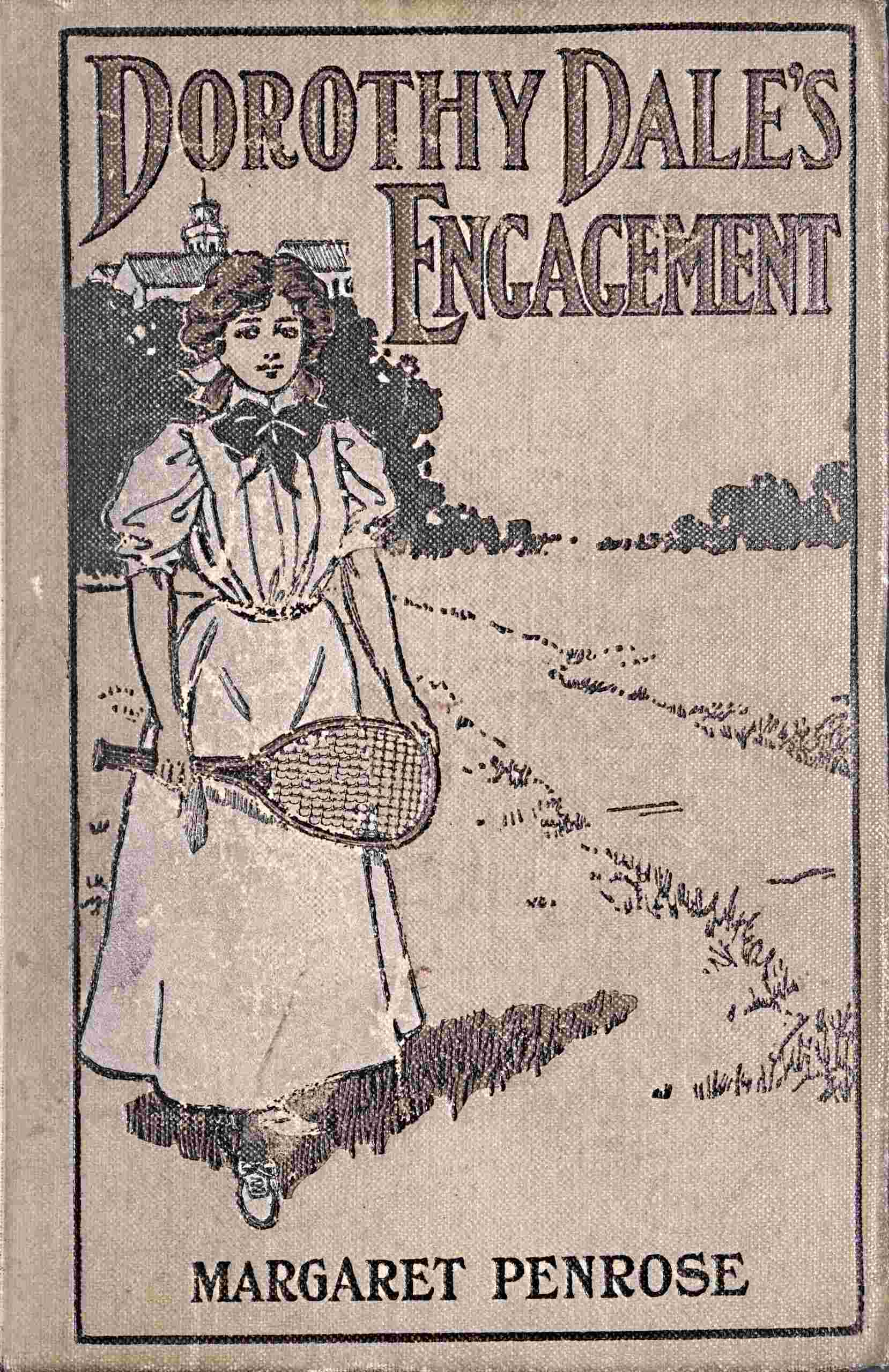
DOROTHY DALE’S
ENGAGEMENT
CHAPTER I
“ALONE IN A GREAT CITY”
“Now, Tavia!”
“Now, Dorothy!” mocked Octavia Travers, making a little face as she did so; but then, Tavia Travers could afford to “make faces,” possessing as she did such a naturally pretty one.
“We must decide immediately,” her chum, Dorothy Dale, said decidedly, “whether to continue in the train under the river and so to the main station, or to change for the Hudson tube. You know, we can walk from the tube station at Twenty-third Street to the hotel Aunt Winnie always patronizes.”
“With these heavy bags, Doro?”
“Only a block and a half, my dear Tavia. You are a strong, healthy girl.”
“But I do so like to have people do things for me,” sighed Tavia, clasping her hands. “And taxicabs are so nice.”
“And expensive,” rejoined Dorothy.
“Of course. That is what helps to make them nice,” declared Tavia. “Doro, I just love to throw away money!”
“You only think you do, my dear,” her chum said placidly. “Once you had thrown some of your own money away—some of that your father sent you to spend for your fall and winter outfit—you would sing a different tune.”
“I don’t believe I would—not if by throwing it away I really made a splurge, Doro,” sighed Tavia. “I love money.”
“You mean, you love what money enables us to have.”
“Yep,” returned the slangy Tavia. “And taxicab rides eat up money horribly. We found that out, Doro, when we were in New York before, that time—before we graduated from dear old Glenwood School.”
“But this isn’t getting us anywhere. To return——”
“‘Revenons à nos moutons!’ Sure! I know,” gabbled Tavia. “Let us return to our mutton. He, he! Have I forgotten my French?”
“I really think you have,” laughed Dorothy Dale. “Most of it. And almost everything else you learned at dear old Glenwood, Tavia. But, quick! Decide, my dear. How shall we enter New York City? We are approaching the Manhattan Transfer.”
“Mercy! So quick?”
“Yes. Just like that.”
“I tell you,” whispered Tavia, suddenly becoming confidential, her sparkling eyes darting a glance ahead. “Let’s leave it to that nice man.”
“Who? What man do you mean, Tavia?” demanded Dorothy, her face at once serious. “Do try to behave.”
“Am behaving,” declared Tavia, nodding. “But I’m a good sport. Let’s leave it to him.”
“Whom do you mean?”
“You know. That nice, Western looking young man who opened the window for us that time. He is sitting in that chair just yonder. Don’t you see?” and she indicated a pair of broad shoulders in a gray coat, above which was revealed a well-shaped head with a thatch of black hair.
“Do consider!” begged Dorothy, catching Tavia’s hand as though she feared her chum was about to get up to speak to this stranger. “This is a public car. We are observed.”
“Little silly!” said Tavia, smiling upon her chum tenderly. “You don’t suppose I would do anything so crude—or rude—as to speak to the gentleman? ‘Fie! fie! fie for shame! Turn your back and tell his name!’ And you don’t know it, you know you don’t, Doro.”
Dorothy broke into smiles again and shook her head; her own eyes, too, dancing roguishly.
“I only know his initials,” she said.
“What?” gasped Tavia Travers in something more than mock horror.
“Yes. They are ‘G. K.’ I saw them on his bag. Couldn’t help it,” explained Dorothy, now laughing outright. “But decide, dear! Shall we change at Manhattan Transfer?”
“If he does—there!” chuckled Tavia. “We’ll get out if the nice Western cowboy person does. Oh! he’s a whole lot nicer looking than Lance Petterby.”
“Dear me, Tavia! Haven’t you forgotten Lance yet?”
“Never!” vowed Tavia, tragically. “Not till the day of my death—and then some, as Lance would himself say.”
“You are incorrigible,” sighed Dorothy. Then: “He’s going to get out, Tavia!”
“Oh! oh! oh!” crowed her chum, under her breath. “You were looking.”
“Goodness me!” returned Dorothy, in some exasperation. “Who could miss that hat?”
The young man in question had put on his broad-brimmed gray hat. He was just the style of man that such a hat became.
The young man lifted down the heavy suitcase from the rack—the one on which Dorothy had seen the big, black letters, “G. K.” He had a second suitcase of the same description under his feet. He set both out into the aisle, threw his folded light overcoat over his arm, and prepared to make for the front door of the car as the train began to slow down.
“Come on, now!” cried Tavia, suddenly in a great hurry.
But Dorothy had to put on her coat, and to make sure that she looked just right in the mirror beside her chair. All Tavia had to do was to toss her summer fur about her neck and grab up her traveling bag.
“We’ll be left!” she cried. “The train doesn’t stop here long.”
“You run, then, and tell them to wait,” Dorothy said calmly.
They were, however, the last to leave the car—the last to leave the train, in fact—at the elevated platform which gives a broad view of the New Jersey meadows.
“My goodness me!” gasped Tavia, as the brakeman helped them to the platform, and waved his hand for departure. “My goodness me! We’re clear at this end of this awful platform, and the tube train stops—and of course starts—at the far end. A mile to walk with these bags and not a redcap in sight. Oh, yes! there’s one,” she added faintly.
“Redcap?” queried Dorothy. “Oh! you mean a porter.”
“Yes,” Tavia said. “Of course you would be slow. Everybody’s got a porter but us.”
Dorothy laughed mellowly. “Who’s fault do you intimate it is?” she asked. “We might have been the first out of the car.”
“He’s got one,” whispered Tavia.
Oddly enough her chum did not ask “Who?” this time. She, too, was looking at the back of the well-set-up young man whose initials seemed to be G. K. He stood confronting an importunate porter, whose smiling face was visible to the girls as he said:
“Why, Boss, yo’ can’t possibly kerry dem two big bags f’om dis end ob de platfo’m to de odder.”
The porter held out both hands for the big suitcases carried by the Western looking young man, who really appeared to be physically much better able to carry his baggage than the negro.
“I don’t suppose two-bits has anything to do with your desire to tote my bag?” suggested the white man, and the listening girls knew he must be smiling broadly.
“Why, Boss, yo’ can’t earn two-bits carryin’ bags yere; but I kin,” and the negro chuckled delightedly as he gained possession of the bags. “Come right along, Boss.”
As the porter set off, the young man turned and saw Dorothy Dale and Tavia Travers behind him. Besides themselves, indeed, this end of the long cement platform was clear. Other passengers from the in-bound train had either gone forward or descended into the tunnel under the tracks to reach the north-side platform. The only porter in sight was the man who had taken G. K.’s bags.
The weight of the shiny black bags the girls carried was obvious. Indeed, perhaps Tavia sagged perceptibly on that side—and intentionally; and, of course, her hazel eyes said “Please!” just as plain as eyes ever spoke before.
Off came the broad-brimmed hat just for an instant. Then he held out both hands.
“Let me help you, ladies,” he said, with the pleasantest of smiles. “Seeing that I have obtained the services of the only Jasper in sight, you’d better let me play porter. Going to take this tube train, ladies?”
“Yes, indeed!” cried Tavia, twinkling with smiles at once, and first to give him a bag.
Dorothy might have hesitated, but the young man was insistent and quick. He seized both bags as a matter of course, and Dorothy Dale could not pull hers away from him.
“You must let us pay your porter, then,” she said, in her quietly pleasant way.
“Bless you! we won’t fight over that,” chuckled the young man.
He was agreeably talkative, with that wholesome, free, yet chivalrous manner which the girls, especially the thoughtful Dorothy, had noticed as particular attributes of the men they had met during their memorable trip to the West, some months before.
She noticed, too, that his attentions to Tavia and herself were nicely balanced. Of course, Tavia, as she always did, began to run on in her light-hearted and irresponsible way; but though the young man listened to her with a quiet smile, he spoke directly to Dorothy quite as often as he did to the flyaway girl. He did not seek to take advantage of Tavia’s exuberant good spirits as so many strangers might have done.
Tavia’s flirtatious ways were a sore trial to her more sober chum; but this young man seemed to understand Tavia at once.
“Of course, you’re from the West?” Tavia finished one “rattlety-bang” series of remarks with this direct question.
“Of course I am. Right from the desert—Desert City, in fact,” he said, with a quiet smile.
“Oh!” gasped Tavia, turning her big eyes on her chum. “Did you hear that, Doro? Desert City!”
For the girls, during their visit to the West had, as Tavia often claimed in true Western slang, helped “put Desert City on the map.”
Dorothy, however, did not propose to let this conversation with a strange man become at all personal. She ignored her chum’s observation and, as the city-bound tube train came sliding in beside the platform, she reached for her own bag and insisted upon taking it from the Westerner’s hand.
“Thank you so much,” she said, with just the right degree of firmness as well as of gratitude.
Perforce he had to give up the bag, and Tavia’s, too, for there was the red-capped, smiling negro expectant of the “two-bits.”
“You are so kind,” breathed Tavia, with one of her wonderful “man-killing” glances at the considerate G. K., as Dorothy’s cousin, Nat White, would have termed her expression of countenance.
G. K. was polite and not brusk; but he was not flirtatious. Dorothy entered the Hudson tube train with a feeling of considerable satisfaction. G. K. did not even enter the car by the same door as themselves nor did he take the empty seat opposite the girls, as he might have done.
“There! he is one young man who will not flirt with you, Tavia,” she said, admonishingly.
“Pooh! I didn’t half try,” declared her chum, lightly.
“My dear! you would be tempted, I believe, to flirt with a blind man!”
“Oh, Doro! Never!” Then she dimpled suddenly, glancing out of the window as the train swept on. “There’s a man I didn’t try to flirt with.”
“Where?” laughed Dorothy.
“Outside there beside the tracks,” for they had not yet reached the Summit Avenue Station, and it is beyond that spot that the trains dive into the tunnel.
“We passed him too quickly then,” said Dorothy. “Lucky man!”
The next moment—or so it seemed—Tavia began on another tack:
“To think! In fifteen minutes, Doro my dear, we shall be ‘Alone in a Great City.’”
“How alone?” drawled her friend. “Do you suppose New York has suddenly been depopulated?”
“But we shall be alone, Doro. What more lonesome than a crowd in which you know nobody?”
“How very thoughtful you have become of a sudden. I hope you will keep your hand on your purse, dear. There will be some people left in the great city—and perhaps one may be a pickpocket.”
The electric lights were flashed on, and the train soon dived into the great tunnel, “like a rabbit into his burrow,” Tavia said. They had to disembark at Grove Street to change for an uptown train. The tall young Westerner did likewise, but he did not accost them.
The Sixth Avenue train soon whisked the girls to their destination, and they got out at Twenty-third Street. As they climbed the steps to the street level, Tavia suddenly uttered a surprised cry.
“Look, will you, Doro?” she said. “Right ahead!”
“G. K.!” exclaimed her friend, for there was the young man mounting the stairs, lugging his two heavy suitcases.
“Suppose he goes to the very same hotel?” giggled Tavia.
“Well—maybe that will be nice,” Dorothy said composedly. “He looks nice enough for us to get acquainted with him—in some perfectly proper way, of course.”
“Whew, Doro!” breathed Tavia, her eyes opening wide again. “You’re coming on, my dear.”
“I am speaking sensibly. If he is a nice young man and perfectly respectable, why shouldn’t he find some means of meeting us—if he wants to—and we are all at the same hotel?”
“But——”
“I don’t believe in flirting,” said Dorothy Dale, calmly, yet with a twinkle in her eyes. “But I certainly would not fly in the face of Providence—as Miss Higley, our old teacher at Glenwood, would say—and refuse to meet G. K. He looks like a really nice young man.”
“Doro!” gasped Tavia. “You amaze me! I shall next expect to see the heavens fall!”
“Don’t be ridiculous,” said her friend, as they reached the exit of the tube station and stepped out upon the sidewalk.
There was the Westerner already dickering with a boy to carry his bags.
“He likes to throw money away, too!” whispered Tavia. “I suppose we must be economical and carry ours.”
“As there seems to be no other boy in sight—yes,” laughed her friend.
“That young man gets the best of us every time,” complained Tavia under her breath.
“He is typically Western,” said Dorothy. “He is prompt.”
But then, the boy starting off with the heavy bags in a little box-wagon he drew, the young man whose initials were G. K., turned with a smile to the two girls.
“Ladies,” he said, lifting his hat again, “at the risk of being considered impertinent, I wish to ask you if you are going my way? If so I will help you with your bags, having again cinched what seems to be the only baggage transportation facilities at this station.”
For once Tavia was really speechless. It was Dorothy who quite coolly asked the young man:
“Which is your direction?”
“To the Fanuel,” he said.
“That is where we are going,” Dorothy admitted, giving him her bag again without question.
“Oh!” exclaimed Tavia, “getting into the picture with a bounce,” as she would have expressed it. “Aren’t you the handiest young man!”
“Thank you,” he replied, laughing. “That is a reputation to make one proud. I never was in this man’s town before, but I was recommended to the Fanuel by my boss.”
“Oh!” Tavia hastened to take the lead in the conversation. “We’ve been here before—Doro and I. And we always stop at the Fanuel.”
“Now, I look on that as a streak of pure luck,” he returned. He looked at Dorothy, however, not at Tavia.
The boy with the wagon went on ahead and the three voyagers followed, laughing and chatting, G. K. swinging the girls’ bags as though they were light instead of heavy.
“I want awfully to know his name,” whispered Tavia, when they came to the hotel entrance and the young man handed over their bags again and went to the curb to get his own suitcases from the boy.
“Let’s,” added Tavia, “go to the clerk’s desk and ask for the rooms your Aunt Winnie wrote about. Then I’ll get a chance to see what he writes on the book.”
“Nonsense, Tavia!” exclaimed Dorothy. “We’ll do nothing of the kind. We must go to the ladies’ parlor and send a boy to the clerk, or the manager, with our cards. This is a family hotel, I know; but the lobby and the office are most likely full of men at this time in the day.”
“Oh, dear! Come on, then, Miss Particular,” groaned Tavia. “And we didn’t even bid him good-bye at parting.”
“What did you want to do?” laughed Dorothy. “Weep on his shoulder and give him some trinket, for instance, as a souvenir?”
“Dorothy Dale!” exclaimed her friend. “I believe you have something up your sleeve. You seem just sure of seeing this nice cowboy person again.”
“All men from the West do not punch cattle for a living. And it would not be the strangest thing in the world if we should meet G. K. again, as he is stopping at this hotel.”
However, the girls saw nothing more of the smiling and agreeable Westerner that day. Dorothy Dale’s aunt had secured by mail two rooms and a bath for her niece and Tavia. The girls only appeared at dinner, and retired early. Even Tavia’s bright eyes could not spy out G. K. while they were at dinner.
Besides, the girls had many other things to think about, and Tavia’s mind could not linger entirely upon even as nice a young man as G. K. appeared to be.
This was their first visit to New York alone, as the more lively girl indicated. Aunt Winnie White had sprained her ankle and could not come to the city for the usual fall shopping. Dorothy was, for the first time, to choose her own fall and winter outfit. Tavia had come on from Dalton, with the money her father had been able to give her for a similar purpose, and the friends were to shop together.
They left the hotel early the next morning and arrived at the first huge department store on their list almost as soon as the store was opened, at nine o’clock.
An hour later they were in the silk department, pricing goods and “just looking” as Tavia said. In her usual thoughtless and incautious way, Tavia dropped her handbag upon the counter while she used both hands to examine a particular piece of goods, calling Dorothy’s attention to it, too.
“No, dear; I do not think it is good enough, either for the money or for your purpose,” Dorothy said. “The color is lovely; but don’t be guided wholly by that.”
“No. I suppose you are right,” sighed Tavia.
She shook her head at the clerk and prepared to follow her friend, who had already left the counter. Hastily picking up what she supposed to be her bag, Tavia ran two or three steps to catch up with Dorothy. As she did so a feminine shriek behind her startled everybody within hearing.
“That girl—she’s got my bag! Stop her!”
“Oh! what is it?” gasped Dorothy, turning.
“Somebody’s stolen something,” stammered Tavia, turning around too.
Then she looked at the bag in her hand. Instead of her own seal-leather one, it was a much more expensive bag, gold mounted and plethoric.
“There she is! She’s got it in her hand!”
A woman dressed in the most extreme fashion and most expensively, darted down the aisle upon the two girls. She pointed a quivering, accusing finger directly at poor Tavia.