
CHAPTER XXIV
THE RESCUE
The sight that had so suddenly shocked Major Dale and his helpers was indeed appalling.
Within the secret room they had found a man, not a ghost nor a demon, but a sick, almost helpless old man—the once popular Captain Mayberry.
At a glance it was plain he was in hiding in the wretched place, and the surroundings showed he had food and some of life's necessities within reach, although the very rats, whose presence were painfully evident, must have enjoyed a keener advantage in the mansion, once proud of the name "Mayberry."
Frightened almost into convulsions, the decrepit old man fell back into a corner, his eyes glaring with the unmistakable gleam of insanity, and his teeth chattering terribly.
A stove, barely alive with heat, served to shelter him from the intruders, for he managed to get behind the old piece of iron, and there crouched and shuddered.
"Come, come!" said Major Dale as quickly as he could command his voice. "Don't you know me? Look! I'm Dale—of the Guards—come to save you, Cap. We have no wish to frighten you!"
"Save me!" hissed the old man. "Go away! I'm crazy—crazy!"
"Not a bit of it," answered the major, stepping nearer to the stove. "Come along. We are snowbound, and had to come in uninvited."
Assured that the specter was a man and nothing more nor less, Tom had hurried back to reassure the girls. Nat turned his attention to old Abe, and, between scolding and explaining, finally succeeded in quieting the colored man's fears. But the major kept close to the lunatic—for such he took Captain Mayberry to be.
"And don't you remember me?" he kept asking, satisfied that a gleam of recognition did pass over the wrinkled face that now peered out into the glare of the lamp from the Fire Bird. "Come! We are hungry, and you are too, I'll wager. Let's have mess. Rations are plenty to-night."
Crawling like some animal, the old man was finally persuaded to come out from behind the stove.
Major Dale laid his hand on the arm of Captain Mayberry.
"GO AWAY—I'M CRAZY, CRAZY!"—Page 220.
"Just out here," directed the major, leading the trembling one. "You see, we have taken possession of your house. Tell me how you feel? How you are?"
Major Dale wanted him to talk, both to quiet the girls' fears and to determine his actual state of mind. But Captain Mayberry's speech was very slow, and decidedly confused.
"I—guess—I'm all right—now," he managed to utter. "Where's—Jane?"
"Jane? Oh, yes, Jane," repeated the major. "That's your sister, Miss Pumfret?"
"Was—not now. She locks me up—leaves me to die!"
"Oh, now, come. Isn't it Jane who brings you things to eat?" asked the major, venturing a guess. "Why, didn't she send—the coal—and the bread?"
"Yes, yes," answered the old man, "but she will not let me go. She drove me crazy. Yes, and I'm crazy now."
"Not a bit of it. Here, sit down on this seat," and Major Dale motioned to Tom. "This young man will stay by you to keep you company while we prepare the mess. Perhaps you will show us how to get water? And have you any way of lighting up?"
A look of intelligence crossed Captain Mayberry's face. He shuffled over to a corner, and actually pressed a button.
The chandeliers poured out a flood of electric light.
"Jane did that," he muttered. "She likes light."
"Well, I'll be hanged!" exclaimed Tom.
"And I'll be jiggered!" added Nat.
"The poor old man!" whispered Dorothy, venturing to take a step toward him. "And to think we were afraid of him!"
"Were!" remarked Tavia significantly. "I'm just scared to death this very minute. Suppose he screams again?"
"What if he does?" Dorothy whispered back. "Surely he has more cause to fear us than we have to fear him. I'm going to—help—with things."
Abe stood with wide-open mouth surveying "the ghost."
Tom and Nat had brought the relief supplies from the wagon—old Abe's strongest carry-all—which had successfully weathered the snowdrifts between Tanglewood Park and The Cedars.
"It's stopped snowing," announced Nat cheerfully. "Guess we will be able to make it all right by daylight."
"Fall in! fall in!" called the major, making a place for Captain Mayberry on the end of the seat that served as table and chairs collectively.
It was a queer meal—but a delightful one.
The relief that Major Dale brought was not in food alone.
"And there's the coffee!" he announced. "Will one of you boys just let that stand on the stove in the captain's private room?"
Tom jumped to comply. He readily found the means of lighting the secret room, and soon found other conveniences, such as water and cooking utensils.
Captain Mayberry had not forgotten how to eat. He was "almost human," as Nat whispered to Dorothy.
"Here, guard!" called the major. "Fetch that coffee. Help yourself." This to the captain. "We eat according to rank this time."
Captain Mayberry seemed to smile. He took the cup of coffee—then the others raised their cups to drink a toast.
"To the Guards!" proposed the major. "Long life and happiness to the last of them!"
It was a strange sight—the cracked and broken cups that Tom had secured in the captain's quarters raised to drink the honored toast!
"And a merry Christmas to Captain Mayberry!" called out Dorothy.
Old Abe dropped his cup—spilled his coffee. He looked down ruefully at the puddle on the floor.
"Any mo'?" he asked. It was the first word he had spoken since he entered the house.
Tom refilled the cup.
"Take care of that," he cautioned Abe. "It's about all."
"What time?" asked the major, addressing Nat.
"Four! Would you believe it? It will be daylight soon."
"Glad of it," replied the major. "We can't leave here any too quickly. It has cleared, you say?"
"Beautifully," answered Nat; "and the sun to-morrow will be a 'ringer' for the moon to-night. I'll bet it will be one of those dazzling days——"
"Likely," agreed the major. "We must take Mayberry back with us," he said in a low voice. "Poor old chap! To think that I should find him—and in such a pitiable condition!"
CHAPTER XXV
YOUTH AND OLD AGE
When the first streak of dawn threw its shadow upon the fleecy blanket that surrounded the old Mayberry Castle, there stood before the door the Fire Bird and the wagon old Abe called his "carry-all."
Into the latter vehicle Captain Mayberry was almost lifted, wrapped in every conceivable sort of warm covering that could be found in his strange quarters. A heavy, and formerly handsome fur coat, besides thick, woolly scarfs and great old army boots had been dug out from queer hiding places, and these were heaped and piled upon the captain until scarcely the outline of his pinched face was left to the danger of the winter morning.
On either side of Captain Mayberry sat Major Dale and Tom Scott, while old Abe was directed to drive this party to the railroad station, as it had been decided that the sick or insane man should at once be taken to the hospital for treatment.
"To think," whispered Dorothy to Tavia as they started off, "that our hospital play should have enabled us to send the poor old man directly to the Institution. We never dreamed who would be our first patient."
"Lucky it's not me or you," commented Tavia, still taking a morbid view of the night's experience.
"And father says he will send for the captain's sister, and try to have them reconciled. That seems to be what worries the old man so much—Jane is angry with him, he declares.
"And I wouldn't do a thing to Jane," declared Tavia. "In my opinion jail would be too good for her. The idea of keeping that old scarecrow cooped up there!"
"But perhaps she did it to keep him out of the institutions. You know, some people have queer ideas about asylums."
"Did it to save cash, likely. Look out, there, Nat! Don't dump us in that snowdrift!"
"No danger," called back Nat from the front seat. "This is all right—road good and hard, and not so slippery."
"Suppose the old fellow should get hilarious," ventured Tavia. "Do you suppose Tom and the major could hold him in that trap?"
"Oh, indeed he is too weak to be violent," responded Dorothy. "And I rather think he will enjoy the ride. He said he made it a habit to go out every day, just about nightfall. He had sense enough to know he must have fresh air or die."
Tired from the night's vigil, the occupants of the Fire Bird soon wearied of conversation, and the drive behind the stage coach was made in silence, save for the creaking of the snow on the frosty roads, and the occasional sounds of an early morning team bound for the town along the old turnpike.
At the Four Corners the Fire Bird cut ahead of the coach, and with a merry call to the captain, the major, Tom and even to old Abe, the occupants of the car soon left behind them the carry-all, as well as the road to Tanglewood Park.
Arriving at The Cedars, in spite of all protests, Dorothy and Tavia were "put to bed," while Norah brought from the kitchen great bowls of beef tea, declaring each young lady should drink at least a quart, "to save them from nemonie," and that the hot foot baths they had would be repeated unless the girls were soon sound asleep.
So it was that now, two days before Christmas, The Cedars was suddenly plunged into a state of subdued excitement. What might happen next not even little Roger dared speculate about.
But that afternoon, when Major Dale was expected to return from his trip to the hospital, and Dorothy and Tavia were sufficiently rested to be down at the station waiting to meet them, the appearance of Miss Brooks brought Tavia suddenly back to the realization of her own predicament.
The little woman ran into the station just in time to obtain her ticket for a late city train, and had not a moment to spare, so that there was no opportunity of either Dorothy or Tavia exchanging a word with her.
"Whew!" exclaimed Tavia, glancing after the woman. "What do you suppose it all means? Did you observe the togs?"
"Didn't she look pretty?" commented Dorothy, "I never saw a person change so with—a new outfit."
"Wonder if she found it—in somebody's bag?"
"Tavia!" exclaimed Dorothy, her voice ringing with indignation. "You must never again speak that way of Miss Brooks. We did wrong to suspect her for a moment. She had absolutely nothing to do with the ring."
"Oh, you know all about it, do you? Of course, she says she had absolutely nothing to do with it."
"No, she has said nothing of the kind. The person who really took it—that is, the one who put it in my bag—has admitted doing it."
"Who?"
"Well, you really must not ask, because, Tavia, dear, I know the person was terribly pressed, somehow, and it does not seem right for me to spread the story of her misfortune. I haven't even told Aunt Winnie."
"Oh, of course, you can keep it to yourself if you have a mind to," replied Tavia in injured tones, "but it strikes me that is rather too interesting a story to be so selfish about."
Dorothy made no reply to this charge—she had not the slightest idea of betraying the confidence Miss Dearing had given in her miserable confession.
Further than this, to-morrow Dorothy was determined to go to the city and search for Miss Dearing, even though it would be the day before Christmas.
The arrival of the city express, from which Major Dale alighted, stopped further comment.
"I was so afraid you would miss this train," exclaimed Dorothy, embracing him, "and I was so worried about you—things seem to be happening so queerly these days."
"Yes, daughter," replied the major, "things are certainly happening. You should have seen Captain Mayberry in his new quarters."
"Did they give him the new bed? The one our play paid for?"
"Indeed, they did. And, what's better, they say he is not by any means incurable. In fact, I am very hopeful, with the proper treatment——"
"Well, I hope they won't forget the proper treatment for that sister," interrupted Tavia.
"Even that we hope to make right," replied the major. "I have sent for Miss Pumfret, and expect she may arrive at The Cedars to-night."
"Good!" exclaimed Tavia, with what might be termed "unholy glee." "Just let me introduce myself!" and she made a pretense of showing her muscle.
"There's the surrey," announced Dorothy, as Nat drove up. "We walked down, it was so delightful in the snow. But Aunt Winnie insisted we should not take out the big sleigh. She says the horses are always so skittish when first put to the cutter, and she was afraid of some other accident."
Major Dale exchanged some words with old Abe before stepping into the vehicle that served in place of the Fire Bird.
"The eight o'clock train," Dorothy overheard her father say. "And be sure to have the light buggy."
"She's coming on the eight," whispered Tavia to Nat. "What do you say if we waylay them and give her a snow bath to cool her off? I'd just like to sail into that lady."
Nat did not reply—the major was now in the surrey, and the little horse started off at a lively trot.
Numbers of cutters and sleighs passed them—every one seemed anxious to make sure of the first sleigh-ride.
One particularly handsome rig was just approaching.
"Whew!" exclaimed Nat. "Look at Agnes Sinclair—and that's Tom Scott with her."
It was indeed Agnes and Tom, in a new cutter with waving plumes at the dashboard, and as the rig passed along, Dorothy noticed that the plumes just matched Agnes' cheeks.
And it may as well be told now that when Agnes Sinclair and Tom Scott stopped at the post-office that very evening Tom posted a number of little notes for Agnes—an informal tea was to be given at Ferndale.
Every single person who got one of these notes knew exactly what it meant—the announcement of the engagement of Miss Agnes Sinclair to Thomas Dudley Scott.
Of course, Dorothy and Tavia were invited, and the card of Agnes' mother came with that of the daughter. Mrs. Sinclair and Mrs. White were close friends.
"I have been wondering why Mrs. Sinclair had not called to see Ned," commented Mrs. White when Dorothy handed her the cards. "This explains it, of course. Dorothy, what did I tell you? See how well trained my eyes are."
"But when Agnes showed plainly she wanted to pose with Ned," argued Dorothy, "that was——"
"Just to throw you off the scent, of course," finished Mrs. White. "Well, I am glad we are going to have an engagement for the holidays. It will make a little round of gaieties for the young folks. Dorothy, you may give Agnes her first shower."
"And make it something good to eat," suggested Nat. "No fun in giving a girl a lot of drygoods—make it ice-cream."
Ned was recovering rapidly, and he too joined in suggesting plans for the "handing around of Agnes." He insisted it was up to him and Nat to give Tom a sendoff, and finally did obtain Mrs. White's permission to give a bachelor dinner in the coach house. They wanted the affair given where there would be no objection to either noise or "muss," as Nat put it, so the coach house was decided upon.
"Plans, plans, nothing but plans," sang Tavia. "I wish some one would make plans for me. I would like to elope this very evening. I am not particular about having a partner in the going away; a railroad ticket would answer."
Dorothy glanced up quickly at Tavia. She knew the latter almost meant what she said—that is, she would really like to run away before Christmas morning.
"And shake me?" asked Nat in mock concern. "Now, Tavia, you and I have been friends for a long, long time——"
But this was too much for Tavia. Suddenly she jumped up, put her hand to her eyes and dashed from the room.
"She's crying!" whispered Ned.
Then Dorothy, too, left the room. She went to comfort Tavia.
CHAPTER XXVI
THE DAY BEFORE CHRISTMAS
"Well, I never expected to forgive him—he was so mean and obstinate——"
The unpleasant, treble voice of Miss Jane Pumfret was interrupted by the lower tones of Major Dale.
"But, my dear woman," he said, "Captain Mayberry is not responsible—he is sick, mentally and physically."
"Well, I'll see," and she arose to go, "I am not much of a hand at making up, anyway."
"But if you could have seen how he begged me to send for you. He seemed to fear you would be angry with him for leaving the old place."
"Angry? More likely to be scared to death. I could not believe the old stage driver that you had really brought him to a hospital. Well, I must be going." She was almost at the door. "Don't mention my name to him, if you please."
Major Dale was at his wits' end. He feared the old captain would be beyond consolation if he did not do as he had promised—send Miss Pumfret to him at once.
Dorothy was just on the stairs. At a glance she understood that her father had failed to bring about a reconciliation between Captain Mayberry and his sister. She approached them.
"You are Miss Pumfret, I know," she began, without waiting for her father's introduction. "Isn't it perfectly splendid?—the news from Captain Mayberry, I mean. He seemed as pleased as a child when I promised him a merry Christmas, and to-morrow morning I am going into the hospital to make sure he gets it. Won't you come with me? He will be delighted to see you, I am sure."
Miss Pumfret looked at the impetuous girl who was going to make sure her brother had a merry Christmas.
"You see," hurried on Dorothy, taking advantage of the moment to further press her request, "we just had the place ready for him. We gave a play, and had a new bed at our disposal."
"My brother a charity patient!" exclaimed the woman. "Why, there's plenty of money in the property, but I won't touch pen to paper to sign——"
"Of course, we can take care of him," interrupted Dorothy; "but I thought maybe you would like to make him a little Christmas present—it is visiting day to-morrow and the day before Christmas."
Little Miss Pumfret glared at Dorothy. Then she stepped back and sank down on the hall seat. "Well," she exclaimed finally, "I'm an old-fashioned woman. Never was used to youngsters' interference, but I like your cheek (this was said with evident sincerity and no idea of being frivolous). I've just a good mind——"
"Oh, do, do, Miss Pumfret! Come with me to-morrow and tell him you will sell Tanglewood Park and—fix it all up——"
"How you do race on! But it's getting late. Perhaps——"
"I'll meet you at the ten o'clock train," went on Dorothy, while even Major Dale was forced to smile at her impetuosity. "I have so many places to go, but I am going to the hospital first."
Miss Pumfret put out her hand—it shook visibly.
"Little girl," she said, "you are right. You have said it all for me. Come to-morrow and say it all over again to—Nick."
Tears fell down the old pinched cheeks, but Dorothy kissed them away. She had found the path to Jane Pumfret's affection—it was cheek, just plain cheek, sometimes called courage.
Yes, it was late, but Dorothy still had Tavia to console—if only she could insist upon Tavia spending Christmas at The Cedars—Dorothy had unlimited faith in the magic of the day before Christmas. Nat called to her as she started up to Tavia's room.
"I say, Doro, maybe I—could help. I'd like to tell her it's all right. I was mean about it. You know, Tavia and I went—in it—together."
"Oh," replied Dorothy vaguely, "I really don't know what you mean."
Nat saw that he was about to betray a secret. He thought, naturally, that Tavia had confided fully in Dorothy.
"Oh, I just meant," he stammered, "that if I can say anything to make Tavia feel—more at home, you know—don't hesitate to ask me."
Tavia was at the head of the stairs looking straight at him.
"Thanks!" she spoke up, all the tears evidently gone. "But if it's all the same to both of you, I would prefer that you keep your pretty saying for Christmas. I'm just dead tired, and fully expect to be asleep in exactly ten minutes."
Dorothy saw that the sudden burst of gloom had been overcome, and knew that Tavia would actually be as good as her word and asleep in ten minutes.
"Good-night, then," called Nat, "and don't forget that to-morrow is the day before Christmas."
"Good-night," added Dorothy, "and don't forget you are to attend to everything to-morrow while I am in the city. See what it is to be on a charity committee! I'll have to have a substitute help with all the most important things—there's heaps to be done yet."
"Good—nig-h-t!" drawled Tavia with a forced yawn. "I am not sure that I will wake up until the day after Christmas."
"To bed! To bed, every one!" called Mrs. White, and then both troubles and pleasant anticipations for a happy ending to the queer holiday became hopelessly tangled in the dreams of the young folks at The Cedars.
Dorothy's last clear thought was: "To-morrow something must happen to make it all right, for to-morrow is the day before Christmas."
The sun was streaming in her window when she opened her eyes. She jumped up with a start, for she was to get an early train, go first to the hospital, then search out the wretched Miss Dearing.
"I could never be happy on Christmas, and think perhaps she might be starving. When I find her I will—— But how can I tell what I may have to do?"
Hurriedly she partook of breakfast and jumped into the depot cart that Nat had driven up to the door.
"Take care that Tavia does not worry," Dorothy cautioned the young man. "I know she has a trouble, and I am sure somehow it will be all adjusted by to-night. I depend upon the witches of Christmas Eve."
Nat laughed and assured her he "would keep track of Tavia." Then the train steamed in, and Dorothy was gone.
"Suppose she fails to meet me," mused the girl, whose very red cheeks were the source of some remarks from a lady in the opposite seat.
Dorothy always looked pretty, but she looked charming when the clear red blood rose to her cheeks and made her deep blue eyes flash like stars, actually ignited with the torch of anticipation.
"But I am sure she will be there. Miss Pumfret is the sort of woman I should think would never break her word."
Nor was she disappointed in her estimate; Jane Pumfret waited—even had a cab ready to drive with Dorothy to the hospital, there to see the new patient, Captain Nick Mayberry.
"Perhaps I had better go first and prepare him," suggested Dorothy as they reached the door of the private room and saw the one spotless bed—the gift of the young ladies' auxiliary.
"No need, dear," objected Miss Pumfret. "Now that I've made up my mind to it I actually can't wait."
The next moment Dorothy drew back to allow brother and sister their own happy moment—Jane Pumfret had the old white-haired man in her arms, was embracing him like a child, and the nurse smiled in complete satisfaction as she, too, stepped aside with Dorothy.
"That is all he wants," she said, "He has worried constantly, and I was so afraid she would not come—I know Miss Pumfret."
Just then the telephone rang. The nurse picked up the receiver. She listened to the call from the office. Then she answered:
"I'm awfully sorry, but I cannot see how we can take her. We haven't a single public bed unoccupied."
She waited a moment, then resumed: "Poor thing. I hate to have you turn her away, but what can we do?"
"A bed," thought Dorothy. "Why, of course, Miss Pumfret will provide a private one for her brother, and perhaps——"
But she did not wait to think further.
"Nurse," she interrupted, her voice carrying through the 'phone, "perhaps that patient could have our bed. Captain Mayberry is to go to the private wing."
In a few words the nurse gathered Dorothy's meaning.
Then she told the matron, speaking through the transmitter, to hold the applicant.
"Would you like to come with me?" she asked Dorothy, as she prepared to interview the prospective patient. "Miss Pumfret will be here for some time yet."
Down the broad marble steps, that seemed to exude everything antiseptic and sterilized, Dorothy hurried along after the head nurse. Into a large hall, then across this into a small waiting-room they passed.
"The patient is only ill from neglect and nervous exhaustion," explained the nurse, "or I would not invite you down."
A second white-capped and white-robed attendant opened the door. Dorothy stepped in first. A woman sat on a leather chair in the far corner of the room.
"She is very weak," explained the second nurse to the first, "and I really was afraid to let her go."
The woman raised her head.
"Miss Dearing!" exclaimed Dorothy, too surprised to suppress her astonishment, "Why, I am so—glad I have found you!"
The woman tried to open her lips, but a sudden movement of her head showed that she had fainted.
"And you know her?" asked the nurses, quickly restoring the woman to consciousness with simple restoratives.
"Slightly," replied Dorothy. "I will wait to see how she gets along."
From the scene in the waiting-room Dorothy hurried back to the side of Captain Mayberry. She wanted to ask Miss Pumfret about the bed.
"Oh, here you are!" exclaimed the little woman pleasantly. "I was just telling Nick what a girl you are. Perhaps you can tell us how to go about getting him into the private ward. He liked it first-rate here," she hurried to explain, "but there's no sense in keeping this bed from some one who may need it."
Dorothy touched the button at the door to call an attendant. It was the head nurse who answered.
"We can have this bed," stammered Dorothy, scarcely able to speak through her excitement. "Miss Pumfret wishes Captain Mayberry removed to the private wing."
"That will do nicely," answered the nurse, smiling. "Your friend has been taken into the observation ward. She will remain there until her case is diagnosed. It was providential that you spoke when you did, or she might have fainted in the street if we had turned her away, and we are not allowed to take patients who apply as she did, unless they are vouched for. You see, it was well you happened to know her."
"Could I speak with her?" asked Dorothy timidly.
"That is precisely what I came up for. She wants very much to speak with you."
CHAPTER XXVII
ALL IS WELL
"No, I'm not a bit excited," pleaded Miss Dearing when the nurse cautioned her to keep quiet. "I'm only happy. I was dying long before I came here, and now I can rest in a bed, and perhaps I will have the courage to get well again."
"Of course you will," insisted Dorothy, delighted that she had been instrumental in actually saving a life. "And perhaps Christmas will bring you peace and courage."
"No, but you have brought it. When I look at your fair face—— Don't you know, that was why I put the ring in your bag?" she asked suddenly. "I knew your face would clear you before any accuser in the world."
Dorothy put her finger to her lips. She did not want Miss Dearing to discuss the painful subject. But the sick woman was persistent.
"And from that moment some evil genius followed me. I did it because other detectives had been praised for making arrests, and I had made none. I could not afford to lose my place, for my mother—was dying. She died, thank God, before she knew her daughter had lied for her, had herself actually been accused of stealing—stealing to earn a dollar!"
"Now, please," begged Dorothy, "do not talk any more about it. When you get well I will come in and see you. My aunt will want a great deal of sewing done. Perhaps you may be able to come to her."
It was actually noon-time, and Dorothy had to hurry back to The Cedars. Miss Pumfret and the captain were still talking about old family affairs, and seemed supremely happy as she left them. The captain, explained the nurse, was suffering more from neglect than any specific ailment, and he had already responded remarkably to treatment.
"Isn't it a queer holiday?" Dorothy asked herself once more in the train, getting back to The Cedars. "And now for Tavia's troubles."
Nat met her at the station, all smiles, but otherwise provokingly uncommunicative.
He simply would not tell her a word of what might have occurred in her absence, and she finally gave up asking him to do so.
"All right," she assured him. "If Tavia's gone I'll blame you, that's all."
Roger met her at the door.
"Some one's waiting for you in the parlor, Doro," he said, without waiting to "digest" his sister's greeting.
Dorothy opened the parlor door. There sat Miss Brooks and little Mary Mahon.
"We came in to wish you a merry Christmas," said Miss Brooks, with her arm about Mary. "This is my niece, my sister's only child. And I found her through your hospital play."
In a few words Miss Brooks made it all clear to Dorothy, and repeated the story told Tavia some time before.
"She is not very strong, and I am going to take her south at once," went on Miss Brooks, while Mary fairly beamed with delight. She was so splendid in her new fur coat; and to think she really had a relative!
"Aunt Stella," she ventured, "you never would have found me if Dorothy had not given me that piece. It was because I acted—like mamma."
"And there is something else," said Miss Brooks, "The matter—about Miss Travers. I received a letter this morning from the firm, refunding her money. Of course, I had urged them to do so. I would not even address envelopes for a house that would deliberately rob young girls."
Miss Brooks offered the slip of paper to Dorothy.
"Wouldn't you rather give it to Miss Travers?" asked Dorothy.
"Oh, yes," replied the other, remembering that Dorothy had refused to listen to the explanation of Tavia's difficulties.
Tavia was in the hall, and Dorothy called her. Her eyes showed she had been weeping. At the sight of Miss Brooks she turned as if to leave the room. Dorothy put a detaining hand on her arm.
"She has good news for you. I am going to leave you alone to hear it."
"No," insisted Tavia, now conscious that there was good news in the air. "Stay and listen, Doro. I did not tell you—because I was a——"
"Now stop!" insisted Dorothy. "No calling of names."
"You take too serious a view of it," interrupted Miss Brooks. "She simply did what hundreds do every day—risked five dollars to make ten——"
"It is nothing in the world but gambling!" declared Tavia almost fiercely.
"I agree with you," answered Miss Brooks, "but you did not go into it with that understanding. Neither did I offer to address their envelopes with a thorough understanding of their methods. I simply was trying to find an address, and I made use of every means I considered legitimate. Here is your money—and your friend's. The address I was looking for came in person," and once more she folded her arms about Mary.
"The money!" exclaimed Tavia, looking at the check in a dazed sort of way, "This is your money, Dorothy," she said, reading the check—"yours and Nat's. I gambled mother's, and spent yours, then I bought Christmas presents."
The check called for fifteen dollars and was made out to bearer. Tavia offered it to Dorothy, who did not take it.
Miss Brooks insisted upon going. She felt she had finished her business at The Cedars.
Tavia drew Dorothy into the library as the door closed upon the visitors. Her eyes were blazing, although her hands seemed cold as they touched Dorothy's arm.
"You know I gambled," she stammered. "I deliberately bought a ticket in a lottery."
"I know you made a mistake," insisted Dorothy. "I could never call that gambling."
"Then take the check, if you are not afraid of it," went on Tavia. "Part of it belongs to Nat—the other five is what I borrowed from you."
"Borrowed from me? Why, I gave you that—outright. It was my Christmas in advance. Just jump into your things, and come down to send a telegram home. Send them five dollars by wire—they will get it in the morning. There is no present like the one that comes on Christmas morning, you know."
"Dorothy!" exclaimed Tavia, "I can't oppose you this time. I know that five dollars will make my father and my mother know that I—but it would be deceiving them," she broke off. "I am not fit to even send the gift."
"Hurry! hurry!" begged Dorothy. "I want to send some Christmas greetings by wire, and they will be too busy to take our messages if you wait later."
Tavia threw her arms about Dorothy.
"You dear old nuisance!" she exclaimed. "I wonder you could not leave some little thing for the angels to do to-morrow."
"Oh, I expect them to give me their undivided attention," declared Dorothy. "I have had such a queer holiday up to this time that I have simply asked for a great big lump of 'peace' in my stocking."
"You deserve it, Doro, dear," and Tavia, to hide the tears that would come into her eyes, placed her arms about Dorothy and hid her face on her shoulder.
Dorothy did get peace, and great happiness, too. Yet there were many happenings still in store for her, and what some of them were will be told in another book, to be called "Dorothy Dale's Camping Days." It was a never-to-be-forgotten outing and one that produced some astonishing results.
"And to-morrow is Christmas," said Dorothy softly. "I feel just like the carol singers, when they used to chant: 'God rest you, merry gentlemen——'"
"Only you're not a——" began Tavia, looking up.
"No, I'm not a gentleman, but I'm merry—quite happy now, and I certainly need a rest. I guess you do, too."
"I certainly do," agreed Tavia. "Come on, let's hurry to the telegraph office."
And here we will say good-by to Dorothy Dale for a while, leaving her and her friends at The Cedars to enjoy their Christmas in their own delightful way. For, after all, and in spite of the many queer happenings connected with them, the holidays were most happy ones.
THE END
The Dorothy Dale Series
By Margaret Penrose
Cloth. 12 mo. Illustrated. Price per volume, 60 cents, postpaid
DOROTHY DALE: A GIRL OF TO-DAY
Dorothy is the daughter of an old Civil War veteran who is running a weekly newspaper in a small Eastern town. When her father falls sick, and the newspaper property is in danger of going to pieces, the girl shows what she can do to support the family.
DOROTHY DALE AT GLENWOOD SCHOOL
More prosperous times have come to the Dale family, and Major Dale resolves to send Dorothy to a boarding school to complete her education. At Glenwood School the girl makes a host of friends and has many good times. But some girls are jealous of Dorothy's popularity, and they seek to get her into trouble in more ways than one.
DOROTHY DALE'S GREAT SECRET
A splendid story of one girl's devotion to another. Dorothy's chum ran away to join a theatrical company. What Dorothy did, and how she kept the secret, makes a tale no girl will care to miss.
DOROTHY DALE AND HER CHUMS
A story of school life, and of strange adventures among the gypsies. Dorothy befriends a little French girl and also a gypsy waif, in a manner sure to touch the hearts of all readers.
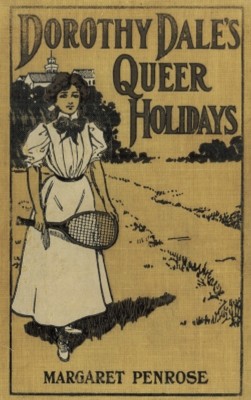
DOROTHY DALE'S QUEER HOLIDAYS
Relates the details of a mystery that surrounded Tanglewood Park. There is a great snowstorm, and the young folks become snowbound, much to their dismay.
CUPPLES & LEON CO., Publishers, NEW YORK
The Motor Girls Series
By Margaret Penrose
Author of the highly successful Dorothy Dale Series
Cloth. 12mo. Handsomely illustrated and beautifully bound in decorated cover, stamped in several colors. Price per volume, 60 cents, postpaid
THE MOTOR GIRLS
Or, A Mystery of the Road
When Cora Kinball got her touring car she did not imagine so many adventures were in store for her. During a trip from one city to another a rich young man lost a pocketbook containing valuable stocks and much cash. Later, to the surprise of everybody, the empty pocketbook was found in the tool box of Cora's automobile. A fine tale that all wide-awake girls will appreciate.
THE MOTOR GIRLS ON A TOUR
Or, Keeping a Strange Promise
A great many things happen in this volume, starting with the running over of a hamper of good things lying in the road. A precious heirloom is missing, and how it was traced up is told with absorbing interest. Mrs. Penrose's books are as safe as they are interesting and should be on the bookshelf of every girl in the land.
CUPPLES & LEON CO., Publishers, NEW YORK