
The Project Gutenberg eBook of Dr. Stearns's Tour from London to Paris
Title: Dr. Stearns's Tour from London to Paris
Author: Samuel Stearns
Release date: October 29, 2014 [eBook #47233]
Most recently updated: October 24, 2024
Language: English
Credits: Produced by Chris Curnow, Val Wooff and the Online
Distributed Proofreading Team at http://www.pgdp.net (This
file was produced from images generously made available
by The Internet Archive)
Transcriber's notes:
The errata have been left as in the original book and not altered in the text.
Obvious printer's errors have been corrected as they were not listed in the errata.
Other than that, the archaic and inconsistent spelling from the original has not been altered.
An American Philosopher.
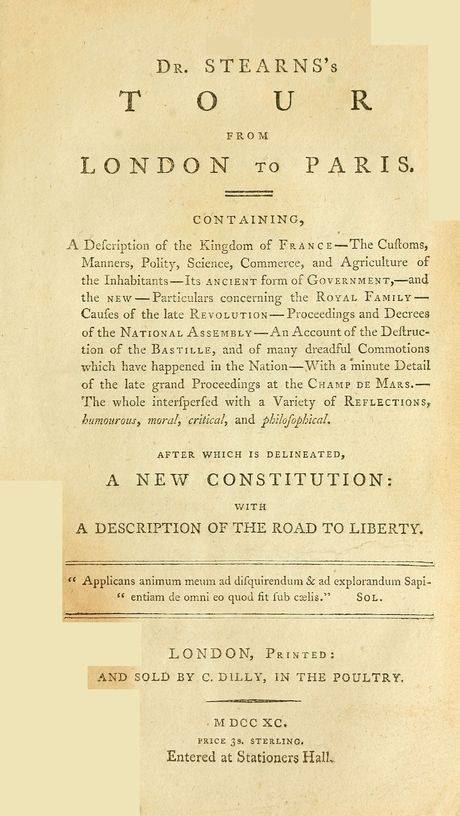
Dr. STEARNS's
TOUR
FROM
LONDON TO PARIS.
====
CONTAINING,
A Description of the Kingdom of France—The Customs, Manners, Polity, Science, Commerce, and Agriculture of the Inhabitants—Its Ancient form of Government,—and the New—Particulars concerning the Royal Family—Causes of the late Revolution—Proceedings and Decrees of the National Assembly—An Account of the Destruction of the Bastille, and of many dreadful Commotions which have happened in the Nation—With a minute Detail of the late grand Proceedings at the Champ de Mars.—The whole interspersed with a Variety of Reflections, humourous, moral, critical, and philosophical.
AFTER WHICH IS DELINEATED,
A NEW CONSTITUTION:
WITH
A DESCRIPTION OF THE ROAD TO LIBERTY.
==========================================
"Applicans animum meum ad disquirendum & ad explorandum Sapientiam
de omni eo quod fit sub cælis." Sol.
==========================================
LONDON, Printed:
AND SOLD BY C. DILLY, IN THE POULTRY.
M DCC XC.
PRICE 3S. STERLING.
Entered at Stationers Hall.
PREFACE.
Kind Reader,
As I am obliged to spend the greatest part of my time in mathematical, philosophical, and physical studies, it was not my design to have written on this subject, although I was advised to do it more than twelve months ago; but on seeing the movements in France, on account of the Revolution, I altered my mind, kept a journal of many things which I saw and heard, and have accordingly written the following pages, which are presented for your perusal and consideration.
I have endeavoured to avoid error, and to compile the narration as accurate as possible: if any thing of that kind shall be discovered, I hope it will be imputed to my being misinformed, and not to any intention of mine to impose upon the public.
As it is the duty of every philosopher to promote the union, harmony, and felicity of mankind, I have mentioned many things which I hope may be productive of establishing the peace and happiness of the inhabitants of the world. But, alas! it is to be regretted, that some who have shone greatly in the philosophical profession, instead of promoting this laudable work, and for the sake of ingrossing the riches, honours, and profits of this perishing world to themselves, have, under a cloak of religion and liberty, sowed discord amongst brethren, excited insurrections, mobs, and riots, which have terminated in carnage and desolation, and proved destructive of the public tranquillity, and of the liberty and happiness of the people. But these abominable works are by no means the business of a true philosopher, who will attempt to do good instead of doing evil.
How far the politicians of the present, or future ages, may agree with me in sentiment, time alone must determine. But if the things that are written in the subsequent sheets shall prove useful and profitable, it will rejoice the author.
After wishing your health and prosperity, and the felicity of mankind through the world,
I subscribe myself,
kind Reader,
Your's and the Public's
most obedient
humble Servant,
SAMUEL STEARNS.
London, Sept. 30, 1790.
ERRATA.
Page 13. line 13. for ni read in.
14. —— 3. — abliged read obliged.
18. —— 19. — was read were.
23. —— 5. — market read marked.
26. —— 7. — received into the centre read
received them into the centre.
36. —— 18. — meteria read materia.
71. —— 10. — malconduct read maleconduct.
96. —— 20. — againt read against.
98. —— 15. — The semicolon should have been placed
after the word only;—.
CHAP. I.
The Doctor engages a Passage to Paris.—Copy of a Card received at Piccadilly.—He arrives at Dover, and Calais.—Is met by a number of Gentlemen, who welcome him to France.—An Account of the Beggars, and of the French Diet.—Observations on drinking Healths.
July 7, 1790.
Having had an inclination to go to Paris for some months past, I went to Piccadilly this day, where I engaged a passage on board the stage coaches, called the diligences, for which I paid five guineas, and was told "That I would be found for that sum, with every thing that might be needful on the way, only I must give about five shillings to the porters."
At Piccadilly I received a card, a copy of which I publish for the information of strangers, and benefit of the owners of the stages.
"The Paris diligences to and from London, set out from the office next the White Bear Inn, Piccadilly, every Monday, Thursday, and Saturday, at five o'clock in the morning. Five guineas each person, for carriage, sea passage, diet and lodging: Port fees excepted. Fourteen pounds luggage allowed; all above to pay three-pence farthing per pound.
"N. B. In case passengers should be detained by contrary winds, they are to pay their own expences from the next day of their arrival at the seaport, to the time of their shipping.
"Also a wagon, every Monday at ten o'clock in the morning, to carry goods and merchandize, which are registered at the said office, and at the Blossoms Inn, Lawrence-lane, Cheapside, where declarations must be delivered in writing, and signed by the owner, of the quality, quantity, and value of the said merchandize, which will be conveyed to Paris in the course of a fortnight, at the rate of seventeen shillings per hundred weight, Custom-house duties excepted. The proprietors, for the conveniency of the public, will discharge the said duties either in England or France, and charge them with the carriage to the person they are directed to, without requiring any interest or commission whatever.
"Attendance at the above offices every day from nine in the morning till seven in the evening, where parcels are registered to Paris, and to every part of France.
"⁂ Passengers luggage must be sent to the office between six and seven o'clock in the evening, or it will be left 'till the following carriage."
As I was on my way to Piccadilly, I was informed that the king of France was to be crowned on the fourteenth of this month, and sworn to adhere to the new Constitution which has been framed by the National Assembly. This made me anxious to get to Paris as soon as possible: but being told the places were all taken in the coaches, and that it was impossible for me to set off till the 12th, I was obliged to wait till that time, but was informed that I must be at Piccadilly with my trunk, &c. by seven in the evening of the 11th; and I was there at the time; lodged at the White Bear inn, and at five the next morning set off for Paris in company with five gentlemen. A lady in a post-chaise overtook us near Greenwich, and came into the diligence.
We breakfasted at a good inn on the road, and dined at Canterbury, where the lady left us, and at evening reached Dover, where we supped, lodged, and went to breakfast. About eleven in the morning of the 13th, we embarked for Calais, and arrived there in about three hours; but had a very rough passage, in consequence of which almost every lady and gentleman on board was afflicted with sea-sickness, which I believe was advantageous to the greatest part of us.
On our arrival at Calais a great number of French gentlemen came to our vessel, to welcome us to France, and invite us to put up at their houses; but on finding that some of us belonged to the diligences, and that there was a place prepared for our entertainment, they went off disappointed.
Although we had been told that we should have nothing to pay, only about five shillings to the porters, we found ourselves mistaken; for we were obliged to pay for the wine which we drank when we dined and supped on the preceding day, and to give money to a swarm of servants, &c. At Calais we were obliged to give in a list of our names to the Custom-house officers, and to give them some money to buy liquor with, that they might drink our healths—that being the custom, as we were told.
We put up at a hotel, called De la Messagrie; where we left another list of our names; for such were the orders of the mayor of the city.
An English lady that had come from Dover with us, and was a decent well-behaved person, and one of excellent sense and understanding, put up at this hotel: she told me she had travelled above 4,000 miles on the European Continent, had been through France, Germany, &c. and was then on her way to Flanders.
At this place we were soon beset with a number of beggars, as
1. By a priest of the order of St. Francis.
2. By the captain of the vessel, that brought us over the English Channel.
3. By the steward of the vessel.
4. By the sailors that came with us.
5. By the poor of the city.
6. By the porters, &c.
We gave the priest some money, and he pronounced a blessing and departed very well pleased. I was told that he and his convents got their living altogether by begging. We gave the captain half a crown a-piece, and some silver, sous, &c. to the other beggars.
In a few minutes another swarm of beggars came that belong to Calais, and as we did not supply all their wants, some of them broke one of the windows belonging to the room where we were sitting, by a rapid stroke with a stick, stone, or some such thing.
We soon sat down to dinner. The table was spread in an elegant manner, with napkins laid in our plates, which we used to keep our clothes clean.
I was asked, A'imez vous la soupe à la Françoise, Monsieur?
My answer was—Oui, Madame.
Besides soup, we had beef, mutton, veal, rabbits, hares, geese, fowls, pigeons, &c. several sorts of pies, excellent wine, and sweet cakes, figs, appricots, cherries and strawberries; the latter we mixed with white sugar and wine, and eat the composition with spoons, which is the French fashion. Their loaves of bread were about two feet in length, and six inches in breadth, and their knives had picked points, and their forks four tines a piece. Every one of us was allowed a tumbler to drink out of: but the French do not drink healths, though they pretended at the Custom-house, that we must give them money to buy liquor with for that purpose. We did not pay for our wines in France as we were on our way to Paris, as we had done at Dover, &c.
The drinking of healths has been, and still is, too much practised both in Great Britain and America; and especially among the lower class of people. For when Timothy Toss Pot is in company, he says, "Your healths ladies and gentlemen," every time he drinks, which will be perhaps fifty times in an evening; whereas it might be as well, nay much better, to drink their healths but once, or not at all, which would save much trouble, and prevent the company from being interrupted with such clamours.
I have asked why the health drinkers do not follow that practice when they drink tea, or coffee; as the Irish woman did when she partook of the sacrament; and have been told, that it is because it is not the fashion, and that from hence it has been omitted. The fashion, however, must be followed, right or wrong; for, Out of the fashion out of the world, according to the old woman's scripture: And, When we are among the Romans we must do as the Romans do. For,
"Men more than all the written laws obey."
Says the poet. Because it is customary I have sometimes been induced to drink healths myself, when I have been in company, through fear that I should be called an uncivil and an unpolite person. But this needless custom is now growing out of use; for our nobility and gentry have discovered that it is superfluous, and many of them have forsaken the needless practice; which example will undoubtedly be followed by the commonality in process of time.
We are told in Bailey's Dictionary, that the custom of drinking healths sprang from Rowena, a beautiful daughter of Hengistus, general of the Saxons. The general invited king Vortigern to supper, and after it was over called for Rowena, who, richly attired, and with a graceful mein, enters with a golden bowl full of wine in her hand, and drinks to the king, saying, "Be of health, lord king:" to which he replied, "Drink health." The king enamoured with her beauty, married her, and gave her and her father all Kent. This was upwards of 1300 years ago.
We are also told in the Historian's Vade-mecum, that the custom of drinking healths was in fashion so early as 1134 years before Christ. The accounts do not agree, and which is the truest I cannot tell.
CHAP. II.
The Latitude, Longitude, and Description of Calais.—The Doctor and others obliged to wear National Cockades.—English Money and Bank Notes not passable in France.—How Strangers ought to be dressed.—A Table of French Coins, with their Value in English Money.—Of French Measures, in Length.
Calais is situated in latitude 50 deg. and 58 min. North, and longitude 1 deg. and 49 min. East from the Royal Observatory at Greenwich. It is a very pleasant town, invironed with ramparts thrown up at a vast expence.
At this place we found the people under arms, and they seemed to be filled with joy in consequence of the Revolution. We that were strangers, were obliged to put on and wear National Cockades, to prevent being insulted by mobs; and no lady or gentleman was suffered to travel without.
Whilst we tarried at Calais we were informed that English money would not pass in France, and that it would be best for us to get our guineas changed. We therefore took change for some, and received 26 livres for each guinea, although an English guinea commonly passes for but 24 livres in France. Hence, about twelve-pence is lost by the exchange.
Bank notes are not negotiable in France; therefore those that travel into that country, ought to take gold and silver, otherwise they will meet with much difficulty. If you draw on the bankers, they will charge you eight per cent. discount; but sometimes it is done at par by French merchants who want to send money to London. No money is allowed to pass in France, unless coined in the present king's reign. Strangers ought therefore to be upon their guard, lest they get imposed upon by taking old coin.
They that go to France ought to dress in the French mode, to prevent being known by sharpers, who sometimes try to take the advantage of those they find to be foreigners.
As it may be of some utility to strangers going into France, I will just add
A TABLE of FRENCH COINS, with their value in ENGLISH.
| £. S. D. | £. S. D. | |
| A Louis d'or, 24 Livres | 2 0 0 | 1 0 0 |
| A Grand Ecu, 6 ditto | 0 10 0 | 0 5 0 |
| The Ecu, 3 ditto | 0 5 0 | 0 2 6 |
| The Vingt-quatre Sols Piece | 0 2 0 | 0 1 0 |
| A Livre | 0 1 8 | 0 0 10 |
| A douze Sols Piece | 0 1 0 | 0 0 6 |
| A Six Sols Piece | 0 0 6 | 0 0 3 |
| A deux Sols | 0 0 2 | 0 0 1 |
| A Sols ½ | 0 0 1½ | 0 0 0¾ |
| A Sol, or Sous | 0 0 1 | 0 0 0½ |
| A deux Liard Piece | 0 0 0½ | 0 0 0¼ |
| A Liard | 0 0 0¼ | 0 0 0⅛ |
A louis d'or is a gold coin. A grand ecu, the ecu, vingt quatre sols piece, the livre, a douze sols piece, and the six sols pieces, are silver: though a livre is no coin, but nominal only. The deux sols, and the sols and half, are a mixture of copper and silver, and the other coins are all copper.
The French measure the distances between their towns by leagues, posts, &c. and a post is two leagues, of their measure.
A French league is fifty-seven yards and nine inches longer than an English league.
A French toise, or fathom, is 76¾ inches longer than an English; and a French foot is equal to 1279/100 inches English measure, &c.
CHAP. III.
Leaves Calais.—A Description of the Stage Coaches in France.—The Doctor arrives at Paris.—A further Account of the Beggars.—With a Description of the Country.
Early in the morning of the memorable 14th of July we left Calais, and proceeded in a stage coach, drawn by eight horses, on our journey towards Paris.
These coaches are almost as large as a small house. They are very heavy; and eight persons may sit comfortably in the inside, and I believe a dozen more upon the outside. We had a conductor who rode armed on the fore-part of this wonderful machine, and a very large dog sitting upon his rump at the conductor's left hand; both of which were employed as sentinals to guard us on the way.
The harnesses for the horses were made of ropes instead of leather, and were very long. Hence, as our coach was very large and the traces very long, we made a grand appearance as we travelled!
Upon the hindmost and foremost horses, on the near side, two Frenchmen were mounted, with boots of a most surprizing magnitude, so well constructed with leather, wood, and iron, that if a horse falls down the rider is not in much danger of having his legs broke; for the prevention of which, the boots were thus made.
The horses were not quite so large as ours in England; but we drove about five or six miles in an hour, and at the end of every post the horses and postillions were changed. The postillions received twelve sous of us when we parted with them, which gave content.
We breakfasted at Boulogne, dined at Montreul, and in the evening came to Abbeville, where we lodged. The people were in arms through the country. Scarce any body was at work in the fields, as it was a time of feasting, and all seemed rejoiced at the sound of the liberty they expect, in consequence of the great and glorious Revolution.
At this place there was a young lady, who manifested by her actions, which speak louder than words, that she had an inclination to lodge with me that night; but as I had no disposition to deal in such commodities, she was disappointed.
The next morning we set out early, breakfasted at Amiens, dined at the Breteuil, supped at Clermont, and rode all night; but were obliged to pay for our breakfasts out of our own pockets the next morning before we came to Paris. We arrived at Paris about nine in the morning, being the 16th of July, having been four days and four hours on our journey. We were abliged to give the conductor half a crown a-piece; and I spent near three guineas on the way, besides what I paid at Piccadilly.
At Paris we had our trunks searched at the Custom-house, and went from thence in a coach to the Hotel de Beauvais, Rue des Vieux Augustins, No. 69, Quartier du Palais Royal, where a gentleman that had come from London with me, and myself, hired three large rooms, neatly furnished, for four livres a-day. We breakfasted at this place, which cost us fifteen sous a-piece each morning, besides what we gave to the servants.
I hired a servant, who remained with me all the time I tarried at Paris: he charged me forty sous per day; but he conducted me so well, that I gave him more than double that sum.
I found Paris very full of people from the country, and from foreign parts. They had met to celebrate the Revolution, and tarried till the next Sunday in order to have another grand convention at the Champ de Mars.
Whilst we were on our way from Calais to Paris, we were followed, in some of the intermediate towns and villiages, by swarms of beggars, who seemed to be in great distress. I asked the reason of their begging; and was told that they were reduced to poverty in consequence of the commercial treaty between England and France; that the manufactories in Great Britain were so much cheaper than they were in France, that the merchants bought many of their goods in England, which had thrown those poor people out of employ, and obliged them to beg for a livelihood.
We frequently contributed to the relief of those distressed objects: but because we could not give to every one, some of them threw a stone at our coach, which did not happen to strike any of us. At, and near Paris, we found but a few beggars, in proportion to the great number of people. Some how or another, they seemed to be much better provided for than they were in the country.
The face of the country between Calais and Paris, appears much like many parts of the Province of Quebec, in America. But I think the soil is not quite so rich. Though some have supposed it is full as good by nature as the island of Great Britain; and that it would produce as large crops, if it was as well manured and cultivated. I was told, that agriculture had been much discouraged in France, before the Revolution, by reason of the oppression that the peasants were under.
More then three-fourths of the land between Calais and Paris, appeared to be overspread with grain, consisting of rye, wheat, oats, and barley. There was also some excellent hemp and flax. The people had begun to reap, and there was a sign of a very plentiful harvest; but the crops were not so large in general as they are in England. We saw but a very few cattle, horses and sheep, and those we did see were small. The fields are not fenced, but lie open to the high-way. We often passed by boys holding cows to feed, by lines tied round their horns, to keep them from running into the fields. The wages for reaping are, generally, thirty sous per day. Both men and women follow the business, begin early, and lie down on the ground, and sleep in the open sunshine, at about ten or eleven in the morning; a practice which I esteem to be unhealthy. Perhaps one may see fifty asleep at a time.
CHAP. IV.
Views and Describes the Champ de Mars.—Goes to the Royal Palace belonging to the Duke of Orleans.—Dines with the French Officers at the Grand Hotel.
On the day of our arrival at Paris, I went in a coach with the gentleman that had put up at the hotel with me, and viewed the Champ de Mars. Here we saw great multitudes of people, eating, drinking, and dancing at the sound of the bands of music. At this place the oaths of allegiance had been administered to the people on the preceding Wednesday; and both the king and the subjects were sworn to adhere to the constitution that has been framed by the National Assembly.
Some of the French took me by the hand when I entered into the Champ de Mars, and cried, "Entrée, entrée, Monsieur." I viewed the place with admiration, and was informed that it took about fifty thousand people near ten days to erect the seats and other great works there.
The Champ de Mars was formed into a grand amphitheatre, having at one end the military school, against which was erected a covered gallery two hundred and twenty-eight feet (French measure) in length, and twenty-one in heighth, for the king, queen, foreign ambassadors, national assembly, &c. &c. and at the other the triumphal arch; from which, to the military school, on either side were thirty rows of seats raised one above another, two thousand seven hundred and ninety French feet in length. In the middle of the area was an altar in a circular form, whose circumference was six hundred and forty-eight feet, French measure, and whose heighth was twenty feet, built of stone taken from the Bastille. The rest of the area, except the places for the federation, was filled with seats; the whole forming an oblong, capable of accommodating between four and five hundred thousand people. Out of these limits were a number of galleries, erected for a great multitude of spectators. Opposite the triumphal arch, a bridge of boats was thrown across the Seine, and the banks of the river was lined with cannon.
For a great distance round the Champ de Mars, a number of temporary buildings were erected for the entertainment of the people.
When we had surveyed these admirable works, we went to the royal palace, which was built by cardinal Richelieu, and given by him to Lewis the XIV. but is now the town seat of the duke of Orleans, who is a nobleman of royal blood, and enjoys the greatest revenue in France. This palace is a most elegant and magnificent structure, which is adorned and beautified with splendid ornaments, that dazzle the eyes of a spectator. In the centre of this structure is an oblong square, laid out in beautiful walks, interspersed with trees, flowers, &c.
Sometimes the duke resides in one part of the palace himself. But the other part is let out in shops, which are under piazzas, and the rooms over them to gay fashionable ladies and gentlemen.
In this palace there is a gallery, which contains most of the illustrious personages that France has produced, drawn by the greatest masters: Italy has been ransacked, and no expence spared to make the whole complete, with pictures, busts, statues, medals, and other curiosities worthy of being collected. It is thought that this building exceeds all in Europe for beauty and grandeur.
After we had viewed the palace we went to a grand hotel, where we dined with a great number of officers. We had a variety of dishes, very excellent wines, and was entertained with much civility and politeness, and at a very reasonable rate. At evening we retired to our lodgings, very well pleased with the entertainments of the day.
CHAP. V.
The Contents of the King's Proclamation.—Of the Obedience paid to it—and, the Proceedings of the Grand Confederation, on the 14th of July, at the Champ de Mars.
Having in the preceding chapter given a description of the Champ de Mars, I shall attempt in this to exhibit how matters were conducted on the 14th: but it may be proper to premise, that on the 11th, the king, to prevent confusion and disorder, wisely issued a proclamation, setting forth how the different corps that were to compose the confederation was to march, &c. His majesty ordered that no troops, but those on guard, should be armed with guns; nor any carriages suffered to follow those of his majesty, the royal family, and their trains. That if any deputy of the confederation, or person invited, should be unable to walk, they might ride in a carriage, and be escorted by a Chevalier d'Ordonnance to the military school, providing they had permission from the mayor of Paris.
That M. de la Fayette should be commander-general of the Parisian national guard, then charged by a decree of the national assembly, and sanctioned by his majesty, with the care of the public tranquillity, should fulfil, under the king's orders, the functions of major-general of the confederation; and in that quality the orders should be given and observed as the orders of his majesty himself.
That the king had in like manner nominated M. Gouvion, major-general of the Parisian guard, lieutenant-general of the confederation for the day of the ceremony.
That when all persons were placed, the blessing the flags and colours should be proceeded to, and the celebration of the mass.
That the king empowered the said M. de la Fayette, to pronounce the confederation oath in the name of all the deputies of the national guards, and those of the troops and marines, according to the forms decreed by the national assembly, and accepted by his majesty; and that all the deputies of the confederation should hold up their hands.
That then the president of the national assembly should pronounce the civic oath for the members of the national assembly; and that the king should in like manner pronounce the oath, the form of which had been decreed by the national assembly, and accepted by his majesty.
That the Te Deum should be sung, and conclude the ceremony; after which the procession should return from the Champ de Mars in the same order it came.
In obedience to this proclamation, an order of procession was drawn up, and proper measures concerted to prevent tumult and disorder, by M. de la Fayette, and M. Bailli, the mayor of Paris.
On the 13th, at ten o'clock in the evening, 4000 Paris guards on the outside of the Champ de Mars, and 2000 within, were placed to preserve order. Before eleven the people began to assemble and seat themselves and came in small parties till day-break; from three to nine they poured in in crowds at the great avenues, where the guards cautioned them not to hurry.
By ten o'clock the seats were filled, the outside gallaries, the windows, and roofs of houses; and every place where a glimpse of the grand procession could be had, was filled with people of all ranks, sexes, and ages, who kept their places till the business was finished, notwithstanding the rain fell in torrents, accompanied with cold squalls of wind from eight till four.
Those guards that were not wanted in the procession, danced in circles, and in great parties marched triumphantly at the beat of the drums, with their hats and caps on the points of their swords, forming battalions, and making sham fights, &c. Sometimes they ran in all directions, flourishing their swords, and being filled with joy cried, "Vive la Libertie! Vive la Loi! Vive la Roi! Vive la Confederation National! Vive mon Frere!"—embracing one another, and the spectators that sat near them.
One, personating a victim of tyranny, was carried with great solemnity to a market spot, where the body was laid, and made the occasion of more firmly uniting, which was testified with a variety of actions.
Having an abbé within the circle, they marched him round with a gun in his hand and a grenadier's cap on his head; and in the same manner they marched a capuchin friar.
At seven o'clock a crucifix was placed on the great altar.
Just before nine a body of priests appeared on the altar, and tied sashes of national colours around their waists, and decorated the crucifix, and various parts of the altar, with ribbons of the same.
At half past ten the bishop of Auton, with more than one hundred priests, proceeded in a double line, guarded by a strong body of national troops, from the grand pavilion to the altar, carrying with them the tables with the commandments, and the sacred books. When they had ascended the altar they began the ceremony of consecrating it.
Just before twelve, a grand salute of one hundred cannon announced the near approach of the procession to the triumphal arch; and the guards formed into ranks for their reception.
The national federatives, and all who assisted in the grand procession, had assembled at six this morning on the Boulevards, between the gates of St. Martin and St. Antoine, and were drawn up in the following order:
1. A troop of horse, with standards, and six trumpets.
2. One division of music, consisting of several hundred instruments.
3. A company of grenadiers.
4. The electors of the city of Paris.
5. A company of volunteers.
6. The assembly of the representatives of the commons.
7. The military committee.
8. A company of chasseurs.
9. A band of drums.
10. The presidents of the districts.
11. The deputies of the commons, appointed to take for them the federal oath.
12. The sixty administrators of the municipality, with the city guards.
13. The second division of music.
14. A battalion of children, pupils of the military school, carrying a standard with the words,
15. A detachment of the colours of the national guard of Paris.
16. A battalion of veterans.
17. The deputies of forty-two chief departments of the nation, in alphabetical order.
18. The oriflamme, or grand standard of France, borne by the marischalls of France, general officers, officers of the staff, subaltern officers, commissioners of war, invalids.
19. The lieutenants of the marischalls of France,—deputies of infantry,—deputies of cavalry.
20. Deputies of hussars, dragoons, and chasseurs.
21. General officers, and deputies of the marine, according to rank.
22. The deputies of forty-one last departments, in alphabetical order.
23. A company of volunteer chasseurs.
24. A company of cavalry, with a standard and two trumpets.
Each department was preceded by a banner, borne by the oldest deputy. These banners were a present from the city of Paris. They consisted of two branches, forming an oak wreath, tied together with national coloured ribbons, bearing on one side—The National Confederation at Paris, July 14, 1790; and the other—The Constitution, with the number and device of the department to which they severally belong.
The military deputies had only their side arms.
At nine the procession passed along the streets of St. Denis, of the Forronerie, to St. Honoré Royal, to the palace of Louis XV. where they halted; and the detachment of the colours of the national guard Paris opening to the right and left, received into the centre.
The procession then moved on through the Cours la Reine, along the quay to the bridge of boats; and the deputies from the provinces received loud acclamations of applause from the people, which were answered by Vivent lis Parisians!
At the end of the bridge the triumphal arch appeared, adorned with various allegorical paintings which represented the gate of St. Antoine.
Over the principal entrance, referring to figures that were darting through all the obstacles to reach the law, was inscribed on the side:
"Sacred to the grand work of the constitution: We will finish it."
On the other:
"Under this defender, the poor man shall no more fear lest the oppressor should spoil him of his heritage."
Over the lateral entrance on the left side, figures of warriors taking the civic oath, seemed to utter,
"Our country, or the law alone can arm us: Let us die to defend it, let us live to love it."
Over the lateral entrance, on the right, heralds sounding trumpets, proclaimed peace throughout the kingdom, and the people were singing,
"Every thing is propitious to our happiness; every thing flatters our wishes; sweet peace drives tumult far from us, and fills up the measure of our pleasures."
On the front, next the amphitheatre, over the middle arch, was a picture of deputies from various nations, come to do homage to the national assembly, with this inscription:
"The rights of men were unknown for ages: They have been re-established for the whole human race."
Under this picture,
"The king of a free people is alone a powerful king."
Over a picture—a woman chaining lions to her ear, with Force and Power in her suite, and leaning on the book of the law. The king and queen holding the dauphin by the hand, follow, preceded by a group of sages. A combat is exhibited with a dreadful hydra, whose head was seen struck off.
"We dread you no more, ye subordinate tyrants, who oppressed us under a hundred various names."
In another place an immense multitude listening with attention to the sage exhortations of a victorious warrior, who seemed to say,
"You prize this liberty, you possess it while you do: Shew yourselves worthy to preserve it."
At one o'clock the van of the procession appeared under this triumphal arch.
M. de la Fayette leading a body of cavalry, himself mounted on a milk white charger, rode into the amphitheatre amid the acclamations of the people, Vive la Fayette! The cavalry filed off to the right, and ranged themselves in the exterior line, on the opposite side to the entrance. The company of grenadiers formed under the steps of the amphitheatre, as well as all the companies who were employed as escorts.
The civil bodies took the places allotted for them, which was previously marked out. The battalion of youths of the military school, formed about one hundred paces from the grand altar, crossing the Champ de Mars; but facing the altar on the side next the military school.
While the national assembly passed through the triumphal arch, the escort of colours passed through the lateral gates, and the members took their seats on the right and left of the chair of state, and the chair of their own president.
The battalion of veterans was placed a hundred paces behind the altar, across the Champ de Mars, but facing the altar.
The detachments of the national guards, appointed to take the oath, ranged themselves under each banner, indicative of his place in the amphitheatre.
The music collected into one band, and occupied the side of the platform under the altar, next to the invalids; and the band of drums were placed on the opposite side.
The detachment of cavalry that closed the procession, formed the exterior line, on the side where they entered, opposite to the first detachment.
The altar was after an antique model. The ascent to it was by four stair cases; at each corner was a platform supporting an urn, which exhaled perfumes. On the south front were these verses from Mahomet, under a picture of arts and sciences:
"C'est la seule vertu qui fait leur difference."
"Men are equal: it is not by birth. It is virtue alone that confers distinction."
And these,