
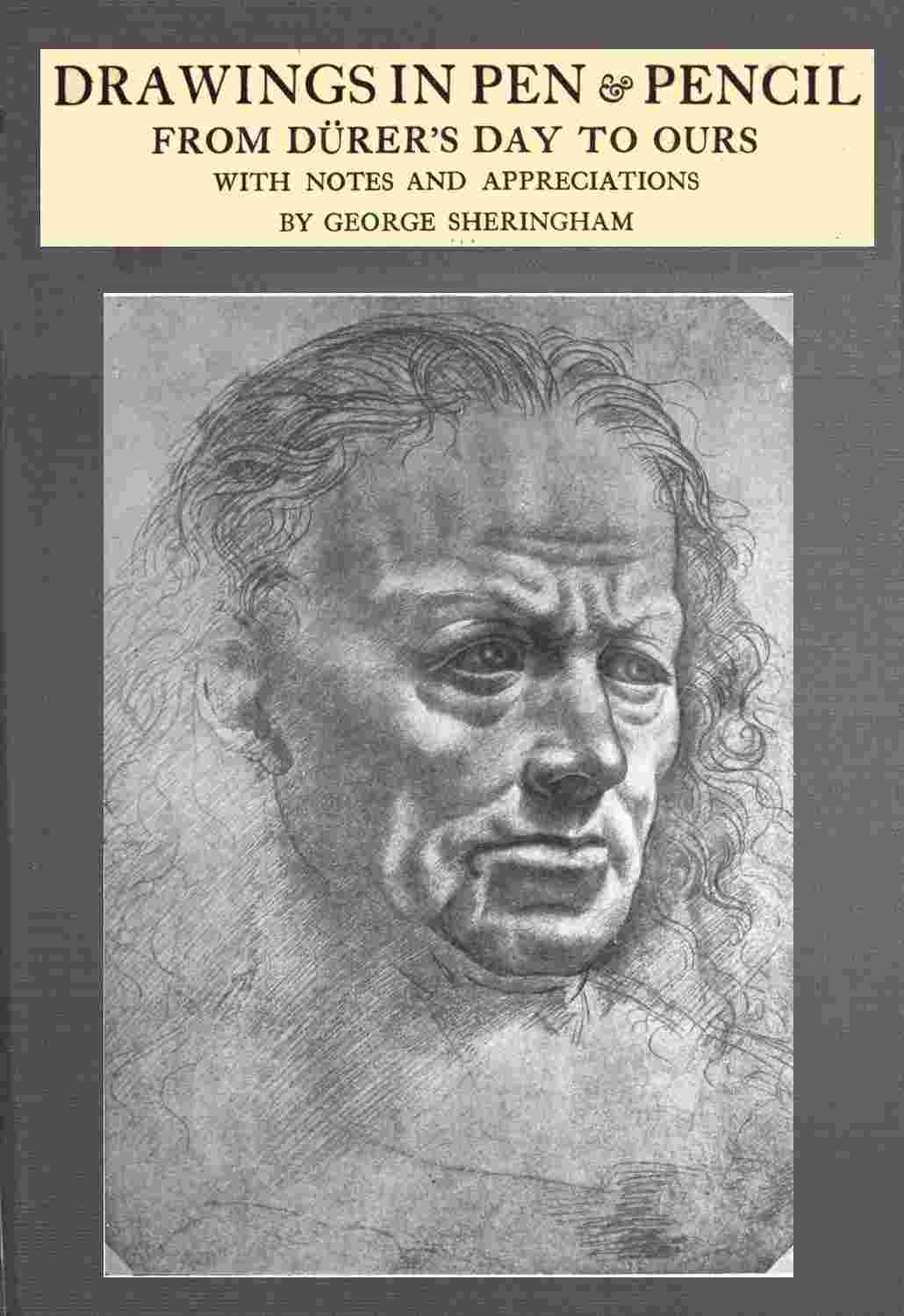
The Project Gutenberg eBook of Drawings in pen & pencil from Dürer's day to ours, with notes and appreciations
Title: Drawings in pen & pencil from Dürer's day to ours, with notes and appreciations
Author: George Sheringham
Editor: C. Geoffrey Holme
Release date: July 14, 2021 [eBook #65836]
Most recently updated: October 18, 2024
Language: English
Credits: Chuck Greif and the Online Distributed Proofreading Team at http://www.pgdp.net (This file was produced from images available at The Internet Archive)
|
(In certain versions of this etext [in certain browsers] clicking on the image will bring up a larger version.) (etext transcriber's note) |
DRAWINGS IN PEN & PENCIL
FROM DÜRER’S DAY TO OURS
WITH NOTES AND APPRECIATIONS
BY GEORGE SHERINGHAM
EDITED BY GEOFFREY HOLME
LONDON: THE STUDIO, Lᵀᴰ 44 LEICESTER SQUARE, W.C.2
MCMXXII
PREFATORY NOTE
In the original circular relating to this volume it was announced that Mr. Malcolm C. Salaman would contribute the letterpress. The Editor desires to express his sincere regret that, owing to serious indisposition, Mr. Salaman has been unable to fulfil this intention.
The Editor wishes to acknowledge his indebtedness to the following owners who have kindly lent drawings for reproduction in this volume: Messrs. Ernest Brown and Phillips (The Leicester Galleries), Mr. William Burrell, Lt.-Col. Pepys Cockerell, Mr. Campbell Dodgson, C.B.E., Mr. Charles Emanuel, Mr. William Foster, Mrs. G. R. Halkett, Mr. Harold Hartley, Mr. Francis Harvey, Mr. C. C. Hoyer-Millar, Mr. J. B. Manson, Mr. A. P. Oppé, Monsieur Ed. Sagot, Mr. Edward J. Shaw, J.P., Monsieur Simonson, Mr. G. Bellingham Smith, Mr. Roland P. Stone, Mr. D. Croal Thomson, Mr. Charles Mallord Turner and Sir Robert Woods, M.P. Also to Messrs. William Marchant & Co. (The Goupil Gallery), Mr. T. Corsan Morton, Mr. E. A. Taylor and Mr. Lockett H. Thomson for the valuable assistance they have rendered in various ways; and to Messrs. G. Bell & Sons, Messrs. Chapman & Hall, Messrs. Charles Chenil & Co., Messrs. J. M. Dent & Sons, Mr. William Heinemann, and the Proprietors of La Gazette du Bon Ton, Punch and The Sketch for permission to reproduce drawings of which they possess the copyrights.
CONTENTS
| “Notes and Appreciations.” By George Sheringham | 1 |
| LIST OF ILLUSTRATIONS | |
| Albano, Francesco. Pen Drawing. Photo, Anderson | 58 |
| Artist Unknown. Drawing in Pencil and Chalks. Photo, Giraudon | 72 |
| Barbieri, Giovanni Francesco. (See Guercino) | |
| Bateman, H. M. An Open Space (pen) | 140 |
| Beardsley, Aubrey. John Bull (pen) | 120 |
| ““Pen Drawing | 121 |
| Béjot, Eugène. Le Quai de Paris à Rouen | 178 |
| Belcher, George. Drawing in pencil and wash | 141 |
| Bell, R. Anning, R.A., R.W.S. Pen Drawing | 164 |
| Bellini, Gentile. The Turk (pen). Photo, Anderson | 40 |
| ““The Turkish Lady (pen). Photo, Anderson | 41 |
| Blake, William. The Soul hovering over the Body (pen and wash) | 119 |
| Blampied, E., R.E. The Sick Mother (pen) | 147 |
| Bone, Muirhead. Front of the Quirinal Palace, Rome (pencil) | 160 |
| ““Quai du Canal, Marseilles (pencil) | 161 |
| Botticelli, Sandro. Abundance (pen and pencil) | 47 |
| Boutet de Monvel, Bernard. Venus et l’Amour (pen) | 182 |
| ““““ Pen Drawing | 183 |
| Brangwyn, Frank, R.A. The Steam Hammer (pen and chalk) | 139 |
| Burne-Jones, Bart., Sir Edward. Seven Works of Mercy (pencil) | 126 |
| Callow, William, R.W.S. The Rialto, Venice (pencil) | 132 |
| Canaletto. Pen Drawing. Photo, Mansell | 76 |
| Carlègle, E. Pen Drawing | 184 |
| Clarke, Harry. Pen Drawing | 151 |
| Claude Lorrain. Pen Drawing | 71 |
| Constable, John, R.A. Salisbury (pencil) | 85 |
| Correggio. The dead Christ carried off by Angels (pen). Photo, Brogi | 31 |
| Cosway, Richard, R.A. Henry (pencil and chalk) | 83 |
| Cotman, John Sell. On the Yare (pencil) | 86 |
| Crawhall, Joseph. Pen Drawings | 166 |
| Dance, George, R.A. Parke, Musician (pencil) | 87 |
| Daumier, Honoré. En Troisième (pen and wash) | 98 |
| ““Les Trois Connaisseurs (pen and wash) | 99 |
| Dulac, Edmund. Pencil Study | 170 |
| Du Maurier, George. Pen Drawing | 113 |
| Dürer, Albrecht. A Courier (pen). Photo, Anderson | 25 |
| ““The Rhinoceros (pen). Photo, Anderson | 26 |
| ““The Procession to Calvary (pen). Photo, Brogi | 27 |
| ““Praying Hands (pen). Photo, Mansell | 28 |
| Emanuel, Frank L. Pencil Drawing | 138 |
| Fisher, A. Hugh, A.R.E. Pencil Drawing | 143 |
| Flint, W. Russell, R.W.S. Women quarrelling (pencil) | 134 |
| Forain, J. L. Pen Drawing | 174 |
| Foster, Birket, R.W.S. Pen Drawing | 92 |
| Fragonard, J. H. Cupids playing around a fallen Hermes (pen) | 79 |
| Gainsborough, Thomas, R.A. The Harvest Wagon (pen). Photo, Mansell | 82 |
| Girtin, Thomas. Carnarvon Castle (pencil) | 89 |
| Greenaway, Kate. Pen Drawing | 116 |
| Griggs, F. L. Pen Drawing | 165 |
| Guardi, Francesco. Venice (pen) | 77 |
| Guercino, Il. Pen Drawing. Photo, Anderson | 57 |
| Hill, Adrian. Folkestone (pencil) | 137 |
| Hill, Vernon. A Sleeper (pencil) | 158 |
| Holbein, Hans. The Family of Sir Thomas More (pen) | 29 |
| Houghton, A. Boyd. Pen Drawing | 111 |
| Hubbard, E. Hesketh. S. Anne’s Gate, Salisbury (pencil) | 154 |
| Hughes, Arthur. Unseen (pen) | 118 |
| Ingres, J. A. D. Madame Gatteaux (pencil). Photo, Mansell | 95 |
| ““Paganini (pencil) | 96 |
| ““C. R. Cockerell (pencil) | 97 |
| Jones, Sydney R. Near Chesham, Bucks. (pen) | 157 |
| Jouas, C. Drawing in pencil and coloured chalks | 175 |
| Keene, Charles. Pen Drawings | 105 to 109 |
| Lalanne, Maxime. Delft (pen) | 171 |
| Laroon, Marcellus. A Hunting Party (pen and pencil) | 78 |
| Lawrence, Sir Thomas, P.R.A. Lady Mary Fitzgerald (pencil) | 93 |
| Leonardo da Vinci. Pen Studies. Photos, Anderson and Brogi | 32 |
| “““Head of an Old Man (pencil) | 33 |
| “““Madonna and Child (pen). Photo, Anderson | 34 |
| “““Head of a Young Woman (pen). Photo, Braun & Co. | 35 |
| Lepère, A. Le Vieux Menton (pen) | 176 |
| ““Crèvecœur (pen) | 177 |
| Lhermitte, L. Pen Drawing | 146 |
| Mahoney, James. Pen Drawing | 110 |
| May, Phil. A Portrait of her Grandmother (pen) | 122 |
| ““Drawing in pencil and chalk | 123 |
| McBey, James. The Stranded Barge (pen) | 167 |
| Meryon, Charles. Pencil Drawing | 101 |
| Michelangelo. Pen Drawings. Photo, Anderson | 42, 43, 46 |
| “Pen Drawing | 45 |
| Morland, George. Pencil Drawing | 86 |
| New, Edmund H. Grasmere Church (pencil) | 152 |
| North, J. W., R.A. The Gamekeeper’s Cottage (pen) | 117 |
| Orpen, Sir William, R.A. Mother and Child (pencil) | 148 |
| “““After Bathing | 149 |
| Ospovat, Henry. “Life might last! We can but try” (pen) | 163 |
| Ostade, Adriaen van. Tavern Scene (pen) | 68 |
| Parmigianino. Pen Drawing. Photo, Brogi | 75 |
| Partridge, Bernard. Place du Pillori, Pont-Audemer (pen) | 133 |
| Pellegrini, Riccardo. Palm Sunday in Italy (pen) | 125 |
| Peruzzi, Baldassare. Pen Drawing. Photo, Anderson | 37 |
| Philpot, Glyn W., A.R.A. Pencil Study | 168 |
| Pinturicchio, Bernardino. Young Woman with Basket (pen) Photo, Brogi | 31 |
| Pinwell, C. J. The Old Couple and the Clock (pencil) | 115 |
| Poulbot, F. Pen Drawing | 181 |
| Poussin, Nicolas. Pen Drawing | 70 |
| Rackham, Arthur, R.W.S. Pen Drawing | 150 |
| Raphael. Pen Drawings. Photo, Anderson | 49, 53 |
| “La Vierge (pen). Photo, Mansell | 50 |
| “Pen Study. Photo, Mansell | 51 |
| Raphael, School of. Pen Drawing. Photo, Anderson | 54 |
| Rembrandt. Lot and his Family leaving Sodom (pen). Photo, Anderson | 61 |
| Rembrandt. Saskia (pen) | 63 |
| “Old Cottages (pen) | 64 |
| “Pen Drawing | 64 |
| “Judas restoring the Price of his Betrayal (pen). Photo, Braun & Co. | 65 |
| Rossetti, Dante Gabriel. Pencil Drawing | 127 |
| Roubille, A. Pen Drawing | 179 |
| Russell, Walter W., A.R.A. Pencil Study | 159 |
| Sambourne, Linley. The Black-and-White Knight (pen) | 131 |
| Shepperson, Claude A., A.R.A., A.R.W.S. The Child (pencil) | 135 |
| Sime, S. H. Pen Drawing | 155 |
| Spurrier, Steven. Pencil Study | 144 |
| Steinlen, T. A. Les Bûcherons (pen) | 172 |
| ““Laveuses | 173 |
| Stevens, Alfred. Pencil Study | 102 |
| Sullivan, Edmund J., A.R.W.S. Robespierre’s List (pen) | 145 |
| Tenniel, Sir John. “What’s this?” said the Lion (pencil) | 128 |
| ““Three little Men (pencil) | 128 |
| Tiepolo, G. B. Faun and Nymph (pen) | 73 |
| Tintoretto. Pen Drawing. Photo, Brogi | 59 |
| Titian. Pen Drawings | 38, 39 |
| Tonks, Henry. Pencil Study | 169 |
| Turner, J. M. W., R.A. Carew Castle Mill (pencil) | 90 |
| “““Monow Bridge, Monmouth (pencil) | 91 |
| Velasquez. Philip IV (pen) | 60 |
| Velde, Adriaen van de. Le Passage du Bac (pen). Photo, Mansell | 69 |
| Veronese, Paolo. Pen Studies | 55 |
| Verpilleux, E. Pencil Drawing | 153 |
| Vinci, Leonardo da. (See Leonardo). | |
| Visscher, Cornelis. Portrait Study in pencil | 67 |
| Walker, Fred, A.R.A. A Dark Deed (pencil) | 112 |
| Whistler, J. McNeill. Girl with Parasol (pen) | 129 |
| Wilkie, Sir David, R.A. The Mail Coach (pen) | 103 |
| Winterhalter, Franz Xaver. Portrait Studies in pencil | 81 |
Printed by Herbert Relach, Ltd., 19-24, Floral Street, Covent Garden, London, W.C.2.
NOTES AND APPRECIATIONS
DRAWING is a thing to be looked at and not written about. Pages and pages written about it will not make a good drawing bad nor a bad drawing good; nor will they, unfortunately, really equip and instruct anyone to know the one from the other—should he happen to lack that subtle sense whereby such things are known; for the reason why one drawing is justly ranked as a masterpiece while another is thrown away lies hidden on the plane of our more transcendental perceptions—such, for example, as the sense whereby we know whether a note is in tune or out of tune; and further: whether a musical composition is base in its gesture or great. At present the majority of people lack these senses but, due to a guiding justice, this fact rarely if ever prevents the artist who has achieved something great from receiving, though it may have been long retarded, his full meed of praise eventually. That the praise is so often belated and the appreciation of an artist retarded until, for him, it has lost its savour is due to many causes: so long as the competitive and childish habit persists—of awarding the palm of greatness to one man’s work by the simple expedient of simultaneously condemning someone else’s—narrowness and prejudice will continue to trouble the artist. It should surely not be difficult to realize that the world of art—like the Kingdom of Heaven—has many mansions, and that, though both have their “housing problems,” still—in both there is room for many.
In life the “housing problem” for the artists is acute and vexed—they have to scramble for a place and, in the scramble, if some are unduly praised far more are unduly blamed. Death seems to be the only arbiter of justice for them. In the struggle for recognition none are more unscrupulous and narrow than the artists themselves; with the instinct of self-preservation strongly developed in them they, metaphorically, deal what they hope will be death-blows at all who stand in their way. It is easier for a camel to go through the eye of a needle than for an artist to be a just critic of his contemporaries. The truth of this assertion is easily tested: ask an artist his opinion of a mixed dozen of old masters—he will have words of praise for all of them and his comparisons will be just and true. Then ask him his opinion of a dozen of the leading artists of his own day—he will not have words of praise for more than two; and if by chance he should still be a student in the schools he will find himself only able to praise one of them; and the remarks he will make about the others will be in questionable taste! Even our most revered old masters gave way to this human weakness. For instance, Michelangelo treated Leonardo as though he held him in profound contempt; especially in a little matter connected with the casting of a bronze. In fact—each paid the other the compliment of jealousy.
The deplorable battle that had to be waged before Whistler’s genius could be accepted is also a good example. In the very forefront of the fight rode Whistler shamelessly wounding, for the sake of his own aggrandizement, his opponents, who were really his brother artists. Viewed at this distance of time it looks a dirty business, and several good artists are only now healing of their wounds. He is forgiven of course, firstly because he was a genius of a high order and secondly because of his wit and the irresistible style with which he handled his weapons; and thirdly because he was, of course, most venomously attacked on all sides himself. It was the power of Whistler’s caustic wit that caused the prestige of our leading art society to become so undermined that, until quite recently, many of our greatest living artists could not face the ignominy of exhibiting there; and to this day one still meets with the bashful student who has to deny himself any visits to its exhibitions!
Fenollosa says: “Art is the power of the imagination to transform materials—to transfigure them—and the history of Art should be the history of this power rather than the history of the materials through which it works.” In the limited size of this book neither the one nor the other history is attempted of European pen and pencil art. Had either been intended the English draughtsmen could not so preponderate in it. That they do so is due to the fact that the book is intended primarily for the English public, and is published in the hope that it may help somewhat to stimulate its appreciation of what its own artists have done and are doing, and what the great masters did in the past.
Drawings have this great advantage—that they convey their meaning instantly. They tell their story more swiftly than a telegraph-form, whereas ideas on a printed page have to be assimilated in the usual processional order. So whoever looks through this collection of drawings with intelligent interest must be rewarded with a share in the vision of many great men on a great variety of subjects. And whether he is conscious of the process or not he must retain some memory of each; perhaps—with luck and other qualities—a very clear memory. For it is a gain, a privilege and a delight to be able to assimilate in an instant the fine idea of a great artist. Surely, too, it must give to the reader a momentary feeling of freedom from the shackles of space and time. My point is that it would take the briefest writer many pages to present to the student of psychology the personality and character of, say, the Earl of Surrey, as they are conveyed to him by Holbein’s drawing—in one coup d’œil. And it would be indeed a long book that gave him as adequate a presentment (as do these drawings) of a hundred different persons, places and incidents by a hundred different writers. For in this book are drawings that will teach him to see like gods, like super-men, like birds, like swashbucklers, and even to see with the eyes of little old ladies. And Michelangelo, in return for a glance, will give him his great conception, and Mr. Bateman will crack ten jokes with him in as many seconds.
But it takes two to establish a work of art—the artist and the other man; and even then the other man can only take from it what he can put into it: Mr. Bateman’s jokes fall flat if the other man has no sense of humour. Michelangelo has no message for the man entirely unfamiliar with fine ideas. The artist can but launch his work of art on the world and hope that the other man will recognize it.
Such diversity of presentment as the collection of drawings in this book gives should do something to inculcate a more catholic appreciation of art than one finds in that unpleasant being—“the average man.” It is the critic’s business to educate the public to that catholicity of appreciation, but unfortunately he may delight in doing the opposite: too often Ruskin’s eloquent writings did but beautifully express his bigoted prejudices. His eloquence succeeded in foisting upon the public as masterpieces—meriting comparison with the works of Titian and Tintoretto—certain banal, third-rate Victorian water-colours. And he is committed to a description of Canaletto as a base painter—because Canaletto painted into a picture what Ruskin considered an unworthy artifice. The critical faculty is to a considerable extent intuitive and sub-conscious, and therefore to concentrate only along a special line of thought is the worst possible training for a critic. However, the English people, having ceased to rely so completely on John Ruskin to do their thinking for them, and growing suspicious of the carping of that most irascible critic have, among other things, discovered the splendid sincerity of Canaletto for themselves. Let us hope that they had the generosity, in embracing Canaletto, to do so without discarding someone else of equal value; but, as a rule, immobile minds cannot take in a new thought without first ejecting some other:—our grandfathers worshipped at Raphael’s shrine; our fathers at Turner’s and we—losing interest in both—have “discovered” Velasquez; the talk in the schools and coteries is of Leonardo and Uccello while Rubens, too, is forgotten or disapproved. Cannot Uccello be great without the depreciation of Raphael! Or must partisan hero-worship be carried on about art in the same spirit as the butcher-boys of rival firms wear light or dark blue ribbons on one special day in the spring!
Surely the real value of art in this world lies in its diversity and infinite variety. The artist’s principal function in the community is that he teaches it to see. This is the great man’s final achievement. So that men who come after him say: “Ah, it was Rembrandt who taught us how glorious a thing is light”; “it was Whistler who showed us the mystery of the evening and the beauty of the Thames”; “Turner who gave us sunsets and Velasquez who taught us the marvel of our physical vision and showed us the very air we breathe.” As each new artist reaches the height of his art our horizon should grow wider and the vision of the world more rich. The new generations are going to teach us the beauty of our back streets and gasometers. Good luck to them, for when they have done it our dullest walks will have a zest!
But Art cannot be of the most truly vital and evolutionary kind unless it is born of national inspiration and has its roots in the social and spiritual life of a people—growing in response to their conscious need and desire for it. We adulate the great Italian artists instead of paying our homage to the Italian people for producing them—as they undoubtedly did, by desiring them; for art was not only a joy to their kings and prelates but a spiritual need to themselves. In such an atmosphere great men were bound to arise to give form to the ideals and emotions of the nation. Other countries have in equal degree made this demand at certain periods of their history; to mention the more obvious—Egypt, Persia, Greece, China, France, Japan. And in answer—great men have arisen to express what were really national ideals in concrete form. The demands of a king and his court may produce a Velasquez; the desire of a city may produce a Watteau or a Sargent; but only the desire of a nation can produce a great school in art.
Religion once held the artist as her most valuable ally and was, invariably, the source of his inspiration in all the greatest masterpieces he gave the world in all branches: whether in architecture, sculpture, painting, or in the lesser arts of carving, illuminating, embroidery, jewellery. For art has ever reached its high-water mark in the expression of religious ideals or in ministering to the needs of a religious civilization: the temples of Egypt, Greece and Ancient India; the paintings of the great schools of Italy, China, Flanders and Japan; the sculptures of the Parthenon and the Renaissance; and even the ju-jus of Africa and Australasia (about the virtues of which Chelsea mimics the adulations of Paris) were one and all oblations to the gods. But Religion in a frenzy of madness drove the artist from her sanctuaries and has not yet admitted the disastrous results of her crime. And all over the world—in the East as well as in the West—the artist has now retaliated and has gone elsewhere for his inspiration (and, incidentally, has turned, for the most part, for his appreciation to the race who are still forbidden by the sacred tenets of their faith to make to themselves “any graven image”). And art is now only the demand of the few.
At this particular point in history—a fact that should give us to think—the peoples of all the world are very far from clamouring to see their ideals given form through art. That many of them have ideals and can formulate their desires this generation has had ample proof; as for instance it had of the English—in the war. But the English have given innumerable proofs, too, that the desire of the mass of this people does not tend towards the arts—for however many great painters the English have produced the fact remains that our only national art—except perhaps the school of Reynolds and a tradition of landscape painting—is, still, literature; as it always has been. It is nothing to us that a national memorial is not conceived on nearly such large or costly lines as are our drapery stores. This causes us no concern whatever; we get what we want—economy of public money; and what we deserve—unworthy memorials. To the present-day public the function of the artist is of small importance—his work is there to amuse us, to flatter our vanity, to decorate our hideous houses (with which we are well content) and, when he is dead, to afford us the mild excitement of a little speculative buying. With such a point of view we can produce no great school in art. Nothing can change us except we change ourselves. Gallant attempts to change us have been made by individuals: Ruskin, in proclaiming one of the world’s great painters, sought to instil some fire of art into our flaccid hearts—and what happened? We pretended to desire great things; we became sentimental about the “beauties of nature” and our insincere desires produced a school of hucksters—who profaned the work of their master and sullied the beauties of nature.
Where a country has no national art the message of its great men, when they come, has to be completed just so far as they can take it in their own lifetime; for it is carried no further by those who follow them; whereas, when art is national, all its forms “interact. From the building of a great temple to the outline of a bowl which the potter turns upon his wheel, all effort is transfused with a single style,” and the message of a great man may take centuries to achieve its completion and fullness in a progressive unfoldment in evolution.
So many of the greatest drawings of the old masters were done in chalk that it is sometimes difficult to find examples executed in pen or pencil that will bring their work within the scope of this book; but in the Family of Thomas More we have an example of Holbein’s pen drawing which could not be better for our purpose. It is obviously the carefully thought out design for a painting of considerable size and, like all Holbein’s portraits, is a most intimate and searching study of psychology. Composition drawings (and this one is a good example) are among the most valuable to us of all works of art. Valuable because the composition sketches of a great man are generally pure inspiration throughout. In them he has worked too rapidly to be conscious of his method—he has been as unconscious as a writer is of his hand-writing. Napoleon said: