
- Q
- Querns. See Milling stones
- R
- Rainey, F. G., 156
- Ranking, John, on extinction of American mammals, 193
- Ray, Cyrus N., 161
- Recent Period. See Postglacial Period
- Red Lady of Paviland, 97
- Reeves, R. G., and cereal treasure, 268
- Renaud, E. B., discoveries of, 173-74
- Retzins, Anders, sets up cephalic index, 210
- Rickard, T. A., on classification of cultures, 35-37;
- on scope of Bronze Age, 34
- Riss glaciation, 47
- River terraces, determination of culture periods of early man through, 50-52, 64, 72, 73
- Rivet, Paul, on origin of early man in New World, 224-25
- Roberts, Frank H. H., Jr., 146;
- digs Lindenmeier site, 150;
- on early man in America, 125, 127, 278
- Rogers, Malcolm J., challenges dating of Mohave and Pinto, 160
- Romer, Alfred S., on extinction of mammals, 203
- Romero, Javier, on Tepexpan man, 138
- Rosholt. See Dating
- Rostrocarinates. See Eoliths
- S
- Saltadora Cave, paintings in, 112-13
- Sandia Cave, dating of man found in, 191;
- findings at, 165, 184;
- points found with extinct mammals in, 191
- Sauer, Carl, 169;
- on agriculture in New World, 265-66, 272;
- on backwardness of living American tribes, 223-24;
- on cornlike Asian grasses, 274;
- on existence of glacial man, 290;
- on extinction of mammals, 202-3;
- on migration routes, 22;
- on pluvials, 294
- Sauk Valley man, 133
- Sautuola, Marcelino de, 112
- Schultz, C. Bertrand, discoveries of, 166;
- on existence of glacial man, 290
- Scopes trial. See Monkey trial
- Scott, William B., on historic existence of Pleistocene mammals, 197
- Sculpture, 171;
- Aurignacian, 98, 256;
- Magdalenian, 107, 256
- Sellards, E. H., believes Oklahoma find glacial, 146;
- discoveries of, 133-34, 171
- Seton, Ernest Thompson, 200
- Shanidar Cave, 96
- Simpson, Sir George C., on rainfall during Great Ice Age, 294;
- on solar energy during glaciation, 57-59
- Simpson, George Gaylord, 281
- Smith, Sir Grafton Elliot, 16;
- on autochthonous origin of Indian cultures, 239-40
- Smith, Joseph, 15, 16
- Smith, Philip S., on crossing into New World, 20
- Smith, Reginald A., 173
- Solecki, Ralph S., 96
- Solutreans, 102-7, 283-84;
- artifacts of, 158, 165;
- hypothesis of invention of bow and arrow by, 108;
- hypothesis of origin of, 104;
- as offshoot of Mousterians, 104, 284;
- painting and sculpture of, 256
- Southern apes, 85-87
- Spear points, association with animal fossils of, 149, 189;
- Clovis Fluted, 148-49, 153, 169, 180-81;
- Folsom, 144-51, 153-62, 164-66;
- invention of, 88, 90;
- Ohio Fluted, 148;
- as puzzle of New World, 281-83;
- as signs of migration routes, 20, 21;
- Solutrean, 104-7
- Spillman, Franz, discoveries of, 194-95
- Spinden, Herbert J., on possibility of paleolithic man in Americas, 287-88
- Stahl, Willy, discoveries of, 170
- Steinheim man, 80;
- resemblance to Swanscombe, 79
- Stephens, John L., 129
- Stewart, George R., on significance of scrapers, 103;
- on use of animal carcasses, 35
- Stewart, T. D., 134;
- on Tepexpan man, 138
- Strong, Duncan, 274;
- and Indian myths, 192
- Strong, W. D., discovers milling stones, 169
- Sullivan, Louis R., 218
- Swanscombe man, 80;
- similarity to Neanderthal man of, 77, 78
- T
- Talgai man, 221, 224
- Tang, in Aterian arrowheads, 105-7;
- in Solutrean points, 104-6
- Tartars, thought to be forebears of Indians, 13, 14
- Taylor, Griffith, on early Australoid migration, 223-24
- Telanthropus, 85
- Ten Kate, C. F., discovers Pericú skulls, 135;
- recognizes Australoid in America, 218
- Tepexpan man, 137-38, 278;
- challenged, 140
- Terra, Helmut de, discoveries of, 137-38, 175, 177
- Thomsen, Christian Jutgenson, defines culture periods, 33
- Tools, in association with animal fossils, 164-67, 169, 177, 179, 195;
- Aurignacian, 99, 107;
- chopping, 286-87;
- core, 100, 174, 183, 286;
- for the dead, 88;
- earliest association of human remains with, 75, 84, 85;
- flake vs. core, 68;
- flaked, 70, 80, 81, 86, 88, 90-94;
- of Fontechevade man, 80;
- natural development of, 67, 68
- Tree rings, 49
- Treganza, A. E., discoveries of, 160
- Trepanning, defined, 7
- Tule Springs, discoveries at, 182
- V
- Vaillant, George C., xii;
- dates sites of Indian culture, 247
- Varves, 132;
- defined, 49
- Vavilov, N. I., on temperate origins of agriculture, 266
- Vespucci, Amerigo, 11
- Vicuña, 8
- Voltaire, on origin of man in New World, 15
- W
- Weapons, in food gathering, 41
- Wegener, A. L., hypothesis of drift of continents by, 224
- Wegner, R. N., 223
- Weidenreich, Franz, 83;
- on Tepexpan man, 138
- Wenchung, Pei, 84
- Whitney, J. D., 123
- Wilford, L. A., on Sauk Valley skull, 133
- Wilson, Thomas, 124;
- speculates on paleolithic hand axes, 173-74
- Wissler, Clark, on cultural range and variety, 7;
- on first migration of man to New World, 277-78
- Woman, as begetter of neolithic age, 38
- Woodbury, George and Edna, on newer western craniums, 135
- Wormington, H. M., 162
- Wright, Sewall, hypothesis on extinction of mammals by, 202
- Wright, W. B., on flake and core tools, 70
- Writing, as determinant in time scale, 115;
- in Indian culture, 246, 253, 255, 262
- Y
- Yukon Valley, as migration route, 21
- Z
- Zero, invention of, 7, 255
- Zeuner, Frederick E., on advent of Aurignacians, 100;
- on glaciation, 54, 55, 59;
- on stay of Solutreans in Europe, 102
- Zinjanthropus boisei, 85
THE NATURAL HISTORY LIBRARY
The Natural History Library makes available in paperback format books of enduring interest in the life and earth sciences. Published in co-operation with The American Museum of Natural History by Doubleday Anchor Books, this series introduces the student and the general reader to the study of man—his origins, his nature, and his environment—and to the whole natural world, from sub-microscopic life to the universe at large.
The series is guided by a board at The American Museum of Natural History consisting of: Franklyn M. Branley, Associate Astronomer, Department of Astronomy; Charles M. Bogert, Chairman and Curator, Department of Herpetology; E. Thomas Gilliard, Associate Curator, Department of Ornithology; Gordon F. Ekholm, Curator of Mexican Archaeology, Department of Anthropology; and Bobb Schaeffer, Curator, Department of Vertebrate Paleontology.
- AUSTIN, MARY The Land of Little Rain N15
- BECK, WILLIAM S. Modern Science and the Nature of Life N8
- BEDICHEK, ROY Adventures with a Texas Naturalist N7
- CRUICKSHANK, HELEN GERE (Ed.) John and William Bartram’s America N2
- DALE, ALAN Observations and Experiments in Natural History N21
- DARWIN, CHARLES The Voyage of the Beagle (Annotated with an Introduction by Leonard Engel) N16
- HICKEY, JOSEPH J. A Guide to Bird Watching N30
- HOWELLS, WILLIAM Back of History (Revised edition) N34
- —— The Heathens N19
- JAMESON, WILLIAM The Wandering Albatross (Revised edition) N6
- KLINGEL, GILBERT C. The Ocean Island (Inagua) N3
- KLUCKHOHN, CLYDE, and LEIGHTON, DOROTHEA The Navaho (Revised by Richard Kluckhohn and Lucy Wales) N28
- KRUTCH, JOSEPH WOOD Grand Canyon N20
- LOCKLEY, R. M. Puffins N18
- —— Shearwaters N4
- MACCREAGH, GORDON White Waters and Black N5
- MACGOWAN, KENNETH, and HESTER, JR., JOSEPH A. Early Man in the New World (Revised edition) N22
- MERCER, E. H. Cells: Their Structure and Function N25
- MUIR, JOHN The Mountains of California N12
- —— The Yosemite N26
- MURIE, ADOLPH A Naturalist in Alaska N32
- OLIVER, DOUGLAS The Pacific Islands (Revised edition) N14
- OLIVER, JAMES A. Snakes in Fact and Fiction N33
- POWELL, JOHN WESLEY The Exploration of the Colorado River N11
- SCOTT, JOHN PAUL Animal Behavior N29
- SHAPIRO, HARRY L. The Heritage of the Bounty N23
- SIMPSON, GEORGE GAYLORD Horses N1
- SKAIFE, S. H. Dwellers in Darkness N9
- SMITH, HOMER W. From Fish to Philosopher N10
- TEXEREAU, JEAN How to Make a Telescope N31
- TURNBULL, COLIN The Forest People N27
- WATSON, FLETCHER G. Between the Planets (Revised edition) N17
- WILEY, FARIDA A. (Ed.) John Burroughs’ America N13
- —— Theodore Roosevelt’s America N24
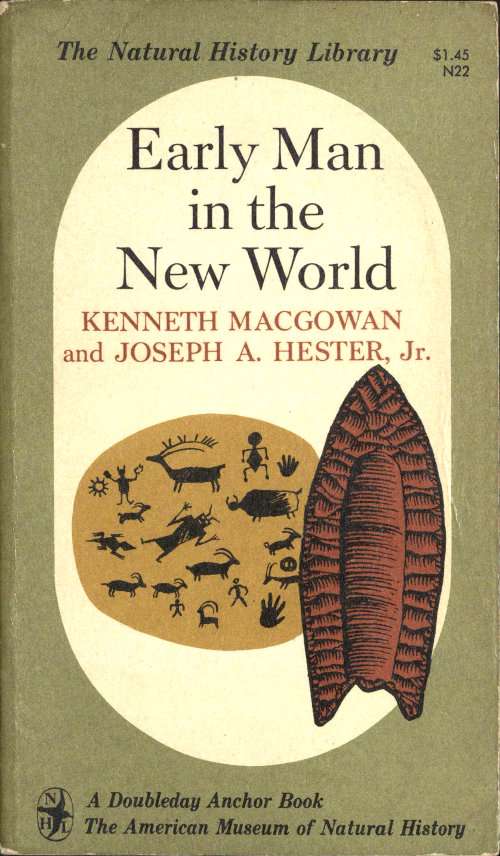
EARLY MAN IN THE NEW WORLD
A Doubleday Anchor Book
95 line drawings
Cover design by Sydney Butchkes
Cover drawing by Richard Erdoes
This eminently readable and authoritative book on the Stone Age American has been extensively revised and updated for this new edition. Early Man in the New World examines and assesses the prevailing theories on the appearance of man in America during the late Ice Age, and his relationship to the present-day American Indian. With ninety-five line drawings depicting the different stone-flaking techniques, illustrating various migration routes, and locating fossil sites, this is an incomparable guide to a continuing archaeological quest. “An admirable introduction,” wrote Harry L. Shapiro in The Saturday Review; The New York Times called it “excellent and provocative.”
KENNETH MACGOWAN is an outstanding amateur archaeologist with a special talent for clarifying the complex mass of evidence and the conflicting theories on the existence of prehistoric man in America. His vocation has been producing plays on Broadway and motion pictures in Hollywood. He is professor emeritus of theater arts at U.C.L.A., and the author of several books.
JOSEPH A. HESTER, JR., Mr. Macgowan’s collaborator on this revised edition, is an associate professor of anthropology at San Jose State College. Dr. Hester is a member of the Society for American Archaeology and a fellow of the American Anthropological Association.
The foreword to this edition is by Gordon Ekholm, Curator of Mexican Archaeology, Department of Anthropology, American Museum of Natural History.
Though best known for his distinguished career in the theater and motion pictures, Kenneth Macgowan has won the respect of professional archaeologists and anthropologists for his special talent in explaining to fellow amateurs the search for prehistoric man in North and South America. First published in 1950, Early Man in the New World has now been extensively revised to include the wealth of new finds in the last decade.
Mr. Macgowan made his reputation first as a dramatic critic for such publications as Vogue and Theatre Arts, then as a Broadway and Hollywood producer. Since 1947 he has been professor of theater arts at U.C.L.A.
Joseph A. Hester, Jr., is associate professor of anthropology at San Jose State College. He has taught at Occidental College, Stanford University, and at U.C.L.A. He received his A.B. degree in 1949 and his Ph.D. degree in 1954 from U.C.L.A., both in anthropology. From 1952 to 1954, Dr. Hester held a fellowship in archaeology with the Carnegie Institution of Washington, and later in 1955-56, a post-doctoral fellowship with the National Science Foundation. He is a member of the Society for American Archaeology and a fellow of the American Anthropological Association.
Transcriber’s Notes
- Retained publication information from the printed edition: this eBook is public-domain in the country of publication.
- Transcribed textual information from some image-based tables.
- Silently corrected a few palpable typos.
- In the text versions only, text in italics is delimited by _underscores_.