
Lately published by C.
Chapple,
Pall Mall.
Embellished with an interesting Frontispiece, designed by Craig, and engraved by Rhodes, price 7s. extra boards, small 8vo.
1. THE TEST OF VIRTUE, and other Poems.
By the late Miss P. Barrel.
2. RELIGIONISM, or POPULAR PREACHERS, alias PULPITEERS, a Satire, price 4s. boards.
3. POETICAL PANTHEON; or, Fabulus History of the Heathen Gods and illustrious Heroes, with Notes, and embellished with twelve elegant Engravings, rendered into easy Verse. By W. R. Johnson, A.M. price 6s. extra boards.
4. POEMS; chiefly Comic and Hudibrastic, containing Burlesque Translations, Dramatic Pieces, and Miscellanies. By W. C. Oulton, Esq. With a Portrait of the Author, Price 9s. boards.
This volume includes some Dramas, Addresses, Songs, &c. which have been performed, spoken, and sung at the different Theatres.
5. LOVE OUTRIGHT!!! By a Lady. Small 4to. price 7s. extra boards.
6. THE BEAUTIES OF THE ANTI-JACOBIN, or WEEKLY EXAMINER; containing the whole of the excellent Poetry, and the permanent Parts of the Prose of that highly esteemed Work. 1 vol. demy 12mo. 5s. boards.
7. LOVE’S LYRICS; or, CUPID’S CARNIVAL; original and translated. By J. Scott Byerley, Esq.
“Frustra laborat, qui omnibus placere studet.”
small 8vo. price 7s. extra boards.
Transcriber’s Notes
About the Book
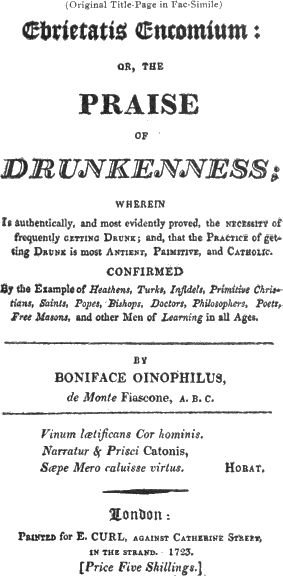
The Encomium Ebrietatis was originally published in 1714 as “Eloge de l’Yvresse” by Albert-Henri de Sallengre, and translated in 1723 by Robert Samber with the present title. The 1812 edition updates the spelling and punctuation, and omits part of the title page (below), but is otherwise the same text.
Title page of 1723 edition from 1910 reprint (the word “facsimile” is used loosely):
Paragraph omitted from 1812 title page:
Confirmed by the example of heathens, Turks, infidels, primitive Christians, saints, popes, bishops, doctors, philosophers, poets, free masons, and other men of learning in all ages
Spelling of Names
Variant spellings have generally not been noted. Common patterns include:
Final “e” omitted: Jerom, Augustin
Simple “e” for “ae” or “æ”: Lacedemonia, Cecilius, Megera, Eschylus
French forms: Gascogn, Trimalchion
Additional Footnote
A. Greek quotation as printed (errors in boldface):
φεύ τίνες ὔδωρ
πίυουσι μανίην σώφρονα μαινόμενοι.
pheu tines udôr
piuousi maniên sôphrona mainomenoi.
Some errors apply only to accentuation. The 1723 edition, or its reprint, has far more errors.