
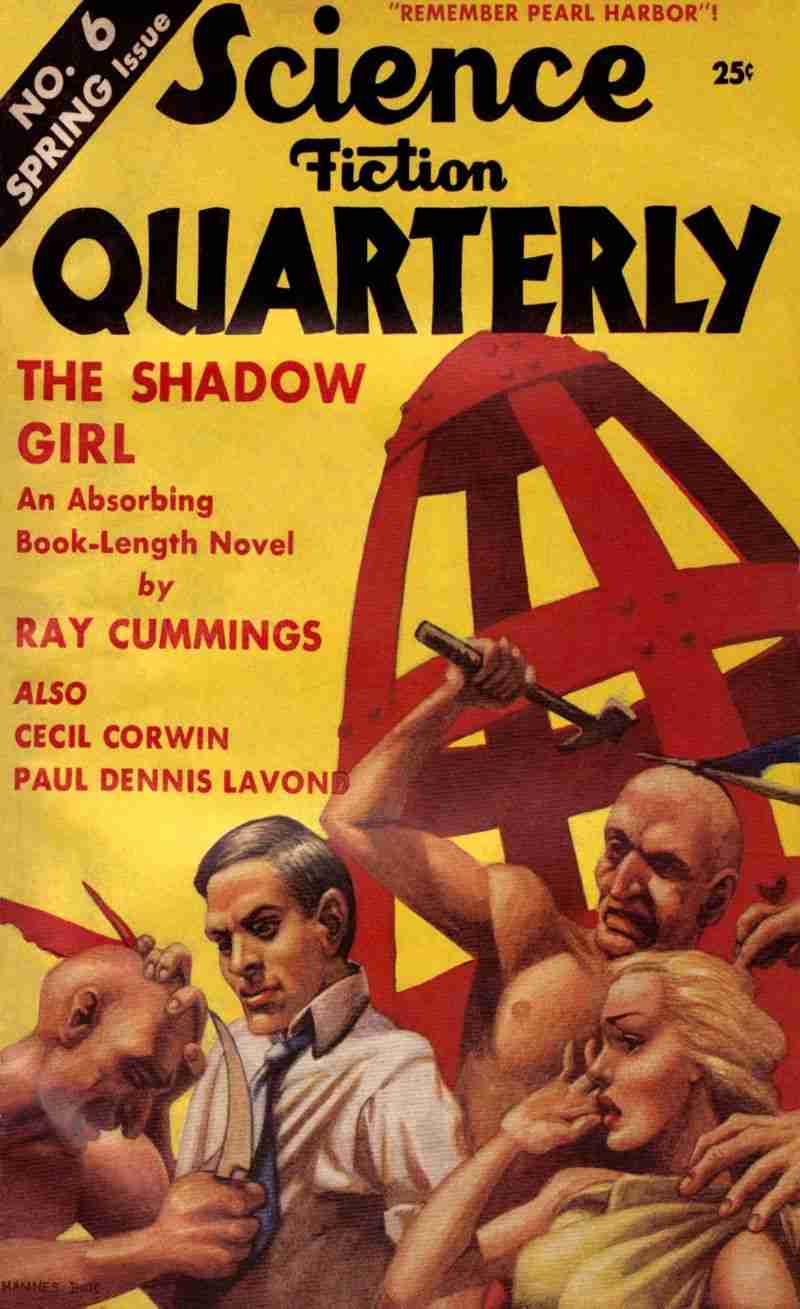
The Project Gutenberg eBook of Einstein's planetoid
Title: Einstein's planetoid
Author: C. M. Kornbluth
Robert W. Lowndes
Frederik Pohl
Illustrator: Chester Cohen
Damon Knight
Release date: March 16, 2024 [eBook #73173]
Language: English
Original publication: New York, NY: Columbia Publications, Inc, 1942
Credits: Alex White, Greg Weeks, Mary Meehan & the online Distributed Proofreaders Canada team at https://www.pgdpcanada.net
EINSTEIN'S PLANETOID
An Engrossing Tale of An Incredible World
by PAUL DENNIS LAVOND
(Author of “Something from Beyond,” “A Prince of Pluto,” etc.)
Paul Dennis Lavond is a pseudonym known to be used by three different authors: C. M. Kornbluth, Robert A. W. Lowndes, and Frederick Pohl.
They were the heirs of space-flight: They planned to be the first humans to land on Alpha Centauri, but the original Hartnett expedition had been lost and they had to find it first. They followed the signals and found that they led to what looked like a one-way excursion to the screwiest planetoid in the galaxy!
[Transcriber's Note: This etext was produced from Science Fiction Quarterly Spring 1942.]
CHAPTER I
HEIRS OF SPACE FLIGHT
Nick Hartnett stepped off the upper lip of the thousand-foot shaft and floated gently downwards. When he had fallen about half the distance, he reached out for a stanchion, grasped it easily and pulled himself gracefully into the lounge-room of the Columbia.
What he saw there was precisely what he expected to see. There was Dorothy Gilbert, curled in a spring-hammock, reading a book. Nick was looking over’ her shoulder before she knew he had entered.
“Bodie’s ‘Parecliptic Orbits,’ ” he read aloud. “Dorothy, don’t you ever think of anything but your job?”
She looked up, smiling, brushing aside a lock of tousled hair that sought her eye. “Often, Nick. But where would we be if I didn’t check my courses against those plotted by a competent authority?”
“Just about where we’ll be if you do,” he guessed, tugging at his ear with long, knobby fingers. “You’re my idea of a competent authority yourself.”
“Thanks, Nick. How are the contracels holding out?”
“Wonderfully!” he grinned. “It seems as if my father did a fair job of inventing there—though maybe not quite good enough.” He knelt and touched a button inset in the floor; instantly the metallic luster of it dulled and clouded, then the clouds seemed to vanish as the floor became transparent. In an instant it appeared to have vanished entirely, revealing an immense sweep of blackness interspersed with white-hot, tiny specks of light that were stars and planets.
Nick stared out at them. The whole field of stars was moving, it seemed, though, in actuality, it was the ship itself that spun on its axis, providing them with the illusion of gravity they required. It was hard for Hartnett to realize that this view was almost brand-new to human eyes, that only twenty or thirty people could ever have seen stars and the solar system from this vantage point, outside the plane of the ecliptic. There were seven persons in the Columbia now, and there had been eighteen or twenty in its predecessor which had been reported lost some years before. Those two ships, the only ones in the System’s great armada to be equipped with the counter-acceleration devices that made it possible to venture out of the confines of the Solar System, were also the only ones to leave the plane of the ecliptic.
“Where’s Earth?” Nick asked absently without looking up.
Dorothy closed the book on a finger and leaned over the edge of the hammock to look. “It’s not in sight now,” she said. “Wait until we spin a little farther. Of course, I can’t guarantee you’ll be able to see it then, either, because the ship may hide it. But we’ll see. We’re looking out one side of the ship and Earth is directly in back of us.”
He snapped off the vision and the floor returned to normal. “As soon as we get the reports from the two goops,” he mused, “we can start making definite plans for the outing.”
“We heard you,” came a voice from just outside the lounge, and, a second later, Bob Vickers appeared, climbing hand-over-hand against the slight pull of the acceleration that managed to seep through the not-quite-perfect guard of the contracels. He pulled himself into the lounge and turned back, extending a hand to Fred Marquis, who followed him in.
The two glared at Nick with injured expressions. “So this,” stated Vickers sadly, “is how you refer to your loyal aides behind their backs.” He turned to Marquis: “Colleague, we may as well tear up that paper and save ourselves further humiliation.”
Dorothy Gilbert closed her book with a snap. “Far be it from me to poke my pretty nose into your little brawls, but haven’t you two been rather long in getting the data?”
Marquis made a sweeping bow. “Fair lady,” he replied softly, “I appeal to your innate sense of justice and fair play. Did or did not our noble captain, on two occasions, call us all away from our gruelling labor to strain our ears trying to hear an alleged distress signal?”
Dorothy laughed gaily, shaking her hair away from her forehead. “Indeed, our noble captain did. Not only was your invaluable time wasted, but mine as well. I was rechecking the course and had to start from scratch after the interruption.”
“My lady is as gracious as she is charming,” bowed Vickers. He faced Nick. “We will be generous, sir, and accept your apology.”
“The ship’s company,” sighed Nick, “is reminded that the original Hartnett expedition was not entirely lost. It is to be assumed that they are still trying to contact someone, us in particular. Thus the careful attention to what appeared to be distress signals.
“Now may I suggest that you save your precious time by letting me know what you found?”
“That,” murmured Marquis to Vickers, “is as close to an apology as he’ll ever get.”
Marquis unrolled a small chart, holding it so both Dorothy and Nick could see. “This,” he explained, “you can check at your leisure, though I’m a monkey’s uncle if you find anything wrong with it. To sum it up briefly, the Columbia is not only the largest space-ship ever made but also the fastest and most powerful.”
“Very nice,” replied Nick, “but that alone isn’t good enough. We can still be the fastest thing aspace and not be capable of a voyage to Alpha Centauri and back within the span of a lifetime.”
“If this is correct,” interrupted Dorothy, jabbing at an equation with her index finger, “then we can do it easily.”
“It’s too damn bad,” mused Nick, “that my father was so secretive about things. Whatever it is we have here, I’ll bet he had just as good—if not better—on the Orion ten years ago.”
“Didn’t he leave any notes?” asked Vickers.
“None. Apparently he feared their falling into the wrong hands in case anything happened to him. The only thing he did leave was wave n, the one he promised to use for communications. That’s what the contracel formula came over.”
Dorothy’s nose wrinkled in puzzlement. “I was under the impression,” she said, “that the contracel formula was radioed to Earth mysteriously—only it was badly garbled, just fractions coming through. And you, Nick, were the only one who could make anything out of it.”
“Partly true,” he admitted. “The ‘mysterious’ radio message however was something I cooked up to keep the newspapers satisfied. I wanted to let out the publicity that the Hartnett expedition wasn’t completely done in, but I didn’t want to draw attention to wave n. The fewer people who know it exists, the better. If I hadn’t thrown them offtrack with a little hocus-pocus, the secret might be out.”
Vickers blinked. “Excuse me,” he put in—“in this case, I guess I am a goop. But can you explain the contracel to me? I never really got it.”
“I’m no better off,” grinned Nick. “I managed to get enough data from the radio so as to know how to throw the thing together, but as to precisely what it does and why I can only guess . . . and I’d rather not get out on a limb on it.
“All I know is this: interstellar travel, to be anything at all, requires really tremendous speed. To get that speed you have to accelerate like hell. And human bodies aren’t equipped to take the acceleration required.
“Well, what Dad did was to figure out a counter-acceleration device, which he called the ‘contracel’ for short. All I know is that it blankets the effects of really terrific acceleration so far as our feeling it goes.”
“Have you any idea, Nick,” asked Dorothy Gilbert, suddenly serious, “where the Hartnett party is?”
He shook his head. “They were outward bound for Alpha Centauri, just as we’ll be after we get home and check these results. I’ve no idea how far they got, because I don’t know how to check distances by wave n. In fact, I don’t think it can be done; the damned thing doesn’t travel right.
“You, Dorothy, and Bob, Edgar, and I are all members of the family of the original Hartnett expedition. The reason I wanted you three was because I really expect to look for Dad and his friends on our way to Alph. You. Fred, and Grenville and Timbie aren’t exactly family members in our little circle, but you’re next thing to it. We’ll have to have a bigger crew for the outing, of course.”
Dorothy ran her fingers through her hair. “It’s been over twelve years since I last saw Harry,” she whispered. “I wonder what he looks like now?”
Joe Timbie was sucking laboriously on a water-tube as they pulled themselves into the control room. He laid it aside at their entrance, and wiped his face furiously.
“The interference is terrific,” he began, “but I sounded the alarm because I’m definitely getting something every now and then, although it’s hard to say what.”
“Any idea as to the source?”
“You know how wave n is. Edgar’s been cooped up in his cage for about seven hours now, and, if he survives, I damn well think he’ll have taken wave n to pieces and put it together again. Then we’ll know how to trace the signals.”
Dorothy Gilbert sat on a bench swinging her legs thoughtfully. “How’s the intensity, Joe?”
Timbie clutched his hair. “O gawd!” he groaned. “It just shouldn’t happen to a dog. This wave has the most unholy variations ever conceived by Lucifer. You remember how it was on Earth?”
“Yeah,” agreed Nick. “Pretty wavy to say the least.”
“Well it’s all of that here—only the little jigger has got itself another twist. Not only does the intensity vary according to no laws whatsoever, but every now and then, she comes through full blast, sans interference, backwards!”
“What!” There was a chorus on that.
“You heard rightly. I used to have a hobby back on Terra. Super-imposition of recordings. I’d take several records of music, and play them simultaneously, working in various others now and then and thus make a new recording. At times I’d run them in backwards, lyrics and all. So, after awhile, I got pretty accustomed to hearing common English words spoken backwards. And damned if some of the apparently garbled signals didn’t sound familiar until suddenly it struck me. I was just beginning to set them down when, whup! in comes the interference, then they’re straight again, but so faint I can’t make them out.”
“Joe,” called Dorothy softly, “are they always in reverse when they’re strong?”
“Why—yes, they are.”
“Does Edgar know that?”
“Nope.”
She slid off the table. “I think I’d better tell him before he wastes any more time.”
“Hold it a moment,” protested Nick. “I want to see if we can get anything. Is the power on, Joe?”
“Yeah. Apparently they stopped just an instant after I rang you.”
“Any idea when they might be on again?”
“Ought to be a few minutes, Nick. I’ve found that they apparently repeat each broadcast three times with a few hours interval between units of three.” He shoved a slip of paper over to Nick. “Here’s what I’ve managed to make out so far.”
Nick picked it up frowning. “Hmm—not much here—it reads ‘horribly warped by effects of motion’ . . . then there’s a blank—‘had to stay and one’—damn, another blank.”
“That’s where it either faded out or interference came in,” explained Joe.
“I see. This is where it reversed, eh? ‘Left and I am’ blank space ‘too slight to lift.’ That’s all.”
“Do you suppose,” asked Marquis, “that the phrase ‘left and I am’ might mean that the person sending the signals is the only one left and he’s about at his rope’s end?”
“Maybe,” suggested Bob Vickers, “something happened to the crew as a result of their acceleration. ‘Horribly warped by effects of motion’ sounds ominous. Perhaps the crew went bats and they had to land to save the ship. Then something happened to them on the planet so that they ‘had to stay and one’—well, maybe he’s telling about the ghastly fate of one of them.”
“What—what about ‘too slight to lift’?” reminded Fred.
“As I recall,” said Nick in hushed tones, “there was one outstanding bad point about Dad’s setup. The contracel controls were pretty heavy and it took a strong man to work them alone. If but one man were on the ship, and he sick, or weak from hunger, he couldn’t lift those levers.” He stared a moment, then added, “Particularly if the gravity on whatever planet the ship is were greater than that of Earth.”
“I thought the controls were automatic,” protested Dorothy.
“They were. But Dad had manual controls installed just in case.”
At this point a wild-eyed, disheveled figure burst in upon them. “I’ve found them,” he cried in a high, strained falsetto. “They’re in a tight little orbit around Proxima Centauri.”
Dorothy Gilbert took his arm. “Come with me,” she whispered. “I have some more data for you; you’ve done wonderfully.”
The two left the room, heads close together. An instant later a faint shriek reached the ears of those in the control room, followed by gibbering noises. Nick made a dive for the exit, to find Edgar cackling faintly to himself as Dorothy led him away. “There, there,” she soothed, “it wasn’t your fault. Now you just go and get a nice long rest, then we’ll help you with the new calculations. . . .”
CHAPTER II
INCREDIBLE WORLD
“Here it is,” exclaimed Dorothy wearily, planking down a sheaf of motors. “If you can follow through on this, Joe, we’ll find the missing. We keep on straight ahead, at right angles to Earth’s ecliptic.” She closed her eyes. “Did you know,” she murmured to no one in particular, “that Edgar’s secret ambition is to purr like a cat?”
“How is he?” asked Nick anxiously.
“In a drunken stupor. After all he’s been through I didn’t have the heart to say no to him. So he emptied an almost full bottle of the rocket blast.” She beamed at Nick. “Edgar has a special name for each grade of alcoholate we distill; this is the stiff one.”
“We’ll have to make some more of that,” declared Marquis. “Heigh ho, it’s back to the primitive. Y’know, scientists are pretty sure that savages spend most of their ingenuity in figuring out ways to make better and still better hooch. Disgusting, isn’t it?”
“Hang on to your stanchions,” yelled Timbie as he pressed a button which would send a warning signal throughout the ship, “we’re accelerating.” Instinctively they obeyed. Without the contracels, they would have been an obscene mass of mangled protoplasm in the seconds that followed; as it was, they experienced something like the feeling one obtains on the downward sweep of a stiff roller coaster.
“Keep a close check on the direction, Joe,” grated Nick.
The impact of acceleration did not last long, but it was some five minutes before they really felt normal again. Timbie bent over calculations, a frown working its way across his forehead. “I don’t like the way this is working out,” he muttered.
“Following Edgar’s equations?” asked Dorothy, picking up the sheet. She glanced over them quickly. “Nothing wrong here only—jeepers, you’re right, Joe! Stop the bus, quick!”
“What’s wrong?” demanded Nick.
“Nothing—except that we’ve passed them. They’re behind us now!”
Timbie’s hands flew over the controls rapidly. “Some day, after the contracel principle has really been perfected, we’re going to have ships that are practically without inertia so long as the power’s on. Ships that can stop dead like that without any terrifying results and go back the way they came as neat as the ancient’s trains on their tracks. But we have to decelerate slowly or we’re basket cases, if anybody ever finds us at all.”
“Wherever they are,” mused Nick, “it’s going to be one sweet job finding the planetoid in this space. It’ll be practically invisible because of the distance from the sun. We may go by it a couple of times.” He jabbed a call button sharply then spoke into a mike. “Grenville? What’s doing? Oh, you are!” He turned to the others. “Our chemical engineer is turning his inventive genius to a superior blend of the rocket blast. How lovely.”
“Noble pastime,” put in Dorothy. “The last batch was pretty raw—I think it would have dissolved my teeth if I hadn’t swallowed it quickly.”
“Listen,” yelped Nick. “Lay off the monkey business for a minute and attend. Hop down to the observation room and look for a small planetoid—I don’t know—could be any port. Use maximum magnification because it may be small—oh, big enough to hold a ship about this size perhaps. Possibly—quite probably dark. Signal us as soon as you see something.”
“If he’s been sampling his wares, he’s likely to see anything,” suggested Marquis.
“That being the case,” replied Nick, “you’d better go down and help him, all of you. It’s a tough job for one man in any condition.”
“Coming?” inquired Marquis of Dorothy. She shook her head.
“Yaaah!” he jibed. “Captain’s pet!”
Dorothy bit her lip. “When I think that we almost went right by it without suspecting. . . . almost missed it completely, I mean.”
Nick clasped her shoulder, his eyes fixed upon the almost invisible planetoid slowly growing before them. “Were you and your brother—very good friends?”
“I scarcely knew him,” she murmured. “He ran away from home when I was seven or eight, and we only saw him once in awhile after that. I think it was nearly six years after he first hit out before he came back. He was mature then and I was just a silly adolescent, but I idolized him because he was so famous.
“He spent nearly a whole month with me—with us, that is—about four years before he signed up with your father. But all that seems unreal now. If he’s—still alive, I’ll probably say ‘hello, Harry,’ and kiss him with sisterly affection and be glad he’s all right, but it won’t really mean much. What about your father, Nick?”
He frowned. “Dad and I were pretty close. Matter of fact, I never called him ‘dad’ until after he disappeared. It was always Steve. He preferred that; didn’t like his own name, though I didn’t know about it for a long time.
“I never could figure out the relationships between the other kids I knew and their parents. I always felt sorry for them; you see, Steve explained to me once—it’s amazing that I got it the first time—that ‘father’ or ‘dad’ or ‘pop’ was something I’d better call him when other people were around just for the sake of appearances. And, when I was in school, why he was ‘my father.’ But when we were alone together—or just the three of us, Steve, Mater, and I—we didn’t have to be formal at all. We were always the best of friends.”
She drew closer to him. “I’d like to meet—Steve.”
He looked at her as if it were the first time they were meeting. “Steve would like you, too,” he replied.
The alarm clanged for some time before they noticed it.
“Sorry!” exclaimed Timbie as he came into the room. “We’ve spotted it. It’s less than 500 miles in diameter.”
He eased himself into the control seat and started to shift them into the proper curve for landing. Fascinated, the three stared out the large port at the rapidly increasing globe before them. Unbroken in surface, it loomed before, a seemingly fantastic and impossible thing, a perfect sphere.
Slowly, prodigiously slow, they approached, coasting gracefully, for inertia or no, there was still the great mass of the ship to take into consideration. There was something wrong about this—somewhere—then, suddenly, the same thought struck all three of them.
“It isn’t a sphere!” voiced Nick. “It just looks that way because of its tremendous speed of rotation!”
Dorothy wheeled out the z-special camera and turned on the power, let it operate for a full minute. Quietly they waited for the automatic developing process, then cut the lights and flashed a projection on the panel in the rear of the room which was ideally suitable for a motion-picture screen. Eyes glued on the meters, Dorothy adapted the flow of film until the images of the planetoid on the panel corresponded to what they saw outside.
“What’s the period of rotation?”
“100 per minute. That, to put it mildly, is fast. It must be extremely dense to hang together at all—and even then, made of ultracohesive matter.”
As Joe put it some time later, the business of landing on Hastur (as the planetoid came to be known, Marquis first dubbed it that after some legendary, elemental wind-being; they found out later that Hastur wasn’t really the being Fred had in mind, but it stuck nonetheless) was roughly analogous to that of a fly lighting on a spinning top. There was Hastur looming before them in the deeps of space, gleaming like phosphor on black velvet, the pseudosphere of it slowly swelling before their eyes. And there was the Columbia, a great overgrown cylinder with a turret in the middle—a turret that completely encircled her, because she spun, too,—albeit slowly in comparison to the planetoid—gently curving in to try to light upon the little world’s surface.
What happened? They should have known, but they didn’t. The Columbia swooped down upon Hastur, like the proverbial falcon upon its prey. Only it wasn’t as simple as that, because the ship touched the outer fringe of that terrifically-accelerated rotating atmosphere and bounced off, ricocheted much like a smooth stone splatting across the surface of water.
They weren’t ready for that splat. It took them unaware and tumbled them all head-over. Luck was with them and no one slammed into anything sharp or deadly hard. Dorothy nursed Nick’s bloody nose and a cut over Marquis’ eye which just missed being serious.
The second time they tried it, it was with less elan and more caution. They figured that if they could cut in at a point, cut in at an angle so close to zero that they were virtually parallel to it, slip in like a hypodermic with the grain, so to speak, they might be able to make it. It was a nice idea but it didn’t work. They were knocked away again. Only this time all hands were prepared and no casualties followed.
At about then Edgar staggered in wanting to know what was. Briefly they told him. Edgar was amazed. He stood there gaping at them, at, he said, their innocence. Then he raised his hands. “Friends,” quoth Edgar, “like little children shall I lead you. Land at the pole.”
They made it.
“It’s odd, isn’t it?” mused Dorothy as Nick helped her up an escarpment.
“What’s odd?” Edgar wanted to know.
“That, despite the terrific rotation of Hastur, we just don’t notice it now that we’re here. I know why of course. Sheer relativity. But it’s still odd, no matter how well you explain it.”
“I know,” mused Edgar. “The most common way is that of picturing a caterpillar crawling down the vane of a fan toward the center. The fan is rotating at terrific speed; the fan is on an express liner which is zipping through Earth’s stratosphere like nobody’s business; the stratosphere is following Earth’s rotation, and so on. Yet our caterpillar isn’t conscious of any motion save his own.”
They stood silent for a moment, surveying the scene before them. Curving horizons could be seen on all sides, the uneven terrain before them now and then pierced by upcroppings of rock. Or perhaps metals. Above them no sky but space, dotted with luminaries. Far away a splotch of brightness—their sun. A world of twilight, this was.
Behind them lay their ship, a faintly gleaming cylinder, badly scraped and somewhat battered from landing. They’d prepared a sort of berth by splashing the terrain before them with blasts from the emergency rocket tubes, fore and aft, but the landing had still been rough, not the kind which would leave a ship in full dress paint.
Somewhere before them, precisely how far they could not know, was the lost Orion.
“I think,” mused Nick, “that the reason for the odd feeling is that we are so vitally aware of the planet’s rotation. After all, Earth is no laggard, either, but it’s so damned big in comparison to this, and so few people, relatively have been off it as yet. What I mean is: if your knowledge of Hastur’s rotation were strictly theoretical, or if you hadn’t seen it from space, the whole thing wouldn’t appear to you as it does now.”
The going was just a trifle more difficult than covering rocky ground would have been on Earth: Vickers had figured Hastur’s gravity as 125% that of Earth.
“Hold it,” called out Edgar, punctuating the exclamation by easing himself onto the asteroid’s surface. “Does anyone know where we’re going?”
“We’re off to find the Hartnetts,” said Dorothy.
“How nice. And where, pray, may they be?”
“Right here—somewhere.”
“Lovely,” drawled Edgar, “just lovely. Have any of you stopped to consider how many days and how many weary miles you can cover on this not-as-small-as-it-looks world without finding anything at all except blisters?”
“We tried to contact them,” cut in Nick, “but not a peep out of the radio at all. The thing just went dead.”
“I’ll have to admit,” continued Edgar, “that at the very moment I can’t think of any better procedure than just striking out in any direction at once. But I rest assured that there is a better way. Therefore, I move that we take it easy until we find one.”
“We could use the ship,” said Dorothy.
“Inadvisable,” objected Nick. “Something tells me we are going to have trouble getting away from this little fiend of a planetoid.”
“How about rocket cameras?” cut in Dorothy.
“Huh?”
“I can make them. We’ll use just enough fuel to send them up half a mile or so. They’ll take pictures, then glide down. We’ll keep an eye on them and see where they land; Edgar will also take calculations while they’re up—they’ll be sort of periscopic photos. Of course we’ll get our ship, but we may spot the other one.”
Nick tapped the rocky surface pondering. “Only thing wrong with that is: why didn’t we see the ship on the way down? We had a much bigger perspective.”
“Perhaps too big. Besides we were too well occupied otherwise.”
“Okay,” sighed Nick. “I can’t see any reason for not trying it.”
CHAPTER III
MENACE UNSEEN
Dorothy clasped Nick’s hand as firmly as hands can be clasped when swathed in space-mitts. “If the photo didn’t deceive us, the ship should be over this ridge.”
Nick nodded, shot an impatient glance at the others straggling up the slight incline. Together he and Dorothy mounted the acclivity, peered anxiously at the sweep below.
A little scream of delight came from Dorothy’s lips, “There, Nick!”
No doubt about it. The lost Orion lay, partly concealed by upcroppings of rock, less than a mile away. Hastily they made their way down the decline, ran in awkward, elephantine steps toward it. As they approached they could see how beaten and scarred it looked.
They bounded to the port and breathlessly clanged upon it. It was shut tightly. Impatiently they beat upon it until finally it swooshed open and they filed into the airlock. Imperturbably the outer door snapped close behind them, clamlike, and painfully slow the inner port dragged itself open.
The lost Orion!
The air was pure—that they noticed first of all when they had doffed cautiously their helmets. Pure and warm. Quickly they took off the clumsy suits and looked about them. No one was in sight; no greeting came to them.
“Hello!” yelled Nick.
No answer.
It was not as large as the Columbia, this ill-fated craft, but a big ship nonetheless. Hearts beating out ill omens, they searched room after room, finding no one.
“Hello! Hello!” cried Dorothy. Edgar grasped her arm. “Wait,” he murmured. “I think I heard an answer.”
Silently they followed him, as he led, to a small room. There was a bed, a set of controls—from this point the mechanisms for opening the double doors had been set in motion—a small heating unit, and a large armchair. As their eyes roved about the room, a figure arose unsteadily from the chair and faced them—a tall, gaunt man, white-haired, his eyes looking as if he had been lost for a thousand years.
Wordlessly he stared at them, as Nick stepped forward, his voice husky.
“Steve!”
The older man looked at him, a sort of dull bewilderment spreading across his face. “Hello, Nick,” he said softly. “I was sort of wondering when you’d come. Who are your friends?”
“I’m Dorothy Gilbert,” spoke up that person coming forward, “and I think I’d better fix something for you right away, Steve. You look as if you haven’t had a square meal since Sinbad went sailing.”
The older man grinned wanly. “Guess I haven’t been eating any too regularly. Haven’t had much company, you see since—”
“Tell us about it later,” interrupted Dorothy. “Edgar, break out the rations and help me with this thing. Looks like an old model.”
“Nothing to it,” murmured Vickers. “I’m Edgar Vickers,” he added in Hartnett’s direction; “my brother, Bob, is the slack-mouthed individual you see behind me. There’s three other fellows in the party, but they stayed back in the ship.”
Hartnett sat down on the bed, his eyes wandering from one to another. “Nice girl you have there, Nick,” he whispered. “You’re not letting any of these other lads get the jump on you, eh?”
“Not a chance,” replied Dorothy without looking up, “I’m after the Hartnett fortune because there’s no one else I know who is worth marrying, even for the kind of lab I want.”
“Did you write the book you always said you would if you were ever marooned, Steve?” asked Nick.
Hartnett nodded. “Guess that’s all that kept me from going nuts. All alone here—not strong enough to do much more than take care of myself, write, and send signals out. Didn’t go outside much after—”
Dorothy faced him, her eyes misty. “Don’t try to soften it Steve—I knew as soon as I came in the ship. Harry’s dead, isn’t he? Like all the others?”
Hartnett nodded. “Yes—like all the others.”
“There’s not much to tell,” said Hartnett slowly, after the meal had been finished. “We started out in the Orion much the same as you did in the Columbia, tested the contracels and decided everything was all right. We noticed this little world here and landed to investigate.
“Only we couldn’t get off.
“We’d been going virtually at the speed of light and that warped the fourth dimensional fields which were a basic part of the contracels. We found that the only way we had of getting off this planetoid was by rockets, and rockets weren’t enough. We just slid along the surface, battered up the ship, then stopped.
“Then we began to find out things about this world. Some of them were interesting, and some—” he broke off suddenly. “Nick, you or none of your party have been out without full suits have you?”
Nick shook his head.
“Good. Don’t. This little world is full of radiations, a good deal of which are undetectable, but nasty nonetheless. Seven of our party succumbed before we suspected anything was wrong, and five more died within the next fortnight from perfectly innocent things which must have acted as catalysts.
“So far as we know, an ordinary suit is protection, but we can’t be sure.”
“What happened to the others?” asked Bob Vickers.
Hartnett was silent for a moment. “When we landed, one of the rocket fuel tanks was ruptured. Not broken open, just cracked enough to let the stuff vaporize and escape. It started to flood the ship gradually, before we found out. We drew lots to see who would seal off the rooms where it had already penetrated, knowing that the chances were a hundred to one that everyone who went would be blown up. It was a suicide job, but those suicides could keep the entire ship from being blasted to free electrons.
“They did. If you’d come from the other side, you’d have seen the great gaping crater and the hole in the ship.”
“I don’t understand. . . .” started Dorothy.
“I do,” spoke up Nick. “When the Orion left, the only rocket fuel which was any good was HZ 7. It had one fault, however. Let any atmosphere get at it and it would vaporize and seep through practically every known substance, except wax. And that vapor was about ten times as touchy as nitro. When it went off you had a terrific explosion.
“What these fellows did, I take it, Steve, was to seal off the sections from the outside, leaving plenty of room for the vapor to explode, perhaps calculating on its drawing closer while they were at work. Then, they went to work on padding so that the concussion wouldn’t completely wreck the ship. Their only chance of escape was completing the job and getting off before the stuff lit up. And working around it was almost a positive guarantee of setting it off.”
Hartnett nodded. “That’s just about what happened. Three men were on the job of sealing off. That was the sure death assignment, because they would have to be practically entombed inside. Five others were on the padding job; they had a chance of not being smashed to pieces by the concussion if the blow held off long enough.
“But it didn’t—not quite long enough. They managed to get their work almost finished. It was just the sheerest luck that the thing didn’t fill the entire ship, or go off before some of us were out of the way. That was when we didn’t all wait to put on full suits—and it seemed all right outside. Well, the radiation got the ones who survived the blast.”
He buried his face in his hands. “It seems as if it happened ten years ago at times, then I feel, sometimes, as if it had happened yesterday.”
Dorothy slipped her arm around him. “It wasn’t your fault. Come, tell us more—about the things you found out about this planetoid.”
He raised his head, brow wrinkled in concentration. “There’s an odd effect at the horizon—maybe you haven’t noticed it yet, eh? The equator of the world seems to be moving, flowing along the ground.”
“Yow!” exclaimed Edgar. “Lorentz-Fitzgerald stuff!”
“Huh?”
“Simple,” he went on. “The speed of rotation of this planetoid at the equator approaches the speed of light, believe it or not. So the equator contracts. Its diameter remains the same, mind you, since it isn’t moving along the line of the diameter, but the circumference grows smaller. And that my friends,” he concluded, “makes the mathematical ‘pi’ a variable so far as Hastur is concerned. Geometry on this planet must be hot stuff—a veritable purgatory for mathematicians.”
“How the devil did you figure all that out?” exclaimed Hartnett, a note of awed admiration in his voice.
Edgar grinned. “I’m not staking my life on it,” he said, “but it’s the only explanation I can think of for the phenomenon you described.”
“Well, you may be right, and then again. . . . The important thing, now, is to get off Hastur. These radiations are what got most of us—doesn’t make too much difference with me, because I’m old. But I’m assuming,” he looked at Dorothy and Nick, “that you two will be wanting to pair off pretty soon. And I don’t think Dorothy would care to start knitting little sweaters with holes for three heads in them after she’d had x-rays taken.”
“We’ll get off,” declared Nick. “Our rockets are powerful enough, I think. We’ll take what we can from the Orion—and I suspect that you and your book, Steve, will be all—then scram away from here fast.”
He clasped Dorothy’s hand. “I only want a hole for one head in that little sweater.”
Joe Timbie turned to Hartnett and Nick with a despairing gesture. “See? All we do is slide along the ground. I’ve given her the best blasts we have and there’s the result.”
“A good thing they’ve found a new kind of rocket fuel in these last years.”
When Dorothy came in, Nick gripped her hands and clung to her. There was no need for words. Silently they looked out of the port onto the scene of their prison, grey twilight world with its sky of starlit black.
Finally he straightened up, reached out and pressed the call-button which would summon all hands to the control room.
“There is nothing wrong with the rocket tubes, or the fuel,” he said softly when all had come. “Everything is working as it should work. Our rockets just aren’t strong enough to get us off.”
“But the contracels?” burst out Marquis bewilderedly.
Hartnett shook his head. “No good here.”
Bob Vickers went over to the window and looked out, staring at the landscape as if there lay an answer to their problem. “Edgar,” he called after a moment, “are you sure about what you said about the equator?”
“No guarantees, but it could very easily be that way.”
“Then mightn’t an object at the equator be thrown off the planet by centrifugal force?”
Edgar turned to Nick. “It might—matter of fact, it should.”
Hartnett bit his lips. “It’s a long chance,” he said, “but still a chance. If the ship will hold together under the terrific punishment it would have to take, sliding along the ground on our rocket blasts, then we may be able to do it.”
“Okay,” declared Nick. “Everybody get into space suits, make sure the air-making apparatus is in order, and take your stations. We’ve got to have lookouts covering all sectors to spot any possible punctures of the hull. As soon as everybody’s checked from their posts, Joe, let her rip.”