
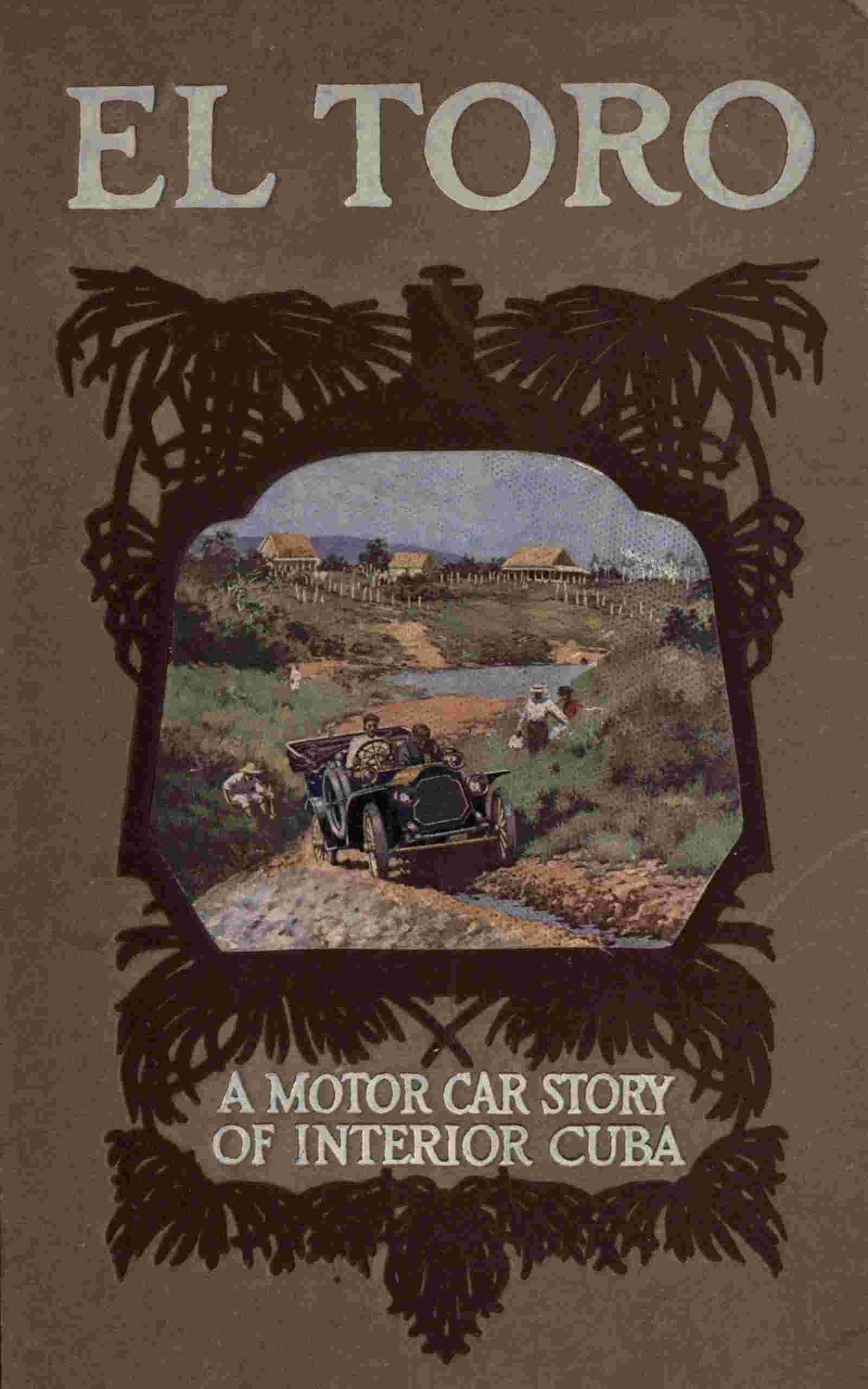
Benavides to Tosca—forty-four miles.
“On these ruts we tore tires off the wheels at two miles an hour.”
“We enjoyed the rare experience of ‘beating it.’”
CHAPTER IV
All ruts, except those made by ox carts, are merely imitations. The country through which we were passing soaks water like a sponge in the wet season. It dries quickly. When the red soil is soft, the immense, heavily-laden carts sink into and cut gashes three or four feet deep in the face of the earth. These parallel, intersect, and cross one another. There is only one way to drive a car over them; that is to always keep the wheels on the high spots. Sometimes the high spot may be wide; sometimes narrow as the wheel; sometimes it may be the sloping side of a gully. On these ruts and on the rocks we tore tires off the wheels at two miles an hour.
From Tosca to Macagua is sixty miles of ruts. As we left the region where the road is over bare rock, we began to work into a region where the ruts alternate with mud. For a short distance the ground had been untraversed for a long time, and was hard and fairly smooth. We enjoyed the rare experience of “beating it,” which down there meant eighteen to twenty miles an hour. This respite from the usual difficulties was brief, for the road finally became merely an opening between sugar fields.
The cane, sweeping the car on either side, rose far above our heads and for many miles it was never possible to see in front of us farther than a few hundred yards. Leaving the sugar cane for short drives over open ground, we noticed that this must have been a particularly patriotic section during the fighting with Spain. Most of the scattered houses were of stone or boards, calcimined white, light blue, or yellow, and nearly each one bore the roughly painted sign: “Viva Cuba Libre.”
Lunch was eaten in a street café at Colon, and while there we became acquainted with the four-hundred of a typical inland city. Politicians in such localities bear reputable names socially and lead the village society. We needed gasoline and were told that there was a private supply owned by a man who was then at the home of the mayor, on the outskirts, where the beaux and belles of Colon had been invited to a dinner party by his honor. We were asked to join the festivities, but excused ourselves and took the oil monopolist back to the town that he might sell us one of his precious ten-gallon cans of gasoline.
The people of the farms that we had met had been picturesque and interesting. The social leaders of this small city were very ordinary types in their commonplace imitation of American dressing. They are uninteresting anomalies, striving for a conventionality of which they know little. They have a color line which does not exist in the country. Out among the hills, the only line of demarkation is the age limit above which it is considered proper and right that little boys and little girls should wear clothes.
We were now running comparatively near the railway and small stations were frequent. To most of these, mahogany was being brought up from the forests of the south, one immense log at a time being hauled on a cart drawn by from four to a dozen oxen. The progress is about two miles an hour when the road is not muddy.
More ruts, open fields covered with loose rocks, mud holes and, then, Macagua, a town to remember. It boasted an hotel, which was club, general store, saloon and salon to the village and surrounding country. We had beds for the first time in Cuba, but our real experience that evening was not in them. Being Sunday, it was a day of celebration.
There had been a baseball game in which the Pinks beat the Blues. Cuba is baseball crazy. Each country team has dainty cotton-flannel suits, which they put on after the game for the purpose of parading around the town. There was a balloon ascension at dusk—a hot-air balloon of red, white, and blue paper going up in flames. The star number on the program was the evening dance. The orchestra, composed of the blackest of Cuban negroes, came early with its kettle drums, cornet, clarinet, gourd and trombone. The tunes were of local invention. A file drawn across the teeth gives the same sensation as the rasping noise they made.
Local society took possession of the hotel floor. They danced a slow, sleepy, never-ceasing, never-changing two-step. The black rabble stood outside, watching the scene through open doors and windows. When each dance was done, the couples marched around in an endless parade. Then the young swains exchanged partners or managed to select the maidens of their respective hearts’ desire. If a young man wanted a certain girl, he grabbed her partner by the unengaged arm, made a few farcical bows, which the grabbed party would duplicate and then withdraw, it being considered highly improper to protest the transfer. By the way of an extra for the edification of the entire party, the American embassy rang in a cake walk.
Our beds were on the balcony which surrounded the second floor of the hotel building. We slept as men will who have not slept in four days.
Tosca to Macagua—sixty miles.
“Palm trees by the thousand, and, scattered among them, small ponds made by heavy rainfall.”
“The car looked like some big black beast, wallowing along in boundless marsh.”
CHAPTER V
By its very monotony, human nature is disappointing. Interior Cubans are guileless, frank, generous, meek, dirty, willing, and altogether submissive and obedient. In other words, they are children. But a community like Macagua has its four-flushers, its liars, and its cheats, the same as London, New York, and Oshkosh. There had been at the dance a man who said he lived some distance eastward, knew every foot of the country and, on returning to his farm in the morning, would be glad to show us the difficultly followed trail. We took him along.
It was very early in the morning and the sun was straight ahead, shining into our eyes over the low mist which had not yet been dispelled. We ran right from town into a great fen, where only a few stunted palm trees rose above the vast ocean of rank guinea grass, covering invisible mires. We could not see the wet places until we ran into them. Trying to get around a deep mud hole, we bumped into a palm tree and had to cut it down.
Chopping a palm tree is like chopping steel tubing. A hundred glancing blows of machete, mattock and axe leave a few scratches on the trunk of the tree. It was while we were hacking away at this palm that our volunteer guide informed us that we were lost. There is no definite road through the tall grass which hides the treacherous swamps. The sun is the best guide. We began to wish for the rocks that we had struggled over, back in Matanzas Province. Our displeasure we vented on the unfortunate fraud who had invented his guide story to obtain a ride in the wonderful automobile from the United States. We were even disappointed that he did not mind being left anywhere to walk back. Provincial Cubans do not travel far from home, ever, but they will wander in any direction with you and worry not at all about going back. The lack of palatable food is about the same in one place as another, and the hut of one Cuban is about as homelike as that of another, so they are seemingly indifferent to time or place.
Sighting the railway, we decided to quit trying to follow the hidden trail through the swamp and take to the right-of-way. Imagine running along the worst railway roadbed of which you can think, just inside the fence, regardless of grades, banks, or ravines. Imagine such a stretch of road covered thick and deep with grass. For several leagues this is what we had, until we struck a high plateau where there was no habitation and no road—only palm trees, by the thousands, and, scattered among them, small ponds made by heavy rainfall.
The grass was short. The sun scorched and there was nothing to drink. We had forgotten to lay in our usual supply of oranges. We wandered about, guided by the sun and trying to keep to the correct general direction. Palm trees are not close together like the trees of a northern forest, but at a certain distance their white trunks bank into a solid wall. Always, it seemed, we were in the middle of a large, white-paled arena. Here, also, Rogelio pointed out to us the flat-topped guao tree, which is dreaded by the natives because of the popular belief that to rest in its shadow means sleep and death.
After awhile we hit a sandy trail which had been the bed of some long since dried-out river. It was seamed in a thousand directions by the draining off of recent rains. We welcomed the approach of the first person we had met since morning, a horse-back rider who appeared to be honestly familiar with the country and who led us, once more, to the trail we had lost. We encountered more tall grass. To a spectator, the car must have looked like some big, black beast, wallowing along in boundless marsh.
A deep blue ridge in the east betokened mountains. We were in a valley. That afternoon we forded nine shallow rivers and rushed innumerable short steep climbs up their farther banks. Some of these grades seemed to stand the car on end, both going down and coming up. At many of them we were forced to stop and cut out notches in the hard clay or solid rock, to clear the fly wheel, when the car should go up over the sharp crown of the hill.
At a small, isolated grocery store, where we stopped for oranges, we learned that we had missed San Domingo, our immediate objective point, by many miles, and so struck directly eastward for Esperanza. It was discouraging information, for we had not eaten at all that day. We were fighting hard and our mettle was improving. We had long since dropped the habit of anxiety that had shadowed our efforts on the first two days.
We kept on going lower and lower into the valley. The valley became muddier and muddier. We crossed quagmires by the score, some of them by following a carefully planned route over solid spots. Others we crossed by making a rough causeway of brush and any broken trees and limbs which we could find. Still others, whose bottoms, by probing with a stick, we found to be made of hard rock, we took by “shooting”—which means driving full tilt straight through the mud and water. “Shooting” became a common pastime with us and a by-word. At every mire one of us would run ahead of the car, size it up or investigate, and yell back the directions to “shoot her” or to get out and help build a floating bridge of brush.
“The valley became muddier and muddier.”
“The sun’s farewell glance spread a woven gold mantilla on the naked shoulders of a grim, forbidding world and the motor car sank, helpless, into the mud as if, also, its day was done.”
We had crossed several rivers that would have been ten to fifteen feet deep with water during the rainy season. Even now some of them had treacherous bottoms of irregularly piled stone. Before fording, it was necessary for one of us to wade through to map out a route over the high places along which the car might be safely driven through the water. We did not stop for a meal at Esperanza, because the daylight was going away from Santa Clara faster than we were going towards it and we wished to spend the night there. We had not yet driven after dark, but to-night it seemed that either we would have to do so or camp in a seemingly uninhabited tract of marshy land.
The low clouds in the west, reflecting the crimson glory of the sun’s farewell glance, spread a woven gold mantilla on the naked shoulders of a grim, forbidding world, and the motor car sank, helpless, into the deep mud as if, also, its day was done. We hesitated before we went to work. We knew that, somewhere, away off behind the big, dark hills, was Santa Clara, food, and shelter. We knew that, somehow, we would raise the car from the enveloping mire. We had accomplished more difficult tasks, yet we hesitated. The flaming clouds darkened into livid fires which flickered and went out. There was no twilight. In the gloom of ominous night, broken only by the slender rays from an oil lamp, we took a new reef in our nerve and began another round of the desperate, elemental fight against the mud. One of us searched for long poles to use as pries. Another vainly sought to make a solid foundation for the jack underneath the car. The others collected rocks. We had previously cursed these ever-present boulders, which we now welcomed. All worn by the day’s hard work and with a big job before us, we stopped, enchanted, as from the far-away hills came the clear, melodious “ah, ohs!” of the voceo de ganado—the silver tones of the native Cuban, calling home his cattle.
“Oiga, chico!” yelled the sanguine Rogelio.
“Que hay!” came the answering call.
Soon white-trousered, bare-footed, dark, wiry fellows surrounded the strange vehicle of los Americanos. All the wealth of words in the Spanish tongue seemed insufficient to express their wonderment. Like a small army, guided and bullied by their natural leader, they carried stones, swung on the long poles, yelled and fussed until, one after another, the wheels were raised and set on an uncertain floor of rough rocks. Waldon jumped to his seat behind the wheel. The motor spit and steadied to the old familiar purr. The native audience stood tense and spellbound. The clutch engaged. With a mighty wrench, the big car tore itself free, scattering behind a wild volley of stones and mud, and jumped to the solid ground ahead.
“El Toro!” cried a Cuban.
“El Toro!” echoed the chorus. And thus was christened the car.
It was nine o’clock, with headlights going for the first time on the precious store of gas, when we again set out to find Santa Clara. The hills were flat-crowned and in quick succession. We could see nothing but a narrow streak of yellow rock ahead. We seemed always to be rising, rising, rising, to the top of everything. Palestine must have looked like this on a still, dark night. We could almost imagine some Old Testament friend would steal out of the dark and bid us halt.
Our entrance to Santa Clara was in sharp contrast to the last few hours of wandering in the solitude of the black night. We rambled noisily over its cobbled streets. We had knocked the muffler away from the exhaust pipe on some grass-hidden rock, and El Toro roared. The whole population ran to the iron-barred windows or into the streets to follow us in a curious, turbulent stream.
The hotel landlord welcomed us at the door and, as it was now raining hard, hurried to help us find shelter for the car. Then we ate a cold and disappointing meal in a night owl street café. An excited little man with a big pad of paper, who said he was the reporter of the Santa Clara newspaper, persisted in getting an extensive interview through the now collapsed interpreter. None of us ever read that story, but, judging from the manner of the fervid scribe, it must have drained empty the possibilities of Cuban journalism.
We retired in a hopeful mood. This had been our record day—sixty-three miles. We had gone to Matanzas, and they said we could not. We had crossed rivers and swamps, and they had said we could not. In five days we had gone 231 miles over country that was said to be impossible for any four-wheeled vehicle. We had yet to cross the mountains. They said we could not, but we thought we could.
Macagua to Santa Clara—sixty-three miles.
“A river would be reached by following down a tortuous pass.”
CHAPTER VI
Camajuani is not well known. We never had heard of it until Tuesday, January 7, 1908. By noon of the same day we found that there was no place which we wished to reach quite so badly as Camajuani. We wanted to go to a lot of other places, but, to reach any of them, we had to go via Camajuani. We had driven ourselves into a predicament just because we had followed the advice of one Fernandez, urbane landlord of the Santa Clara Hotel.
We were bound southeastward from Santa Clara, through Placetas. Camajuani is northeast of Santa Clara. Señor Fernandez said that it was necessary to go through Camajuani to reach Placetas. We believed him. He also told us that the heavy rain, which almost obscured the rugged mountain range ahead of us, would not continue. Again we believed him, although, as we eyed the morning prospect, it did not look promising to us.
At noon it continued to rain. Northern rains of our previous experience had been mere sprinkles in comparison with this tropical downpour. We had come six or seven miles. There was no use in going back, because that was just as hard as going ahead. Without sun, compass, highway, or guide of any kind, we were not much surer of the location of Santa Clara than we were of the whereabouts of the much-sought Camajuani. It was a rough, wet country, looking as though nature had dumped here everything left over when she tired of molding the rest of Cuba into shape.
Rivers and creeks were at the bottom of each red dirt hill, now soaked into muggy slime in which the protruding rocks made every inch of the way a precarious, uncertain struggle. As the hills became higher and the gorges became deeper, we came closer to the great ravines of the Santa Fe mountain passes. The country was rougher than any we had yet tackled. The only road we had to follow was the rough irregular trillo, or pony trail, across the hills, by way of the innumerable ravines, washouts, and river beds.
The first few miles out of Santa Clara were over a fairly good macadam road, which gradually dissolved into a soggy trail of wet clay. The first tire to go that day exploded while we were wallowing through the deep mud in the lee of a ruined Spanish fort. Rogelio, being energetic and just as keen for accomplishment as the rest of us, volunteered to replace this tire. On several occasions he had wished to help us in changing the inner tubes or casings. Not wishing to shirk our own work, however, we spared Rogelio and saved him for the pump. Also, on many occasions we carefully conserved his energy for frequent little skits with the machete, which he handled nicely.
We knocked off work to prowl around the ruined fort, which, evidently, had set in the center of a much-battled battle-field. When a running schedule approximates a mile and a half an hour, a few extra minutes spent in sight-seeing do not seriously affect it. In the meantime, the rain continued and increased. Washouts and deep ravines, that we might have crossed the day before without serious difficulty, were now becoming almost impassable on account of the swashy mud. Where this mud was only a thin layer of slime over the native rock, the hillsides, which we had to climb in a zigzag fashion, were so slippery that even the sure-footed Cuban ponies we occasionally met on the trail would slide and sprawl.
Between each line of hills ran a river. This would be reached by following down a tortuous pass or a winding, rough shelf on the side of a cliff. Three large rivers were forded. If ever there had been bridges, they had been burnt. Each ford meant a slow, difficult drive through water nearly two feet deep and over a treacherous bottom, partly of stone, partly of loose rock, and partly of clay or sand. Sometimes, in order to cross a river a hundred yards wide, it would be necessary to drive an irregular, oblique course an eighth of a mile long.
When we could not follow the regular path up the hillside on the other side of a river, we would be compelled to take to the bare side of the hill, and go up in any possible direction to the top of the bluff, there to find a roundabout way back to the trail. Many of the mountain passes were so narrow and so furrowed with yawning gullies that we were forced to run with one wheel on a slightly sloping side wall and the other on the narrow crest of the deepest rut. This frequently compelled us to cut narrow shelves in the rock to form a solid footing for the wheels. Both going down the ravines and up the opposite ones, driving was a case of slipping around on the rut brows. Had a wheel dropped into one of these ruts, it would have meant a long, tedious job of jacking-up on a foundation of loose rocks.
We must have been about a third of the way up the highest crest of the Santa Fe mountains at noon. The car had tipped sidewise to a rakish angle, with the left wheels deep in the mud, the middle of the car resting on ruts, and the right wheels in space, while the whole car was pointed upward on a stiff grade. Everything was soaked, including our box of groceries. We opened a can of sausages with a machete, they being the only food which the rain had not spoiled.
The worst insult is that which comes from one’s own brother. As we sat munching our mock luncheon, while the rain beat against our faces, ran down our backs, flooded our tonneau, and washed the bottom out of the ravine we were trying to climb, we were greeted by a young American surveyor on horse-back and almost hidden within the ample folds of a rubber poncho. We explained ourselves and he explained himself, and then started to explain the Santa Fe mountains. He was quite certain that we could never reach the top of the ridge; in fact, he suggested that we would be several kinds of profane fools to try. His conversational tone implied that he thought we were, anyway. His sneering demeanor rankled. We were glad when he and his prophecy were gone, and glad to meet a couple of black laborers without opinions but with good muscles. We impressed them into service. They helped us dig, scrape, and carry stones. We were all fighting mad, and we all worked.
Foot by foot, we made a path for the car up the mountain and the car climbed the mountain. Gradually, we won the summit of the Santa Fe ridge. There was just one house in sight, a shack whose rough, slabbed walls were not tight enough to keep out the deluge. It was a haven of refuge to us, and the poor supper we ate that night on the damp, storm-darkened mountain peak was to us a delectable banquet. The night was cold. We were roughly bedded on benches and in hammocks.
The farmer, like many others who have homes along isolated trails, kept a small supply of goods that might be purchased by wayfarers. We bought four cotton blankets. All through the long, restless hours, a thin-clad little black baby wailed most dismally with the cold. That was a dreary night for all of us. We knew that we had done a lot, but, measured on the map, that lot meant exactly fourteen miles. We wondered what we would do the next day. We wondered where we would have been, had we not followed the advice given us at Santa Clara, but had gone around the foot of the Santa Fes instead of over their worst passes. This, our host of the night said, we should have done, as the correct route from Santa Clara to Placetas lay in almost the opposite direction to the way we had taken.
Santa Clara to Camp Santa Fe—fourteen miles.
“We had to ford ... a fast flowing torrent set down in a gorge ... which had no path leading to a crossing of any kind.”
CHAPTER VII
Natives of sunburnt islands often are surprising. There is a type of Cuban negro, or creole, who is modeled after Adonis, muscled like Atlas, and with the disposition of whatever dead and done God it was who had the attributes of a faithful Newfoundland dog. The two men whom we had hired the previous evening came back to help us in the morning. They were on hand ere we awakened in the dark, wet dawn to put on our mud-plastered shoes and be dressed.
Before we ever started the car, we went out into the big swamps that lay between the two next hills and built a corduroy road of brush and palm trunks. The rain had stopped for the moment, but the whole land was water-logged. While the two Cubans whacked and slashed at brush and palms, we lugged and carried and built our road. It takes skill as well as muscle to chop wood with a machete. The Cubans had both. We marveled that they could be negroes and that the strange mixture of Spanish and African blood could produce, in a southern country, such superb giants.
To get out of the mountains we had to ford two more rivers. One was a typical stream. The other was a fast-flowing torrent set down in a gorge that had once been bridged, but which now had no path leading to a crossing of any kind. Ox carts had not yet made a trail through it. Only horses had forded. It was a disappointing sight, after a week of endeavor such as ours had been. Casually, it looked like our finish. We hunted up and down its banks for a defile or a shelf that we could follow to the bottom. Two of us stripped and swam into the river, looking for a path where the uneven bed formed ledges high enough and wide enough to make a feasible route for the car to be driven across. In some places immense boulders absolutely blocked our way. From the top of the gorge a quartette of rural señoritas, apparently shocked, and yet as obviously pleased, by this unusual exhibition, peeped slyly at us through the grass.
Finally, with one of us guiding each front wheel, the car was driven slowly through the river on one of the twisted lines of rock. It was nearly noon when we reached Camajuani. No king ever rode into his capital with finer airs. Our Cuban helpers were perched on the running boards, their russet hides gleaming in the sun and their faces beaming with pride at being a part of such an unwonted expedition. We stopped for breakfast, having had nothing except a hurried cup of very black and very dirty coffee that morning. We had come three miles. Our chests expanded. Imagine our glee when, in the café where we awaited our chicken and rice we espied our friend, the surveyor. I have this good to report of him. He swallowed his previous misjudgment of our capabilities with generous congratulations and offered to buy us a bottle of Rioja blanco.
By comparison with the sloppy, muddy ravines, the long, wiggling trail of angular rocks between Camajuani and Salamanca were, to us, a boulevard. We struck south for Placetas, being just as far away from it as when we had left Santa Clara. The stony trail gradually led to lower land, where there was nothing underneath except sloughs, gullies and rivers and nothing above except rain and a black, angry sky.
We had obtained great skill on mud holes. We could now tell the hard bottom ones from the mires without sounding. Driving to the edge of a sort of plateau, there spread before us a plashy lowland, which seemed to be nothing but a succession of marshes. On the other side rose the hazy outlines of a mountain range, but we knew what work it would take to reach those hills. We knew that the tall grass hid mud holes and ruts where ox carts had been laboriously dragged across.
As the gloom of the rainy afternoon deepened, telling that the meager sunlight was about to disappear, we worried along past a picturesque old Spanish village, set all alone in the desolation, with its ruined cathedral another milestone in the path of the recent war. We sought a sugar mill, tucked in a corner of the distant hills. The history of two days before repeated itself. Again we sank into the mud as darkness hid our plight.
These typical pantanos, or mud holes, are simply enlargements of long, narrow rivers of mud. You may walk up and down and find no place where it is easier to pass than at any other place. Where we failed in crossing, either by driving carefully over the more solid lumps of earth or by rushing the narrowest place, there remained just one thing to do: jack up each wheel in succession and build a solid foundation of stone underneath. With all four wheels in the mud, this is a tiresome task, at sun down, in an unknown country, and away from even the trace of a town.
Once up out of the mud and going, we lost no time in driving across a field to a farmhouse we had spied. It offered no accommodation, but a short distance on the other side of a muddy river was a sugar mill. We left the car standing in the rain by the farmhouse and pushed ahead on foot, to the mill, for we were too tired and hungry to tackle the job of driving the car across the river in the darkness.
At every large sugar mill there is a laborers’ eating house, in combination with the store. Both first and second-class meals are served. We ate first class and enjoyed it. We could have eaten second class and, at least, swallowed it, for our appetites had lost all trace of daintiness.
That night we found out the true meaning of hacienda. It is a beautiful Spanish house, set in the middle of thousands of acres of sugar cane and surrounded by people who live, but appear to have no homes. As a wayfarer, you knock timidly at the door above the grand staircase which is on the outside of the house, because there is only one floor to the inside. Through the latticed window a female voice shrieks:
“Que hay!” and your interpreter reels off a thousand words of address, introduction, request, and petition.
Then a man’s voice breaks out of the window, but the most beautiful Castillian rhetoric, sung by the most intelligent interpreter, cannot get him to open the door. That is an hacienda. We put up at the eating house.
Over the table on which we had eaten, we spread many layers of empty sugar bags, borrowed from the store, whereat, also, we bought some Cuban-made shoes and cigarros arroz. In the upper right-hand corner of the room there was an acetylene generator. In the lower left-hand corner was a baker’s oven. Both were busy on the night shift. Between these two evils we stretched flat on our backs on the table, smoked and dropped the burnt cigarettes, one after another, on the floor of sun-dried tile. We made jokes at our own expense and drew our cotton blankets closer about our necks as the chill of the night increased.
Toward morning we gave up the endeavor to sleep and retired to the kitchen. The charcoal fire was almost out and we piled on more fuel. We took off our shoes and some of our clothes and laid them around the edge of the fire to dry. The baker gave us fresh bread and we had the first helping of coffee, and eggs fried by dropping them into an immense pan of deep grease, which appeared to have been used on the same stove, in the same pan, for the same purpose, day in and day out for several years. Then we sat down to await daylight.
Camp Santa Fe to Camp Convenio—thirteen miles.
“Digging to obtain a footing for the wheels in the roughest ravines.”
CHAPTER VIII
People learn rapidly under the pressure of necessity. When we had begun driving over the roadless interior of Cuba we had favored the car. In crossing extremely bad places we invariably chose the route which made the car’s task the lightest. Later we learned that all the car needed was traction and we began to favor ourselves.
Going back from the sugar mill, in the early morning, to the farmhouse where we had left El Toro, we noticed two chances of crossing the muggy river where automobiling in Cuba had ceased the night before. One place was wide, low, and flat. It meant long hours of tedious filling in with brush. The other was a narrow cut between two precipitous walls. We chose the cut, for it required only a few minutes to fill the narrow bottom with enough brush to allow the car to be driven down one hillside and up the other as fast as all its power could take it.
Our underbrush pontoons were engineering triumphs. We knew exactly how much brush it required to support the car when driven rapidly over one of them. It would have been a mere waste of labor to have piled on enough brush to allow slow driving, stopping, or recrossing. The whole country was a wide morass. We were in the lowland, between two ranges of mountains. The only difference between what we called mud holes and the rest of the country, was that the mud holes had no bottom, whereas the hard ground or stone underneath the remaining miles of our travel allowed us to plow slowly through the surface mire.
Near the mill we halted before a strange and fascinating scene. A dozen heavy carts, loaded with sugar cane, that had been left outside the mill yard the night before, clogged the only available passageway to the country beyond. We sat in the car and watched a hundred men and fifty straining, tugging bulls try to get the heavy carts through the mud, in which they settled to their axles. Musical, yet vicious, pleading, yet commanding, using goad as well as voice, the violent drivers yelled at each struggling bull by name:
“Tamarindo! Canario!”
Often a dozen yelled in chorus. Failing to budge the foremost cart, all ceased their efforts and, wildly gesticulating, argued and wrangled while more bulls were brought from a rear cart and hitched to the one stuck in the mud ahead. It took a dozen of the wide-shouldered, powerful bulls, pulling all together, with all their might, to drag each cart to the hard ground in the mill yard. In the meantime, scores of idle mill laborers, representing every type which the island affords, lounged around, dividing their attention between the curious struggle and the strange sight which we made in our motor car. While they watched with curious eyes, they pared long sugar canes with skillful flips of their machetes and sucked the thin sweetness.
At last an opening was effected. Straddling the gaping ruts, with wheels twisted to the full limit of the springs, Waldon drove the car out of the mess. Leaving behind a great babel of unintelligible tongues, we went on our way toward Placetas. Sliding down embankments, crossing pools, digging trenches to obtain a footing for the wheels in the roughest ravines, we reached the bed of a dried river, whose hard bottom held only occasional pools of water made by the recent rains. We followed this to a hill, from whose brow a level path led to Placetas.
Here was a post of the United States Army and the entire force, commissioned and enlisted, turned out to welcome us and get what home news we had to offer. For seventeen months these regulars had been in the little interior town and were glad to talk with Americans. They told us about themselves and about their duties. They told us how they had put down insurrections without ever firing a cartridge. The Cuban is not a coward. Naturally he is a fighter, but he knows there is an awful wallop in the sinewy fist of Uncle Sam.
The soldier boys directed us to a trail, among four, at the other edge of town. We took the wrong one. After many miles of driving over the damp lowlands, with all sense of direction lost in the dark, sunless day, we learned from a passing farmer that we were going straight backward toward Santa Clara. Also, we found that we were on the trail which we should have taken before we had been sent up among the hills around Camajuani.
Retracing six or seven miles, we found an old, unused trail through the grass and mud, which looked like a short cut in the right direction. There was no variety and no town. We just plugged along in the mud, sweated under the hard work of crossing washouts, or worried through the tall, damp grass. We knew by our watches that the little daylight was about to depart, and, so, when we found a used trail, we took to it, although we had no idea where it went. At least, the trail meant a country store or a farmhouse.
Now it was raining again and we did our best to hurry toward a hut, just visible in the waning light. Almost in front of it, the front tire exploded, while warping the car over the jagged rocks of a washout. As we replaced it the interpreter negotiated with the storekeeper for shelter and food. It proved that the whole family was sick, and that we could not come in. However, we were informed that a tobacco grower lived a mile farther on. We took the tobacco grower for granted, drove through his fences and across his fields, and lost not one minute of time making the last of our twenty-seven miles for the day. When we got to his rather pretentious hut, which had two rooms and several lesser buildings surrounding it, we told Rogelio to inform him that he was our host, was very glad to see us, and that we could have everything there was in the place to eat. We got it.
They made the meal from the ground up; killing and cleaning guinea hens, roasting and grinding coffee—for, like many other farmers, this one grew his own coffee—cooking rice, and boiling pottage.
There is every opportunity to eat well in Cuba. Where they do not eat well, it is because they do not care or know how. Chickens and guinea hens are raised without care. There is generally a guinea hen or a quail or some other fat bird wandering around the house, anxious to be shot for breakfast, dinner, or supper. Anything that you can stick into the ground will grow. It is possible to raise coffee on one side of the house and sweet potatoes on the other, bananas just outside the lean-to and potatoes in the front yard.
There is a funny touch of Cuban innocence in their potatoes. They care little for the small ones which grow down there, and so they ship them to the United States, where the Broadway hostelries serve them as Bermudas and other varieties costing four times the usual price. In exchange, Cuba imports the vulgar Irish variety at extravagant prices and cares not that half of them have rotted away in transit. Bananas are the staple vegetable. They are rarely ripened and eaten as fruit. Generally, they are picked and cooked green, by frying, like potatoes.
The lack of household economy in eating also applies to meats. Although there is plenty of fowl and a bountiful supply of vegetables, the stock-yards of Chicago have an extensive Cuban trade in canned meats, of the doubtful, aged varieties. Domestic beef is muscular and better adapted to the pulling of ox carts than to the delectation of satiated appetites.
As we sat on the hard benches, in the dirt-floored living room, waiting for our supper, Rogelio slumbered. The three men of the establishment tried to talk with us, but we could only point to the peacefully sleeping interpreter. Although we protested, the family served our meal before it sat down to its own. They watched us eat, and then we were almost as curious and possibly as unreserved in our candid staring while we watched them eat.
The gathering was an unusual and picturesque one—planter in white starched suit, laborers in rough, nondescript garb, women in loose calico dresses, children in dirty cotton slips, a naked baby on the floor, oblivious to surroundings while it played with a coquettish kitten, and the eldest daughter of the house eating thick pottage from a large spoon with her fingers. Let it not be considered, however, because the señorita of the far-away tobacco plantation uses her fingers to segregate the meat from the soup, that she is a spurious señorita. She has the ordinary and universal charm of the backwoods maiden everywhere. You will notice that literature always is prone to get human interest by ringing in a peasant lass, a milkmaid, or some other daughter of the untonsured meadows. I simply imitate literature by offering an olive-tinted señorita who shyly glances over a huge spoon, from which she picks out choice chunks of chicken with her more or less dainty fingers.
It was a big family for such a small house, and they told us we might sleep in the tobacco store house. Señorita and señora departed to prepare our beds. Returning, they beamed hospitably, and said that they had made better provision for us, in another building close to hand. Waldon, with the lighted side lamp in one hand, gallantly accompanied the ladies as they escorted us to our bedchamber. He lost his gallantry and nearly dropped the lamp when his glance followed its feeble rays into the shed.
“Carajo!—and then some in English! Fellows, it’s a pig pen!”
He was right. One half the interior was fenced off by a few slabs. Back of the fence were a dozen grunting pigs. In front of the fence were piles of corn. Above the pigs was a platform on which was piled more corn. Two hammocks were swung on what Crebbin, who still had a laugh in him, naively called the mezzanine floor. On the ground floor were two more hammocks.
We matched for the mezzanine beds and retired. Outside, it rained. Inside, the pigs grunted. We made merry. Sleeping with pigs was more nearly a joke than a hardship. We repeated the name of the locality to ourselves, “Casa Cinco.” Never will we forget Casa Cinco. Bent like half-opened jack knives, in canvas hammocks, we talked and laughed, and laughed and talked, and fell asleep to the lullaby of grunting swine.