
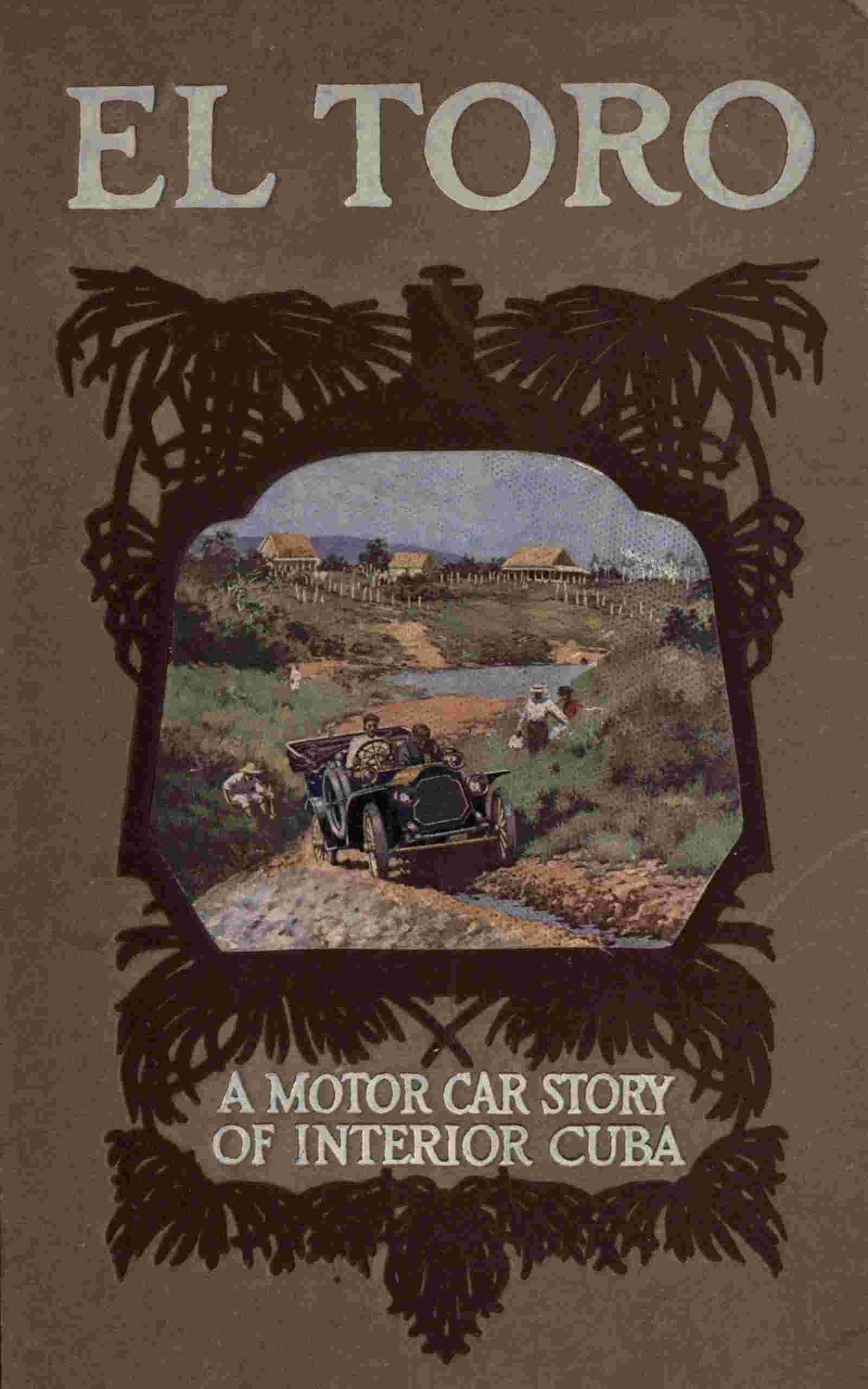
PREFACE
Occasionally business has experiences which are interesting on their own account. To set them down in words is an agreeable task and entirely different from the making of business literature of the familiar kinds. This narrative is just the relation of what happened, when, on other business bent, we strayed into the unknown and stayed to have a motoring experience, which was far enough from the conventional to deserve a place in the realm of adventure. The tale is here recounted in the hope that it will possess for others a degree of the interest which, for ourselves, has made it a substantial part of our recollections. Most of all, ye unworthy scribe hopes that the narration will be acceptable to those who made it possible—to Sidney D. Waldon, father of the great idea and leading spirit of the enterprise resulting therefrom, Edwin S. George, Fred Crebbin and Rogelio Gaarken.
E. R. E.
Detroit, April, 1909.
“Once in a while a good sort of winding dirt road gave promise of speed.”
CHAPTER I
Red and vivid against the dense night, a camp fire of palm bark flared, fluttered, and went out. Its momentary glare illumined one of those strange scenes, occasioned by strange people being marooned in a strange place. The rest of the world, which seemed very far away, was shut out, on the one side, by a reef of palm trees sharply silhouetted against the somber sky and, on the other, by a barrier of hills.
“Are we up against it?” Crebbin spoke.
“If you mean by ‘it’ that hill yonder, we are.” Waldon answered.
Three jaded men sat around the fire. Like the fire, their conversation had flamed and gone out. They gazed into the darkening embers, mused on the strangeness of some things and speculated on the final solution of the problem which was theirs by reason of their present whereabouts. A palm tree, which had never before enjoyed the company of a four-wheeled vehicle, stood sentinel over an automobile, from whose tonneau protruded the feet of a folded and, presumably, sleeping figure. On a bed of brush slumbered the only one of the party who was native to the country and thereby accustomed to its lack of things comfortable. The others had abandoned this bed on which they could not sleep, had scoured the unfamiliar woods for fuel and had amused themselves by keeping an unnecessary fire ablaze, for the mere companionship of its warmth and for its light, which drove away the trepidation of loneliness. There was no noise, except the strange sounds from the underbrush and palm forests.
The strangers were ourselves. The native was our interpreter.
We were thirty miles from Havana, Cuba. In our sleepy thoughts, Cuba was a mighty big place, Havana far away and our own homes as distant and chimerical as the moon. The moon did not shine on that part of Cuba that night. We were a discouraged bunch, with only a few stars on which to hang our sense of location. Our hopes were in cold storage. We marveled at the wildness of a land that was figuratively but a few steps from the gay and careless Havana. We laughed hysterically at the recollection of our day’s performance in bringing the car over the roadless country whose stone trails are followed only by ox carts and ponies.
Remembering we were bound across the island to one of the oldest of its very old towns, we realized that, when dawn should raise the curtain on the scene night had shut out, we would be almost up against the impossible. However, we did not seek to pry into the future. We simply tried to neglect it. We were not sure where we were and we did not care very much, because it made no difference. It was just about as hard to get into and out of one place as another. We had learned much about Cuba in a few hours.
We imitated sleep with apathy. Occasionally, we tried to bring the real world back to us, by noisily gathering more fallen palm bark for the fire. Palm bark makes a poor fire for the cheering of lonely spirits. It is a fickle stimulant, the effect being great while it lasts, but it does not last long enough to give any real comfort. The dead, dark, cold night was depressing.
We were startled like children when the thundering of near-by hoofs awoke us to the fact that we were no longer alone. The insurgents were busy in Cuba just then and we had not been there long enough to learn that Cuba and insurgents are not bad, but just naughty. The disturbers were as surprised as we. One was a country doctor who was riding miles to visit a stricken “spiggotie” in some distant hut.
A spiggotie is any kind of a provincial Cuban, when mentioned by an outsider. He is one of that species of uncertain race which populates the Spanish-American countries and makes it difficult for a visitor to draw a color line between negro and Castillian blood. I have also met spiggoties who were a charming mixture of Spanish, negro, and Chinese.
The doctor looked down from his pony at us in wonder. His servant on the other pony was alarmed. Presumably, he never had seen an automobile before. Having lived in the midst of three or four puny wars and one real one, he showed the common spiggotie attitude of being suspicious of everything that was not Cuban and regular. The doctor gave us the customary “que hay,” and we awakened the interpreter to say it back to him.
A Cuban does not say much, but he uses a lot of words on the job and is willing to put a highly dramatic touch to the most trivial question or remark. Our interpreter was fully impressed with the honor of being a part of the first automobile expedition across the rough provinces of Cuba. The rattle of Spanish was like two kettle drums in action together.
Evidently, the doctor asked all that could be asked and the interpreter told him more about us than we could have told him. We tried to break into the conversation, but the interpreter was disposed to consider our assistance as a hindrance. We pried one unconsoling fact out of him. The doctor thought we were more than right in supposing we might be up against it. He named about a hundred rivers and a thousand hills which were impassable. He explained that the trail we were following did not lead anywhere, that there was no trail which led anywhere and that there was no road which could be followed. He said that we would have to go back. Then he said that we could not go back. That we had come this far seemed only to impress him with the fact that we must have dropped out of a cloud or come in an airship. It was certainly impossible to make him believe we had driven an automobile from Havana.
Thirty miles is a short distance for an automobile in some places. Between Philadelphia and New York it is a matter of thirty minutes. It had been a matter of five or six hours with us, there in Cuba. We were glad to have the doctor go on his way, for we had heard enough about deep rivers, steep hills, walls of rock, and crooked gullies. We wanted to think about something else until daylight. At least we had rather think about what had been than what was to come. It seemed strange that so much could have happened in the last twenty-four hours.
There was an element of humor in our plight, but we were not in a humorous mood. There was great beauty in the wild, dark night for those who were used to the quiet, homespun nights of Wayne County, Michigan. We knew that we were missing the enchantment of the hour, but we were not in the mood to mind missing anything.
We were the victims of our own imagination rather than the victims of circumstances. We had imagined that Cuba was a sort of national park with an immense system of boulevards. There is one magnificent highway in Cuba, fifty-two miles long, which reaches from Havana to San Cristobal. In publicity it reaches around the world. It has been the course of automobile road races. Automobile writers, attending said automobile races, wrote columns about the beautiful Cubaland, in which the wandering motorist from the north may drive as fast as he likes, while balmy breezes blow across the palm-sentineled macadam. The government has started a road from Havana eastward across the island. Some of this has been surveyed, a little of it graded and it actually exists for a half-dozen miles out of Havana. Down in Santiago province, General Wood has built a road or two. The middle of the island is roadless. There is no continuous travel by vehicle.
Havana presents a wrong idea of Cuba. It is a tourists’ town. It has boulevards and carriages. Cuba has wandering trails and ox carts. No four-wheeled vehicle is used outside the towns. Probably no vehicle of any kind, unless in time of war, ever has made a continuous journey across the island. The ox carts are for local travel. Cross country travel is on foot or on ponies.
Yesterday, on the little coast steamer which carried us across the gulf, we had discussed with eager expectance the fascinations of touring in Cuba, as presented in the steamship company’s alluring pamphlets. We had come south with a Packard car to run it fast and furiously for thousands and thousands of miles under hot weather conditions. A Cuban on the steamer listened while we recounted our plans for this great trying out of the speed and endurance of our motor car. He asked us:
“Have you ever been in Cuba?” and, upon our negative reply:
“Do you really think you can drive an automobile through the interior of Cuba?”
We assured him that we could drive one anywhere, but he merely laughed and sauntered away to tell the other passengers what seemed to him to be a funny story. Other Cubans talked to us. They were all iconoclasts and some of them were plain “knockers.” At first we were insulted and then our peace of mind was destroyed. Slowly, but surely, we approached the truth. Everywhere we turned for a reassuring opinion concerning the suppositious highways, we got the same answer:
“There are no roads; you can’t do it.”
They all explained the impossibility of traversing its valley lands and mountain regions, of making even a most laborious way across the arroyos, through the bridgeless rivers, over the barren stone, and in the wide swamps. There are roads on the map. The maps were originally made by Spaniards with a greater regard for neat drafting than the truth. It is hard to find those roads on the earth. Their course occasionally is marked by washouts.
We slept on the information but gained nothing. This day we had left our cabins early, to catch the first morning glimpse of the beautiful harbor of Havana. As we looked upon its blue shores, under the bluer sky, and felt the charm of early southern morn, it seemed impossible that such a most excellent place to come to could be without roads leading from one beauty spot to another.
The original Cuban came along with a parting slam at our hopes. We were saved from developing a streak of yellow by being carried to a close view of the sunken “Maine.” While our little ship was at anchor, waiting for the tender to land its passengers, we surveyed that unprecedented monument resting in the middle of Havana harbor and our American blood created a stubborn desire to conquer Cuba, roads or no roads, if it took all the gasoline in the world and all the tires in Akron, Ohio.
We were whisked from dreamland into the confusion of the custom-house. Meekly as possible, we suffered the high-handed tactics of the revenue officers. These new Cuban officials, who used to be flunkeys in the household of Spain, with their new freedom and their new uniforms, are arrogant. Some day, if he has not already done so, an American chap, with more valor than discretion, is going to jail for hitting one of them.
It is a land of mañana, these being the headquarters. You can do anything to-morrow. All you can do to-day is to fume and go up to the Prado, where there is a good street eating store, and get acquainted with café con leche. Every addition to our list of Cuban acquaintances added further proof of the impassability of the Cuban interior. It is easy to be bold before the battle. We felt as bold as Moro Castle looked across the bay, when we drove around the beautiful shore drive toward Camp Columbia and for a wild, hilarious rush out on the wonderful San Cristobal road. We rushed back again to Havana because we were eager to tackle the impossible.
Two native sugar planters, who had grown white haired in middle Cuba, were introduced to us at the Hotel Pasaje, as conclusive evidence that we were venturing on a dangerous and incredible journey. We listened to them while we changed our northern garb for clothes more suitable to the task ahead of us. At the local garage, we engaged an interpreter, commonly known as “Cuba.” He had had some experience as a chauffeur and was the only person we could find who seemed to think there might be a chance of getting beyond the eastern limits of the city. The proprietor of the garage cheerfully assured us that we would never reach Matanzas.
So we left Havana.
Driving on the boulevard which sweeps around the harbor, it was incredible that the ending should be a great desert of broken rock. We did not speculate on the future, but were satisfied to rush over the undulating macadam, rolling up an immense funnel of white dust which spread clear to the tops of the regal palms along the roadside.
Our future was hidden by the hills in front of us. We did not care. It was enough, just to dash at racing speed past little scarlet Edens among the bright flambollan flowers, where the silver-tongued moscareta warbled his southern song behind the leaves of the spreading laurel and the merry tomequin answered from the majestic ceiba. It was enough, just to fly past palm-thatched huts and wave at the insular urchins who, partly curious and partly fearful, were half-hidden in the doorways. It was enough, just to watch the little speck on the far hillside become a bold, commanding block-house as we raced toward it. Block-houses are still popular in Cuba. One meets up with a block-house on almost any hillside, whether or not there is any apparent habitation in the region.
A few miles and it all ended. The boulevard became merely a long stretch of rough white stones—a new generation of road in the making—level and almost straight, but with no surface over the jagged rocks and no bridges over the many streams. So we drove, part of the time over the rocks and part of the time in the rut-worn gully below. It was hard going, but not impossible. Anyway, it did not last long because this particular road ceased entirely. We were in the middle of Cuba.
A mere path straggled over and among the hills and was lost in the great patches of native rock. We began to take the country seriously. Trepidation mingled with curiosity. Once in a while a good sort of winding dirt road gave promise of speed, only to change, like a dissolving lantern slide, to a staggering trail over the rocks or between them. The stones increased in number and in size. Each occasional break in the bumping, swaying, swinging, car-racking, tire-tearing progress became shorter. We forgot the stately palms, the queer huts, and the beautiful red flowers. We did not even hear the evening song of the many birds.
“Insular urchins, partly curious and partly fearful, were half-hidden in the doorways.”
“Everywhere was stone.... Each mile was gained by defiant effort.”
Everywhere was stone. Even the rough fields were so littered with loose rock that cultivation had not been tried. Each mile was gained by defiant effort. We began to worry over the fact that, not only were the prophets vindicated, but their prophecies had foretold worse conditions the farther we went eastward. We thumped along to a deep valley from whose bottom the sun had already fled and on whose far side a great bluff of solid rock arose to dispute our way.
Night does not settle in Cuba as it does in New England. It snaps, or, rather, day snaps into night. Twilight is not long enough to deserve the name. The task of getting to the opposite crown of the valley was too great for the few minutes of remaining daylight; so we camped. We were not prepared for camping, because we had anticipated spending our nights in villages or towns. We had learned a lot that afternoon and were still growing in wisdom. We made particular note of the point that when one is traveling through that country in a motor car his night stop is invariably just exactly where he happens to be when the sun sets.
That was a wonderful night. It was dark when three of us, including the interpreter, struck into the region of awesome shadows and shivering noises, seeking habitation and food. We could see nothing. We simply wandered and yelled to attract attention. Every time we sent a loud “que hay” reverberating among the hills, we jumped at our own temerity. At last a hound bayed in answer and a feeble light flickered far off, up in the sky. We trudged up another hill toward it.
A gaunt, scraggy Cuban met us. We watched his long machete with fascinated eyes, while the loquacious “Cuba” gave him a detailed account of ourselves, in Spanish. The Cuban welcomed us to his home, a hut of palm slabs roofed with thatch and floored with dirt. By the sinister rays of a small oil torch, mother and children ate a meal of pottage. The children cried and we gave them a few Spanish coins. Charity is cheap in a country of depreciated silver.
We asked for water, and it was drawn from a pigskin. We asked for food, and were told that on the next hill-top dwelt a Great Señor—one Govin, owner of the big newspaper in Havana and who could speak English. We matched coins to see who would venture back alone to the somewhat distant camp with a bucket of water. Crebbin lost and trundled off into the darkness, seeking the light of the bonfire, which furnished our only clue to the whereabouts of headquarters.
Under the talkative guidance of our still wonder-struck Cuban friend, we found the other house. The owner was brought out of bed to hear our reason for being there. He was much interested and much surprised. He was glad to give us food but he refused to be in a hurry. Also Señora, before she started to the kitchen to get us guinea hen and yams, insisted that the strange tale be repeated to her.
The house of Govin was high above the surrounding country, but there was nothing to see in the darkness and nothing to hear except the barking of dogs and the echoing sounds from distant woods.
Across the front of the low, board house ran a long porch. So closely framed it was in shrubbery, and so dense was the night packed around it, that there was almost the privacy of a room. The master, in his half-attire of white linen, kept up a running fire of conversation, partly in Spanish through and to the interpreter, and partly in English. Highly interested, but, for the most part, quiet, were the several laborers who shared the hospitality of the porch. Occasionally they interjected rapid exclamations and questions in Spanish. It was hard to concentrate upon Señor Govin and our conversation.
The curiousness of the situation had unraveled my nerves. Never before had it seemed possible that a person could be so comparatively close to accustomed things and yet be so isolated. The whole scheme was like a bunch of dramatics grabbed from a play or torn from a copyrighted novel. Persons who are not used to prowling about the back yards and blind alleys of the world find it hard to adjust themselves to strange society, except in the broad light of day.
Probably the two at the roadside camp a mile away, and the one struggling along the hilly trail with a bucketful of water, felt the impressiveness of the night as much, or more, than we who sat on the Govin porch and talked with the Govin family.
It was a romantic situation until Govin, innocently desiring to please, cracked the grandeur of the night and pierced the helpless heavens by turning on the rusty voice of a battered ten-dollar phonograph.
Finally, we ate our delayed supper at our own fireside. We were not yet sleepy. The food and warmth cheered us, for although the days be hot in Cuba, the nights are cold. Twenty-four hours had not acclimated us to a change of fifty degrees in the temperature with the setting of the sun. Then began our vigil.
Thirty miles back of us lay Havana with its gay opera, its bright cafés, and its dirty hotels, swarming with tourists. Thirty miles back lay a world’s city, known to the world, close to the rest of the world, and familiar to the world as any other capital. Thirty miles back lay our expectations, our fancies, and our nerve. Thirty miles back lay the things we knew. This was unknown wilderness.
Havana to Camp Solitude—thirty miles.
“A hill like a natural stairway of great, rough limestone steps.”
CHAPTER II
Second-hand breakfasts, made from the ruins of supper, are never pleasant. It is less pleasant to meet the cold, damp, gray dawn without even the satisfaction of awakening from sleep. Our second morning in Cuba,—we stolidly watched the dark sky turn into tawny streaks and gradually brighten into daylight. We ate a few crackers and gnawed at a few left-over guinea hen bones, with tea, brewed in a tin cup, for a chaser. We were impatient for the sun to drive the chill out of the morning and out of our bones.
Now we faced the toughest proposition we ever had met; so we dodged it. Easier than trying to climb the bluffs that blocked the way was a circuitous route over the top of a wind-blown, grass-covered hill in somebody’s field. We broke down the stone fence, drove the car through, and dashed over these fields, skipping from one hill to another. At last we brought up at the back door of the house of Govin. He gave us advice and bananas, both of which we swallowed as fast as we could.
Bananas in Cuba are fine; advice is poor. We were in the center of a magnificent panorama of hills, very green, and fringed with palms that reached the horizon and seemed to be everlasting. Señor Govin had selected his home well. It was a beautiful and wonderful country. Also, it was the third of January and the now scorching sun had warmed us to the continuance of our fight against the rocks. Courage had returned and we were willing to accept whatever Cuba had to offer in the way of highway difficulties.
What happened the day before we forgot. There is no time to remember, when journeying as we journeyed. The new difficulties are so rapidly encountered that each experience wipes out the recollection of the previous one. With a good-bye from Señor and a smiling adios from Señora, we ran down a long, clay-covered lane to the stone-floored valley, which was the only road there was to follow. That day we took the measure of our ability to strike the first two letters off the word impossible.
We discovered a new kind of hill—a hill like a natural stairway of great, rough limestone steps. It was steep enough to be an almost impossible climb, even had it been smooth. At the left was a deep gorge on whose bottom wound the rusty rails of the Havana Central. On the right was a plowed field, crossed by gullies and covered with stones.
“The clearance of an ox cart is thirty-eight to forty-eight inches.”
“At Jaruca, the whole town joined us at luncheon.”
Stones, by the way, do not affect agriculture. The soil grows its crop whether cleared of stones or not. They hitch a squad of bulls onto a plow and literally rip up the face of the earth. Then they plant sugar cane. After a while they come around with machetes and cut it down. Next they load it, in half-ton bunches, on ox carts and haul it to the mill. If the roads become worse, by the deepening of the immense ruts, they put on higher wheels and more oxen.
The clearance of an ox cart is thirty-eight to forty-eight inches. When it is wet the carts sink into the earth up to the hubs. They travel in groups, so that when an extremely bad place is reached, the oxen from several carts may be hitched onto each cart in succession. It takes from four to twelve oxen to pull an ordinary cart.
We surveyed that particular hill from all angles, reconnoitering the railway track, the fields, and the hill itself. A native, who happened along, showed us how to cut off the tail of a scorpion with a machete so that he becomes a safe companion. There are scorpions under most of the rocks and there are lots of rocks. Centipedes are correspondingly numerous. We climbed the hill itself, filling the jutting surfaces of the step-like rocks with loose stones and, then, driving up the rough, perilous incline by sheer power.
Next we found that getting down the opposite side of some of these stepped hills was likely to be harder than getting up. They are so steep that the car slides with the wheels locked. Once we had to fasten a rope to the rear end of the car, give it a couple of turns around a palm tree and let the car go bumping down, a yard at a time. At one place we were lucky enough to find a couple of planks which had been used to bridge a shallow creek, so we drove down the hill by using the planks for skids from one step to the next.
Our first ford was a wide, shallow stream with a hard rock bed. Through the clear rippling water of this first river the car shot with a great splurge and spreading of white spray. We had dreaded the rivers which had been pictured to us as impassable. By this stream was a country grocery, in front of which lounged a rural guard. We asked him if this was a typical river. He laughed and started to tell us about deep torrents that flowed over beds of stone, between wall-like cliffs. We changed the subject and dickered with him for his machete, with which he claimed to have killed seven Spaniards during the last war.
Rural guards are near soldiers. They get more money than United States regulars and wear better clothes, with celluloid collars that are wiped clean every day. They carry machetes and revolvers. They will sell either or both. They ride good ponies and go to country dances. They are not impressive.
“Through the clear rippling water of this first river the car shot with a great splurge.”
The route continued an interesting one. There are more kinds of trail in a half day’s journey in Cuba than there is in going from Hell’s Gate to the Golden Gate. A comparatively level stretch of red dirt, strewn with boulders, suddenly leaves off in a tract of grass where the route is marked only by stone fences. Where the red soil is hard, the travel is not extremely difficult, the principal obstruction being loose stones, which must be dodged. The same dirt, soaked up by a heavy rain, becomes a bottomless mire. In some places there is nothing to follow but a path through high-growing sugar cane. In other places, unless the ground is seamed with deep ruts by the continuous travel of heavy ox carts in wet weather, the only thing which signifies a traveled path will be the country stores. Some of these are in board houses. Most of them are merely thatched huts. They all keep a little supply of vile liquors and canned meats. At some of them it is possible to buy oranges and bananas.
During those scorching days, with infrequent opportunities to get good drinking water, we quenched our thirst with the juice of many oranges. They are little ones, but cheap and good. We bought them by the dozen and threw them loosely into the folded top, back of the tonneau. Bananas we ate immediately upon purchase. The tree-ripened bananas of Cuba are very thin skinned and delicious, but one hour in the sun spoils them.
Our second morning’s work, to relate, would appear to be the tale of a long journey. As a matter of fact, we laboriously worked our way over the rocks for a few miles to Jaruca, where we stopped for lunch. Jaruca was our first interior village. We had passed no towns since leaving Havana. We got our initial experience of a typical inland meal and started in learning to like the peculiar style of cooking which is partly Spanish, partly devilish, and ninety-five per cent. grease.
The main thing to eat is a pottage of beans and meat, fried bananas and chicken or guinea, cooked with rice. In the large towns or in places near the rivers or along the coast, there is always fish. The bread is good everywhere. It comes in small individual loaves and is so greatly “shortened” that it needs no butter, which is a good thing. There is no butter, except the canned stuff shipped in from the United States. This is impossible. It looks like melted vaseline. We did not taste it.
At Jaruca, the whole town joined us at luncheon. Only those who had been to Havana had seen an automobile and some of them had never heard of one. They were all timid. In addition to which, we were Americans. The interior Cubans have a very sensible respect for los Americanos. They are frank in their inspection of a stranger. At the café, where we sat at a corner table almost on the sidewalk, we were surrounded by the closely packed populace, that carefully examined our make-up, from toes to turbans, and discussed us in Spanish. Those who did not stick by us during the meal clustered about the car. Hunger is a preventive of embarrassment. Besides, we broke even with the town by scaring it out of its wits with an exhibition of fast and fancy driving on the way to the edge of the village.
That afternoon we made good use of our hatchet. Many times there would be several drops, or great depressions, in the rock and at each place we would have to cut down underbrush alongside the path that we might get around the hole. Much of the driving was in deep trenches where the travel of many ox carts had worn the ruts into a ditch. For hundreds of yards we drove between these close walls of dirt, where the grass-covered ground, on either side, rose higher than the car. This ditch, winding past rows of huts in which lived sugar plantation laborers, debouched now and then into open territory, where the road was any feasible way among the shrubs, rocks, palms, and ruts.
We began to tire under the hard work and were glad that the sun was sinking rapidly toward the line of hills back of us. We hoped to reach suitable shelter before dark, for we needed a night of real sleep. We struck the first river of consequence, and one of us waded through it to find out where and how we might cross. It was not difficult, but this was not the region of rivers. We had yet to cross the ones of which we had been warned.
Rivers down there are both a blessing and a curse. They stop traffic and they stop thirst. There are but few wells. We struck one artesian well which supplied water for many square leagues. A league, incidentally, has its own meaning, being a colloquial measure of about a mile and a half, instead of the usual three miles implied by the marine kind. Most of the drinking water comes from the rivers. It is carried away in cans or water jars. The former are principally five-gallon kerosene cans saved for the purpose. It is not very good water and, unless obtained at a store, is given one to drink from a porron.
A porron is a Spanish-made clay bottle with an opening at the top, through which to fill it, and a small nozzle on one side, through which to empty it. The use of the porron is the only visible evidence of cleanliness on the island. It is against all etiquette and many rules to touch the spout to the lips. You simply aim as well as you can and hit your mouth as often as you can.
We ended our journey at Benavides. Benavides is a dot on the map. In reality, it is a board hut, yclept grocery. We had fought our way thirty-four miles. Hungrily impatient, we waited in the stone-flagged main room of the house for a much-fried supper. We ate it by the glimmer of a side lamp. Around the dirty table at which we sat, collected all the inhabitants of the house, and a dozen others who must have lived somewhere but who appeared and disappeared in a mysteriously dramatic fashion.
It was a dismal meal and a poor one and we were cross. We were glad to creep onto the wire spring cots which they spread for us in a partially enclosed corner of the hut. That night we accrued some more wisdom about touring in Cuba. We undressed, for we had not yet learned our part, but that was the last time we were so foolish, except one joyous night when we put up at a regular hotel in the real city of Santa Clara.
Each of us had, underneath, a wire mattress, and, on top, a starched sheet. Cold air rushed through the meshes of the woven wire, for the night was a chill one, while the starched sheet felt like the dank sides of a sepulchre. Outside, innumerable pigs grunted between the several acts of a protracted dog fight, and the chickens, which roosted in the house, fluttered from one corner of the room to another; the many fleas were still bolder.
There is an intimacy about living things in Cuba which is somewhat appalling to a man who has been more or less used to picking his associates, or, at least, his family. Cats, dogs, chickens, and pigs are welcome in the household. The children sit on the floor and quarrel with each other and with the dogs. It is not infrequent to find a hut which has its household snake. There are no poisonous snakes on the Isle de Cuba, but there is a large brand which looks as if it would like to be poisonous if it knew how. Just as the family dog, in Illinois, protects the house against burglars, so the family snake in Santa Clara Province protects the house against rats—but this is not a tale of grewsome things.
Each successive night had its elements of humor, but that night at Benavides we had not yet arisen to the greatness of mind and broadness of character which permitted us to enjoy the humorous phases of the evening. We rolled around on our cots to change the water marks which the wire mattress made in our skin, and tried to sleep during the brief intervals between occasions when it was necessary to awake and pull the sheets back onto us. If all of the other fellows had the same shrinkage of the soul which I experienced that night (and, out of fairness to myself, I think they did), the expedition came awfully close to needing an epitaph.
Camp Solitude to Benavides—thirty-four miles.
“We drove under the everlasting palms and among boulders half-hidden in the luxuriant grass.”
CHAPTER III
Heathen who worship the sun are not such bad philosophers, after all. For the second time we learned that the bright sun changes the circumstances; so we resolved to make our pluck last from sunrise to sunrise, instead of from sunrise to sunset. We were sanguine travelers who set out from Benavides to Matanzas, over a fairly good yellow clay road which lasted only about one-third of the nine miles to Cuba’s show town at the head of the Yumuri Valley. We gayly bid good morning to the familiar rocks.
Crossing them was not as hard work as it had been the first day. Places which had puzzled and almost stumped us, we crossed with Icarian abandon. Waldon, at the steering wheel, had learned new tricks of acrobatic motoring and all of us had developed unexpected ingenuity in makeshift road engineering. We did not waste any time in rolling away the wrong rock or any other rock than the one whose removal was absolutely necessary to make progress possible. We had developed a system of team work and were able to go over these patches of rock at four or five miles an hour where, previously, we had been able to make only two or three.
Coming to a place where there was a new road under construction, but not far enough under to be used for motoring, we encountered the contractor in charge of the grading. He was an English-speaking Cuban, who had served time in the United States, and was greatly amazed at our approach. The only way we could convince him that we had driven from Havana was by pointing out that we could not have come from any other place. He seemed to like us and so gave us all the information he had concerning the impossibility of going any farther than Matanzas.
Every first-class city in Cuba has a road. It does not straggle out of town. It darts straight into the country as though it intended to cross the island. After a couple of miles it stops, as if the money had run out, the mayor had died, or some other calamity had occasioned its sudden ending. About six inches past the edge of the macadam there is likely to be a deep morass, a bed of rocks that look as though they had been thrown there from a volcano, or a great confusion of bottomless ruts. There is no such thing as a compromise between the good and the bad. It is either one or the other. We struck the good about the time we came within sight of the cathedral towers of Matanzas.
It was quite a novelty to drive fast over the smooth macadam. We had almost forgotten that we ever had been in any other country or that we ever had driven an automobile fast enough to roll up dust. Passing a beautiful cemetery with a magnificent wall and gateway, the interpreter explained that it was possible for a Cuban town to maintain a beautiful cemetery because it leases the lots instead of selling them, and the income from the dead is fairly permanent. Edwin made a real joke, by asking what they did with the dead beats who did not pay the rent.
An astonished rural guard, on the outskirts of Matanzas, was glad to drop his duties and accompany us in the car to the center of town. He guided us to the Grand Hotel Paris. That word “grand,” as applied to the Cuban hotels, is a great deal like the word “best,” as applied to automobiles in American advertising. There are so many Grand Hotels at which one would not stop, except out of necessity, that the word has lost its meaning. This one, however, was fairly deserving of the title and we were immediately charmed with the clerk.
Rogelio Gaarken was his name, and he was the first Cuban we had met who did more thinking than jabbering. “Cuba,” our original interpreter, was to go back to Havana from here, so we shanghaied Rogelio, much to the disgust of the proprietor, because this was the tourist season and Rogelio was needed to bring down Havana’s overflow of sightseers at eleven dollars per, guide to the Yumuri Valley and dinner, with a thirty-cent bottle of wine, thrown in.
It was nine o’clock when we reached Matanzas and two o’clock when we left. The visiting fever had struck us and we loitered away the hours seeing some of the most convenient sights and adding to our stingy supplies. We put in some groceries and road building hardware, including a mattock.
A mattock is worth two dollars in Spanish money, but in usefulness it is worth twelve shovels, six crowbars and three hatchets. The pick end is the best mechanical substitute for dynamite, while the wide blade on the other side can be used for anything from chopping out shale and rock-like clay to peeling sugar cane for luncheon. We also purchased as much gasoline as we could carry, for Matanzas is the only place in Cuba where it is refined. Gasoline is an uncertain quantity down there. We had got beyond being critical about the uncertainty of its quality. The smallest town has kerosene and some of the country stores carry benzine. Gasoline is only found in the larger cities, where the mayor or some other dignitary owns a gasoline stove.
The government engineer of the Province of Matanzas gave us a blue print showing the way we should go toward Santa Clara. After he had finished his elaborate directions, he told us that it would be impossible to travel that road. He said that we might go a little way but would soon come to a river fifteen to twenty feet deep and a hundred yards wide. Our only comment was:
“Adios.”
Jagged rocks had made our tires suffer and we were not well supplied with extras. “Cuba,” returning to Havana, carried word to the garage there to ship new tires to us at Santa Clara. As we followed the blue print out of town, our conversation dwelt on the river.
Slowly and laboriously picking our way toward the wide, deep gorge in which the dreaded stream itself was hidden, we schemed out a lot of things that would have been a credit to Robinson Crusoe and other noted performers of bogus engineering feats. Our favorite plan was an immense raft of palm trunks, it being agreed that, if we worked all night, we could probably get the raft ready to float by morning.
We came upon the river unexpectedly, our first intimation of its whereabouts being three bare piers sticking above the bluff and telling of the destructive march of Weyler through a province that once had boasted a few century-old bridges. Then we saw the river. It was as dry as the top of a hill, a fair sample of the many valleys floored with nothing but rocks of volcanic roughness. It was marvelous that the tires were not literally torn from the rims and that the twisted wheels and groaning frame did not weaken under the strenuous task.
Having crossed so much rock, we argued that surely nothing worse could be ahead. We began to gain confidence in ourselves and to lose confidence in Cuban information. When the government engineer of a province did not know that a river a few miles from his office was only full of water in the wet season, we concluded that the mere prophecies of provincials were not worth worrying about.
Ambling along until nightfall, we often crossed fields where it was easier to take a roundabout way than to try to follow the trail. Slowly we drove under the everlasting palms and among the boulders half-hidden in the luxuriant grass. The war had bled fast and furiously around here. Stone houses of the Spanish period all were gone or stood in ruins, dim pages in the history of minor battles which never will be written. The country had blossomed again. The red flambollan, the stately sugar cane, and the fast-growing bananas had wiped the stain away, but thatch-roofed huts replaced the old Spanish houses which once reared picturesquely in wild regions.
For miles the road would be marked by wavering stone fences, but there was nothing between these fences to show that it had been used since the war or that it ever had been anything else than the rock-strewn virgin soil. Sometimes the grass grew as high as the car. Sometimes the fences would be long lines of palms, framing a magnificent vista of miles upon miles that ended in the blue, blue hills at the horizon. Had there been a road between these fences or between these palms, Mercury himself could have asked no better speedway.
As the country became flatter, sugar plantations became larger and more frequent. Now and then we would strike the railway, at a sugar mill siding or where it passed through some village. We scared the whole town of Limonar out of the lethargy into which it had sunk since the war. Isolated and without excitement save local brawls, dances and cock fights, the sudden bursting into its midst of a motor car, manned by Americans, was like the bursting of the first bomb of another war. Having stopped to buy oranges, the inhabitants—men, women, debutantes in sheath gowns of the original pattern, and little children—chased us as far as they could hold the pace. This was easy until we found a fairly level field and drove out into the loneliness of vast country where there is nothing except the rapid growth of wild plants and grasses.
Recklessly we drove through deep grass, among the burned houses and ruined fences, always reminding us of the fact that we were probably the first to follow across these provinces in wake of the devastating armies of a decade past. Hidden in the grass were ruts that had been cut by heavily loaded ox carts years before and which had hardened almost like rock.
Eventually we arrived at Tosca, a handful of huts set in a bleak region of grass, where there were not even palm trees to hide poverty and desolation. We had ceased to ask if we might stay. We simply announced ourselves and took what we could get. Here, it was a supper of our own canned stuff, purchased at Matanzas; eggs which we bought of one of the farmers at a dollar a dozen, and bread furnished by the hospitable family which had nothing else to offer, except the use of their living room. We ate by candlelight, under the curious gaze of astounded farmers, timid women, and the frightened glances of little babies, who sat on the floor and sucked sugar cane.
Every time we gathered, in the evening, around some Cuban farmhouse table, we were impressed by the fact that our trip had two distinct parts and was, in reality, two distinct journeys. One was a journey by day, over a hard and trying land. The other was a journey by night, into many peculiar places. By day, we worked and studied the country. At night, we loitered and studied the people. Each day was complete in itself. We never paid attention to what had passed or to what might come. Perhaps, because we were tired, generally, it was easier than thinking, speculating, or planning, just to sit among the Cubans and be interested in them. Little things were mutually amusing.
The fact that we brewed tea in huge cups and drank it in huge, hot gulps amused the Cubans. Courteously and gladly, they heated water and, then, laughed to see us pour it on the little green leaves. On the other hand, we were amused by the universal presence of sewing machines. The smaller and meaner the hut, the more prominently loomed the sewing machine. The real Cuban lives in almost squalor; dresses in almost rags. The squalor is accented by the sewing machine. Ragged pants are sewed together and patched, likewise.
The Cuban has a few passions. He gratifies these and does not give a rap for anything else. The sewing machine is evidently one of the national passions—carefully cultivated by the enterprising foreign department of the sewing machine trust. But the greatest of Cuban passions is gambling. The lid is on bull-fighting and cock-fighting in Cuba. It is a leaky lid. When Saturday night comes, the ragged Cuban goes to a dirty corner in his dirty hut, raises a dirty board and brings out a dirty bag, in which are many dirty Spanish dollars. He places the bag carefully under one arm and under the other, still more carefully, he places his favorite little black rooster and starts off for the nearest cock pit. Money is merely a medium of wager.
Our daily march was improving. We had gone forty-four miles.
That evening we spent rearranging our supplies and tools in the tousled tonneau. Whatever we had that was not necessary we threw away, and placed our road implements where they would rattle the least, knock our shins the least, and yet be ready for instant use. Then we raised the top and entertained each other with merry persiflage, until we were sleepy enough to lay down in our clothes on benches within the hut and forget it.
Sleep was our greatest need. Shivering through long wakeful hours of another night spent in our clothes, on hard boards, attacked by fleas, and awakened by the clamor of yawling dogs and puling chickens, we found a tonic in Rogelio, whom we called “Roe.” He was an excellent type of that dark-hued, wiry Cuban, whose well-chiseled features and wonderful black eyes are far superior to the alleged beauty of the Cuban woman. Some of the mahogany-tinted country women have such eyes, but never the señorita of the town. The latter is, in most cases, simply a human synonym for talcum powder. I would like to corner the powder market in Cuba.
Rogelio was quaint, as well as handsome. Some ancestor had been a humorist and a philosopher. Rogelio became one of us. He made it easier for us to look up at the dark, thatched roof and to fill our sleepless moments with laughter instead of commiseration.