
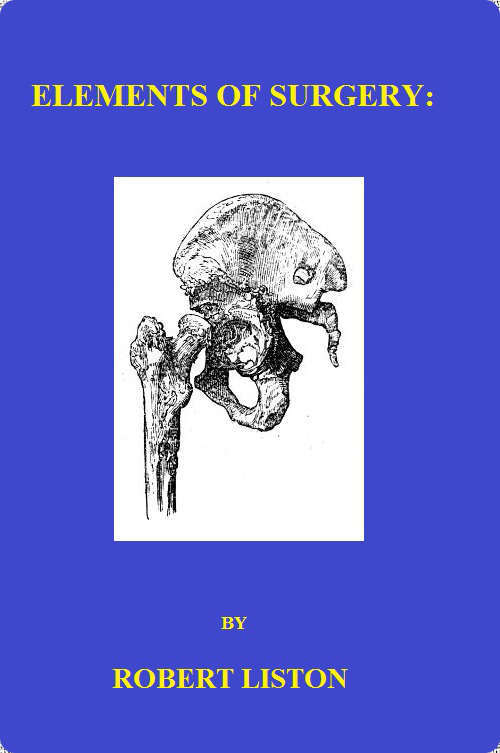
The formation of matter is preceded by great pain, and frequent startings of the limb during sleep, accompanied with fever, and other symptoms of severe constitutional disturbance. On the escape of matter by the natural process from the capsule the painful feelings usually subside. The abscess may appear, as already stated, near the trochanter major, or in the back part of the thigh. Matter sometimes makes its way into the pelvis, through a perforation in the acetabulum, thence it may fall through the sacro-ischiatic notch into the thigh, and find its way under the fascia, nearly to the knee; or again, it may present to the side of the rectum, or even, as I have seen, burst into the bowel and continue to be discharged thus for a long period. If the treatment is neglected, abscess succeeds abscess; and in consequence of the profuse discharge, which may be evacuated from one or many openings round the joint, the patient is at length exhausted, and sinks. In some instances the spontaneous cure by anchylosis occurs, as in the instances from which these sketches are taken. In the one, the head and neck of the bone had been almost entirely destroyed by ulceration, before anchylosis had begun; in the other, the change is very slight, but the head of the femur and os innominatum are inseparably united by bone, and their cancellated texture runs into each other. Or when the femur has been dislocated, which is a very rare occurrence, the disease sometimes gradually abates, and a sort of new joint is formed; the limb, after some time, may thus again become so far useful to the patient.
In many cases, the appearance which the various parts of the diseased joint present, are similar to those which have been already described when treating of affections of the joints generally. Frequently, however, the osseous tissue in this situation is much more extensively affected. Often the whole cartilage on the head of the femur is completely removed, exposing the bone in an ulcerated condition; and when the system has long borne up under the disease, the greater portion of the head, neck, and even of the trochanter, is destroyed, the extremity of the bone being completely altered in form, and composed of a loose and spongy structure. A similar disorganisation occurs in the acetabulum; the mucous gland is destroyed, the cartilage is often wholly removed, and the margins of the acetabulum absorbed, a large and flat ulcerated depression merely being left for the reception of the diseased femur; in other instances the margins remain unaffected, whilst the ulceration proceeds in the centre, and the cavity is thereby much deepened. Not unfrequently the ulceration proceeds farther, and an aperture is formed in the acetabulum, so that matter accumulates within the pelvis. The opening is sometimes so large that the femur is protruded through it. When matter has formed in the soft parts round the joint, portions of the bones of the pelvis, in contact with the pus, are ulcerated to a greater or less extent, and sometimes these ulcers are surrounded by deposits of new bony matter.
From such changes in the osseous parts of the articulation the limb is shortened, sometimes to a great degree, though no dislocation has occurred. Indeed, dislocation is by no means so frequent a cause of the shortening as is generally believed.
If the head of the femur has been dislocated, and if the disease in the joint has afterwards subsided, the acetabulum is found to be much contracted, with its margins smooth and little elevated, and, if the patient survive for a number of years, it will be almost wholly obliterated. But a portion of the dorsum of the ilium, upward and backward, which is the most frequent dislocation in this disease, is gradually absorbed, so as to form a sort of glenoid cavity for the reception of the femur, the extremity of which becomes more solid in texture, and more smooth on its articular surface. The remaining neck of the bone is in the sketch here given turned forwards, and must have given rise to great eversion of the toes. I have seen one other specimen of this form of luxation. The limb is generally, however, inverted; and what remains of the head of the bone consequently points backwards. The consecutive luxation occasionally, also, though rarely, takes place upon the pubis. Whilst a depression is thus formed, new bone is sometimes deposited round its margins, whereby the cavity is increased in depth, so as to resemble somewhat the original acetabulum, the new deposit having become smooth and of a regular form.
ON CERTAIN ALTERATIONS OF FORM IN THE HEAD AND NECK OF THE THIGH BONE.
When treating of atrophy of the articular cartilages, it was observed that, in the latter stages of the disease, the subjacent bone was liable to become denuded, and its articular extremity more or less deformed. Now one of the most interesting of these changes occurs in the head of the thigh bone, which becomes polished on its surface, flattened and expanded, with a corresponding alteration in the acetabulum. In other cases the head of the thigh bone is somewhat elongated, and the acetabulum becomes deepened in proportion, by a deposition of new bone around its margin, as shown in the preceding page, frequently to such an extent as to render the removal of the head of the bone, even after the removal of all the soft parts by maceration, almost impossible without fracture of the edge of the socket. The head of the bone may also become still further misshapen, and anchylosis result; while in some instances the new bony matter presents in the form of nodosities, sometimes projecting towards the cavity of the articulation. This cut represents a section of the upper end of the femur of a labouring man, aged 49, who had fallen on the trochanter ten years before death, and became gradually lame in consequence, with shortening of the limb and anchylosis of the joint, although he had never been confined more than a day or two on account of the injury.
But there is another affection in which the femur may be shortened in a comparatively brief space of time from absorption of the intra-capsular portion of its neck, generally succeeding to a fall on the trochanter, and sometimes occurring in young and middle-aged subjects. In treating of fractures of the cervix femoris, it will be observed that retraction of the limb is occasionally delayed for a while: hence the importance of an accurate knowledge of those cases in which shortening of the neck of the thigh bone may succeed to an injury short of fracture. The deficiency of accurate anatomical details concerning such cases led to a doubt as to their existence; but this question has been completely put at rest since the history and dissection of two unequivocal examples by Mr. Gulliver; and the annexed cut represents the changes of form in the head of the bone, the shortening of the neck and comparative length of the femora, in a young man from whom these bones were obtained, and who walked about as many others have done, during the progress of the disease.
In the above, and in many other cases, the shortening of the neck of the bone is unaccompanied by any absorption of the articular cartilage of its head. A section of another well marked specimen may be here added. This bone also exhibits approximation of the head to the shaft, from absorption of the neck. The head is somewhat flattened and expanded, but the articular cartilage is entire, and of its natural thickness. The acetabalum was diminished in depth, but enlarged laterally, so as to correspond with the alteration of shape in the head of the thigh-bone. The preparation was obtained from a man at 32, who died at the General Hospital at Chatham of pulmonary consumption, after a confinement of two years in hospital. Previously to his admission, he had regularly performed his duty as a light infantry soldier, from which it is plain that his limbs were then of equal length, although, when the body was examined, the affected femur was upwards of one inch and a half shorter than the other. From a careful inquiry after his death, it appeared that he had, five years previously, fallen on the trochanter, in consequence of which he often complained of pain in the hip, but continued to do his duty long after, never having been confined on account of the accident. It therefore results, that morbid change had taken place during his long confinement in hospital, a circumstance not very favourable to the recommendation by some surgeons of the horizontal posture, as a remedy in such cases, and equally adverse to the opinion of certain continental pathologists, who inform us, that shortening of the neck of the femur is to be attributed to the gradual operation of the superincumbent weight of the body.
In old subjects, particularly in fat women, the neck of the femur is often shortened, and becomes more transverse and brittle than natural, from a true interstitial absorption or atrophy of the osseous tissue. This has sometimes been described as a natural effect of age, but it is undoubtedly disease, for in the greater number of old people the neck of the thigh-bone presents its usual length and obliquity. The affection is obviously a very serious one, as predisposing to fracture of the part, under circumstances which render its reunion almost hopeless.
Treatment of Affections of the Joints.—After the infliction of a wound, accidental or not, in order to prevent inflammation of a joint from becoming violent, it is of the utmost importance to bring the edges of the wound into close apposition. Sometimes neither local action, nor disturbance of the constitution, supervene on an opening, even of considerable size, being made into a joint, while the slightest puncture often gives rise to the most dreadful symptoms, both local and general. An incised wound, of no great extent, will be sufficiently closed by the careful application of adhesive plaster, and attention to the position of the limb; but if it is extensive stitches become indispensable. The parts must be kept in a state of complete relaxation and rest; cold cloths or iced water, allowed to drop or run over the surface by capillary attraction, should be assiduously applied. The patient’s bowels must be freely opened, and he is to be kept on low diet. If inflammatory action occur, bleeding, locally and generally, must be had recourse to energetically, accompanied with warm fomentations to the parts; and, at the same time, preparations of antimony, and other saline medicines, are to be administered internally. If there be reason, from the symptoms, to suspect the formation of matter, the parts ought to be attentively examined, in order to detect its presence; and, when discovered to exist, it must be evacuated without delay. In chronic cases, even local bleeding to any great extent is inadmissible. In some a few leeches may be applied, followed by counter-irritation, with advantage. The employment of counter-irritation is, perhaps, chiefly to be trusted to in the treatment of those more chronic affections of the joints in which, from the painful feelings, there is reason to dread disease of cartilage or bone. Of these, blisters are most in use; though, from my own experience, I cannot much recommend them. Their constant repetition is exceedingly annoying, and the slow progress which is made towards a cure under their use is far from encouraging. Tartrate of antimony, applied in the form either of ointment or of plaster, is generally productive of much advantage, in the first instance, by causing a great degree of superficial irritation, and relieving the internal parts. After the pustules have been fully developed, its use is to be discontinued till the surface be nearly whole, when it is again to be resumed, if the recurrence of painful feelings should demand it. Caustic issues have been much praised, and are occasionally beneficial. An eschar is made by the caustic potass applied to the skin, or by rubbing the bichloride of mercury, or any other caustic, into scarifications made by the lancet: the slough separates, and pus is discharged. Instead of promoting a continuation of the discharge, by applying savine ointment, and inserting foreign bodies, or employing other irritating dressings, it is better, when the sore begins to heal, to repeat the application of the caustic to another part; or, when the issue begins to dry up, to apply for a few hours a pledget of strong antimonial ointment.
The employment of the bichloride of mercury, though a most efficient escharotic, appears not to be unattended with danger, as in many instances violent purging, with tenesmus and bloody stools, follow its application. When swelling exists without pain, considerable advantage may be derived from frictions and liniments of various kinds, with careful bandaging. No applications can be of the least avail unless the joint be kept completely at rest.
When there is no pain in the joint, when swelling exists, with or without fluctuation, and there is every reason to believe that the extremities of the bones are not much diseased, a cure may be, in general, obtained by the employment of rest, support, and slight superficial excitement. A practice which has been extensively and rather indiscriminately pursued in diseases of joints and of other parts, in affections of synovial membrane, ulceration of cartilage, disease of bone, and even in cases of necrosis, is here detailed. It is useful in proper cases, very hurtful in others. The joint is well washed with soap and water, and afterwards rubbed with camphorated spirits of wine: it is then covered with an ointment spread on lint, and composed of equal parts of the unguentum hydrargyri cum camphora and the ceratum saponis—in the majority of cases the mercurial ointment would be better omitted—strips of lead, soap, or adhesive plaster are then applied with a moderate degree of tightness round, from two or three inches below the joint to the same distance above it: these are covered with soap-plaster spread on thick leather, and the whole is surrounded with a bandage, which extends from the extremity of the limb. The bandage should be put on as far as the joint, before the plasters are applied. The irritation produced on the surface tends to check the deep-seated action, whilst the compression excites the action of the absorbents to remove the effused fluids, and thus to reduce the swelling: by the joint being kept completely motionless, not the least salutary indication of the treatment, the cartilage and bones, if ulcerated, are placed in a condition tending much to expedite their restoration to a natural state. If they are diseased to such an extent that the process of cicatrisation cannot be expected, a cure by anchylosis is, by these means, much more likely to occur. The dressings may be left undisturbed for the space of a week or two; at which period, and, in many cases, sooner, they will be found much slackened, in consequence of the swelling being greatly reduced. By repetition of the application at intervals, the disease will, in a great many instances, rapidly cease, and the joint resume almost its natural appearance; but the period at which this takes place will be found to vary much according to circumstances. If, however, the plasters produce such irritation as to cause a return of inflammatory action, their use must be discontinued till such action has been subdued by the usual means. If the thickening of the external parts has occurred to such an extent as to cause immobility of the joint, or if partial anchylosis has ensued, the limb may be brought to the most convenient position, the knee nearly, but not quite, straight, the elbow half bent, and so on, by the cautious use of a jointed splint, fitted with an extending screw. The practitioner is not to be deterred from having recourse to the above practice, even when matter has collected and burst externally, for sometimes under its employment the cavities of abscesses contract rapidly. After the swelling and other symptoms of disease have subsided, the joint is to be slightly moved, but with great care; and, by a gradual increase of the movement, the natural motion of the part may be ultimately restored. The great object in treating chronic affections of joints must be to give them support, and prevent motion as much as possible. This is effected pretty well in the articulations, removed from the trunk, by the process above described, modified according to circumstances. The filth and smell arising from the plasters often becomes annoying, and, above all, the eruptions and excoriations produced by them prove so troublesome that the application requires to be discontinued. The principal and most essential indication, that of securing repose to the affected parts, is fully as well obtained by the application of well-adjusted splints. These may be formed of lint soaked in a mucilage of gum acacia, as described in the Practical Surgery, p. 150, or coarse linen may be smeared over thickly with a coating of mucilage mixed with common whiting, and another layer of linen spread over that. This is laid out smooth and allowed to dry; portions of this sheet are cut to the form of the affected joint, and, after being moistened, are applied and retained by a roller. A firm case is thus formed, which may be afterwards lined with lint or cotton wadding, and so reapplied. The most suitable splints of all are made of leather, prepared without oil, softened in warm water, and put on as above described. They are, when they have become dry, pared and well fitted, then lined with wash-leather, and padded as may be required. The employment of these splints gives great relief in cases where further excited action has been lighted up in the joint in consequence of the surface of the articulating cartilage having become ulcerated from its free or attached surfaces, or in consequence of matter finding its way into the synovial cavity from the cancelli in the head of the bone. In cases, also, where the painful sensations have existed from the first, and even before any great alteration in the external form of the joint has taken place, indicating primary ulceration of cartilage, this practice affords immediate relief. These splints are easily applicable to the shoulder or hip-joints; and, in the majority of instances, nothing further requires to be done. It appears that Dr. Physick of Philadelphia had been for many years in the habit of confining the motions of the hip-joint by means of hollowed wooden splints, and his practice was marked by very favourable results.9
It is seldom that local abstraction of blood is at all required, and its employment in cases of morbus coxarius in weak constitutions, which it generally seizes upon, is very questionable. Neither is counter-irritation called for; and it is only in extreme cases, when the suffering is intense, that small blisters over the fore part of the joint, or a slight drain in that situation, or behind the trochanter, is admissible. The nitrate of silver rubbed on the surface causes vesication and discharge; and its early repetition is often followed by good effects. The tincture of iodine, or a liniment containing sulphuric acid, may sometimes be applied with the same view. There is no doubt whatever, that much of the benefit that attends upon counter-irritation, both in the human body and in the lower animals, is to be attributed to the rest that is at the same time enjoined, and often indispensable. It is thus that the firing and blistering of horses does good in the majority of the diseases of tendons, bursæ, bones, and joints. In some instances, it may be necessary to have recourse to soothing applications, as fomentations to affected joints, and to employ general antiphlogistic means suited to the age, strength, and constitution of the patient. In the greater number of cases in young subjects, after the stomach and bowels are unloaded, the system must be supported by tonics and nutritious food; none are more beneficial than the preparations of iron.
When the occurrence of anchylosis affords the only hope, this process ought to be encouraged by rest, and the limb at the same time kept in that position which will be most useful in after life; this will be effected here also by the employment of splints.
In cases of disease of the knee, ankle, elbow, or wrist joints, notwithstanding everything that can be done, the disease often runs its course, abscesses form and give way, the patient’s health declines, and he becomes emaciated and hectic. In such cases amputation, when not contraindicated by internal disease, must be had recourse to, as the only remedy. In some few instances, the excision of the diseased extremities of the bones may supersede this operation; but this will be discussed in a future part of the work. Every circumstance must be well weighed before mutilation be resorted to; and there can be little doubt that thousands of limbs have been saved by the employment of the means above mentioned, which would have been otherwise doomed to amputation.
Hydrops articuli will in general be got rid of by the use of friction, either dry or with liniments; by stimulating plasters or by blisters; and by the proper application of bandages. Mercurial ointments are used in this affection, and often with very great benefit. Electricity has been recommended.10
In neuralgic affections of joints, it is clear that the symptoms are to be combated by general and not by local means, at least of a severe nature. The patient must be amused and occupied, exercise in the open air must be enjoined, and attention paid to diet. The state of the digestive organs and secretions should be looked to, and corrected if need be. Medicines directed to the regulation of the functions of the uterus are essential in the majority of cases. When there is reason to suspect the lodgement of sordes or worms in the intestinal canal of children so affected, the balsam of copaiba, in doses of Ʒss., or more, on an empty stomach, followed, if need be, by brisk purgatives, will be found to answer admirably. Tonics, such as preparations of iron, of quina, &c., are then given with advantage: many apparently bad cases yield at once to such treatment.
As local applications, anodynes, fomentations, or cold lotions are employed, according to circumstances. Frictions with gently stimulating liniments, belladonna, veratria, &c., may be used as occasion demands. The patient must be encouraged to use the affected limb as much as possible; and the use of all severe and heroic remedies, as bleeding, blistering, counter-irritation, setons, issues, or moxas, discountenanced.
OF INFLAMMATION OF BONE, AND DISEASES THENCE ARISING.
Bones grow and are nourished by the same means, and are subject to the same laws, with other parts of the system. Like all the tissues of a white colour, particularly when their growth is completed, they are less freely supplied with bloodvessels and nerves than other parts. When incited action of the bloodvessels occurs in the harder textures, sensibility is roused to an exquisite degree, and the healthy and perverted processes often advance with great vigour and amazing rapidity.
Inflammation of bone often arises from external injury, and in some constitutions from very slight causes. Its occurrence is supposed to be favoured by a syphilitic taint, but the inflammatory disposition is much more frequently produced in a system vitiated by the abuse of mercury. From the unyielding nature of the tissue, the pain attendant on inflammatory action is dreadfully excruciating; it is also most violent during the night, even in chronic cases, a circumstance which does not admit of satisfactory explanation. The integuments over the inflamed bone are swollen, and the tumour is œdematous; whilst a hard and solid tumefaction exists in the more deeply-seated parts, caused partly by enlargement of the osseous tissue and partly by effusion of lymph into the cellular substance. The bone is imbedded in a gelatinous or lymphatic effusion, situated mostly beneath the periosteum. This membrane is more vascular than in its natural condition, thickened, and at the same time opened out in texture. The bloodvessels of the affected bone are much increased, both in activity and in size; and, in consequence of enlargement of the vessels, and thickening of the naturally delicate membrane on which the vessels ramify, the bone is swollen and increased in size; its texture, as shown in the annexed cut, is loose, somewhat resembling the cancellated structure, and its surface is occupied by numerous foramina, which are enlarged in proportion to the size of the vessels which they contain. The limb is often enormously swollen and indurated. The gelatinous effusion beneath the periosteum speedily becomes organised, nodules of osseous matter project into it, and adhere to the surface of the bone frequently by a narrow neck; these increase in number, gradually assume a solid appearance: the bone is thus thickened, often to a very great extent.
It has been supposed that the new osseous matter is deposited by the vessels of the soft parts and of the periosteum; but there can be little doubt but that it is secreted principally by the vessels which ramify within the substance of the bone, and by the vessels of the periosteum after they have entered the osseous tissue. Thus, in the case of fracture, the new osseous particles lie between the periosteum and bone at a distance from the broken ends, where the vessels are enlarged and increased in activity, or adhere to fragments which have been detached in part and retain their vitality, but not to the under surface of the periosteum. There is no doubt that thin laminæ of bone are now and then found attached to the periosteum, or impacted within its substance; but this is to be attributed to that morbid action of the tissue, to which this as well as several other membranes is subject.
When bone is extensively affected with inflammation, motion is impaired; the muscles being displaced and retarded in their action by the swelling and irregularity of the bone, by effusion of lymph into their tissue and intermuscular spaces, and, perhaps, also, by their partaking, in some measure, of the inflammatory action. Any attempt to move the parts very much aggravates the patient’s suffering. Occasionally inflammation attacks almost all the bones in the body, and causes great constitutional disturbance, by exhausting the powers of life: it sometimes terminates fatally. Bones become inflamed from various causes. However it originates, the action ends, as in the other tissues, in resolution, suppuration, or mortification. The effusion by which the diseased vessels naturally relieve themselves in softer textures cannot here take place so readily, or to such an extent as to prove beneficial: the intensity of the action is with difficulty subdued, and, consequently, resolution is comparatively rare. When it does occur, the parts do not soon regain their natural condition, but often remain considerably swollen and indurated, as is seen in nodes, which continue during the life of the patient, without causing pain or much inconvenience.
Suppuration on the surface, or in the centre, and partial or total death of a portion of bone are the most frequent consequences of external injury and incited vascular action; but suppuration in the cancellated texture frequently follows very slight incited action in those of a scrofulous habit. Tubercular matter exists, in all probability, previously, and it leads very often to long continued disease, curable only by operation. The matter may find its way to the surface after long suffering and great constitutional disturbance. Again, it may be confined for months, or even years, the patient suffering from time to time the most excruciating agony. The bone becomes thickened towards the surface by new deposit, as the cavity is increased by ulcerative absorption, and relief is only afforded, a correct diagnosis having been formed, by artificial evacuation of the matter. In many cases small sequestra lie in the cavity; and though the matter escapes naturally, or is evacuated, the patient’s strength becomes worn out, and he perishes, unless the limb is removed. So long as dead portions of bone remain, the discharge cannot cease permanently. Fresh collections are apt to form in the soft parts if the original openings close. It is no easy matter to discover or remove sequestra from deeply seated bones. A section of the femur is represented on the next page, showing a cloaca leading to the cavity of an abscess in the medullary canal. The bone is very dense in consistence, and irregular on its surface.
SUPPURATION IN BONE
Suppuration in bones is necessarily connected with loss of substance, and condensation of the surrounding parts; and purulent collections exteriorly, if allowed to press long, or if bound down by unyielding sheaths, will sooner or later produce a breach of continuity, by causing absorption of the outer lamella and the subjacent cancellated texture. A similar effect is produced by aneurismal and some other tumours. Such loss of substance is, in some instances, speedily repaired, after removal of the cause, by effusion of new matter from the surrounding bloodvessels of the bone; thus, in disease in consequence of pressure from large aneurism, there is reason to suppose that the healing process commences as soon as the aneurismal sac begins to diminish, as after operation. But, as has been already observed, the healthy actions are more vigorous in the softer tissues than in bone; and when ulceration has occurred in the latter, it is generally attended with weak action, and presents the same general characters as an ulcer in the soft parts, connected with a feeble action of the bloodvessels; the discharge is thin and fetid, absorption gradually proceeds, and there is little or no effort towards reparation. Cavities in bones are necessarily slower in healing than those in the soft parts; the vitality and power of reparation are lower; and there being no elasticity in the parts, the walls cannot come rapidly together, contract and coalesce. It may tend to prevent confusion of the two different morbid states, if we confine the term ulceration to suppuration in, and absorption of, bone, whilst the vessels retain a considerable power of action, throw out new matter, and procure a reparation of the breach; and this condition of the osseous tissue exists when the disease is situated in the surface of the bone, and when it has been produced by an external cause. On the contrary, the term caries will denote that peculiar kind of ulceration in which reparation is hardly attempted by nature, and is with difficulty obtained by the most active interference; and this disease will most generally be found to affect the cancellated structure. The comparative frequency of one or other of the terminations of inflammation depends much on the kind of bone implicated.
CARIES
Caries most frequently occurs in the heads of long and in the cancellated structure of the short bones, as unhealthy suppuration most frequently takes place in the loose, fatty, and cellular tissues of the soft parts. The formation of abscess in the cancelli is generally preceded by deposit of tubercular matter, isolated or collected in masses, and by the softening of this cheesy substance. When pus has formed in the substance of a bone, the outer lamella, in the end, becomes absorbed, and the effusion undermines the periosteum, which, from the distension, also ulcerates: the matter then spreads into the neighbouring cellular tissue, or makes its way to the surface, and is evacuated, or, what is still worse, it escapes into an articulation. The discharge is often continued, as already stated, in consequence of a dead portion of the cancellated structure being imbedded either in the carious cavity, or in the soft parts, where they sometimes are lodged for a long period.
It was formerly remarked that bones become highly sensible from incited action; hence, during the progress of this disease, which is attended with more or less inflammation, the patient generally suffers most excruciating agony—so great, in general, as to prevent him, perhaps for weeks, from enjoying the least repose. The affected part is considerably swollen, but the enlargement is seldom so general, or so great as in the diseased state of the ligaments and other apparatus of a joint. White swelling, however, may be the precursor of caries; or, in other words, a disease commencing in the bursæ, ligaments, synovial membrane, or cartilage, may extend to the bone; and breach of continuity, attended with weak action, be the consequence. In caries the affected portion appears neither to possess vitality enough to enable it to repair the breach, nor to be sufficiently deprived of vitality to be thrown off by the surrounding parts. Considerable portions of dead bone are occasionally found in carious cavities, in the heads of bones, and even in the vertebral column. Small portions are also detached piecemeal in the progress of ulceration, and discharged; but it is seldom that the whole surface is thrown off, so as to give place to a healthy and reparative action. When the parietes of the cavity have remained a considerable time in this inactive state, the surrounding vessels become more active, and the surface of the bone in the vicinity is studded with nodules of new osseous matter. The disease here delineated affected only a small portion of the cancellated texture of the condyle. An ashy looking substance fills the cavity, and this again was concealed in the recent state by lardaceous matter. The elbow joint is unaffected, excepting only that, from the deposit of new bone in spiculæ and nodules, and the condensation of the soft parts, almost complete anchylosis had taken place. This deposit is not always limited to the affected bone, if one only be the seat of the disease, but frequently extends to those articulated with it. The soft parts are commonly more or less thickened, and rendered exceedingly dense by effusion of lymph into the cellular texture; and so great is this thickening sometimes, that the knife is resisted as if by cartilage. The discharge which proceeds from the carious part is generally highly fetid, very profuse, is often poured through several openings, and the surrounding skin is excoriated and generally of a livid colour. The ichorous discharge occasionally dries up for a short period and again breaks out more violently. The surface of the ulcer is, in some cases, occupied by soft unhealthy granulations; in others the earthy part of the bone is most prominent. When the parts have been macerated and dried, the disease is often found to have proceeded more in width than in depth, and the absorption has not reduced all points of the diseased surface to the same level, thin portions remaining somewhat elevated, and giving the part a cancellated appearance; and there often project numerous minute osseous fibrillæ of considerable length, which intermix with one another, and form a most delicate network. In other instances, the ulceration has extended more deeply and uniformly, and a considerable cavity is formed, with irregular margins and surface; not unfrequently it contains dead portions of the cancellated structure, in some of a dark, in others of a light colour; or it is occupied, in the recent state, by a substance resembling lard. The surrounding bone is much softened, and, after maceration, becomes exceedingly light. The disease is generally confined to one or two bones, but occasionally involves a whole chain. It may be limited to a part of one bone in a joint, or may embrace the whole of it. Its extent will depend on the severity of the primary action, or on the degree and duration of the pressure of fluid which has been allowed to exist, whether from the nature of the superincumbent texture or the carelessness of the surgeon.
Interstitial absorption of those bones which are in the neighbourhood of the carious ulceration often occurs in the tarsus and carpus. The superincumbent integuments are livid and cold, and pain is felt in the situation of the bones; yet they are not affected with continuous ulceration, but portions of their substance are gradually removed by absorption, so that they are much loosened in texture, and may be altogether destroyed, or come to consist merely of a thin and reticulated osseous shell, whilst at the same time their cartilaginous surfaces often remain in their healthy condition.
The constitutional disorder attendant on caries is at first very great; the sympathetic fever is followed by hectic, under which, and the discharge, many patients sink. The general affection in some degree keeps pace with the local in violence and duration. The irritation is in some cases so great as to destroy the patient in a very few months or weeks; but not unfrequently a constitution, by no means strong, will be enabled to bear up for a long period under very extensive disease of a bone. The paroxysms of pain and inflammation occasion fresh attacks of constitutional derangement: this occurs till the patient’s health and strength are exhausted, and he sinks under the disease, or is relieved by the spontaneous or artificial removal of the cause.
A natural cure of caries may occur in consequence of the diseased parts so far recovering their natural degree of vascular action as to form granulations and repair the breach; but most frequently it is necessary, for the accomplishment of this purpose, that incited action occur to a very considerable degree; and the diseased parts, already extremely weak, have not sufficient power to withstand the action, but perish; whilst the action of the surrounding parts, not being increased to such a degree as to overcome their powers, throws off the dead, secretes a more bland discharge, and deposits healthy granulations, which gradually fill up the cavity.
Treatment.—In inflammation of bone, resolution must be brought about, if possible; the other terminations are to be prevented by all possible means, since they frequently endanger the limb, and even the life, of the patient, and, at best, never admit of a speedy cure. To promote resolution, blood must be drawn copiously from the part; and general bleeding may also be required, though in some constitutions it cannot be safely carried to any great extent. After local bleeding, fomentations assiduously applied will tend much to relieve the sufferings of the patient. Purgatives, nauseating doses of antimony, and all safe measures likely to subdue the vascular action, must at the same time be adopted. Free incisions through the periosteum sometimes relieve the pain, and cut short the disease, the distended vessels being thereby emptied; but such practice is only a last resource, when the action has resisted all other means, and threatens an unfavourable termination. If, notwithstanding the resolutive means employed, the inflammation proceeds unabated, and suppuration occurs, the effused pus ought never to be allowed to remain on the surface of the bone, but must be evacuated by early incision. Otherwise the pressure of the extraneous fluid will cause absorption of the bone, or detachment of periosteum and superficial necrosis; the absorbed surface will, in its turn, secrete pus, and thus an ulcer will be produced; and, from the vascular action becoming debilitated in consequence of the previous incitation, that ulcer will in all probability degenerate into caries. Much mischief is produced by squeezing and bandaging tightly the inflamed parts, as can readily be understood; yet such practice is frequently adopted after suppuration. By it the inflammatory action is excited anew, the formation of matter is very much increased, and however useful such manipulation may be in stiffness of a joint, or mere swelling of bursæ, and sheaths of tendons, still, in inflammation and abscess of bones or joints it is extremely prejudicial, and from its indiscriminate employment by those ignorant of the profession, many limbs have been destroyed. General chronic periostitis, which is produced by exposure to cold, or occurs after or during mercurial courses, and is often supposed to be a symptom of syphilis, is relieved by the internal exhibition of the bichloride of mercury, or other mercurial preparations, combined with sarsaparilla and diaphoretics. In many instances such an affection will yield to no other treatment; and thus the practitioner is occasionally obliged to have recourse to a somewhat paradoxical practice, that of giving mercury for a disease which seems to have been produced by that mineral.
In inflammation of the short bones or heads of the long bones, if the action does not yield to topical bleeding and becomes chronic, counter-irritants must be employed. Blisters repeated are often useful in subduing the remaining action, and in obstinate cases small caustic issues are sometimes of service. During the adhesion of the eschar, the best application is a common poultice or water dressing, which, on the separation of the dead part, may be exchanged for any simple ointment, it not being at all desirable in general to check the discharge and heal up the breach of surface. Moxa is sometimes employed to make an issue in these and other cases, but it is not superior in any respect to the potential cautery, whilst its employment is generally very alarming to the patient. The sores following the use of the moxa are in some instances tedious in healing; and this may be ascribed to the vitality of the surrounding parts having been diminished by the application.
In cases of atrophy of bone, and where there is reason to suspect the scrofulous or tubercular deposit to be going on, the affected part should not be much used, and means taken to give tone to the system. Preparations of iron are often exhibited with advantage. The combination of iodine with iron may sometimes answer. Abscesses should be opened early, so as to prevent extension of the mischief. In abscess in the shafts of the long bones, it is occasionally necessary to make an opening through the outer lamella by the trephine, so as to evacuate its contents. Some instructive cases have been given by Sir B. Brodie, illustrative of the good effects of this practice. I subjoin one out of many from my own hospital practice.
“W. A., aged 22, was admitted Oct. 26, 1837, under the care of Mr. Liston. He is a policeman of weak conformation. He states that when about six or seven years of age he was first attacked with an aching pain in the right leg, near its middle, and since that period has been subject to three or four attacks every year. These usually were experienced in the spring, during rough, windy, and cold weather, and continued from one to three weeks. The pain was always aggravated at night, and so trifling in the day that he was always able to go about. These attacks ceased to occur when he was between 15 and 16 years of age, and since that time, until last May, he has been free from them. He states that up to about his 16th year the bone of the leg gradually enlarged in its middle portion, but then became stationary, and at the period of entering the police the difference between the bones of both legs was not great; this was about two years ago. Since then he has been accustomed to walk for a considerable length of time daily. During some months he was obliged to do the night work, and then he was much exposed to cold and wet. Last May, while thus engaged, he experienced again an aching pain in the middle of the right tibia; this was aggravated at night; and after a fortnight’s duration, during which it became gradually worse, he was obliged to give up his duties in the police, being unable to continue them any longer. At this time he consulted the surgeon of the subdivision with which he was connected; his treatment was fomentations to the leg and aperient medicine occasionally. Not being much relieved by this, he afterwards ordered the application of leeches on three several occasions, and mercury to salivation. At the end of three weeks he returned to his duty. In the latter part of September he was again attacked with pain during night duty; this pain increased rapidly in severity, and after three nights he was again obliged to leave duty. He was now treated again with the frequent and copious application of leeches at different intervals, and likewise took some pills, which did not affect his mouth. This treatment, with frequent fomentations, was persevered in for a month, but without permanent benefit, and then he was brought to this hospital. Has never had any syphilitic complaint.
“Present state.—Has an enlargement of the tibia about its middle third, of a diffused character, and which seems to extend a good deal inwards and backwards; in this part he experiences a throbbing and lancinating pain at night; during the day he is in general easy; at night there is considerable heat and swelling in the leg; tongue whitish; appetite good. The following pills were ordered:—℞. Bichloride of mercury, two grains; powder of gum guiacum, two scruples; oil of sassafras, ten minims; extract of sarsaparilla, four scruples. To be divided into twenty-four pills, of which let two be taken three times a day. Apply eighteen leeches to the affected part.
“Nov. 4. The leeches were repeated; much the same.
“8. Symptoms as before. As he complains of pain over the eyebrow, with nausea, let the mercury be left off. A variety of constitutional and local treatment has been pursued during Mr. Liston’s absence from the hospital, but without affording any relief; the patient’s nights were passed in great agony, and his general health began to suffer. On the 27th, after consultation with Mr. Fisher, the surgeon to the Police Force, Mr. Liston had the patient carried into the operating theatre. He made an incision along the spine of the tibia of about three inches in extent; another shorter one was made to fall on this at right angles from the inner side. The surface of the bone thus exposed was perforated to the depth of fully half an inch by a small trephine. A very dense circle was removed from the perforation; still the fluid, which was suspected to exist, did not appear. Mr. Liston, encouraged by the intense pain complained of as the process of perforation proceeded, again applied the crown of the instrument, and after a few more turns, brought out a further circle of considerable thickness, and this was forthwith followed by a flow of well-digested purulent matter.